Impact of Talent Management Strategies on Sainsbury's Performance
VerifiedAdded on 2022/12/13
|30
|6826
|498
Report
AI Summary
This research project evaluates the impact of effective talent management strategies on the organizational performance of Sainsbury's, a major UK retailer. The report begins with an introduction defining talent management and its significance in the UK retail sector, followed by an examination of the literature on the topic. The methodology section outlines the research approach, including data collection through questionnaires. The data analysis chapter presents the findings, including frequency distribution tables and interpretations. The study then addresses the challenges faced by UK retail firms in managing talent, such as Brexit, employee well-being, workforce management, and employee retention. The research also analyzes the relationship between talent management strategies and organizational performance, and concludes with recommendations for Sainsbury's to improve its business performance, including strategies for aligning talent with strategies, building a strong employer brand, investing in employee development, and fostering a culture of continuous feedback and recognition. The reflection section discusses the personal and professional development gained during the research process.
Research project(part B)
(To evaluate the impact of effective talent
management strategies on performance of the
organisation. A study on Sainsbury. )
(To evaluate the impact of effective talent
management strategies on performance of the
organisation. A study on Sainsbury. )

Paraphrase This Document
Need a fresh take? Get an instant paraphrase of this document with our AI Paraphraser
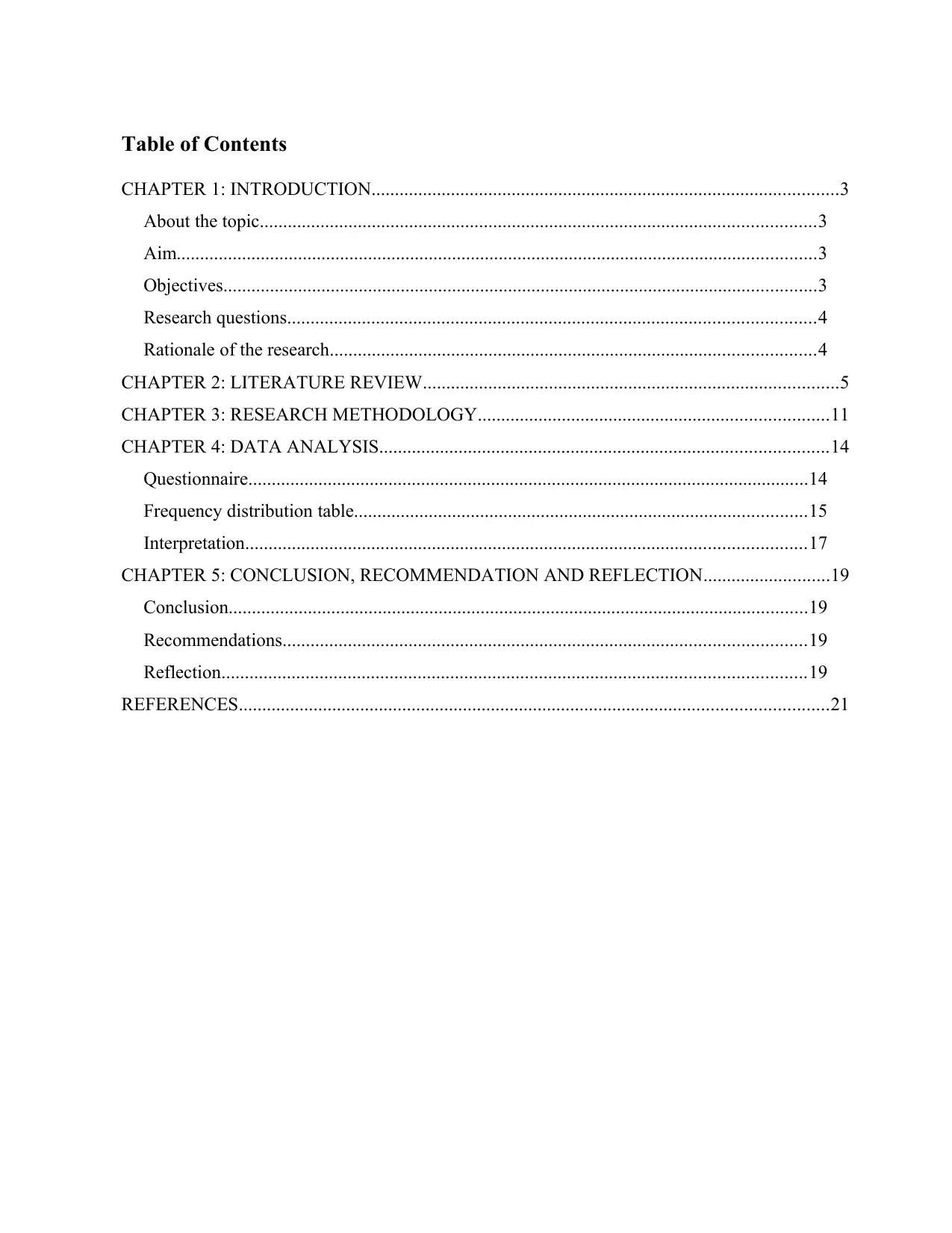
Table of Contents
CHAPTER 1: INTRODUCTION....................................................................................................3
About the topic.......................................................................................................................3
Aim.........................................................................................................................................3
Objectives...............................................................................................................................3
Research questions.................................................................................................................4
Rationale of the research........................................................................................................4
CHAPTER 2: LITERATURE REVIEW.........................................................................................5
CHAPTER 3: RESEARCH METHODOLOGY...........................................................................11
CHAPTER 4: DATA ANALYSIS................................................................................................14
Questionnaire........................................................................................................................14
Frequency distribution table.................................................................................................15
Interpretation........................................................................................................................17
CHAPTER 5: CONCLUSION, RECOMMENDATION AND REFLECTION...........................19
Conclusion............................................................................................................................19
Recommendations................................................................................................................19
Reflection.............................................................................................................................19
REFERENCES..............................................................................................................................21
CHAPTER 1: INTRODUCTION....................................................................................................3
About the topic.......................................................................................................................3
Aim.........................................................................................................................................3
Objectives...............................................................................................................................3
Research questions.................................................................................................................4
Rationale of the research........................................................................................................4
CHAPTER 2: LITERATURE REVIEW.........................................................................................5
CHAPTER 3: RESEARCH METHODOLOGY...........................................................................11
CHAPTER 4: DATA ANALYSIS................................................................................................14
Questionnaire........................................................................................................................14
Frequency distribution table.................................................................................................15
Interpretation........................................................................................................................17
CHAPTER 5: CONCLUSION, RECOMMENDATION AND REFLECTION...........................19
Conclusion............................................................................................................................19
Recommendations................................................................................................................19
Reflection.............................................................................................................................19
REFERENCES..............................................................................................................................21
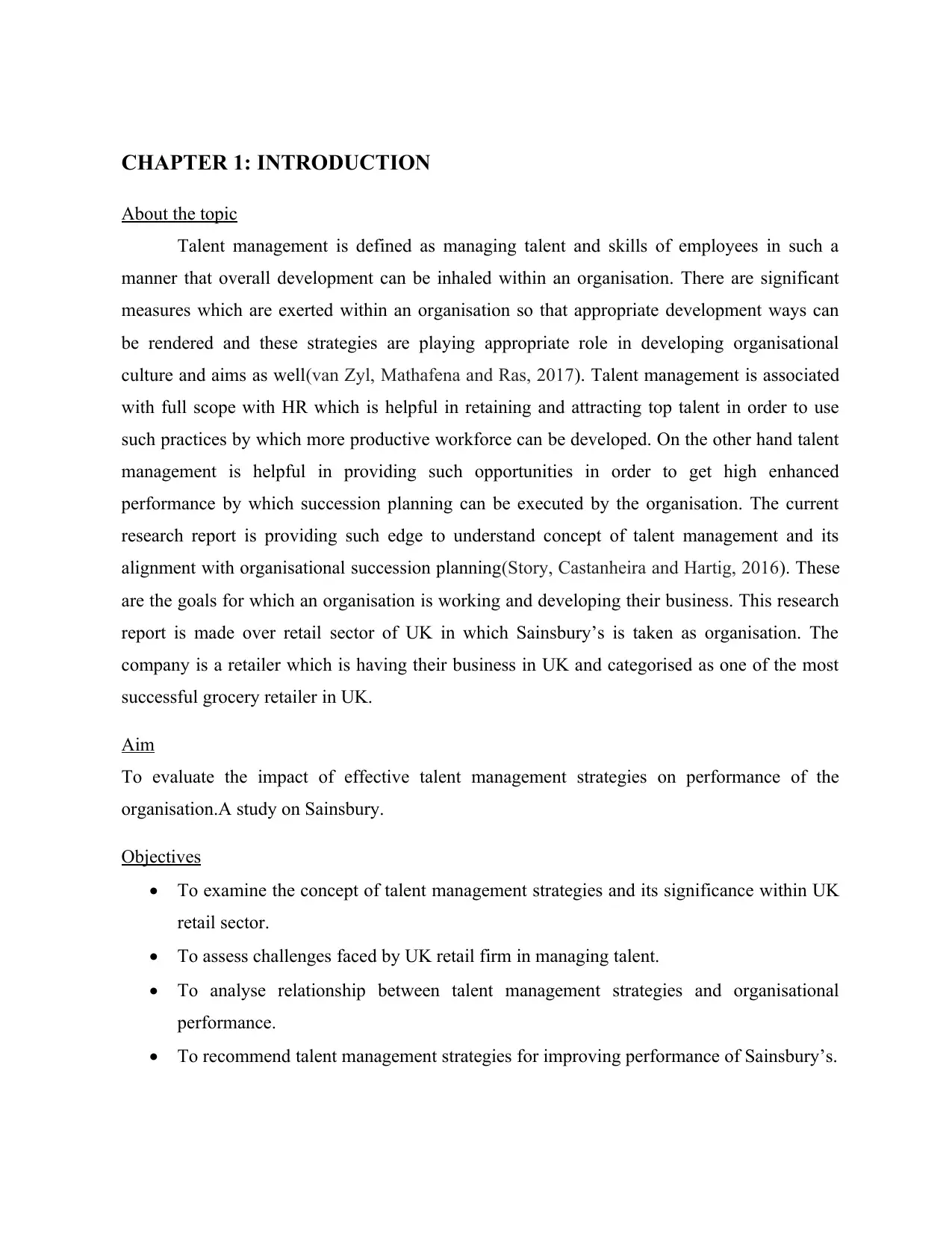
CHAPTER 1: INTRODUCTION
About the topic
Talent management is defined as managing talent and skills of employees in such a
manner that overall development can be inhaled within an organisation. There are significant
measures which are exerted within an organisation so that appropriate development ways can
be rendered and these strategies are playing appropriate role in developing organisational
culture and aims as well(van Zyl, Mathafena and Ras, 2017). Talent management is associated
with full scope with HR which is helpful in retaining and attracting top talent in order to use
such practices by which more productive workforce can be developed. On the other hand talent
management is helpful in providing such opportunities in order to get high enhanced
performance by which succession planning can be executed by the organisation. The current
research report is providing such edge to understand concept of talent management and its
alignment with organisational succession planning(Story, Castanheira and Hartig, 2016). These
are the goals for which an organisation is working and developing their business. This research
report is made over retail sector of UK in which Sainsbury’s is taken as organisation. The
company is a retailer which is having their business in UK and categorised as one of the most
successful grocery retailer in UK.
Aim
To evaluate the impact of effective talent management strategies on performance of the
organisation.A study on Sainsbury.
Objectives
To examine the concept of talent management strategies and its significance within UK
retail sector.
To assess challenges faced by UK retail firm in managing talent.
To analyse relationship between talent management strategies and organisational
performance.
To recommend talent management strategies for improving performance of Sainsbury’s.
About the topic
Talent management is defined as managing talent and skills of employees in such a
manner that overall development can be inhaled within an organisation. There are significant
measures which are exerted within an organisation so that appropriate development ways can
be rendered and these strategies are playing appropriate role in developing organisational
culture and aims as well(van Zyl, Mathafena and Ras, 2017). Talent management is associated
with full scope with HR which is helpful in retaining and attracting top talent in order to use
such practices by which more productive workforce can be developed. On the other hand talent
management is helpful in providing such opportunities in order to get high enhanced
performance by which succession planning can be executed by the organisation. The current
research report is providing such edge to understand concept of talent management and its
alignment with organisational succession planning(Story, Castanheira and Hartig, 2016). These
are the goals for which an organisation is working and developing their business. This research
report is made over retail sector of UK in which Sainsbury’s is taken as organisation. The
company is a retailer which is having their business in UK and categorised as one of the most
successful grocery retailer in UK.
Aim
To evaluate the impact of effective talent management strategies on performance of the
organisation.A study on Sainsbury.
Objectives
To examine the concept of talent management strategies and its significance within UK
retail sector.
To assess challenges faced by UK retail firm in managing talent.
To analyse relationship between talent management strategies and organisational
performance.
To recommend talent management strategies for improving performance of Sainsbury’s.
⊘ This is a preview!⊘
Do you want full access?
Subscribe today to unlock all pages.

Trusted by 1+ million students worldwide
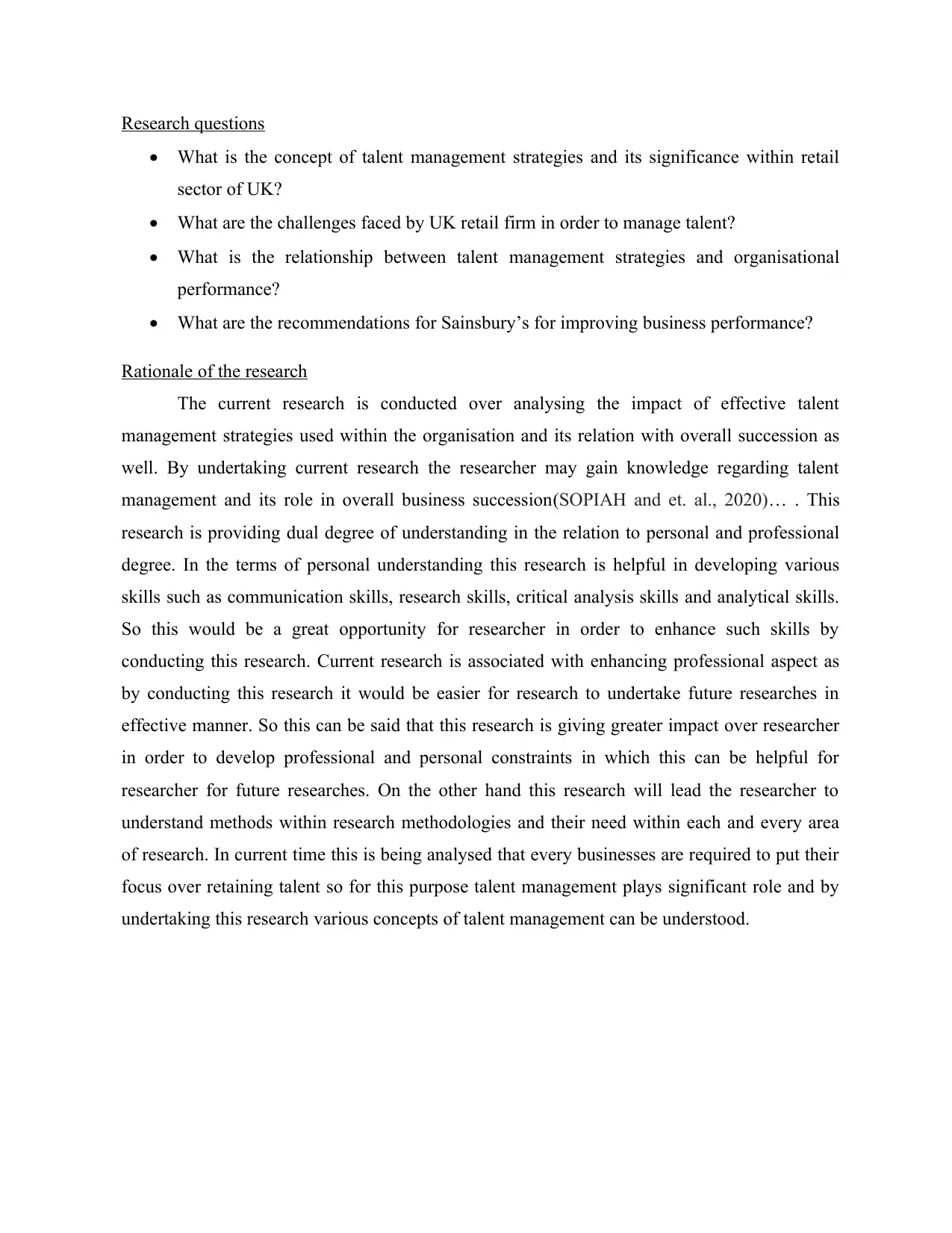
Research questions
What is the concept of talent management strategies and its significance within retail
sector of UK?
What are the challenges faced by UK retail firm in order to manage talent?
What is the relationship between talent management strategies and organisational
performance?
What are the recommendations for Sainsbury’s for improving business performance?
Rationale of the research
The current research is conducted over analysing the impact of effective talent
management strategies used within the organisation and its relation with overall succession as
well. By undertaking current research the researcher may gain knowledge regarding talent
management and its role in overall business succession(SOPIAH and et. al., 2020)… . This
research is providing dual degree of understanding in the relation to personal and professional
degree. In the terms of personal understanding this research is helpful in developing various
skills such as communication skills, research skills, critical analysis skills and analytical skills.
So this would be a great opportunity for researcher in order to enhance such skills by
conducting this research. Current research is associated with enhancing professional aspect as
by conducting this research it would be easier for research to undertake future researches in
effective manner. So this can be said that this research is giving greater impact over researcher
in order to develop professional and personal constraints in which this can be helpful for
researcher for future researches. On the other hand this research will lead the researcher to
understand methods within research methodologies and their need within each and every area
of research. In current time this is being analysed that every businesses are required to put their
focus over retaining talent so for this purpose talent management plays significant role and by
undertaking this research various concepts of talent management can be understood.
What is the concept of talent management strategies and its significance within retail
sector of UK?
What are the challenges faced by UK retail firm in order to manage talent?
What is the relationship between talent management strategies and organisational
performance?
What are the recommendations for Sainsbury’s for improving business performance?
Rationale of the research
The current research is conducted over analysing the impact of effective talent
management strategies used within the organisation and its relation with overall succession as
well. By undertaking current research the researcher may gain knowledge regarding talent
management and its role in overall business succession(SOPIAH and et. al., 2020)… . This
research is providing dual degree of understanding in the relation to personal and professional
degree. In the terms of personal understanding this research is helpful in developing various
skills such as communication skills, research skills, critical analysis skills and analytical skills.
So this would be a great opportunity for researcher in order to enhance such skills by
conducting this research. Current research is associated with enhancing professional aspect as
by conducting this research it would be easier for research to undertake future researches in
effective manner. So this can be said that this research is giving greater impact over researcher
in order to develop professional and personal constraints in which this can be helpful for
researcher for future researches. On the other hand this research will lead the researcher to
understand methods within research methodologies and their need within each and every area
of research. In current time this is being analysed that every businesses are required to put their
focus over retaining talent so for this purpose talent management plays significant role and by
undertaking this research various concepts of talent management can be understood.
Paraphrase This Document
Need a fresh take? Get an instant paraphrase of this document with our AI Paraphraser
CHAPTER 2: LITERATURE REVIEW
What is the concept of talent management strategies and its significance within retail sector
of UK?
According to Smith(2017), Talent management is regarded as one of the important
concept which is used within business in order to develop such aspects in which overall benefits
can be taken out from employees. Talent management are such strategies which can be used in
order to retain and attract talent in significant manner and to include employees in business
processes. In retail industry talent management plays effective role as employees are regarded
as frontier of the organisation and they are directly communicated with customers. So in order
to get high customer footfall talented employees are required to be kept within business so that
they can understand and satisfy needs and demands of their customers. In current time this is
mandatory to keep employees happy so that they can contribute fuller efforts within business
and lead the business to attain its objectives. Primarily talent management is associated with
providing higher employee satisfaction so that to develop sense of belongingness in them and to
provide them opportunities to showcase their talent. In this manner for a business talent
management strategies are playing prominent role in managing the business and dealing with
complexities as well which are existed within market and may affect organisational success. In
differential manner this can be said talent management is an emerging concept which helps
employees to get such opportunities in which they can use their talent for attaining
organisational objectives and giving higher chances of rising in the market by inhaling large
amount of customer base and dealing with their needs and desires.
According (Cappelli and et. al., 2018), The basic idea of talent management is to deal
with skills of employees and aligning them with organisational needs. Talent management is
helpful in dealing with skills of employees so that these skills can be used for getting market
prominence and developing business scenario as well. An organisation is working to satisfy
major objective of enhancing customer footfall and to earn higher profit so that market
prominence and image. Talent management strategies can be used for developing such aspects
within business in which skills of employees can be used in fuller manner by developing and
aligning with organisational needs and requirements. This is regarded as the prominent concept
What is the concept of talent management strategies and its significance within retail sector
of UK?
According to Smith(2017), Talent management is regarded as one of the important
concept which is used within business in order to develop such aspects in which overall benefits
can be taken out from employees. Talent management are such strategies which can be used in
order to retain and attract talent in significant manner and to include employees in business
processes. In retail industry talent management plays effective role as employees are regarded
as frontier of the organisation and they are directly communicated with customers. So in order
to get high customer footfall talented employees are required to be kept within business so that
they can understand and satisfy needs and demands of their customers. In current time this is
mandatory to keep employees happy so that they can contribute fuller efforts within business
and lead the business to attain its objectives. Primarily talent management is associated with
providing higher employee satisfaction so that to develop sense of belongingness in them and to
provide them opportunities to showcase their talent. In this manner for a business talent
management strategies are playing prominent role in managing the business and dealing with
complexities as well which are existed within market and may affect organisational success. In
differential manner this can be said talent management is an emerging concept which helps
employees to get such opportunities in which they can use their talent for attaining
organisational objectives and giving higher chances of rising in the market by inhaling large
amount of customer base and dealing with their needs and desires.
According (Cappelli and et. al., 2018), The basic idea of talent management is to deal
with skills of employees and aligning them with organisational needs. Talent management is
helpful in dealing with skills of employees so that these skills can be used for getting market
prominence and developing business scenario as well. An organisation is working to satisfy
major objective of enhancing customer footfall and to earn higher profit so that market
prominence and image. Talent management strategies can be used for developing such aspects
within business in which skills of employees can be used in fuller manner by developing and
aligning with organisational needs and requirements. This is regarded as the prominent concept
which leads the business to develop proper insight so that employees can exert their overall
contribution in such a way that goals of the business can be attained in full edge manner. Talent
management includes various dimensions such as recruitment and selection, training and
development and many more. So managing these dimensions will lead the business to acquire
such prominence in which they can learn to develop business functions by utilising their skills
in optimal manner. These strategies may link the business to gain higher profits and
attainability within marketplace so as to gain higher success talent management strategies may
be helpful for business. For retail industry employees are playing vital role as all the efforts are
being executed by them in order to communicate with customers without facing any significant
barrier. So for a business in retail industry this is imperative to use such practices of talent
management in order to attain prominence and objectives of the business in early stage of time.
What are the challenges faced by UK retail firm in order to manage talent?
According to Sheehan, Grant and Garavan (2018), Managing talent is regarded as the
major aspect of the business in which whole focus is rendered over employees and gaining their
talent within business in order to gain success and business prominence as well. Talent
management strategies can harvest skills of employees in such a way that the same can be used
by the business in order to attain overall objectives and aims. Retail sector of UK is articulating
talent management strategies within business in order to pull talent in the organisation and to
acquire large prominence. Retail industry is leading private sector employer in the UK
providing employment to more than 3 million employees. Management of employees and talent
is important for success of any organization as it makes sure that skilful employees and talent is
retained. There are various talent management challenges faced such as Employee retention,
pay, employee well-being etc. Those challenges are associated with certain political
developments as well. Below given are some of the major challenges faced by UK retail firms
in managing their talent:
Brexit: Brexit is going to lead retail firm and across other sectors towards different
challenges related to talent management for HR Managers. As the result of Brexit laws
there are restrictive laws in place such as, from 1st January 2020 there will be no visa for
low skilled workers and all prospective migrants and talents will be admitted and
screened using a point-based system. Therefore, they must make the proper and legally
contribution in such a way that goals of the business can be attained in full edge manner. Talent
management includes various dimensions such as recruitment and selection, training and
development and many more. So managing these dimensions will lead the business to acquire
such prominence in which they can learn to develop business functions by utilising their skills
in optimal manner. These strategies may link the business to gain higher profits and
attainability within marketplace so as to gain higher success talent management strategies may
be helpful for business. For retail industry employees are playing vital role as all the efforts are
being executed by them in order to communicate with customers without facing any significant
barrier. So for a business in retail industry this is imperative to use such practices of talent
management in order to attain prominence and objectives of the business in early stage of time.
What are the challenges faced by UK retail firm in order to manage talent?
According to Sheehan, Grant and Garavan (2018), Managing talent is regarded as the
major aspect of the business in which whole focus is rendered over employees and gaining their
talent within business in order to gain success and business prominence as well. Talent
management strategies can harvest skills of employees in such a way that the same can be used
by the business in order to attain overall objectives and aims. Retail sector of UK is articulating
talent management strategies within business in order to pull talent in the organisation and to
acquire large prominence. Retail industry is leading private sector employer in the UK
providing employment to more than 3 million employees. Management of employees and talent
is important for success of any organization as it makes sure that skilful employees and talent is
retained. There are various talent management challenges faced such as Employee retention,
pay, employee well-being etc. Those challenges are associated with certain political
developments as well. Below given are some of the major challenges faced by UK retail firms
in managing their talent:
Brexit: Brexit is going to lead retail firm and across other sectors towards different
challenges related to talent management for HR Managers. As the result of Brexit laws
there are restrictive laws in place such as, from 1st January 2020 there will be no visa for
low skilled workers and all prospective migrants and talents will be admitted and
screened using a point-based system. Therefore, they must make the proper and legally
⊘ This is a preview!⊘
Do you want full access?
Subscribe today to unlock all pages.
Trusted by 1+ million students worldwide
compliant arrangement of all the talents required as there can be various barriers that
could be faced on migrating talent from foreign land.
Employee Wellbeing: Mental health of talent is a major important challenge faced by
every retail firm from their employees. As per the surveys conducted, number of
employees rating their mental health as very good is decreased to 54% as compared to
engineer employees with rate of 64%. This statistic clearly highlights the importance of
mitigating challenges of employee well being and benefits of Very good mental health
level of talent of retail firm. HR Professional are provided with responsibility to manage
mental health problems of both individuals and the firms they work for.
Workforce Management: Workforce management is a wide task and activity which
includes various roles and responsibilities to various job roles. Improper management of
workforce can have devastating consequences for employee experience and retention
rate of employees for retail firms. To manage the same retail firms can move towards
implementation of workforce management software, which will provide HR managers
with single view which will help them in managing and identifying additional talents
and resources effectively.
Attracting and Retaining talent: Every retail firm looks to attract skilful talent to work
in their organization and it is a task which takes employee friendly environment and
policies that needs to be established by HR. Research conducted has clearly highlighted
that staff turnover rates are lot higher in retail firms as compared to other industry
sectors and moreover this trend doesn’t look to be improved in future. This high staff
turnover rate increases the training and hiring cost for retail firms.
Managing theft and misconduct in Employees: There can be instances where
employees does a misconduct which might vary in severity. Those misconducts can
include persistent lateness, missing work deadlines, gross professional misconduct etc.
It is very important to manage all these misconducts in such a appropriate manner that
employees are not feeling over threatened and moreover they are aware of consequences
of doing such misconducts in future and the same can be decreased.
What is the relationship between talent management strategies and organizational
performance?
could be faced on migrating talent from foreign land.
Employee Wellbeing: Mental health of talent is a major important challenge faced by
every retail firm from their employees. As per the surveys conducted, number of
employees rating their mental health as very good is decreased to 54% as compared to
engineer employees with rate of 64%. This statistic clearly highlights the importance of
mitigating challenges of employee well being and benefits of Very good mental health
level of talent of retail firm. HR Professional are provided with responsibility to manage
mental health problems of both individuals and the firms they work for.
Workforce Management: Workforce management is a wide task and activity which
includes various roles and responsibilities to various job roles. Improper management of
workforce can have devastating consequences for employee experience and retention
rate of employees for retail firms. To manage the same retail firms can move towards
implementation of workforce management software, which will provide HR managers
with single view which will help them in managing and identifying additional talents
and resources effectively.
Attracting and Retaining talent: Every retail firm looks to attract skilful talent to work
in their organization and it is a task which takes employee friendly environment and
policies that needs to be established by HR. Research conducted has clearly highlighted
that staff turnover rates are lot higher in retail firms as compared to other industry
sectors and moreover this trend doesn’t look to be improved in future. This high staff
turnover rate increases the training and hiring cost for retail firms.
Managing theft and misconduct in Employees: There can be instances where
employees does a misconduct which might vary in severity. Those misconducts can
include persistent lateness, missing work deadlines, gross professional misconduct etc.
It is very important to manage all these misconducts in such a appropriate manner that
employees are not feeling over threatened and moreover they are aware of consequences
of doing such misconducts in future and the same can be decreased.
What is the relationship between talent management strategies and organizational
performance?
Paraphrase This Document
Need a fresh take? Get an instant paraphrase of this document with our AI Paraphraser
According to Santoro and et. al., (2019),Talent management refers to the ability of
analyzingsomeone person skills, traits and personality and providing job according to the job
requirement. Every person has some unique talent in every field of his interest. It is the
anticipation of utilizing the human capital in the organization. Talent refers to the natural ability
of the individual that a person is born with having creative, mental power and intelligence. It is
a foremost aspect in the organization for business strategy and important assets for the people in
the company.
A talent management strategy defines the balance between skills expected and skill
internally available by company which maintains a competitive advantage. There are four
effective talent management strategies which make the organization success and retain skilled
employees.
Align talent and strategies- In this strategy the personal and organizational goals are
tracked by developing talent strategies to achieve the organizational goals. The choice
of talent drives the quality and quantity of employee’s retention. It also increases the
productivity that results in alignment of strategy. The organization is required in
workplace to identify the talent management process, enhancement of training and
development, profiling of successful employees and optimization of overall
performance.
Performing consistent employee’s reviews- the organization should have objective
work environment where employees are treated fairlywith same standards and
expectations. It is necessary to review the performance of the employee by numerical
ratings or using impartial system which will increase the level of performance. the
performance review offers feedback and motivates the employees dedication in respect
of quality and quantity of work.
Recognize top employees- the hiring of ideal employee results in recognition of
organization. It helps in knowing the contribution of employeesand identifies persistent
and optimistic workers who takes initiative and prioritize the organization success. The
recognition is provided for the work done in kind or in amount. To promote the success
of employee’s organization provides productive work atmosphere where they feel happy
analyzingsomeone person skills, traits and personality and providing job according to the job
requirement. Every person has some unique talent in every field of his interest. It is the
anticipation of utilizing the human capital in the organization. Talent refers to the natural ability
of the individual that a person is born with having creative, mental power and intelligence. It is
a foremost aspect in the organization for business strategy and important assets for the people in
the company.
A talent management strategy defines the balance between skills expected and skill
internally available by company which maintains a competitive advantage. There are four
effective talent management strategies which make the organization success and retain skilled
employees.
Align talent and strategies- In this strategy the personal and organizational goals are
tracked by developing talent strategies to achieve the organizational goals. The choice
of talent drives the quality and quantity of employee’s retention. It also increases the
productivity that results in alignment of strategy. The organization is required in
workplace to identify the talent management process, enhancement of training and
development, profiling of successful employees and optimization of overall
performance.
Performing consistent employee’s reviews- the organization should have objective
work environment where employees are treated fairlywith same standards and
expectations. It is necessary to review the performance of the employee by numerical
ratings or using impartial system which will increase the level of performance. the
performance review offers feedback and motivates the employees dedication in respect
of quality and quantity of work.
Recognize top employees- the hiring of ideal employee results in recognition of
organization. It helps in knowing the contribution of employeesand identifies persistent
and optimistic workers who takes initiative and prioritize the organization success. The
recognition is provided for the work done in kind or in amount. To promote the success
of employee’s organization provides productive work atmosphere where they feel happy
and enable them in growth by awarding time for employee’s side projects, setting clear,
attainable expectations.
Take talent management courses-in developing talented employees training is the
essential key by understanding and increasing knowledge in talent management
strategies for success. To satisfy the needs of management team mentoring program
should be conducted. The courses help in retention of the employees, goal setting,
technology etc. This course helps the managers in identifying the people required in
team.
Organizational performance defines the actual output of an organization measured against
the goal and objective. It encompasses of three area involving financial performance, product
market performance and shareholder return.
The relationship between talent management strategies and organizational performance
states the knowledge and strategies foe improvement and change in the organization for
performance sustainability. The talented employees are identified with the potential of future
leaders. Development and growth strategy are linked with the organization mission and vision
which leads to prosperity and sustainability. The success, profitability and sustainability of
organization performance are influenced by ability to retain and sustain top talent of employees.
To increase and improve the business value talent management applies the strategic planning of
human resource for optimizing the goals of the organization. Through strategic planning it helps
the organization in employee motivation which leads to better results and provides the reasons
for staying in the company. A systematic management approach integrates the system with
talent acquisition which leads to high client satisfaction. Talent management is important for
the organization which helps in identifying the needs and involves the process of employee
acquiring on the basis of skills which leads to increase in productivity.Talent management
develops the capabilities in the people which lead to better performance.
What are the recommendations for Sainsbury’s for improving business
performance?
In order to improve the business performance of the Sainsbury it should apply various
models such as SWOT analysis PESTEL analysis which helps in defining the current and future
attainable expectations.
Take talent management courses-in developing talented employees training is the
essential key by understanding and increasing knowledge in talent management
strategies for success. To satisfy the needs of management team mentoring program
should be conducted. The courses help in retention of the employees, goal setting,
technology etc. This course helps the managers in identifying the people required in
team.
Organizational performance defines the actual output of an organization measured against
the goal and objective. It encompasses of three area involving financial performance, product
market performance and shareholder return.
The relationship between talent management strategies and organizational performance
states the knowledge and strategies foe improvement and change in the organization for
performance sustainability. The talented employees are identified with the potential of future
leaders. Development and growth strategy are linked with the organization mission and vision
which leads to prosperity and sustainability. The success, profitability and sustainability of
organization performance are influenced by ability to retain and sustain top talent of employees.
To increase and improve the business value talent management applies the strategic planning of
human resource for optimizing the goals of the organization. Through strategic planning it helps
the organization in employee motivation which leads to better results and provides the reasons
for staying in the company. A systematic management approach integrates the system with
talent acquisition which leads to high client satisfaction. Talent management is important for
the organization which helps in identifying the needs and involves the process of employee
acquiring on the basis of skills which leads to increase in productivity.Talent management
develops the capabilities in the people which lead to better performance.
What are the recommendations for Sainsbury’s for improving business
performance?
In order to improve the business performance of the Sainsbury it should apply various
models such as SWOT analysis PESTEL analysis which helps in defining the current and future
⊘ This is a preview!⊘
Do you want full access?
Subscribe today to unlock all pages.
Trusted by 1+ million students worldwide
performance of the organization. To make the shopping convenient for customers it can be
through putting food back. The Sainsbury is introducing the entry price point for seeking
customer’s value and highlighting price reduction through price lockdown campaigns. It should
focus on future brands of niche brand by developing new and exclusive brands aligning
products with customer missions. The Sainsbury has the opportunity to target new customers by
providing beauty, wellness and food services already dealing. To improve customer satisfaction
there must be investment in super markets by adopting new technologies that will boost the
standards by automating in-store processes. The Sainsbury should adopt the digitized nectar
scheme for personalized promotions around the customer, new opportunities for suppliers and
refocusing on banking business.
To improve the organization performance use of human resources should be done in
effective way as they provides assistance in designing of new business strategies leads to
organizational effectiveness. The organization can focus on education and growth by having
leadership working with different groups and individuals which understands the strength and
weakness of individuals before making a plan of action. It is essential to keep the needs and
preferences of the customers in mind by evaluating increases overall efficiency of company.
The Monitoring and evaluating job performance of employees annual or twice-yearly by
written appraisals will identify the areas of improvement and tells how well they are doing
and at what level they require the training.
According to Mihalcea (2017), The organization should use the strategy of human
information system and human resource management system as it creates learning and
development in employees which ultimate leads to growth of organization performance. The
recommendations provided to the company for maintaining competitive position in market by
creating awareness of the brands, brand loyalty through promotion by taking new advertisement
style of print and digital media. The use of talent management helps the organization to remain
competitive, drives innovation. The strategy of performance management can be applied for
creating and sustaining improved performance of employees in organization by establishing
clears goals and offering feedback.
through putting food back. The Sainsbury is introducing the entry price point for seeking
customer’s value and highlighting price reduction through price lockdown campaigns. It should
focus on future brands of niche brand by developing new and exclusive brands aligning
products with customer missions. The Sainsbury has the opportunity to target new customers by
providing beauty, wellness and food services already dealing. To improve customer satisfaction
there must be investment in super markets by adopting new technologies that will boost the
standards by automating in-store processes. The Sainsbury should adopt the digitized nectar
scheme for personalized promotions around the customer, new opportunities for suppliers and
refocusing on banking business.
To improve the organization performance use of human resources should be done in
effective way as they provides assistance in designing of new business strategies leads to
organizational effectiveness. The organization can focus on education and growth by having
leadership working with different groups and individuals which understands the strength and
weakness of individuals before making a plan of action. It is essential to keep the needs and
preferences of the customers in mind by evaluating increases overall efficiency of company.
The Monitoring and evaluating job performance of employees annual or twice-yearly by
written appraisals will identify the areas of improvement and tells how well they are doing
and at what level they require the training.
According to Mihalcea (2017), The organization should use the strategy of human
information system and human resource management system as it creates learning and
development in employees which ultimate leads to growth of organization performance. The
recommendations provided to the company for maintaining competitive position in market by
creating awareness of the brands, brand loyalty through promotion by taking new advertisement
style of print and digital media. The use of talent management helps the organization to remain
competitive, drives innovation. The strategy of performance management can be applied for
creating and sustaining improved performance of employees in organization by establishing
clears goals and offering feedback.
Paraphrase This Document
Need a fresh take? Get an instant paraphrase of this document with our AI Paraphraser
CHAPTER 3: RESEARCH METHODOLOGY
Research methodology is defined as such aspects of research which are used within
research in order to pertain with research results and to acquire positive output as well. In the
research methodology is playing one of the essential roles in attaining research objectives and
following such process which can be used within research in order to attain research objective
in appropriate manner(Melnikovas, 2018). Research methodology is set of such plans, actions
and procedures which is helpful in analysing research information and to gather reasonable data
as well. Research methodology is the path by which overall research will be executed in
appropriate manner and in this way along with gaining high efficacy research can be completed.
This is highly important for researcher that they choose right research methodology so that
properly distinguish between reliable and unreliable data. These are the efforts which are
helpful in developing research results in such a manner that overall direction can be gained by
research. In order to accomplish research objective this is the primal step to select appropriate
research methodology so that research aim can be attained and proper path for research can also
be made as this would be helpful in developing research in systematic manner(Park, 2017).
There are different types of research methodology which is used within the current research and
these are elaborated as under:
Research Philosophy: Research philosophy is defined as those set of actions which are used
within research so that to attain research objective and to settle down the overall investigation
so that to execute the overall research in proper and profitable manner. Research philosophy is
set of assumptions which are undertaken within research so as to develop the overall research
process in such a way that the same can be aligned with research objectives(Gallagher and
O’Sullivan, 2020). Research philosophy is collectively known as those phenomena which
should be used and gathered under the research for accomplishing research aims and objectives.
There are two types of research philosophy such as interpretivism and positivism.
Interpretivismresearch philosophy is associated with elementary study in which researcher tend
to access real information which helps in drawing accurate result out of research. On the other
hand positivism research philosophy is based over hypothetical data which may be and may not
be true and accurate. Under this research, interpretivism research philosophy is being used as
this enable the researcher to use questionnaire and attain research objectives as well(Shields,
Research methodology is defined as such aspects of research which are used within
research in order to pertain with research results and to acquire positive output as well. In the
research methodology is playing one of the essential roles in attaining research objectives and
following such process which can be used within research in order to attain research objective
in appropriate manner(Melnikovas, 2018). Research methodology is set of such plans, actions
and procedures which is helpful in analysing research information and to gather reasonable data
as well. Research methodology is the path by which overall research will be executed in
appropriate manner and in this way along with gaining high efficacy research can be completed.
This is highly important for researcher that they choose right research methodology so that
properly distinguish between reliable and unreliable data. These are the efforts which are
helpful in developing research results in such a manner that overall direction can be gained by
research. In order to accomplish research objective this is the primal step to select appropriate
research methodology so that research aim can be attained and proper path for research can also
be made as this would be helpful in developing research in systematic manner(Park, 2017).
There are different types of research methodology which is used within the current research and
these are elaborated as under:
Research Philosophy: Research philosophy is defined as those set of actions which are used
within research so that to attain research objective and to settle down the overall investigation
so that to execute the overall research in proper and profitable manner. Research philosophy is
set of assumptions which are undertaken within research so as to develop the overall research
process in such a way that the same can be aligned with research objectives(Gallagher and
O’Sullivan, 2020). Research philosophy is collectively known as those phenomena which
should be used and gathered under the research for accomplishing research aims and objectives.
There are two types of research philosophy such as interpretivism and positivism.
Interpretivismresearch philosophy is associated with elementary study in which researcher tend
to access real information which helps in drawing accurate result out of research. On the other
hand positivism research philosophy is based over hypothetical data which may be and may not
be true and accurate. Under this research, interpretivism research philosophy is being used as
this enable the researcher to use questionnaire and attain research objectives as well(Shields,
2019). Interpretivismallows researcher to develop uniqueness within research due to which
significant information can be used in such a way that overall benefits can be attained for
dealing with research objectives.
Research Approach: Research approach is categorised as such plans and processes which are
helpful in developing research objectives and acquiring such benefits in order to collect data
regarding research and meet objectives as well. Research approaches are contextual frameworks
within research which are based over beliefs, values and other dimensions associated with
research (Bairagi and Munot, 2019). Research approaches are related with attaining research
objectives in which overall research study can be performed and accessibility within research
can be made. There are two types of research approaches such as inductive and deductive.
Under this research inductive research approach is used as this enable researcher to gain in
depth knowledge regarding research topic. On the other hand this approach will lead in
providing such insights in which deep analysis can be performed.
Research Choice: Research choice is defined as those factors within business that would be
helpful in developing the overall research in appropriate manner. Besides this research choice
leads the research to get done in systematic manner by collecting information from reliable
sources along with attaining objectives as well (Gilroy and et. al., 2018). There are two types of
research choice available which can be used by researcher in order to align efforts with research
objectives. Quantitative and qualitative are the research choices that can be used by researcher
to attain objectives in direct or indirect manner (Bairagi and Munot, 2019). In quantitative
research choice diversified analysis can be performed as various respondents whereas
qualitative research choice is associated with in depth analysis so this would lead in getting
thorough information regarding the topic. Under this research quantitative research choice will
be used as this enables in getting opinions from various respondents at once.
Research Strategy: Research strategy is defined as those set of actions which will help
researcher to accumulate data and information related to the topic. Research strategy is
collective efforts made by researcher which helps to execute research plan in appropriate
manner along with getting assistance in attaining research objectives (Murshed and Zhang,
2016). There are various types of research strategy such as case study, experimental interview,
significant information can be used in such a way that overall benefits can be attained for
dealing with research objectives.
Research Approach: Research approach is categorised as such plans and processes which are
helpful in developing research objectives and acquiring such benefits in order to collect data
regarding research and meet objectives as well. Research approaches are contextual frameworks
within research which are based over beliefs, values and other dimensions associated with
research (Bairagi and Munot, 2019). Research approaches are related with attaining research
objectives in which overall research study can be performed and accessibility within research
can be made. There are two types of research approaches such as inductive and deductive.
Under this research inductive research approach is used as this enable researcher to gain in
depth knowledge regarding research topic. On the other hand this approach will lead in
providing such insights in which deep analysis can be performed.
Research Choice: Research choice is defined as those factors within business that would be
helpful in developing the overall research in appropriate manner. Besides this research choice
leads the research to get done in systematic manner by collecting information from reliable
sources along with attaining objectives as well (Gilroy and et. al., 2018). There are two types of
research choice available which can be used by researcher in order to align efforts with research
objectives. Quantitative and qualitative are the research choices that can be used by researcher
to attain objectives in direct or indirect manner (Bairagi and Munot, 2019). In quantitative
research choice diversified analysis can be performed as various respondents whereas
qualitative research choice is associated with in depth analysis so this would lead in getting
thorough information regarding the topic. Under this research quantitative research choice will
be used as this enables in getting opinions from various respondents at once.
Research Strategy: Research strategy is defined as those set of actions which will help
researcher to accumulate data and information related to the topic. Research strategy is
collective efforts made by researcher which helps to execute research plan in appropriate
manner along with getting assistance in attaining research objectives (Murshed and Zhang,
2016). There are various types of research strategy such as case study, experimental interview,
⊘ This is a preview!⊘
Do you want full access?
Subscribe today to unlock all pages.
Trusted by 1+ million students worldwide

1 out of 30


Related Documents


Your All-in-One AI-Powered Toolkit for Academic Success.
+13062052269
info@desklib.com
Available 24*7 on WhatsApp / Email
![[object Object]](/_next/static/media/star-bottom.7253800d.svg)
Unlock your academic potential
Copyright © 2020–2026 A2Z Services. All Rights Reserved. Developed and managed by ZUCOL.