Portfolio: Talent Management, Regulations, and HRM at Nationwide Bank
VerifiedAdded on 2020/06/06
|10
|3715
|24
Portfolio
AI Summary
This portfolio delves into the talent management strategies employed by Nationwide Bank, emphasizing recruitment, performance management, reward systems, training, and diversity initiatives. It analyzes the impacts of various regulations, including the Equality Act 2010, health and safety legislation, minimum wage laws, and race relations acts, on the organization and its HRM practices. Furthermore, the portfolio considers the influence of environmental factors on HRM, providing recommendations for improving talent management. The content highlights how Nationwide Bank strives to maintain a competitive edge and deliver quality services by focusing on its human resources and adapting to the changing regulatory and environmental landscape. The portfolio provides insights into how Nationwide Bank manages its human capital to achieve its strategic goals.

PORTFOLIO
1
1

Paraphrase This Document
Need a fresh take? Get an instant paraphrase of this document with our AI Paraphraser
Contents
INTRODUCTION...........................................................................................................................3
TASK...............................................................................................................................................3
Talent management strategies................................................................................................3
Impacts of regulations on organisation and HRM..................................................................5
Impact of environmental factors on HRM practice................................................................7
Core position in business........................................................................................................8
RECOMMENDATION...................................................................................................................8
CONCLUSION................................................................................................................................8
2
INTRODUCTION...........................................................................................................................3
TASK...............................................................................................................................................3
Talent management strategies................................................................................................3
Impacts of regulations on organisation and HRM..................................................................5
Impact of environmental factors on HRM practice................................................................7
Core position in business........................................................................................................8
RECOMMENDATION...................................................................................................................8
CONCLUSION................................................................................................................................8
2
INTRODUCTION
Every company understand that their employees are key assets who are present in the
organization. There was a time when firms do not see differences between human resource and
other resources like financial, but now they understand that employees are most important assets
of an enterprise. Talent management is a process which focuses on managing employees so they
can be managed in a better way. This assignment is based on Nationwide bank. This organization
is mainly dealing in insurance sector but, they are known for building society. This project will
discuss about talent management strategy of chosen company. Regulatory factors which make a
huge impact on organization will also become part of this file. Few environmental factors will
also be considered in this assignment who have capacity to affect HRM practice of Nationwide
bank. Few recommendations will be included in this project which company can pursue for
attaining better results (Synder, 2012).
TASK
Talent management strategies
In order to carry out the different operations effectively it is important for nationwide
bank to form effective and competitive strategies. Human resources is one of the most important
asset of an enterprise and is required that they are managed in a way that their full capacity
utilization can be made. There are distinct variety of employees that work under this unit and has
their own working behaviors. As they belong to an entirely different backgrounds there are
greater chances of conflicts as it becomes difficult to establish a common view among them. For
same effective strategies are made by the management so that they can achieve the competitive
advantage over the other banks. Some of the most important strategies are as follows;
Recruitment and selection procedure - it is a process through which the human resource
is made available in the enterprise and all the vacancies are full filled. It is important that choice
of recruitment process is chosen in a way that the best candidate is selected for the job. In the
referred bank the selection of candidates is done using the external sources of recruitment. In this
the candidates are encouraged to apply for the job in which thy give their C.V. using the online
medium (Fahr and Tatum, 2015). A complete form is filled and is sent to the official site of the
referred bank. After getting all the application forms the process of evaluating them is started. It
is an important stage where proper attention needs to be given to each forms so that the best ones
3
Every company understand that their employees are key assets who are present in the
organization. There was a time when firms do not see differences between human resource and
other resources like financial, but now they understand that employees are most important assets
of an enterprise. Talent management is a process which focuses on managing employees so they
can be managed in a better way. This assignment is based on Nationwide bank. This organization
is mainly dealing in insurance sector but, they are known for building society. This project will
discuss about talent management strategy of chosen company. Regulatory factors which make a
huge impact on organization will also become part of this file. Few environmental factors will
also be considered in this assignment who have capacity to affect HRM practice of Nationwide
bank. Few recommendations will be included in this project which company can pursue for
attaining better results (Synder, 2012).
TASK
Talent management strategies
In order to carry out the different operations effectively it is important for nationwide
bank to form effective and competitive strategies. Human resources is one of the most important
asset of an enterprise and is required that they are managed in a way that their full capacity
utilization can be made. There are distinct variety of employees that work under this unit and has
their own working behaviors. As they belong to an entirely different backgrounds there are
greater chances of conflicts as it becomes difficult to establish a common view among them. For
same effective strategies are made by the management so that they can achieve the competitive
advantage over the other banks. Some of the most important strategies are as follows;
Recruitment and selection procedure - it is a process through which the human resource
is made available in the enterprise and all the vacancies are full filled. It is important that choice
of recruitment process is chosen in a way that the best candidate is selected for the job. In the
referred bank the selection of candidates is done using the external sources of recruitment. In this
the candidates are encouraged to apply for the job in which thy give their C.V. using the online
medium (Fahr and Tatum, 2015). A complete form is filled and is sent to the official site of the
referred bank. After getting all the application forms the process of evaluating them is started. It
is an important stage where proper attention needs to be given to each forms so that the best ones
3
⊘ This is a preview!⊘
Do you want full access?
Subscribe today to unlock all pages.

Trusted by 1+ million students worldwide
gets short listed. After screening of the forms is done the next step is to invite the short listed
candidates to appear for aptitude test. It can be decided at the same time that in what manner the
examination will take place. At this stage the total number of applicants who got short listed are
reduced and minimum candidates are taken to the next step of capability based. At this stage
personal interaction between applicants and recruitment channel take place where the final
judgments are given. The behavior and skills of people who are applying for a particular job is
tested closely and the final selection is hence done. Thereafter the personnel are provided with
the reply letters offering them the post they applied for. It is an effective mode of filling up of all
the vacant space in Nationwide bank and through which it creates a competent working
surroundings and gives a tough rivalry to other in the same field.
Performance management – In order to excel in own field, it is important that the talent
of an enterprise is sustained for which effective action needs to be taken. As the competition is
increasing on a high speed it is of utmost importance that recognition to talent is given so that it
can be further developed. It is only possible if appropriate code of conduct is followed to manage
the overall talent. It is the scarcest resource and difficult to manage. It can be done by aligning
the individual goal with the organizations strategies. Through this process it becomes easy to
align the work force goals and hence their job role gets clarified. By doing this employee get to
know their role in an enterprise and hence work with more focus (Wiradirnata, Ridjal and
Kurniawan, 2017). By establishing responsibility of each employee their commitment towards
the enterprise gets increased. Another strategy adopted by the enterprise to raise the performance
manage is through breaking down overall information so that the silos faced are better dealt and
hence the issues are faced using flow of information. Apart from this pay for performance also
helps in developing the overall talent at the work place. An individual feels motivated when
provided with higher returns and also develops zeal to do well in the long run. This way the right
person is given the right job which reduces the gap between actual and desired results.
Reward – This is a positive medium of motivation which helps in raising the present
scale of operations. It is an important factor that creates a competitive working surroundings and
ensure growth of overall firm in the long run. There are a range of options on the basis of which
the rewards are decided and given to the employees which assist in promoting the performance
level of organization. When the work force know that they will be rewarded with incentives their
interest in job raises. The management of Nationwide bank makes the incentive plans and set it
4
candidates to appear for aptitude test. It can be decided at the same time that in what manner the
examination will take place. At this stage the total number of applicants who got short listed are
reduced and minimum candidates are taken to the next step of capability based. At this stage
personal interaction between applicants and recruitment channel take place where the final
judgments are given. The behavior and skills of people who are applying for a particular job is
tested closely and the final selection is hence done. Thereafter the personnel are provided with
the reply letters offering them the post they applied for. It is an effective mode of filling up of all
the vacant space in Nationwide bank and through which it creates a competent working
surroundings and gives a tough rivalry to other in the same field.
Performance management – In order to excel in own field, it is important that the talent
of an enterprise is sustained for which effective action needs to be taken. As the competition is
increasing on a high speed it is of utmost importance that recognition to talent is given so that it
can be further developed. It is only possible if appropriate code of conduct is followed to manage
the overall talent. It is the scarcest resource and difficult to manage. It can be done by aligning
the individual goal with the organizations strategies. Through this process it becomes easy to
align the work force goals and hence their job role gets clarified. By doing this employee get to
know their role in an enterprise and hence work with more focus (Wiradirnata, Ridjal and
Kurniawan, 2017). By establishing responsibility of each employee their commitment towards
the enterprise gets increased. Another strategy adopted by the enterprise to raise the performance
manage is through breaking down overall information so that the silos faced are better dealt and
hence the issues are faced using flow of information. Apart from this pay for performance also
helps in developing the overall talent at the work place. An individual feels motivated when
provided with higher returns and also develops zeal to do well in the long run. This way the right
person is given the right job which reduces the gap between actual and desired results.
Reward – This is a positive medium of motivation which helps in raising the present
scale of operations. It is an important factor that creates a competitive working surroundings and
ensure growth of overall firm in the long run. There are a range of options on the basis of which
the rewards are decided and given to the employees which assist in promoting the performance
level of organization. When the work force know that they will be rewarded with incentives their
interest in job raises. The management of Nationwide bank makes the incentive plans and set it
4
Paraphrase This Document
Need a fresh take? Get an instant paraphrase of this document with our AI Paraphraser
as targets to be achieved. Those candidates who are successful in achieving same are provided
with the promised monetary or non-monetary advantage. This way the human resource gets
influenced and perform to its maximum level in order to get recognition among the work force.
Training and developing – Last but not the least, in order to raise the overall talent in
Nationwide bank effective use of training process is taken. It is a process through which the
current level of skills on an individual are raised so that their contribution in the operations gets
increased. There are different types of training programs which are used such as on the job or off
the job training depending upon the nature and complexity of work to be done. Employees are
provided with the financial learning so that they can be made more familiar with the data and
learn to deal with the same. This further helps in delivering better customer care services which
are very much important to maintain the long term connection among the organization and its
clients. Close monitoring is kept to the distinct departments so that errors are minimized and
effective utilization of provided resources is made (Berger and Schaeck, 2011).
Diversity – People from different caste creed or background has different experiences.
They have excellence and weaknesses in variety of areas. In order to deal with the range of task
that needs to be performed in Nationwide bank diversification of employee is maintained. This
way different talents are retaining in the enterprise and hence growth is ensured using same.
When people are good in some and bad in other collectively they contribute towards the growth
by assisting each other in different areas.
Equality – To work with proper concentration it is very much required that employees are
treated in the same manner. They need to be given equal opportunities so that they do not feel
ignored or anything like that as this will have a direct impact on how they perform. If same is not
ensured or employees are treated differently than it puts direct impact on the overall results of the
firm. Apart from being a choice it is also a part of regulations that needs to be maintained by
every organization.
By maintaining the above distinct strategies, Nationwide bank is able to raise the talent
level in enterprise and hence achieve growth in the long run. They are successful in ensuring an
effective work place and delivering good services to its customers (Mwesigwa and et. al, 2015).
Impacts of regulations on organisation and HRM
Legislations are the mandatory requirement which are required to be followed by the
organisation in order to run the operations in an effective manner. As, this can be said that the
5
with the promised monetary or non-monetary advantage. This way the human resource gets
influenced and perform to its maximum level in order to get recognition among the work force.
Training and developing – Last but not the least, in order to raise the overall talent in
Nationwide bank effective use of training process is taken. It is a process through which the
current level of skills on an individual are raised so that their contribution in the operations gets
increased. There are different types of training programs which are used such as on the job or off
the job training depending upon the nature and complexity of work to be done. Employees are
provided with the financial learning so that they can be made more familiar with the data and
learn to deal with the same. This further helps in delivering better customer care services which
are very much important to maintain the long term connection among the organization and its
clients. Close monitoring is kept to the distinct departments so that errors are minimized and
effective utilization of provided resources is made (Berger and Schaeck, 2011).
Diversity – People from different caste creed or background has different experiences.
They have excellence and weaknesses in variety of areas. In order to deal with the range of task
that needs to be performed in Nationwide bank diversification of employee is maintained. This
way different talents are retaining in the enterprise and hence growth is ensured using same.
When people are good in some and bad in other collectively they contribute towards the growth
by assisting each other in different areas.
Equality – To work with proper concentration it is very much required that employees are
treated in the same manner. They need to be given equal opportunities so that they do not feel
ignored or anything like that as this will have a direct impact on how they perform. If same is not
ensured or employees are treated differently than it puts direct impact on the overall results of the
firm. Apart from being a choice it is also a part of regulations that needs to be maintained by
every organization.
By maintaining the above distinct strategies, Nationwide bank is able to raise the talent
level in enterprise and hence achieve growth in the long run. They are successful in ensuring an
effective work place and delivering good services to its customers (Mwesigwa and et. al, 2015).
Impacts of regulations on organisation and HRM
Legislations are the mandatory requirement which are required to be followed by the
organisation in order to run the operations in an effective manner. As, this can be said that the
5
laws are the framework which strictly needs to adhere by each organisation in order to gain the
sustainability in an effective manner. However, this can be said that the organisation is totally
relied upon the rules and regulations that are required to be adhere by the organisation. Various
rules and regulations are the main body that are required to be followed by the organisations in
an effective manner. These regulations are the main things that needs to adopt strongly. Now,
various laws, rules and regulations which are applied upon the business must have to be
considered while assessing it (Hanna and Knight, 2011). However, this can be said that
compliance officer needs to adopt these applicable laws in an effective manner. Here are some of
the rules and regulations mentioned:
Equality Act 2010: This Act has enacted and revised along with the explanatory notes.
The Act emerge into force 1 October 2010 and aims to deliver a simple, autonomous project.
This can be said that the equity started to in the court of chancery that was fixed as an adequate
and remedy could not be furnished via common law because of the monetary compensation was
not adequate and plaintiff was ignored. Earlier, the decisions were made on the basis of the court
verdict. Now, with the emergence of the equity law, company needs to give equal attention to the
firm. However, there is a need to emerge the planning structure under which equal wage is
required to be paid by the organisation to all the employees.
Health and safety act – The health and safety act in UK had introduced with an aim to
provide safe and secure workplace to employees. In this government provides certain
regulations, guidance and Approved Codes of Practice for employers. Thus, the law carrying out
detailed responsibilities of a manager in each and every aspect of health and safety at workplace.
For example - from providing safely with computers to stress and hazardous chemicals. The Act
contains powers for the HSE to enforce these employer duties and penalties for non-compliance.
The act describes general duties of employers, employees, contractors, suppliers of goods and
substances which are going to be used at work, persons in control of work premises, and those
who manage and maintain them, and persons in general (Llewellyn, 2013).
Minimum wages act – The act sets with providing minimum wages which must paid to
people who are working at workplace. Minimum wages act states that all employees should be
treated in equal manner in terms of wages and remuneration. Along with this, income level of an
individual involves good health, comfort, dignity and contingency provided. Although, it is
legal right of all employees to get enough wages as per their job role and responsibilities. Fair
6
sustainability in an effective manner. However, this can be said that the organisation is totally
relied upon the rules and regulations that are required to be adhere by the organisation. Various
rules and regulations are the main body that are required to be followed by the organisations in
an effective manner. These regulations are the main things that needs to adopt strongly. Now,
various laws, rules and regulations which are applied upon the business must have to be
considered while assessing it (Hanna and Knight, 2011). However, this can be said that
compliance officer needs to adopt these applicable laws in an effective manner. Here are some of
the rules and regulations mentioned:
Equality Act 2010: This Act has enacted and revised along with the explanatory notes.
The Act emerge into force 1 October 2010 and aims to deliver a simple, autonomous project.
This can be said that the equity started to in the court of chancery that was fixed as an adequate
and remedy could not be furnished via common law because of the monetary compensation was
not adequate and plaintiff was ignored. Earlier, the decisions were made on the basis of the court
verdict. Now, with the emergence of the equity law, company needs to give equal attention to the
firm. However, there is a need to emerge the planning structure under which equal wage is
required to be paid by the organisation to all the employees.
Health and safety act – The health and safety act in UK had introduced with an aim to
provide safe and secure workplace to employees. In this government provides certain
regulations, guidance and Approved Codes of Practice for employers. Thus, the law carrying out
detailed responsibilities of a manager in each and every aspect of health and safety at workplace.
For example - from providing safely with computers to stress and hazardous chemicals. The Act
contains powers for the HSE to enforce these employer duties and penalties for non-compliance.
The act describes general duties of employers, employees, contractors, suppliers of goods and
substances which are going to be used at work, persons in control of work premises, and those
who manage and maintain them, and persons in general (Llewellyn, 2013).
Minimum wages act – The act sets with providing minimum wages which must paid to
people who are working at workplace. Minimum wages act states that all employees should be
treated in equal manner in terms of wages and remuneration. Along with this, income level of an
individual involves good health, comfort, dignity and contingency provided. Although, it is
legal right of all employees to get enough wages as per their job role and responsibilities. Fair
6
⊘ This is a preview!⊘
Do you want full access?
Subscribe today to unlock all pages.
Trusted by 1+ million students worldwide
wage is that level that helps to cope the level of employment as well as driven up industry’s
capacity to pay.
Race relation act – The act was developed in 1965, in order to demonstrate racial
discrimination; in simple terms the act outlines discrimination which has been made on the basis
of race, colours, national origins and ethnic in business organisations. In addition, it also racer
religion act also created the offence of "incitement to racial hatred". Thus the main objective of
this law is to promote healthy and positive relations among people who belongs from diverse
cultural or racial groups (Lee and Kim, 2013).
The above discussed laws needs to be maintained in the exact same manner and it is
important that no violation of these are done as this will make the firm guilty and actions are
taken against same. It protects the unfair practices at work place and ensures that proper working
is maintained.
Impact of environmental factors on HRM practice
There are two types of environment for an organisation and each one of them has their direct
and indirect impact on the operations. Since they are present outside business boundaries the
management has no control over the same and hence the operations need to be modified as per
the requirement. Factors that has their impact on the operations are politics, social, economic,
technological and legal. Each one of them has their influence on the operations as the capacity of
an enterprise to perform at its maximum level gets effected. In order to evaluate how the refereed
bank gets effected by these elements a detail discussion is done on the same (Oladapo and et. al,
2016).
Political – This is the most important factor which has its great impact on how a company
design its strategies and take actions. Apart from this it also has its impact on the human resource
of Nationwide Bank. If the present government has favourable regulations for the work force
than the level of job security and safety of employees is raised. Employees feel secure to work
with such countries whose government give preference to the work force as this way their
development is ensured. It effects the operations of organisations as they have to be more careful
towards them as they know their actions will be judged (Moore, 2014).
Social factors – Every enterprise needs to maintain the corporate social responsibility as
this way their long term existence in the market can be ensured. Transparency has to be
maintained which put pressure on the referred enterprise human resource. They have to work
7
capacity to pay.
Race relation act – The act was developed in 1965, in order to demonstrate racial
discrimination; in simple terms the act outlines discrimination which has been made on the basis
of race, colours, national origins and ethnic in business organisations. In addition, it also racer
religion act also created the offence of "incitement to racial hatred". Thus the main objective of
this law is to promote healthy and positive relations among people who belongs from diverse
cultural or racial groups (Lee and Kim, 2013).
The above discussed laws needs to be maintained in the exact same manner and it is
important that no violation of these are done as this will make the firm guilty and actions are
taken against same. It protects the unfair practices at work place and ensures that proper working
is maintained.
Impact of environmental factors on HRM practice
There are two types of environment for an organisation and each one of them has their direct
and indirect impact on the operations. Since they are present outside business boundaries the
management has no control over the same and hence the operations need to be modified as per
the requirement. Factors that has their impact on the operations are politics, social, economic,
technological and legal. Each one of them has their influence on the operations as the capacity of
an enterprise to perform at its maximum level gets effected. In order to evaluate how the refereed
bank gets effected by these elements a detail discussion is done on the same (Oladapo and et. al,
2016).
Political – This is the most important factor which has its great impact on how a company
design its strategies and take actions. Apart from this it also has its impact on the human resource
of Nationwide Bank. If the present government has favourable regulations for the work force
than the level of job security and safety of employees is raised. Employees feel secure to work
with such countries whose government give preference to the work force as this way their
development is ensured. It effects the operations of organisations as they have to be more careful
towards them as they know their actions will be judged (Moore, 2014).
Social factors – Every enterprise needs to maintain the corporate social responsibility as
this way their long term existence in the market can be ensured. Transparency has to be
maintained which put pressure on the referred enterprise human resource. They have to work
7
Paraphrase This Document
Need a fresh take? Get an instant paraphrase of this document with our AI Paraphraser
with high degree of efficiency as any error made by them will be identified. If it is found that
mistakes are made on regular basis than questions are raised against them.
Core position in business
In the banking sector job role of each employee are very much crucial as they deal with
finance which is an important asset. Financial Manager is an important authority in Nationwide
Bank and the description f same is given below:
Job description – He advises clients about the business plans and assist them in their
decision making so that their success is ensured (Qian, Strahan and Yang, 2015). Suggestions are
provided in regard to the best investment suggestions as how they can use their available funds
and can get maximum returns. Maintaining proper working atmosphere is another important role
performed by a manger for which it has to make effective strategies which are capable of getting
the best results. planning for the long term is done in which decisions for the allocation of
resources is also taken. A manger should be capable of providing the financial assistance to other
branch managers so that balance among them is maintained (Blank, 2013).
Person specification in order to apply for the role of manager there is a list of particulars
which as to be present in them. some of them are as follows:
Experience of minimum 2year in the same field
Required qualification of accounting
Has to problem solving and needs to possess analytical skills
Should be good in communication as this way only he can deal with the day to day
operations
Person applying for the role of manager also needs to have the IT skills so that he
can deal with the regular operations
Has to be innovative and creative so that he can contribute toward developing the
scale of operations over the period of time.
Recruitment channel – In order to apply for the post of the same candidate needs to clear
different exams as they act as a base to judge a person’s capabilities and hence accordingly
they are provided with the job opportunities (Zhang and Liang, 2011).
Performance management criteria – In order to judge who is performing well use of
different accounting years’ results are used. It helps in identifying in which year the
performance was good which is judged against the profits made (Cotter and et. al, 2013).
8
mistakes are made on regular basis than questions are raised against them.
Core position in business
In the banking sector job role of each employee are very much crucial as they deal with
finance which is an important asset. Financial Manager is an important authority in Nationwide
Bank and the description f same is given below:
Job description – He advises clients about the business plans and assist them in their
decision making so that their success is ensured (Qian, Strahan and Yang, 2015). Suggestions are
provided in regard to the best investment suggestions as how they can use their available funds
and can get maximum returns. Maintaining proper working atmosphere is another important role
performed by a manger for which it has to make effective strategies which are capable of getting
the best results. planning for the long term is done in which decisions for the allocation of
resources is also taken. A manger should be capable of providing the financial assistance to other
branch managers so that balance among them is maintained (Blank, 2013).
Person specification in order to apply for the role of manager there is a list of particulars
which as to be present in them. some of them are as follows:
Experience of minimum 2year in the same field
Required qualification of accounting
Has to problem solving and needs to possess analytical skills
Should be good in communication as this way only he can deal with the day to day
operations
Person applying for the role of manager also needs to have the IT skills so that he
can deal with the regular operations
Has to be innovative and creative so that he can contribute toward developing the
scale of operations over the period of time.
Recruitment channel – In order to apply for the post of the same candidate needs to clear
different exams as they act as a base to judge a person’s capabilities and hence accordingly
they are provided with the job opportunities (Zhang and Liang, 2011).
Performance management criteria – In order to judge who is performing well use of
different accounting years’ results are used. It helps in identifying in which year the
performance was good which is judged against the profits made (Cotter and et. al, 2013).
8
RECOMMENDATION
After going through the above discussion it is suggested to nationwide bank that it should
work more on making more effective strategies so that it can create a better and effective
working environment. For same it can work on developing better polices like exploring better
option for attracting people to apply for different vacancy. This will have a positive effect on the
overall performance. It is also recommended that the research team of the referred enterprise
should work more so that it can determine the changes that place in the surroundings so that
timely arrangements are made and fluctuations are balanced (Migliorisi and Wescott, 2011).
CONCLUSION
From the above report this has been summarized that Nationwide bank has formulated
effective strategies which has helped it in achieving the competitive advantage. It was recognized
that there are series of regulations which needs to be followed while carrying out the day to day
operations. These laws are compulsory for enterprise to maintain and if found guilty than direct
legal actions are taken which restricts the growth capacity of firm. It was further recognized that
there are factors which has their impact on the working of Nationwide bank such as impacts of
social pressure which cannot be avoided. Finally, the above report concluded with the job
responsibility of personnel which are performed by the mangers in bank.
9
After going through the above discussion it is suggested to nationwide bank that it should
work more on making more effective strategies so that it can create a better and effective
working environment. For same it can work on developing better polices like exploring better
option for attracting people to apply for different vacancy. This will have a positive effect on the
overall performance. It is also recommended that the research team of the referred enterprise
should work more so that it can determine the changes that place in the surroundings so that
timely arrangements are made and fluctuations are balanced (Migliorisi and Wescott, 2011).
CONCLUSION
From the above report this has been summarized that Nationwide bank has formulated
effective strategies which has helped it in achieving the competitive advantage. It was recognized
that there are series of regulations which needs to be followed while carrying out the day to day
operations. These laws are compulsory for enterprise to maintain and if found guilty than direct
legal actions are taken which restricts the growth capacity of firm. It was further recognized that
there are factors which has their impact on the working of Nationwide bank such as impacts of
social pressure which cannot be avoided. Finally, the above report concluded with the job
responsibility of personnel which are performed by the mangers in bank.
9
⊘ This is a preview!⊘
Do you want full access?
Subscribe today to unlock all pages.
Trusted by 1+ million students worldwide
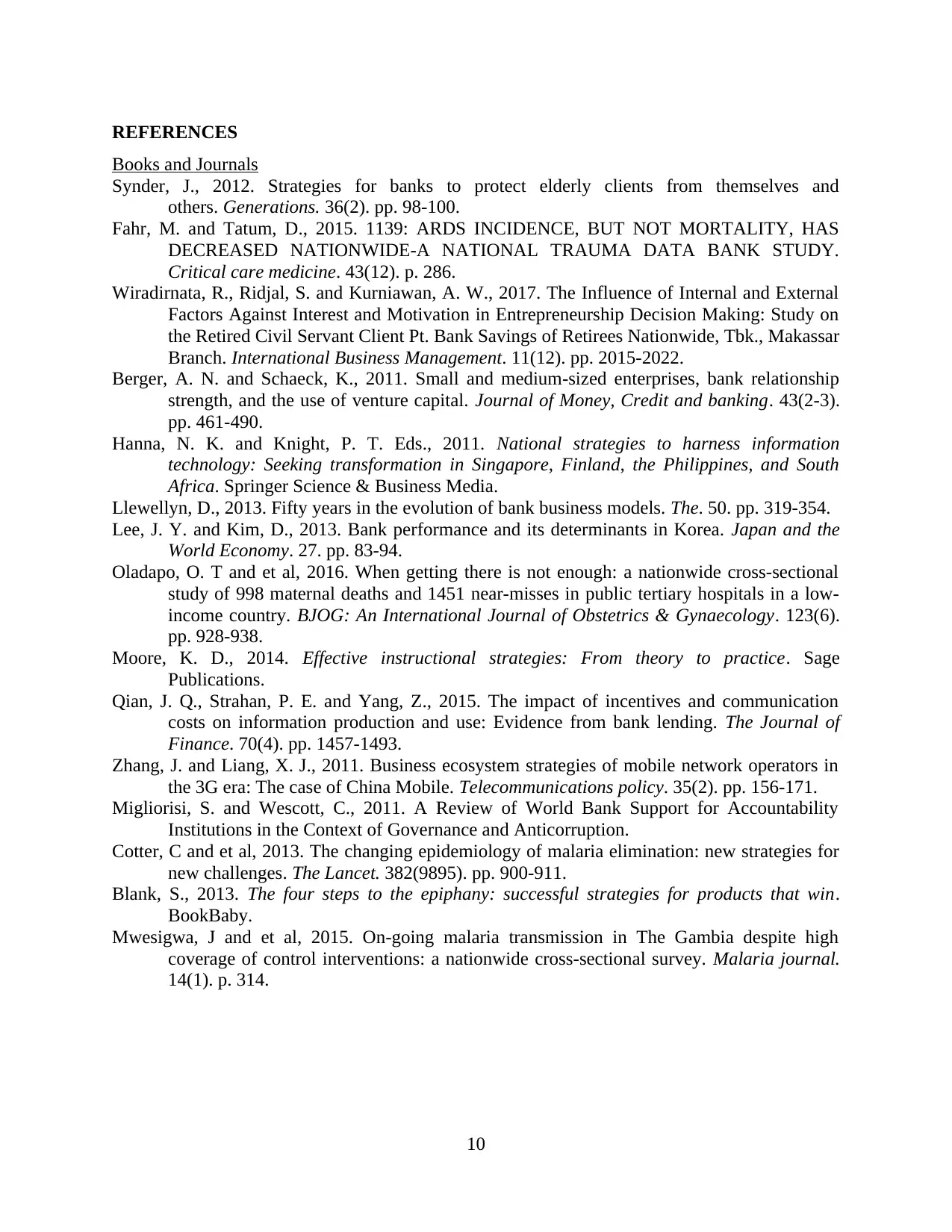
REFERENCES
Books and Journals
Synder, J., 2012. Strategies for banks to protect elderly clients from themselves and
others. Generations. 36(2). pp. 98-100.
Fahr, M. and Tatum, D., 2015. 1139: ARDS INCIDENCE, BUT NOT MORTALITY, HAS
DECREASED NATIONWIDE-A NATIONAL TRAUMA DATA BANK STUDY.
Critical care medicine. 43(12). p. 286.
Wiradirnata, R., Ridjal, S. and Kurniawan, A. W., 2017. The Influence of Internal and External
Factors Against Interest and Motivation in Entrepreneurship Decision Making: Study on
the Retired Civil Servant Client Pt. Bank Savings of Retirees Nationwide, Tbk., Makassar
Branch. International Business Management. 11(12). pp. 2015-2022.
Berger, A. N. and Schaeck, K., 2011. Small and medium‐sized enterprises, bank relationship
strength, and the use of venture capital. Journal of Money, Credit and banking. 43(2‐3).
pp. 461-490.
Hanna, N. K. and Knight, P. T. Eds., 2011. National strategies to harness information
technology: Seeking transformation in Singapore, Finland, the Philippines, and South
Africa. Springer Science & Business Media.
Llewellyn, D., 2013. Fifty years in the evolution of bank business models. The. 50. pp. 319-354.
Lee, J. Y. and Kim, D., 2013. Bank performance and its determinants in Korea. Japan and the
World Economy. 27. pp. 83-94.
Oladapo, O. T and et al, 2016. When getting there is not enough: a nationwide cross‐sectional
study of 998 maternal deaths and 1451 near‐misses in public tertiary hospitals in a low‐
income country. BJOG: An International Journal of Obstetrics & Gynaecology. 123(6).
pp. 928-938.
Moore, K. D., 2014. Effective instructional strategies: From theory to practice. Sage
Publications.
Qian, J. Q., Strahan, P. E. and Yang, Z., 2015. The impact of incentives and communication
costs on information production and use: Evidence from bank lending. The Journal of
Finance. 70(4). pp. 1457-1493.
Zhang, J. and Liang, X. J., 2011. Business ecosystem strategies of mobile network operators in
the 3G era: The case of China Mobile. Telecommunications policy. 35(2). pp. 156-171.
Migliorisi, S. and Wescott, C., 2011. A Review of World Bank Support for Accountability
Institutions in the Context of Governance and Anticorruption.
Cotter, C and et al, 2013. The changing epidemiology of malaria elimination: new strategies for
new challenges. The Lancet. 382(9895). pp. 900-911.
Blank, S., 2013. The four steps to the epiphany: successful strategies for products that win.
BookBaby.
Mwesigwa, J and et al, 2015. On-going malaria transmission in The Gambia despite high
coverage of control interventions: a nationwide cross-sectional survey. Malaria journal.
14(1). p. 314.
10
Books and Journals
Synder, J., 2012. Strategies for banks to protect elderly clients from themselves and
others. Generations. 36(2). pp. 98-100.
Fahr, M. and Tatum, D., 2015. 1139: ARDS INCIDENCE, BUT NOT MORTALITY, HAS
DECREASED NATIONWIDE-A NATIONAL TRAUMA DATA BANK STUDY.
Critical care medicine. 43(12). p. 286.
Wiradirnata, R., Ridjal, S. and Kurniawan, A. W., 2017. The Influence of Internal and External
Factors Against Interest and Motivation in Entrepreneurship Decision Making: Study on
the Retired Civil Servant Client Pt. Bank Savings of Retirees Nationwide, Tbk., Makassar
Branch. International Business Management. 11(12). pp. 2015-2022.
Berger, A. N. and Schaeck, K., 2011. Small and medium‐sized enterprises, bank relationship
strength, and the use of venture capital. Journal of Money, Credit and banking. 43(2‐3).
pp. 461-490.
Hanna, N. K. and Knight, P. T. Eds., 2011. National strategies to harness information
technology: Seeking transformation in Singapore, Finland, the Philippines, and South
Africa. Springer Science & Business Media.
Llewellyn, D., 2013. Fifty years in the evolution of bank business models. The. 50. pp. 319-354.
Lee, J. Y. and Kim, D., 2013. Bank performance and its determinants in Korea. Japan and the
World Economy. 27. pp. 83-94.
Oladapo, O. T and et al, 2016. When getting there is not enough: a nationwide cross‐sectional
study of 998 maternal deaths and 1451 near‐misses in public tertiary hospitals in a low‐
income country. BJOG: An International Journal of Obstetrics & Gynaecology. 123(6).
pp. 928-938.
Moore, K. D., 2014. Effective instructional strategies: From theory to practice. Sage
Publications.
Qian, J. Q., Strahan, P. E. and Yang, Z., 2015. The impact of incentives and communication
costs on information production and use: Evidence from bank lending. The Journal of
Finance. 70(4). pp. 1457-1493.
Zhang, J. and Liang, X. J., 2011. Business ecosystem strategies of mobile network operators in
the 3G era: The case of China Mobile. Telecommunications policy. 35(2). pp. 156-171.
Migliorisi, S. and Wescott, C., 2011. A Review of World Bank Support for Accountability
Institutions in the Context of Governance and Anticorruption.
Cotter, C and et al, 2013. The changing epidemiology of malaria elimination: new strategies for
new challenges. The Lancet. 382(9895). pp. 900-911.
Blank, S., 2013. The four steps to the epiphany: successful strategies for products that win.
BookBaby.
Mwesigwa, J and et al, 2015. On-going malaria transmission in The Gambia despite high
coverage of control interventions: a nationwide cross-sectional survey. Malaria journal.
14(1). p. 314.
10

1 out of 10


Related Documents


Your All-in-One AI-Powered Toolkit for Academic Success.
+13062052269
info@desklib.com
Available 24*7 on WhatsApp / Email
![[object Object]](/_next/static/media/star-bottom.7253800d.svg)
Unlock your academic potential
Copyright © 2020–2026 A2Z Services. All Rights Reserved. Developed and managed by ZUCOL.