Research on Tamoxifen's Effectiveness in Breast Cancer
VerifiedAdded on 2023/03/30
|13
|2849
|128
Report
AI Summary
This report analyzes the effectiveness of Tamoxifen in preventing the recurrence of breast cancer in women with a history of the disease. It begins with a background on the PICO framework, research questions, and keywords. The report details the search strategy, including the use of databases like PubMed and BioMed Central, and the application of Boolean operators. The results section reviews several research articles, including studies by Moon et al. (2017), Langballe et al. (2016), Margolese et al. (2015), and Haque et al. (2015), which examine Tamoxifen's impact, side effects, and interactions with other medications. The report includes a table summarizing the articles, focusing on population, interventions, comparisons, and outcomes. The discussion section synthesizes the findings, highlighting the significance of Haque et al.'s (2015) study and the potential impact of antidepressants on Tamoxifen's efficacy. The report concludes by emphasizing the importance of understanding Tamoxifen's role in breast cancer treatment and the need for further research into its interactions and side effects.
RESEARCH METHODOLOGY

Paraphrase This Document
Need a fresh take? Get an instant paraphrase of this document with our AI Paraphraser
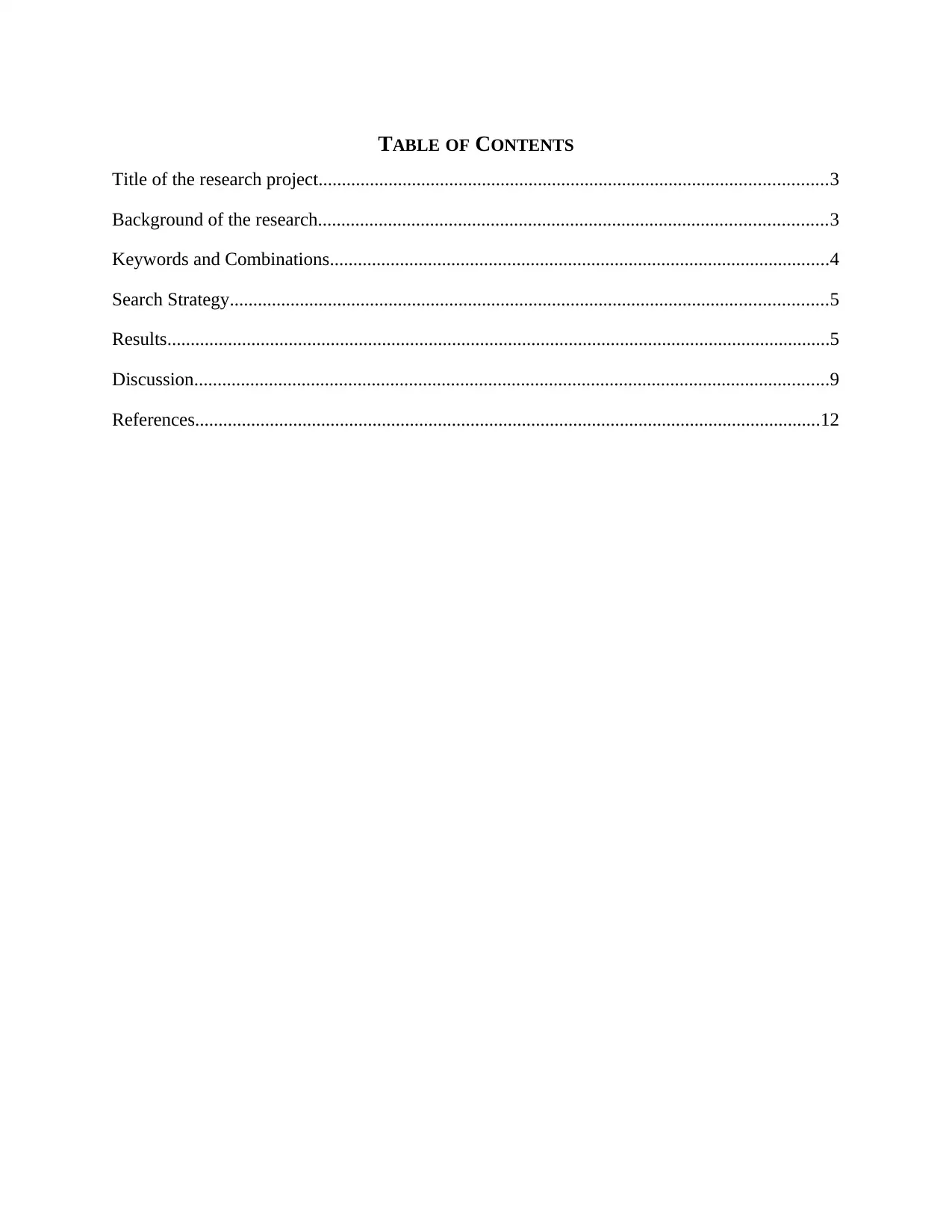
TABLE OF CONTENTS
Title of the research project.............................................................................................................3
Background of the research.............................................................................................................3
Keywords and Combinations...........................................................................................................4
Search Strategy................................................................................................................................5
Results..............................................................................................................................................5
Discussion........................................................................................................................................9
References......................................................................................................................................12
Title of the research project.............................................................................................................3
Background of the research.............................................................................................................3
Keywords and Combinations...........................................................................................................4
Search Strategy................................................................................................................................5
Results..............................................................................................................................................5
Discussion........................................................................................................................................9
References......................................................................................................................................12
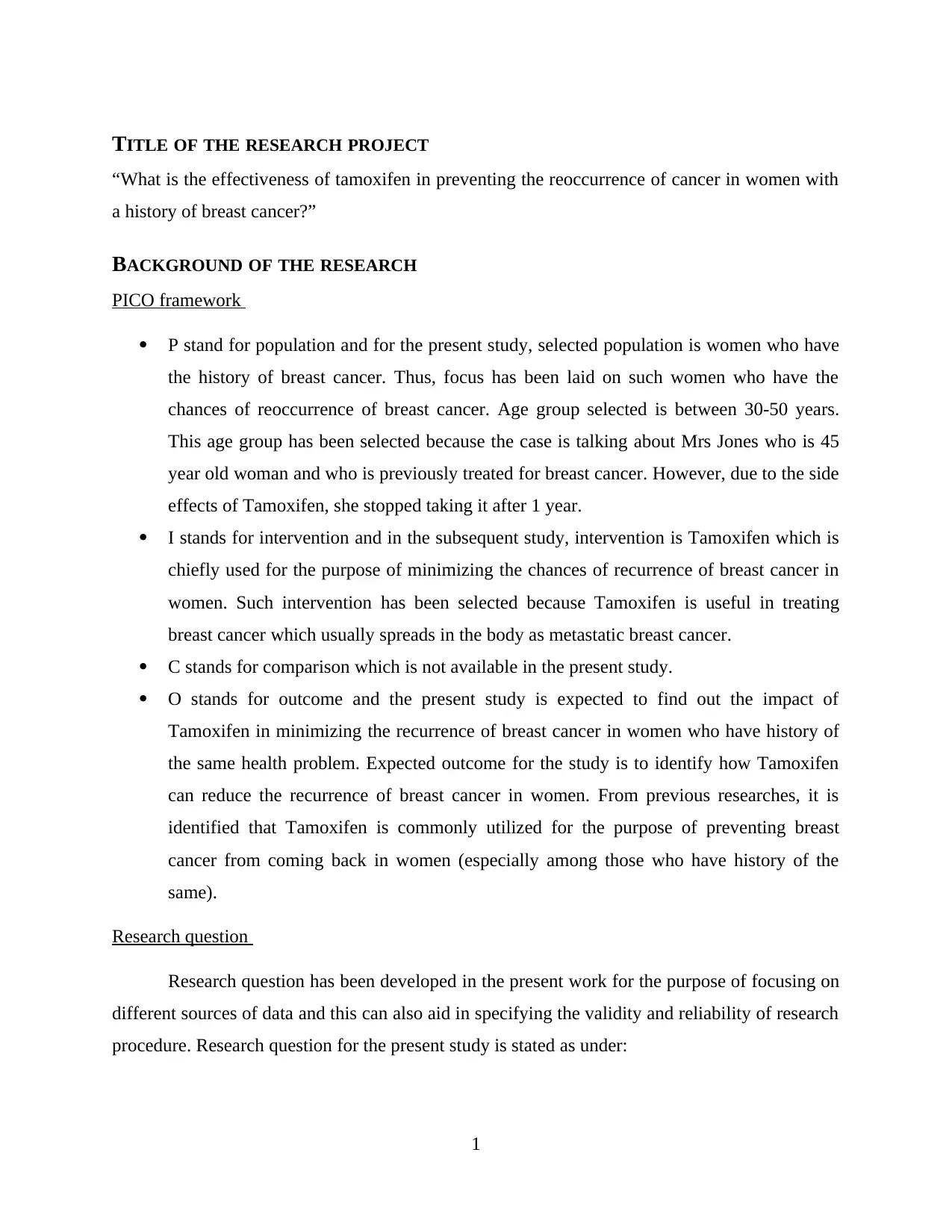
TITLE OF THE RESEARCH PROJECT
“What is the effectiveness of tamoxifen in preventing the reoccurrence of cancer in women with
a history of breast cancer?”
BACKGROUND OF THE RESEARCH
PICO framework
P stand for population and for the present study, selected population is women who have
the history of breast cancer. Thus, focus has been laid on such women who have the
chances of reoccurrence of breast cancer. Age group selected is between 30-50 years.
This age group has been selected because the case is talking about Mrs Jones who is 45
year old woman and who is previously treated for breast cancer. However, due to the side
effects of Tamoxifen, she stopped taking it after 1 year.
I stands for intervention and in the subsequent study, intervention is Tamoxifen which is
chiefly used for the purpose of minimizing the chances of recurrence of breast cancer in
women. Such intervention has been selected because Tamoxifen is useful in treating
breast cancer which usually spreads in the body as metastatic breast cancer.
C stands for comparison which is not available in the present study.
O stands for outcome and the present study is expected to find out the impact of
Tamoxifen in minimizing the recurrence of breast cancer in women who have history of
the same health problem. Expected outcome for the study is to identify how Tamoxifen
can reduce the recurrence of breast cancer in women. From previous researches, it is
identified that Tamoxifen is commonly utilized for the purpose of preventing breast
cancer from coming back in women (especially among those who have history of the
same).
Research question
Research question has been developed in the present work for the purpose of focusing on
different sources of data and this can also aid in specifying the validity and reliability of research
procedure. Research question for the present study is stated as under:
1
“What is the effectiveness of tamoxifen in preventing the reoccurrence of cancer in women with
a history of breast cancer?”
BACKGROUND OF THE RESEARCH
PICO framework
P stand for population and for the present study, selected population is women who have
the history of breast cancer. Thus, focus has been laid on such women who have the
chances of reoccurrence of breast cancer. Age group selected is between 30-50 years.
This age group has been selected because the case is talking about Mrs Jones who is 45
year old woman and who is previously treated for breast cancer. However, due to the side
effects of Tamoxifen, she stopped taking it after 1 year.
I stands for intervention and in the subsequent study, intervention is Tamoxifen which is
chiefly used for the purpose of minimizing the chances of recurrence of breast cancer in
women. Such intervention has been selected because Tamoxifen is useful in treating
breast cancer which usually spreads in the body as metastatic breast cancer.
C stands for comparison which is not available in the present study.
O stands for outcome and the present study is expected to find out the impact of
Tamoxifen in minimizing the recurrence of breast cancer in women who have history of
the same health problem. Expected outcome for the study is to identify how Tamoxifen
can reduce the recurrence of breast cancer in women. From previous researches, it is
identified that Tamoxifen is commonly utilized for the purpose of preventing breast
cancer from coming back in women (especially among those who have history of the
same).
Research question
Research question has been developed in the present work for the purpose of focusing on
different sources of data and this can also aid in specifying the validity and reliability of research
procedure. Research question for the present study is stated as under:
1
⊘ This is a preview!⊘
Do you want full access?
Subscribe today to unlock all pages.

Trusted by 1+ million students worldwide
What is the effectiveness of tamoxifen in preventing the reoccurrence of cancer in
women with a history of breast cancer?
Therefore, in this respect the present research study has been describing the useful of
Tamoxifen in preventing the recurrence of breast cancer in women. Tamoxifen is regarded as the
endocrine treatment which is also recommended to millions of women on larger scale. The main
action of Tamoxifen is to block the growth promoting effects of estrogens on breast cancer.
Tamoxifen could be used along with other medication for the purpose of forming a treatment that
can regulate the growth of new blood vessels (Lehman and et.al 2016 p.349). However, at the
same time after surgery, women diagnosed with hormone- receptor positive breast cancer usually
get treatment from hormonal therapy medicine which also assists in reducing the recurrence risk
of breast cancer. Tamoxifen is a major part of hormonal therapy which is chiefly utilized in
treating premenopausal and postmenopausal women.
Therefore, in this context, the present research study has been describing the impacts of
Tamoxifen in the case of breast cancer. Along with the same, focus has also been laid on all such
therapies which are used in the realm of treating women with breast cancer. The present research
work is carried out so as to develop awareness among women regarding the use of Tamoxifen. It
is useful in binding with estrogen receptors without activating growth in breast cancer cells
(Haque and et.al 2016 p.337).
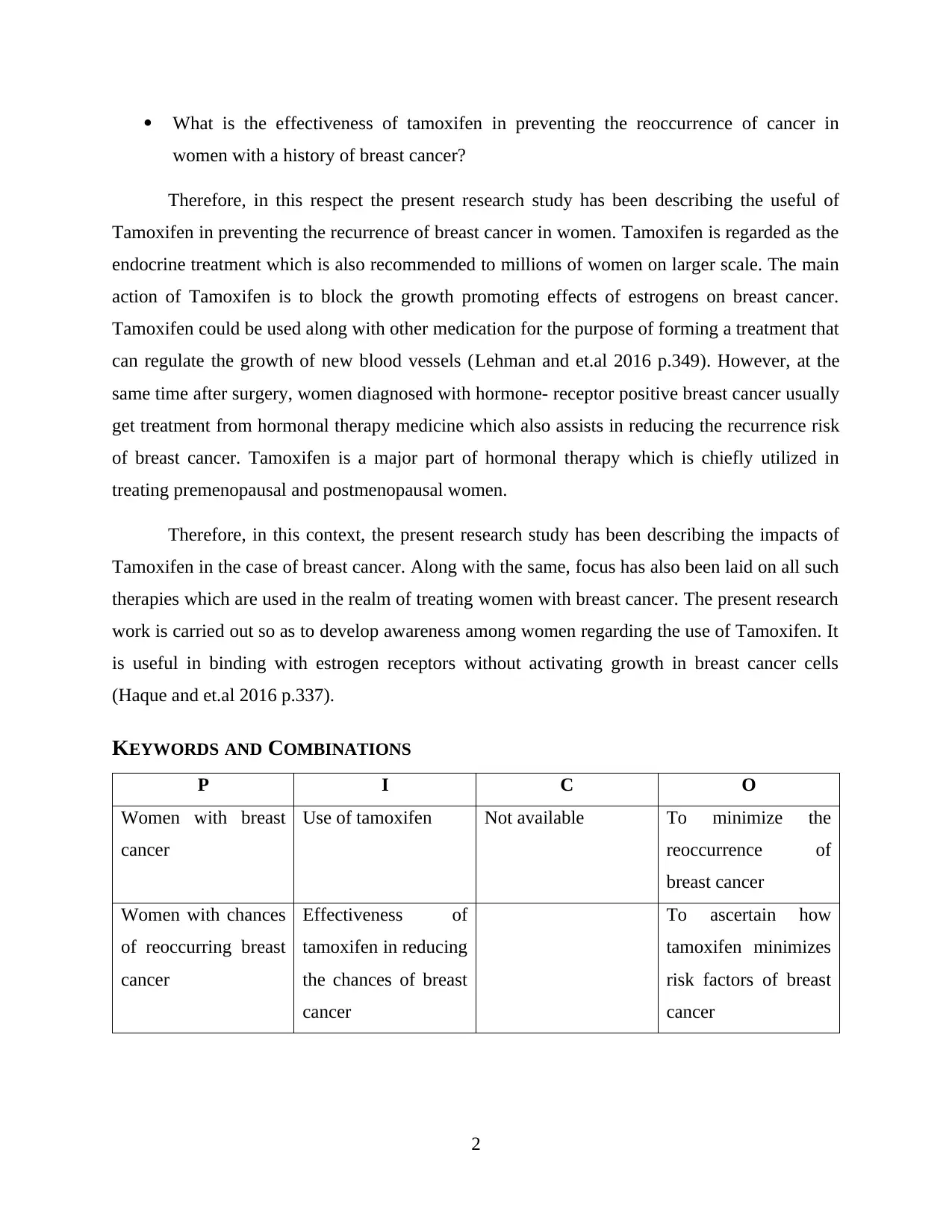
KEYWORDS AND COMBINATIONS
P I C O
Women with breast
cancer
Use of tamoxifen Not available To minimize the
reoccurrence of
breast cancer
Women with chances
of reoccurring breast
cancer
Effectiveness of
tamoxifen in reducing
the chances of breast
cancer
To ascertain how
tamoxifen minimizes
risk factors of breast
cancer
2
women with a history of breast cancer?
Therefore, in this respect the present research study has been describing the useful of
Tamoxifen in preventing the recurrence of breast cancer in women. Tamoxifen is regarded as the
endocrine treatment which is also recommended to millions of women on larger scale. The main
action of Tamoxifen is to block the growth promoting effects of estrogens on breast cancer.
Tamoxifen could be used along with other medication for the purpose of forming a treatment that
can regulate the growth of new blood vessels (Lehman and et.al 2016 p.349). However, at the
same time after surgery, women diagnosed with hormone- receptor positive breast cancer usually
get treatment from hormonal therapy medicine which also assists in reducing the recurrence risk
of breast cancer. Tamoxifen is a major part of hormonal therapy which is chiefly utilized in
treating premenopausal and postmenopausal women.
Therefore, in this context, the present research study has been describing the impacts of
Tamoxifen in the case of breast cancer. Along with the same, focus has also been laid on all such
therapies which are used in the realm of treating women with breast cancer. The present research
work is carried out so as to develop awareness among women regarding the use of Tamoxifen. It
is useful in binding with estrogen receptors without activating growth in breast cancer cells
(Haque and et.al 2016 p.337).
KEYWORDS AND COMBINATIONS
P I C O
Women with breast
cancer
Use of tamoxifen Not available To minimize the
reoccurrence of
breast cancer
Women with chances
of reoccurring breast
cancer
Effectiveness of
tamoxifen in reducing
the chances of breast
cancer
To ascertain how
tamoxifen minimizes
risk factors of breast
cancer
2
Paraphrase This Document
Need a fresh take? Get an instant paraphrase of this document with our AI Paraphraser
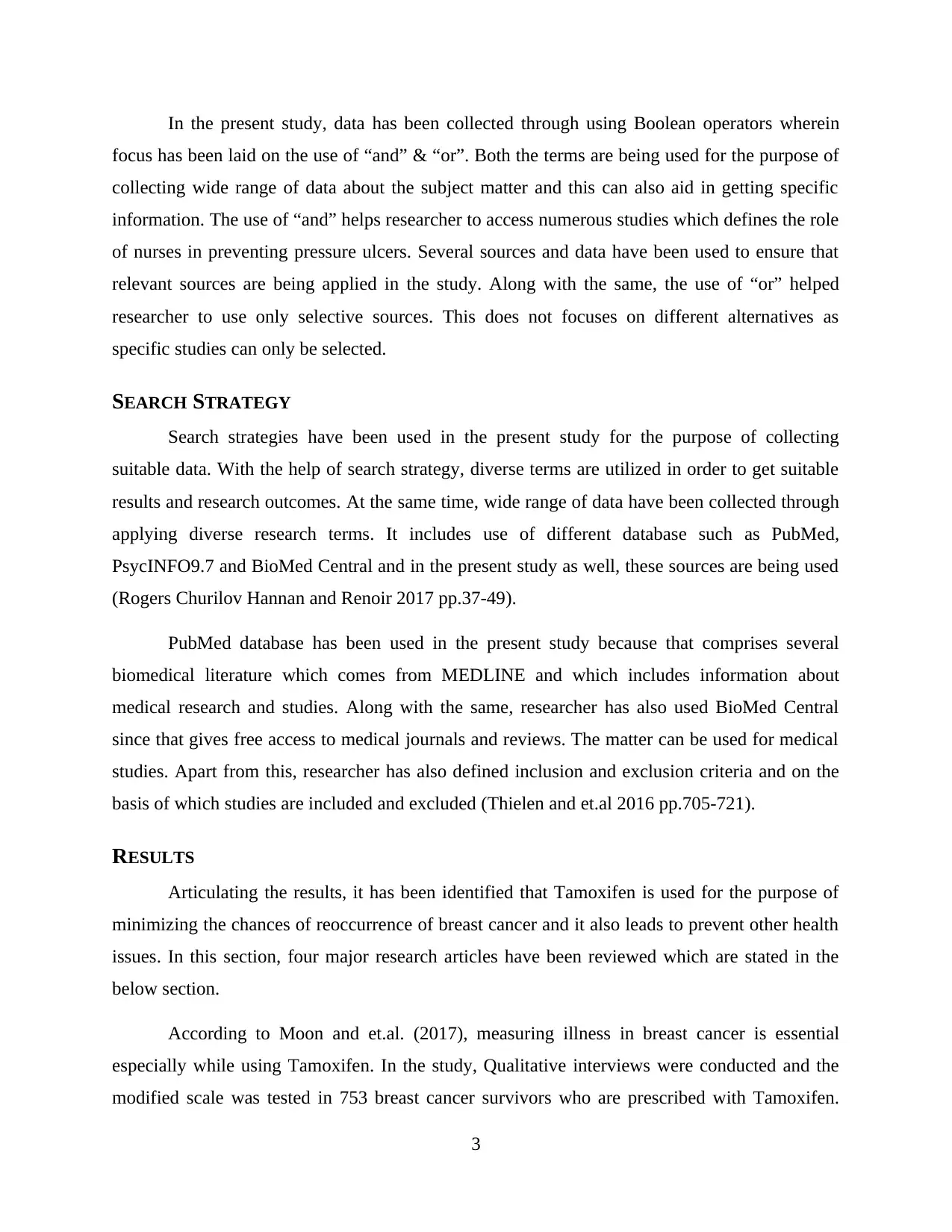
In the present study, data has been collected through using Boolean operators wherein
focus has been laid on the use of “and” & “or”. Both the terms are being used for the purpose of
collecting wide range of data about the subject matter and this can also aid in getting specific
information. The use of “and” helps researcher to access numerous studies which defines the role
of nurses in preventing pressure ulcers. Several sources and data have been used to ensure that
relevant sources are being applied in the study. Along with the same, the use of “or” helped
researcher to use only selective sources. This does not focuses on different alternatives as
specific studies can only be selected.
SEARCH STRATEGY
Search strategies have been used in the present study for the purpose of collecting
suitable data. With the help of search strategy, diverse terms are utilized in order to get suitable
results and research outcomes. At the same time, wide range of data have been collected through
applying diverse research terms. It includes use of different database such as PubMed,
PsycINFO9.7 and BioMed Central and in the present study as well, these sources are being used
(Rogers Churilov Hannan and Renoir 2017 pp.37-49).
PubMed database has been used in the present study because that comprises several
biomedical literature which comes from MEDLINE and which includes information about
medical research and studies. Along with the same, researcher has also used BioMed Central
since that gives free access to medical journals and reviews. The matter can be used for medical
studies. Apart from this, researcher has also defined inclusion and exclusion criteria and on the
basis of which studies are included and excluded (Thielen and et.al 2016 pp.705-721).
RESULTS
Articulating the results, it has been identified that Tamoxifen is used for the purpose of
minimizing the chances of reoccurrence of breast cancer and it also leads to prevent other health
issues. In this section, four major research articles have been reviewed which are stated in the
below section.
According to Moon and et.al. (2017), measuring illness in breast cancer is essential
especially while using Tamoxifen. In the study, Qualitative interviews were conducted and the
modified scale was tested in 753 breast cancer survivors who are prescribed with Tamoxifen.
3
focus has been laid on the use of “and” & “or”. Both the terms are being used for the purpose of
collecting wide range of data about the subject matter and this can also aid in getting specific
information. The use of “and” helps researcher to access numerous studies which defines the role
of nurses in preventing pressure ulcers. Several sources and data have been used to ensure that
relevant sources are being applied in the study. Along with the same, the use of “or” helped
researcher to use only selective sources. This does not focuses on different alternatives as
specific studies can only be selected.
SEARCH STRATEGY
Search strategies have been used in the present study for the purpose of collecting
suitable data. With the help of search strategy, diverse terms are utilized in order to get suitable
results and research outcomes. At the same time, wide range of data have been collected through
applying diverse research terms. It includes use of different database such as PubMed,
PsycINFO9.7 and BioMed Central and in the present study as well, these sources are being used
(Rogers Churilov Hannan and Renoir 2017 pp.37-49).
PubMed database has been used in the present study because that comprises several
biomedical literature which comes from MEDLINE and which includes information about
medical research and studies. Along with the same, researcher has also used BioMed Central
since that gives free access to medical journals and reviews. The matter can be used for medical
studies. Apart from this, researcher has also defined inclusion and exclusion criteria and on the
basis of which studies are included and excluded (Thielen and et.al 2016 pp.705-721).
RESULTS
Articulating the results, it has been identified that Tamoxifen is used for the purpose of
minimizing the chances of reoccurrence of breast cancer and it also leads to prevent other health
issues. In this section, four major research articles have been reviewed which are stated in the
below section.
According to Moon and et.al. (2017), measuring illness in breast cancer is essential
especially while using Tamoxifen. In the study, Qualitative interviews were conducted and the
modified scale was tested in 753 breast cancer survivors who are prescribed with Tamoxifen.
3
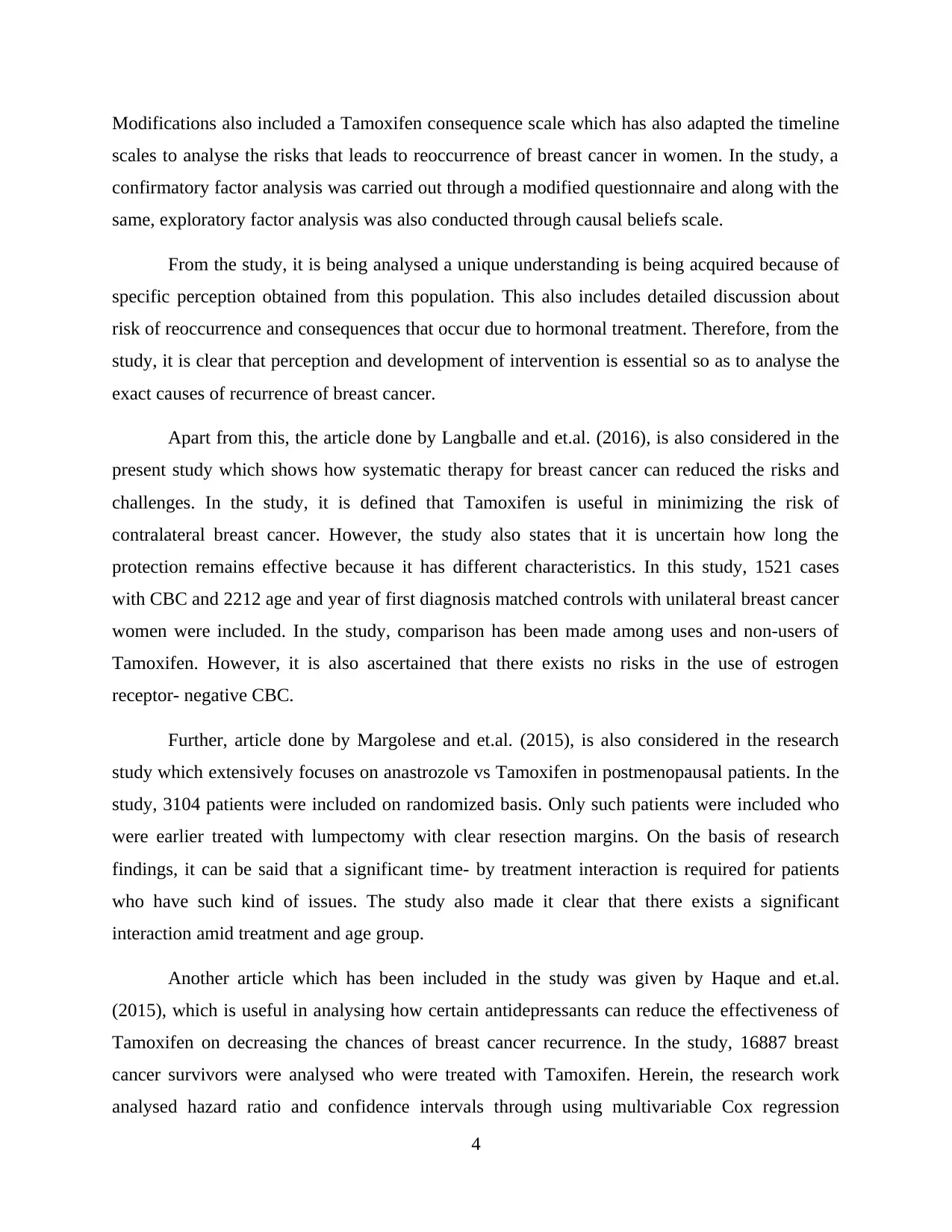
Modifications also included a Tamoxifen consequence scale which has also adapted the timeline
scales to analyse the risks that leads to reoccurrence of breast cancer in women. In the study, a
confirmatory factor analysis was carried out through a modified questionnaire and along with the
same, exploratory factor analysis was also conducted through causal beliefs scale.
From the study, it is being analysed a unique understanding is being acquired because of
specific perception obtained from this population. This also includes detailed discussion about
risk of reoccurrence and consequences that occur due to hormonal treatment. Therefore, from the
study, it is clear that perception and development of intervention is essential so as to analyse the
exact causes of recurrence of breast cancer.
Apart from this, the article done by Langballe and et.al. (2016), is also considered in the
present study which shows how systematic therapy for breast cancer can reduced the risks and
challenges. In the study, it is defined that Tamoxifen is useful in minimizing the risk of
contralateral breast cancer. However, the study also states that it is uncertain how long the
protection remains effective because it has different characteristics. In this study, 1521 cases
with CBC and 2212 age and year of first diagnosis matched controls with unilateral breast cancer
women were included. In the study, comparison has been made among uses and non-users of
Tamoxifen. However, it is also ascertained that there exists no risks in the use of estrogen
receptor- negative CBC.
Further, article done by Margolese and et.al. (2015), is also considered in the research
study which extensively focuses on anastrozole vs Tamoxifen in postmenopausal patients. In the
study, 3104 patients were included on randomized basis. Only such patients were included who
were earlier treated with lumpectomy with clear resection margins. On the basis of research
findings, it can be said that a significant time- by treatment interaction is required for patients
who have such kind of issues. The study also made it clear that there exists a significant
interaction amid treatment and age group.
Another article which has been included in the study was given by Haque and et.al.
(2015), which is useful in analysing how certain antidepressants can reduce the effectiveness of
Tamoxifen on decreasing the chances of breast cancer recurrence. In the study, 16887 breast
cancer survivors were analysed who were treated with Tamoxifen. Herein, the research work
analysed hazard ratio and confidence intervals through using multivariable Cox regression
4
scales to analyse the risks that leads to reoccurrence of breast cancer in women. In the study, a
confirmatory factor analysis was carried out through a modified questionnaire and along with the
same, exploratory factor analysis was also conducted through causal beliefs scale.
From the study, it is being analysed a unique understanding is being acquired because of
specific perception obtained from this population. This also includes detailed discussion about
risk of reoccurrence and consequences that occur due to hormonal treatment. Therefore, from the
study, it is clear that perception and development of intervention is essential so as to analyse the
exact causes of recurrence of breast cancer.
Apart from this, the article done by Langballe and et.al. (2016), is also considered in the
present study which shows how systematic therapy for breast cancer can reduced the risks and
challenges. In the study, it is defined that Tamoxifen is useful in minimizing the risk of
contralateral breast cancer. However, the study also states that it is uncertain how long the
protection remains effective because it has different characteristics. In this study, 1521 cases
with CBC and 2212 age and year of first diagnosis matched controls with unilateral breast cancer
women were included. In the study, comparison has been made among uses and non-users of
Tamoxifen. However, it is also ascertained that there exists no risks in the use of estrogen
receptor- negative CBC.
Further, article done by Margolese and et.al. (2015), is also considered in the research
study which extensively focuses on anastrozole vs Tamoxifen in postmenopausal patients. In the
study, 3104 patients were included on randomized basis. Only such patients were included who
were earlier treated with lumpectomy with clear resection margins. On the basis of research
findings, it can be said that a significant time- by treatment interaction is required for patients
who have such kind of issues. The study also made it clear that there exists a significant
interaction amid treatment and age group.
Another article which has been included in the study was given by Haque and et.al.
(2015), which is useful in analysing how certain antidepressants can reduce the effectiveness of
Tamoxifen on decreasing the chances of breast cancer recurrence. In the study, 16887 breast
cancer survivors were analysed who were treated with Tamoxifen. Herein, the research work
analysed hazard ratio and confidence intervals through using multivariable Cox regression
4
⊘ This is a preview!⊘
Do you want full access?
Subscribe today to unlock all pages.
Trusted by 1+ million students worldwide
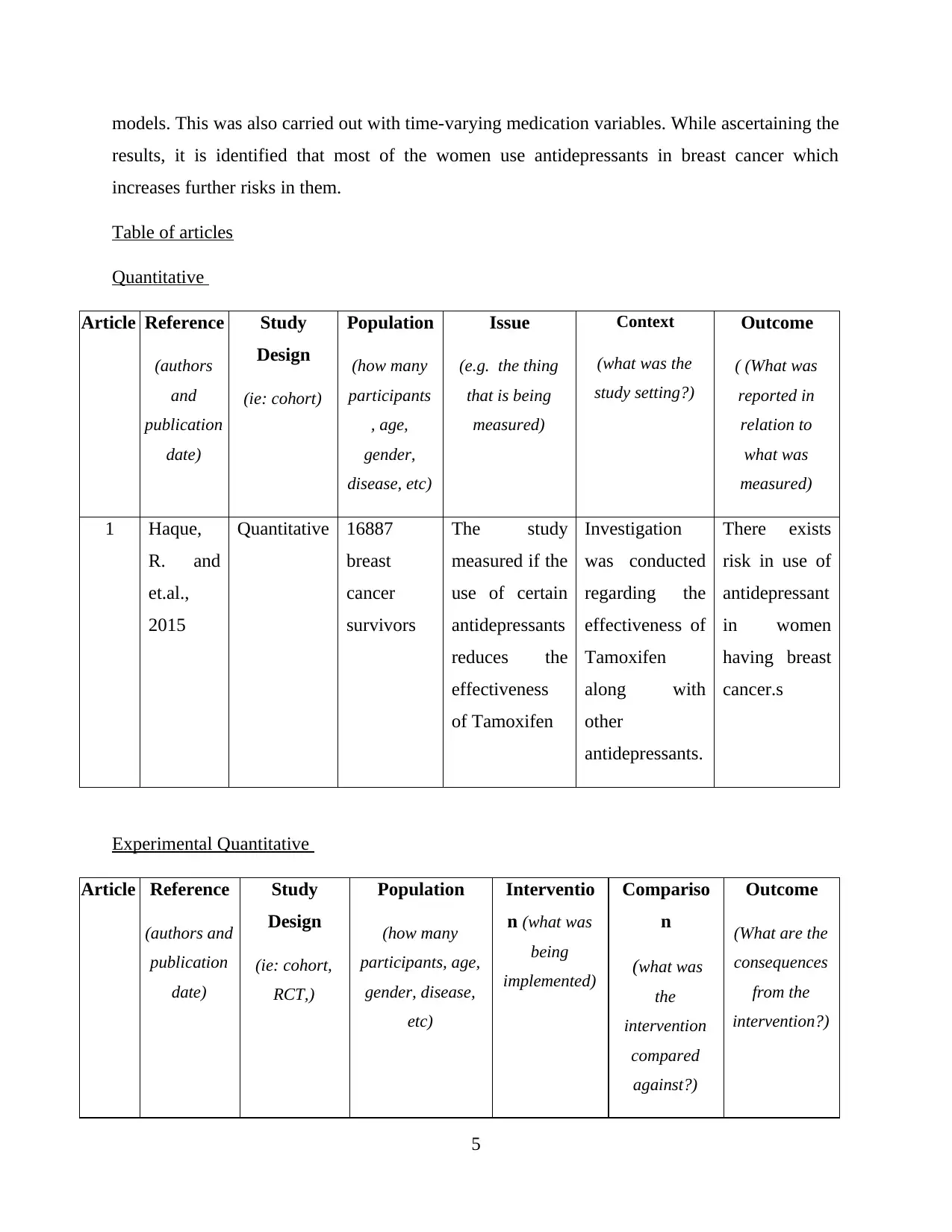
models. This was also carried out with time-varying medication variables. While ascertaining the
results, it is identified that most of the women use antidepressants in breast cancer which
increases further risks in them.
Table of articles
Quantitative
Article Reference
(authors
and
publication
date)
Study
Design
(ie: cohort)
Population
(how many
participants
, age,
gender,
disease, etc)
Issue
(e.g. the thing
that is being
measured)
Context
(what was the
study setting?)
Outcome
( (What was
reported in
relation to
what was
measured)
1 Haque,
R. and
et.al.,
2015
Quantitative 16887
breast
cancer
survivors
The study
measured if the
use of certain
antidepressants
reduces the
effectiveness
of Tamoxifen
Investigation
was conducted
regarding the
effectiveness of
Tamoxifen
along with
other
antidepressants.
There exists
risk in use of
antidepressant
in women
having breast
cancer.s
Experimental Quantitative
Article Reference
(authors and
publication
date)
Study
Design
(ie: cohort,
RCT,)
Population
(how many
participants, age,
gender, disease,
etc)
Interventio
n (what was
being
implemented)
Compariso
n
(what was
the
intervention
compared
against?)
Outcome
(What are the
consequences
from the
intervention?)
5
results, it is identified that most of the women use antidepressants in breast cancer which
increases further risks in them.
Table of articles
Quantitative
Article Reference
(authors
and
publication
date)
Study
Design
(ie: cohort)
Population
(how many
participants
, age,
gender,
disease, etc)
Issue
(e.g. the thing
that is being
measured)
Context
(what was the
study setting?)
Outcome
( (What was
reported in
relation to
what was
measured)
1 Haque,
R. and
et.al.,
2015
Quantitative 16887
breast
cancer
survivors
The study
measured if the
use of certain
antidepressants
reduces the
effectiveness
of Tamoxifen
Investigation
was conducted
regarding the
effectiveness of
Tamoxifen
along with
other
antidepressants.
There exists
risk in use of
antidepressant
in women
having breast
cancer.s
Experimental Quantitative
Article Reference
(authors and
publication
date)
Study
Design
(ie: cohort,
RCT,)
Population
(how many
participants, age,
gender, disease,
etc)
Interventio
n (what was
being
implemented)
Compariso
n
(what was
the
intervention
compared
against?)
Outcome
(What are the
consequences
from the
intervention?)
5
Paraphrase This Document
Need a fresh take? Get an instant paraphrase of this document with our AI Paraphraser
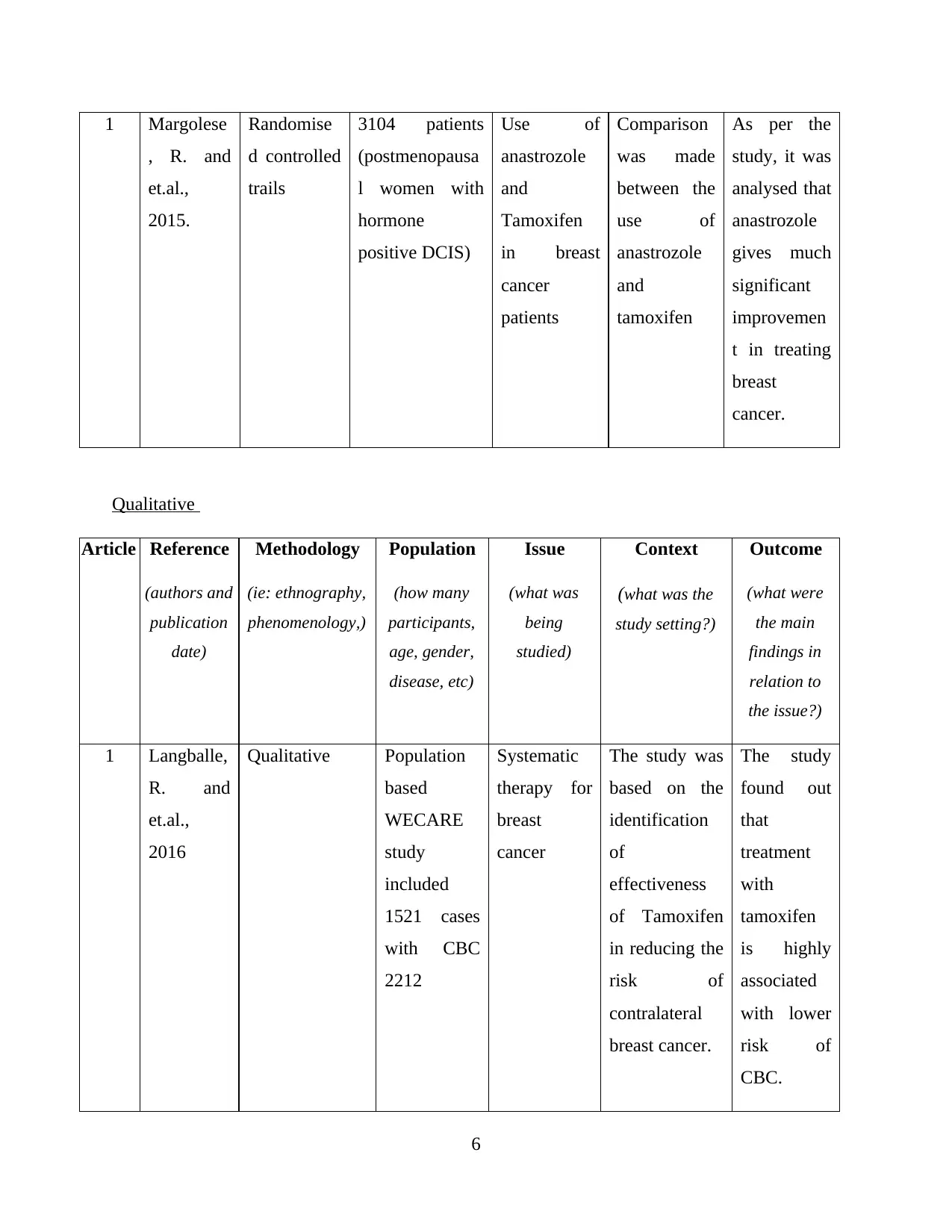
1 Margolese
, R. and
et.al.,
2015.
Randomise
d controlled
trails
3104 patients
(postmenopausa
l women with
hormone
positive DCIS)
Use of
anastrozole
and
Tamoxifen
in breast
cancer
patients
Comparison
was made
between the
use of
anastrozole
and
tamoxifen
As per the
study, it was
analysed that
anastrozole
gives much
significant
improvemen
t in treating
breast
cancer.
Qualitative
Article Reference
(authors and
publication
date)
Methodology
(ie: ethnography,
phenomenology,)
Population
(how many
participants,
age, gender,
disease, etc)
Issue
(what was
being
studied)
Context
(what was the
study setting?)
Outcome
(what were
the main
findings in
relation to
the issue?)
1 Langballe,
R. and
et.al.,
2016
Qualitative Population
based
WECARE
study
included
1521 cases
with CBC
2212
Systematic
therapy for
breast
cancer
The study was
based on the
identification
of
effectiveness
of Tamoxifen
in reducing the
risk of
contralateral
breast cancer.
The study
found out
that
treatment
with
tamoxifen
is highly
associated
with lower
risk of
CBC.
6
, R. and
et.al.,
2015.
Randomise
d controlled
trails
3104 patients
(postmenopausa
l women with
hormone
positive DCIS)
Use of
anastrozole
and
Tamoxifen
in breast
cancer
patients
Comparison
was made
between the
use of
anastrozole
and
tamoxifen
As per the
study, it was
analysed that
anastrozole
gives much
significant
improvemen
t in treating
breast
cancer.
Qualitative
Article Reference
(authors and
publication
date)
Methodology
(ie: ethnography,
phenomenology,)
Population
(how many
participants,
age, gender,
disease, etc)
Issue
(what was
being
studied)
Context
(what was the
study setting?)
Outcome
(what were
the main
findings in
relation to
the issue?)
1 Langballe,
R. and
et.al.,
2016
Qualitative Population
based
WECARE
study
included
1521 cases
with CBC
2212
Systematic
therapy for
breast
cancer
The study was
based on the
identification
of
effectiveness
of Tamoxifen
in reducing the
risk of
contralateral
breast cancer.
The study
found out
that
treatment
with
tamoxifen
is highly
associated
with lower
risk of
CBC.
6
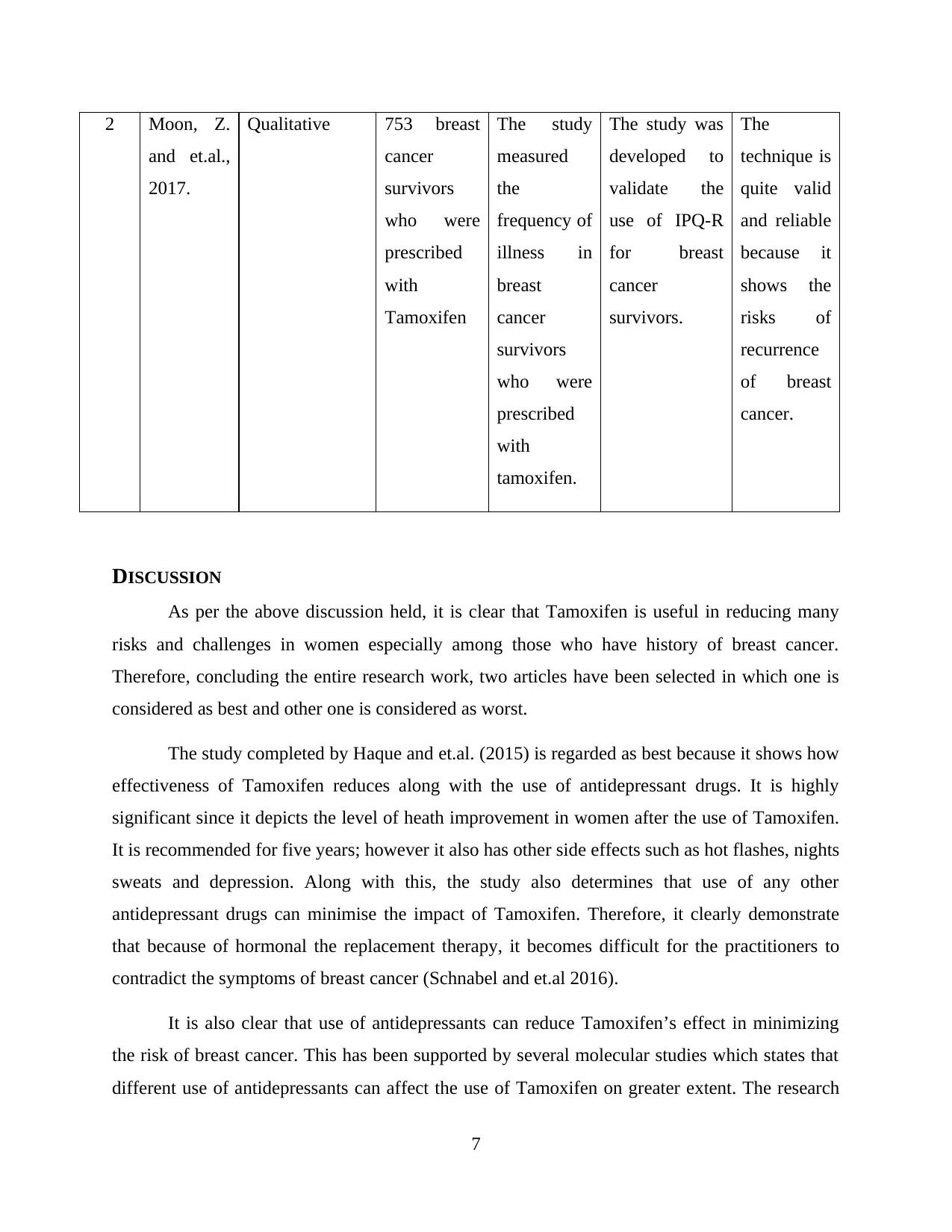
2 Moon, Z.
and et.al.,
2017.
Qualitative 753 breast
cancer
survivors
who were
prescribed
with
Tamoxifen
The study
measured
the
frequency of
illness in
breast
cancer
survivors
who were
prescribed
with
tamoxifen.
The study was
developed to
validate the
use of IPQ-R
for breast
cancer
survivors.
The
technique is
quite valid
and reliable
because it
shows the
risks of
recurrence
of breast
cancer.
DISCUSSION
As per the above discussion held, it is clear that Tamoxifen is useful in reducing many
risks and challenges in women especially among those who have history of breast cancer.
Therefore, concluding the entire research work, two articles have been selected in which one is
considered as best and other one is considered as worst.
The study completed by Haque and et.al. (2015) is regarded as best because it shows how
effectiveness of Tamoxifen reduces along with the use of antidepressant drugs. It is highly
significant since it depicts the level of heath improvement in women after the use of Tamoxifen.
It is recommended for five years; however it also has other side effects such as hot flashes, nights
sweats and depression. Along with this, the study also determines that use of any other
antidepressant drugs can minimise the impact of Tamoxifen. Therefore, it clearly demonstrate
that because of hormonal the replacement therapy, it becomes difficult for the practitioners to
contradict the symptoms of breast cancer (Schnabel and et.al 2016).
It is also clear that use of antidepressants can reduce Tamoxifen’s effect in minimizing
the risk of breast cancer. This has been supported by several molecular studies which states that
different use of antidepressants can affect the use of Tamoxifen on greater extent. The research
7
and et.al.,
2017.
Qualitative 753 breast
cancer
survivors
who were
prescribed
with
Tamoxifen
The study
measured
the
frequency of
illness in
breast
cancer
survivors
who were
prescribed
with
tamoxifen.
The study was
developed to
validate the
use of IPQ-R
for breast
cancer
survivors.
The
technique is
quite valid
and reliable
because it
shows the
risks of
recurrence
of breast
cancer.
DISCUSSION
As per the above discussion held, it is clear that Tamoxifen is useful in reducing many
risks and challenges in women especially among those who have history of breast cancer.
Therefore, concluding the entire research work, two articles have been selected in which one is
considered as best and other one is considered as worst.
The study completed by Haque and et.al. (2015) is regarded as best because it shows how
effectiveness of Tamoxifen reduces along with the use of antidepressant drugs. It is highly
significant since it depicts the level of heath improvement in women after the use of Tamoxifen.
It is recommended for five years; however it also has other side effects such as hot flashes, nights
sweats and depression. Along with this, the study also determines that use of any other
antidepressant drugs can minimise the impact of Tamoxifen. Therefore, it clearly demonstrate
that because of hormonal the replacement therapy, it becomes difficult for the practitioners to
contradict the symptoms of breast cancer (Schnabel and et.al 2016).
It is also clear that use of antidepressants can reduce Tamoxifen’s effect in minimizing
the risk of breast cancer. This has been supported by several molecular studies which states that
different use of antidepressants can affect the use of Tamoxifen on greater extent. The research
7
⊘ This is a preview!⊘
Do you want full access?
Subscribe today to unlock all pages.
Trusted by 1+ million students worldwide
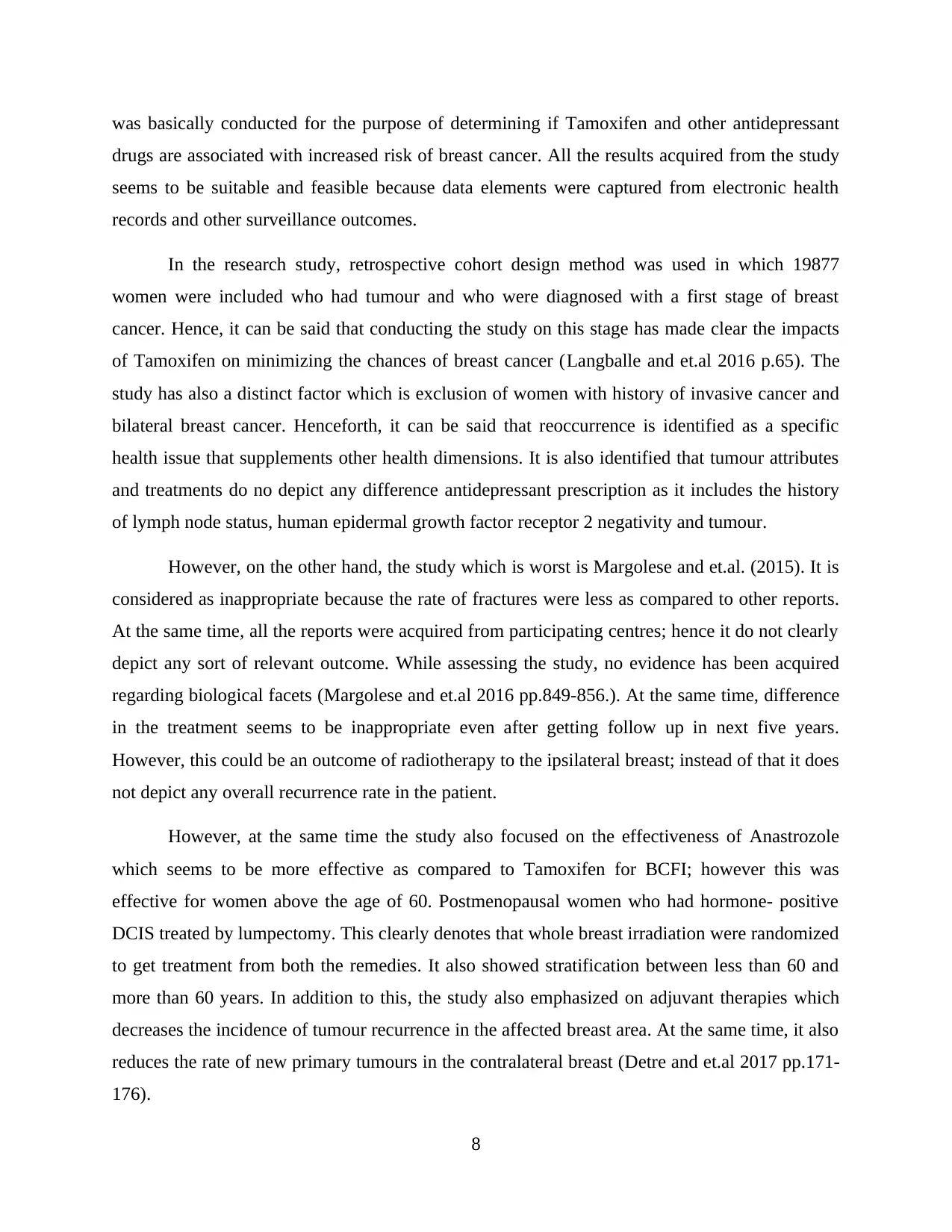
was basically conducted for the purpose of determining if Tamoxifen and other antidepressant
drugs are associated with increased risk of breast cancer. All the results acquired from the study
seems to be suitable and feasible because data elements were captured from electronic health
records and other surveillance outcomes.
In the research study, retrospective cohort design method was used in which 19877
women were included who had tumour and who were diagnosed with a first stage of breast
cancer. Hence, it can be said that conducting the study on this stage has made clear the impacts
of Tamoxifen on minimizing the chances of breast cancer (Langballe and et.al 2016 p.65). The
study has also a distinct factor which is exclusion of women with history of invasive cancer and
bilateral breast cancer. Henceforth, it can be said that reoccurrence is identified as a specific
health issue that supplements other health dimensions. It is also identified that tumour attributes
and treatments do no depict any difference antidepressant prescription as it includes the history
of lymph node status, human epidermal growth factor receptor 2 negativity and tumour.
However, on the other hand, the study which is worst is Margolese and et.al. (2015). It is
considered as inappropriate because the rate of fractures were less as compared to other reports.
At the same time, all the reports were acquired from participating centres; hence it do not clearly
depict any sort of relevant outcome. While assessing the study, no evidence has been acquired
regarding biological facets (Margolese and et.al 2016 pp.849-856.). At the same time, difference
in the treatment seems to be inappropriate even after getting follow up in next five years.
However, this could be an outcome of radiotherapy to the ipsilateral breast; instead of that it does
not depict any overall recurrence rate in the patient.
However, at the same time the study also focused on the effectiveness of Anastrozole
which seems to be more effective as compared to Tamoxifen for BCFI; however this was
effective for women above the age of 60. Postmenopausal women who had hormone- positive
DCIS treated by lumpectomy. This clearly denotes that whole breast irradiation were randomized
to get treatment from both the remedies. It also showed stratification between less than 60 and
more than 60 years. In addition to this, the study also emphasized on adjuvant therapies which
decreases the incidence of tumour recurrence in the affected breast area. At the same time, it also
reduces the rate of new primary tumours in the contralateral breast (Detre and et.al 2017 pp.171-
176).
8
drugs are associated with increased risk of breast cancer. All the results acquired from the study
seems to be suitable and feasible because data elements were captured from electronic health
records and other surveillance outcomes.
In the research study, retrospective cohort design method was used in which 19877
women were included who had tumour and who were diagnosed with a first stage of breast
cancer. Hence, it can be said that conducting the study on this stage has made clear the impacts
of Tamoxifen on minimizing the chances of breast cancer (Langballe and et.al 2016 p.65). The
study has also a distinct factor which is exclusion of women with history of invasive cancer and
bilateral breast cancer. Henceforth, it can be said that reoccurrence is identified as a specific
health issue that supplements other health dimensions. It is also identified that tumour attributes
and treatments do no depict any difference antidepressant prescription as it includes the history
of lymph node status, human epidermal growth factor receptor 2 negativity and tumour.
However, on the other hand, the study which is worst is Margolese and et.al. (2015). It is
considered as inappropriate because the rate of fractures were less as compared to other reports.
At the same time, all the reports were acquired from participating centres; hence it do not clearly
depict any sort of relevant outcome. While assessing the study, no evidence has been acquired
regarding biological facets (Margolese and et.al 2016 pp.849-856.). At the same time, difference
in the treatment seems to be inappropriate even after getting follow up in next five years.
However, this could be an outcome of radiotherapy to the ipsilateral breast; instead of that it does
not depict any overall recurrence rate in the patient.
However, at the same time the study also focused on the effectiveness of Anastrozole
which seems to be more effective as compared to Tamoxifen for BCFI; however this was
effective for women above the age of 60. Postmenopausal women who had hormone- positive
DCIS treated by lumpectomy. This clearly denotes that whole breast irradiation were randomized
to get treatment from both the remedies. It also showed stratification between less than 60 and
more than 60 years. In addition to this, the study also emphasized on adjuvant therapies which
decreases the incidence of tumour recurrence in the affected breast area. At the same time, it also
reduces the rate of new primary tumours in the contralateral breast (Detre and et.al 2017 pp.171-
176).
8
Paraphrase This Document
Need a fresh take? Get an instant paraphrase of this document with our AI Paraphraser
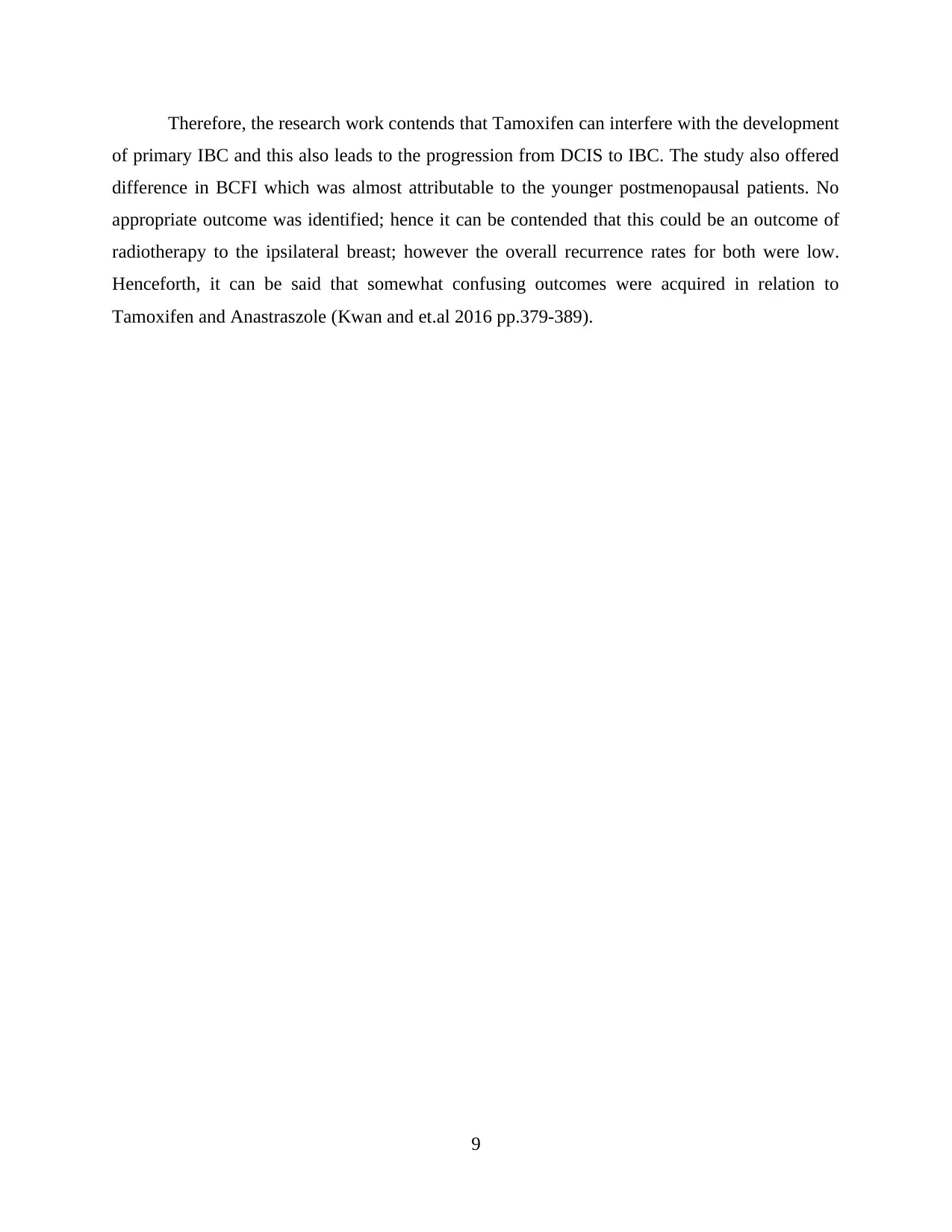
Therefore, the research work contends that Tamoxifen can interfere with the development
of primary IBC and this also leads to the progression from DCIS to IBC. The study also offered
difference in BCFI which was almost attributable to the younger postmenopausal patients. No
appropriate outcome was identified; hence it can be contended that this could be an outcome of
radiotherapy to the ipsilateral breast; however the overall recurrence rates for both were low.
Henceforth, it can be said that somewhat confusing outcomes were acquired in relation to
Tamoxifen and Anastraszole (Kwan and et.al 2016 pp.379-389).
9
of primary IBC and this also leads to the progression from DCIS to IBC. The study also offered
difference in BCFI which was almost attributable to the younger postmenopausal patients. No
appropriate outcome was identified; hence it can be contended that this could be an outcome of
radiotherapy to the ipsilateral breast; however the overall recurrence rates for both were low.
Henceforth, it can be said that somewhat confusing outcomes were acquired in relation to
Tamoxifen and Anastraszole (Kwan and et.al 2016 pp.379-389).
9
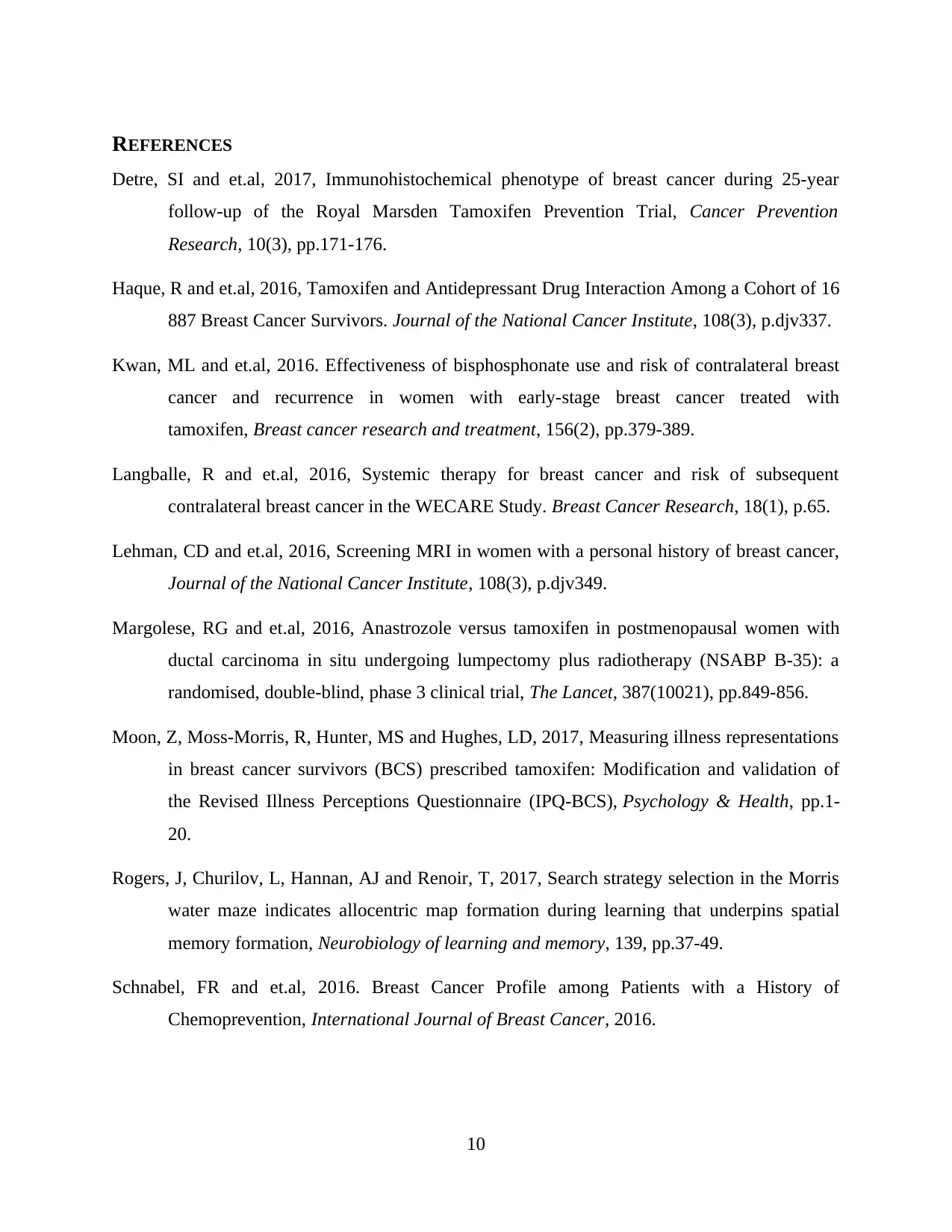
REFERENCES
Detre, SI and et.al, 2017, Immunohistochemical phenotype of breast cancer during 25-year
follow-up of the Royal Marsden Tamoxifen Prevention Trial, Cancer Prevention
Research, 10(3), pp.171-176.
Haque, R and et.al, 2016, Tamoxifen and Antidepressant Drug Interaction Among a Cohort of 16
887 Breast Cancer Survivors. Journal of the National Cancer Institute, 108(3), p.djv337.
Kwan, ML and et.al, 2016. Effectiveness of bisphosphonate use and risk of contralateral breast
cancer and recurrence in women with early-stage breast cancer treated with
tamoxifen, Breast cancer research and treatment, 156(2), pp.379-389.
Langballe, R and et.al, 2016, Systemic therapy for breast cancer and risk of subsequent
contralateral breast cancer in the WECARE Study. Breast Cancer Research, 18(1), p.65.
Lehman, CD and et.al, 2016, Screening MRI in women with a personal history of breast cancer,
Journal of the National Cancer Institute, 108(3), p.djv349.
Margolese, RG and et.al, 2016, Anastrozole versus tamoxifen in postmenopausal women with
ductal carcinoma in situ undergoing lumpectomy plus radiotherapy (NSABP B-35): a
randomised, double-blind, phase 3 clinical trial, The Lancet, 387(10021), pp.849-856.
Moon, Z, Moss-Morris, R, Hunter, MS and Hughes, LD, 2017, Measuring illness representations
in breast cancer survivors (BCS) prescribed tamoxifen: Modification and validation of
the Revised Illness Perceptions Questionnaire (IPQ-BCS), Psychology & Health, pp.1-
20.
Rogers, J, Churilov, L, Hannan, AJ and Renoir, T, 2017, Search strategy selection in the Morris
water maze indicates allocentric map formation during learning that underpins spatial
memory formation, Neurobiology of learning and memory, 139, pp.37-49.
Schnabel, FR and et.al, 2016. Breast Cancer Profile among Patients with a History of
Chemoprevention, International Journal of Breast Cancer, 2016.
10
Detre, SI and et.al, 2017, Immunohistochemical phenotype of breast cancer during 25-year
follow-up of the Royal Marsden Tamoxifen Prevention Trial, Cancer Prevention
Research, 10(3), pp.171-176.
Haque, R and et.al, 2016, Tamoxifen and Antidepressant Drug Interaction Among a Cohort of 16
887 Breast Cancer Survivors. Journal of the National Cancer Institute, 108(3), p.djv337.
Kwan, ML and et.al, 2016. Effectiveness of bisphosphonate use and risk of contralateral breast
cancer and recurrence in women with early-stage breast cancer treated with
tamoxifen, Breast cancer research and treatment, 156(2), pp.379-389.
Langballe, R and et.al, 2016, Systemic therapy for breast cancer and risk of subsequent
contralateral breast cancer in the WECARE Study. Breast Cancer Research, 18(1), p.65.
Lehman, CD and et.al, 2016, Screening MRI in women with a personal history of breast cancer,
Journal of the National Cancer Institute, 108(3), p.djv349.
Margolese, RG and et.al, 2016, Anastrozole versus tamoxifen in postmenopausal women with
ductal carcinoma in situ undergoing lumpectomy plus radiotherapy (NSABP B-35): a
randomised, double-blind, phase 3 clinical trial, The Lancet, 387(10021), pp.849-856.
Moon, Z, Moss-Morris, R, Hunter, MS and Hughes, LD, 2017, Measuring illness representations
in breast cancer survivors (BCS) prescribed tamoxifen: Modification and validation of
the Revised Illness Perceptions Questionnaire (IPQ-BCS), Psychology & Health, pp.1-
20.
Rogers, J, Churilov, L, Hannan, AJ and Renoir, T, 2017, Search strategy selection in the Morris
water maze indicates allocentric map formation during learning that underpins spatial
memory formation, Neurobiology of learning and memory, 139, pp.37-49.
Schnabel, FR and et.al, 2016. Breast Cancer Profile among Patients with a History of
Chemoprevention, International Journal of Breast Cancer, 2016.
10
⊘ This is a preview!⊘
Do you want full access?
Subscribe today to unlock all pages.
Trusted by 1+ million students worldwide

1 out of 13


Related Documents


Your All-in-One AI-Powered Toolkit for Academic Success.
+13062052269
info@desklib.com
Available 24*7 on WhatsApp / Email
![[object Object]](/_next/static/media/star-bottom.7253800d.svg)
Unlock your academic potential
Copyright © 2020–2026 A2Z Services. All Rights Reserved. Developed and managed by ZUCOL.