Music Track Selection Analysis for Tango Events: A Data Project
VerifiedAdded on 2020/04/21
|52
|13993
|124
Project
AI Summary
This project undertakes a comprehensive data analysis of music track selections by DJs in Argentine Tango events, aiming to identify patterns and factors influencing playlist choices. The research utilizes data mining, TF-IDF, and data visualization techniques, employing SPSS software for analysis of playlists collected from DJs worldwide. The study investigates correlations between music data and geographic regions, event types, and audience preferences. Key research questions include how preferences change over time, identification of emerging trends, the average lifecycle of a hit, and the impact of dance tempo. The project seeks to determine the most frequently played tracks, patterns in music selection based on event type, and similarities or differences in track selection among DJs from different parts of the world. The findings are presented through data visualization, with a focus on enhancing the Tango music event experience and assisting DJs in their music track selection processes. The research acknowledges its limitations and reflects on its methods and accomplishments, offering insights for future work in the field of music data analysis.

DATA ANALYSIS
Name:
Student ID:
Supervised by:
Date:
Name:
Student ID:
Supervised by:
Date:

Paraphrase This Document
Need a fresh take? Get an instant paraphrase of this document with our AI Paraphraser

Abstract
Music has significant role in all the events in the world. The current research revolves around the
Argentine Tango dance party or events and the DJs’ from all the corners of the world. The main
objective of this research is to measure the factors which holds key role in selection of music
track’s list for worldwide DJs, to play in the Tango events, and to certify these music tracks with
high influence, from the Data Analysis scope. Thus, this research aims to answer- “What can
data analysis reveal from the selection of music tracks by DJs in Tango music events and how?”
which helps in enhancing the event. This research supports to answer the factors which influence
the track selection and in which degree. Data analysis tool is used for clarifying the patterns. TF-
IDF (term frequency–inverse document frequency), data mining and data visualisation methods
are used in this research. SPSS software is used for data analysis of the current research. The
current research has another set of objectives i.e., to observe the correlation between the
provided music data and then to qualify the type of music played for entertaining the crowd in
various geographical regions, and for different events. The overall goal of the research method is
to answer the following questions- How does the preferences change over time? Find the region
which will probably begin with a new trend? Determine the duration for the average lifecycle of
a hit i.e., from peak to decay? Identify the highly played orchestras in all the continents? How
will the dance tempo impact the event from beginning to end? Recognize the most often or
highly played music tracks in all the continents and how are these tracks compared? Does there
exists any pattern for music track selection based on the event type or day? Mention the
resemblance or differences of track selection, from different DJs of different parts of the world?
Initially, the research gathers the track playlists from different DJs present in various parts of the
world. Next step includes data processing with the help of data analysis i.e., data mining through
visualization. Visualization is this research’s product. This research provides music data
visualization. The beneficiaries of this research are determined. The respective results are
represented and discussed briefly. The limitations of the current research are highlighted.
Further, the reflections of the research, its methods and procedures are reflected in the later part
of the research. The achievement and future work of the research are also presented.
Music has significant role in all the events in the world. The current research revolves around the
Argentine Tango dance party or events and the DJs’ from all the corners of the world. The main
objective of this research is to measure the factors which holds key role in selection of music
track’s list for worldwide DJs, to play in the Tango events, and to certify these music tracks with
high influence, from the Data Analysis scope. Thus, this research aims to answer- “What can
data analysis reveal from the selection of music tracks by DJs in Tango music events and how?”
which helps in enhancing the event. This research supports to answer the factors which influence
the track selection and in which degree. Data analysis tool is used for clarifying the patterns. TF-
IDF (term frequency–inverse document frequency), data mining and data visualisation methods
are used in this research. SPSS software is used for data analysis of the current research. The
current research has another set of objectives i.e., to observe the correlation between the
provided music data and then to qualify the type of music played for entertaining the crowd in
various geographical regions, and for different events. The overall goal of the research method is
to answer the following questions- How does the preferences change over time? Find the region
which will probably begin with a new trend? Determine the duration for the average lifecycle of
a hit i.e., from peak to decay? Identify the highly played orchestras in all the continents? How
will the dance tempo impact the event from beginning to end? Recognize the most often or
highly played music tracks in all the continents and how are these tracks compared? Does there
exists any pattern for music track selection based on the event type or day? Mention the
resemblance or differences of track selection, from different DJs of different parts of the world?
Initially, the research gathers the track playlists from different DJs present in various parts of the
world. Next step includes data processing with the help of data analysis i.e., data mining through
visualization. Visualization is this research’s product. This research provides music data
visualization. The beneficiaries of this research are determined. The respective results are
represented and discussed briefly. The limitations of the current research are highlighted.
Further, the reflections of the research, its methods and procedures are reflected in the later part
of the research. The achievement and future work of the research are also presented.

Table of Contents
1. Introduction............................................................................................................................1
1.1 Background......................................................................................................................1
1.1.1 Why this research?..................................................................................................3
1.1.2 Information Visualization.......................................................................................4
1.2 Research Questions.........................................................................................................4
1.3 Why did I choose the Project.........................................................................................4
1.4 Beneficiaries.....................................................................................................................5
1.5 Products of this Research...............................................................................................5
1.6 Research Objectives........................................................................................................5
1.7 Scope and Definition.......................................................................................................6
1.8 Methods............................................................................................................................7
1.8.1 Software Development Methodology.....................................................................7
1.9 Testing the Objectives.....................................................................................................8
1.10 Structure of Dissertation................................................................................................8
2. Critical Context......................................................................................................................9
2.1 Approach..........................................................................................................................9
2.2 Visual Analytics.............................................................................................................10
Process of Visual Data Analytics............................................................................................11
Building blocks of Visual Analytics........................................................................................11
2.3 Visual Data Mining.......................................................................................................12
3. Method...................................................................................................................................13
3.1 Participants....................................................................................................................13
3.2 Materials........................................................................................................................14
3.3 Methods..........................................................................................................................14
1. Introduction............................................................................................................................1
1.1 Background......................................................................................................................1
1.1.1 Why this research?..................................................................................................3
1.1.2 Information Visualization.......................................................................................4
1.2 Research Questions.........................................................................................................4
1.3 Why did I choose the Project.........................................................................................4
1.4 Beneficiaries.....................................................................................................................5
1.5 Products of this Research...............................................................................................5
1.6 Research Objectives........................................................................................................5
1.7 Scope and Definition.......................................................................................................6
1.8 Methods............................................................................................................................7
1.8.1 Software Development Methodology.....................................................................7
1.9 Testing the Objectives.....................................................................................................8
1.10 Structure of Dissertation................................................................................................8
2. Critical Context......................................................................................................................9
2.1 Approach..........................................................................................................................9
2.2 Visual Analytics.............................................................................................................10
Process of Visual Data Analytics............................................................................................11
Building blocks of Visual Analytics........................................................................................11
2.3 Visual Data Mining.......................................................................................................12
3. Method...................................................................................................................................13
3.1 Participants....................................................................................................................13
3.2 Materials........................................................................................................................14
3.3 Methods..........................................................................................................................14
⊘ This is a preview!⊘
Do you want full access?
Subscribe today to unlock all pages.

Trusted by 1+ million students worldwide
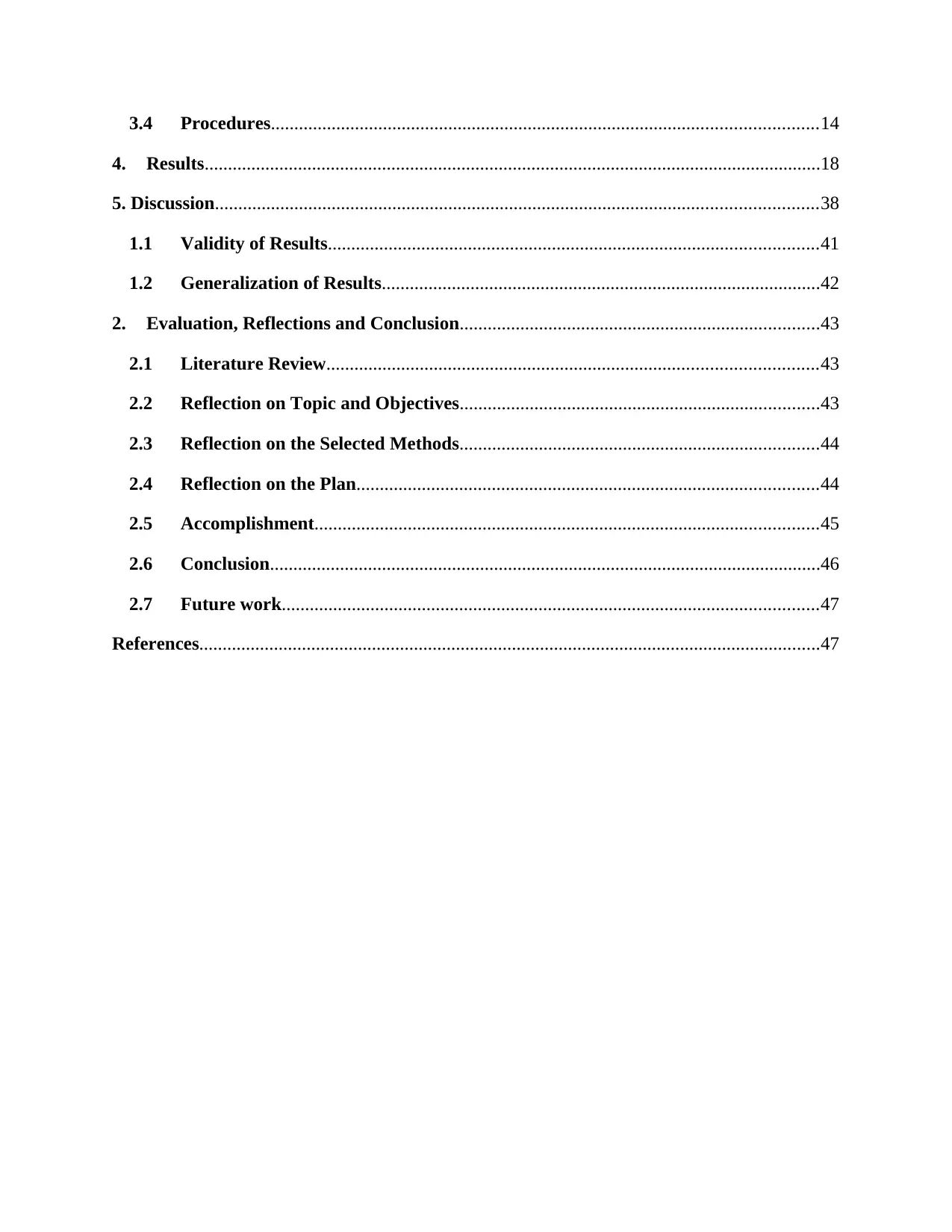
3.4 Procedures.....................................................................................................................14
4. Results....................................................................................................................................18
5. Discussion.................................................................................................................................38
1.1 Validity of Results.........................................................................................................41
1.2 Generalization of Results..............................................................................................42
2. Evaluation, Reflections and Conclusion.............................................................................43
2.1 Literature Review.........................................................................................................43
2.2 Reflection on Topic and Objectives.............................................................................43
2.3 Reflection on the Selected Methods.............................................................................44
2.4 Reflection on the Plan...................................................................................................44
2.5 Accomplishment............................................................................................................45
2.6 Conclusion......................................................................................................................46
2.7 Future work...................................................................................................................47
References.....................................................................................................................................47
4. Results....................................................................................................................................18
5. Discussion.................................................................................................................................38
1.1 Validity of Results.........................................................................................................41
1.2 Generalization of Results..............................................................................................42
2. Evaluation, Reflections and Conclusion.............................................................................43
2.1 Literature Review.........................................................................................................43
2.2 Reflection on Topic and Objectives.............................................................................43
2.3 Reflection on the Selected Methods.............................................................................44
2.4 Reflection on the Plan...................................................................................................44
2.5 Accomplishment............................................................................................................45
2.6 Conclusion......................................................................................................................46
2.7 Future work...................................................................................................................47
References.....................................................................................................................................47
Paraphrase This Document
Need a fresh take? Get an instant paraphrase of this document with our AI Paraphraser
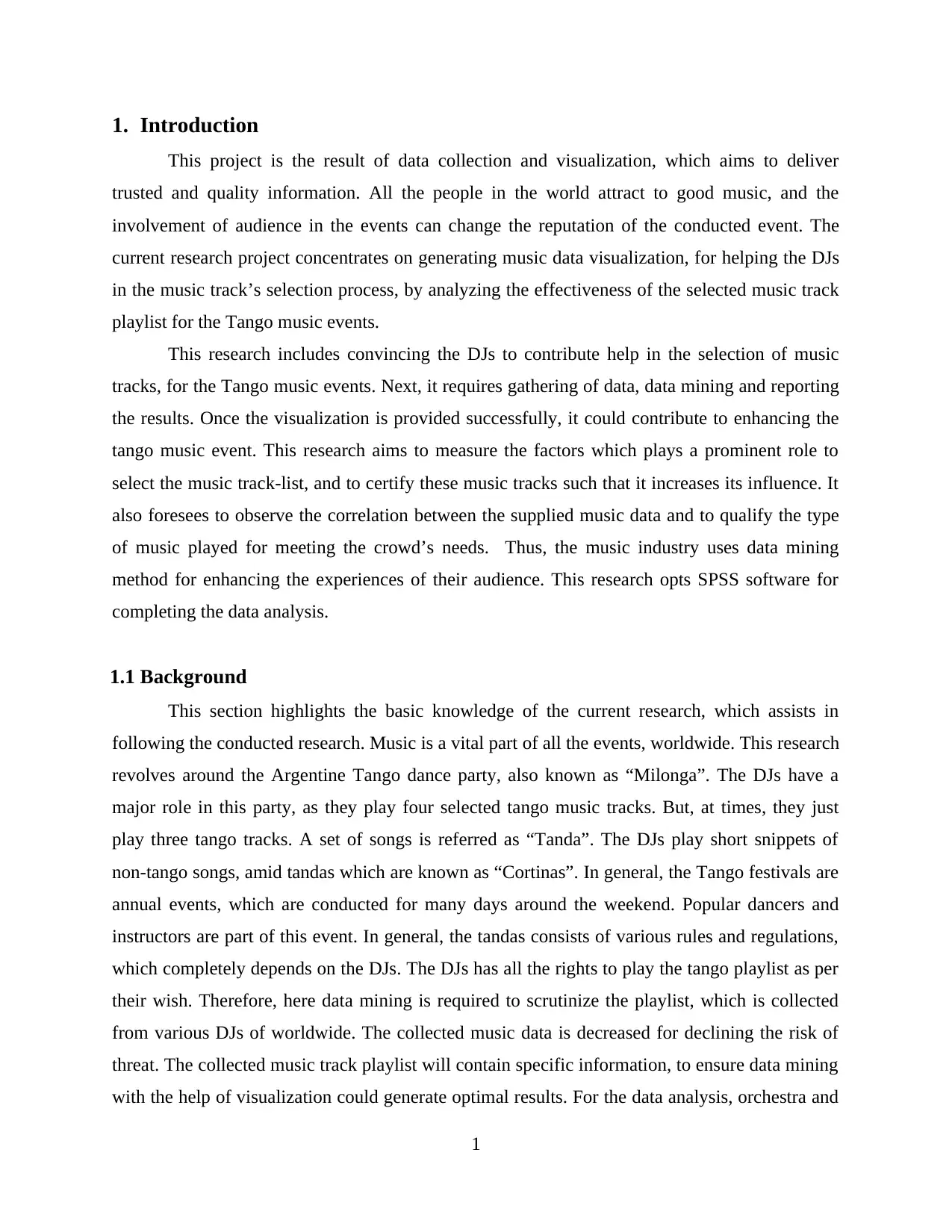
1. Introduction
This project is the result of data collection and visualization, which aims to deliver
trusted and quality information. All the people in the world attract to good music, and the
involvement of audience in the events can change the reputation of the conducted event. The
current research project concentrates on generating music data visualization, for helping the DJs
in the music track’s selection process, by analyzing the effectiveness of the selected music track
playlist for the Tango music events.
This research includes convincing the DJs to contribute help in the selection of music
tracks, for the Tango music events. Next, it requires gathering of data, data mining and reporting
the results. Once the visualization is provided successfully, it could contribute to enhancing the
tango music event. This research aims to measure the factors which plays a prominent role to
select the music track-list, and to certify these music tracks such that it increases its influence. It
also foresees to observe the correlation between the supplied music data and to qualify the type
of music played for meeting the crowd’s needs. Thus, the music industry uses data mining
method for enhancing the experiences of their audience. This research opts SPSS software for
completing the data analysis.
1.1 Background
This section highlights the basic knowledge of the current research, which assists in
following the conducted research. Music is a vital part of all the events, worldwide. This research
revolves around the Argentine Tango dance party, also known as “Milonga”. The DJs have a
major role in this party, as they play four selected tango music tracks. But, at times, they just
play three tango tracks. A set of songs is referred as “Tanda”. The DJs play short snippets of
non-tango songs, amid tandas which are known as “Cortinas”. In general, the Tango festivals are
annual events, which are conducted for many days around the weekend. Popular dancers and
instructors are part of this event. In general, the tandas consists of various rules and regulations,
which completely depends on the DJs. The DJs has all the rights to play the tango playlist as per
their wish. Therefore, here data mining is required to scrutinize the playlist, which is collected
from various DJs of worldwide. The collected music data is decreased for declining the risk of
threat. The collected music track playlist will contain specific information, to ensure data mining
with the help of visualization could generate optimal results. For the data analysis, orchestra and
1
This project is the result of data collection and visualization, which aims to deliver
trusted and quality information. All the people in the world attract to good music, and the
involvement of audience in the events can change the reputation of the conducted event. The
current research project concentrates on generating music data visualization, for helping the DJs
in the music track’s selection process, by analyzing the effectiveness of the selected music track
playlist for the Tango music events.
This research includes convincing the DJs to contribute help in the selection of music
tracks, for the Tango music events. Next, it requires gathering of data, data mining and reporting
the results. Once the visualization is provided successfully, it could contribute to enhancing the
tango music event. This research aims to measure the factors which plays a prominent role to
select the music track-list, and to certify these music tracks such that it increases its influence. It
also foresees to observe the correlation between the supplied music data and to qualify the type
of music played for meeting the crowd’s needs. Thus, the music industry uses data mining
method for enhancing the experiences of their audience. This research opts SPSS software for
completing the data analysis.
1.1 Background
This section highlights the basic knowledge of the current research, which assists in
following the conducted research. Music is a vital part of all the events, worldwide. This research
revolves around the Argentine Tango dance party, also known as “Milonga”. The DJs have a
major role in this party, as they play four selected tango music tracks. But, at times, they just
play three tango tracks. A set of songs is referred as “Tanda”. The DJs play short snippets of
non-tango songs, amid tandas which are known as “Cortinas”. In general, the Tango festivals are
annual events, which are conducted for many days around the weekend. Popular dancers and
instructors are part of this event. In general, the tandas consists of various rules and regulations,
which completely depends on the DJs. The DJs has all the rights to play the tango playlist as per
their wish. Therefore, here data mining is required to scrutinize the playlist, which is collected
from various DJs of worldwide. The collected music data is decreased for declining the risk of
threat. The collected music track playlist will contain specific information, to ensure data mining
with the help of visualization could generate optimal results. For the data analysis, orchestra and
1
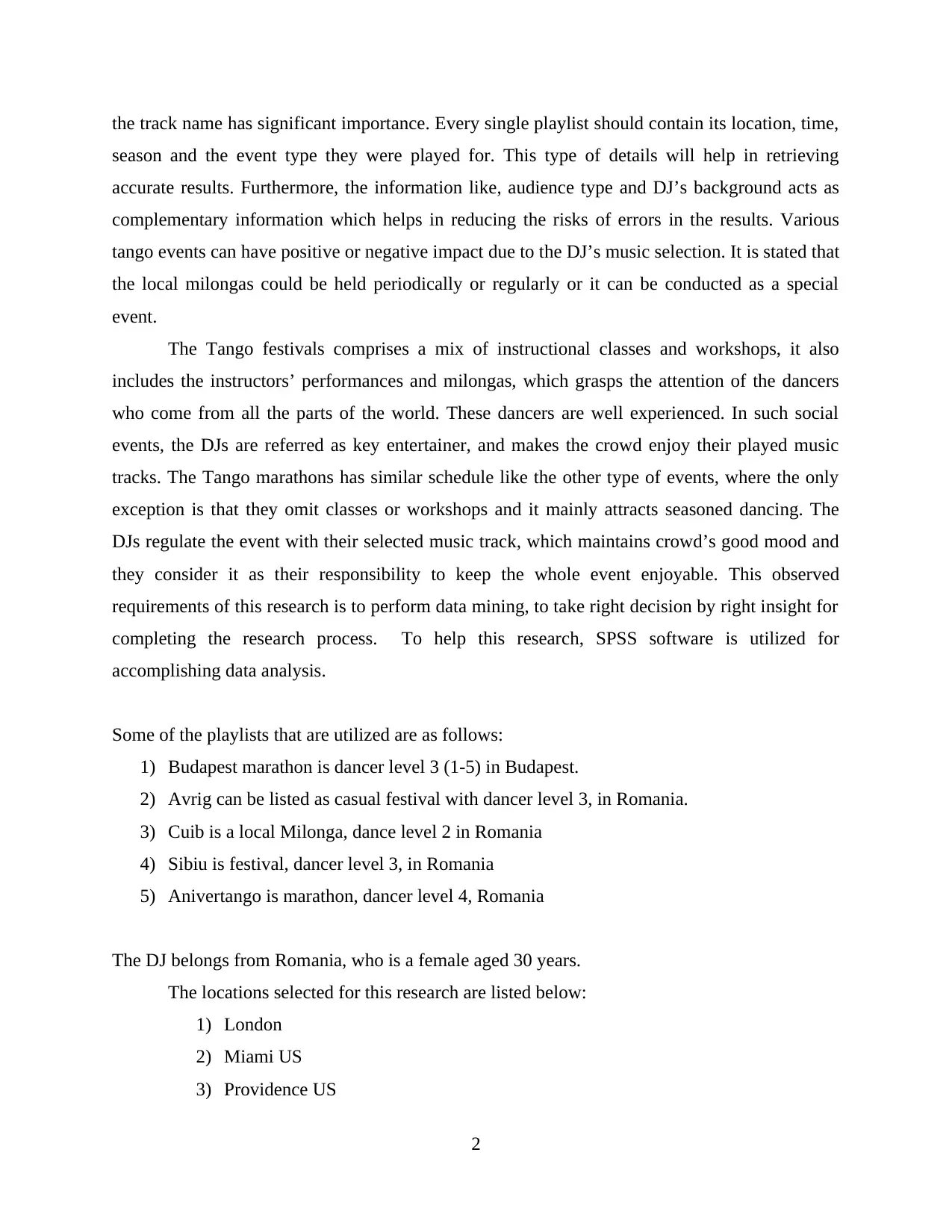
the track name has significant importance. Every single playlist should contain its location, time,
season and the event type they were played for. This type of details will help in retrieving
accurate results. Furthermore, the information like, audience type and DJ’s background acts as
complementary information which helps in reducing the risks of errors in the results. Various
tango events can have positive or negative impact due to the DJ’s music selection. It is stated that
the local milongas could be held periodically or regularly or it can be conducted as a special
event.
The Tango festivals comprises a mix of instructional classes and workshops, it also
includes the instructors’ performances and milongas, which grasps the attention of the dancers
who come from all the parts of the world. These dancers are well experienced. In such social
events, the DJs are referred as key entertainer, and makes the crowd enjoy their played music
tracks. The Tango marathons has similar schedule like the other type of events, where the only
exception is that they omit classes or workshops and it mainly attracts seasoned dancing. The
DJs regulate the event with their selected music track, which maintains crowd’s good mood and
they consider it as their responsibility to keep the whole event enjoyable. This observed
requirements of this research is to perform data mining, to take right decision by right insight for
completing the research process. To help this research, SPSS software is utilized for
accomplishing data analysis.
Some of the playlists that are utilized are as follows:
1) Budapest marathon is dancer level 3 (1-5) in Budapest.
2) Avrig can be listed as casual festival with dancer level 3, in Romania.
3) Cuib is a local Milonga, dance level 2 in Romania
4) Sibiu is festival, dancer level 3, in Romania
5) Anivertango is marathon, dancer level 4, Romania
The DJ belongs from Romania, who is a female aged 30 years.
The locations selected for this research are listed below:
1) London
2) Miami US
3) Providence US
2
season and the event type they were played for. This type of details will help in retrieving
accurate results. Furthermore, the information like, audience type and DJ’s background acts as
complementary information which helps in reducing the risks of errors in the results. Various
tango events can have positive or negative impact due to the DJ’s music selection. It is stated that
the local milongas could be held periodically or regularly or it can be conducted as a special
event.
The Tango festivals comprises a mix of instructional classes and workshops, it also
includes the instructors’ performances and milongas, which grasps the attention of the dancers
who come from all the parts of the world. These dancers are well experienced. In such social
events, the DJs are referred as key entertainer, and makes the crowd enjoy their played music
tracks. The Tango marathons has similar schedule like the other type of events, where the only
exception is that they omit classes or workshops and it mainly attracts seasoned dancing. The
DJs regulate the event with their selected music track, which maintains crowd’s good mood and
they consider it as their responsibility to keep the whole event enjoyable. This observed
requirements of this research is to perform data mining, to take right decision by right insight for
completing the research process. To help this research, SPSS software is utilized for
accomplishing data analysis.
Some of the playlists that are utilized are as follows:
1) Budapest marathon is dancer level 3 (1-5) in Budapest.
2) Avrig can be listed as casual festival with dancer level 3, in Romania.
3) Cuib is a local Milonga, dance level 2 in Romania
4) Sibiu is festival, dancer level 3, in Romania
5) Anivertango is marathon, dancer level 4, Romania
The DJ belongs from Romania, who is a female aged 30 years.
The locations selected for this research are listed below:
1) London
2) Miami US
3) Providence US
2
⊘ This is a preview!⊘
Do you want full access?
Subscribe today to unlock all pages.
Trusted by 1+ million students worldwide
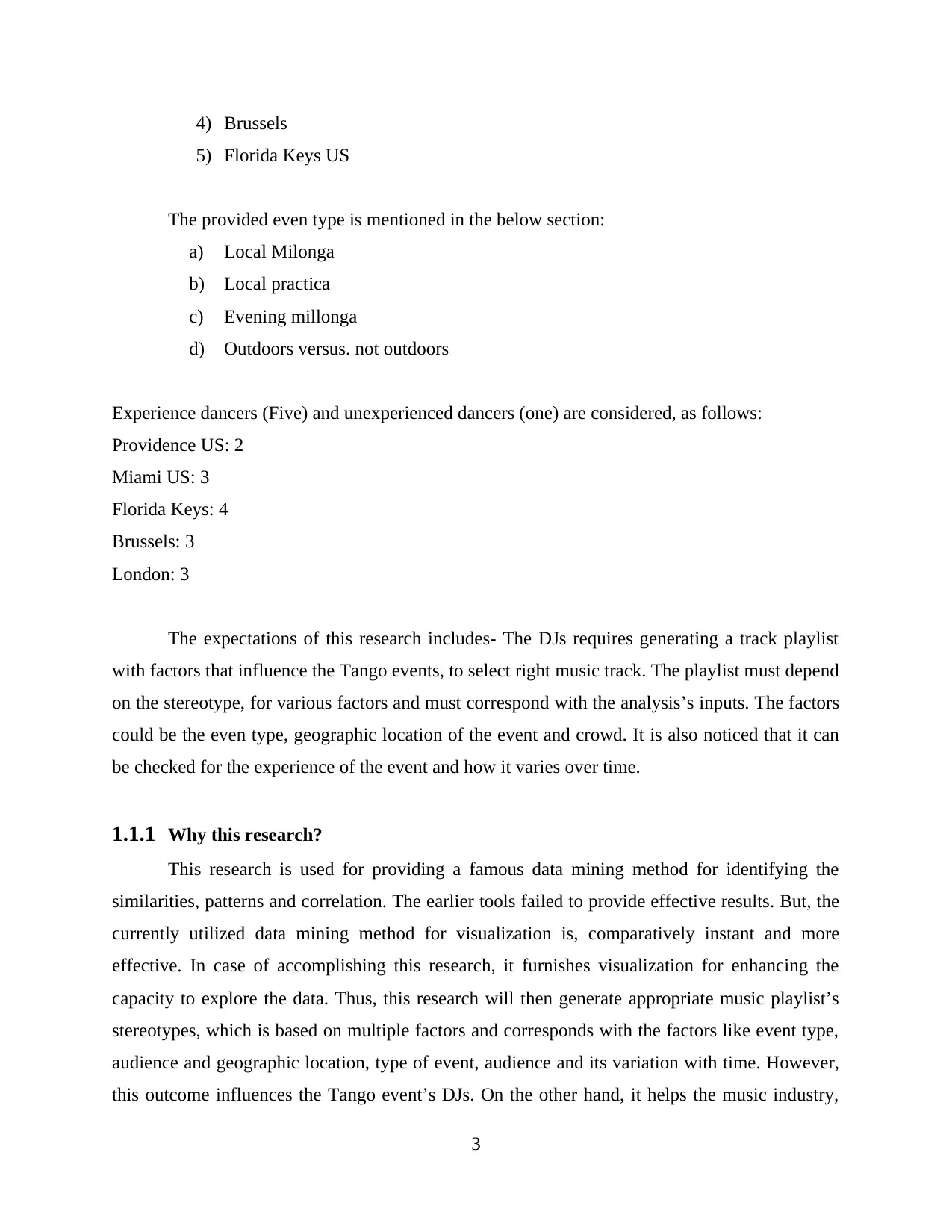
4) Brussels
5) Florida Keys US
The provided even type is mentioned in the below section:
a) Local Milonga
b) Local practica
c) Evening millonga
d) Outdoors versus. not outdoors
Experience dancers (Five) and unexperienced dancers (one) are considered, as follows:
Providence US: 2
Miami US: 3
Florida Keys: 4
Brussels: 3
London: 3
The expectations of this research includes- The DJs requires generating a track playlist
with factors that influence the Tango events, to select right music track. The playlist must depend
on the stereotype, for various factors and must correspond with the analysis’s inputs. The factors
could be the even type, geographic location of the event and crowd. It is also noticed that it can
be checked for the experience of the event and how it varies over time.
1.1.1 Why this research?
This research is used for providing a famous data mining method for identifying the
similarities, patterns and correlation. The earlier tools failed to provide effective results. But, the
currently utilized data mining method for visualization is, comparatively instant and more
effective. In case of accomplishing this research, it furnishes visualization for enhancing the
capacity to explore the data. Thus, this research will then generate appropriate music playlist’s
stereotypes, which is based on multiple factors and corresponds with the factors like event type,
audience and geographic location, type of event, audience and its variation with time. However,
this outcome influences the Tango event’s DJs. On the other hand, it helps the music industry,
3
5) Florida Keys US
The provided even type is mentioned in the below section:
a) Local Milonga
b) Local practica
c) Evening millonga
d) Outdoors versus. not outdoors
Experience dancers (Five) and unexperienced dancers (one) are considered, as follows:
Providence US: 2
Miami US: 3
Florida Keys: 4
Brussels: 3
London: 3
The expectations of this research includes- The DJs requires generating a track playlist
with factors that influence the Tango events, to select right music track. The playlist must depend
on the stereotype, for various factors and must correspond with the analysis’s inputs. The factors
could be the even type, geographic location of the event and crowd. It is also noticed that it can
be checked for the experience of the event and how it varies over time.
1.1.1 Why this research?
This research is used for providing a famous data mining method for identifying the
similarities, patterns and correlation. The earlier tools failed to provide effective results. But, the
currently utilized data mining method for visualization is, comparatively instant and more
effective. In case of accomplishing this research, it furnishes visualization for enhancing the
capacity to explore the data. Thus, this research will then generate appropriate music playlist’s
stereotypes, which is based on multiple factors and corresponds with the factors like event type,
audience and geographic location, type of event, audience and its variation with time. However,
this outcome influences the Tango event’s DJs. On the other hand, it helps the music industry,
3
Paraphrase This Document
Need a fresh take? Get an instant paraphrase of this document with our AI Paraphraser
which enhances experiences of the audience and in turn increases their profit. For added profit, it
is required that the music track must match the seasonal trend and place. And this requires
correlation, which can be found by data mining process. Further, it handles large data collection
and also identifies various patterns from it.
1.1.2 Information Visualization
Information Visualization is also known as InfoVis. It represents a type of study that has
visual representations of abstract data which could be numerical and non-numerical. For
instance, text or geographic information. Thus, this type of data helps to have interactivity, it also
provides clear understanding and it can identify the difficult data patterns. InfoVis is an online
source which is reachable to large number of research audience (Sindiy et al., 2013). It
effectively and instantly identifies the anomalies along with the data patterns. It is a tool
especially used for large dataset (Robertson and Kaptein, 2016).
1.2 Research Questions
The important question of this research is to resolve: “What can data analysis reveal from
the selection of music tracks by DJs in Tango music events and how?” Hence, this question’s
answer determines whether, the data analysis of the provided playlists being played in Tango
events- from DJs around the world, could help in enhancing it, then in tango event which factors
could influence the track selection and in which degree. The patterns are clarified based on data
analysis tool.
1.3 Why did I choose the Project
For visualization, music data is an interesting platform. My personal opinion on
visualization can help to improvise the data for conveying and to present to the analysts for
easing their work. On the other hand, it has the flexibility to visually recognize and manipulate
the data, by addition and removal of new insights on the data. Tango events are very popular and
it includes contribution of various DJs from different parts of the world, for gathering the music
track playlist/ data. In contains various events and with different crowd. Satisfaction of the
crowd, by entertaining them is the ultimate goal of this event. If the crowd is not satisfied then it
4
is required that the music track must match the seasonal trend and place. And this requires
correlation, which can be found by data mining process. Further, it handles large data collection
and also identifies various patterns from it.
1.1.2 Information Visualization
Information Visualization is also known as InfoVis. It represents a type of study that has
visual representations of abstract data which could be numerical and non-numerical. For
instance, text or geographic information. Thus, this type of data helps to have interactivity, it also
provides clear understanding and it can identify the difficult data patterns. InfoVis is an online
source which is reachable to large number of research audience (Sindiy et al., 2013). It
effectively and instantly identifies the anomalies along with the data patterns. It is a tool
especially used for large dataset (Robertson and Kaptein, 2016).
1.2 Research Questions
The important question of this research is to resolve: “What can data analysis reveal from
the selection of music tracks by DJs in Tango music events and how?” Hence, this question’s
answer determines whether, the data analysis of the provided playlists being played in Tango
events- from DJs around the world, could help in enhancing it, then in tango event which factors
could influence the track selection and in which degree. The patterns are clarified based on data
analysis tool.
1.3 Why did I choose the Project
For visualization, music data is an interesting platform. My personal opinion on
visualization can help to improvise the data for conveying and to present to the analysts for
easing their work. On the other hand, it has the flexibility to visually recognize and manipulate
the data, by addition and removal of new insights on the data. Tango events are very popular and
it includes contribution of various DJs from different parts of the world, for gathering the music
track playlist/ data. In contains various events and with different crowd. Satisfaction of the
crowd, by entertaining them is the ultimate goal of this event. If the crowd is not satisfied then it
4
can decline the popularity of the tango events. Thus, music data visualization is a challenging
task for the researcher.
1.4 Beneficiaries
This research includes the following groups of people as beneficiaries of this study:
1) The Tango dancers are the first group, who will find the information of this
research more informative.
2) The next group includes, the worldwide DJs for the Tango events. As, this
research considers the DJs’ major task i.e., music track list of the event for
ensuring the crowd to retain their dancing mood. On the other hand, this research
can also help them to play these tracks in various events, in different parts of the
world.
3) The final group refers to the sociologists, who will be informed about how the
DJs in different occasion attempt to assume the crowd in the events. The obtained
results will interest to know about various inspiring factors for the DJs’ to select
the music by considering the sociological patterns such as, continent, type of
event and dancing level. Collaboration with sociologist and the data analysis
results can conclude the sociological considerations.
Eventually, this research should provide music data visualization.
1.5 Products of this Research
The current research’s product is a visualization, which projects visual data mining
methods for enabling selection of music tracks, based on certain sociological considerations.
1.6 Research Objectives
This research’s key objective is to measure the factors that has a major role in selecting
the music track list, and to certify these music tracks in a way that it has higher influence, from
the scope of Data Analysis. It also foresees to identify the correlation between the supplied music
data; then find answers for when, where, to whom and by who; and to qualify the type of music
played for entertaining the crowd based on different sociological factors like different crowd,
different place and different event.
5
task for the researcher.
1.4 Beneficiaries
This research includes the following groups of people as beneficiaries of this study:
1) The Tango dancers are the first group, who will find the information of this
research more informative.
2) The next group includes, the worldwide DJs for the Tango events. As, this
research considers the DJs’ major task i.e., music track list of the event for
ensuring the crowd to retain their dancing mood. On the other hand, this research
can also help them to play these tracks in various events, in different parts of the
world.
3) The final group refers to the sociologists, who will be informed about how the
DJs in different occasion attempt to assume the crowd in the events. The obtained
results will interest to know about various inspiring factors for the DJs’ to select
the music by considering the sociological patterns such as, continent, type of
event and dancing level. Collaboration with sociologist and the data analysis
results can conclude the sociological considerations.
Eventually, this research should provide music data visualization.
1.5 Products of this Research
The current research’s product is a visualization, which projects visual data mining
methods for enabling selection of music tracks, based on certain sociological considerations.
1.6 Research Objectives
This research’s key objective is to measure the factors that has a major role in selecting
the music track list, and to certify these music tracks in a way that it has higher influence, from
the scope of Data Analysis. It also foresees to identify the correlation between the supplied music
data; then find answers for when, where, to whom and by who; and to qualify the type of music
played for entertaining the crowd based on different sociological factors like different crowd,
different place and different event.
5
⊘ This is a preview!⊘
Do you want full access?
Subscribe today to unlock all pages.
Trusted by 1+ million students worldwide
The related requirements to meet the research objective (RO) are listed below:
RO1: How does the preferences change over time?
RO2: Find the region which will probably begin with a new trend?
RO3: Determine the duration for the average lifecycle of a hit i.e., from peak to
decay?
RO4: Identify the highly played orchestras in all the continents?
RO5: How will the dance tempo impact the event from beginning to end?
RO6: Recognize the most often or highly played music tracks in all the continents
and how are these tracks compared?
RO7: Does there exists any pattern for music track selection based on the event
type or day?
RO8: Mention the resemblance or differences of track selection, from different
DJs of different parts of the world?
The other objectives are:
i. Collect enough track playlists from different DJs present in various parts of
the world.
ii. Perform data processing using data analysis (i.e., data mining through
visualization), which answers the research question.
iii. Determine the research beneficiaries.
iv. Identify the limitations of the research.
v. Design visualization solution.
vi. Implement visualization solution.
vii. Evaluate the results.
viii. Provide reflections of the conducted research.
1.7 Scope and Definition
This study concentrates on visualization, like how one or more visualizations could be
improved and support the DJs around the world, for the tango events to select the effective track
playlist. The prototype will concentrate on selecting the track playlist, and to certify these tracks
in with high influence, using Data Analysis. This research considers visualization based on
different sociological factors like different crowd, different place and different event, to find the
6
RO1: How does the preferences change over time?
RO2: Find the region which will probably begin with a new trend?
RO3: Determine the duration for the average lifecycle of a hit i.e., from peak to
decay?
RO4: Identify the highly played orchestras in all the continents?
RO5: How will the dance tempo impact the event from beginning to end?
RO6: Recognize the most often or highly played music tracks in all the continents
and how are these tracks compared?
RO7: Does there exists any pattern for music track selection based on the event
type or day?
RO8: Mention the resemblance or differences of track selection, from different
DJs of different parts of the world?
The other objectives are:
i. Collect enough track playlists from different DJs present in various parts of
the world.
ii. Perform data processing using data analysis (i.e., data mining through
visualization), which answers the research question.
iii. Determine the research beneficiaries.
iv. Identify the limitations of the research.
v. Design visualization solution.
vi. Implement visualization solution.
vii. Evaluate the results.
viii. Provide reflections of the conducted research.
1.7 Scope and Definition
This study concentrates on visualization, like how one or more visualizations could be
improved and support the DJs around the world, for the tango events to select the effective track
playlist. The prototype will concentrate on selecting the track playlist, and to certify these tracks
in with high influence, using Data Analysis. This research considers visualization based on
different sociological factors like different crowd, different place and different event, to find the
6
Paraphrase This Document
Need a fresh take? Get an instant paraphrase of this document with our AI Paraphraser
correlation between the provided music data and to qualify the music to be played for satisfying
the crowd.
1.8 Methods
The current research requires problem-driven research approach, because it helps in
resolving the real-world issues. The music track selection is also a real-time event which requires
lot of working, as it could be challenging to meet certain circumstances like the geographical
area, different crowd and different event. The event must have appropriate music, which matches
needs of the place, crowd and event.
To perform data analysis, SPSS software is utilized in the current research. For data or
playlist processing, data mining method is used for gathering data. Because, it has the capacity to
handle handles large data and also recognizes various patterns from the data collection. This
research requires finding the correlation among the gathered data, which is easy with data
mining. The correlation attempts to find the match with seasonal trend and location of the event,
for enhancing the experiences of the audience.
Once the data is collected, data cleaning takes place. As the received playlists from the
DJs of different parts of the world will not have same required format. Thus, data cleaning
amends the format of the gathered data, which recovers the missing elements. The gathered data
is visualized by data visualization. Then data analysis is performed with Data Visualisation, to
increase the capacity to recognize the influencing factors, for music track selection. The method
like TF-IDF (term frequency–inverse document frequency) efficiently supports information
retrieval. It helps the process like text mining that acts as a weighting factor. This research uses
text mining as the music track playlists are in the format of text file. The research answers are
revealed by combining the elements and its frequencies.
1.8.1 Software Development Methodology
Any field requires effective method, which changes from time to time. Similarly,
appropriate selection of music track is also important for the music event organizers.
Development requires implementing an effective methodology. This research’s objective is to
develop music data visualization prototype. Later, using this prototype, a software will be
developed to help the beneficiaries. The prototypes are developed in small divisions, where
every single division is an iteration or iterative prototyping that contains a new set of prototypes.
7
the crowd.
1.8 Methods
The current research requires problem-driven research approach, because it helps in
resolving the real-world issues. The music track selection is also a real-time event which requires
lot of working, as it could be challenging to meet certain circumstances like the geographical
area, different crowd and different event. The event must have appropriate music, which matches
needs of the place, crowd and event.
To perform data analysis, SPSS software is utilized in the current research. For data or
playlist processing, data mining method is used for gathering data. Because, it has the capacity to
handle handles large data and also recognizes various patterns from the data collection. This
research requires finding the correlation among the gathered data, which is easy with data
mining. The correlation attempts to find the match with seasonal trend and location of the event,
for enhancing the experiences of the audience.
Once the data is collected, data cleaning takes place. As the received playlists from the
DJs of different parts of the world will not have same required format. Thus, data cleaning
amends the format of the gathered data, which recovers the missing elements. The gathered data
is visualized by data visualization. Then data analysis is performed with Data Visualisation, to
increase the capacity to recognize the influencing factors, for music track selection. The method
like TF-IDF (term frequency–inverse document frequency) efficiently supports information
retrieval. It helps the process like text mining that acts as a weighting factor. This research uses
text mining as the music track playlists are in the format of text file. The research answers are
revealed by combining the elements and its frequencies.
1.8.1 Software Development Methodology
Any field requires effective method, which changes from time to time. Similarly,
appropriate selection of music track is also important for the music event organizers.
Development requires implementing an effective methodology. This research’s objective is to
develop music data visualization prototype. Later, using this prototype, a software will be
developed to help the beneficiaries. The prototypes are developed in small divisions, where
every single division is an iteration or iterative prototyping that contains a new set of prototypes.
7
All these prototypes are first developed and approved by the professionals. Various prototypes
are initially designed by the developers, for refining the best prototype. However, it is time
consuming and difficult, but it is the best way to meet the desired results.
1.9 Testing the Objectives
For ensuring the right answer for the research question, it is essential to meet all the
objectives of the research. The answer can be retrieved by the researcher, just by having a clear
picture of the issues related to data exploration, for identifying the requirements. The identified
requirements are utilized for designing and implementing the prototype, with the help of data
mining methodology. For ensuring to test the research question, it is necessary that the designed
prototype must meet the identified requirements and implement the paradigm of data
exploration. Finally, the prototype is utilized for answering the research question. The objective
of the test is to evaluate the prototype’s capabilities for visual data mining, when compared to the
present screener which hardly has any capabilities to perform visual data mining.
1.10 Structure of Dissertation
Chapter 1 is the introduction of the dissertation about the research. This chapter provides
the background of the overall research, where it describes the reason for establishing this
research and its objective, where a list of research objectives for the research are listed. This
section also sheds light on the scope, methods and beneficiaries of the research.
Chapter 2 includes critical context, which is an overview of the approaches, visual
analytics and visual data mining.
Chapter 3 revolves around the methods used in the research. This chapter helps in clearly
understanding the methods used, research procedure, and the participants of the research. The
stepwise methods implemented in the research are studied. The importance of the implemented
methods are determined in this section.
Chapter 4 projects the results of the research. The research questions are answered in this
section. The execution results are represented clearly. This chapter is a significant part of the
dissertation, which displays the results of the conducted research using the SPSS software.
Chapter 5 ensures discussion of all the acquired results. The determined results are
discussed briefly in this part of the dissertation. All the research questions are answered, based
8
are initially designed by the developers, for refining the best prototype. However, it is time
consuming and difficult, but it is the best way to meet the desired results.
1.9 Testing the Objectives
For ensuring the right answer for the research question, it is essential to meet all the
objectives of the research. The answer can be retrieved by the researcher, just by having a clear
picture of the issues related to data exploration, for identifying the requirements. The identified
requirements are utilized for designing and implementing the prototype, with the help of data
mining methodology. For ensuring to test the research question, it is necessary that the designed
prototype must meet the identified requirements and implement the paradigm of data
exploration. Finally, the prototype is utilized for answering the research question. The objective
of the test is to evaluate the prototype’s capabilities for visual data mining, when compared to the
present screener which hardly has any capabilities to perform visual data mining.
1.10 Structure of Dissertation
Chapter 1 is the introduction of the dissertation about the research. This chapter provides
the background of the overall research, where it describes the reason for establishing this
research and its objective, where a list of research objectives for the research are listed. This
section also sheds light on the scope, methods and beneficiaries of the research.
Chapter 2 includes critical context, which is an overview of the approaches, visual
analytics and visual data mining.
Chapter 3 revolves around the methods used in the research. This chapter helps in clearly
understanding the methods used, research procedure, and the participants of the research. The
stepwise methods implemented in the research are studied. The importance of the implemented
methods are determined in this section.
Chapter 4 projects the results of the research. The research questions are answered in this
section. The execution results are represented clearly. This chapter is a significant part of the
dissertation, which displays the results of the conducted research using the SPSS software.
Chapter 5 ensures discussion of all the acquired results. The determined results are
discussed briefly in this part of the dissertation. All the research questions are answered, based
8
⊘ This is a preview!⊘
Do you want full access?
Subscribe today to unlock all pages.
Trusted by 1+ million students worldwide

1 out of 52


Related Documents


Your All-in-One AI-Powered Toolkit for Academic Success.
+13062052269
info@desklib.com
Available 24*7 on WhatsApp / Email
![[object Object]](/_next/static/media/star-bottom.7253800d.svg)
Unlock your academic potential
Copyright © 2020–2026 A2Z Services. All Rights Reserved. Developed and managed by ZUCOL.