PHE 630: Limiting Tobacco Related Illness Through Targeted Approach
VerifiedAdded on 2023/06/18
|10
|2306
|183
Project
AI Summary
This project proposal outlines a public health program aimed at limiting tobacco-related illnesses in the US through a targeted approach. It addresses the increasing tobacco consumption and its severe health impacts, focusing on strategies such as advertising bans, smoking restrictions, and taxation. The project identifies key research questions related to tobacco-related illnesses, reasons for increased tobacco use, and effective healthcare interventions. The evaluation methodology includes process and outcome evaluations, utilizing quantitative research methods for data collection and analysis. The proposal also discusses impact and formative evaluation methods, emphasizing the importance of measuring program effectiveness and making early improvements. The appendix includes detailed process evaluation strategies and outcome evaluation methods.
Proposal project
Table of Contents
Table of Contents

Paraphrase This Document
Need a fresh take? Get an instant paraphrase of this document with our AI Paraphraser
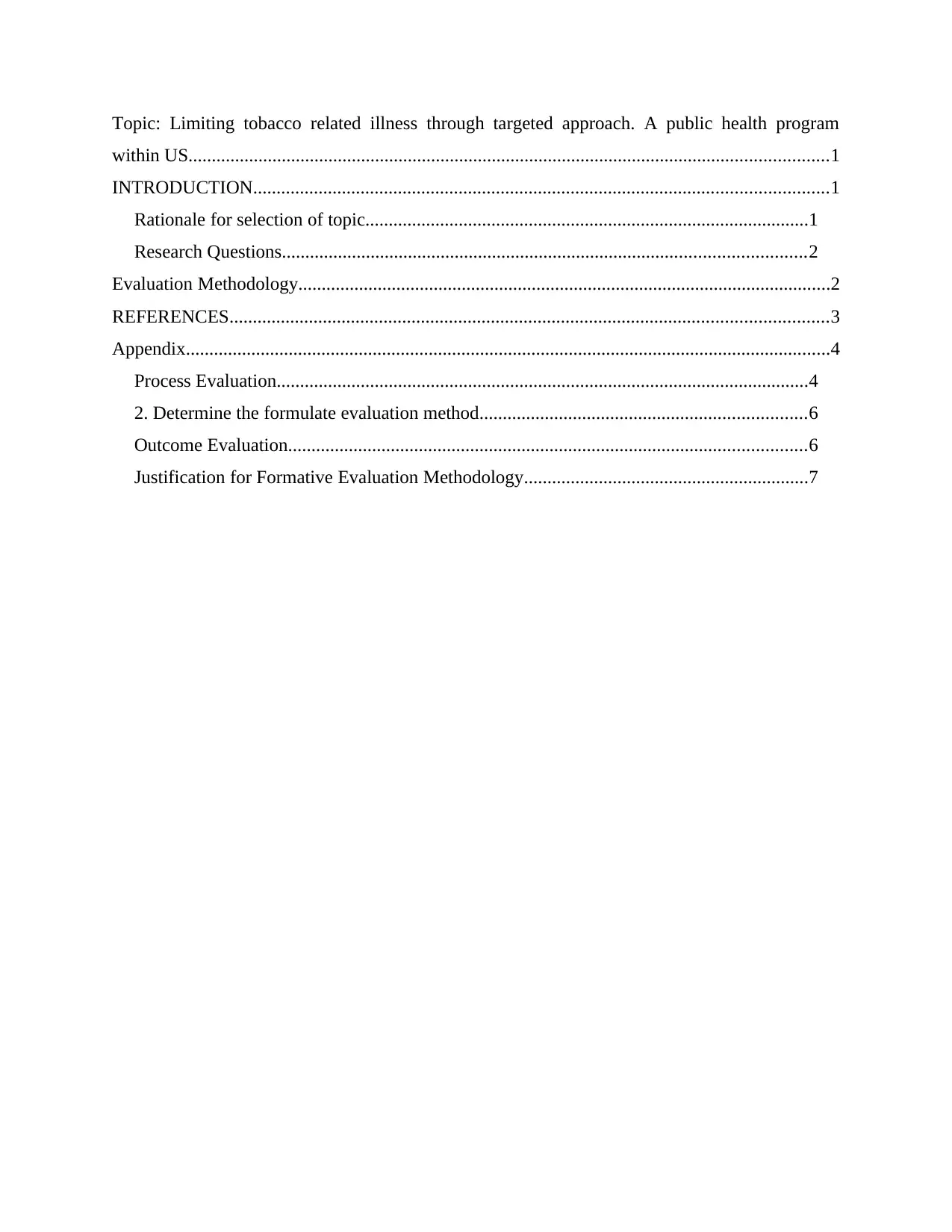
Topic: Limiting tobacco related illness through targeted approach. A public health program
within US.........................................................................................................................................1
INTRODUCTION...........................................................................................................................1
Rationale for selection of topic...............................................................................................1
Research Questions................................................................................................................2
Evaluation Methodology..................................................................................................................2
REFERENCES................................................................................................................................3
Appendix..........................................................................................................................................4
Process Evaluation..................................................................................................................4
2. Determine the formulate evaluation method......................................................................6
Outcome Evaluation...............................................................................................................6
Justification for Formative Evaluation Methodology.............................................................7
within US.........................................................................................................................................1
INTRODUCTION...........................................................................................................................1
Rationale for selection of topic...............................................................................................1
Research Questions................................................................................................................2
Evaluation Methodology..................................................................................................................2
REFERENCES................................................................................................................................3
Appendix..........................................................................................................................................4
Process Evaluation..................................................................................................................4
2. Determine the formulate evaluation method......................................................................6
Outcome Evaluation...............................................................................................................6
Justification for Formative Evaluation Methodology.............................................................7
Topic: Limiting tobacco related illness through targeted approach. A public
health program within US.
INTRODUCTION
It has been analysed and seen that the Tobacco consumption is rapidly increasing within the
modern society that is having a very severe impact on the health and overall development of
individuals within the society (Kachroo, Burch-Smith and Grant, 2021). It has been seen that the
Cigarette smoking is the most common form of the tobacco that is causing the cancer, heart
diseases, stroke and other lung diseases and diabetes together with chronic obstructive
pulmonary disease (COPD), which includes emphysema and chronic bronchitis. Thus, it has
become vital and important for government of all nations and political leaders as well as the
overall society to have a check and limit the consumption of tobacco to keep a check and control
in the tobacco related illness. It has been also seen and analysed that the total ban on tobacco
advertising and its promotion along with leading restrictions on smoking in public places and
sustaining a higher increase in tobacco taxation are effective ways to control tobacco intake
(Bashore and Hobbie, 2021). Thus, current project aim and focus at analysing and identifying the
tobacco related illness along with limiting and having check on these through target approach.
Aim
The main of current study is, “To analysis about the effective ways and strategies that can
be adopted within health care sector and society to limit the tobacco related illness through
targeted approach.” A public health program within US.
Objective
To analysis about the tobacco related illness.
To identify about the main reason and factors that are leading increase in
consumption of tobacco within youth and adults of US.
To investigate about effective ways that can be adopted by Health care sector of
US for Limiting tobacco related illness through having a targeted approach.
Rationale for selection of topic
The selection and choosing of the current topic based on Limiting tobacco related illness
through targeted approach is rationale as in take and high consumption of tobacco has become a
most vital issue and problem within the society of US that is having many adverse impact on the
1
health program within US.
INTRODUCTION
It has been analysed and seen that the Tobacco consumption is rapidly increasing within the
modern society that is having a very severe impact on the health and overall development of
individuals within the society (Kachroo, Burch-Smith and Grant, 2021). It has been seen that the
Cigarette smoking is the most common form of the tobacco that is causing the cancer, heart
diseases, stroke and other lung diseases and diabetes together with chronic obstructive
pulmonary disease (COPD), which includes emphysema and chronic bronchitis. Thus, it has
become vital and important for government of all nations and political leaders as well as the
overall society to have a check and limit the consumption of tobacco to keep a check and control
in the tobacco related illness. It has been also seen and analysed that the total ban on tobacco
advertising and its promotion along with leading restrictions on smoking in public places and
sustaining a higher increase in tobacco taxation are effective ways to control tobacco intake
(Bashore and Hobbie, 2021). Thus, current project aim and focus at analysing and identifying the
tobacco related illness along with limiting and having check on these through target approach.
Aim
The main of current study is, “To analysis about the effective ways and strategies that can
be adopted within health care sector and society to limit the tobacco related illness through
targeted approach.” A public health program within US.
Objective
To analysis about the tobacco related illness.
To identify about the main reason and factors that are leading increase in
consumption of tobacco within youth and adults of US.
To investigate about effective ways that can be adopted by Health care sector of
US for Limiting tobacco related illness through having a targeted approach.
Rationale for selection of topic
The selection and choosing of the current topic based on Limiting tobacco related illness
through targeted approach is rationale as in take and high consumption of tobacco has become a
most vital issue and problem within the society of US that is having many adverse impact on the
1
⊘ This is a preview!⊘
Do you want full access?
Subscribe today to unlock all pages.

Trusted by 1+ million students worldwide
health of the individuals. It has been also seen and analysed that the continuous intake and
consumption of tobacco causes many serious illness and even death and also hampers and reduce
the productivity and strength of the society. Thus, selection of the current topic is rationale that
focus on the limiting the tobacco related illness. Future, the chosen topic also meets the personal
interest of the researcher and supports improved development of skill and knowledge.
Research Questions
what are the main tobacco related illness exits within the society of US?
Which could be the main reason and factors that are leading increase in consumption of
tobacco within youth and adults of US?
What are the effective ways that can be adopted by Health care sector of US for Limiting
tobacco related illness through having a targeted approach?
Evaluation Methodology
It has been seen and analysed that there are various types of evaluation methods that needs
to be conducted to over a program life cycle. The main types and forms of the evaluation
methodology are discussed and provided as below:
Process evaluation- It is used and related with the measuring the activities of the program
and tend to related with the program quality and who are the target audience to whom which it is
reaching. Use of process evaluation is rationale is it helps to answer the questions such as the
project has reached the target group or not along with effective implementation of the set
objectives and aim (Glasser and Roberts, 2021).
Impact evaluation- The use and implication of the impact evaluation is mainly made to
measure the immediate effect of the program and it is tending to align with the programmes
objectives. Further, the use of the impact evaluation is rationale and significant with the
programmes to measure the programs objective and its objective are achieved or not through
emphasising on the desired short term changes (Xiong and et. al., 2021).
Outcome evaluation- The outcome evaluation is mainly related and concerned with the long
term effect of the programme that are generally tend to use and measures the long term success
and goal of a project. Further, implication of the outcome evaluation is effective and rationale to
measures and analysis about the results and outcome that how the program goals and set
objective has been achieved.
2
consumption of tobacco causes many serious illness and even death and also hampers and reduce
the productivity and strength of the society. Thus, selection of the current topic is rationale that
focus on the limiting the tobacco related illness. Future, the chosen topic also meets the personal
interest of the researcher and supports improved development of skill and knowledge.
Research Questions
what are the main tobacco related illness exits within the society of US?
Which could be the main reason and factors that are leading increase in consumption of
tobacco within youth and adults of US?
What are the effective ways that can be adopted by Health care sector of US for Limiting
tobacco related illness through having a targeted approach?
Evaluation Methodology
It has been seen and analysed that there are various types of evaluation methods that needs
to be conducted to over a program life cycle. The main types and forms of the evaluation
methodology are discussed and provided as below:
Process evaluation- It is used and related with the measuring the activities of the program
and tend to related with the program quality and who are the target audience to whom which it is
reaching. Use of process evaluation is rationale is it helps to answer the questions such as the
project has reached the target group or not along with effective implementation of the set
objectives and aim (Glasser and Roberts, 2021).
Impact evaluation- The use and implication of the impact evaluation is mainly made to
measure the immediate effect of the program and it is tending to align with the programmes
objectives. Further, the use of the impact evaluation is rationale and significant with the
programmes to measure the programs objective and its objective are achieved or not through
emphasising on the desired short term changes (Xiong and et. al., 2021).
Outcome evaluation- The outcome evaluation is mainly related and concerned with the long
term effect of the programme that are generally tend to use and measures the long term success
and goal of a project. Further, implication of the outcome evaluation is effective and rationale to
measures and analysis about the results and outcome that how the program goals and set
objective has been achieved.
2
Paraphrase This Document
Need a fresh take? Get an instant paraphrase of this document with our AI Paraphraser
Summative evaluation- It is basically take place at the end of the programme that may also
take as valuable to conduct the summative evaluation of the programme that comprises of
possible implement of the programme and its setting. Further, the summative evaluation is
rationale with the peer based programmes as help in determining the program setting along with
emphasising on the recommendations that are evolved out of the program (Crettez and Deloche,
2021).
With respect to the current health based programme on the topic of limiting tobacco related
illness through targeted approach implication of the process and outcome evaluation has been
made.
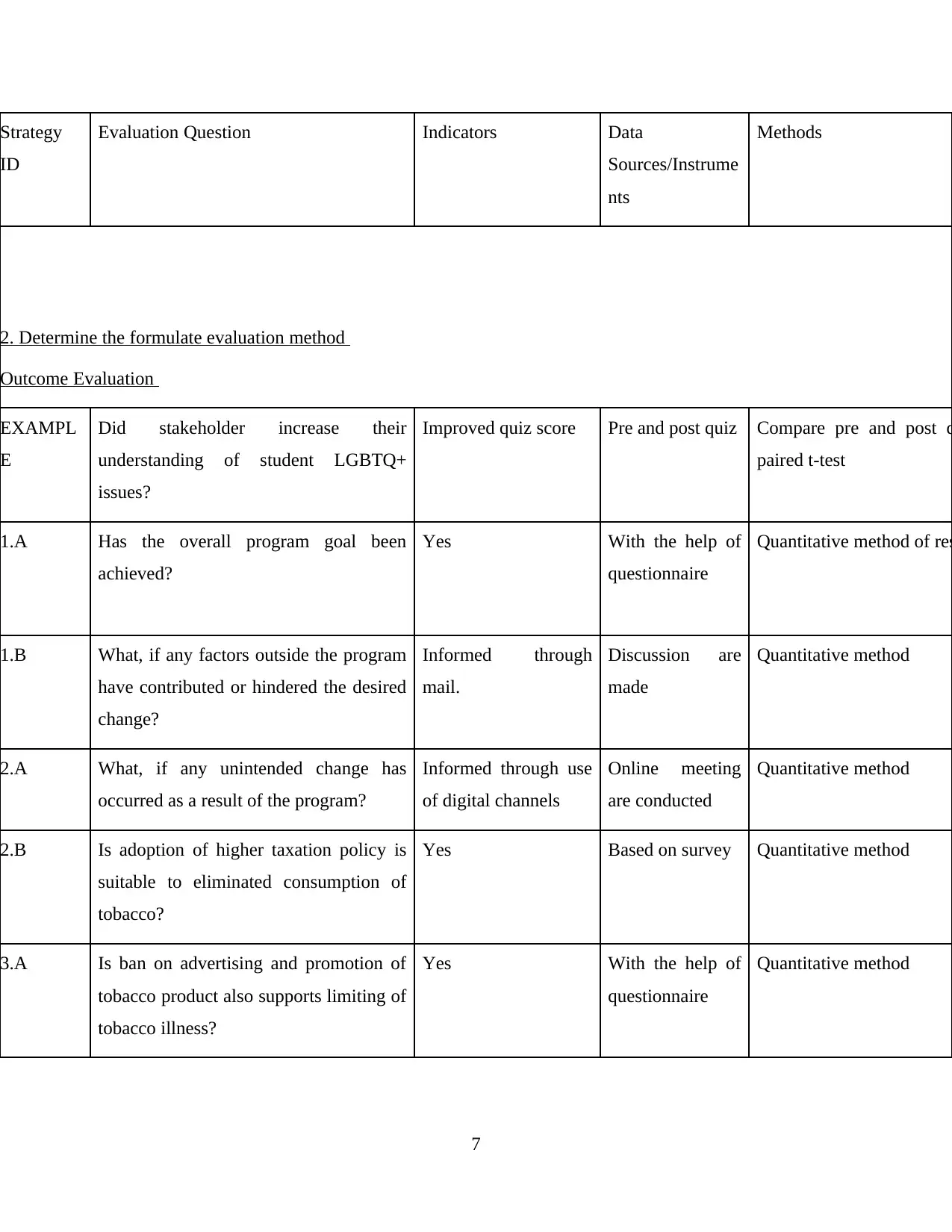
The process evaluation tend to provide an effective step to step process to achieve and
accomplish the set objective. Based on the process evaluation the research method that has been
used within current study comprises of positivity philosophy that supports a more systematic and
practical nature of investigation. Along with this, deductive approach of the program has been
also applied to have better scanning and testing of the collected facts (Feng, Hu and Orji, 2021).
A further description about the data collection and analysis techniques has been provided below:
Data collection- Use of the quantitative nature of research method has been made for
collection of data. It is rationale and justifiable as it supports easy collection of facts in numeric
terms through the help of questionnaire that is more time and cost efficient to collect and present.
Along with this, measurable set of results and better analysis and presentation of facts is also
supported by the use of quantitative nature of method.
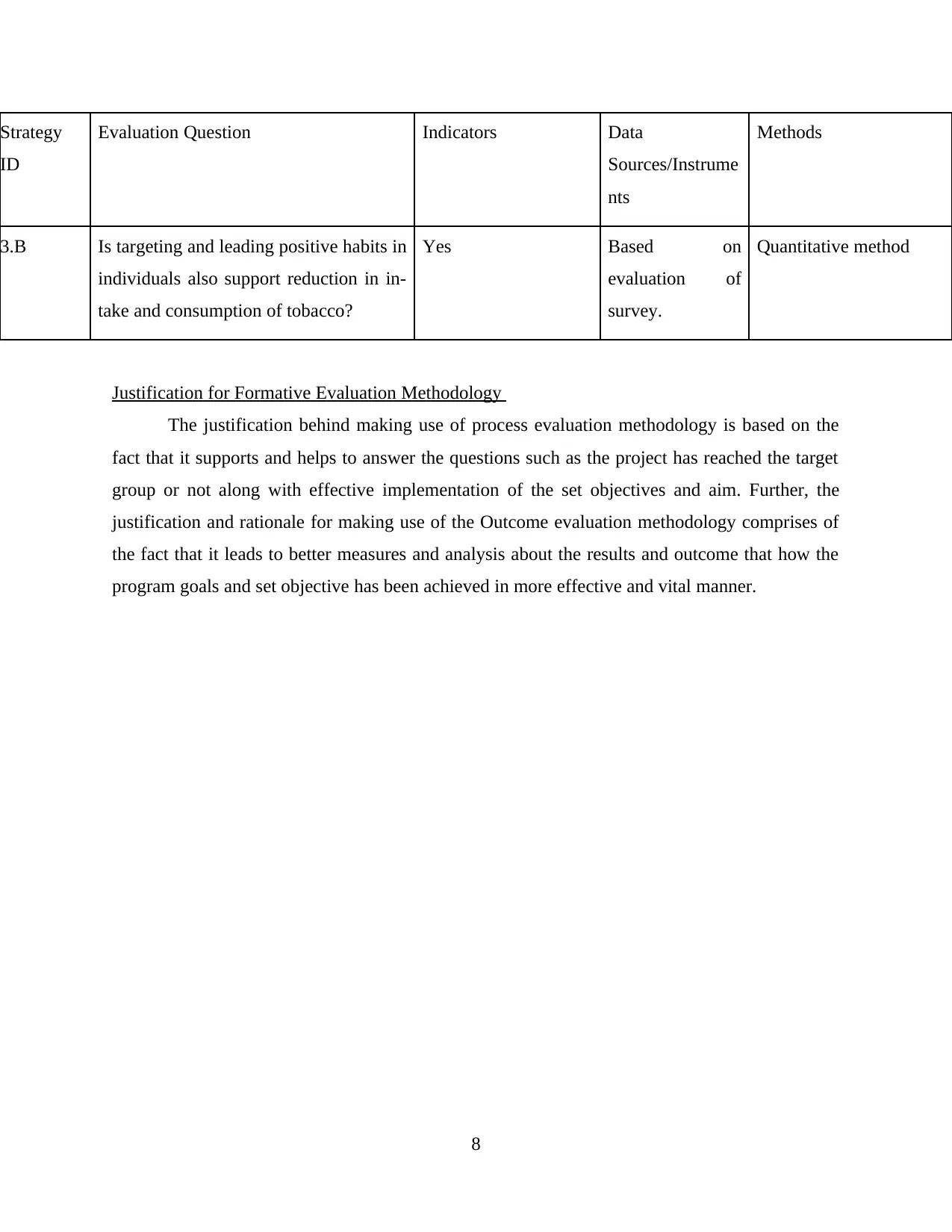
Further, with respect to current health programme implication of the outcome evaluation has
been made that comprises of the key results and outcome of current proposal (Zimpeck and et.
al., 2021). The main finding of current study would comprises of the better understanding about
the tobacco and its related illness along with identifying the effective ways that can be adopted
by Health care sector of US for Limiting tobacco related illness through having a targeted
approach.
Impact evaluation method
The impact evaluation method comprises of the three main questions i.e. descriptive,
causal and evaluative that are provided as below:
How well has the current project achieved its objectives as well as the sub-
objectives?
3
take as valuable to conduct the summative evaluation of the programme that comprises of
possible implement of the programme and its setting. Further, the summative evaluation is
rationale with the peer based programmes as help in determining the program setting along with
emphasising on the recommendations that are evolved out of the program (Crettez and Deloche,
2021).
With respect to the current health based programme on the topic of limiting tobacco related
illness through targeted approach implication of the process and outcome evaluation has been
made.
The process evaluation tend to provide an effective step to step process to achieve and
accomplish the set objective. Based on the process evaluation the research method that has been
used within current study comprises of positivity philosophy that supports a more systematic and
practical nature of investigation. Along with this, deductive approach of the program has been
also applied to have better scanning and testing of the collected facts (Feng, Hu and Orji, 2021).
A further description about the data collection and analysis techniques has been provided below:
Data collection- Use of the quantitative nature of research method has been made for
collection of data. It is rationale and justifiable as it supports easy collection of facts in numeric
terms through the help of questionnaire that is more time and cost efficient to collect and present.
Along with this, measurable set of results and better analysis and presentation of facts is also
supported by the use of quantitative nature of method.
Further, with respect to current health programme implication of the outcome evaluation has
been made that comprises of the key results and outcome of current proposal (Zimpeck and et.
al., 2021). The main finding of current study would comprises of the better understanding about
the tobacco and its related illness along with identifying the effective ways that can be adopted
by Health care sector of US for Limiting tobacco related illness through having a targeted
approach.
Impact evaluation method
The impact evaluation method comprises of the three main questions i.e. descriptive,
causal and evaluative that are provided as below:
How well has the current project achieved its objectives as well as the sub-
objectives?
3
How well have the desired short term changes been achieved?
Impact evaluation justification
The justification and rationale for the use of the impact evaluation comprises of the factor
that Impact evaluation effectively measures the program effectiveness along with immediate
analysis after the completion of the program and up to six months after the completion of the
program.
Formative evaluation method
The formative evaluation method tends to comprises of the Evaluation of a program
during development in order to make early improvements along with also helps to refine or
improve a program. The main questions and strategies involved within formative evaluation
method are provided as below:
How well is the program being delivered?
What strategies can we use to improve this program?
The use of the formative evaluation method is rationale at the starting of a new program that
supports improved assistance in the early phase of the program development.
REFERENCES
Books and journal
Kachroo, P., Burch-Smith, T.M. and Grant, M., 2021. An Emerging Role for Chloroplasts in
Disease and Defense. Annual Review of Phytopathology, 59, pp.423-445.
Glasser, A.M. and Roberts, M.E., 2021. Retailer density reduction approaches to tobacco control:
a review. Health & place, 67, p.102342.
Xiong, S. and et. al., 2021. Perspectives and perceived barriers to pharmacist-prescribed tobacco
cessation services in the community pharmacy setting. Journal of the American
Pharmacists Association.
Crettez, B. and Deloche, R., 2021. Time-inconsistent preferences and the minimum legal tobacco
consuming age. Rationality and Society, 33(2), pp.176-195.
Feng, B., Hu, X. and Orji, I.J., 2021. Multi-tier supply chain sustainability in the pulp and paper
industry: a framework and evaluation methodology. International Journal of Production
Research, pp.1-27.
4
Impact evaluation justification
The justification and rationale for the use of the impact evaluation comprises of the factor
that Impact evaluation effectively measures the program effectiveness along with immediate
analysis after the completion of the program and up to six months after the completion of the
program.
Formative evaluation method
The formative evaluation method tends to comprises of the Evaluation of a program
during development in order to make early improvements along with also helps to refine or
improve a program. The main questions and strategies involved within formative evaluation
method are provided as below:
How well is the program being delivered?
What strategies can we use to improve this program?
The use of the formative evaluation method is rationale at the starting of a new program that
supports improved assistance in the early phase of the program development.
REFERENCES
Books and journal
Kachroo, P., Burch-Smith, T.M. and Grant, M., 2021. An Emerging Role for Chloroplasts in
Disease and Defense. Annual Review of Phytopathology, 59, pp.423-445.
Glasser, A.M. and Roberts, M.E., 2021. Retailer density reduction approaches to tobacco control:
a review. Health & place, 67, p.102342.
Xiong, S. and et. al., 2021. Perspectives and perceived barriers to pharmacist-prescribed tobacco
cessation services in the community pharmacy setting. Journal of the American
Pharmacists Association.
Crettez, B. and Deloche, R., 2021. Time-inconsistent preferences and the minimum legal tobacco
consuming age. Rationality and Society, 33(2), pp.176-195.
Feng, B., Hu, X. and Orji, I.J., 2021. Multi-tier supply chain sustainability in the pulp and paper
industry: a framework and evaluation methodology. International Journal of Production
Research, pp.1-27.
4
⊘ This is a preview!⊘
Do you want full access?
Subscribe today to unlock all pages.
Trusted by 1+ million students worldwide
Zimpeck, A. and et. al., 2021. Evaluation Methodology. In Mitigating Process Variability and
Soft Errors at Circuit-Level for FinFETs (pp. 73-79). Springer, Cham.
Bashore, L. and Hobbie, W., 2021, June. Emerging and Ongoing Survivorship Challenges
Among Childhood Cancer Survivors and Providing Risk-Based Focused Follow-Up
Care. In Seminars in Oncology Nursing (p. 151163). WB Saunders.
Appendix
Process Evaluation
Strategy
ID
Evaluation Question Indicators Data
Sources/Instrume
nts
Methods
EXAMPL
E
Did the stakeholders receive the
education materials?
Confirmation of mail
received
US postal service
mail receipt and
Excel
spreadsheet
listing each
stakeholder
When receive a mail recei
of materials in Excel spr
stakeholder and provid
received
1.A Is program is reaching the audience Yes through g-mail. Questionnaire
has been used as
instrument that is
mailed to the
stakeholders.
Use of quantitative res
survey strategy is made
1.B Are all project activities reaching all
parts of the target group?
Yes. through g-mail. Questionnaire
has been used as
instrument that is
mailed to the
stakeholders.
Use of quantitative res
survey strategy is made
5
Soft Errors at Circuit-Level for FinFETs (pp. 73-79). Springer, Cham.
Bashore, L. and Hobbie, W., 2021, June. Emerging and Ongoing Survivorship Challenges
Among Childhood Cancer Survivors and Providing Risk-Based Focused Follow-Up
Care. In Seminars in Oncology Nursing (p. 151163). WB Saunders.
Appendix
Process Evaluation
Strategy
ID
Evaluation Question Indicators Data
Sources/Instrume
nts
Methods
EXAMPL
E
Did the stakeholders receive the
education materials?
Confirmation of mail
received
US postal service
mail receipt and
Excel
spreadsheet
listing each
stakeholder
When receive a mail recei
of materials in Excel spr
stakeholder and provid
received
1.A Is program is reaching the audience Yes through g-mail. Questionnaire
has been used as
instrument that is
mailed to the
stakeholders.
Use of quantitative res
survey strategy is made
1.B Are all project activities reaching all
parts of the target group?
Yes. through g-mail. Questionnaire
has been used as
instrument that is
mailed to the
stakeholders.
Use of quantitative res
survey strategy is made
5
Paraphrase This Document
Need a fresh take? Get an instant paraphrase of this document with our AI Paraphraser
Strategy
ID
Evaluation Question Indicators Data
Sources/Instrume
nts
Methods
2.A Are participants and other key
stakeholders satisfied with all aspects of
the project?
Yes. It has been
checked through g-
mail.
Questionnaire
has been used as
instrument that is
mailed to the
stakeholders.
Use of quantitative res
survey strategy is made
2.B Are all activities being implemented as
intended? If not why?
Yes. Questionnaire
has been used as
instrument that is
mailed to the
stakeholders.
Use of quantitative res
survey strategy is made
3.A What if any changes have been made to
intended activities?
If any change is made
it has been discussed
with the participants
through g-mail.
Questionnaire
has been used as
instrument that is
mailed to the
stakeholders.
Use of quantitative res
survey strategy is made
3.B Are all materials, information and
presentations suitable for the target
audience?
Yes. . Questionnaire
has been used as
instrument that is
mailed to the
stakeholders.
Use of quantitative res
survey strategy is made
Strategy
ID
Evaluation Question Indicators Data Sources /
Instruments
Methods
6
ID
Evaluation Question Indicators Data
Sources/Instrume
nts
Methods
2.A Are participants and other key
stakeholders satisfied with all aspects of
the project?
Yes. It has been
checked through g-
mail.
Questionnaire
has been used as
instrument that is
mailed to the
stakeholders.
Use of quantitative res
survey strategy is made
2.B Are all activities being implemented as
intended? If not why?
Yes. Questionnaire
has been used as
instrument that is
mailed to the
stakeholders.
Use of quantitative res
survey strategy is made
3.A What if any changes have been made to
intended activities?
If any change is made
it has been discussed
with the participants
through g-mail.
Questionnaire
has been used as
instrument that is
mailed to the
stakeholders.
Use of quantitative res
survey strategy is made
3.B Are all materials, information and
presentations suitable for the target
audience?
Yes. . Questionnaire
has been used as
instrument that is
mailed to the
stakeholders.
Use of quantitative res
survey strategy is made
Strategy
ID
Evaluation Question Indicators Data Sources /
Instruments
Methods
6
Strategy
ID
Evaluation Question Indicators Data
Sources/Instrume
nts
Methods
2. Determine the formulate evaluation method
Outcome Evaluation
EXAMPL
E
Did stakeholder increase their
understanding of student LGBTQ+
issues?
Improved quiz score Pre and post quiz Compare pre and post q
paired t-test
1.A Has the overall program goal been
achieved?
Yes With the help of
questionnaire
Quantitative method of res
1.B What, if any factors outside the program
have contributed or hindered the desired
change?
Informed through
mail.
Discussion are
made
Quantitative method
2.A What, if any unintended change has
occurred as a result of the program?
Informed through use
of digital channels
Online meeting
are conducted
Quantitative method
2.B Is adoption of higher taxation policy is
suitable to eliminated consumption of
tobacco?
Yes Based on survey Quantitative method
3.A Is ban on advertising and promotion of
tobacco product also supports limiting of
tobacco illness?
Yes With the help of
questionnaire
Quantitative method
7
ID
Evaluation Question Indicators Data
Sources/Instrume
nts
Methods
2. Determine the formulate evaluation method
Outcome Evaluation
EXAMPL
E
Did stakeholder increase their
understanding of student LGBTQ+
issues?
Improved quiz score Pre and post quiz Compare pre and post q
paired t-test
1.A Has the overall program goal been
achieved?
Yes With the help of
questionnaire
Quantitative method of res
1.B What, if any factors outside the program
have contributed or hindered the desired
change?
Informed through
mail.
Discussion are
made
Quantitative method
2.A What, if any unintended change has
occurred as a result of the program?
Informed through use
of digital channels
Online meeting
are conducted
Quantitative method
2.B Is adoption of higher taxation policy is
suitable to eliminated consumption of
tobacco?
Yes Based on survey Quantitative method
3.A Is ban on advertising and promotion of
tobacco product also supports limiting of
tobacco illness?
Yes With the help of
questionnaire
Quantitative method
7
⊘ This is a preview!⊘
Do you want full access?
Subscribe today to unlock all pages.
Trusted by 1+ million students worldwide
Strategy
ID
Evaluation Question Indicators Data
Sources/Instrume
nts
Methods
3.B Is targeting and leading positive habits in
individuals also support reduction in in-
take and consumption of tobacco?
Yes Based on
evaluation of
survey.
Quantitative method
Justification for Formative Evaluation Methodology
The justification behind making use of process evaluation methodology is based on the
fact that it supports and helps to answer the questions such as the project has reached the target
group or not along with effective implementation of the set objectives and aim. Further, the
justification and rationale for making use of the Outcome evaluation methodology comprises of
the fact that it leads to better measures and analysis about the results and outcome that how the
program goals and set objective has been achieved in more effective and vital manner.
8
ID
Evaluation Question Indicators Data
Sources/Instrume
nts
Methods
3.B Is targeting and leading positive habits in
individuals also support reduction in in-
take and consumption of tobacco?
Yes Based on
evaluation of
survey.
Quantitative method
Justification for Formative Evaluation Methodology
The justification behind making use of process evaluation methodology is based on the
fact that it supports and helps to answer the questions such as the project has reached the target
group or not along with effective implementation of the set objectives and aim. Further, the
justification and rationale for making use of the Outcome evaluation methodology comprises of
the fact that it leads to better measures and analysis about the results and outcome that how the
program goals and set objective has been achieved in more effective and vital manner.
8

1 out of 10


Related Documents


Your All-in-One AI-Powered Toolkit for Academic Success.
+13062052269
info@desklib.com
Available 24*7 on WhatsApp / Email
![[object Object]](/_next/static/media/star-bottom.7253800d.svg)
Unlock your academic potential
Copyright © 2020–2026 A2Z Services. All Rights Reserved. Developed and managed by ZUCOL.