Analyzing TBLT Frameworks (Willis & Ellis) and Designing a Lesson Plan
VerifiedAdded on 2020/05/16
|9
|1312
|468
Report
AI Summary
This report offers a comprehensive analysis of task-based language teaching (TBLT), comparing and contrasting the frameworks proposed by Jane Willis and Rod Ellis. It begins by outlining the key stages of each model – pre-task, task cycle, and language focus for Willis; and pre-task, during task, and post-task for Ellis – highlighting similarities and differences, with a focus on Ellis' framework's emphasis on communication. The core of the report is a detailed lesson plan designed for first-year undergraduate students, utilizing Ellis' framework. The lesson, centered on the portrayal of globalization and its cultural influence in newspapers, includes pre-task activities to introduce vocabulary and concepts, during-task activities involving reading, image analysis, and video viewing, and post-task activities for reflection and discussion. The lesson also incorporates a student survey and graph to analyze student preferences for TBLT. The report demonstrates how TBLT can be applied to enhance language learning through real-world tasks and engagement with current issues, such as globalization.
Running head: TASK-BASED LANGUAGE TEACHING
Task-based language teaching
Name of the University
Name of the Student
Author note
Task-based language teaching
Name of the University
Name of the Student
Author note
Paraphrase This Document
Need a fresh take? Get an instant paraphrase of this document with our AI Paraphraser

1
TASK-BASED LANGUAGE TEACHING
Task 1: Comparing and contrasting Willis’ and Ellis’ Framework for Task-based Learning
In 1996, Jane Willis came up with an innovative framework for task-based language
teaching. In the model, she incorporated three stages of learning – pre-task, task cycle and
language focus. Later, in 2003, Rod Ellis introduced a modified version of the model and
established another framework. His model also had three stages that included pre-task, during
task and post-task. It can be observed that both Willis’ and Ellis’ TBLT framework have similar
stages of teaching. In the first stage of Willis’ model, the teacher discovers the topic emphasizes
helpful words and phrases and then learners are taught with examples. The task cycle stage
provides learners the chance to carry out actual world tasks with the teacher monitoring them.
The last stage that is language focus lays stress on language traits utilized during previous two
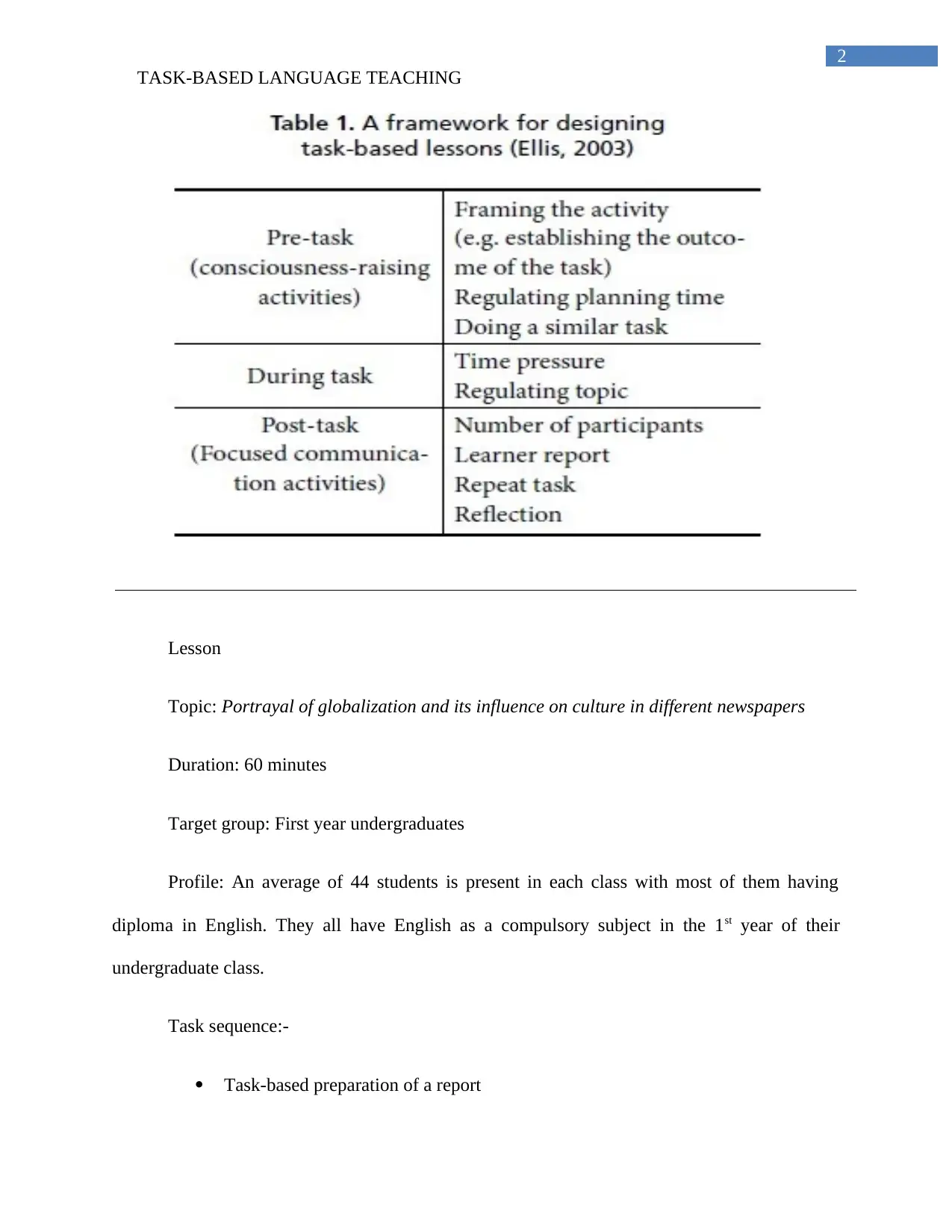
stages (Hung, 2014). On the other hand, the first stage of Ellis’ model is characterized by
activities for consciousness elevating. Then, the second stage involves regulating the topic. The
last stage of Ellis’ model is characterized by communication activities where students reflect on
what they have learned. Thus, it is evident that although both models have certain similarities,
Ellis’ model gives a better opportunity for students to be involved on a deeper level (Ellis, 2013).
Communication activities are laid more stress in Ellis’ model that was missing from Willis’
framework.
Task 2: Designing lesson for TBLT using Ellis’ framework
The following lesson is designed for first-year undergraduate students using the Ellis’
framework for Task-based language teaching.
TASK-BASED LANGUAGE TEACHING
Task 1: Comparing and contrasting Willis’ and Ellis’ Framework for Task-based Learning
In 1996, Jane Willis came up with an innovative framework for task-based language
teaching. In the model, she incorporated three stages of learning – pre-task, task cycle and
language focus. Later, in 2003, Rod Ellis introduced a modified version of the model and
established another framework. His model also had three stages that included pre-task, during
task and post-task. It can be observed that both Willis’ and Ellis’ TBLT framework have similar
stages of teaching. In the first stage of Willis’ model, the teacher discovers the topic emphasizes
helpful words and phrases and then learners are taught with examples. The task cycle stage
provides learners the chance to carry out actual world tasks with the teacher monitoring them.
The last stage that is language focus lays stress on language traits utilized during previous two
stages (Hung, 2014). On the other hand, the first stage of Ellis’ model is characterized by
activities for consciousness elevating. Then, the second stage involves regulating the topic. The
last stage of Ellis’ model is characterized by communication activities where students reflect on
what they have learned. Thus, it is evident that although both models have certain similarities,
Ellis’ model gives a better opportunity for students to be involved on a deeper level (Ellis, 2013).
Communication activities are laid more stress in Ellis’ model that was missing from Willis’
framework.
Task 2: Designing lesson for TBLT using Ellis’ framework
The following lesson is designed for first-year undergraduate students using the Ellis’
framework for Task-based language teaching.

2
TASK-BASED LANGUAGE TEACHING
Lesson
Topic: Portrayal of globalization and its influence on culture in different newspapers
Duration: 60 minutes
Target group: First year undergraduates
Profile: An average of 44 students is present in each class with most of them having
diploma in English. They all have English as a compulsory subject in the 1st year of their
undergraduate class.
Task sequence:-
Task-based preparation of a report
TASK-BASED LANGUAGE TEACHING
Lesson
Topic: Portrayal of globalization and its influence on culture in different newspapers
Duration: 60 minutes
Target group: First year undergraduates
Profile: An average of 44 students is present in each class with most of them having
diploma in English. They all have English as a compulsory subject in the 1st year of their
undergraduate class.
Task sequence:-
Task-based preparation of a report
⊘ This is a preview!⊘
Do you want full access?
Subscribe today to unlock all pages.

Trusted by 1+ million students worldwide

3
TASK-BASED LANGUAGE TEACHING
Speaking on the topic
Listening to peers
Pre-Task
Students will be introduced to the topic and the tasks that follow
Task objective: To reveal to the students, the topic of globalization and expose them to the terms
and phrases related to it. It must be remembered that new terms and phrases should be introduced
to the students.
1. Show images of people of different nationalities shaking hands, flags of two countries
together in a frame and more such images. Ask the students if they recognize any of the
faces or the flags. Read out articles from ‘The Guardian’ and ‘The New York Times’ and
then explain it by drawing images of cultural differences in the blackboard. Videos
containing information related to different cultures may also be used. Ask the students
whether they have any idea about the visuals shown.
2. Categorize students into two separate groups – Group 1 and Group 2 – and assign them
the task to bring articles with pictures on cultural practices published in two leading
dailies of UK and US. Group 1 should bring articles from UK dailies and magazines
while Group 2 shall gather articles from US dailies.
3. Each group then will assemble and discuss the issues they found on the articles and the
meaning of the pictures. They will then be asked to identify the similarities and
differences between the content of the article published in the newspapers of both
countries and write those down.
TASK-BASED LANGUAGE TEACHING
Speaking on the topic
Listening to peers
Pre-Task
Students will be introduced to the topic and the tasks that follow
Task objective: To reveal to the students, the topic of globalization and expose them to the terms
and phrases related to it. It must be remembered that new terms and phrases should be introduced
to the students.
1. Show images of people of different nationalities shaking hands, flags of two countries
together in a frame and more such images. Ask the students if they recognize any of the
faces or the flags. Read out articles from ‘The Guardian’ and ‘The New York Times’ and
then explain it by drawing images of cultural differences in the blackboard. Videos
containing information related to different cultures may also be used. Ask the students
whether they have any idea about the visuals shown.
2. Categorize students into two separate groups – Group 1 and Group 2 – and assign them
the task to bring articles with pictures on cultural practices published in two leading
dailies of UK and US. Group 1 should bring articles from UK dailies and magazines
while Group 2 shall gather articles from US dailies.
3. Each group then will assemble and discuss the issues they found on the articles and the
meaning of the pictures. They will then be asked to identify the similarities and
differences between the content of the article published in the newspapers of both
countries and write those down.
Paraphrase This Document
Need a fresh take? Get an instant paraphrase of this document with our AI Paraphraser

4
TASK-BASED LANGUAGE TEACHING
4. Ask them to role-play as reporters and news anchors presenting news story on the impact
of cultural variations in international relations.
5. Reveal the task, ‘Globalization and its impact on culture as portrayed in different
newspapers’, finding similarities and differences. The task is similar to what they have
just finished doing with the addition that they will now have to verbally explain these in
English. Remember not to force them into speaking perfectly at the very beginning, as
this would make them nervous. Let them go with the flow and explain in ways with
which they are comfortable.
During Task
This stage involves four activities:
1. Reading newspaper articles on globalization and its influence on culture
2. Collecting images relating to the topic and pasting them alongside the notes
3. Watching video on culture and globalization and its portrayal in different media
4. Sharing the experience in the class with teacher and fellow students
TASK-BASED LANGUAGE TEACHING
4. Ask them to role-play as reporters and news anchors presenting news story on the impact
of cultural variations in international relations.
5. Reveal the task, ‘Globalization and its impact on culture as portrayed in different
newspapers’, finding similarities and differences. The task is similar to what they have
just finished doing with the addition that they will now have to verbally explain these in
English. Remember not to force them into speaking perfectly at the very beginning, as
this would make them nervous. Let them go with the flow and explain in ways with
which they are comfortable.
During Task
This stage involves four activities:
1. Reading newspaper articles on globalization and its influence on culture
2. Collecting images relating to the topic and pasting them alongside the notes
3. Watching video on culture and globalization and its portrayal in different media
4. Sharing the experience in the class with teacher and fellow students

5
TASK-BASED LANGUAGE TEACHING
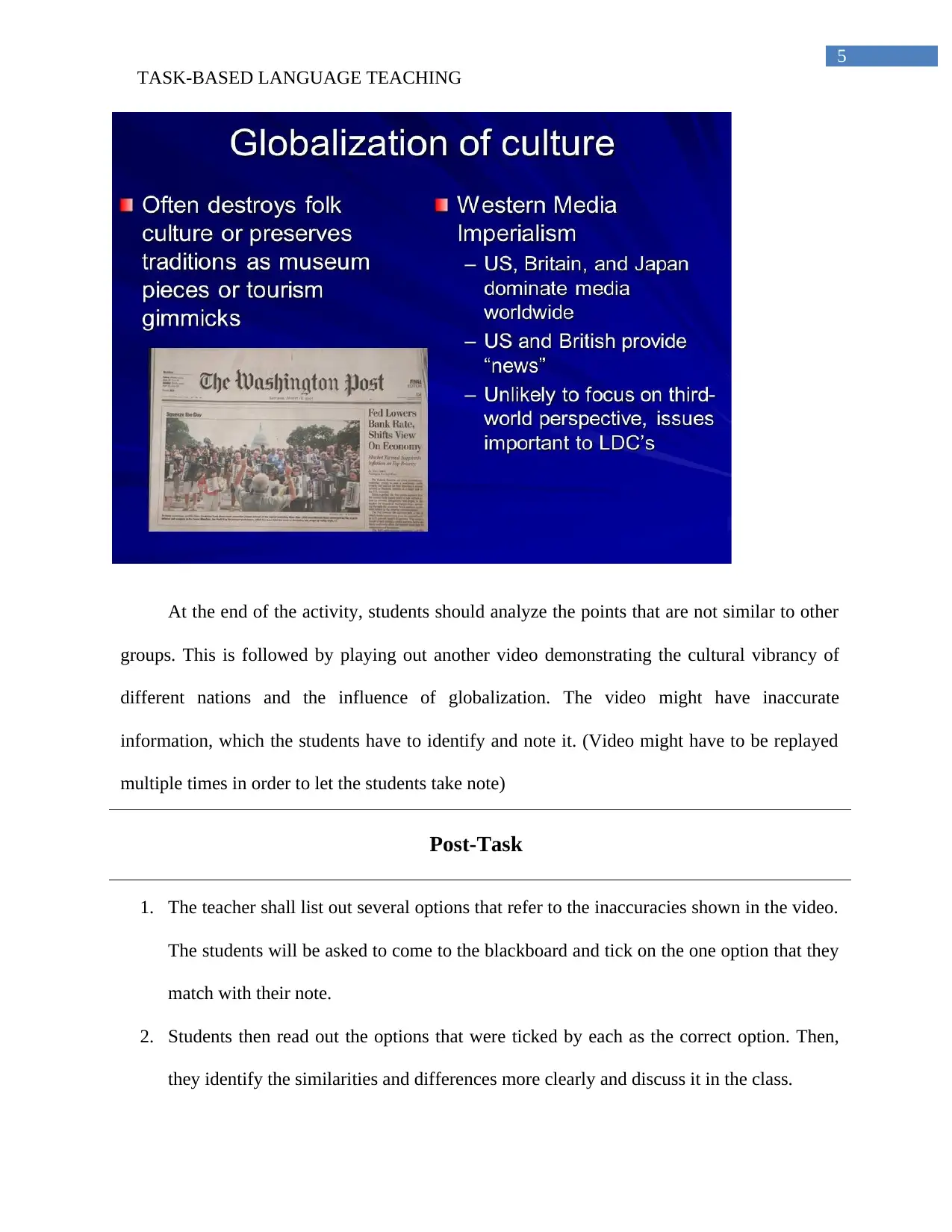
At the end of the activity, students should analyze the points that are not similar to other
groups. This is followed by playing out another video demonstrating the cultural vibrancy of
different nations and the influence of globalization. The video might have inaccurate
information, which the students have to identify and note it. (Video might have to be replayed
multiple times in order to let the students take note)
Post-Task
1. The teacher shall list out several options that refer to the inaccuracies shown in the video.
The students will be asked to come to the blackboard and tick on the one option that they
match with their note.
2. Students then read out the options that were ticked by each as the correct option. Then,
they identify the similarities and differences more clearly and discuss it in the class.
TASK-BASED LANGUAGE TEACHING
At the end of the activity, students should analyze the points that are not similar to other
groups. This is followed by playing out another video demonstrating the cultural vibrancy of
different nations and the influence of globalization. The video might have inaccurate
information, which the students have to identify and note it. (Video might have to be replayed
multiple times in order to let the students take note)
Post-Task
1. The teacher shall list out several options that refer to the inaccuracies shown in the video.
The students will be asked to come to the blackboard and tick on the one option that they
match with their note.
2. Students then read out the options that were ticked by each as the correct option. Then,
they identify the similarities and differences more clearly and discuss it in the class.
⊘ This is a preview!⊘
Do you want full access?
Subscribe today to unlock all pages.

Trusted by 1+ million students worldwide

6
TASK-BASED LANGUAGE TEACHING
3. The teacher should hold an interactive session where each student is allowed to express
their views on the reasons for the dissimilarities in the portrayal of culture and influence
of globalization on it in different newspapers.
4. After that, the students may identify any new word or phrase that they have heard for the
first time. Ask them to make a phrase or sentence with the new word.
5. The students then can be asked to relate their culture to the ones shown in the video and
share their personal experiences on the effects of globalization imposed on their culture.
They can be encouraged to talk about the positives of globalization such as exchange of
cultural values and tradition and appreciation of the same.
6. At the end of it, the teacher shall prepare a questionnaire in which the students will be
asked about their overall experience of the task. It would also contain questions like
“Which part of the task was most difficult to execute and why?” “What was the best part
about the task?” “Which words did you find the most difficult to understand?” and so on.
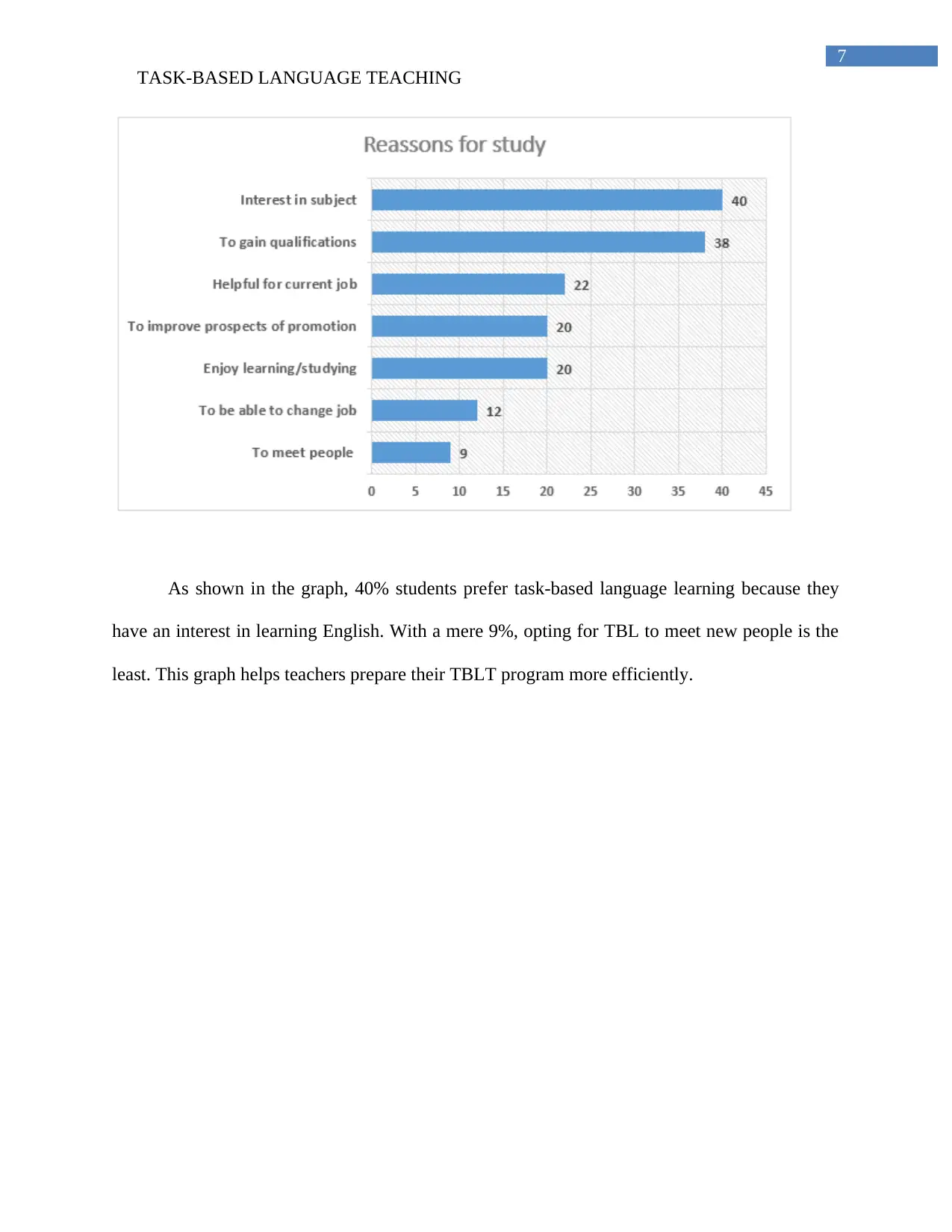
The following graph represents the number of students who take up Task-based learning and the
reasons for taking up TBLT
TASK-BASED LANGUAGE TEACHING
3. The teacher should hold an interactive session where each student is allowed to express
their views on the reasons for the dissimilarities in the portrayal of culture and influence
of globalization on it in different newspapers.
4. After that, the students may identify any new word or phrase that they have heard for the
first time. Ask them to make a phrase or sentence with the new word.
5. The students then can be asked to relate their culture to the ones shown in the video and
share their personal experiences on the effects of globalization imposed on their culture.
They can be encouraged to talk about the positives of globalization such as exchange of
cultural values and tradition and appreciation of the same.
6. At the end of it, the teacher shall prepare a questionnaire in which the students will be
asked about their overall experience of the task. It would also contain questions like
“Which part of the task was most difficult to execute and why?” “What was the best part
about the task?” “Which words did you find the most difficult to understand?” and so on.
The following graph represents the number of students who take up Task-based learning and the
reasons for taking up TBLT
Paraphrase This Document
Need a fresh take? Get an instant paraphrase of this document with our AI Paraphraser

7
TASK-BASED LANGUAGE TEACHING
As shown in the graph, 40% students prefer task-based language learning because they
have an interest in learning English. With a mere 9%, opting for TBL to meet new people is the
least. This graph helps teachers prepare their TBLT program more efficiently.
TASK-BASED LANGUAGE TEACHING
As shown in the graph, 40% students prefer task-based language learning because they
have an interest in learning English. With a mere 9%, opting for TBL to meet new people is the
least. This graph helps teachers prepare their TBLT program more efficiently.

8
TASK-BASED LANGUAGE TEACHING
References:
Ellis, R. (2014, December). Taking the critics to task: The case for task-based teaching.
In Proceedings of the Sixth cls International Conference clasic 2014, Singapore (pp. 103-
117).
Skehan, P. (2014). Task-based performance and task-based instruction: Research
contributions. Plenary address to the Task-Based Learning SIG-JALT, Osaka, Japan.
TASK-BASED LANGUAGE TEACHING
References:
Ellis, R. (2014, December). Taking the critics to task: The case for task-based teaching.
In Proceedings of the Sixth cls International Conference clasic 2014, Singapore (pp. 103-
117).
Skehan, P. (2014). Task-based performance and task-based instruction: Research
contributions. Plenary address to the Task-Based Learning SIG-JALT, Osaka, Japan.
⊘ This is a preview!⊘
Do you want full access?
Subscribe today to unlock all pages.

Trusted by 1+ million students worldwide
1 out of 9
Related Documents
Your All-in-One AI-Powered Toolkit for Academic Success.
+13062052269
info@desklib.com
Available 24*7 on WhatsApp / Email
Unlock your academic potential
Copyright © 2020–2025 A2Z Services. All Rights Reserved. Developed and managed by ZUCOL.