TWC Marketing Case Study: Target Market, Mix, and Responsibility
VerifiedAdded on 2023/06/03
|11
|3067
|165
Case Study
AI Summary
This case study provides an in-depth analysis of the Tasmanian Walking Company (TWC), focusing on its marketing strategies, target market, and commitment to social responsibility. The company primarily targets affluent, urban individuals aged 45-65 who seek luxurious and adventurous experiences in natural settings. TWC employs various marketing strategies, including pre-walk interactions and direct marketing, to cater to client needs and ensure satisfaction. The company's values are rooted in environmental sustainability, utilizing sustainable practices in accommodation and operations. TWC also contributes to local economies by sourcing products locally and supporting community initiatives. The extended marketing mix elements, including product, price, promotion, and place, are carefully managed to maintain exclusivity and high standards. TWC leverages travel trade shows, public relations, and social media to promote its offerings and engage with potential clients, ensuring a positive brand image and attracting new customers. Desklib provides access to similar case studies and assignments for students.
Running Head: 822118
Case Study Analysis
Student’s Name:
Student’s ID:
Case Study Analysis
Student’s Name:
Student’s ID:

Paraphrase This Document
Need a fresh take? Get an instant paraphrase of this document with our AI Paraphraser

1
Assessment 2
Table of Contents
Introduction.................................................................................................................................................2
Answers.......................................................................................................................................................2
Conclusion...................................................................................................................................................8
References...................................................................................................................................................9
Assessment 2
Table of Contents
Introduction.................................................................................................................................................2
Answers.......................................................................................................................................................2
Conclusion...................................................................................................................................................8
References...................................................................................................................................................9
2
Assessment 2
Introduction
The report will explain the case study evaluation of Tasmanian Walking Company (TWC) given
in the article “Principle of Marketing”. The paper will recognize the issues and provide solutions
to the company. It will provide the answers to the three questions as per the requirement of the
assignment. It will discuss the target market of TWC and the strategies implemented by the
company to know their target market. It will also reflect the use of the decisions of socially
responsible products by TWC. Moreover, it will also highlight the elements of the marketing mix
utilized by TWC to provide importance to the clients.
Answers
1. The Tasmanian Walking Company (TWC) has been marketing from the last 25 years in various
sectors, allowing people of every status and levels to experience the most famous mountain and
coastline locations all over the world. The clients of the TWC are mainly between 45-65 years
old urban people and they prefer a luxurious, adventurous and natural experience (Armstrong et
al., 2017). They are mostly retired persons like the doctors and lawyers and have high disposable
income and enthusiasm to pay for a walk in natural areas and feel the experience individually.
As for the example, the founder of this organization Ken Latona, was an expert in setting up
walks on the basis of accommodation in Australia. He was an experienced person in the
architectural field and utilized it to gain the right of designing and improving the Cradle
Mountain Huts based on the Overland Track of Tasmania. These huts still now are the only place
which provides personal lodging to the tourists besides the Overland Tack. The Cradle Mountain
Huts has developed a lot from its opening which was almost before 30 years. The tourists are
given the experience of Lake St Clair National Park, which is the heart of Cradle Mountain,
listed among the World Heritage of Tasmania (Kubacki et al., 2015). Apart from aiming for the
high-income clients of Victoria, New South Wales, and Queensland, TWC also targets the
foreign tourists and has achieved their market in USA, UK, and Japan. However, though people
from China demands the beaches, wildlife, and wine of Australia as their main attractions, they
are not on the list of the target market of TWC. This might due to the reason they are not
interested in taking walks in natural areas. After offering only the experience of walking, TWC
had introduced a four-day tour walk around the Bay of Fires Lodge in the year 1999 (McDonald,
Assessment 2
Introduction
The report will explain the case study evaluation of Tasmanian Walking Company (TWC) given
in the article “Principle of Marketing”. The paper will recognize the issues and provide solutions
to the company. It will provide the answers to the three questions as per the requirement of the
assignment. It will discuss the target market of TWC and the strategies implemented by the
company to know their target market. It will also reflect the use of the decisions of socially
responsible products by TWC. Moreover, it will also highlight the elements of the marketing mix
utilized by TWC to provide importance to the clients.
Answers
1. The Tasmanian Walking Company (TWC) has been marketing from the last 25 years in various
sectors, allowing people of every status and levels to experience the most famous mountain and
coastline locations all over the world. The clients of the TWC are mainly between 45-65 years
old urban people and they prefer a luxurious, adventurous and natural experience (Armstrong et
al., 2017). They are mostly retired persons like the doctors and lawyers and have high disposable
income and enthusiasm to pay for a walk in natural areas and feel the experience individually.
As for the example, the founder of this organization Ken Latona, was an expert in setting up
walks on the basis of accommodation in Australia. He was an experienced person in the
architectural field and utilized it to gain the right of designing and improving the Cradle
Mountain Huts based on the Overland Track of Tasmania. These huts still now are the only place
which provides personal lodging to the tourists besides the Overland Tack. The Cradle Mountain
Huts has developed a lot from its opening which was almost before 30 years. The tourists are
given the experience of Lake St Clair National Park, which is the heart of Cradle Mountain,
listed among the World Heritage of Tasmania (Kubacki et al., 2015). Apart from aiming for the
high-income clients of Victoria, New South Wales, and Queensland, TWC also targets the
foreign tourists and has achieved their market in USA, UK, and Japan. However, though people
from China demands the beaches, wildlife, and wine of Australia as their main attractions, they
are not on the list of the target market of TWC. This might due to the reason they are not
interested in taking walks in natural areas. After offering only the experience of walking, TWC
had introduced a four-day tour walk around the Bay of Fires Lodge in the year 1999 (McDonald,
⊘ This is a preview!⊘
Do you want full access?
Subscribe today to unlock all pages.

Trusted by 1+ million students worldwide
3
Assessment 2
2016). This permits the organization to enter in new market divisions which consist of the clients
preferring beach walking.
The marketing and sales team of TWC at their head office, are controlling the database of their
clients and applying their pre and post wall communication policies. This also includes the
meeting the clients' demands and recognizing the opportunities for their new target market and
products (McDonald et al., 2017). Moreover, the sales team are in charge of communicating with
the clients and controlling the online booking process. When any client decides their walking
experience, TWC utilizes the pre-walk interaction and direct marketing to create the sale and
make sure that the clients receive all the vital information. After their initial process, they sent an
email to the clients regarding the journey, a list of gears needed and a link to frequently asked
questions. They sent some short videos which are either attached to the emails of the customers
or on the company's website, where the guides explain the significance of some kits like the
hiking boots and thermal clothes. Mostly the clients will have four to five times interactions with
the company before reaching for their walk. This allows the company to completely know the
demands of the clients and the clients also ask questions regarding the walk (Zhao, 2016). The
marketing team of TWC is proud of themselves on giving services to the clients. They realize
that that the walks are not in the comfort zones of the clients so they provide importance to the
clients and make sure that the clients coming in Tasmania are satisfied and excited instead of
feeling nervous. The guides of the TWC are provided rigorous training so that they could give
high standards of service and hospitality (Smith et al., 2015). They are the most vital assets of
the organization. TWC also has its own website and social media so that clients interested in
walks of TWC could contact them through these mediums.
Assessment 2
2016). This permits the organization to enter in new market divisions which consist of the clients
preferring beach walking.
The marketing and sales team of TWC at their head office, are controlling the database of their
clients and applying their pre and post wall communication policies. This also includes the
meeting the clients' demands and recognizing the opportunities for their new target market and
products (McDonald et al., 2017). Moreover, the sales team are in charge of communicating with
the clients and controlling the online booking process. When any client decides their walking
experience, TWC utilizes the pre-walk interaction and direct marketing to create the sale and
make sure that the clients receive all the vital information. After their initial process, they sent an
email to the clients regarding the journey, a list of gears needed and a link to frequently asked
questions. They sent some short videos which are either attached to the emails of the customers
or on the company's website, where the guides explain the significance of some kits like the
hiking boots and thermal clothes. Mostly the clients will have four to five times interactions with
the company before reaching for their walk. This allows the company to completely know the
demands of the clients and the clients also ask questions regarding the walk (Zhao, 2016). The
marketing team of TWC is proud of themselves on giving services to the clients. They realize
that that the walks are not in the comfort zones of the clients so they provide importance to the
clients and make sure that the clients coming in Tasmania are satisfied and excited instead of
feeling nervous. The guides of the TWC are provided rigorous training so that they could give
high standards of service and hospitality (Smith et al., 2015). They are the most vital assets of
the organization. TWC also has its own website and social media so that clients interested in
walks of TWC could contact them through these mediums.
Paraphrase This Document
Need a fresh take? Get an instant paraphrase of this document with our AI Paraphraser
4
Assessment 2
2. The values of TWC has continued to be the same in spite of the change in ownership over the
years. The structure of TWC is constructed on the concept of environmental sustainability and
social responsibility. The company’s tag-line is ‘‘it’s in our nature’ ’which has a double
meaning. The first meaning is that the walks are based in Tasmania, the natural and physical
surroundings of TWC. The second meaning is that each employee of TWC are deeply passionate
regarding the naturally adventure tourism of sustainability, and maintains these values in the
luxurious experience and information given by them. The responsibility of nature and
environment are very much vital for the company and supports the marketing planning of TWC
(French and Russell-Bennett, 2015). The sustainability is also an important item of TWC. As for
example, since its introduction, the firm have utilized naturally sustainable methods and
materials to form the accommodation for their clients, to offer a different luxurious experience in
the natural surroundings. All the buildings have the facility of solar power, rainwater is collected
in tanks and then recycled; renewable gas is utilized for heating, and food and living deliveries
are carried in and all the wastes are taken away. These activities have helped the organization to
achieve the Advanced Ecotourism Certificates, and also gain several awards at a national and
state level (Binggeser et al., 2015). TWC also follow the best track guidelines for their every
walks, which helps the clients and the guides to follow the selected tracks, remove all the
wastages and then recycle. The Cradle Mountain Huts are always under the inspection of the
highest conservation levels. But, TWC follows these rules and by their sustainability marketing,
and make sure that the natural surroundings are left in a better situation than when they leave the
place.
TWC is not only concentrated on increasing the natural environment for the enjoyment of their
clients but also believes in giving back to the society, by their strategies of sustainable
marketing. As for example, TWC purchases almost all of their products and materials from the
local market. They make sure that local cafés are utilized to provide packed lunches for their
clients as they walk from the starting point of their journey. This strategy is to help and support
the local economies and businesses in remote towns of Tasmania like the Derby and Sheffield
and gives regular and important food orders to keep the locals in active mode. Apart from all
these, the employees of TWC regularly work with the environmental groups like the
Conservation Volunteers Australia to remove the weeds from the wildlife areas or the clean the
Assessment 2
2. The values of TWC has continued to be the same in spite of the change in ownership over the
years. The structure of TWC is constructed on the concept of environmental sustainability and
social responsibility. The company’s tag-line is ‘‘it’s in our nature’ ’which has a double
meaning. The first meaning is that the walks are based in Tasmania, the natural and physical
surroundings of TWC. The second meaning is that each employee of TWC are deeply passionate
regarding the naturally adventure tourism of sustainability, and maintains these values in the
luxurious experience and information given by them. The responsibility of nature and
environment are very much vital for the company and supports the marketing planning of TWC
(French and Russell-Bennett, 2015). The sustainability is also an important item of TWC. As for
example, since its introduction, the firm have utilized naturally sustainable methods and
materials to form the accommodation for their clients, to offer a different luxurious experience in
the natural surroundings. All the buildings have the facility of solar power, rainwater is collected
in tanks and then recycled; renewable gas is utilized for heating, and food and living deliveries
are carried in and all the wastes are taken away. These activities have helped the organization to
achieve the Advanced Ecotourism Certificates, and also gain several awards at a national and
state level (Binggeser et al., 2015). TWC also follow the best track guidelines for their every
walks, which helps the clients and the guides to follow the selected tracks, remove all the
wastages and then recycle. The Cradle Mountain Huts are always under the inspection of the
highest conservation levels. But, TWC follows these rules and by their sustainability marketing,
and make sure that the natural surroundings are left in a better situation than when they leave the
place.
TWC is not only concentrated on increasing the natural environment for the enjoyment of their
clients but also believes in giving back to the society, by their strategies of sustainable
marketing. As for example, TWC purchases almost all of their products and materials from the
local market. They make sure that local cafés are utilized to provide packed lunches for their
clients as they walk from the starting point of their journey. This strategy is to help and support
the local economies and businesses in remote towns of Tasmania like the Derby and Sheffield
and gives regular and important food orders to keep the locals in active mode. Apart from all
these, the employees of TWC regularly work with the environmental groups like the
Conservation Volunteers Australia to remove the weeds from the wildlife areas or the clean the
5
Assessment 2
litters from the natural surroundings like the Forester Beach, beside the Bay of Fires Lodge Walk
(O’Malley and Lichrou, 2016). Moreover, when TWC needs fresh materials like the uniform for
their employees, they carry out a survey to make sure that they buy from those companies, who
share similar values like TWC.
Assessment 2
litters from the natural surroundings like the Forester Beach, beside the Bay of Fires Lodge Walk
(O’Malley and Lichrou, 2016). Moreover, when TWC needs fresh materials like the uniform for
their employees, they carry out a survey to make sure that they buy from those companies, who
share similar values like TWC.
⊘ This is a preview!⊘
Do you want full access?
Subscribe today to unlock all pages.
Trusted by 1+ million students worldwide
6
Assessment 2
3. The extended marketing mix elements which have been managed in this case are the people,
product, price, promotion, and place. All the tourists could not afford the guided walks along
with the sustainable adventurous and luxurious tours. A single walk of TWC cost almost $3000
for each person (Dawes, 2017). The company intentionally ignores targeting the mass markets
with their product, it helps to maintain small groups and exclusiveness which adds importance to
the experiences of their clients. Every walk is taken as the package, consisting of transportation
cost from and to their locations, lodging cost, and expenses of meals and personal guide. The
clients have to bring their personal walking kits and have to pay extra for the spa sessions during
their tour to the Bay of Fires Lodge Walk. TWC is slowly holding their positions in the
international and foreign markets by attending the trade shows of travel and tourism like the
Australian Tourism Exchange (ATE) (Tarlow, 2016). The ATE helps to connect the Australian
tourism companies with the retailers and the wholesalers of all over the world, through face to
face appointments and broader networking events. TWC takes part in this event on yearly basis.
In order to attend the event of ATE, the activities of the personal selling and sales and
promotions of TWC starts almost two months before the event, as they recognize through online
about the wholesalers and the retailers they have to meet at the time of the event. The organizers
of TWC then matches the preferences of TWC with those retailers and wholesalers TWC has
chosen to talk with them. After getting the schedule, the Director of Sales and Marketing takes
the preparation for the next four day of 15 minutes meetings with nearly 100 tour operators and
wholesalers like the Flight Centre Global, when she discusses the products and new facilities for
the upcoming season of tourism (O’Boyle and Dawson, 2015).
For the marketing in the local market, TWC works closely with the experts of public relations in
order to draw the attention of the suitable reporters and media persons to take part in their guided
walks. After receiving such experiences, the reporters creates news regarding the facilities of
TWC, which are then published in newspaper, magazines and online travel sites (Erragcha and
Romdhane, 2014). Most significantly, TWC could share this news, scenic images, and other
references through their social media and websites. Apart from these references by another
medium, TWC motivates their clients to share their personal experiences through social media
and specifically the pictures they have clicked during their walks. This kind of promotion is the
vital portion of the promotional plan, which helps to involve new clients in the online sites.
Assessment 2
3. The extended marketing mix elements which have been managed in this case are the people,
product, price, promotion, and place. All the tourists could not afford the guided walks along
with the sustainable adventurous and luxurious tours. A single walk of TWC cost almost $3000
for each person (Dawes, 2017). The company intentionally ignores targeting the mass markets
with their product, it helps to maintain small groups and exclusiveness which adds importance to
the experiences of their clients. Every walk is taken as the package, consisting of transportation
cost from and to their locations, lodging cost, and expenses of meals and personal guide. The
clients have to bring their personal walking kits and have to pay extra for the spa sessions during
their tour to the Bay of Fires Lodge Walk. TWC is slowly holding their positions in the
international and foreign markets by attending the trade shows of travel and tourism like the
Australian Tourism Exchange (ATE) (Tarlow, 2016). The ATE helps to connect the Australian
tourism companies with the retailers and the wholesalers of all over the world, through face to
face appointments and broader networking events. TWC takes part in this event on yearly basis.
In order to attend the event of ATE, the activities of the personal selling and sales and
promotions of TWC starts almost two months before the event, as they recognize through online
about the wholesalers and the retailers they have to meet at the time of the event. The organizers
of TWC then matches the preferences of TWC with those retailers and wholesalers TWC has
chosen to talk with them. After getting the schedule, the Director of Sales and Marketing takes
the preparation for the next four day of 15 minutes meetings with nearly 100 tour operators and
wholesalers like the Flight Centre Global, when she discusses the products and new facilities for
the upcoming season of tourism (O’Boyle and Dawson, 2015).
For the marketing in the local market, TWC works closely with the experts of public relations in
order to draw the attention of the suitable reporters and media persons to take part in their guided
walks. After receiving such experiences, the reporters creates news regarding the facilities of
TWC, which are then published in newspaper, magazines and online travel sites (Erragcha and
Romdhane, 2014). Most significantly, TWC could share this news, scenic images, and other
references through their social media and websites. Apart from these references by another
medium, TWC motivates their clients to share their personal experiences through social media
and specifically the pictures they have clicked during their walks. This kind of promotion is the
vital portion of the promotional plan, which helps to involve new clients in the online sites.
Paraphrase This Document
Need a fresh take? Get an instant paraphrase of this document with our AI Paraphraser
7
Assessment 2
When the scenic images and posts are uploaded by TWC, they ignore any type of sales strategies
and simply share that things which are inspiring and motivating (Li et al., 2016). TWC also
make sure that the posts of their website and social media of the organization are appropriate as
per the season so that the clients receive an exact information of their expectations if they have to
experience a walk at that season of the year. During the winter season, TWC would upload and
share those pictures of walks at the snowy areas and appreciate this with some remarks. High
standards of inspirational video are also shared by TWC on their Facebook so that some potential
clients could get some ideas about the wildlife areas of Tasmania (Noo-urai and Jaroenwisan,
2016). It is time-consuming for a company like TWC to always keep their online sites and social
media updated. The high standard and personal experience on offer mean that most of the
contents made on the basis of the clients, where the company is tagged are positive. But, like all
other companies, TWC also controls the risk of negativity spread through word of mouth (Klein,
2015). It is done during their post-walk interactions with the clients and also during the follow-
up reporting time, the guides are instructed to inform any problems with TWC.
A small travel company like TWC also has to face some seasonal issues like the competition and
external market trends. Their clear concentration on offering high standards of adventurous
experiences in the natural surroundings has given them the competitive benefits, which the
owners are thinking to develop in the coming years. In order to maintain their points of
differences, TWC needs a strategy of triple bottom line to protect the nature and to gain profits.
TWC have to draw the attention of the passionate and reliable employees to provide their high
standards experience and maintain the values of the organization. The future of TWC seems to
be brighter after winning the Gold in the category of ecotourism at the Qantas Australian
Tourism Awards.
Assessment 2
When the scenic images and posts are uploaded by TWC, they ignore any type of sales strategies
and simply share that things which are inspiring and motivating (Li et al., 2016). TWC also
make sure that the posts of their website and social media of the organization are appropriate as
per the season so that the clients receive an exact information of their expectations if they have to
experience a walk at that season of the year. During the winter season, TWC would upload and
share those pictures of walks at the snowy areas and appreciate this with some remarks. High
standards of inspirational video are also shared by TWC on their Facebook so that some potential
clients could get some ideas about the wildlife areas of Tasmania (Noo-urai and Jaroenwisan,
2016). It is time-consuming for a company like TWC to always keep their online sites and social
media updated. The high standard and personal experience on offer mean that most of the
contents made on the basis of the clients, where the company is tagged are positive. But, like all
other companies, TWC also controls the risk of negativity spread through word of mouth (Klein,
2015). It is done during their post-walk interactions with the clients and also during the follow-
up reporting time, the guides are instructed to inform any problems with TWC.
A small travel company like TWC also has to face some seasonal issues like the competition and
external market trends. Their clear concentration on offering high standards of adventurous
experiences in the natural surroundings has given them the competitive benefits, which the
owners are thinking to develop in the coming years. In order to maintain their points of
differences, TWC needs a strategy of triple bottom line to protect the nature and to gain profits.
TWC have to draw the attention of the passionate and reliable employees to provide their high
standards experience and maintain the values of the organization. The future of TWC seems to
be brighter after winning the Gold in the category of ecotourism at the Qantas Australian
Tourism Awards.
8
Assessment 2
Conclusion
The article had analyzed the case study of Tasmanian Walking Company (TWC) provided in the
journal “Principle of Marketing”. The report had identified the problems regarding the company
and provide solutions to them. It had given the solutions to all the three questions as per the
requirement of the assignment. It had discussed the strategies of the target markets of TWC to
retain their clients and hold their positions in the domestic market. It had evaluated the products
of social responsibility and environmental sustainability to hold the clients' value. It had also
highlighted the elements of the marketing mix utilized by TWC to carefully control the
organization.
Assessment 2
Conclusion
The article had analyzed the case study of Tasmanian Walking Company (TWC) provided in the
journal “Principle of Marketing”. The report had identified the problems regarding the company
and provide solutions to them. It had given the solutions to all the three questions as per the
requirement of the assignment. It had discussed the strategies of the target markets of TWC to
retain their clients and hold their positions in the domestic market. It had evaluated the products
of social responsibility and environmental sustainability to hold the clients' value. It had also
highlighted the elements of the marketing mix utilized by TWC to carefully control the
organization.
⊘ This is a preview!⊘
Do you want full access?
Subscribe today to unlock all pages.
Trusted by 1+ million students worldwide
9
Assessment 2
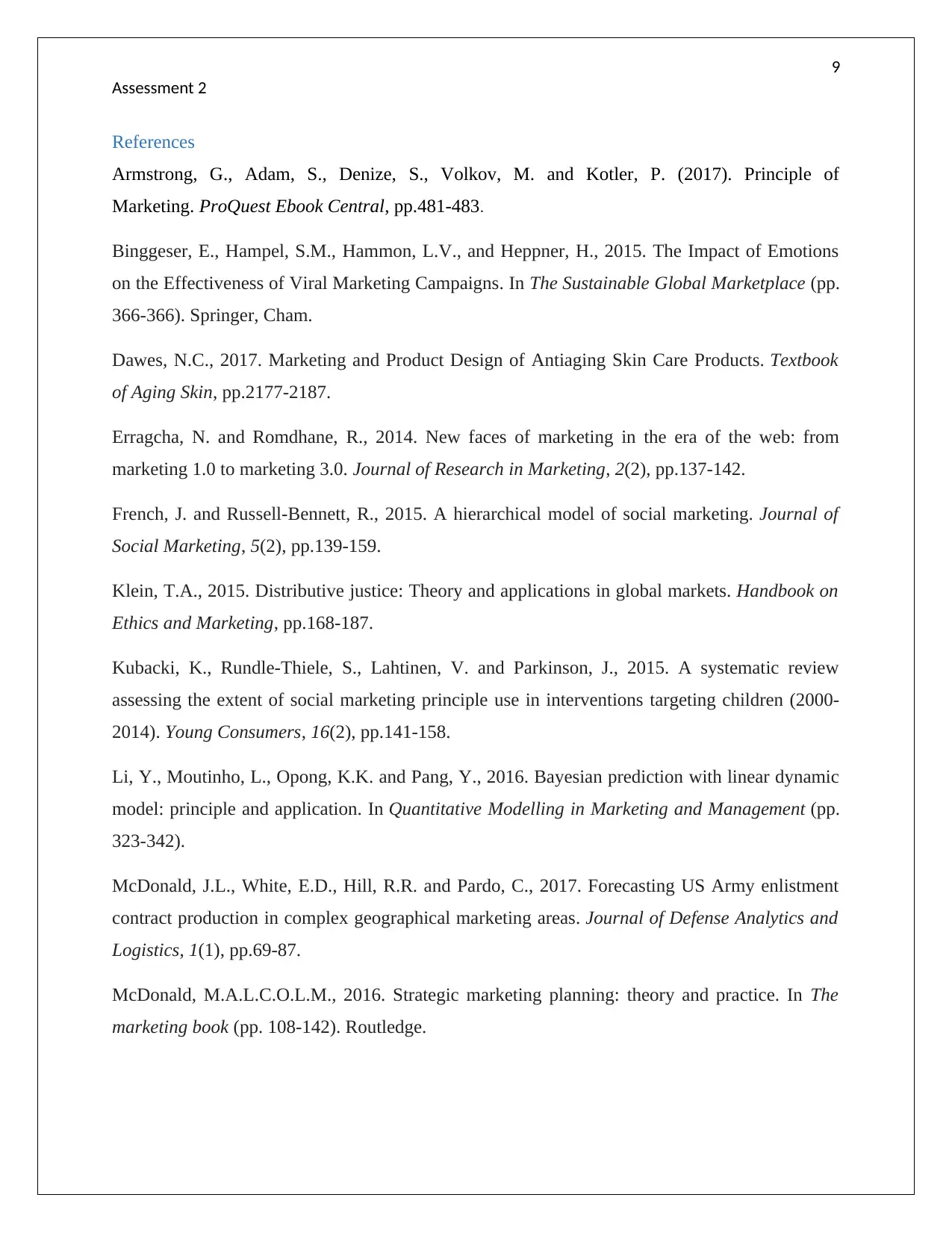
References
Armstrong, G., Adam, S., Denize, S., Volkov, M. and Kotler, P. (2017). Principle of
Marketing. ProQuest Ebook Central, pp.481-483.
Binggeser, E., Hampel, S.M., Hammon, L.V., and Heppner, H., 2015. The Impact of Emotions
on the Effectiveness of Viral Marketing Campaigns. In The Sustainable Global Marketplace (pp.
366-366). Springer, Cham.
Dawes, N.C., 2017. Marketing and Product Design of Antiaging Skin Care Products. Textbook
of Aging Skin, pp.2177-2187.
Erragcha, N. and Romdhane, R., 2014. New faces of marketing in the era of the web: from
marketing 1.0 to marketing 3.0. Journal of Research in Marketing, 2(2), pp.137-142.
French, J. and Russell-Bennett, R., 2015. A hierarchical model of social marketing. Journal of
Social Marketing, 5(2), pp.139-159.
Klein, T.A., 2015. Distributive justice: Theory and applications in global markets. Handbook on
Ethics and Marketing, pp.168-187.
Kubacki, K., Rundle-Thiele, S., Lahtinen, V. and Parkinson, J., 2015. A systematic review
assessing the extent of social marketing principle use in interventions targeting children (2000-
2014). Young Consumers, 16(2), pp.141-158.
Li, Y., Moutinho, L., Opong, K.K. and Pang, Y., 2016. Bayesian prediction with linear dynamic
model: principle and application. In Quantitative Modelling in Marketing and Management (pp.
323-342).
McDonald, J.L., White, E.D., Hill, R.R. and Pardo, C., 2017. Forecasting US Army enlistment
contract production in complex geographical marketing areas. Journal of Defense Analytics and
Logistics, 1(1), pp.69-87.
McDonald, M.A.L.C.O.L.M., 2016. Strategic marketing planning: theory and practice. In The
marketing book (pp. 108-142). Routledge.
Assessment 2
References
Armstrong, G., Adam, S., Denize, S., Volkov, M. and Kotler, P. (2017). Principle of
Marketing. ProQuest Ebook Central, pp.481-483.
Binggeser, E., Hampel, S.M., Hammon, L.V., and Heppner, H., 2015. The Impact of Emotions
on the Effectiveness of Viral Marketing Campaigns. In The Sustainable Global Marketplace (pp.
366-366). Springer, Cham.
Dawes, N.C., 2017. Marketing and Product Design of Antiaging Skin Care Products. Textbook
of Aging Skin, pp.2177-2187.
Erragcha, N. and Romdhane, R., 2014. New faces of marketing in the era of the web: from
marketing 1.0 to marketing 3.0. Journal of Research in Marketing, 2(2), pp.137-142.
French, J. and Russell-Bennett, R., 2015. A hierarchical model of social marketing. Journal of
Social Marketing, 5(2), pp.139-159.
Klein, T.A., 2015. Distributive justice: Theory and applications in global markets. Handbook on
Ethics and Marketing, pp.168-187.
Kubacki, K., Rundle-Thiele, S., Lahtinen, V. and Parkinson, J., 2015. A systematic review
assessing the extent of social marketing principle use in interventions targeting children (2000-
2014). Young Consumers, 16(2), pp.141-158.
Li, Y., Moutinho, L., Opong, K.K. and Pang, Y., 2016. Bayesian prediction with linear dynamic
model: principle and application. In Quantitative Modelling in Marketing and Management (pp.
323-342).
McDonald, J.L., White, E.D., Hill, R.R. and Pardo, C., 2017. Forecasting US Army enlistment
contract production in complex geographical marketing areas. Journal of Defense Analytics and
Logistics, 1(1), pp.69-87.
McDonald, M.A.L.C.O.L.M., 2016. Strategic marketing planning: theory and practice. In The
marketing book (pp. 108-142). Routledge.
Paraphrase This Document
Need a fresh take? Get an instant paraphrase of this document with our AI Paraphraser
10
Assessment 2
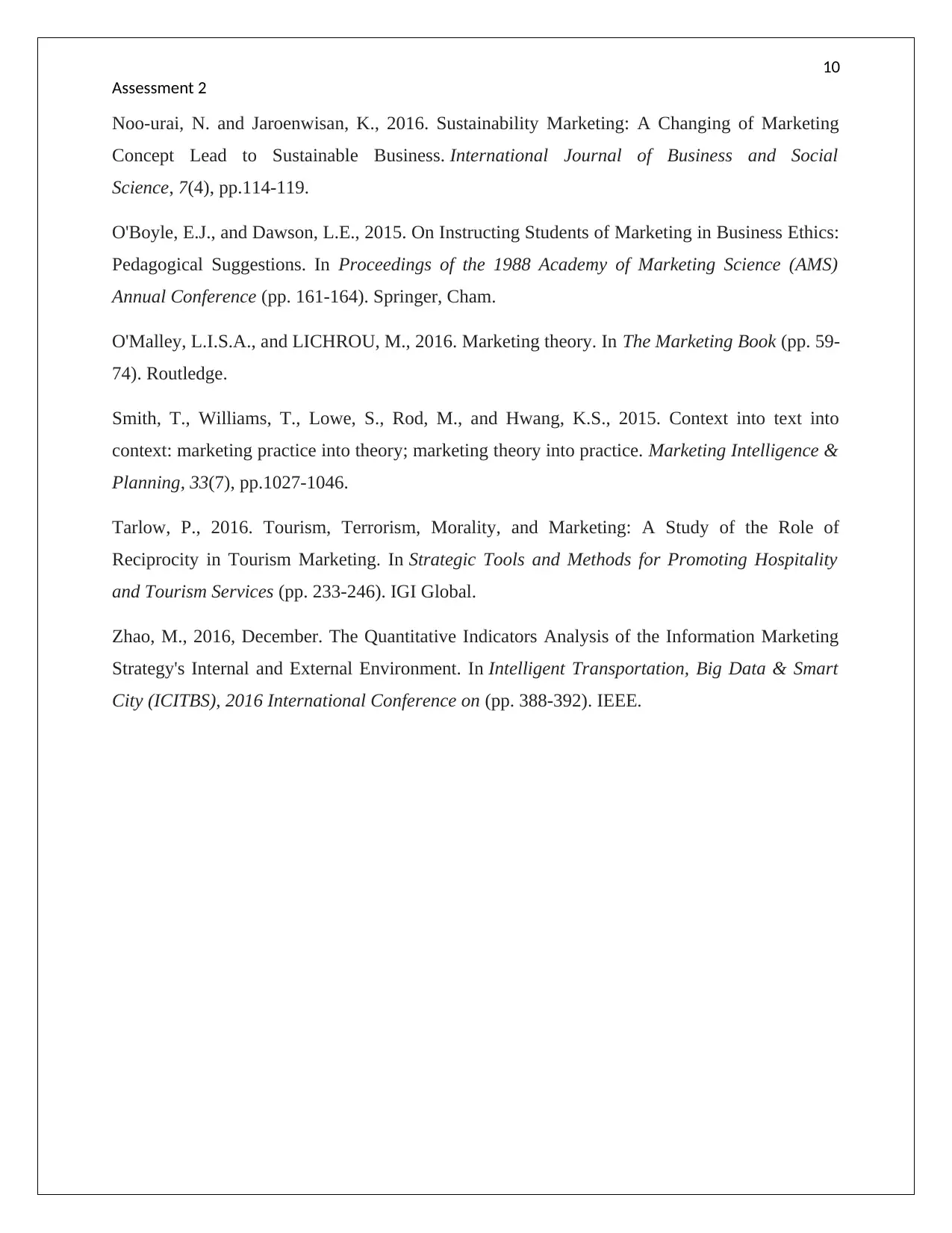
Noo-urai, N. and Jaroenwisan, K., 2016. Sustainability Marketing: A Changing of Marketing
Concept Lead to Sustainable Business. International Journal of Business and Social
Science, 7(4), pp.114-119.
O'Boyle, E.J., and Dawson, L.E., 2015. On Instructing Students of Marketing in Business Ethics:
Pedagogical Suggestions. In Proceedings of the 1988 Academy of Marketing Science (AMS)
Annual Conference (pp. 161-164). Springer, Cham.
O'Malley, L.I.S.A., and LICHROU, M., 2016. Marketing theory. In The Marketing Book (pp. 59-
74). Routledge.
Smith, T., Williams, T., Lowe, S., Rod, M., and Hwang, K.S., 2015. Context into text into
context: marketing practice into theory; marketing theory into practice. Marketing Intelligence &
Planning, 33(7), pp.1027-1046.
Tarlow, P., 2016. Tourism, Terrorism, Morality, and Marketing: A Study of the Role of
Reciprocity in Tourism Marketing. In Strategic Tools and Methods for Promoting Hospitality
and Tourism Services (pp. 233-246). IGI Global.
Zhao, M., 2016, December. The Quantitative Indicators Analysis of the Information Marketing
Strategy's Internal and External Environment. In Intelligent Transportation, Big Data & Smart
City (ICITBS), 2016 International Conference on (pp. 388-392). IEEE.
Assessment 2
Noo-urai, N. and Jaroenwisan, K., 2016. Sustainability Marketing: A Changing of Marketing
Concept Lead to Sustainable Business. International Journal of Business and Social
Science, 7(4), pp.114-119.
O'Boyle, E.J., and Dawson, L.E., 2015. On Instructing Students of Marketing in Business Ethics:
Pedagogical Suggestions. In Proceedings of the 1988 Academy of Marketing Science (AMS)
Annual Conference (pp. 161-164). Springer, Cham.
O'Malley, L.I.S.A., and LICHROU, M., 2016. Marketing theory. In The Marketing Book (pp. 59-
74). Routledge.
Smith, T., Williams, T., Lowe, S., Rod, M., and Hwang, K.S., 2015. Context into text into
context: marketing practice into theory; marketing theory into practice. Marketing Intelligence &
Planning, 33(7), pp.1027-1046.
Tarlow, P., 2016. Tourism, Terrorism, Morality, and Marketing: A Study of the Role of
Reciprocity in Tourism Marketing. In Strategic Tools and Methods for Promoting Hospitality
and Tourism Services (pp. 233-246). IGI Global.
Zhao, M., 2016, December. The Quantitative Indicators Analysis of the Information Marketing
Strategy's Internal and External Environment. In Intelligent Transportation, Big Data & Smart
City (ICITBS), 2016 International Conference on (pp. 388-392). IEEE.

1 out of 11


Your All-in-One AI-Powered Toolkit for Academic Success.
+13062052269
info@desklib.com
Available 24*7 on WhatsApp / Email
![[object Object]](/_next/static/media/star-bottom.7253800d.svg)
Unlock your academic potential
Copyright © 2020–2026 A2Z Services. All Rights Reserved. Developed and managed by ZUCOL.