Psychology 202 Report: The Impact of Tattoos on Job Hireability

Verified

Added on  2022/08/17

|4
|1039
|15
Report
AI Summary
This psychology report investigates the impact of tattoos on employment opportunities, focusing on visible versus non-visible tattoos and their perceived threat level. The report begins by outlining the research questions and hypotheses, including the prediction that individuals without visible tattoos will be more likely to be hired. It then reviews existing literature, including studies by Timming (2015) and Jibuti (2018), which examine the relationship between tattoos and employment discrimination. The report discusses the variables, including independent variables such as visible and non-visible tattoos, and dependent variables like trustworthiness and hireability. The study employs an experimental research design to explore whether job titles influence responses and whether non-threatening tattoos are viewed more favorably. The report concludes by highlighting the importance of understanding how body art influences hiring decisions and addressing the limitations of previous research by considering different types of tattoos.

Document Page
RUNNING HEAD: PSYCHOLOGY 0
RESEARCH METHODS IN PSYCHOLOGY
tabler-icon-diamond-filled.svg

Paraphrase This Document

Need a fresh take? Get an instant paraphrase of this document with our AI Paraphraser
Document Page
PSYCHOLOGY 1
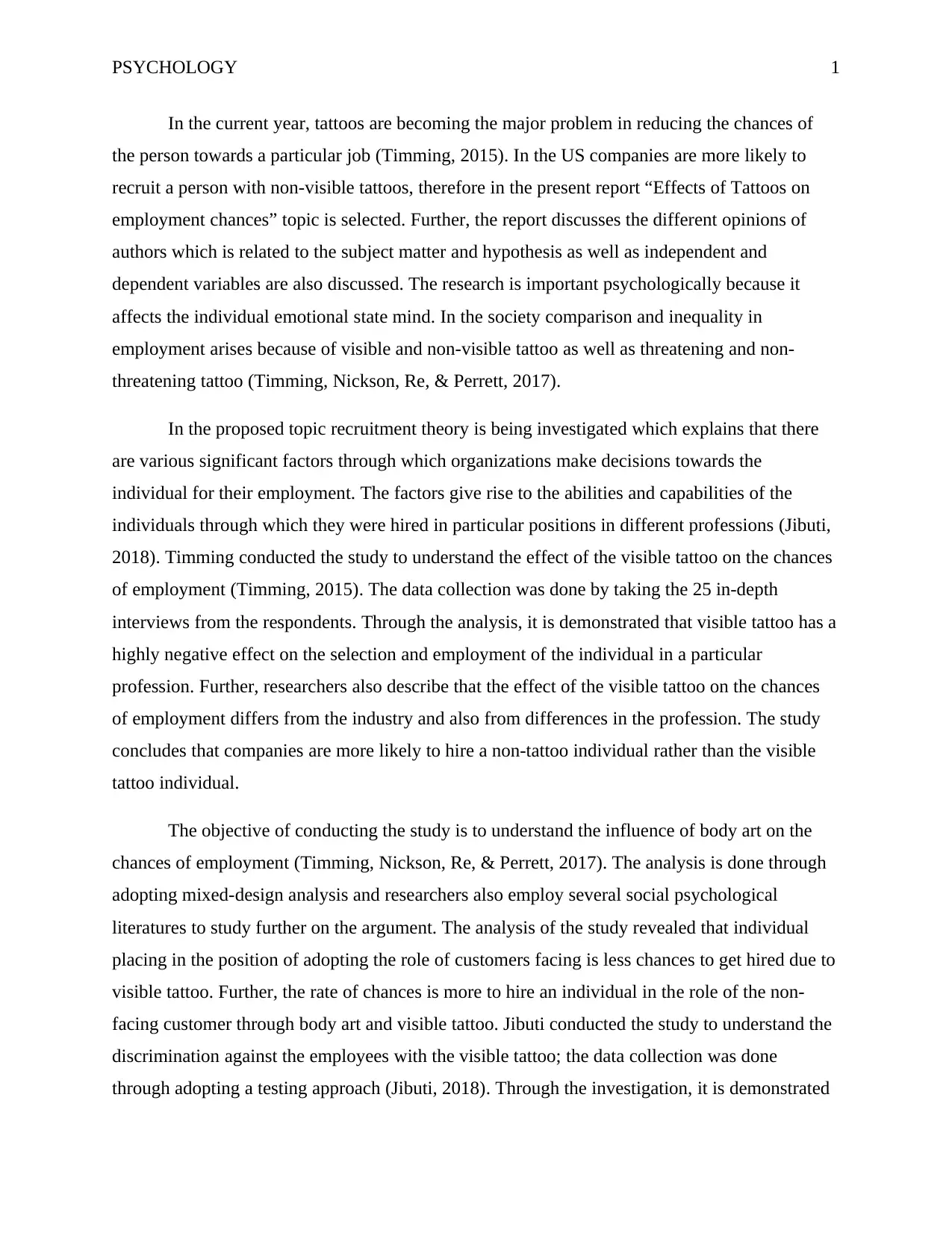
In the current year, tattoos are becoming the major problem in reducing the chances of
the person towards a particular job (Timming, 2015). In the US companies are more likely to
recruit a person with non-visible tattoos, therefore in the present report “Effects of Tattoos on
employment chances” topic is selected. Further, the report discusses the different opinions of
authors which is related to the subject matter and hypothesis as well as independent and
dependent variables are also discussed. The research is important psychologically because it
affects the individual emotional state mind. In the society comparison and inequality in
employment arises because of visible and non-visible tattoo as well as threatening and non-
threatening tattoo (Timming, Nickson, Re, & Perrett, 2017).
In the proposed topic recruitment theory is being investigated which explains that there
are various significant factors through which organizations make decisions towards the
individual for their employment. The factors give rise to the abilities and capabilities of the
individuals through which they were hired in particular positions in different professions (Jibuti,
2018). Timming conducted the study to understand the effect of the visible tattoo on the chances
of employment (Timming, 2015). The data collection was done by taking the 25 in-depth
interviews from the respondents. Through the analysis, it is demonstrated that visible tattoo has a
highly negative effect on the selection and employment of the individual in a particular
profession. Further, researchers also describe that the effect of the visible tattoo on the chances
of employment differs from the industry and also from differences in the profession. The study
concludes that companies are more likely to hire a non-tattoo individual rather than the visible
tattoo individual.
The objective of conducting the study is to understand the influence of body art on the
chances of employment (Timming, Nickson, Re, & Perrett, 2017). The analysis is done through
adopting mixed-design analysis and researchers also employ several social psychological
literatures to study further on the argument. The analysis of the study revealed that individual
placing in the position of adopting the role of customers facing is less chances to get hired due to
visible tattoo. Further, the rate of chances is more to hire an individual in the role of the non-
facing customer through body art and visible tattoo. Jibuti conducted the study to understand the
discrimination against the employees with the visible tattoo; the data collection was done
through adopting a testing approach (Jibuti, 2018). Through the investigation, it is demonstrated
Document Page
PSYCHOLOGY 2
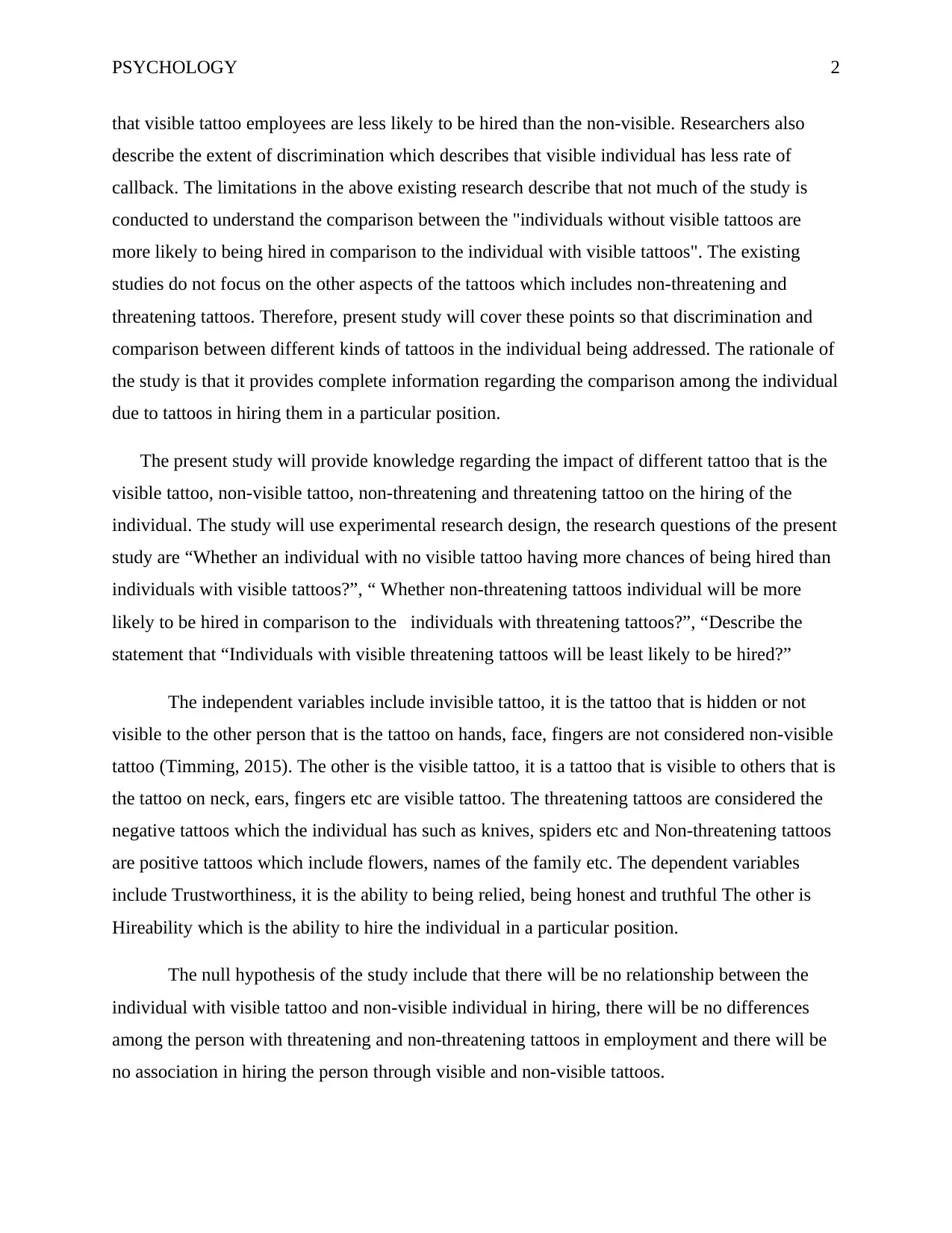
that visible tattoo employees are less likely to be hired than the non-visible. Researchers also
describe the extent of discrimination which describes that visible individual has less rate of
callback. The limitations in the above existing research describe that not much of the study is
conducted to understand the comparison between the "individuals without visible tattoos are
more likely to being hired in comparison to the individual with visible tattoos". The existing
studies do not focus on the other aspects of the tattoos which includes non-threatening and
threatening tattoos. Therefore, present study will cover these points so that discrimination and
comparison between different kinds of tattoos in the individual being addressed. The rationale of
the study is that it provides complete information regarding the comparison among the individual
due to tattoos in hiring them in a particular position.
The present study will provide knowledge regarding the impact of different tattoo that is the
visible tattoo, non-visible tattoo, non-threatening and threatening tattoo on the hiring of the
individual. The study will use experimental research design, the research questions of the present
study are “Whether an individual with no visible tattoo having more chances of being hired than
individuals with visible tattoos?”, “ Whether non-threatening tattoos individual will be more
likely to be hired in comparison to the individuals with threatening tattoos?”, “Describe the
statement that “Individuals with visible threatening tattoos will be least likely to be hired?”
The independent variables include invisible tattoo, it is the tattoo that is hidden or not
visible to the other person that is the tattoo on hands, face, fingers are not considered non-visible
tattoo (Timming, 2015). The other is the visible tattoo, it is a tattoo that is visible to others that is
the tattoo on neck, ears, fingers etc are visible tattoo. The threatening tattoos are considered the
negative tattoos which the individual has such as knives, spiders etc and Non-threatening tattoos
are positive tattoos which include flowers, names of the family etc. The dependent variables
include Trustworthiness, it is the ability to being relied, being honest and truthful The other is
Hireability which is the ability to hire the individual in a particular position.
The null hypothesis of the study include that there will be no relationship between the
individual with visible tattoo and non-visible individual in hiring, there will be no differences
among the person with threatening and non-threatening tattoos in employment and there will be
no association in hiring the person through visible and non-visible tattoos.
Document Page
PSYCHOLOGY 3
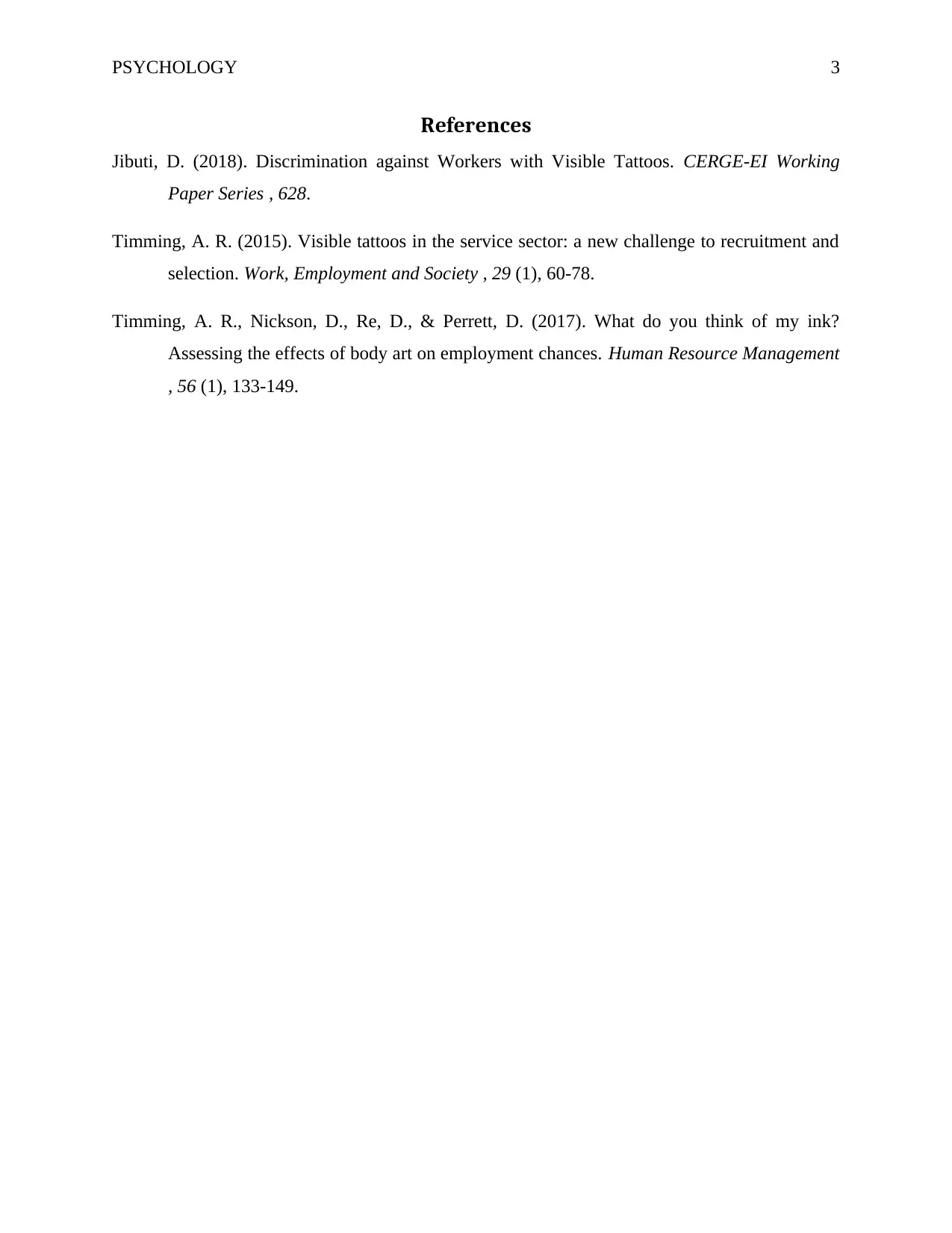
References
Jibuti, D. (2018). Discrimination against Workers with Visible Tattoos. CERGE-EI Working
Paper Series , 628.
Timming, A. R. (2015). Visible tattoos in the service sector: a new challenge to recruitment and
selection. Work, Employment and Society , 29 (1), 60-78.
Timming, A. R., Nickson, D., Re, D., & Perrett, D. (2017). What do you think of my ink?
Assessing the effects of body art on employment chances. Human Resource Management
, 56 (1), 133-149.
chevron_up_icon
1 out of 4
circle_padding
hide_on_mobile
zoom_out_icon
[object Object]