Taxation Assignment: Analyzing Tax Consequences for Our Earth and Sam
VerifiedAdded on 2022/12/26
|14
|3903
|45
Homework Assignment
AI Summary
This assignment analyzes the tax implications for Our Earth Pty Ltd, a company that manufactures biodegradable coffee cups, and Sam, an individual who owns farmland. The first part of the assignment addresses the tax consequences of compensation received by Our Earth Pty Ltd due to design patent infringement, lost revenue, interest on damages, and reimbursement of legal fees. The analysis classifies these amounts as either capital gains or ordinary income based on relevant tax laws and case precedents, including the Income Tax Assessment Act 1997. The second part focuses on Sam's farmland, evaluating the tax implications of selling the land after subdivision and the associated costs. The assignment considers the initial purchase, operational activities, and the impact of rezoning the land for subdivision on the ultimate tax liability. The document provides a detailed breakdown of assessable income and the application of tax principles to specific scenarios.
Running head: TAXATION
Taxation
Name of the Student
Name of the University
Author Note
Taxation
Name of the Student
Name of the University
Author Note

Paraphrase This Document
Need a fresh take? Get an instant paraphrase of this document with our AI Paraphraser
1TAXATION
Table of Contents
Answer 1....................................................................................................................................2
Issue........................................................................................................................................2
Rule........................................................................................................................................2
Application.............................................................................................................................4
Conclusion..............................................................................................................................7
Answer 2....................................................................................................................................7
Issue........................................................................................................................................7
Rule........................................................................................................................................8
Application.............................................................................................................................9
Conclusion............................................................................................................................11
Reference..................................................................................................................................12
Table of Contents
Answer 1....................................................................................................................................2
Issue........................................................................................................................................2
Rule........................................................................................................................................2
Application.............................................................................................................................4
Conclusion..............................................................................................................................7
Answer 2....................................................................................................................................7
Issue........................................................................................................................................7
Rule........................................................................................................................................8
Application.............................................................................................................................9
Conclusion............................................................................................................................11
Reference..................................................................................................................................12
2TAXATION
Answer 1
Issue
In the given instance, the issue is to evaluate the tax consequences pertaining to the below
mentioned transactions as accrued to the Our Earth Pty Ltd.
Firstly, the issue is the tax implications that Our Earth Pty Ltd has incurred owing to the
compensation of $300,000 received against the damages for design patent infringement.
Secondly, the issue is the tax implications for the compensation amounting to $200,000
received for the loss of revenue that has been caused to Our Earth Pty Ltd for the 12-month
period that Coffee Bean Pty Ltd had been using the other product.
Thirdly, the issue is the tax implication with respect to the interest amounting to $15,000
that has been received on the damages payout.
Fourthly, the issue is the tax implications for the amount of $40,000 received as a
reimbursement of legal fees incurred by Our Earth Pty Ltd.
Rule
The compensations that are received against any loss of items of income are to be treated
in accordance with the doctrine of replacement. Under this doctrine, the compensation that
has been received against any item of income or any prospect that might ensure income needs
to be treated in a similar manner as that of the income that it has been replacing for the
purpose of taxation. This is because the item against which the compensation has been
received, would be have the probability of accruing an income and has the prospect of being
assessed under taxation. The loss of the same has made that probability to disappear and no
tax can be charged with respect to the same. Hence, applying the doctrine of replacement, it
can be stated that the compensation would be construed to have replaced the item against
Answer 1
Issue
In the given instance, the issue is to evaluate the tax consequences pertaining to the below
mentioned transactions as accrued to the Our Earth Pty Ltd.
Firstly, the issue is the tax implications that Our Earth Pty Ltd has incurred owing to the
compensation of $300,000 received against the damages for design patent infringement.
Secondly, the issue is the tax implications for the compensation amounting to $200,000
received for the loss of revenue that has been caused to Our Earth Pty Ltd for the 12-month
period that Coffee Bean Pty Ltd had been using the other product.
Thirdly, the issue is the tax implication with respect to the interest amounting to $15,000
that has been received on the damages payout.
Fourthly, the issue is the tax implications for the amount of $40,000 received as a
reimbursement of legal fees incurred by Our Earth Pty Ltd.
Rule
The compensations that are received against any loss of items of income are to be treated
in accordance with the doctrine of replacement. Under this doctrine, the compensation that
has been received against any item of income or any prospect that might ensure income needs
to be treated in a similar manner as that of the income that it has been replacing for the
purpose of taxation. This is because the item against which the compensation has been
received, would be have the probability of accruing an income and has the prospect of being
assessed under taxation. The loss of the same has made that probability to disappear and no
tax can be charged with respect to the same. Hence, applying the doctrine of replacement, it
can be stated that the compensation would be construed to have replaced the item against
⊘ This is a preview!⊘
Do you want full access?
Subscribe today to unlock all pages.

Trusted by 1+ million students worldwide
3TAXATION
which it has been replaced. Similarly, the tax implications that was supposed to accrue to the
items as a replacement of which the compensation has been incurred would also accrue in a
similar manner to the compensation as well. This comes in line with the case of Haritos v
Commissioner of Taxation [2015] FCAFC 92. In this case, it has been contended by the court
that the tax implications that was supposed to be accrued to the to the items of income would
also accrue to the compensation that has been received as a replacement of the same. In this
case, the compensation in question would be treated in the same as that of the item of income
it has been replacing.
The main object of the compensation is to neutralize the losses that has been caused owing
to the destruction of the income or a prospect of income. Hence, it can be illustrated in that
context, the items of income that has been rendered to be an ordinary income under the
section 6.5 of the Income Tax Assessment Act 1997 (Cth), would also be render any
compensation that has been received in place of that as an ordinary income under the same as
well. In this context, it can be stated that the compensation that has been extended towards
the loss of an ordinary income has the effect of appropriating the loss and owing to its effect
of the appropriation of the ordinary income, it also needs to be construed to be an ordinary
income. In the same way, it can be stated that the income, which has the implication for the
purpose of taxation pertaining to capital gain would render the compensation received against
the loss of the same to be directed towards the capital gain. This can further be supported by
the case of August v Commissioner of Taxation [2013] FCAFC 85. In this case, it has been
contended by the court that factory, which is permanent would be construed to be a capital
asset under section 104.5 of the Income Tax Assessment Act 1997 (Cth). Losses that has
been accrued by virtue of the destruction in the same would also be treated as a loss of capital
asset. This would render any loss pertaining to the same to be loss of capital asset. Any
compensation that has been accrued for the loss of the such capital asset would be treated as a
which it has been replaced. Similarly, the tax implications that was supposed to accrue to the
items as a replacement of which the compensation has been incurred would also accrue in a
similar manner to the compensation as well. This comes in line with the case of Haritos v
Commissioner of Taxation [2015] FCAFC 92. In this case, it has been contended by the court
that the tax implications that was supposed to be accrued to the to the items of income would
also accrue to the compensation that has been received as a replacement of the same. In this
case, the compensation in question would be treated in the same as that of the item of income
it has been replacing.
The main object of the compensation is to neutralize the losses that has been caused owing
to the destruction of the income or a prospect of income. Hence, it can be illustrated in that
context, the items of income that has been rendered to be an ordinary income under the
section 6.5 of the Income Tax Assessment Act 1997 (Cth), would also be render any
compensation that has been received in place of that as an ordinary income under the same as
well. In this context, it can be stated that the compensation that has been extended towards
the loss of an ordinary income has the effect of appropriating the loss and owing to its effect
of the appropriation of the ordinary income, it also needs to be construed to be an ordinary
income. In the same way, it can be stated that the income, which has the implication for the
purpose of taxation pertaining to capital gain would render the compensation received against
the loss of the same to be directed towards the capital gain. This can further be supported by
the case of August v Commissioner of Taxation [2013] FCAFC 85. In this case, it has been
contended by the court that factory, which is permanent would be construed to be a capital
asset under section 104.5 of the Income Tax Assessment Act 1997 (Cth). Losses that has
been accrued by virtue of the destruction in the same would also be treated as a loss of capital
asset. This would render any loss pertaining to the same to be loss of capital asset. Any
compensation that has been accrued for the loss of the such capital asset would be treated as a
Paraphrase This Document
Need a fresh take? Get an instant paraphrase of this document with our AI Paraphraser
4TAXATION
capital gain for the purpose of taxation. This is because the capital asset has the prospect of
earning a capital gain if the same has been sold. In this case, the compensation can be
construed to have the same implications as that of the proceeds that has been received from
the sale of the capital asset (Woellner et al, 2016).
It has been contended in the case of News Australia Holdings Pty Ltd v Commissioner of
Taxation [2017] FCA 645, that any exclusive right that a person paying the tax owns with
respect to a particular product would be treated as an capital asset and the same has the
prospect of earning capital gain when sold. This requires any compensation that has been
received for the loss of such a capital asset would also be treated as a capital gain as the same
is construed to be a proceed that has been received from the sale of the same. Any
infringement of such right would have two implications, firstly the capital loss and secondly
the loss of profit that has been expected to incur from the right. Any compensation that will
follow such a loss of profit would also be considered to be an ordinary income. This can
further be extended with the case of Federal Commissioner of Taxation v Northumberland
Development Co Pty Ltd 95 ATC 4483. Any profit that has been accrued from a right would
be treated as ordinary income and so the compensation that has been received from the loss of
the same.
It can be stated that any interest that has been accrued to any of the damages when paid
will have the same tax implication of an ordinary income as given under section 6.5 of the
Income Tax Assessment Act 1997 (Cth). This can further be elucidated with the case of Mills
v Commissioner of Taxation [2012] HCA 51. Again, it can be stated that legal expenses and
costs pertaining to the legal proceedings are treated as general deductions under section 8.1 of
the the Income Tax Assessment Act 1997 (Cth), Hence, any reimbursement of the same
would also be treated as an ordinary income.
capital gain for the purpose of taxation. This is because the capital asset has the prospect of
earning a capital gain if the same has been sold. In this case, the compensation can be
construed to have the same implications as that of the proceeds that has been received from
the sale of the capital asset (Woellner et al, 2016).
It has been contended in the case of News Australia Holdings Pty Ltd v Commissioner of
Taxation [2017] FCA 645, that any exclusive right that a person paying the tax owns with
respect to a particular product would be treated as an capital asset and the same has the
prospect of earning capital gain when sold. This requires any compensation that has been
received for the loss of such a capital asset would also be treated as a capital gain as the same
is construed to be a proceed that has been received from the sale of the same. Any
infringement of such right would have two implications, firstly the capital loss and secondly
the loss of profit that has been expected to incur from the right. Any compensation that will
follow such a loss of profit would also be considered to be an ordinary income. This can
further be extended with the case of Federal Commissioner of Taxation v Northumberland
Development Co Pty Ltd 95 ATC 4483. Any profit that has been accrued from a right would
be treated as ordinary income and so the compensation that has been received from the loss of
the same.
It can be stated that any interest that has been accrued to any of the damages when paid
will have the same tax implication of an ordinary income as given under section 6.5 of the
Income Tax Assessment Act 1997 (Cth). This can further be elucidated with the case of Mills
v Commissioner of Taxation [2012] HCA 51. Again, it can be stated that legal expenses and
costs pertaining to the legal proceedings are treated as general deductions under section 8.1 of
the the Income Tax Assessment Act 1997 (Cth), Hence, any reimbursement of the same
would also be treated as an ordinary income.
5TAXATION
Application
In the instant situation, Our Earth Pty Ltd was the sole supplier as well as manufacturers of
specially designed biodegradable coffee cups, which are made from sustainable materials.
They had the sole right to deal in that cups and no other business operating in Australia has
the supply rights of the same. However, afterwards it came to the notice of Our Earth Pty Ltd
that another business owner namely Coffee Bean Pty Ltd has been supplying similar cups.
The cups that they have been selling were at a cheaper price than that of the cups sold by the
Our Earth Pty Ltd. Moreover, Coffee Bean Pty Ltd has failed to mention to their customers
that the cups they have been supplying were not original Our Earth Pty Ltd cups but the same
has been supplied from an overseas company. This has caused a considerable amount of loss
to the Our Earth Pty Ltd that has compelled them to opt for a legal proceeding. This
proceeding has earned Our Earth Pty Ltd certain compensation and the tax implications of the
same can be summed up as follows:
1. Owing to this proceeding Our Earth Pty Ltd has received $300,000 damages for
design patent infringement, This needs to be construed as a capital gain as it has
been contended in the case of News Australia Holdings Pty Ltd v Commissioner of
Taxation [2017] FCA 645, that any exclusive right that a person paying the tax
owns with respect to a particular product would be treated as an capital asset and
the same has the prospect of earning capital gain when sold. This requires any
compensation that has been received for the loss of such a capital asset would also
be treated as a capital gain as the same is construed to be a proceed that has been
received from the sale of the same.
2. Owing to this proceeding Our Earth Pty Ltd has received $200,000 for expected
lost revenue over the 12 month period that Coffee Bean Pty Ltd had been using the
other product. This can be construed as an ordinary income as any compensation
Application
In the instant situation, Our Earth Pty Ltd was the sole supplier as well as manufacturers of
specially designed biodegradable coffee cups, which are made from sustainable materials.
They had the sole right to deal in that cups and no other business operating in Australia has
the supply rights of the same. However, afterwards it came to the notice of Our Earth Pty Ltd
that another business owner namely Coffee Bean Pty Ltd has been supplying similar cups.
The cups that they have been selling were at a cheaper price than that of the cups sold by the
Our Earth Pty Ltd. Moreover, Coffee Bean Pty Ltd has failed to mention to their customers
that the cups they have been supplying were not original Our Earth Pty Ltd cups but the same
has been supplied from an overseas company. This has caused a considerable amount of loss
to the Our Earth Pty Ltd that has compelled them to opt for a legal proceeding. This
proceeding has earned Our Earth Pty Ltd certain compensation and the tax implications of the
same can be summed up as follows:
1. Owing to this proceeding Our Earth Pty Ltd has received $300,000 damages for
design patent infringement, This needs to be construed as a capital gain as it has
been contended in the case of News Australia Holdings Pty Ltd v Commissioner of
Taxation [2017] FCA 645, that any exclusive right that a person paying the tax
owns with respect to a particular product would be treated as an capital asset and
the same has the prospect of earning capital gain when sold. This requires any
compensation that has been received for the loss of such a capital asset would also
be treated as a capital gain as the same is construed to be a proceed that has been
received from the sale of the same.
2. Owing to this proceeding Our Earth Pty Ltd has received $200,000 for expected
lost revenue over the 12 month period that Coffee Bean Pty Ltd had been using the
other product. This can be construed as an ordinary income as any compensation
⊘ This is a preview!⊘
Do you want full access?
Subscribe today to unlock all pages.
Trusted by 1+ million students worldwide
6TAXATION
that will follow such a loss of profit would also be considered to be an ordinary
income. This can further be extended with the case of Federal Commissioner of
Taxation v Northumberland Development Co Pty Ltd 95 ATC 4483. Any profit
that has been accrued from a right would be treated as ordinary income and so the
compensation that has been received from the loss of the same.
3. Owing to this proceeding Our Earth Pty Ltd has received $15,000 interest on the
damages payout. This would be construed to be an ordinary income as it can be
stated that any interest that has been accrued to any of the damages when paid will
have the same tax implication of an ordinary income as given under section 6.5 of
the Income Tax Assessment Act 1997 (Cth). This can further be elucidated with
the case of Mills v Commissioner of Taxation [2012] HCA 51.
4. Owing to this proceeding Our Earth Pty Ltd has received $40,000 reimbursement
of legal fees incurred by Our Earth Pty Ltd. This can be construed to be an
ordinary income as it can be stated that legal expenses and costs pertaining to the
legal proceedings are treated as general deductions under section 8.1 of the the
Income Tax Assessment Act 1997 (Cth), Hence, any reimbursement of the same
would also be treated as an ordinary income.
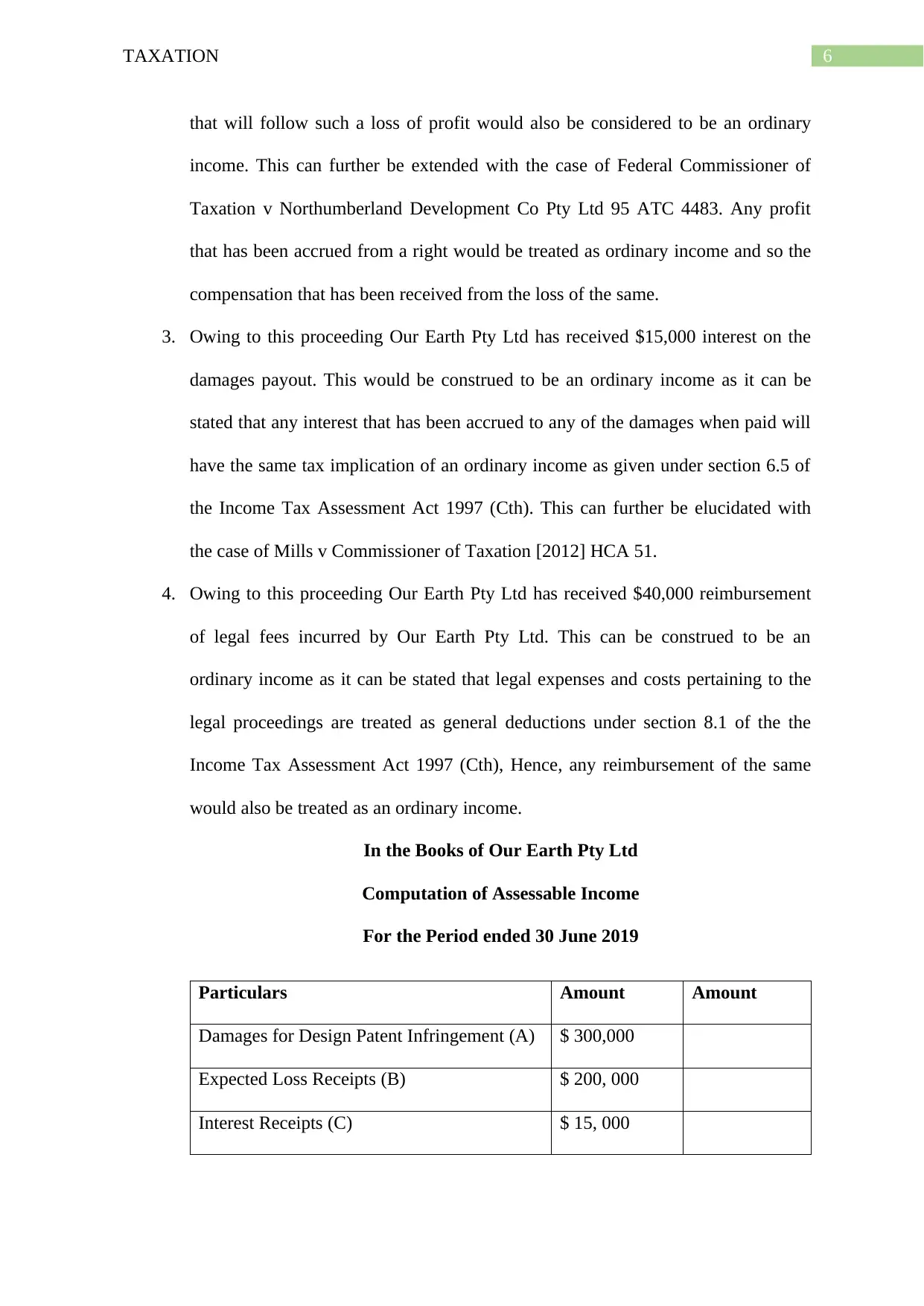
In the Books of Our Earth Pty Ltd
Computation of Assessable Income
For the Period ended 30 June 2019
Particulars Amount Amount
Damages for Design Patent Infringement (A) $ 300,000
Expected Loss Receipts (B) $ 200, 000
Interest Receipts (C) $ 15, 000
that will follow such a loss of profit would also be considered to be an ordinary
income. This can further be extended with the case of Federal Commissioner of
Taxation v Northumberland Development Co Pty Ltd 95 ATC 4483. Any profit
that has been accrued from a right would be treated as ordinary income and so the
compensation that has been received from the loss of the same.
3. Owing to this proceeding Our Earth Pty Ltd has received $15,000 interest on the
damages payout. This would be construed to be an ordinary income as it can be
stated that any interest that has been accrued to any of the damages when paid will
have the same tax implication of an ordinary income as given under section 6.5 of
the Income Tax Assessment Act 1997 (Cth). This can further be elucidated with
the case of Mills v Commissioner of Taxation [2012] HCA 51.
4. Owing to this proceeding Our Earth Pty Ltd has received $40,000 reimbursement
of legal fees incurred by Our Earth Pty Ltd. This can be construed to be an
ordinary income as it can be stated that legal expenses and costs pertaining to the
legal proceedings are treated as general deductions under section 8.1 of the the
Income Tax Assessment Act 1997 (Cth), Hence, any reimbursement of the same
would also be treated as an ordinary income.
In the Books of Our Earth Pty Ltd
Computation of Assessable Income
For the Period ended 30 June 2019
Particulars Amount Amount
Damages for Design Patent Infringement (A) $ 300,000
Expected Loss Receipts (B) $ 200, 000
Interest Receipts (C) $ 15, 000
Paraphrase This Document
Need a fresh take? Get an instant paraphrase of this document with our AI Paraphraser
7TAXATION
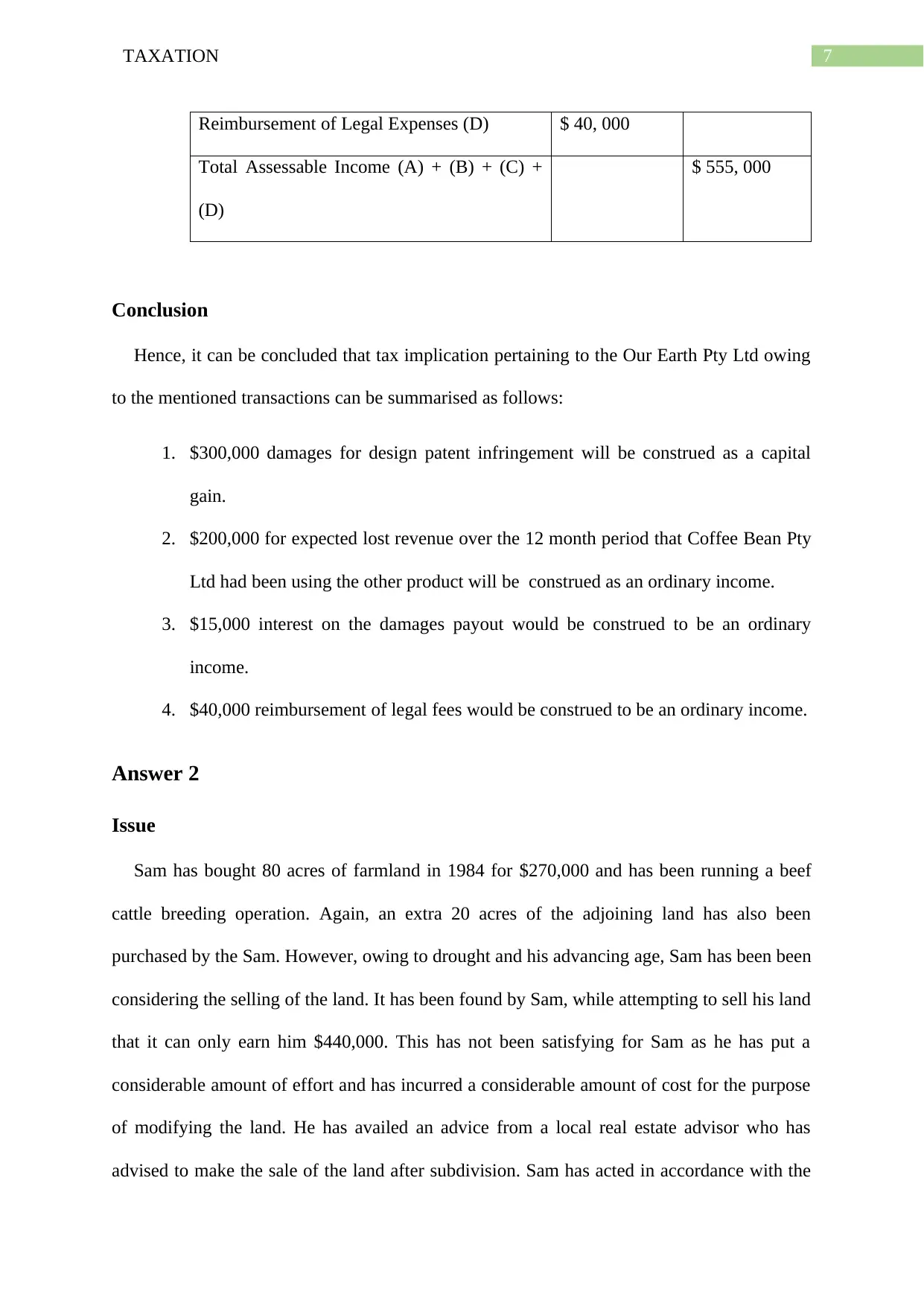
Reimbursement of Legal Expenses (D) $ 40, 000
Total Assessable Income (A) + (B) + (C) +
(D)
$ 555, 000
Conclusion
Hence, it can be concluded that tax implication pertaining to the Our Earth Pty Ltd owing
to the mentioned transactions can be summarised as follows:
1. $300,000 damages for design patent infringement will be construed as a capital
gain.
2. $200,000 for expected lost revenue over the 12 month period that Coffee Bean Pty
Ltd had been using the other product will be construed as an ordinary income.
3. $15,000 interest on the damages payout would be construed to be an ordinary
income.
4. $40,000 reimbursement of legal fees would be construed to be an ordinary income.
Answer 2
Issue
Sam has bought 80 acres of farmland in 1984 for $270,000 and has been running a beef
cattle breeding operation. Again, an extra 20 acres of the adjoining land has also been
purchased by the Sam. However, owing to drought and his advancing age, Sam has been been
considering the selling of the land. It has been found by Sam, while attempting to sell his land
that it can only earn him $440,000. This has not been satisfying for Sam as he has put a
considerable amount of effort and has incurred a considerable amount of cost for the purpose
of modifying the land. He has availed an advice from a local real estate advisor who has
advised to make the sale of the land after subdivision. Sam has acted in accordance with the
Reimbursement of Legal Expenses (D) $ 40, 000
Total Assessable Income (A) + (B) + (C) +
(D)
$ 555, 000
Conclusion
Hence, it can be concluded that tax implication pertaining to the Our Earth Pty Ltd owing
to the mentioned transactions can be summarised as follows:
1. $300,000 damages for design patent infringement will be construed as a capital
gain.
2. $200,000 for expected lost revenue over the 12 month period that Coffee Bean Pty
Ltd had been using the other product will be construed as an ordinary income.
3. $15,000 interest on the damages payout would be construed to be an ordinary
income.
4. $40,000 reimbursement of legal fees would be construed to be an ordinary income.
Answer 2
Issue
Sam has bought 80 acres of farmland in 1984 for $270,000 and has been running a beef
cattle breeding operation. Again, an extra 20 acres of the adjoining land has also been
purchased by the Sam. However, owing to drought and his advancing age, Sam has been been
considering the selling of the land. It has been found by Sam, while attempting to sell his land
that it can only earn him $440,000. This has not been satisfying for Sam as he has put a
considerable amount of effort and has incurred a considerable amount of cost for the purpose
of modifying the land. He has availed an advice from a local real estate advisor who has
advised to make the sale of the land after subdivision. Sam has acted in accordance with the
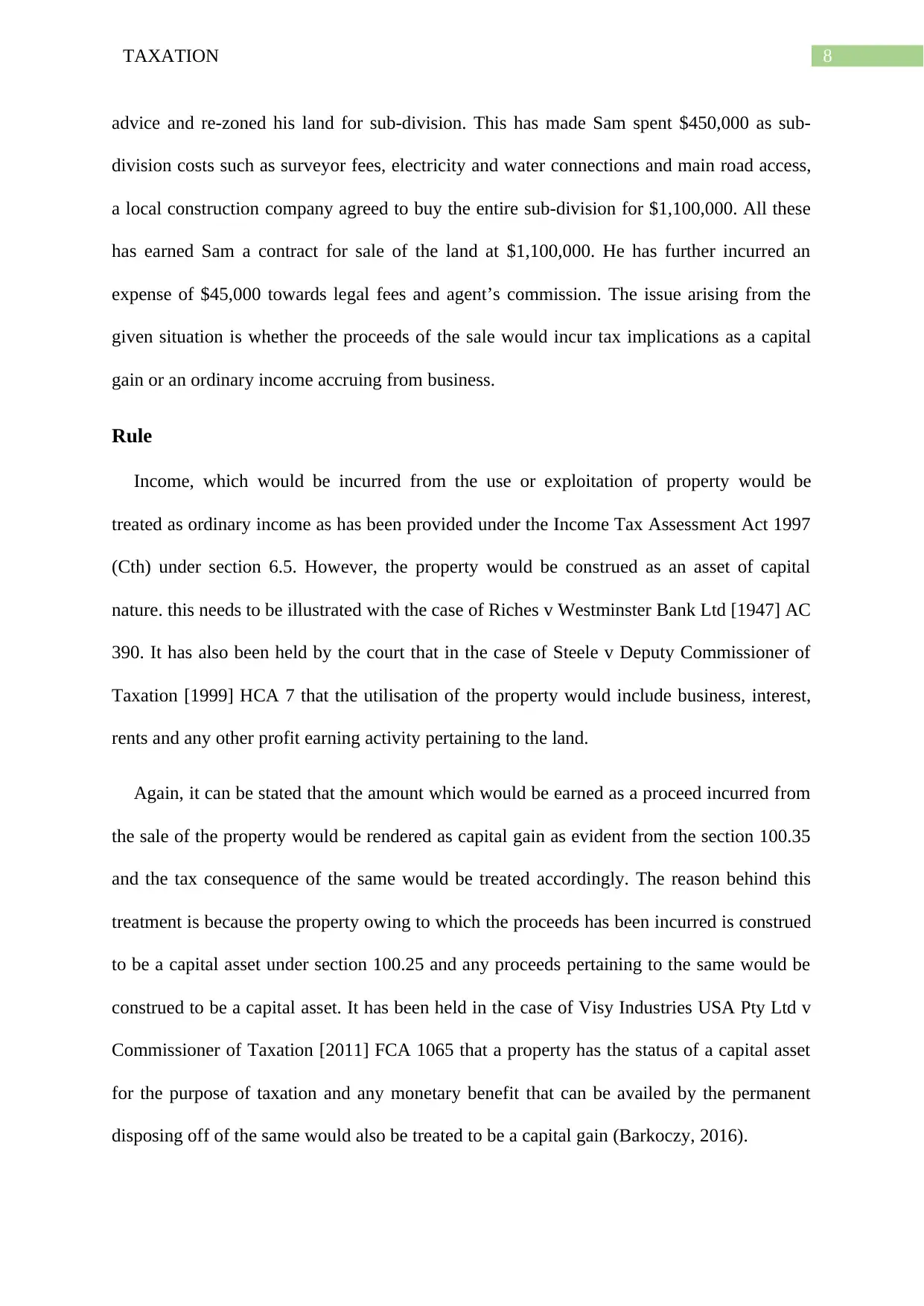
8TAXATION
advice and re-zoned his land for sub-division. This has made Sam spent $450,000 as sub-
division costs such as surveyor fees, electricity and water connections and main road access,
a local construction company agreed to buy the entire sub-division for $1,100,000. All these
has earned Sam a contract for sale of the land at $1,100,000. He has further incurred an
expense of $45,000 towards legal fees and agent’s commission. The issue arising from the
given situation is whether the proceeds of the sale would incur tax implications as a capital
gain or an ordinary income accruing from business.
Rule
Income, which would be incurred from the use or exploitation of property would be
treated as ordinary income as has been provided under the Income Tax Assessment Act 1997
(Cth) under section 6.5. However, the property would be construed as an asset of capital
nature. this needs to be illustrated with the case of Riches v Westminster Bank Ltd [1947] AC
390. It has also been held by the court that in the case of Steele v Deputy Commissioner of
Taxation [1999] HCA 7 that the utilisation of the property would include business, interest,
rents and any other profit earning activity pertaining to the land.
Again, it can be stated that the amount which would be earned as a proceed incurred from
the sale of the property would be rendered as capital gain as evident from the section 100.35
and the tax consequence of the same would be treated accordingly. The reason behind this
treatment is because the property owing to which the proceeds has been incurred is construed
to be a capital asset under section 100.25 and any proceeds pertaining to the same would be
construed to be a capital asset. It has been held in the case of Visy Industries USA Pty Ltd v
Commissioner of Taxation [2011] FCA 1065 that a property has the status of a capital asset
for the purpose of taxation and any monetary benefit that can be availed by the permanent
disposing off of the same would also be treated to be a capital gain (Barkoczy, 2016).
advice and re-zoned his land for sub-division. This has made Sam spent $450,000 as sub-
division costs such as surveyor fees, electricity and water connections and main road access,
a local construction company agreed to buy the entire sub-division for $1,100,000. All these
has earned Sam a contract for sale of the land at $1,100,000. He has further incurred an
expense of $45,000 towards legal fees and agent’s commission. The issue arising from the
given situation is whether the proceeds of the sale would incur tax implications as a capital
gain or an ordinary income accruing from business.
Rule
Income, which would be incurred from the use or exploitation of property would be
treated as ordinary income as has been provided under the Income Tax Assessment Act 1997
(Cth) under section 6.5. However, the property would be construed as an asset of capital
nature. this needs to be illustrated with the case of Riches v Westminster Bank Ltd [1947] AC
390. It has also been held by the court that in the case of Steele v Deputy Commissioner of
Taxation [1999] HCA 7 that the utilisation of the property would include business, interest,
rents and any other profit earning activity pertaining to the land.
Again, it can be stated that the amount which would be earned as a proceed incurred from
the sale of the property would be rendered as capital gain as evident from the section 100.35
and the tax consequence of the same would be treated accordingly. The reason behind this
treatment is because the property owing to which the proceeds has been incurred is construed
to be a capital asset under section 100.25 and any proceeds pertaining to the same would be
construed to be a capital asset. It has been held in the case of Visy Industries USA Pty Ltd v
Commissioner of Taxation [2011] FCA 1065 that a property has the status of a capital asset
for the purpose of taxation and any monetary benefit that can be availed by the permanent
disposing off of the same would also be treated to be a capital gain (Barkoczy, 2016).
⊘ This is a preview!⊘
Do you want full access?
Subscribe today to unlock all pages.
Trusted by 1+ million students worldwide
9TAXATION
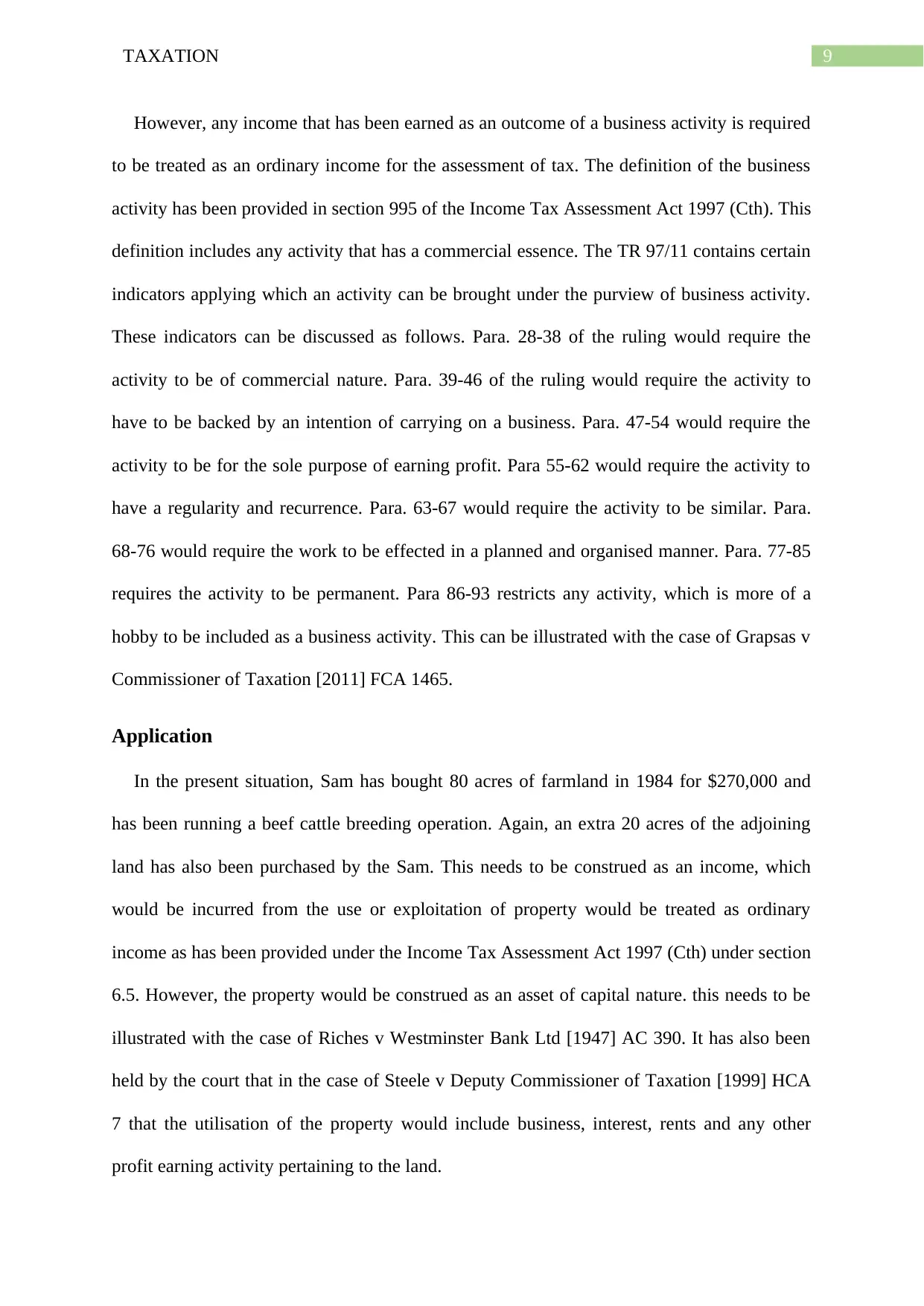
However, any income that has been earned as an outcome of a business activity is required
to be treated as an ordinary income for the assessment of tax. The definition of the business
activity has been provided in section 995 of the Income Tax Assessment Act 1997 (Cth). This
definition includes any activity that has a commercial essence. The TR 97/11 contains certain
indicators applying which an activity can be brought under the purview of business activity.
These indicators can be discussed as follows. Para. 28-38 of the ruling would require the
activity to be of commercial nature. Para. 39-46 of the ruling would require the activity to
have to be backed by an intention of carrying on a business. Para. 47-54 would require the
activity to be for the sole purpose of earning profit. Para 55-62 would require the activity to
have a regularity and recurrence. Para. 63-67 would require the activity to be similar. Para.
68-76 would require the work to be effected in a planned and organised manner. Para. 77-85
requires the activity to be permanent. Para 86-93 restricts any activity, which is more of a
hobby to be included as a business activity. This can be illustrated with the case of Grapsas v
Commissioner of Taxation [2011] FCA 1465.
Application
In the present situation, Sam has bought 80 acres of farmland in 1984 for $270,000 and
has been running a beef cattle breeding operation. Again, an extra 20 acres of the adjoining
land has also been purchased by the Sam. This needs to be construed as an income, which
would be incurred from the use or exploitation of property would be treated as ordinary
income as has been provided under the Income Tax Assessment Act 1997 (Cth) under section
6.5. However, the property would be construed as an asset of capital nature. this needs to be
illustrated with the case of Riches v Westminster Bank Ltd [1947] AC 390. It has also been
held by the court that in the case of Steele v Deputy Commissioner of Taxation [1999] HCA
7 that the utilisation of the property would include business, interest, rents and any other
profit earning activity pertaining to the land.
However, any income that has been earned as an outcome of a business activity is required
to be treated as an ordinary income for the assessment of tax. The definition of the business
activity has been provided in section 995 of the Income Tax Assessment Act 1997 (Cth). This
definition includes any activity that has a commercial essence. The TR 97/11 contains certain
indicators applying which an activity can be brought under the purview of business activity.
These indicators can be discussed as follows. Para. 28-38 of the ruling would require the
activity to be of commercial nature. Para. 39-46 of the ruling would require the activity to
have to be backed by an intention of carrying on a business. Para. 47-54 would require the
activity to be for the sole purpose of earning profit. Para 55-62 would require the activity to
have a regularity and recurrence. Para. 63-67 would require the activity to be similar. Para.
68-76 would require the work to be effected in a planned and organised manner. Para. 77-85
requires the activity to be permanent. Para 86-93 restricts any activity, which is more of a
hobby to be included as a business activity. This can be illustrated with the case of Grapsas v
Commissioner of Taxation [2011] FCA 1465.
Application
In the present situation, Sam has bought 80 acres of farmland in 1984 for $270,000 and
has been running a beef cattle breeding operation. Again, an extra 20 acres of the adjoining
land has also been purchased by the Sam. This needs to be construed as an income, which
would be incurred from the use or exploitation of property would be treated as ordinary
income as has been provided under the Income Tax Assessment Act 1997 (Cth) under section
6.5. However, the property would be construed as an asset of capital nature. this needs to be
illustrated with the case of Riches v Westminster Bank Ltd [1947] AC 390. It has also been
held by the court that in the case of Steele v Deputy Commissioner of Taxation [1999] HCA
7 that the utilisation of the property would include business, interest, rents and any other
profit earning activity pertaining to the land.
Paraphrase This Document
Need a fresh take? Get an instant paraphrase of this document with our AI Paraphraser
10TAXATION
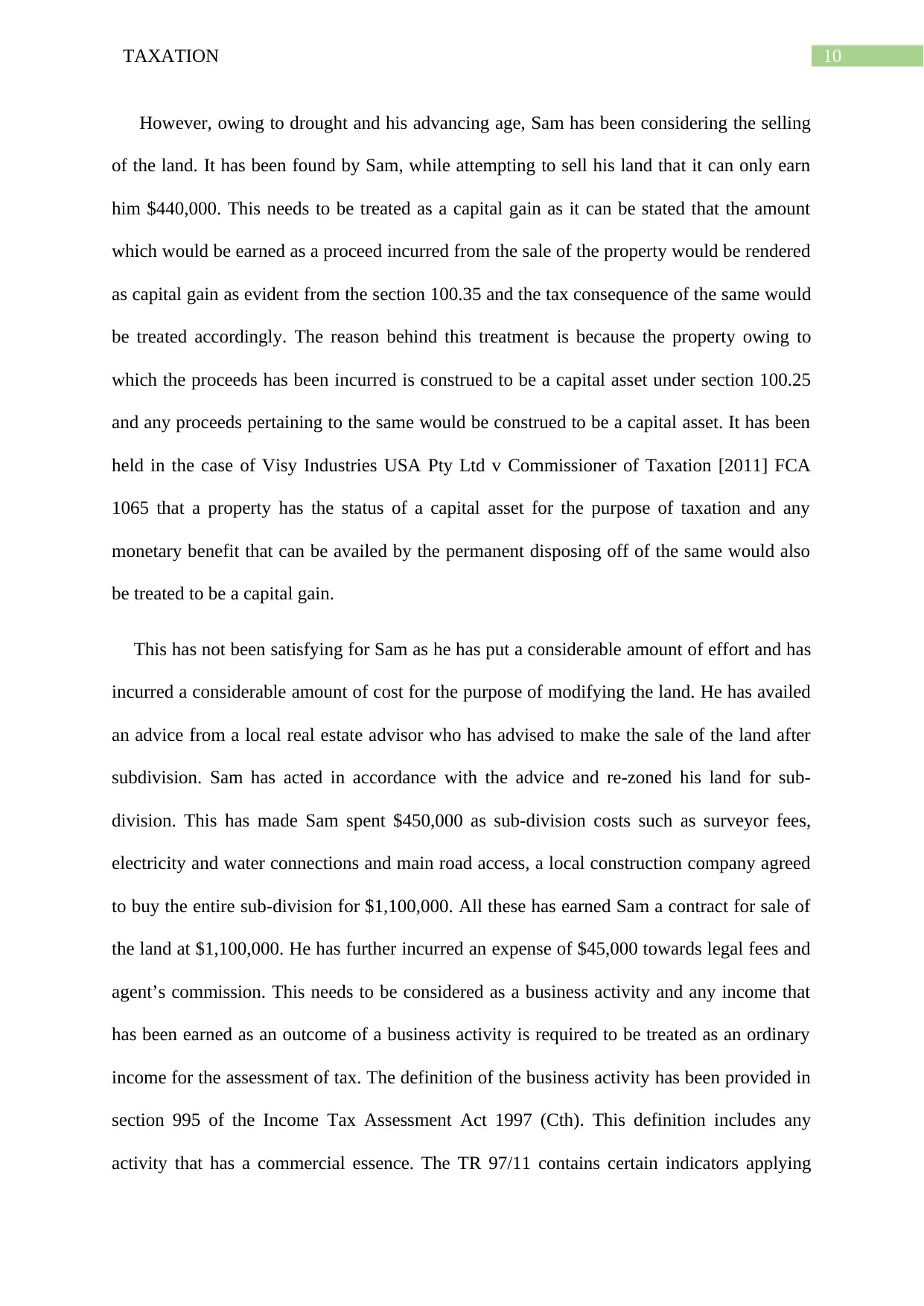
However, owing to drought and his advancing age, Sam has been considering the selling
of the land. It has been found by Sam, while attempting to sell his land that it can only earn
him $440,000. This needs to be treated as a capital gain as it can be stated that the amount
which would be earned as a proceed incurred from the sale of the property would be rendered
as capital gain as evident from the section 100.35 and the tax consequence of the same would
be treated accordingly. The reason behind this treatment is because the property owing to
which the proceeds has been incurred is construed to be a capital asset under section 100.25
and any proceeds pertaining to the same would be construed to be a capital asset. It has been
held in the case of Visy Industries USA Pty Ltd v Commissioner of Taxation [2011] FCA
1065 that a property has the status of a capital asset for the purpose of taxation and any
monetary benefit that can be availed by the permanent disposing off of the same would also
be treated to be a capital gain.
This has not been satisfying for Sam as he has put a considerable amount of effort and has
incurred a considerable amount of cost for the purpose of modifying the land. He has availed
an advice from a local real estate advisor who has advised to make the sale of the land after
subdivision. Sam has acted in accordance with the advice and re-zoned his land for sub-
division. This has made Sam spent $450,000 as sub-division costs such as surveyor fees,
electricity and water connections and main road access, a local construction company agreed
to buy the entire sub-division for $1,100,000. All these has earned Sam a contract for sale of
the land at $1,100,000. He has further incurred an expense of $45,000 towards legal fees and
agent’s commission. This needs to be considered as a business activity and any income that
has been earned as an outcome of a business activity is required to be treated as an ordinary
income for the assessment of tax. The definition of the business activity has been provided in
section 995 of the Income Tax Assessment Act 1997 (Cth). This definition includes any
activity that has a commercial essence. The TR 97/11 contains certain indicators applying
However, owing to drought and his advancing age, Sam has been considering the selling
of the land. It has been found by Sam, while attempting to sell his land that it can only earn
him $440,000. This needs to be treated as a capital gain as it can be stated that the amount
which would be earned as a proceed incurred from the sale of the property would be rendered
as capital gain as evident from the section 100.35 and the tax consequence of the same would
be treated accordingly. The reason behind this treatment is because the property owing to
which the proceeds has been incurred is construed to be a capital asset under section 100.25
and any proceeds pertaining to the same would be construed to be a capital asset. It has been
held in the case of Visy Industries USA Pty Ltd v Commissioner of Taxation [2011] FCA
1065 that a property has the status of a capital asset for the purpose of taxation and any
monetary benefit that can be availed by the permanent disposing off of the same would also
be treated to be a capital gain.
This has not been satisfying for Sam as he has put a considerable amount of effort and has
incurred a considerable amount of cost for the purpose of modifying the land. He has availed
an advice from a local real estate advisor who has advised to make the sale of the land after
subdivision. Sam has acted in accordance with the advice and re-zoned his land for sub-
division. This has made Sam spent $450,000 as sub-division costs such as surveyor fees,
electricity and water connections and main road access, a local construction company agreed
to buy the entire sub-division for $1,100,000. All these has earned Sam a contract for sale of
the land at $1,100,000. He has further incurred an expense of $45,000 towards legal fees and
agent’s commission. This needs to be considered as a business activity and any income that
has been earned as an outcome of a business activity is required to be treated as an ordinary
income for the assessment of tax. The definition of the business activity has been provided in
section 995 of the Income Tax Assessment Act 1997 (Cth). This definition includes any
activity that has a commercial essence. The TR 97/11 contains certain indicators applying
11TAXATION
which an activity can be brought under the purview of business activity. These indicators can
be discussed as follows. Para. 28-38 of the ruling would require the activity to be of
commercial nature. Para. 39-46 of the ruling would require the activity to have to be backed
by an intention of carrying on a business. Para. 47-54 would require the activity to be for the
sole purpose of earning profit. Para 55-62 would require the activity to have a regularity and
recurrence. Para. 63-67 would require the activity to be similar. Para. 68-76 would require the
work to be effected in a planned and organised manner. Para. 77-85 requires the activity to be
permanent. Para 86-93 restricts any activity, which is more of a hobby to be included as a
business activity. This can be illustrated with the case of Grapsas v Commissioner of
Taxation [2011] FCA 1465.
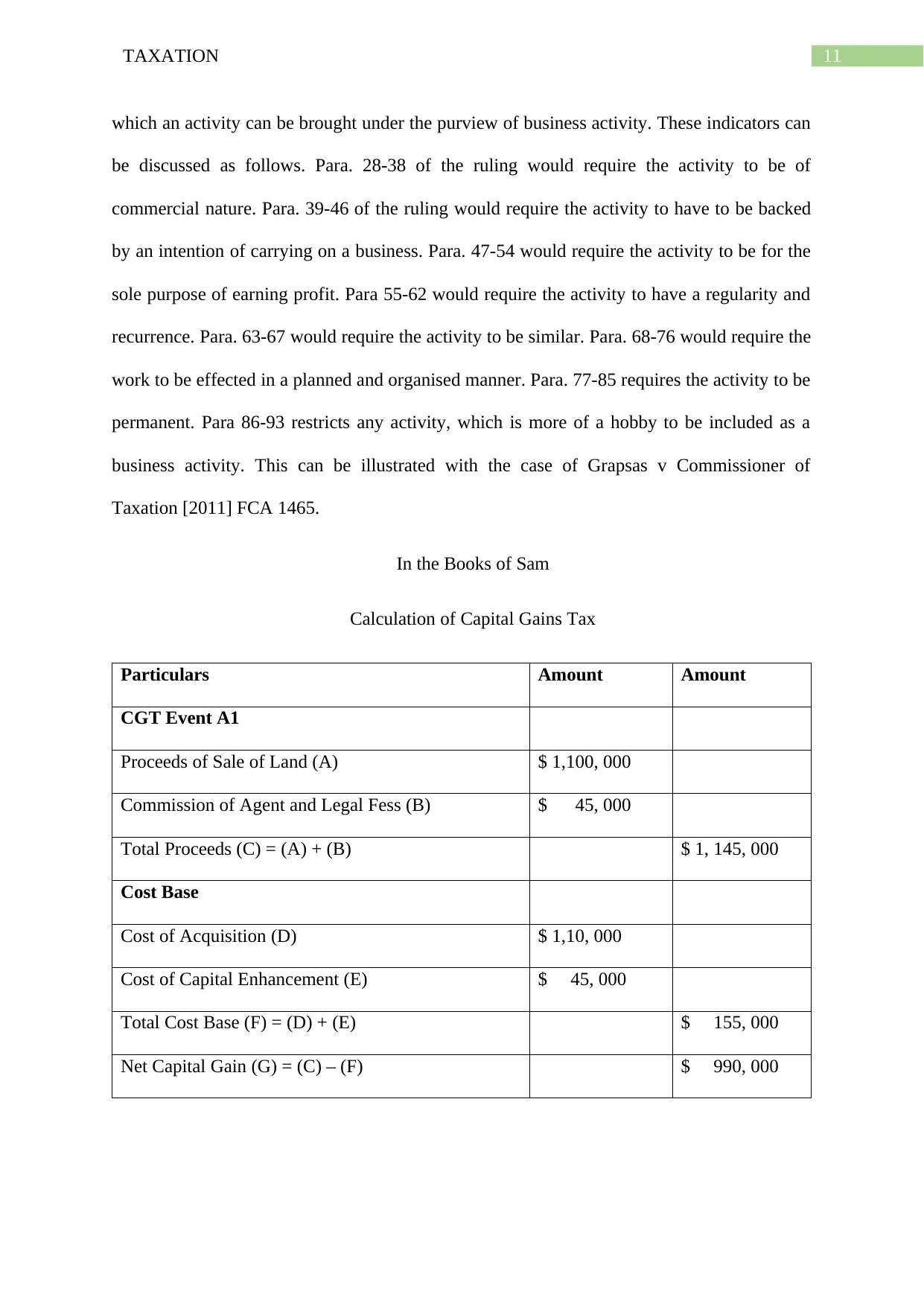
In the Books of Sam
Calculation of Capital Gains Tax
Particulars Amount Amount
CGT Event A1
Proceeds of Sale of Land (A) $ 1,100, 000
Commission of Agent and Legal Fess (B) $ 45, 000
Total Proceeds (C) = (A) + (B) $ 1, 145, 000
Cost Base
Cost of Acquisition (D) $ 1,10, 000
Cost of Capital Enhancement (E) $ 45, 000
Total Cost Base (F) = (D) + (E) $ 155, 000
Net Capital Gain (G) = (C) – (F) $ 990, 000
which an activity can be brought under the purview of business activity. These indicators can
be discussed as follows. Para. 28-38 of the ruling would require the activity to be of
commercial nature. Para. 39-46 of the ruling would require the activity to have to be backed
by an intention of carrying on a business. Para. 47-54 would require the activity to be for the
sole purpose of earning profit. Para 55-62 would require the activity to have a regularity and
recurrence. Para. 63-67 would require the activity to be similar. Para. 68-76 would require the
work to be effected in a planned and organised manner. Para. 77-85 requires the activity to be
permanent. Para 86-93 restricts any activity, which is more of a hobby to be included as a
business activity. This can be illustrated with the case of Grapsas v Commissioner of
Taxation [2011] FCA 1465.
In the Books of Sam
Calculation of Capital Gains Tax
Particulars Amount Amount
CGT Event A1
Proceeds of Sale of Land (A) $ 1,100, 000
Commission of Agent and Legal Fess (B) $ 45, 000
Total Proceeds (C) = (A) + (B) $ 1, 145, 000
Cost Base
Cost of Acquisition (D) $ 1,10, 000
Cost of Capital Enhancement (E) $ 45, 000
Total Cost Base (F) = (D) + (E) $ 155, 000
Net Capital Gain (G) = (C) – (F) $ 990, 000
⊘ This is a preview!⊘
Do you want full access?
Subscribe today to unlock all pages.
Trusted by 1+ million students worldwide

1 out of 14


Related Documents


Your All-in-One AI-Powered Toolkit for Academic Success.
+13062052269
info@desklib.com
Available 24*7 on WhatsApp / Email
![[object Object]](/_next/static/media/star-bottom.7253800d.svg)
Unlock your academic potential
Copyright © 2020–2026 A2Z Services. All Rights Reserved. Developed and managed by ZUCOL.