Taxation 1 Assignment: Taxation of Capital Gains and Damages
VerifiedAdded on 2022/12/27
|15
|4535
|1
Report
AI Summary
This report examines the tax implications for Our Earth Pty Ltd, an Australian company, resulting from a patent infringement case against Coffee Bean Pty Ltd. The assignment addresses the tax treatment of $300,000 in damages for design patent infringement and $200,000 for expected lost revenue. It delves into the classification of these amounts as capital gains or ordinary income under Australian tax law, specifically referencing the Income Tax Assessment Act 1997 (ITAA97). The report explores relevant legal principles, including the Quid pro quo principle and the application of Div 6 and Div 8 of ITAA97. It references the C&F parking company case for a comparative analysis of the taxability of proceeds from lawsuits. The analysis considers the potential for tax obligations and the importance of forward planning to avoid spreading tax burdens to shareholders. The report also discusses the impact of patent litigation settlements and the IRS's rulings on deferred compensation, ultimately assessing Our Earth Pty Ltd's tax liabilities based on the received compensation and its components (damages, lost revenue, and interest) following the patent violation.
1
Running Head: TAXATION 1
Taxation 1
Student’s Name
Affiliate Institution
Date
Running Head: TAXATION 1
Taxation 1
Student’s Name
Affiliate Institution
Date

Paraphrase This Document
Need a fresh take? Get an instant paraphrase of this document with our AI Paraphraser
2
TAXATION 1
QUESTION ONE
Issue
Our Earth Pty Ltd has received some capital gains as a result of compensation paid by
coffee bean patty ltd which was found to have infringed patent rights of our company. Some of
the amounts payable to the company by coffee bean party ltd were capital gains and ordinary
capital gains. Although the company had incurred a loss due to the patent infringement, the
interests received from the paid money for damages and the refurbishment of the legal fees are in
a way ordinary capital gain to the company and thus attracts tax obligation to the company. Due
to the paid compensation, Our Earth Pty Ltd should expect to face some tax obligations resulting
from the transactions. Failing to plan forward, the company might be spreading the tax obligation
to her shareholders. In case there is no truism in the claims of Our Earth Pty Ltd did of incurring
a loss as a result of the patent right infringement the amount received will be valid for taxation.
Law
The amount payable as a result of damages and other infringement incidents can be
classified as ordinary income or even as statutory income. This can be found under Div 6 of
(income tax assessment act 1997) (ITAA97). According to this act legislative gains refer to the
capital gains received by a company, eligible termination payments (ETPs), insurance for income
losses which are assessable, assessable recoupment, and finally the employment allowances
(Gummow, 2011). Concession exception considerations are required in the case of any damages
payment, in cases where the recipient is assessable in more than one provision, the introduction
of an anti-overlap regulation is necessary to enable the assessment of the exemption to have fair
taxation on compensation which is being received. In most cases, compensation payments may
TAXATION 1
QUESTION ONE
Issue
Our Earth Pty Ltd has received some capital gains as a result of compensation paid by
coffee bean patty ltd which was found to have infringed patent rights of our company. Some of
the amounts payable to the company by coffee bean party ltd were capital gains and ordinary
capital gains. Although the company had incurred a loss due to the patent infringement, the
interests received from the paid money for damages and the refurbishment of the legal fees are in
a way ordinary capital gain to the company and thus attracts tax obligation to the company. Due
to the paid compensation, Our Earth Pty Ltd should expect to face some tax obligations resulting
from the transactions. Failing to plan forward, the company might be spreading the tax obligation
to her shareholders. In case there is no truism in the claims of Our Earth Pty Ltd did of incurring
a loss as a result of the patent right infringement the amount received will be valid for taxation.
Law
The amount payable as a result of damages and other infringement incidents can be
classified as ordinary income or even as statutory income. This can be found under Div 6 of
(income tax assessment act 1997) (ITAA97). According to this act legislative gains refer to the
capital gains received by a company, eligible termination payments (ETPs), insurance for income
losses which are assessable, assessable recoupment, and finally the employment allowances
(Gummow, 2011). Concession exception considerations are required in the case of any damages
payment, in cases where the recipient is assessable in more than one provision, the introduction
of an anti-overlap regulation is necessary to enable the assessment of the exemption to have fair
taxation on compensation which is being received. In most cases, compensation payments may
3
TAXATION 1
be subject to deductions under the (DIV8) deductions as well as the capital expenditure (s40-80)
of ITAA97.
The fundamental principle of the damages assessment states that such an amount of money
received from compensation should be awarded to the injured party by the tribunal to help in
regaining the state of the company. This principle does not apply in cases whereby the party had
not incurred any injuries in her incomes and operations. The second principle states that all the
damages are to be assessed once by reference and concerning the probability which is has been
proved and is available (Gummow, 2011). The above principle is then broken down forming
several taxation rules which apply to the compensated damages. The rules are as follows;
If the award of damage compensation is accounted for and the defendant found to have
wrongful conducts such as inflating, deducting, hastening or even delaying the plaintiff
tax borne incidence, the taxation is concerned as irrelevant to the damage to be
compensated. In such cases, there is no adjustment in the amount to be paid due to
modification of the taxation law (Richardson & Lanis, 2007). Mostly this is considered
during incidents when the damages and what is to be compensated would or will be
subject to taxation. Furthermore, this is also discussed in events where the statutory
compensation rights are applied to the net amount after tax has been affected.
Secondly, if the defendants’ infringement actions are found to have a negative effect
on the taxation of the plaintiff, for instance, alteration of the taxation incidences which
are subjective to remoteness, taxation incidence which has been altered becomes an
appropriate damages assessment for the tax obligation to be affected (Richardson &
Lanis, 2007). This is because those actions have resulted in a loss in the taxation process.
TAXATION 1
be subject to deductions under the (DIV8) deductions as well as the capital expenditure (s40-80)
of ITAA97.
The fundamental principle of the damages assessment states that such an amount of money
received from compensation should be awarded to the injured party by the tribunal to help in
regaining the state of the company. This principle does not apply in cases whereby the party had
not incurred any injuries in her incomes and operations. The second principle states that all the
damages are to be assessed once by reference and concerning the probability which is has been
proved and is available (Gummow, 2011). The above principle is then broken down forming
several taxation rules which apply to the compensated damages. The rules are as follows;
If the award of damage compensation is accounted for and the defendant found to have
wrongful conducts such as inflating, deducting, hastening or even delaying the plaintiff
tax borne incidence, the taxation is concerned as irrelevant to the damage to be
compensated. In such cases, there is no adjustment in the amount to be paid due to
modification of the taxation law (Richardson & Lanis, 2007). Mostly this is considered
during incidents when the damages and what is to be compensated would or will be
subject to taxation. Furthermore, this is also discussed in events where the statutory
compensation rights are applied to the net amount after tax has been affected.
Secondly, if the defendants’ infringement actions are found to have a negative effect
on the taxation of the plaintiff, for instance, alteration of the taxation incidences which
are subjective to remoteness, taxation incidence which has been altered becomes an
appropriate damages assessment for the tax obligation to be affected (Richardson &
Lanis, 2007). This is because those actions have resulted in a loss in the taxation process.
⊘ This is a preview!⊘
Do you want full access?
Subscribe today to unlock all pages.

Trusted by 1+ million students worldwide
4
TAXATION 1
If the incident hadn't happened, the adjusted prevalence would be liable to taxation and
the loss incurred would have been income which would be subject to tax.
Finally, For a conclusion to be made in determining whether the defendant's actions
affect the liability to tax of the plaintiff, tax computation for the period of the damage that
the plaintiff would have been taxed should be conducted. Besides, the calculation of what
the plaintiff is expected to be liable to impose on the damages also should be performed
(Richardson & Lanis, 2007).
Another principle is the Quid pro quo, the replacement or the whole policy. This principle
refers to questioning the reasons and the accounts to which the compensation was made. This is a
further assessment on payment whether settlements were made to income account or the capital
account which includes lost wages or the loss of profit. If compensation were made to damage
concerned with income, ordinary concept, ITAA97 s6-5 would have applied to the beneficially.
Some other factors override the principle of Quid pro quo; for instance if the damages payment
constitutes income gains which are arrived at as a result of periodic payment which is not
associated with installments of a large amount of money (Sikka & Willmott, 2010). Regarding
ITAA97, ss20-35, 20-20 and 20-40 outgoings are not to be subject to deductions as they are not
categorized as general deductions. This is because these deductions do not follow the reception
of deductible compensations.
After resolving patent infringement cases either by agreements or through the judgmental
ruling, the infringer is responsible for compensation, and the plaintiff gets subjected to several
tax obligations. The primary attention arises to the infringer tax deductions and also the winner is
TAXATION 1
If the incident hadn't happened, the adjusted prevalence would be liable to taxation and
the loss incurred would have been income which would be subject to tax.
Finally, For a conclusion to be made in determining whether the defendant's actions
affect the liability to tax of the plaintiff, tax computation for the period of the damage that
the plaintiff would have been taxed should be conducted. Besides, the calculation of what
the plaintiff is expected to be liable to impose on the damages also should be performed
(Richardson & Lanis, 2007).
Another principle is the Quid pro quo, the replacement or the whole policy. This principle
refers to questioning the reasons and the accounts to which the compensation was made. This is a
further assessment on payment whether settlements were made to income account or the capital
account which includes lost wages or the loss of profit. If compensation were made to damage
concerned with income, ordinary concept, ITAA97 s6-5 would have applied to the beneficially.
Some other factors override the principle of Quid pro quo; for instance if the damages payment
constitutes income gains which are arrived at as a result of periodic payment which is not
associated with installments of a large amount of money (Sikka & Willmott, 2010). Regarding
ITAA97, ss20-35, 20-20 and 20-40 outgoings are not to be subject to deductions as they are not
categorized as general deductions. This is because these deductions do not follow the reception
of deductible compensations.
After resolving patent infringement cases either by agreements or through the judgmental
ruling, the infringer is responsible for compensation, and the plaintiff gets subjected to several
tax obligations. The primary attention arises to the infringer tax deductions and also the winner is
Paraphrase This Document
Need a fresh take? Get an instant paraphrase of this document with our AI Paraphraser
5
TAXATION 1
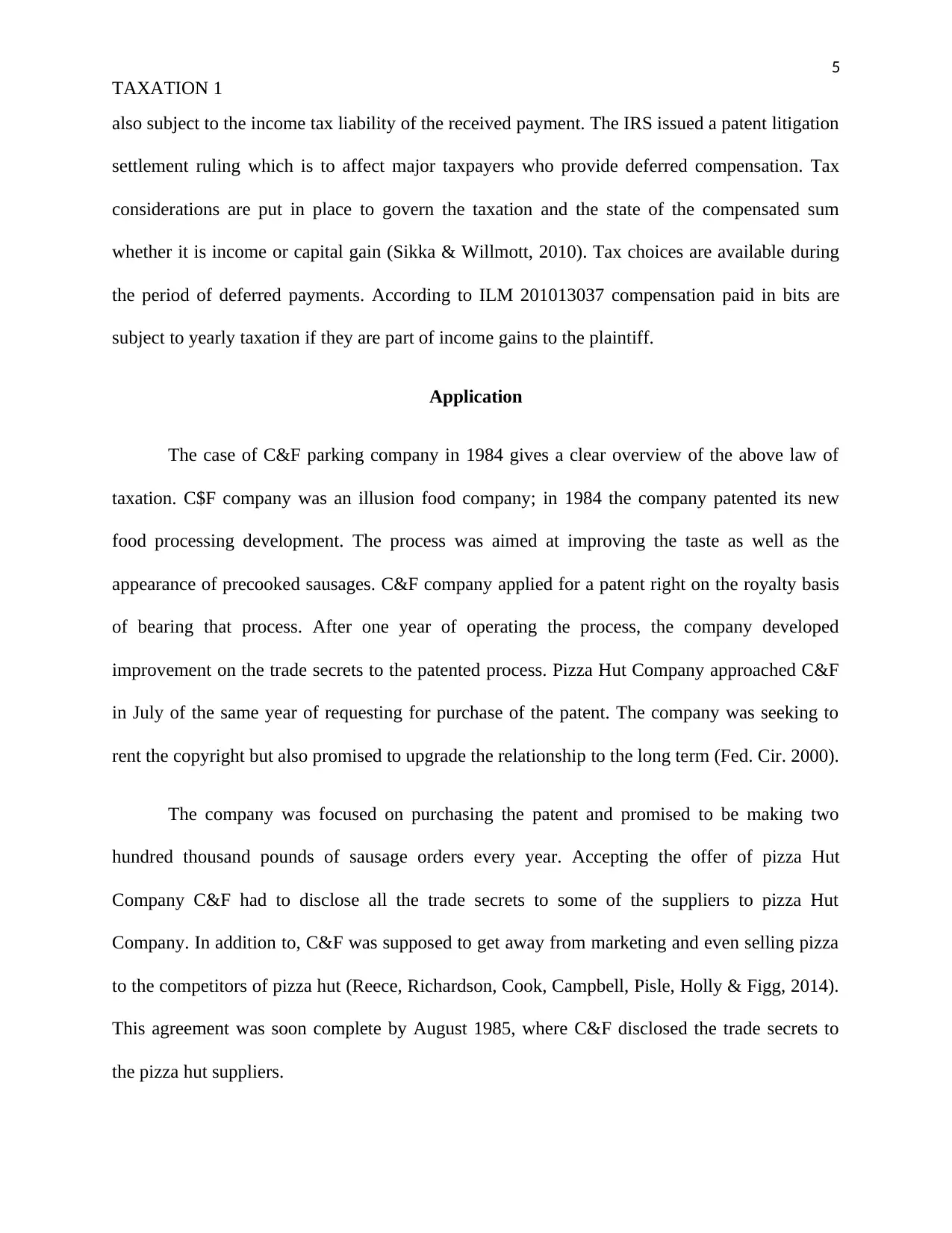
also subject to the income tax liability of the received payment. The IRS issued a patent litigation
settlement ruling which is to affect major taxpayers who provide deferred compensation. Tax
considerations are put in place to govern the taxation and the state of the compensated sum
whether it is income or capital gain (Sikka & Willmott, 2010). Tax choices are available during
the period of deferred payments. According to ILM 201013037 compensation paid in bits are
subject to yearly taxation if they are part of income gains to the plaintiff.
Application
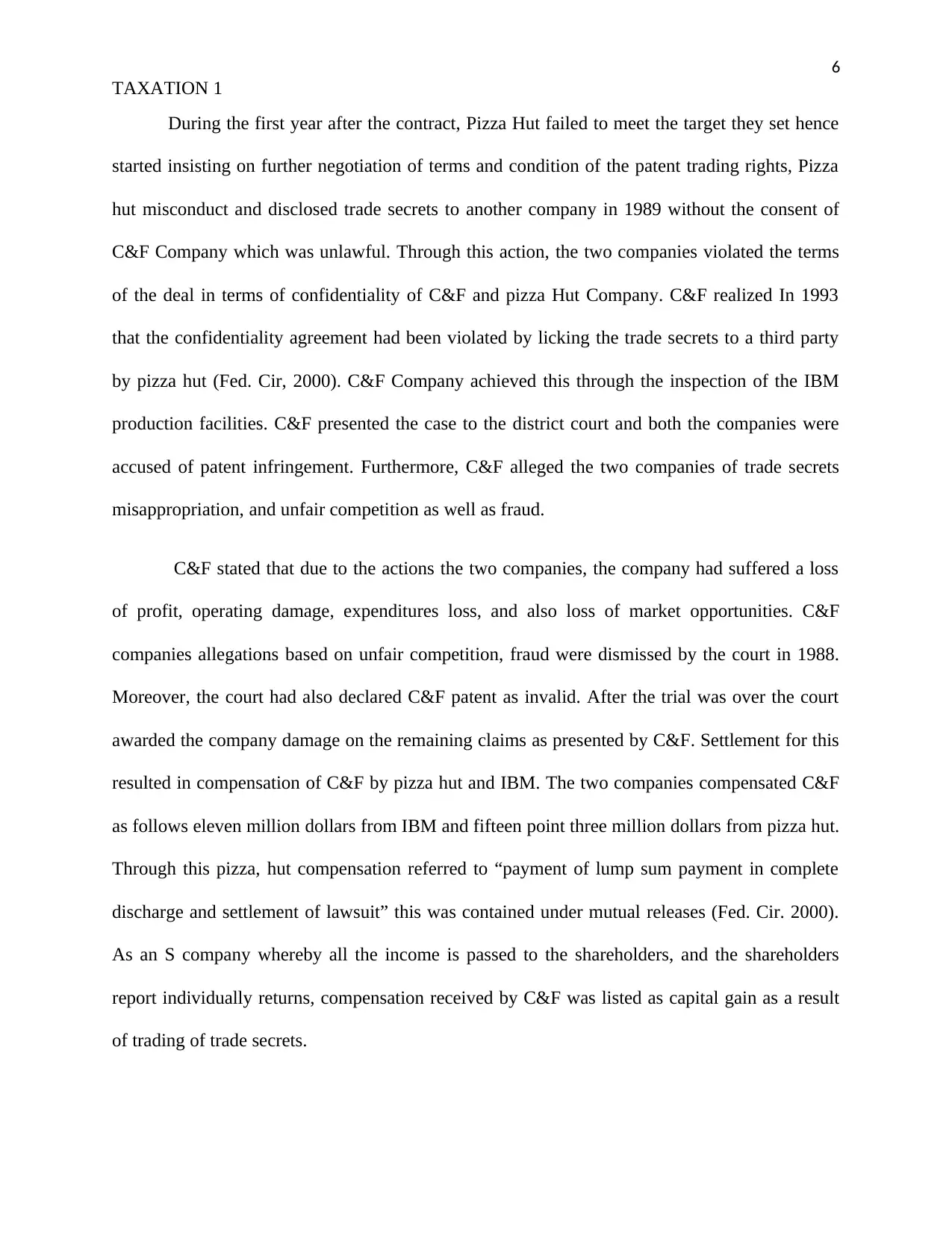
The case of C&F parking company in 1984 gives a clear overview of the above law of
taxation. C$F company was an illusion food company; in 1984 the company patented its new
food processing development. The process was aimed at improving the taste as well as the
appearance of precooked sausages. C&F company applied for a patent right on the royalty basis
of bearing that process. After one year of operating the process, the company developed
improvement on the trade secrets to the patented process. Pizza Hut Company approached C&F
in July of the same year of requesting for purchase of the patent. The company was seeking to
rent the copyright but also promised to upgrade the relationship to the long term (Fed. Cir. 2000).
The company was focused on purchasing the patent and promised to be making two
hundred thousand pounds of sausage orders every year. Accepting the offer of pizza Hut
Company C&F had to disclose all the trade secrets to some of the suppliers to pizza Hut
Company. In addition to, C&F was supposed to get away from marketing and even selling pizza
to the competitors of pizza hut (Reece, Richardson, Cook, Campbell, Pisle, Holly & Figg, 2014).
This agreement was soon complete by August 1985, where C&F disclosed the trade secrets to
the pizza hut suppliers.
TAXATION 1
also subject to the income tax liability of the received payment. The IRS issued a patent litigation
settlement ruling which is to affect major taxpayers who provide deferred compensation. Tax
considerations are put in place to govern the taxation and the state of the compensated sum
whether it is income or capital gain (Sikka & Willmott, 2010). Tax choices are available during
the period of deferred payments. According to ILM 201013037 compensation paid in bits are
subject to yearly taxation if they are part of income gains to the plaintiff.
Application
The case of C&F parking company in 1984 gives a clear overview of the above law of
taxation. C$F company was an illusion food company; in 1984 the company patented its new
food processing development. The process was aimed at improving the taste as well as the
appearance of precooked sausages. C&F company applied for a patent right on the royalty basis
of bearing that process. After one year of operating the process, the company developed
improvement on the trade secrets to the patented process. Pizza Hut Company approached C&F
in July of the same year of requesting for purchase of the patent. The company was seeking to
rent the copyright but also promised to upgrade the relationship to the long term (Fed. Cir. 2000).
The company was focused on purchasing the patent and promised to be making two
hundred thousand pounds of sausage orders every year. Accepting the offer of pizza Hut
Company C&F had to disclose all the trade secrets to some of the suppliers to pizza Hut
Company. In addition to, C&F was supposed to get away from marketing and even selling pizza
to the competitors of pizza hut (Reece, Richardson, Cook, Campbell, Pisle, Holly & Figg, 2014).
This agreement was soon complete by August 1985, where C&F disclosed the trade secrets to
the pizza hut suppliers.
6
TAXATION 1
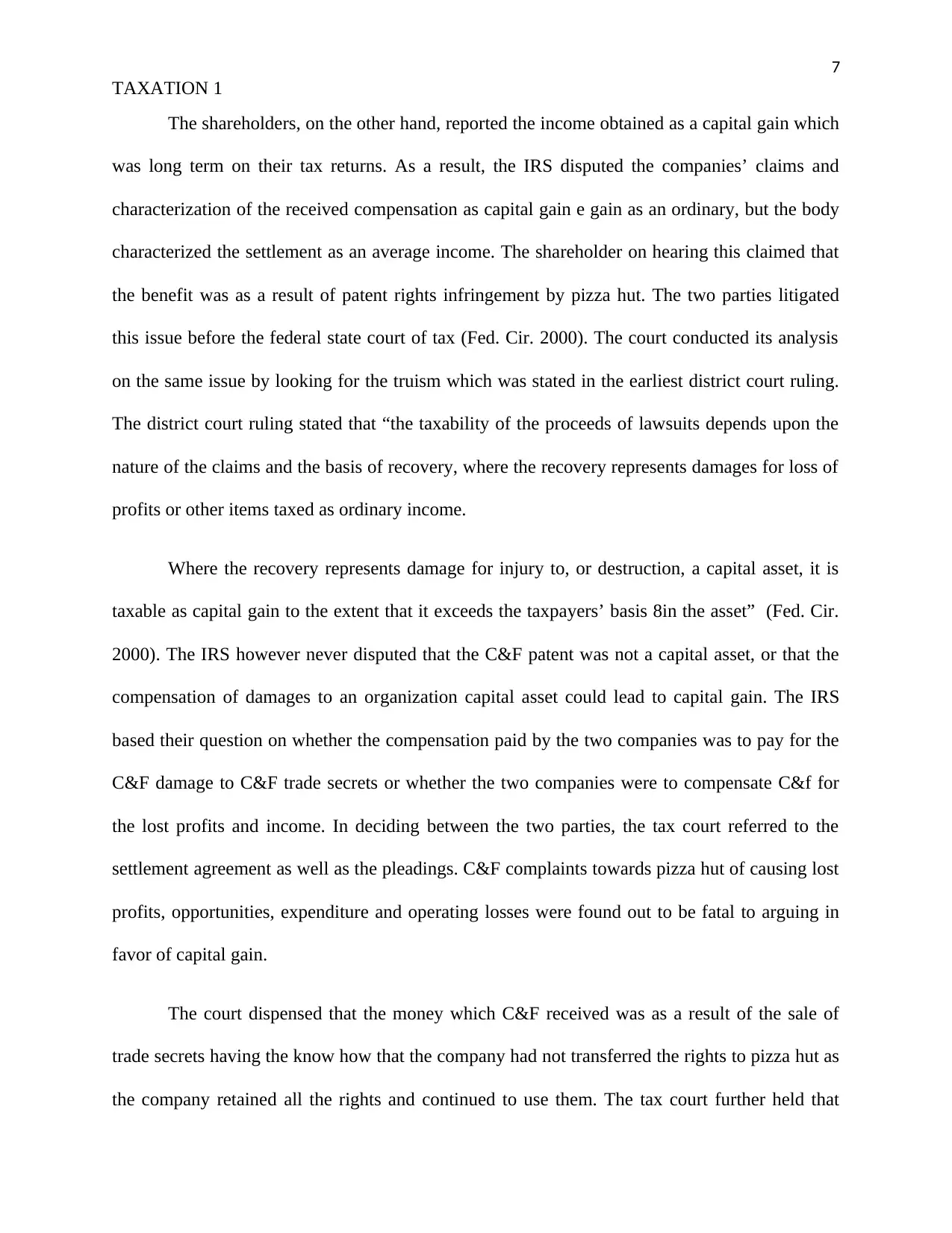
During the first year after the contract, Pizza Hut failed to meet the target they set hence
started insisting on further negotiation of terms and condition of the patent trading rights, Pizza
hut misconduct and disclosed trade secrets to another company in 1989 without the consent of
C&F Company which was unlawful. Through this action, the two companies violated the terms
of the deal in terms of confidentiality of C&F and pizza Hut Company. C&F realized In 1993
that the confidentiality agreement had been violated by licking the trade secrets to a third party
by pizza hut (Fed. Cir, 2000). C&F Company achieved this through the inspection of the IBM
production facilities. C&F presented the case to the district court and both the companies were
accused of patent infringement. Furthermore, C&F alleged the two companies of trade secrets
misappropriation, and unfair competition as well as fraud.
C&F stated that due to the actions the two companies, the company had suffered a loss
of profit, operating damage, expenditures loss, and also loss of market opportunities. C&F
companies allegations based on unfair competition, fraud were dismissed by the court in 1988.
Moreover, the court had also declared C&F patent as invalid. After the trial was over the court
awarded the company damage on the remaining claims as presented by C&F. Settlement for this
resulted in compensation of C&F by pizza hut and IBM. The two companies compensated C&F
as follows eleven million dollars from IBM and fifteen point three million dollars from pizza hut.
Through this pizza, hut compensation referred to “payment of lump sum payment in complete
discharge and settlement of lawsuit” this was contained under mutual releases (Fed. Cir. 2000).
As an S company whereby all the income is passed to the shareholders, and the shareholders
report individually returns, compensation received by C&F was listed as capital gain as a result
of trading of trade secrets.
TAXATION 1
During the first year after the contract, Pizza Hut failed to meet the target they set hence
started insisting on further negotiation of terms and condition of the patent trading rights, Pizza
hut misconduct and disclosed trade secrets to another company in 1989 without the consent of
C&F Company which was unlawful. Through this action, the two companies violated the terms
of the deal in terms of confidentiality of C&F and pizza Hut Company. C&F realized In 1993
that the confidentiality agreement had been violated by licking the trade secrets to a third party
by pizza hut (Fed. Cir, 2000). C&F Company achieved this through the inspection of the IBM
production facilities. C&F presented the case to the district court and both the companies were
accused of patent infringement. Furthermore, C&F alleged the two companies of trade secrets
misappropriation, and unfair competition as well as fraud.
C&F stated that due to the actions the two companies, the company had suffered a loss
of profit, operating damage, expenditures loss, and also loss of market opportunities. C&F
companies allegations based on unfair competition, fraud were dismissed by the court in 1988.
Moreover, the court had also declared C&F patent as invalid. After the trial was over the court
awarded the company damage on the remaining claims as presented by C&F. Settlement for this
resulted in compensation of C&F by pizza hut and IBM. The two companies compensated C&F
as follows eleven million dollars from IBM and fifteen point three million dollars from pizza hut.
Through this pizza, hut compensation referred to “payment of lump sum payment in complete
discharge and settlement of lawsuit” this was contained under mutual releases (Fed. Cir. 2000).
As an S company whereby all the income is passed to the shareholders, and the shareholders
report individually returns, compensation received by C&F was listed as capital gain as a result
of trading of trade secrets.
⊘ This is a preview!⊘
Do you want full access?
Subscribe today to unlock all pages.
Trusted by 1+ million students worldwide
7
TAXATION 1
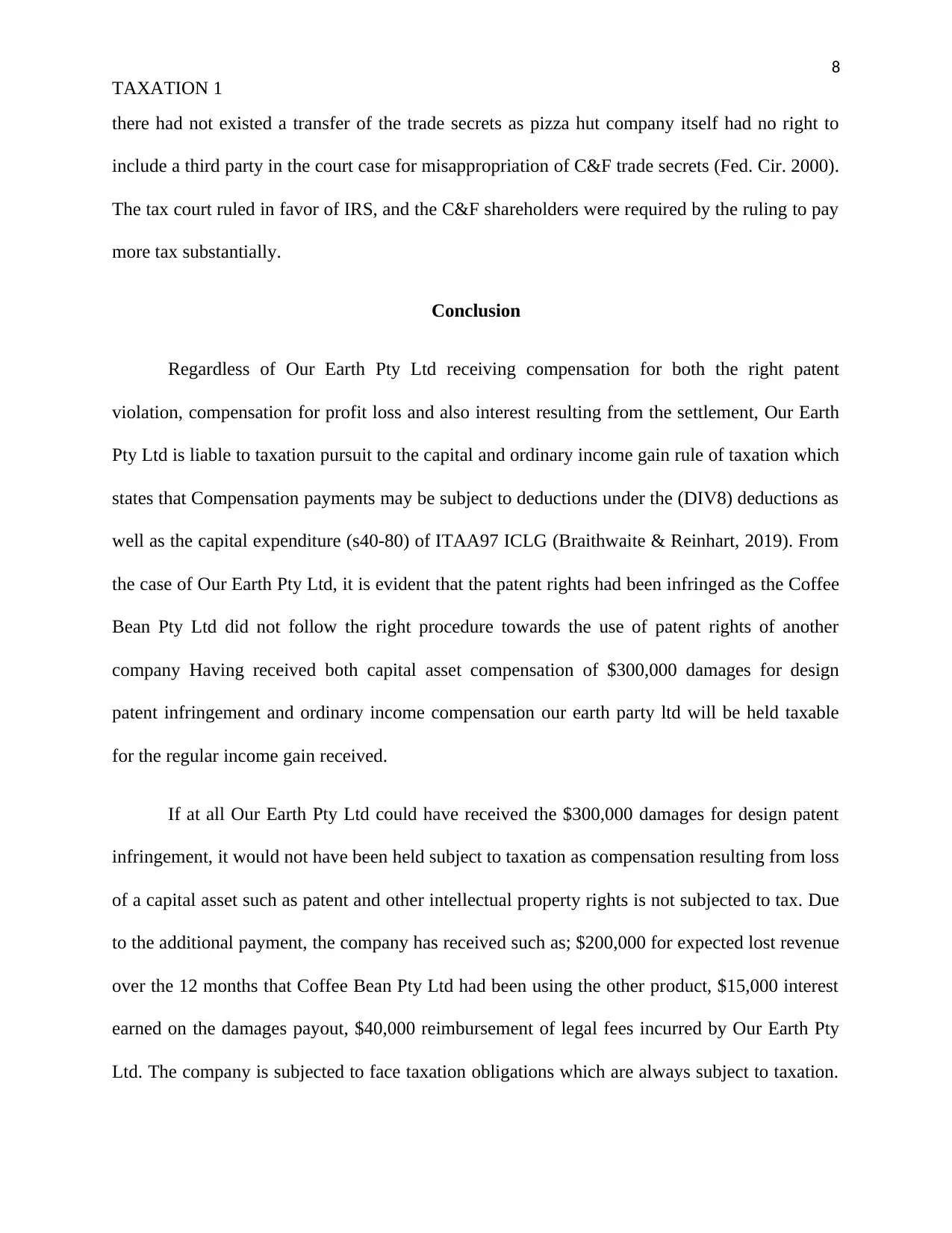
The shareholders, on the other hand, reported the income obtained as a capital gain which
was long term on their tax returns. As a result, the IRS disputed the companies’ claims and
characterization of the received compensation as capital gain e gain as an ordinary, but the body
characterized the settlement as an average income. The shareholder on hearing this claimed that
the benefit was as a result of patent rights infringement by pizza hut. The two parties litigated
this issue before the federal state court of tax (Fed. Cir. 2000). The court conducted its analysis
on the same issue by looking for the truism which was stated in the earliest district court ruling.
The district court ruling stated that “the taxability of the proceeds of lawsuits depends upon the
nature of the claims and the basis of recovery, where the recovery represents damages for loss of
profits or other items taxed as ordinary income.
Where the recovery represents damage for injury to, or destruction, a capital asset, it is
taxable as capital gain to the extent that it exceeds the taxpayers’ basis 8in the asset” (Fed. Cir.
2000). The IRS however never disputed that the C&F patent was not a capital asset, or that the
compensation of damages to an organization capital asset could lead to capital gain. The IRS
based their question on whether the compensation paid by the two companies was to pay for the
C&F damage to C&F trade secrets or whether the two companies were to compensate C&f for
the lost profits and income. In deciding between the two parties, the tax court referred to the
settlement agreement as well as the pleadings. C&F complaints towards pizza hut of causing lost
profits, opportunities, expenditure and operating losses were found out to be fatal to arguing in
favor of capital gain.
The court dispensed that the money which C&F received was as a result of the sale of
trade secrets having the know how that the company had not transferred the rights to pizza hut as
the company retained all the rights and continued to use them. The tax court further held that
TAXATION 1
The shareholders, on the other hand, reported the income obtained as a capital gain which
was long term on their tax returns. As a result, the IRS disputed the companies’ claims and
characterization of the received compensation as capital gain e gain as an ordinary, but the body
characterized the settlement as an average income. The shareholder on hearing this claimed that
the benefit was as a result of patent rights infringement by pizza hut. The two parties litigated
this issue before the federal state court of tax (Fed. Cir. 2000). The court conducted its analysis
on the same issue by looking for the truism which was stated in the earliest district court ruling.
The district court ruling stated that “the taxability of the proceeds of lawsuits depends upon the
nature of the claims and the basis of recovery, where the recovery represents damages for loss of
profits or other items taxed as ordinary income.
Where the recovery represents damage for injury to, or destruction, a capital asset, it is
taxable as capital gain to the extent that it exceeds the taxpayers’ basis 8in the asset” (Fed. Cir.
2000). The IRS however never disputed that the C&F patent was not a capital asset, or that the
compensation of damages to an organization capital asset could lead to capital gain. The IRS
based their question on whether the compensation paid by the two companies was to pay for the
C&F damage to C&F trade secrets or whether the two companies were to compensate C&f for
the lost profits and income. In deciding between the two parties, the tax court referred to the
settlement agreement as well as the pleadings. C&F complaints towards pizza hut of causing lost
profits, opportunities, expenditure and operating losses were found out to be fatal to arguing in
favor of capital gain.
The court dispensed that the money which C&F received was as a result of the sale of
trade secrets having the know how that the company had not transferred the rights to pizza hut as
the company retained all the rights and continued to use them. The tax court further held that
Paraphrase This Document
Need a fresh take? Get an instant paraphrase of this document with our AI Paraphraser
8
TAXATION 1
there had not existed a transfer of the trade secrets as pizza hut company itself had no right to
include a third party in the court case for misappropriation of C&F trade secrets (Fed. Cir. 2000).
The tax court ruled in favor of IRS, and the C&F shareholders were required by the ruling to pay
more tax substantially.
Conclusion
Regardless of Our Earth Pty Ltd receiving compensation for both the right patent
violation, compensation for profit loss and also interest resulting from the settlement, Our Earth
Pty Ltd is liable to taxation pursuit to the capital and ordinary income gain rule of taxation which
states that Compensation payments may be subject to deductions under the (DIV8) deductions as
well as the capital expenditure (s40-80) of ITAA97 ICLG (Braithwaite & Reinhart, 2019). From
the case of Our Earth Pty Ltd, it is evident that the patent rights had been infringed as the Coffee
Bean Pty Ltd did not follow the right procedure towards the use of patent rights of another
company Having received both capital asset compensation of $300,000 damages for design
patent infringement and ordinary income compensation our earth party ltd will be held taxable
for the regular income gain received.
If at all Our Earth Pty Ltd could have received the $300,000 damages for design patent
infringement, it would not have been held subject to taxation as compensation resulting from loss
of a capital asset such as patent and other intellectual property rights is not subjected to tax. Due
to the additional payment, the company has received such as; $200,000 for expected lost revenue
over the 12 months that Coffee Bean Pty Ltd had been using the other product, $15,000 interest
earned on the damages payout, $40,000 reimbursement of legal fees incurred by Our Earth Pty
Ltd. The company is subjected to face taxation obligations which are always subject to taxation.
TAXATION 1
there had not existed a transfer of the trade secrets as pizza hut company itself had no right to
include a third party in the court case for misappropriation of C&F trade secrets (Fed. Cir. 2000).
The tax court ruled in favor of IRS, and the C&F shareholders were required by the ruling to pay
more tax substantially.
Conclusion
Regardless of Our Earth Pty Ltd receiving compensation for both the right patent
violation, compensation for profit loss and also interest resulting from the settlement, Our Earth
Pty Ltd is liable to taxation pursuit to the capital and ordinary income gain rule of taxation which
states that Compensation payments may be subject to deductions under the (DIV8) deductions as
well as the capital expenditure (s40-80) of ITAA97 ICLG (Braithwaite & Reinhart, 2019). From
the case of Our Earth Pty Ltd, it is evident that the patent rights had been infringed as the Coffee
Bean Pty Ltd did not follow the right procedure towards the use of patent rights of another
company Having received both capital asset compensation of $300,000 damages for design
patent infringement and ordinary income compensation our earth party ltd will be held taxable
for the regular income gain received.
If at all Our Earth Pty Ltd could have received the $300,000 damages for design patent
infringement, it would not have been held subject to taxation as compensation resulting from loss
of a capital asset such as patent and other intellectual property rights is not subjected to tax. Due
to the additional payment, the company has received such as; $200,000 for expected lost revenue
over the 12 months that Coffee Bean Pty Ltd had been using the other product, $15,000 interest
earned on the damages payout, $40,000 reimbursement of legal fees incurred by Our Earth Pty
Ltd. The company is subjected to face taxation obligations which are always subject to taxation.
9
TAXATION 1
Our Earth Pty Ltd should record gains received from the compensation as both capital gain and
also ordinary benefits to avoid further costs and added penalties for tax eviction.
QUESTION TWO
Issue
Having made up a decision to resell his land which he has operated in for many years,
Sam requested for an evaluation of his property. But the evaluator disappointed Sam
expectations by valuing the area at a low cost. Considering its strategic position, Sam thought of
selling the property in subdivisions. In Australia, several tax obligations are applied when one
decides to divide land for resale to enjoy profits out of the property sale. Hence the decision of
sub-dividing his land attracted additional costs to Sam as well as tax obligations. Having divided
the land and retaining the ownership of the property also attracted tax to Sam. Having not built or
even lived in this land Sam was not too lucky to get primary residence execution when selling
the estate. Finally, having signed a sale contract which lasted for three months before settlement
Sam was also liable to income tax obligation and agent commission fee for those three months.
Law
Capital gain tax (CGT) is the tax that is attached to any gains that are made out of the sale
of any capital asset; this is also included and charged in every tax income statement in Australia.
Capital gain tax is not treated separately from ordinary taxes. The Australian rules indicate
clearly that if there exists a pre-capital gain taxable land and it has undergone sub-division, the
land will not lose its capital gain tax status even though it has experienced a sub-division. Capital
TAXATION 1
Our Earth Pty Ltd should record gains received from the compensation as both capital gain and
also ordinary benefits to avoid further costs and added penalties for tax eviction.
QUESTION TWO
Issue
Having made up a decision to resell his land which he has operated in for many years,
Sam requested for an evaluation of his property. But the evaluator disappointed Sam
expectations by valuing the area at a low cost. Considering its strategic position, Sam thought of
selling the property in subdivisions. In Australia, several tax obligations are applied when one
decides to divide land for resale to enjoy profits out of the property sale. Hence the decision of
sub-dividing his land attracted additional costs to Sam as well as tax obligations. Having divided
the land and retaining the ownership of the property also attracted tax to Sam. Having not built or
even lived in this land Sam was not too lucky to get primary residence execution when selling
the estate. Finally, having signed a sale contract which lasted for three months before settlement
Sam was also liable to income tax obligation and agent commission fee for those three months.
Law
Capital gain tax (CGT) is the tax that is attached to any gains that are made out of the sale
of any capital asset; this is also included and charged in every tax income statement in Australia.
Capital gain tax is not treated separately from ordinary taxes. The Australian rules indicate
clearly that if there exists a pre-capital gain taxable land and it has undergone sub-division, the
land will not lose its capital gain tax status even though it has experienced a sub-division. Capital
⊘ This is a preview!⊘
Do you want full access?
Subscribe today to unlock all pages.
Trusted by 1+ million students worldwide
10
TAXATION 1
gain is given by calculating the cost base subtraction from the actual proceeds sale of the asset
(Hefferan & Boyd, 2010). In cases where the sale proceeds exceed the cost base then the
regulation refers to that as a capital gain which is a typical example is subject to taxation
Subdivision of land is not subject to taxation, but the sale of the sub-divided assets attracts tax
obligations inform of revenue or capital nature. The Tax office of Australia has issued taxation
ruling which has a clear interpretation of the law. Mostly these laws are concerned with the
description of various factors which might term sub-division of land from being just a mere
realization to a capital asset and finally to an undertaking of revenue (Woellner, Barkoczy,
Murphy, Evans & Pinto, 2010).
The factors to consider according to the tax office includes; the significance of the
landowner intention to subdivide the land and to sell or buy a sub-divided property, whether the
sub-division is a business transaction or landowners decision. Another factor is the costs
involved in the subdivision of the land, and also the profit sought magnitude of this decision
(Tambuwala, Rajabifard, Bennett, Wallace & Williamson, 2012). Moreover, the research of the
complexity and nature of the sub-division, another consideration is the individual who is
responsible for the divisions and how the divisions are made and also the relationship of the sub-
divider and the landowner. The taxation will now consider the valuation of the land since it was
attained to the time of conversion from capital asset to revenue in nature. This is after all the
conditions are well researched, and the results indicate that the submission is revenue in nature.
If a sub-division is found out to be of profit-making capital gain tax will impose on the sale of
the divide lots.
TAXATION 1
gain is given by calculating the cost base subtraction from the actual proceeds sale of the asset
(Hefferan & Boyd, 2010). In cases where the sale proceeds exceed the cost base then the
regulation refers to that as a capital gain which is a typical example is subject to taxation
Subdivision of land is not subject to taxation, but the sale of the sub-divided assets attracts tax
obligations inform of revenue or capital nature. The Tax office of Australia has issued taxation
ruling which has a clear interpretation of the law. Mostly these laws are concerned with the
description of various factors which might term sub-division of land from being just a mere
realization to a capital asset and finally to an undertaking of revenue (Woellner, Barkoczy,
Murphy, Evans & Pinto, 2010).
The factors to consider according to the tax office includes; the significance of the
landowner intention to subdivide the land and to sell or buy a sub-divided property, whether the
sub-division is a business transaction or landowners decision. Another factor is the costs
involved in the subdivision of the land, and also the profit sought magnitude of this decision
(Tambuwala, Rajabifard, Bennett, Wallace & Williamson, 2012). Moreover, the research of the
complexity and nature of the sub-division, another consideration is the individual who is
responsible for the divisions and how the divisions are made and also the relationship of the sub-
divider and the landowner. The taxation will now consider the valuation of the land since it was
attained to the time of conversion from capital asset to revenue in nature. This is after all the
conditions are well researched, and the results indicate that the submission is revenue in nature.
If a sub-division is found out to be of profit-making capital gain tax will impose on the sale of
the divide lots.
Paraphrase This Document
Need a fresh take? Get an instant paraphrase of this document with our AI Paraphraser
11
TAXATION 1
Application
The case of Morgan is clear evidence of the above the law and also a similar situation to
that of Sam. Morgan decided to divide his maize farm for sale to maximize on profit after the
land surveyor and value expert valued it at a lower price than he expected. Application of the
conditions given by the tax office of Australia to Morgan’s’ case, it was reflected that Morgan
intentions to sell the land after he had subdivided was pure for capital gain (McCulloch v.
Morgan). Moreover, in Australia capital gains attract taxation under the capital gain tax laws of
the nation (Crabtree, Blunden, Phibbs, Sappideen, Mortimer, Shahib-Smith & Chung, 2013). As
Morgan’s land was not exceptional to pre-capital gain tax, moreover graham had not been living
in the ground or had he constructed any house, hence he never received any exemptions.
The costs involved in the subdivision of Morgan’s had to be calculated, and capital gain
obligations attracted by this sale analyzed to determine the nature of the transactions and any
exemptions in case they are available. This made Morgan’s total land sale subject to taxation
according to the Australian capital gain taxation rule. Having bought the piece of land after 1982,
Morgan was also not exempted to capital gain tax obligation on the property. The sale of
Morgan’s piece of land in slots attracted more taxation which ended up as a loss to him.
Conclusion
Calculation of Cost base for Sam can be done as follows;
Land purchase expense $380,000
Agent commission and legal fee $45000
TAXATION 1
Application
The case of Morgan is clear evidence of the above the law and also a similar situation to
that of Sam. Morgan decided to divide his maize farm for sale to maximize on profit after the
land surveyor and value expert valued it at a lower price than he expected. Application of the
conditions given by the tax office of Australia to Morgan’s’ case, it was reflected that Morgan
intentions to sell the land after he had subdivided was pure for capital gain (McCulloch v.
Morgan). Moreover, in Australia capital gains attract taxation under the capital gain tax laws of
the nation (Crabtree, Blunden, Phibbs, Sappideen, Mortimer, Shahib-Smith & Chung, 2013). As
Morgan’s land was not exceptional to pre-capital gain tax, moreover graham had not been living
in the ground or had he constructed any house, hence he never received any exemptions.
The costs involved in the subdivision of Morgan’s had to be calculated, and capital gain
obligations attracted by this sale analyzed to determine the nature of the transactions and any
exemptions in case they are available. This made Morgan’s total land sale subject to taxation
according to the Australian capital gain taxation rule. Having bought the piece of land after 1982,
Morgan was also not exempted to capital gain tax obligation on the property. The sale of
Morgan’s piece of land in slots attracted more taxation which ended up as a loss to him.
Conclusion
Calculation of Cost base for Sam can be done as follows;
Land purchase expense $380,000
Agent commission and legal fee $45000
12
TAXATION 1
Subdivision expenses $450000
Total $875000
Capital Gains:
This refers to the excess value which is realized after sales which are above cost base and are
subjected to taxation. The capital gain for Sam can be calculated as follows;
Sale value (20% on 1,100,000) $880000
Less: cost base $875000
Capital gain $5000
Concerning the conditions given by the tax office of the country, it is clear that Sam
intention to sell the land was to make a profit, more so the subdivision was done and paid for by
Sam, and hence he had turned his land from capital formation to revenue form. From the case of
Sam, it is also clear that Sam had purchased the piece of land in 1984 and hence he was
exempted for income gain tax of the land (McLaren, 2014). Furthermore, having not lived in that
land or even constructed a home in the piece of land Sam was also not exempted under residence
exemption which is provided by Australian law. Sam has decided to take the wrong decision as
he has also engaged in a sale contract which took more than three months to be settled.
The interest that Sam will receive in July will also be subject to his income tax as they
will be classified as ordinary incomes and hence putting Sam on a critical condition, Sam will be
subjected to a capital gain tax of his land as his intentions had turned his capital asset to revenue.
TAXATION 1
Subdivision expenses $450000
Total $875000
Capital Gains:
This refers to the excess value which is realized after sales which are above cost base and are
subjected to taxation. The capital gain for Sam can be calculated as follows;
Sale value (20% on 1,100,000) $880000
Less: cost base $875000
Capital gain $5000
Concerning the conditions given by the tax office of the country, it is clear that Sam
intention to sell the land was to make a profit, more so the subdivision was done and paid for by
Sam, and hence he had turned his land from capital formation to revenue form. From the case of
Sam, it is also clear that Sam had purchased the piece of land in 1984 and hence he was
exempted for income gain tax of the land (McLaren, 2014). Furthermore, having not lived in that
land or even constructed a home in the piece of land Sam was also not exempted under residence
exemption which is provided by Australian law. Sam has decided to take the wrong decision as
he has also engaged in a sale contract which took more than three months to be settled.
The interest that Sam will receive in July will also be subject to his income tax as they
will be classified as ordinary incomes and hence putting Sam on a critical condition, Sam will be
subjected to a capital gain tax of his land as his intentions had turned his capital asset to revenue.
⊘ This is a preview!⊘
Do you want full access?
Subscribe today to unlock all pages.
Trusted by 1+ million students worldwide

1 out of 15


Related Documents


Your All-in-One AI-Powered Toolkit for Academic Success.
+13062052269
info@desklib.com
Available 24*7 on WhatsApp / Email
![[object Object]](/_next/static/media/star-bottom.7253800d.svg)
Unlock your academic potential
Copyright © 2020–2026 A2Z Services. All Rights Reserved. Developed and managed by ZUCOL.