Taxation Law Assignment: Income Tax, Deductions, and Case Analysis
VerifiedAdded on 2023/06/05
|13
|3550
|356
Homework Assignment
AI Summary
This taxation law assignment presents solutions to several key issues. The first question addresses the determination of ordinary income under section 6-5 of the ITAA 1997, analyzing whether annual lottery payments constitute taxable income, supported by case law such as Scott v Commissioner of Taxation. The second question involves the computation of taxable income for a pharmacy, including assessable income and eligible deductions. The third question examines the principle of tax avoidance, referencing the case of IRC v Duke of Westminster [1936] and its implications for structuring financial arrangements. The final question explores the entitlement to claim losses arising from co-ownership of rental property, referencing TR 93/32 and the case of McDonald v FC of T (1987), clarifying the treatment of co-ownership for income tax purposes and the allocation of losses.
Running head: TAXATION LAW
Taxation Law
Name of the Student
Name of the University
Authors Note
Course ID
Taxation Law
Name of the Student
Name of the University
Authors Note
Course ID

Paraphrase This Document
Need a fresh take? Get an instant paraphrase of this document with our AI Paraphraser
1TAXATION LAW
Table of Contents
Answer to question 1:.................................................................................................................2
Issues:.....................................................................................................................................2
Laws:......................................................................................................................................2
Application:............................................................................................................................3
Conclusion:............................................................................................................................4
Answer to question 2:.................................................................................................................4
Answer to question 3:.................................................................................................................5
Answer to question 4:.................................................................................................................6
Issue:......................................................................................................................................6
Laws:......................................................................................................................................6
Application:............................................................................................................................9
Conclusion:..........................................................................................................................10
References:...............................................................................................................................11
Table of Contents
Answer to question 1:.................................................................................................................2
Issues:.....................................................................................................................................2
Laws:......................................................................................................................................2
Application:............................................................................................................................3
Conclusion:............................................................................................................................4
Answer to question 2:.................................................................................................................4
Answer to question 3:.................................................................................................................5
Answer to question 4:.................................................................................................................6
Issue:......................................................................................................................................6
Laws:......................................................................................................................................6
Application:............................................................................................................................9
Conclusion:..........................................................................................................................10
References:...............................................................................................................................11
2TAXATION LAW
Answer to question 1:
Issues:
The current issue is based on determining whether the annual payment that is received
by the taxpayer constitute ordinary income under the ordinary concepts of “section 6-5,
ITAA 1997”.
Laws:
The taxable income is subjected to income tax since it is added to the taxable income.
The conception of ordinary income is generally derived from the case law approach and has
been developed over the years (Edmonds 2018). The ordinary income is taken into the
consideration as the taxpayers taxable income under “section 6-5, ITAA 1997”. The taxable
income of the taxpayer comprises of the income in accordance with the ordinary income
which is usually known as the ordinary income.
Ordinary income is generally characterised as the receipt that is periodic having
regularity and recurrence of receipt. The receipt is associated with the revenue generating
activities. “Section 6-5 of the ITAA 1997” explains ordinary income as the income which is
based on the ordinary concepts (Burton 2017). Gains require the characterisation by the court
of law in ascertaining whether it has the character of income and within the ordinary concept
of “section 6-5 of the ITAA 1997”. The court of law in “Scott v Commissioner of Taxation
(1935)” interpreted that income should be ascertained based on the ordinary concepts of
mankind.
A receipt cannot be characterised as the ordinary income unless it meets the
prerequisites such as whether it can be convertible to cash or it is a real gain to the taxpayer.
On finding that both the prerequisites of income has been satisfied then the gain will be
treated as the ordinary income given it reflects the adequate characteristics of income such as
Answer to question 1:
Issues:
The current issue is based on determining whether the annual payment that is received
by the taxpayer constitute ordinary income under the ordinary concepts of “section 6-5,
ITAA 1997”.
Laws:
The taxable income is subjected to income tax since it is added to the taxable income.
The conception of ordinary income is generally derived from the case law approach and has
been developed over the years (Edmonds 2018). The ordinary income is taken into the
consideration as the taxpayers taxable income under “section 6-5, ITAA 1997”. The taxable
income of the taxpayer comprises of the income in accordance with the ordinary income
which is usually known as the ordinary income.
Ordinary income is generally characterised as the receipt that is periodic having
regularity and recurrence of receipt. The receipt is associated with the revenue generating
activities. “Section 6-5 of the ITAA 1997” explains ordinary income as the income which is
based on the ordinary concepts (Burton 2017). Gains require the characterisation by the court
of law in ascertaining whether it has the character of income and within the ordinary concept
of “section 6-5 of the ITAA 1997”. The court of law in “Scott v Commissioner of Taxation
(1935)” interpreted that income should be ascertained based on the ordinary concepts of
mankind.
A receipt cannot be characterised as the ordinary income unless it meets the
prerequisites such as whether it can be convertible to cash or it is a real gain to the taxpayer.
On finding that both the prerequisites of income has been satisfied then the gain will be
treated as the ordinary income given it reflects the adequate characteristics of income such as
⊘ This is a preview!⊘
Do you want full access?
Subscribe today to unlock all pages.

Trusted by 1+ million students worldwide
3TAXATION LAW
regular or periodic receipts (Peiro. and Smyth 2017). As general rule gains are treated as the
ordinary income when it is received periodically or regularly rather than receiving it as the
lump sum. The court of law in “Blake v FC of T (1984)” regular receipts are treated as
income in nature.
For a taxpayer an item of income has the character of gain unless it comes home. The
court of law in “McNeil v FC of T (2007)” held that the character of income must be
determined under the circumstances of its derivation by the taxpayer and without paying
regard to the character it may have had given it has been derived by some other person (Jones
2017). The court in “Hochstrassser v Mayes (1960)” held its opinion by stating that in order
to have the character of income the item should be gain by the taxpayer that derives it.
A gain that is in the form of number derived periodically possess the character of
income since it involves recurrence regularity and periodicity. The taxation commissioner in
“FC of T v Dixon (1952)” held that the periodic receipts possess the character of income
stream (Buchanan and Consett 2016). This means that the amount of money is paid
periodically or at least yearly. The nature of the receipts should be ascertained with respect to
all the necessary factors together with the quality in the recipient’s hands.
Application:
The present evidences gained from the case suggest that lotteries commission carry
out instantaneous lottery where the winner is provided $50,000 for every year up to time
period of 20 years. The first $50,000 is paid to the winner soon when the winner is notified
and the amounts are payable following the first annual payment. In case of death the
commission pays the deceased estate with the outstanding amount.
With respect to the “S 6-5, ITAA 1997” the sum from the lottery can be considered as
the income based on the ordinary meaning (Brydges and Yuen 2018). With reference to
regular or periodic receipts (Peiro. and Smyth 2017). As general rule gains are treated as the
ordinary income when it is received periodically or regularly rather than receiving it as the
lump sum. The court of law in “Blake v FC of T (1984)” regular receipts are treated as
income in nature.
For a taxpayer an item of income has the character of gain unless it comes home. The
court of law in “McNeil v FC of T (2007)” held that the character of income must be
determined under the circumstances of its derivation by the taxpayer and without paying
regard to the character it may have had given it has been derived by some other person (Jones
2017). The court in “Hochstrassser v Mayes (1960)” held its opinion by stating that in order
to have the character of income the item should be gain by the taxpayer that derives it.
A gain that is in the form of number derived periodically possess the character of
income since it involves recurrence regularity and periodicity. The taxation commissioner in
“FC of T v Dixon (1952)” held that the periodic receipts possess the character of income
stream (Buchanan and Consett 2016). This means that the amount of money is paid
periodically or at least yearly. The nature of the receipts should be ascertained with respect to
all the necessary factors together with the quality in the recipient’s hands.
Application:
The present evidences gained from the case suggest that lotteries commission carry
out instantaneous lottery where the winner is provided $50,000 for every year up to time
period of 20 years. The first $50,000 is paid to the winner soon when the winner is notified
and the amounts are payable following the first annual payment. In case of death the
commission pays the deceased estate with the outstanding amount.
With respect to the “S 6-5, ITAA 1997” the sum from the lottery can be considered as
the income based on the ordinary meaning (Brydges and Yuen 2018). With reference to
Paraphrase This Document
Need a fresh take? Get an instant paraphrase of this document with our AI Paraphraser
4TAXATION LAW
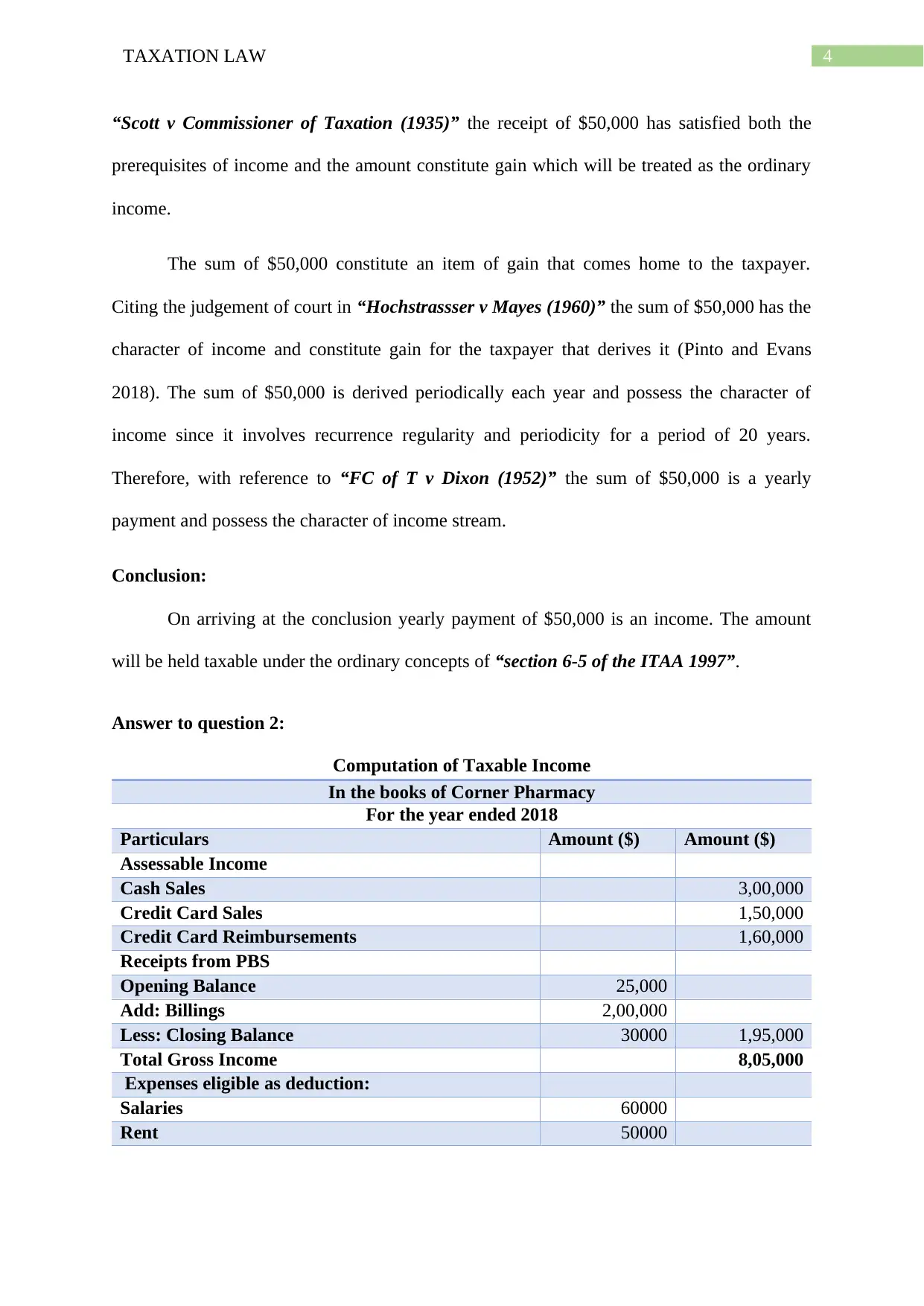
“Scott v Commissioner of Taxation (1935)” the receipt of $50,000 has satisfied both the
prerequisites of income and the amount constitute gain which will be treated as the ordinary
income.
The sum of $50,000 constitute an item of gain that comes home to the taxpayer.
Citing the judgement of court in “Hochstrassser v Mayes (1960)” the sum of $50,000 has the
character of income and constitute gain for the taxpayer that derives it (Pinto and Evans
2018). The sum of $50,000 is derived periodically each year and possess the character of
income since it involves recurrence regularity and periodicity for a period of 20 years.
Therefore, with reference to “FC of T v Dixon (1952)” the sum of $50,000 is a yearly
payment and possess the character of income stream.
Conclusion:
On arriving at the conclusion yearly payment of $50,000 is an income. The amount
will be held taxable under the ordinary concepts of “section 6-5 of the ITAA 1997”.
Answer to question 2:
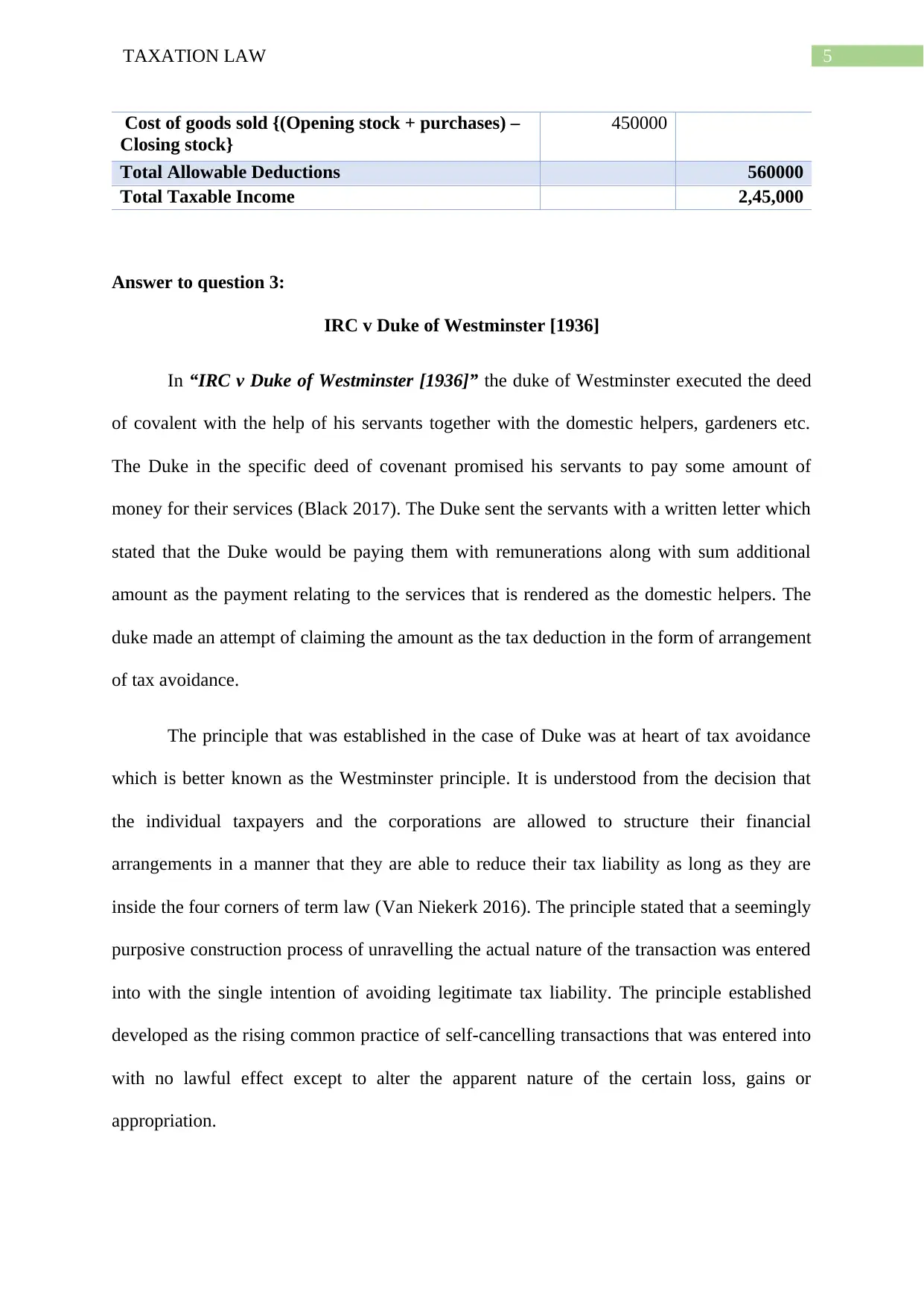
Computation of Taxable Income
In the books of Corner Pharmacy
For the year ended 2018
Particulars Amount ($) Amount ($)
Assessable Income
Cash Sales 3,00,000
Credit Card Sales 1,50,000
Credit Card Reimbursements 1,60,000
Receipts from PBS
Opening Balance 25,000
Add: Billings 2,00,000
Less: Closing Balance 30000 1,95,000
Total Gross Income 8,05,000
Expenses eligible as deduction:
Salaries 60000
Rent 50000
“Scott v Commissioner of Taxation (1935)” the receipt of $50,000 has satisfied both the
prerequisites of income and the amount constitute gain which will be treated as the ordinary
income.
The sum of $50,000 constitute an item of gain that comes home to the taxpayer.
Citing the judgement of court in “Hochstrassser v Mayes (1960)” the sum of $50,000 has the
character of income and constitute gain for the taxpayer that derives it (Pinto and Evans
2018). The sum of $50,000 is derived periodically each year and possess the character of
income since it involves recurrence regularity and periodicity for a period of 20 years.
Therefore, with reference to “FC of T v Dixon (1952)” the sum of $50,000 is a yearly
payment and possess the character of income stream.
Conclusion:
On arriving at the conclusion yearly payment of $50,000 is an income. The amount
will be held taxable under the ordinary concepts of “section 6-5 of the ITAA 1997”.
Answer to question 2:
Computation of Taxable Income
In the books of Corner Pharmacy
For the year ended 2018
Particulars Amount ($) Amount ($)
Assessable Income
Cash Sales 3,00,000
Credit Card Sales 1,50,000
Credit Card Reimbursements 1,60,000
Receipts from PBS
Opening Balance 25,000
Add: Billings 2,00,000
Less: Closing Balance 30000 1,95,000
Total Gross Income 8,05,000
Expenses eligible as deduction:
Salaries 60000
Rent 50000
5TAXATION LAW
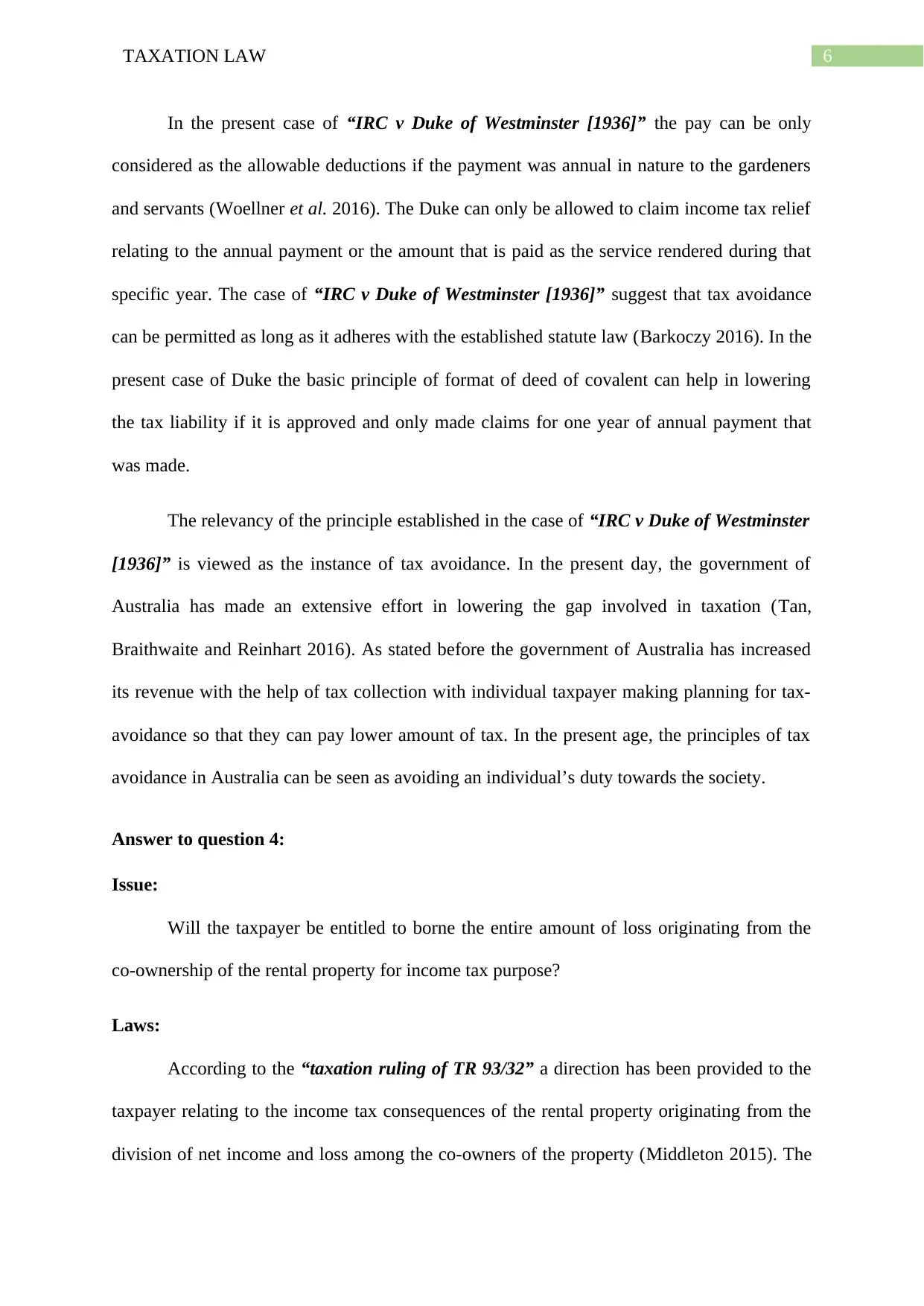
Cost of goods sold {(Opening stock + purchases) –
Closing stock}
450000
Total Allowable Deductions 560000
Total Taxable Income 2,45,000
Answer to question 3:
IRC v Duke of Westminster [1936]
In “IRC v Duke of Westminster [1936]” the duke of Westminster executed the deed
of covalent with the help of his servants together with the domestic helpers, gardeners etc.
The Duke in the specific deed of covenant promised his servants to pay some amount of
money for their services (Black 2017). The Duke sent the servants with a written letter which
stated that the Duke would be paying them with remunerations along with sum additional
amount as the payment relating to the services that is rendered as the domestic helpers. The
duke made an attempt of claiming the amount as the tax deduction in the form of arrangement
of tax avoidance.
The principle that was established in the case of Duke was at heart of tax avoidance
which is better known as the Westminster principle. It is understood from the decision that
the individual taxpayers and the corporations are allowed to structure their financial
arrangements in a manner that they are able to reduce their tax liability as long as they are
inside the four corners of term law (Van Niekerk 2016). The principle stated that a seemingly
purposive construction process of unravelling the actual nature of the transaction was entered
into with the single intention of avoiding legitimate tax liability. The principle established
developed as the rising common practice of self-cancelling transactions that was entered into
with no lawful effect except to alter the apparent nature of the certain loss, gains or
appropriation.
Cost of goods sold {(Opening stock + purchases) –
Closing stock}
450000
Total Allowable Deductions 560000
Total Taxable Income 2,45,000
Answer to question 3:
IRC v Duke of Westminster [1936]
In “IRC v Duke of Westminster [1936]” the duke of Westminster executed the deed
of covalent with the help of his servants together with the domestic helpers, gardeners etc.
The Duke in the specific deed of covenant promised his servants to pay some amount of
money for their services (Black 2017). The Duke sent the servants with a written letter which
stated that the Duke would be paying them with remunerations along with sum additional
amount as the payment relating to the services that is rendered as the domestic helpers. The
duke made an attempt of claiming the amount as the tax deduction in the form of arrangement
of tax avoidance.
The principle that was established in the case of Duke was at heart of tax avoidance
which is better known as the Westminster principle. It is understood from the decision that
the individual taxpayers and the corporations are allowed to structure their financial
arrangements in a manner that they are able to reduce their tax liability as long as they are
inside the four corners of term law (Van Niekerk 2016). The principle stated that a seemingly
purposive construction process of unravelling the actual nature of the transaction was entered
into with the single intention of avoiding legitimate tax liability. The principle established
developed as the rising common practice of self-cancelling transactions that was entered into
with no lawful effect except to alter the apparent nature of the certain loss, gains or
appropriation.
⊘ This is a preview!⊘
Do you want full access?
Subscribe today to unlock all pages.
Trusted by 1+ million students worldwide
6TAXATION LAW
In the present case of “IRC v Duke of Westminster [1936]” the pay can be only
considered as the allowable deductions if the payment was annual in nature to the gardeners
and servants (Woellner et al. 2016). The Duke can only be allowed to claim income tax relief
relating to the annual payment or the amount that is paid as the service rendered during that
specific year. The case of “IRC v Duke of Westminster [1936]” suggest that tax avoidance
can be permitted as long as it adheres with the established statute law (Barkoczy 2016). In the
present case of Duke the basic principle of format of deed of covalent can help in lowering
the tax liability if it is approved and only made claims for one year of annual payment that
was made.
The relevancy of the principle established in the case of “IRC v Duke of Westminster
[1936]” is viewed as the instance of tax avoidance. In the present day, the government of
Australia has made an extensive effort in lowering the gap involved in taxation (Tan,
Braithwaite and Reinhart 2016). As stated before the government of Australia has increased
its revenue with the help of tax collection with individual taxpayer making planning for tax-
avoidance so that they can pay lower amount of tax. In the present age, the principles of tax
avoidance in Australia can be seen as avoiding an individual’s duty towards the society.
Answer to question 4:
Issue:
Will the taxpayer be entitled to borne the entire amount of loss originating from the
co-ownership of the rental property for income tax purpose?
Laws:
According to the “taxation ruling of TR 93/32” a direction has been provided to the
taxpayer relating to the income tax consequences of the rental property originating from the
division of net income and loss among the co-owners of the property (Middleton 2015). The
In the present case of “IRC v Duke of Westminster [1936]” the pay can be only
considered as the allowable deductions if the payment was annual in nature to the gardeners
and servants (Woellner et al. 2016). The Duke can only be allowed to claim income tax relief
relating to the annual payment or the amount that is paid as the service rendered during that
specific year. The case of “IRC v Duke of Westminster [1936]” suggest that tax avoidance
can be permitted as long as it adheres with the established statute law (Barkoczy 2016). In the
present case of Duke the basic principle of format of deed of covalent can help in lowering
the tax liability if it is approved and only made claims for one year of annual payment that
was made.
The relevancy of the principle established in the case of “IRC v Duke of Westminster
[1936]” is viewed as the instance of tax avoidance. In the present day, the government of
Australia has made an extensive effort in lowering the gap involved in taxation (Tan,
Braithwaite and Reinhart 2016). As stated before the government of Australia has increased
its revenue with the help of tax collection with individual taxpayer making planning for tax-
avoidance so that they can pay lower amount of tax. In the present age, the principles of tax
avoidance in Australia can be seen as avoiding an individual’s duty towards the society.
Answer to question 4:
Issue:
Will the taxpayer be entitled to borne the entire amount of loss originating from the
co-ownership of the rental property for income tax purpose?
Laws:
According to the “taxation ruling of TR 93/32” a direction has been provided to the
taxpayer relating to the income tax consequences of the rental property originating from the
division of net income and loss among the co-owners of the property (Middleton 2015). The
Paraphrase This Document
Need a fresh take? Get an instant paraphrase of this document with our AI Paraphraser
7TAXATION LAW
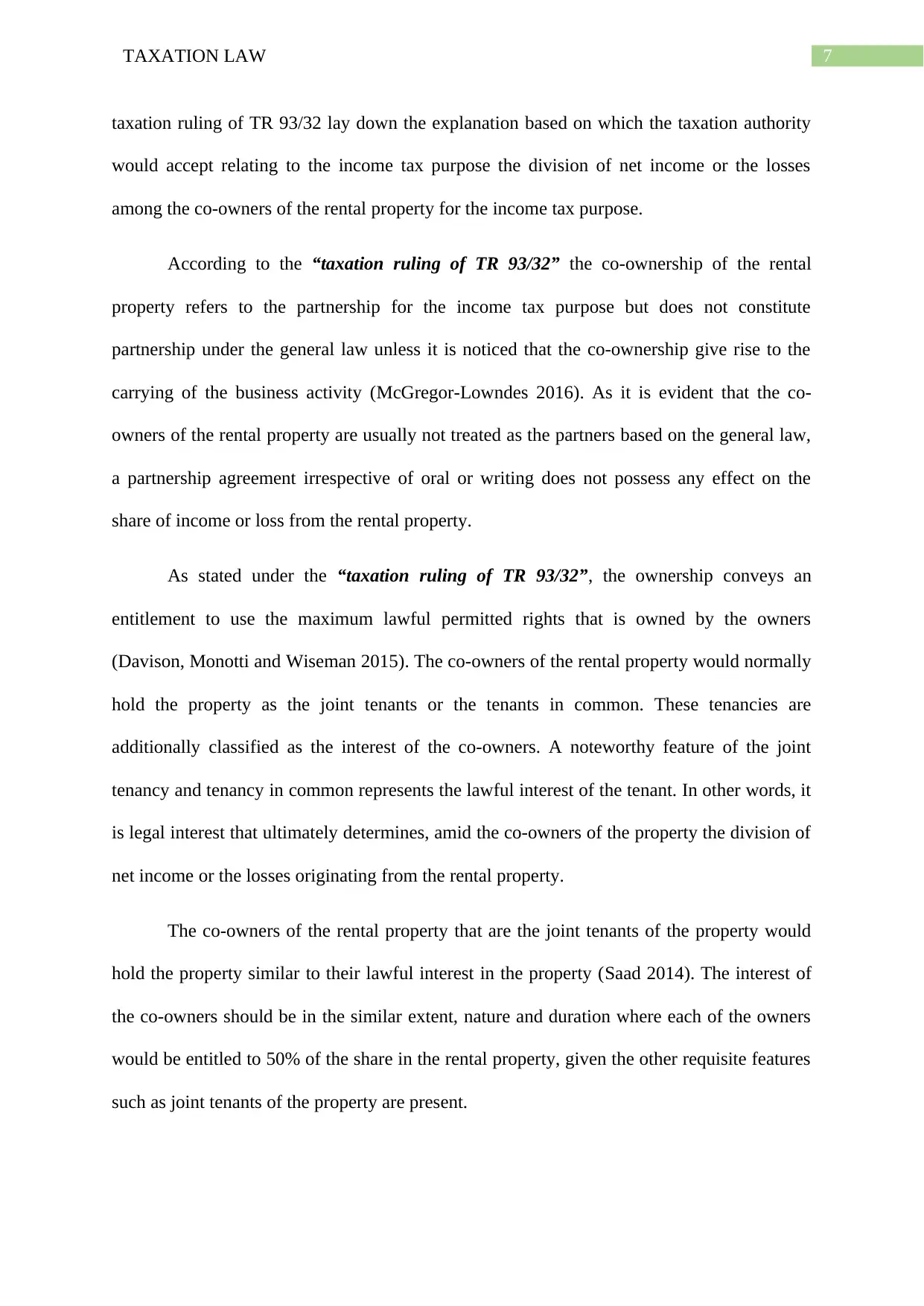
taxation ruling of TR 93/32 lay down the explanation based on which the taxation authority
would accept relating to the income tax purpose the division of net income or the losses
among the co-owners of the rental property for the income tax purpose.
According to the “taxation ruling of TR 93/32” the co-ownership of the rental
property refers to the partnership for the income tax purpose but does not constitute
partnership under the general law unless it is noticed that the co-ownership give rise to the
carrying of the business activity (McGregor-Lowndes 2016). As it is evident that the co-
owners of the rental property are usually not treated as the partners based on the general law,
a partnership agreement irrespective of oral or writing does not possess any effect on the
share of income or loss from the rental property.
As stated under the “taxation ruling of TR 93/32”, the ownership conveys an
entitlement to use the maximum lawful permitted rights that is owned by the owners
(Davison, Monotti and Wiseman 2015). The co-owners of the rental property would normally
hold the property as the joint tenants or the tenants in common. These tenancies are
additionally classified as the interest of the co-owners. A noteworthy feature of the joint
tenancy and tenancy in common represents the lawful interest of the tenant. In other words, it
is legal interest that ultimately determines, amid the co-owners of the property the division of
net income or the losses originating from the rental property.
The co-owners of the rental property that are the joint tenants of the property would
hold the property similar to their lawful interest in the property (Saad 2014). The interest of
the co-owners should be in the similar extent, nature and duration where each of the owners
would be entitled to 50% of the share in the rental property, given the other requisite features
such as joint tenants of the property are present.
taxation ruling of TR 93/32 lay down the explanation based on which the taxation authority
would accept relating to the income tax purpose the division of net income or the losses
among the co-owners of the rental property for the income tax purpose.
According to the “taxation ruling of TR 93/32” the co-ownership of the rental
property refers to the partnership for the income tax purpose but does not constitute
partnership under the general law unless it is noticed that the co-ownership give rise to the
carrying of the business activity (McGregor-Lowndes 2016). As it is evident that the co-
owners of the rental property are usually not treated as the partners based on the general law,
a partnership agreement irrespective of oral or writing does not possess any effect on the
share of income or loss from the rental property.
As stated under the “taxation ruling of TR 93/32”, the ownership conveys an
entitlement to use the maximum lawful permitted rights that is owned by the owners
(Davison, Monotti and Wiseman 2015). The co-owners of the rental property would normally
hold the property as the joint tenants or the tenants in common. These tenancies are
additionally classified as the interest of the co-owners. A noteworthy feature of the joint
tenancy and tenancy in common represents the lawful interest of the tenant. In other words, it
is legal interest that ultimately determines, amid the co-owners of the property the division of
net income or the losses originating from the rental property.
The co-owners of the rental property that are the joint tenants of the property would
hold the property similar to their lawful interest in the property (Saad 2014). The interest of
the co-owners should be in the similar extent, nature and duration where each of the owners
would be entitled to 50% of the share in the rental property, given the other requisite features
such as joint tenants of the property are present.
8TAXATION LAW
As the general proposition, it is very correct to define the rental property owners in
the case McDonald’s as the co-owners for investment purpose instead of partners in business
functions (Cao et al. 2015). Subsequently, the co-owners of the rental property are usually
not treated as the partners under the general law with the result that they are not subjected to
applicable general law of partnerships. This includes the division of net income and losses
originating from the rental property.
Similarly in “McDonald v FC of T (1987)”, Mr McDonald and his wife Mrs
McDonald both lawfully and beneficially owned the two units as the joint tenants
(Hashimzade and Epifantseva 2017). The taxpayer rented out both the units based on the
agreement that 25% of the profits would be distributed to Mr McDonald while the rest 75%
will be distributed to Mrs McDonald. However, in the event of any loss from the rental
property would be entirely borne by Mr McDonald.
The main question that originated was whether the operating loss from the property
was entirely incurred by the taxpayer or one-half of the loss was incurred by both Mr and Mrs
McDonald (Fry 2017). The court of law denied the claim of the taxpayer that there was
partnership between the Mr and Mrs McDonald both under the act as well as under the
general law, that the two units were property of partnership. The court contented that as there
was no partnership under the general law and the only relevant relationship that existed
between the parties were of co-ownership.
As the parties were joint tenants based on the law and equity, therefore, the losses that
is incurred in letting the premises must be shared in equal manner based on the outcome that
the respondents was entitled to claim an allowable deductions for only one-half of the loss
(Basu 2016). The private engagement amid the taxpayer cannot change or override their
respective entitlement based on income tax purpose. Both the husband and wife owned the
As the general proposition, it is very correct to define the rental property owners in
the case McDonald’s as the co-owners for investment purpose instead of partners in business
functions (Cao et al. 2015). Subsequently, the co-owners of the rental property are usually
not treated as the partners under the general law with the result that they are not subjected to
applicable general law of partnerships. This includes the division of net income and losses
originating from the rental property.
Similarly in “McDonald v FC of T (1987)”, Mr McDonald and his wife Mrs
McDonald both lawfully and beneficially owned the two units as the joint tenants
(Hashimzade and Epifantseva 2017). The taxpayer rented out both the units based on the
agreement that 25% of the profits would be distributed to Mr McDonald while the rest 75%
will be distributed to Mrs McDonald. However, in the event of any loss from the rental
property would be entirely borne by Mr McDonald.
The main question that originated was whether the operating loss from the property
was entirely incurred by the taxpayer or one-half of the loss was incurred by both Mr and Mrs
McDonald (Fry 2017). The court of law denied the claim of the taxpayer that there was
partnership between the Mr and Mrs McDonald both under the act as well as under the
general law, that the two units were property of partnership. The court contented that as there
was no partnership under the general law and the only relevant relationship that existed
between the parties were of co-ownership.
As the parties were joint tenants based on the law and equity, therefore, the losses that
is incurred in letting the premises must be shared in equal manner based on the outcome that
the respondents was entitled to claim an allowable deductions for only one-half of the loss
(Basu 2016). The private engagement amid the taxpayer cannot change or override their
respective entitlement based on income tax purpose. Both the husband and wife owned the
⊘ This is a preview!⊘
Do you want full access?
Subscribe today to unlock all pages.
Trusted by 1+ million students worldwide
9TAXATION LAW
property equally. As a consequence, they were entitled to have 50% of the interest in net
profit and losses of the partnership. Their agreement of sharing the profit and losses in
different proportions was entirely ineffective for income tax purpose.
Application:
In the current case of Joseph and Jane both holding a rental property as the joint
tenants. The agreement of joint tenancy between then stated that 20% of the profits would be
distributed to Joseph while the rest 80% will be distributed to Jane. However, in the event of
any loss from the rental property would be entirely borne by Joseph.
Referring to “taxation ruling of TR 93/32” the co-ownership of rental property
between Joseph and Jane refers to the partnership for the income tax purpose but does not
establish partnership in terms of the general law (Saad 2014). As the requisite feature of joint
tenants of the property is present in the case of Jane and Joseph. Furthermore, the interest of
the Joseph and Jane is in the similar extent, nature and duration. As a result the co-owners
would be entitled to 50% of the share in the rental property.
Based on the general proposition, it would be appropriate to define the rental property
owners in the case of Joseph and Jane as the co-owners for investment purpose instead of
partners for business purposes. In the present case of Joseph and Jane, with reference to
“McDonald v FC of T (1987)” there was no partnership under the Act as well as under the
general law (Davison, Monotti and Wiseman 2015). Since Joseph and Jane were the joint
tenants based on the law and equity, therefore, the losses of $50,000 that is incurred in letting
the premises must be shared in equal manner based on the outcome that the respondents are
permitted to claim an allowable deductions for only one-half of the loss.
In an alternative event if Joseph and Jane decides to sell the property any capital gains
or capital loss originating from such property must be shared equally. This is because both
property equally. As a consequence, they were entitled to have 50% of the interest in net
profit and losses of the partnership. Their agreement of sharing the profit and losses in
different proportions was entirely ineffective for income tax purpose.
Application:
In the current case of Joseph and Jane both holding a rental property as the joint
tenants. The agreement of joint tenancy between then stated that 20% of the profits would be
distributed to Joseph while the rest 80% will be distributed to Jane. However, in the event of
any loss from the rental property would be entirely borne by Joseph.
Referring to “taxation ruling of TR 93/32” the co-ownership of rental property
between Joseph and Jane refers to the partnership for the income tax purpose but does not
establish partnership in terms of the general law (Saad 2014). As the requisite feature of joint
tenants of the property is present in the case of Jane and Joseph. Furthermore, the interest of
the Joseph and Jane is in the similar extent, nature and duration. As a result the co-owners
would be entitled to 50% of the share in the rental property.
Based on the general proposition, it would be appropriate to define the rental property
owners in the case of Joseph and Jane as the co-owners for investment purpose instead of
partners for business purposes. In the present case of Joseph and Jane, with reference to
“McDonald v FC of T (1987)” there was no partnership under the Act as well as under the
general law (Davison, Monotti and Wiseman 2015). Since Joseph and Jane were the joint
tenants based on the law and equity, therefore, the losses of $50,000 that is incurred in letting
the premises must be shared in equal manner based on the outcome that the respondents are
permitted to claim an allowable deductions for only one-half of the loss.
In an alternative event if Joseph and Jane decides to sell the property any capital gains
or capital loss originating from such property must be shared equally. This is because both
Paraphrase This Document
Need a fresh take? Get an instant paraphrase of this document with our AI Paraphraser
10TAXATION LAW
Joseph and Jane held 50% interest in the net income and losses of the partnership. The
agreement of Joseph and Jane to share the profit and loss in the different proportion will be
ineffective. The private engagement amid the taxpayer cannot change or override their
respective entitlement based on income tax purpose.
Conclusion:
Conclusively, no partnership existed under the general law for Joseph and Jane.
Hence, the losses and profits should be shared in equal proportions for income tax purpose.
Joseph and Jane held 50% interest in the net income and losses of the partnership. The
agreement of Joseph and Jane to share the profit and loss in the different proportion will be
ineffective. The private engagement amid the taxpayer cannot change or override their
respective entitlement based on income tax purpose.
Conclusion:
Conclusively, no partnership existed under the general law for Joseph and Jane.
Hence, the losses and profits should be shared in equal proportions for income tax purpose.
11TAXATION LAW
References:
Barkoczy, S., 2016. Core tax legislation and study guide. OUP Catalogue.
Basu, S., 2016. Global perspectives on e-commerce taxation law. Routledge.
Black, C., 2017. The Attribution of Profits to Permanent Establishments: Testing the
Interaction of Domestic Taxation Laws and Tax Treaties in Practice.
Brydges, N. and Yuen, K., 2018. A matter of trusts: Trusts, income tax, CGT and foreign
residents. Taxation in Australia, 53(2), p.80.
Buchanan, R. and Consett, E., 2016. Section 974-80 ITAA97: The current state of play. Tax
Specialist, 19(5), p.217.
Burton, M., 2017. A Review of Judicial References to the Dictum of Jordan CJ, Expressed in
Scott v. Commissioner of Taxation, in Elaborating the Meaning of Income for the Purposes
of the Australian Income Tax. J. Austl. Tax'n, 19, p.50.
Cao, L., Hosking, A., Kouparitsas, M., Mullaly, D., Rimmer, X., Shi, Q., Stark, W. and
Wende, S., 2015. Understanding the economy-wide efficiency and incidence of major
Australian taxes. Canberra: Treasury working paper, 2001.
Davison, M., Monotti, A. and Wiseman, L., 2015. Australian intellectual property law.
Cambridge University Press.
Edmonds, R., 2018. Resource Capital Fund IV LP: the issues on appeal?. Taxation in
Australia, 53(1), p.22.
Fry, M., 2017. Australian taxation of offshore hubs: an examination of the law on the ability
of Australia to tax economic activity in offshore hubs and the position of the Australian
Taxation Office. The APPEA Journal, 57(1), pp.49-63.
References:
Barkoczy, S., 2016. Core tax legislation and study guide. OUP Catalogue.
Basu, S., 2016. Global perspectives on e-commerce taxation law. Routledge.
Black, C., 2017. The Attribution of Profits to Permanent Establishments: Testing the
Interaction of Domestic Taxation Laws and Tax Treaties in Practice.
Brydges, N. and Yuen, K., 2018. A matter of trusts: Trusts, income tax, CGT and foreign
residents. Taxation in Australia, 53(2), p.80.
Buchanan, R. and Consett, E., 2016. Section 974-80 ITAA97: The current state of play. Tax
Specialist, 19(5), p.217.
Burton, M., 2017. A Review of Judicial References to the Dictum of Jordan CJ, Expressed in
Scott v. Commissioner of Taxation, in Elaborating the Meaning of Income for the Purposes
of the Australian Income Tax. J. Austl. Tax'n, 19, p.50.
Cao, L., Hosking, A., Kouparitsas, M., Mullaly, D., Rimmer, X., Shi, Q., Stark, W. and
Wende, S., 2015. Understanding the economy-wide efficiency and incidence of major
Australian taxes. Canberra: Treasury working paper, 2001.
Davison, M., Monotti, A. and Wiseman, L., 2015. Australian intellectual property law.
Cambridge University Press.
Edmonds, R., 2018. Resource Capital Fund IV LP: the issues on appeal?. Taxation in
Australia, 53(1), p.22.
Fry, M., 2017. Australian taxation of offshore hubs: an examination of the law on the ability
of Australia to tax economic activity in offshore hubs and the position of the Australian
Taxation Office. The APPEA Journal, 57(1), pp.49-63.
⊘ This is a preview!⊘
Do you want full access?
Subscribe today to unlock all pages.
Trusted by 1+ million students worldwide

1 out of 13


Related Documents


Your All-in-One AI-Powered Toolkit for Academic Success.
+13062052269
info@desklib.com
Available 24*7 on WhatsApp / Email
![[object Object]](/_next/static/media/star-bottom.7253800d.svg)
Unlock your academic potential
Copyright © 2020–2026 A2Z Services. All Rights Reserved. Developed and managed by ZUCOL.