Taxation Law Assessment 2 (2018): Complete Solution Guide

Verified

Added on  2023/06/07

|10
|1317
|468
Homework Assignment
AI Summary
This document provides a comprehensive solution to a Taxation Law assessment, addressing various aspects of Australian taxation. The solution begins by calculating Alice's net capital gain or loss, considering the sale of a car, gifted shares, sold shares, and a restrictive covenant payment. It then analyzes a partnership's income, calculating the assessable income for partners Anne and Brian, including interest and salary. The solution further explores trust income, determining the tax liabilities of beneficiaries Mr. Luke, Pauline, and Jane, and the treatment of medical expenses. Finally, it examines redundancy payments, differentiating between genuine and non-genuine redundancy payments and their tax implications based on ATO guidelines. The document offers detailed calculations and explanations, referencing relevant tax laws and providing a thorough understanding of the concepts.
Document Page
Running head: TAXATION LAW
Taxation Law
Name of the Student:
Name of the University:
Authors Note:
tabler-icon-diamond-filled.svg

Paraphrase This Document

Need a fresh take? Get an instant paraphrase of this document with our AI Paraphraser
Document Page
1TAXATION LAW
Contents
Answer 1:.........................................................................................................................................2
Answer 2:.........................................................................................................................................4
Answer 3:.........................................................................................................................................7
Answer 4:.........................................................................................................................................8
References:......................................................................................................................................9
Document Page
2TAXATION LAW
Answer 1:
Particulars Amount
($)
Amount
($)
No capital gain or loss on sale of car
Shares gifted to son:
Market value of shares as on the date of gift 50,000.
00
Less: Cost of shares 75,000.
00
Capital gain / (Loss) (25,000.0
0)
Shares sold:
Sale proceeds from sale of shares 100,000.
00
Less: Cost of acquisition 60,000.
00
Capital gain / (Loss) before use of discount 40,000.
00
Document Page
3TAXATION LAW
Less: Discount under discount method (40000 x 50%) 20,000.
00
Capital gain / (Loss) 20,000.
00
Capital gain for receiving non-competition fees (s160M (6) 50,000.
00
Net capital 45,000.
00
Notes:
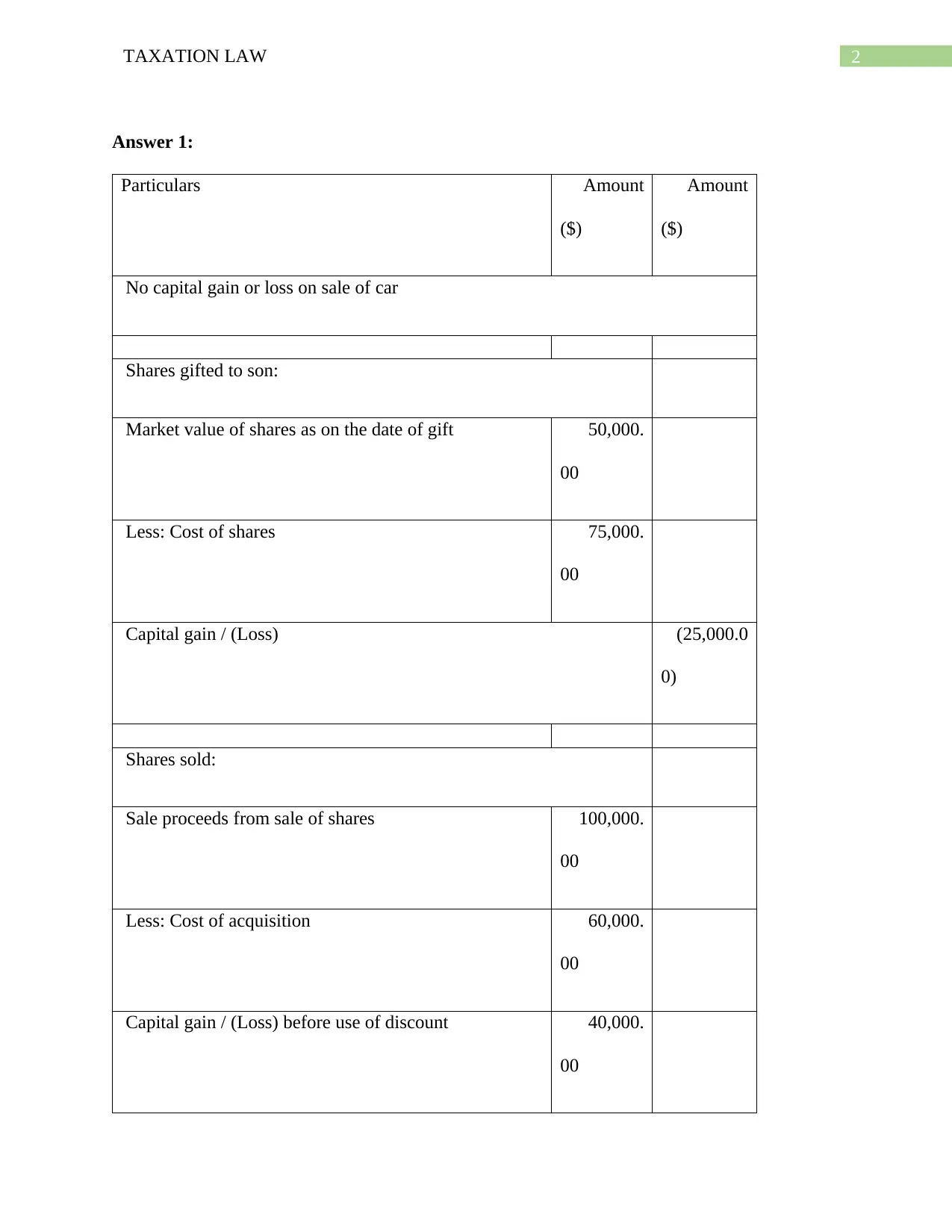
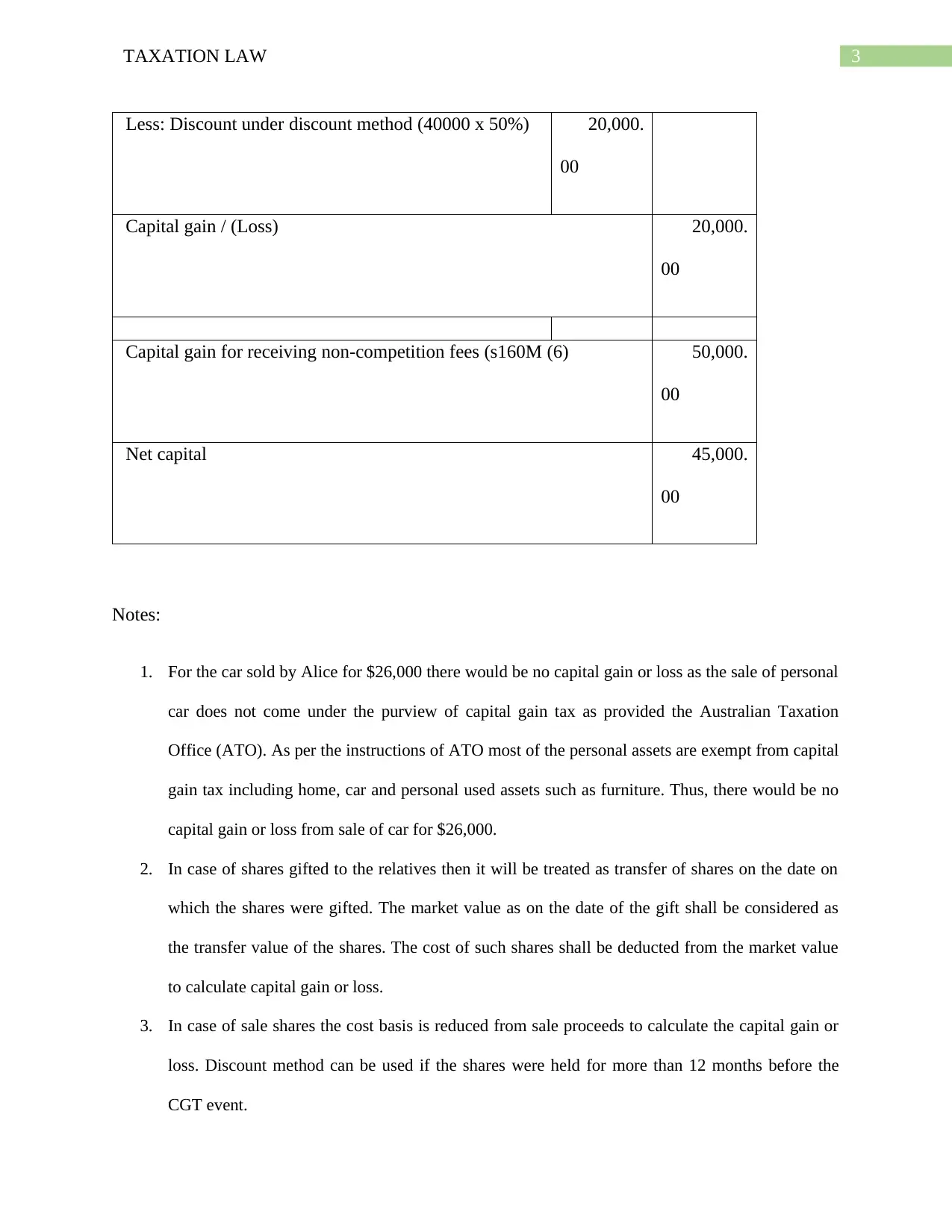
1. For the car sold by Alice for $26,000 there would be no capital gain or loss as the sale of personal
car does not come under the purview of capital gain tax as provided the Australian Taxation
Office (ATO). As per the instructions of ATO most of the personal assets are exempt from capital
gain tax including home, car and personal used assets such as furniture. Thus, there would be no
capital gain or loss from sale of car for $26,000.
2. In case of shares gifted to the relatives then it will be treated as transfer of shares on the date on
which the shares were gifted. The market value as on the date of the gift shall be considered as
the transfer value of the shares. The cost of such shares shall be deducted from the market value
to calculate capital gain or loss.
3. In case of sale shares the cost basis is reduced from sale proceeds to calculate the capital gain or
loss. Discount method can be used if the shares were held for more than 12 months before the
CGT event.
tabler-icon-diamond-filled.svg

Paraphrase This Document

Need a fresh take? Get an instant paraphrase of this document with our AI Paraphraser
Document Page
4TAXATION LAW
4. As per the Income Tax Assessment Act, 1936, s160M (6), restrictive covenant receipt is
subjected to capital gain tax (Grudnoff 2015).
Answer 2:
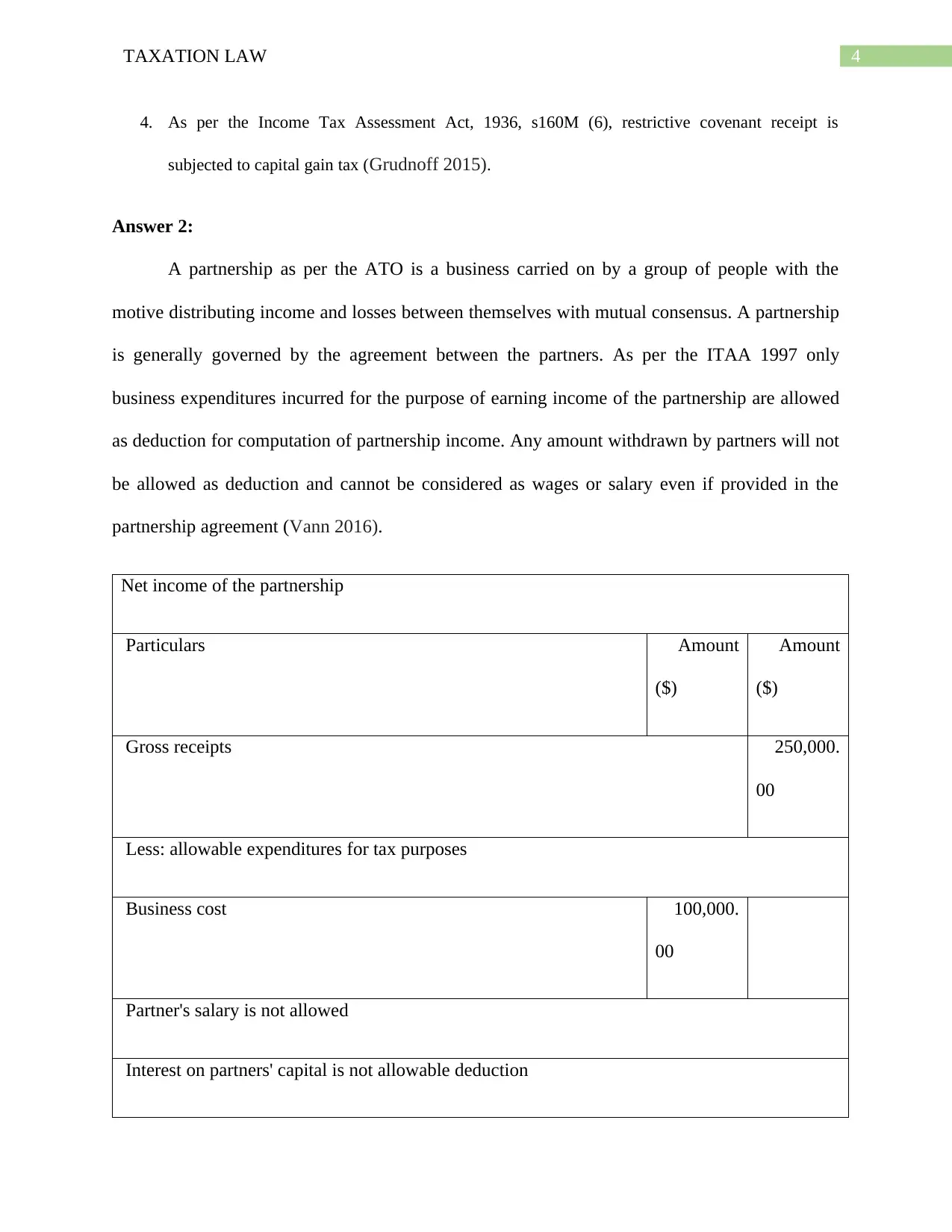
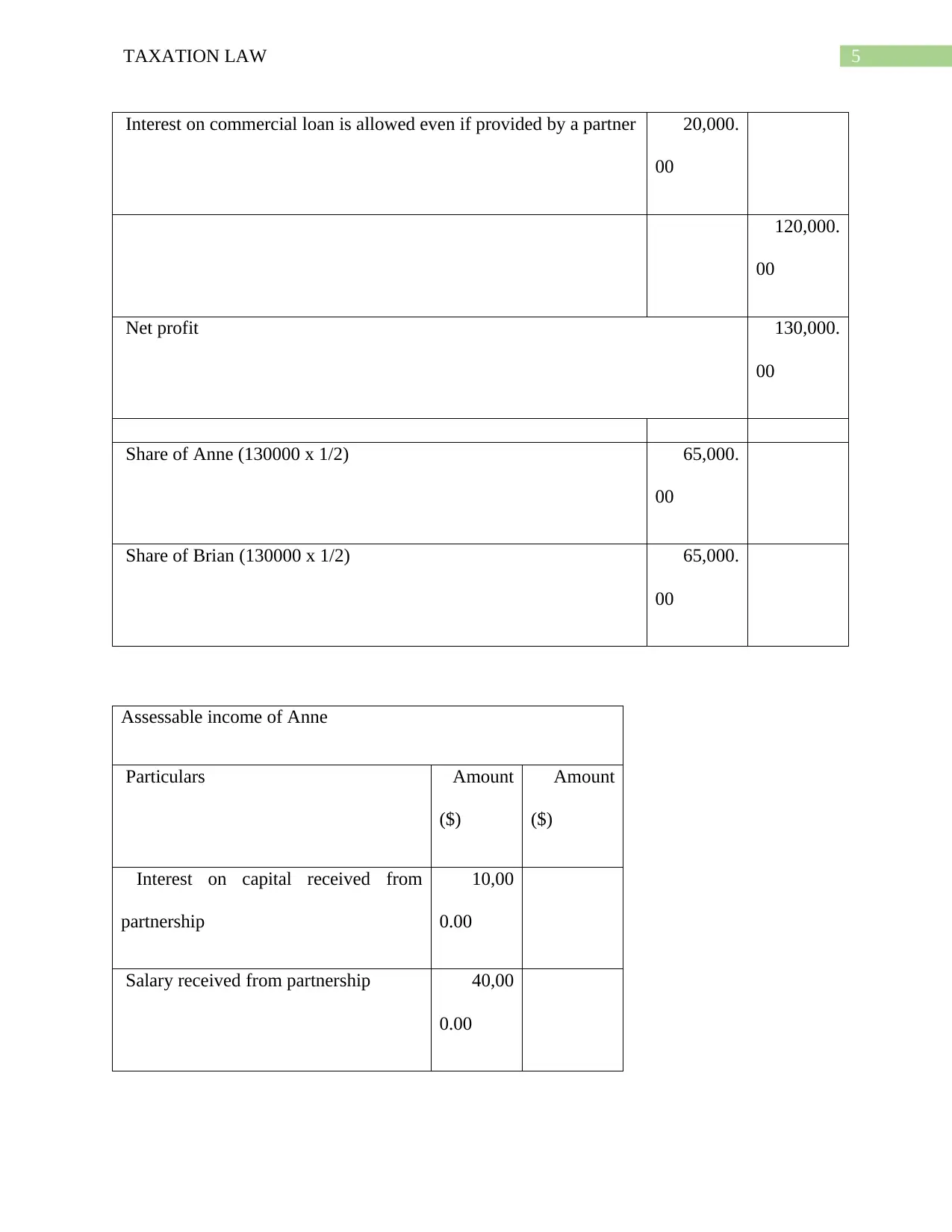
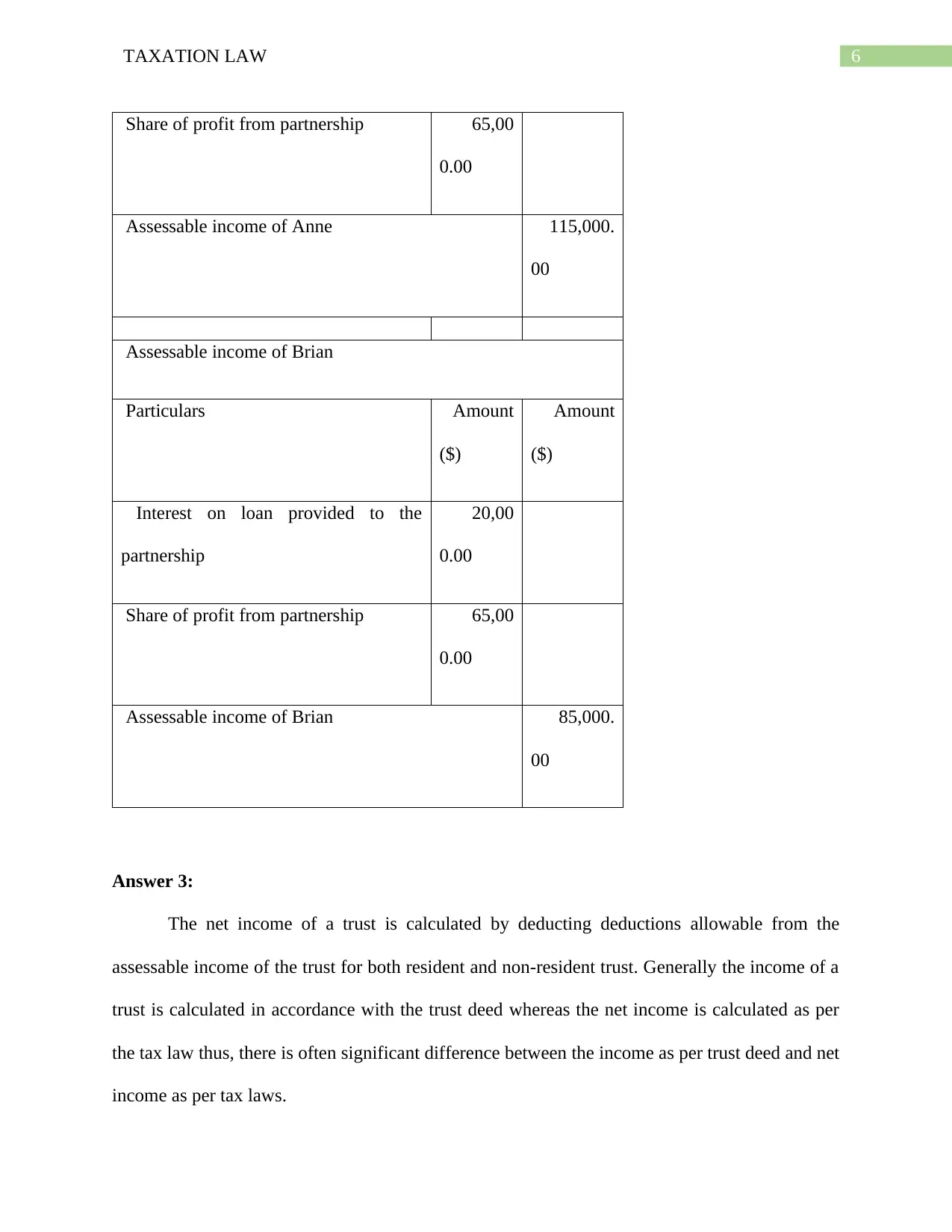
A partnership as per the ATO is a business carried on by a group of people with the
motive distributing income and losses between themselves with mutual consensus. A partnership
is generally governed by the agreement between the partners. As per the ITAA 1997 only
business expenditures incurred for the purpose of earning income of the partnership are allowed
as deduction for computation of partnership income. Any amount withdrawn by partners will not
be allowed as deduction and cannot be considered as wages or salary even if provided in the
partnership agreement (Vann 2016).
Net income of the partnership
Particulars Amount
($)
Amount
($)
Gross receipts 250,000.
00
Less: allowable expenditures for tax purposes
Business cost 100,000.
00
Partner's salary is not allowed
Interest on partners' capital is not allowable deduction
Document Page
5TAXATION LAW
Interest on commercial loan is allowed even if provided by a partner 20,000.
00
120,000.
00
Net profit 130,000.
00
Share of Anne (130000 x 1/2) 65,000.
00
Share of Brian (130000 x 1/2) 65,000.
00
Assessable income of Anne
Particulars Amount
($)
Amount
($)
Interest on capital received from
partnership
10,00
0.00
Salary received from partnership 40,00
0.00
Document Page
6TAXATION LAW
Share of profit from partnership 65,00
0.00
Assessable income of Anne 115,000.
00
Assessable income of Brian
Particulars Amount
($)
Amount
($)
Interest on loan provided to the
partnership
20,00
0.00
Share of profit from partnership 65,00
0.00
Assessable income of Brian 85,000.
00
Answer 3:
The net income of a trust is calculated by deducting deductions allowable from the
assessable income of the trust for both resident and non-resident trust. Generally the income of a
trust is calculated in accordance with the trust deed whereas the net income is calculated as per
the tax law thus, there is often significant difference between the income as per trust deed and net
income as per tax laws.
tabler-icon-diamond-filled.svg

Paraphrase This Document

Need a fresh take? Get an instant paraphrase of this document with our AI Paraphraser
Document Page
7TAXATION LAW
The beneficiaries of a trust are assessed for the income of the trust on the basis of their shares in
the income of the trust. In case there is a trustee then the income of the trustee will be taxable in
the hands of the trustee if so provided in the trust deed (Blakelock & King 2017).
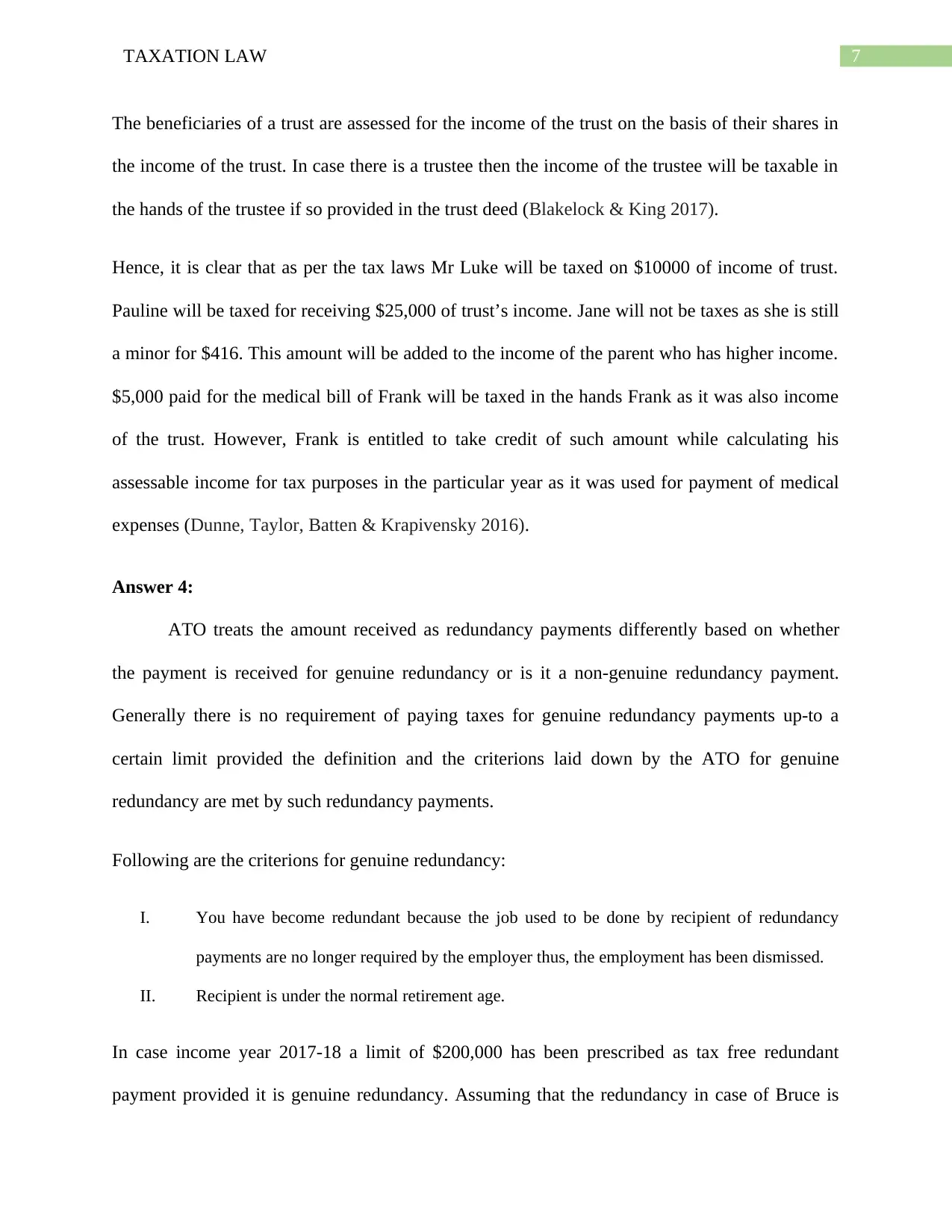
Hence, it is clear that as per the tax laws Mr Luke will be taxed on $10000 of income of trust.
Pauline will be taxed for receiving $25,000 of trust’s income. Jane will not be taxes as she is still
a minor for $416. This amount will be added to the income of the parent who has higher income.
$5,000 paid for the medical bill of Frank will be taxed in the hands Frank as it was also income
of the trust. However, Frank is entitled to take credit of such amount while calculating his
assessable income for tax purposes in the particular year as it was used for payment of medical
expenses (Dunne, Taylor, Batten & Krapivensky 2016).
Answer 4:
ATO treats the amount received as redundancy payments differently based on whether
the payment is received for genuine redundancy or is it a non-genuine redundancy payment.
Generally there is no requirement of paying taxes for genuine redundancy payments up-to a
certain limit provided the definition and the criterions laid down by the ATO for genuine
redundancy are met by such redundancy payments.
Following are the criterions for genuine redundancy:
I. You have become redundant because the job used to be done by recipient of redundancy
payments are no longer required by the employer thus, the employment has been dismissed.
II. Recipient is under the normal retirement age.
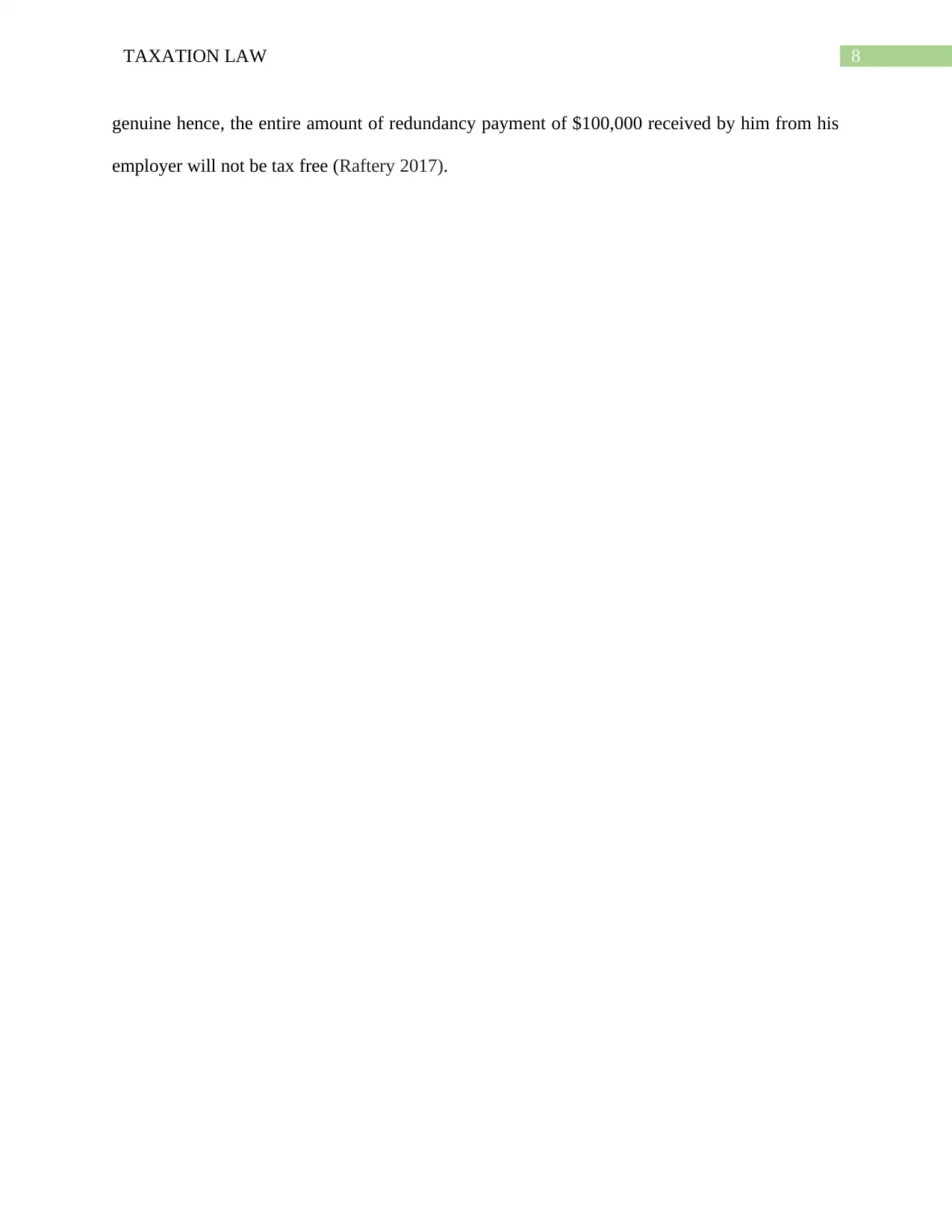
In case income year 2017-18 a limit of $200,000 has been prescribed as tax free redundant
payment provided it is genuine redundancy. Assuming that the redundancy in case of Bruce is
Document Page
8TAXATION LAW
genuine hence, the entire amount of redundancy payment of $100,000 received by him from his
employer will not be tax free (Raftery 2017).
Document Page
9TAXATION LAW
References:
Blakelock, S., & King, P. (2017). Taxation law: The advance of ATO data matching. Proctor,
The, 37(6), 18.
Dunne, J., Taylor, H., Batten, N., & Krapivensky, N. (2016). 2015 case review: High ATO
success rate continues. Taxation in Australia, 50(10), 609.
Grudnoff, M. (2015). Top gears: How negative gearing and the capital gains tax discount benefit
the top 10 per cent and drive up house prices.
Raftery, A. (2017). 101 Ways to Save Money on Your Tax-Legally! 2017-2018. John Wiley &
Sons.
Vann, R. (2016). Hybrid Entities in Australia: Resource Capital Fund III LP Case.
chevron_up_icon
1 out of 10
circle_padding
hide_on_mobile
zoom_out_icon
[object Object]