Taxation Law Assignment: Taxation of Income and Capital Gains

Verified

Added on  2020/03/01

|5
|695
|354
Homework Assignment
AI Summary
This taxation law assignment provides solutions to two key questions. The first question examines deductible business expenses, including those for cleaning supplies, advertising, and motor vehicle leases, referencing relevant case law. It differentiates between deductible and non-deductible legal fees. The second question addresses the tax treatment of revenue from subdivided land, distinguishing between capital gains and ordinary income, and applying the principles from the case of Federal Commissioner of Taxation v Whitfords Beach Pty Ltd. The assignment demonstrates an understanding of assessable income, GST, and tax liability. It emphasizes the importance of direct relationships between expenses and income, and the implications of land subdivision for tax purposes.
Document Page
Running head: TAXATION LAW
Taxation Law
Name of the Student
Name of the University
Authors Note
Course ID
tabler-icon-diamond-filled.svg

Paraphrase This Document

Need a fresh take? Get an instant paraphrase of this document with our AI Paraphraser
Document Page
1TAXATION LAW
Table of Contents
Answer to question 1:.................................................................................................................2
Answer to question 2:.................................................................................................................3
Reference List:...........................................................................................................................4
Document Page
2TAXATION LAW
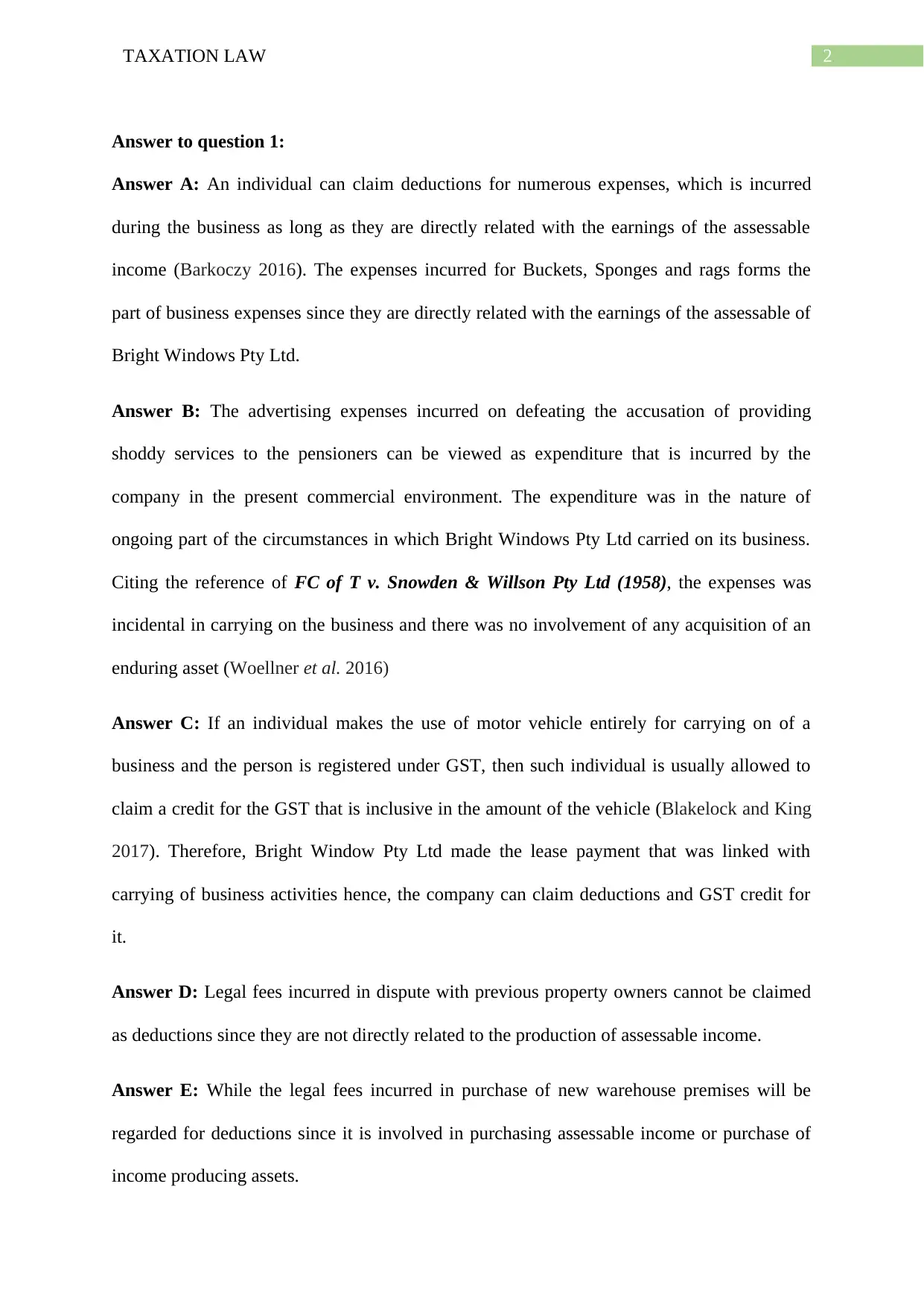
Answer to question 1:
Answer A: An individual can claim deductions for numerous expenses, which is incurred
during the business as long as they are directly related with the earnings of the assessable
income (Barkoczy 2016). The expenses incurred for Buckets, Sponges and rags forms the
part of business expenses since they are directly related with the earnings of the assessable of
Bright Windows Pty Ltd.
Answer B: The advertising expenses incurred on defeating the accusation of providing
shoddy services to the pensioners can be viewed as expenditure that is incurred by the
company in the present commercial environment. The expenditure was in the nature of
ongoing part of the circumstances in which Bright Windows Pty Ltd carried on its business.
Citing the reference of FC of T v. Snowden & Willson Pty Ltd (1958), the expenses was
incidental in carrying on the business and there was no involvement of any acquisition of an
enduring asset (Woellner et al. 2016)
Answer C: If an individual makes the use of motor vehicle entirely for carrying on of a
business and the person is registered under GST, then such individual is usually allowed to
claim a credit for the GST that is inclusive in the amount of the vehicle (Blakelock and King
2017). Therefore, Bright Window Pty Ltd made the lease payment that was linked with
carrying of business activities hence, the company can claim deductions and GST credit for
it.
Answer D: Legal fees incurred in dispute with previous property owners cannot be claimed
as deductions since they are not directly related to the production of assessable income.
Answer E: While the legal fees incurred in purchase of new warehouse premises will be
regarded for deductions since it is involved in purchasing assessable income or purchase of
income producing assets.
Document Page
3TAXATION LAW
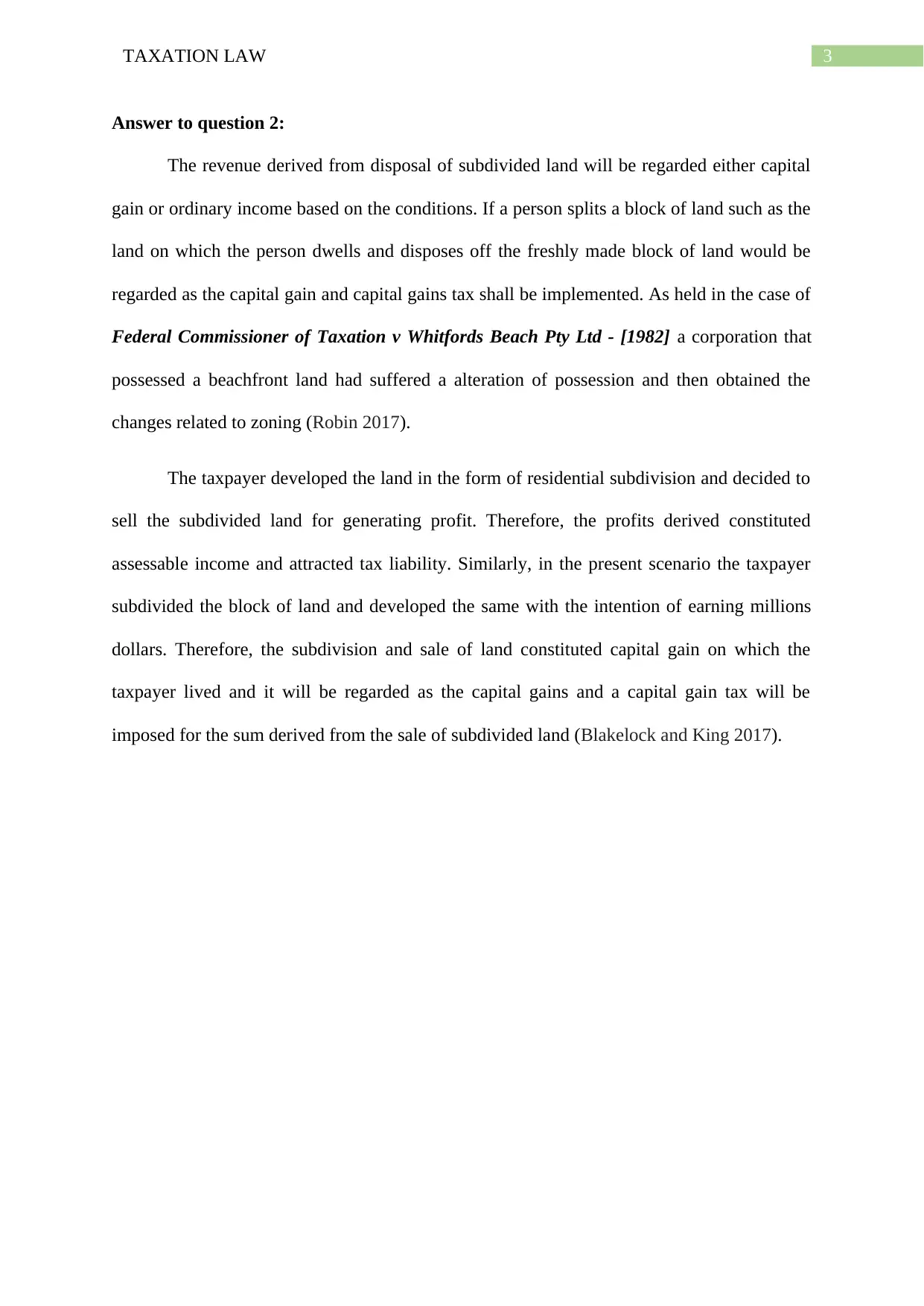
Answer to question 2:
The revenue derived from disposal of subdivided land will be regarded either capital
gain or ordinary income based on the conditions. If a person splits a block of land such as the
land on which the person dwells and disposes off the freshly made block of land would be
regarded as the capital gain and capital gains tax shall be implemented. As held in the case of
Federal Commissioner of Taxation v Whitfords Beach Pty Ltd - [1982] a corporation that
possessed a beachfront land had suffered a alteration of possession and then obtained the
changes related to zoning (Robin 2017).
The taxpayer developed the land in the form of residential subdivision and decided to
sell the subdivided land for generating profit. Therefore, the profits derived constituted
assessable income and attracted tax liability. Similarly, in the present scenario the taxpayer
subdivided the block of land and developed the same with the intention of earning millions
dollars. Therefore, the subdivision and sale of land constituted capital gain on which the
taxpayer lived and it will be regarded as the capital gains and a capital gain tax will be
imposed for the sum derived from the sale of subdivided land (Blakelock and King 2017).
tabler-icon-diamond-filled.svg

Paraphrase This Document

Need a fresh take? Get an instant paraphrase of this document with our AI Paraphraser
Document Page
4TAXATION LAW
Reference List:
Barkoczy, S., 2016. Foundations of Taxation Law 2016. OUP Catalogue.
Blakelock, S. and King, P., 2017. Taxation law: The advance of ATO data
matching. Proctor, The, 37(6), p.18.
ROBIN, H., 2017. AUSTRALIAN TAXATION LAW 2017. OXFORD University Press.
Woellner, R.H., Barkoczy, S., Murphy, S., Evans, C. and Pinto, D., 2016. Australian
Taxation Law Select: Legislation and Commentary 2016. Oxford University Press.
chevron_up_icon
1 out of 5
circle_padding
hide_on_mobile
zoom_out_icon
[object Object]