HI6028 Taxation Case Study: Capital Gains, Fringe Benefits Analysis
VerifiedAdded on 2019/09/23
|14
|2517
|69
Case Study
AI Summary
This assignment analyzes two case studies related to Australian taxation. The first case study focuses on capital gains tax, examining the sale of a holiday home, calculating taxable income using both discount and indexation methods, and addressing the treatment of capital losses and the impact of the Income Tax Assessment Act. The second case study delves into fringe benefits tax, exploring the tax implications of company cars and employee loans. It covers the computation of fringe benefits for car usage and interest-free loans, and the application of relevant provisions from the Income Tax Assessment Act. The analysis includes calculations, considerations for tax planning, and emphasizes the importance of maintaining proper documentation for tax purposes. The assignment provides a detailed overview of these complex tax scenarios.
HI6028_Taxation_Assignment
[Type the document subtitle]
Student
[Pick the date]
[Type the document subtitle]
Student
[Pick the date]

Paraphrase This Document
Need a fresh take? Get an instant paraphrase of this document with our AI Paraphraser

Contents
Case study 1: Capital Gain Taxation..........................................................................................................2
Case study 2: Fringe Benefits.......................................................................................................................8
References.................................................................................................................................................13
1
Case study 1: Capital Gain Taxation..........................................................................................................2
Case study 2: Fringe Benefits.......................................................................................................................8
References.................................................................................................................................................13
1

Case study 1: Capital Gain Taxation
Facts of the case:
Fred is a resident assessee
Assessee has sold Holiday home. That means, the assessee has a Main residence
where he resides
Holiday home is located in Blue Mountain
Agreement to sale happened in August 2015
Actual sales consideration received in February 2016
Sale consideration $8,00,000
Cost incurred for selling the house property $ 1100 (legal fees inclusive of Goods
and Service Tax) plus $9900 (Sale agent’s commission inclusive of Goods and
Service Tax)
Year of Purchase 1987. Month March
Cost of purchasing the House property $100000
Stamp duty paid on purchase of the said property $2000 (2% of consideration)
Legal fees paid $2000
Fred has other Capital Loss of $10000
The capital loss has arose due to Sale of Shares
Assumptions:
The house property is located within the Taxation Authorities
2
Facts of the case:
Fred is a resident assessee
Assessee has sold Holiday home. That means, the assessee has a Main residence
where he resides
Holiday home is located in Blue Mountain
Agreement to sale happened in August 2015
Actual sales consideration received in February 2016
Sale consideration $8,00,000
Cost incurred for selling the house property $ 1100 (legal fees inclusive of Goods
and Service Tax) plus $9900 (Sale agent’s commission inclusive of Goods and
Service Tax)
Year of Purchase 1987. Month March
Cost of purchasing the House property $100000
Stamp duty paid on purchase of the said property $2000 (2% of consideration)
Legal fees paid $2000
Fred has other Capital Loss of $10000
The capital loss has arose due to Sale of Shares
Assumptions:
The house property is located within the Taxation Authorities
2
⊘ This is a preview!⊘
Do you want full access?
Subscribe today to unlock all pages.

Trusted by 1+ million students worldwide
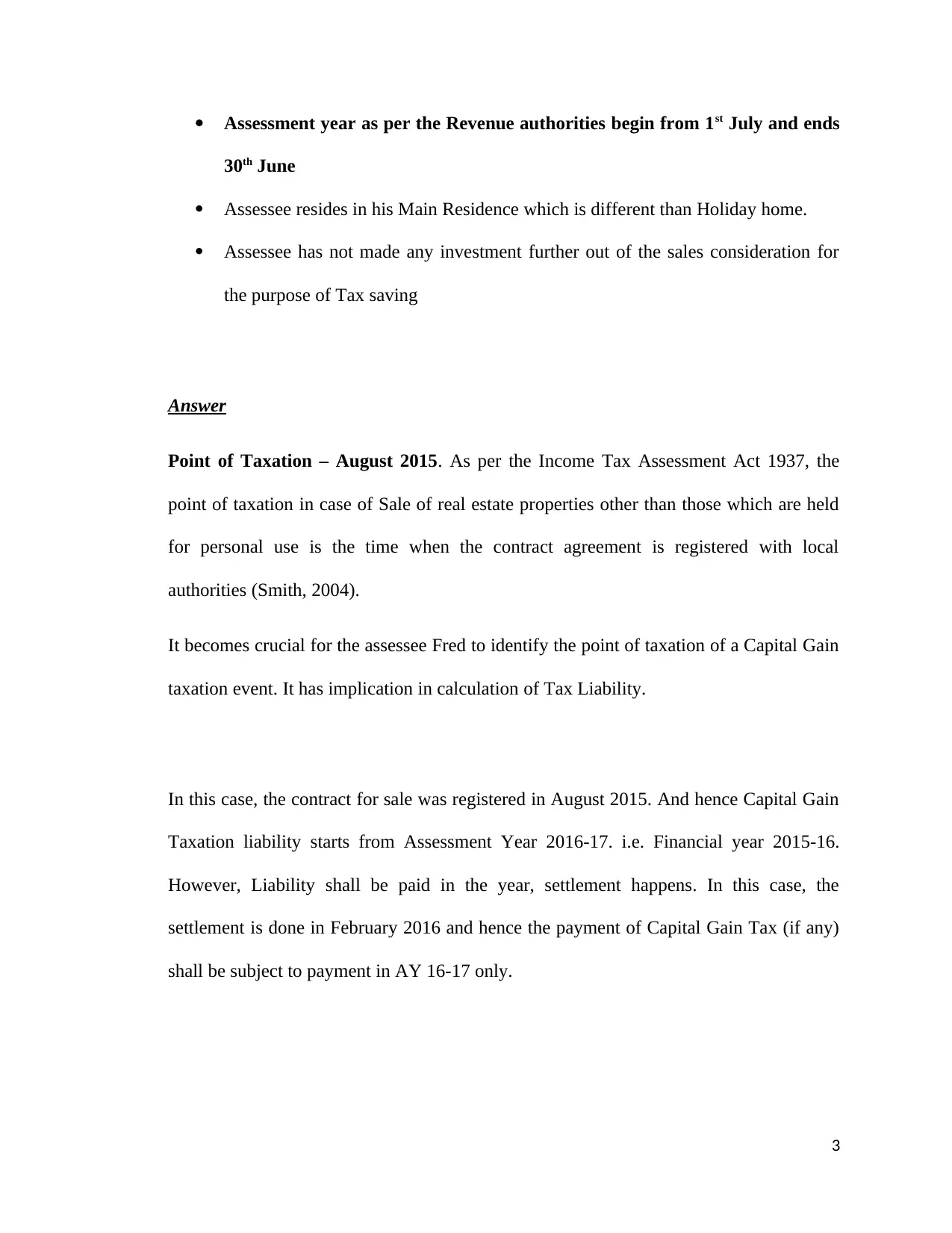
Assessment year as per the Revenue authorities begin from 1st July and ends
30th June
Assessee resides in his Main Residence which is different than Holiday home.
Assessee has not made any investment further out of the sales consideration for
the purpose of Tax saving
Answer
Point of Taxation – August 2015. As per the Income Tax Assessment Act 1937, the
point of taxation in case of Sale of real estate properties other than those which are held
for personal use is the time when the contract agreement is registered with local
authorities (Smith, 2004).
It becomes crucial for the assessee Fred to identify the point of taxation of a Capital Gain
taxation event. It has implication in calculation of Tax Liability.
In this case, the contract for sale was registered in August 2015. And hence Capital Gain
Taxation liability starts from Assessment Year 2016-17. i.e. Financial year 2015-16.
However, Liability shall be paid in the year, settlement happens. In this case, the
settlement is done in February 2016 and hence the payment of Capital Gain Tax (if any)
shall be subject to payment in AY 16-17 only.
3
30th June
Assessee resides in his Main Residence which is different than Holiday home.
Assessee has not made any investment further out of the sales consideration for
the purpose of Tax saving
Answer
Point of Taxation – August 2015. As per the Income Tax Assessment Act 1937, the
point of taxation in case of Sale of real estate properties other than those which are held
for personal use is the time when the contract agreement is registered with local
authorities (Smith, 2004).
It becomes crucial for the assessee Fred to identify the point of taxation of a Capital Gain
taxation event. It has implication in calculation of Tax Liability.
In this case, the contract for sale was registered in August 2015. And hence Capital Gain
Taxation liability starts from Assessment Year 2016-17. i.e. Financial year 2015-16.
However, Liability shall be paid in the year, settlement happens. In this case, the
settlement is done in February 2016 and hence the payment of Capital Gain Tax (if any)
shall be subject to payment in AY 16-17 only.
3
Paraphrase This Document
Need a fresh take? Get an instant paraphrase of this document with our AI Paraphraser
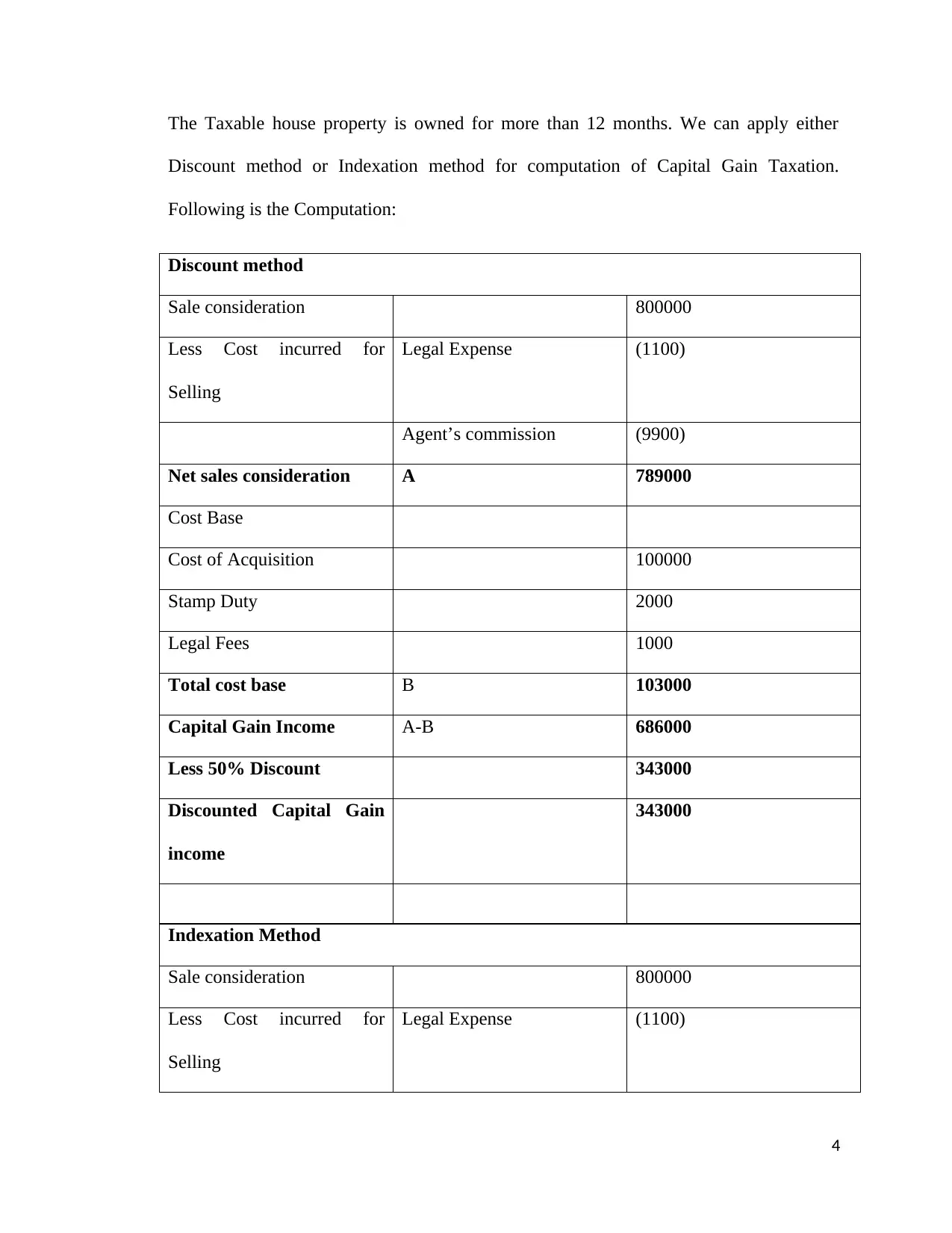
The Taxable house property is owned for more than 12 months. We can apply either
Discount method or Indexation method for computation of Capital Gain Taxation.
Following is the Computation:
Discount method
Sale consideration 800000
Less Cost incurred for
Selling
Legal Expense (1100)
Agent’s commission (9900)
Net sales consideration A 789000
Cost Base
Cost of Acquisition 100000
Stamp Duty 2000
Legal Fees 1000
Total cost base B 103000
Capital Gain Income A-B 686000
Less 50% Discount 343000
Discounted Capital Gain
income
343000
Indexation Method
Sale consideration 800000
Less Cost incurred for
Selling
Legal Expense (1100)
4
Discount method or Indexation method for computation of Capital Gain Taxation.
Following is the Computation:
Discount method
Sale consideration 800000
Less Cost incurred for
Selling
Legal Expense (1100)
Agent’s commission (9900)
Net sales consideration A 789000
Cost Base
Cost of Acquisition 100000
Stamp Duty 2000
Legal Fees 1000
Total cost base B 103000
Capital Gain Income A-B 686000
Less 50% Discount 343000
Discounted Capital Gain
income
343000
Indexation Method
Sale consideration 800000
Less Cost incurred for
Selling
Legal Expense (1100)
4
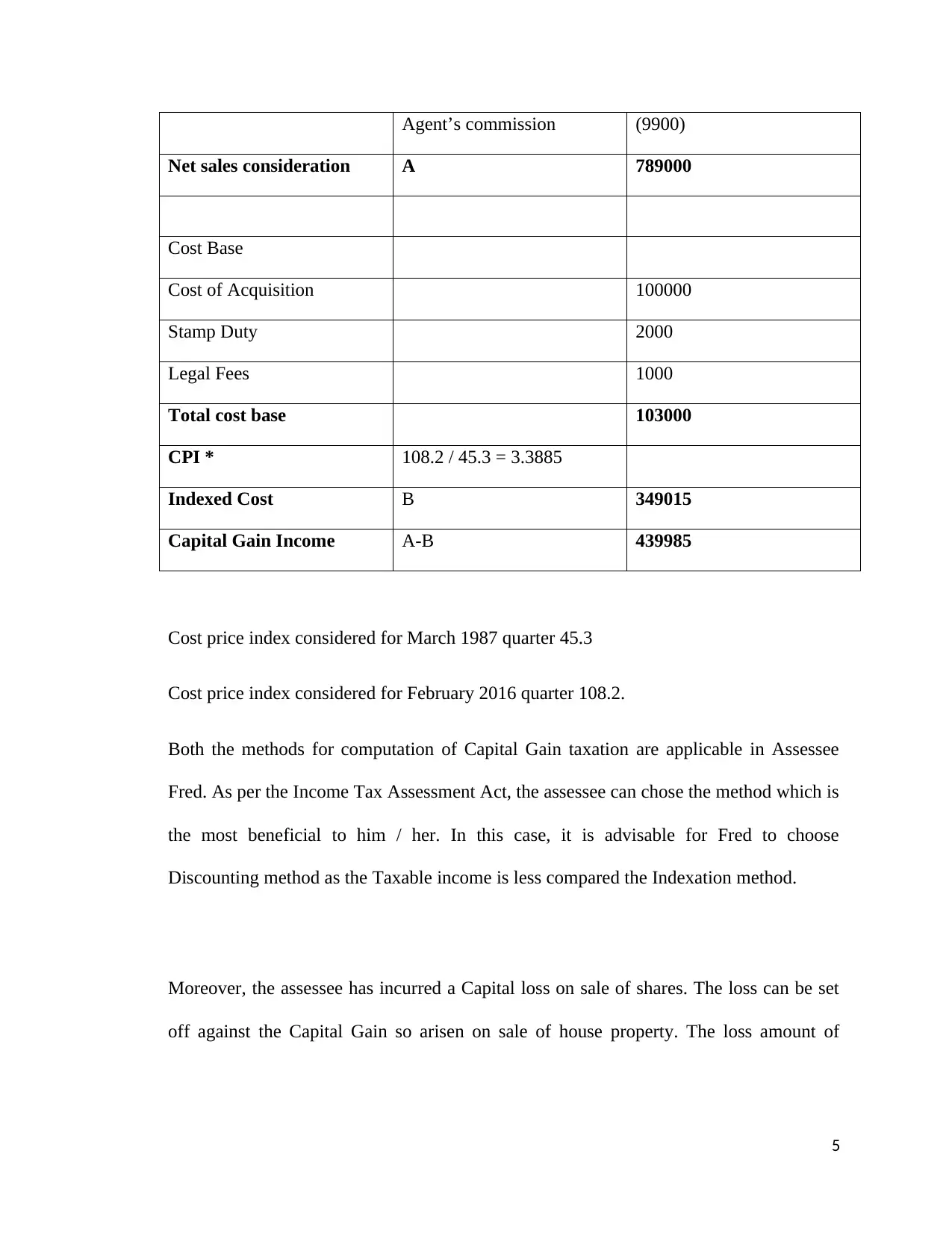
Agent’s commission (9900)
Net sales consideration A 789000
Cost Base
Cost of Acquisition 100000
Stamp Duty 2000
Legal Fees 1000
Total cost base 103000
CPI * 108.2 / 45.3 = 3.3885
Indexed Cost B 349015
Capital Gain Income A-B 439985
Cost price index considered for March 1987 quarter 45.3
Cost price index considered for February 2016 quarter 108.2.
Both the methods for computation of Capital Gain taxation are applicable in Assessee
Fred. As per the Income Tax Assessment Act, the assessee can chose the method which is
the most beneficial to him / her. In this case, it is advisable for Fred to choose
Discounting method as the Taxable income is less compared the Indexation method.
Moreover, the assessee has incurred a Capital loss on sale of shares. The loss can be set
off against the Capital Gain so arisen on sale of house property. The loss amount of
5
Net sales consideration A 789000
Cost Base
Cost of Acquisition 100000
Stamp Duty 2000
Legal Fees 1000
Total cost base 103000
CPI * 108.2 / 45.3 = 3.3885
Indexed Cost B 349015
Capital Gain Income A-B 439985
Cost price index considered for March 1987 quarter 45.3
Cost price index considered for February 2016 quarter 108.2.
Both the methods for computation of Capital Gain taxation are applicable in Assessee
Fred. As per the Income Tax Assessment Act, the assessee can chose the method which is
the most beneficial to him / her. In this case, it is advisable for Fred to choose
Discounting method as the Taxable income is less compared the Indexation method.
Moreover, the assessee has incurred a Capital loss on sale of shares. The loss can be set
off against the Capital Gain so arisen on sale of house property. The loss amount of
5
⊘ This is a preview!⊘
Do you want full access?
Subscribe today to unlock all pages.
Trusted by 1+ million students worldwide
$10000 can be adjusted against the Capital gain income of $343000. Next Capital gain
income works out to be $333000.
Instead of loss from sale of shares, the assessee had incurred loss on sale of antique vase.
Antiques are part of collectables. As per the Income Tax Assessment Act, assets which
are of personal use incuding collectables are exempted assets and hence capital gain
chapter does not apply. But, there is a condition of asset value $10000 in case of
collectable. As per the relevant provisions of the act, items which are of value less than
$10000 are exempt from Capital Gain purview. In the given case, the Assessee, Fred has
incurred a loss of $10000 in Collectables, which means the actual value or the actual cost
of purchasing the Antique was more than $10000. This is an exception to the exemption
clause. Hence the consumable item does not fall in the exempted category and hence
liable to Capital Gain Tax. It shall be noted that Capital Gain income includes loss also.
In the given case, the loss can be set off against the capital gain of $343000.
The loss on sale of antique vase will not create any difference in Capital gain income
because the same is taxable in the eyes of law.
In case the revenue authorities scrutinize the case, the assessee, Fred in this case is liable
to produce all necessary documents which justify the Sales consideration / Purchase cost
of the Capital Gain Asset. If he fails to do so, the revenue department can raise demand
which shall be paid along with necessary penalty and interest. It is rather advisable to
6
income works out to be $333000.
Instead of loss from sale of shares, the assessee had incurred loss on sale of antique vase.
Antiques are part of collectables. As per the Income Tax Assessment Act, assets which
are of personal use incuding collectables are exempted assets and hence capital gain
chapter does not apply. But, there is a condition of asset value $10000 in case of
collectable. As per the relevant provisions of the act, items which are of value less than
$10000 are exempt from Capital Gain purview. In the given case, the Assessee, Fred has
incurred a loss of $10000 in Collectables, which means the actual value or the actual cost
of purchasing the Antique was more than $10000. This is an exception to the exemption
clause. Hence the consumable item does not fall in the exempted category and hence
liable to Capital Gain Tax. It shall be noted that Capital Gain income includes loss also.
In the given case, the loss can be set off against the capital gain of $343000.
The loss on sale of antique vase will not create any difference in Capital gain income
because the same is taxable in the eyes of law.
In case the revenue authorities scrutinize the case, the assessee, Fred in this case is liable
to produce all necessary documents which justify the Sales consideration / Purchase cost
of the Capital Gain Asset. If he fails to do so, the revenue department can raise demand
which shall be paid along with necessary penalty and interest. It is rather advisable to
6
Paraphrase This Document
Need a fresh take? Get an instant paraphrase of this document with our AI Paraphraser
keep a regular file which has all the relevant documents in original for the purpose of
justifying what is shown in the return of income at the end of the year. It is also stated in
law that the records should be maintained in English language or which are easily
translable to English.
Following are some of the records required to be maintained by the assessee in the
Capital Gain Taxation
Acknowledgement receipts of purchase of property or transfer of properties
Borrowing of money. Interest expended related to the asset sold in the Capital
Gain Working
Bills / supportive papers justifying the payment to the professionals like agents,
Book keeper, Legal advisors and other miscellaneous cost for advertising
Insurance premium paid receipts and other rates and taxes
Valuation reports by Income tax recognized and registered valuers
Job card of the repairing work / maintanence contracts etc
Bank statements which support all above transactions
7
justifying what is shown in the return of income at the end of the year. It is also stated in
law that the records should be maintained in English language or which are easily
translable to English.
Following are some of the records required to be maintained by the assessee in the
Capital Gain Taxation
Acknowledgement receipts of purchase of property or transfer of properties
Borrowing of money. Interest expended related to the asset sold in the Capital
Gain Working
Bills / supportive papers justifying the payment to the professionals like agents,
Book keeper, Legal advisors and other miscellaneous cost for advertising
Insurance premium paid receipts and other rates and taxes
Valuation reports by Income tax recognized and registered valuers
Job card of the repairing work / maintanence contracts etc
Bank statements which support all above transactions
7
Case study 2: Fringe Benefits
Salary income is taxable when there is a transaction of payment between Employer and
employee. Any sum paid directly or indirectly by employer to employee is to be treated as salary
income in the hands of employee (ATO, 2015). At times, in big companies and multi- nationals,
in order to keep the reputation of the concerns, the employer, apart from Salary package offers,
many facilities which otherwise the employee would have done as a part of his / her living. For
eg Car, house. These are considered to be fringe benefits which form essential Salary taxable
income. In other words it can be understood that it is a complete salary package which the
employer has offered in terms of company car medical insurance, hospitalisation schemes,
holiday schemes, pension plans, interest free loans, etc. It is not necessary that there has to be an
establishment of Employer and employee relation (ATO, 2015). The fringe benefits could be
passed on between two independent contractors also the recipient of such benefits must consider
fair market value of the benefits so availed as part of their taxable income. Difference countries
have different law framework for taxability of fringe benefit taxation. For eg in India, Fringe
Benefit taxation has been abolished. Some of the exempt category benefits are social security,
medical facilities – hospitalization, Federal unemployment taxes etc.
In Australian republic, Fringe Benefit tax is borne by the employer (ATO, 2015). The Income
Tax Assessment Act has established various provisions relating the chargeability and taxability
of Fringe Benefit Taxation.
In the given case study, the employer has given Car to employee for office to home commuting
or for official purpose.
8
Salary income is taxable when there is a transaction of payment between Employer and
employee. Any sum paid directly or indirectly by employer to employee is to be treated as salary
income in the hands of employee (ATO, 2015). At times, in big companies and multi- nationals,
in order to keep the reputation of the concerns, the employer, apart from Salary package offers,
many facilities which otherwise the employee would have done as a part of his / her living. For
eg Car, house. These are considered to be fringe benefits which form essential Salary taxable
income. In other words it can be understood that it is a complete salary package which the
employer has offered in terms of company car medical insurance, hospitalisation schemes,
holiday schemes, pension plans, interest free loans, etc. It is not necessary that there has to be an
establishment of Employer and employee relation (ATO, 2015). The fringe benefits could be
passed on between two independent contractors also the recipient of such benefits must consider
fair market value of the benefits so availed as part of their taxable income. Difference countries
have different law framework for taxability of fringe benefit taxation. For eg in India, Fringe
Benefit taxation has been abolished. Some of the exempt category benefits are social security,
medical facilities – hospitalization, Federal unemployment taxes etc.
In Australian republic, Fringe Benefit tax is borne by the employer (ATO, 2015). The Income
Tax Assessment Act has established various provisions relating the chargeability and taxability
of Fringe Benefit Taxation.
In the given case study, the employer has given Car to employee for office to home commuting
or for official purpose.
8
⊘ This is a preview!⊘
Do you want full access?
Subscribe today to unlock all pages.
Trusted by 1+ million students worldwide
Assuming the car is from the following category:
Sedan / Hatch back car
Utility vehicle which are four wheelers
Passenger car – which can carry fewer than Nine passengers
In certain cases, the Income Tax Assessment Act provides exemption to Fringe Benefit Taxation.
In case the employee uses the vehicle for travelling between home and work; Marketing related
travelling; official tour utility; used for minors
Any usage of car other than the specified purpose amounts to Fringe Benefit (Austaxpbr, 2001).
It is therefore necessary to compute the Fringe benefit. If the employer maintains adequate
records, it can compute fringe benefit on Operating cost method.
Cost of Car = $33000
Repairing Expense= $550 (including GST)
Time when the car was not used for official purpose. 15 days.
Fringe benefit applicable for the 15 days.
Total days in the year when the car was put in use = 336 days. As per the Australian Taxation
office, the year of computation of Fringe benefit is from 1st April to 31st March.
Fringe Benefit (33000+550) x 15 / 336 = $1498
9
Sedan / Hatch back car
Utility vehicle which are four wheelers
Passenger car – which can carry fewer than Nine passengers
In certain cases, the Income Tax Assessment Act provides exemption to Fringe Benefit Taxation.
In case the employee uses the vehicle for travelling between home and work; Marketing related
travelling; official tour utility; used for minors
Any usage of car other than the specified purpose amounts to Fringe Benefit (Austaxpbr, 2001).
It is therefore necessary to compute the Fringe benefit. If the employer maintains adequate
records, it can compute fringe benefit on Operating cost method.
Cost of Car = $33000
Repairing Expense= $550 (including GST)
Time when the car was not used for official purpose. 15 days.
Fringe benefit applicable for the 15 days.
Total days in the year when the car was put in use = 336 days. As per the Australian Taxation
office, the year of computation of Fringe benefit is from 1st April to 31st March.
Fringe Benefit (33000+550) x 15 / 336 = $1498
9
Paraphrase This Document
Need a fresh take? Get an instant paraphrase of this document with our AI Paraphraser
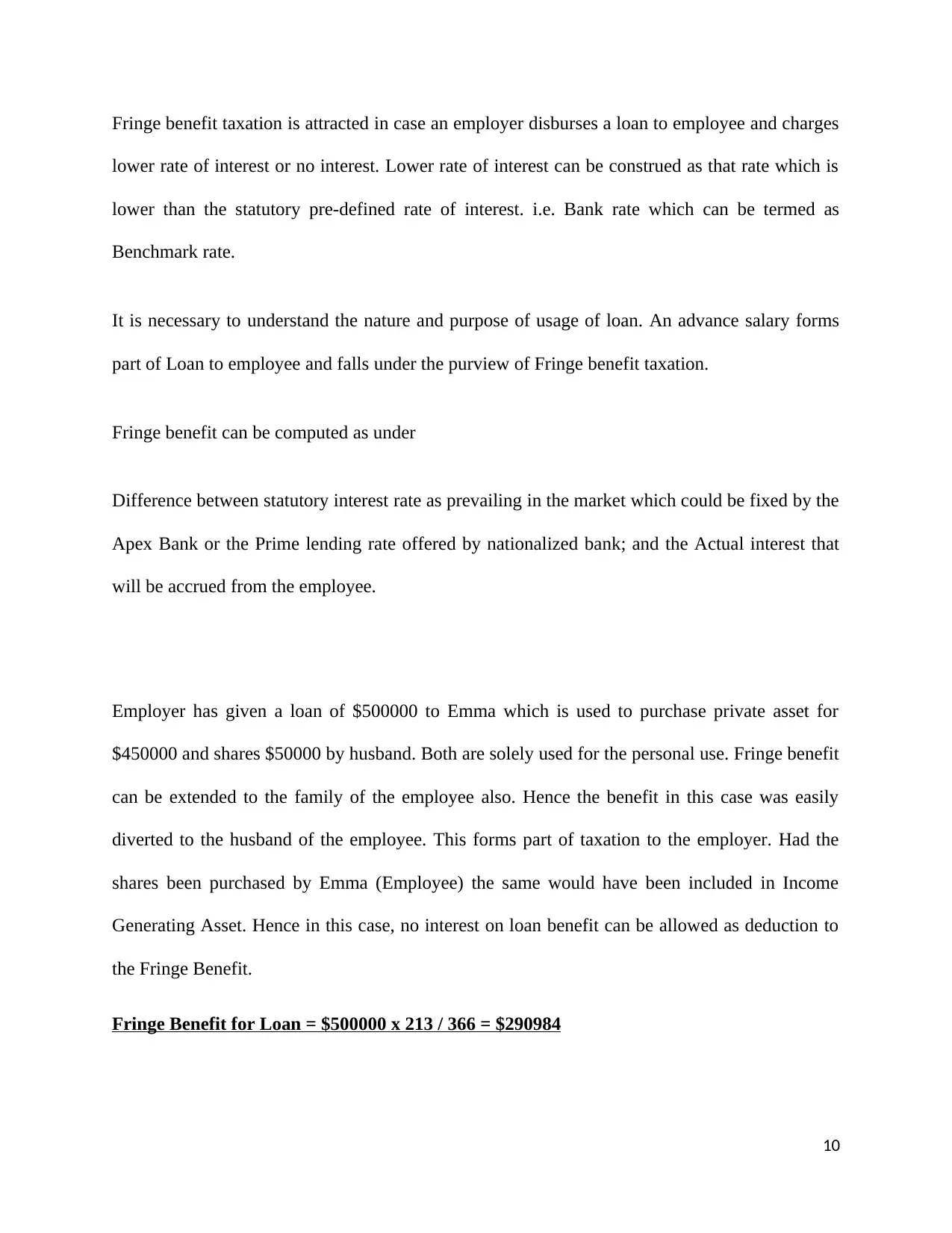
Fringe benefit taxation is attracted in case an employer disburses a loan to employee and charges
lower rate of interest or no interest. Lower rate of interest can be construed as that rate which is
lower than the statutory pre-defined rate of interest. i.e. Bank rate which can be termed as
Benchmark rate.
It is necessary to understand the nature and purpose of usage of loan. An advance salary forms
part of Loan to employee and falls under the purview of Fringe benefit taxation.
Fringe benefit can be computed as under
Difference between statutory interest rate as prevailing in the market which could be fixed by the
Apex Bank or the Prime lending rate offered by nationalized bank; and the Actual interest that
will be accrued from the employee.
Employer has given a loan of $500000 to Emma which is used to purchase private asset for
$450000 and shares $50000 by husband. Both are solely used for the personal use. Fringe benefit
can be extended to the family of the employee also. Hence the benefit in this case was easily
diverted to the husband of the employee. This forms part of taxation to the employer. Had the
shares been purchased by Emma (Employee) the same would have been included in Income
Generating Asset. Hence in this case, no interest on loan benefit can be allowed as deduction to
the Fringe Benefit.
Fringe Benefit for Loan = $500000 x 213 / 366 = $290984
10
lower rate of interest or no interest. Lower rate of interest can be construed as that rate which is
lower than the statutory pre-defined rate of interest. i.e. Bank rate which can be termed as
Benchmark rate.
It is necessary to understand the nature and purpose of usage of loan. An advance salary forms
part of Loan to employee and falls under the purview of Fringe benefit taxation.
Fringe benefit can be computed as under
Difference between statutory interest rate as prevailing in the market which could be fixed by the
Apex Bank or the Prime lending rate offered by nationalized bank; and the Actual interest that
will be accrued from the employee.
Employer has given a loan of $500000 to Emma which is used to purchase private asset for
$450000 and shares $50000 by husband. Both are solely used for the personal use. Fringe benefit
can be extended to the family of the employee also. Hence the benefit in this case was easily
diverted to the husband of the employee. This forms part of taxation to the employer. Had the
shares been purchased by Emma (Employee) the same would have been included in Income
Generating Asset. Hence in this case, no interest on loan benefit can be allowed as deduction to
the Fringe Benefit.
Fringe Benefit for Loan = $500000 x 213 / 366 = $290984
10
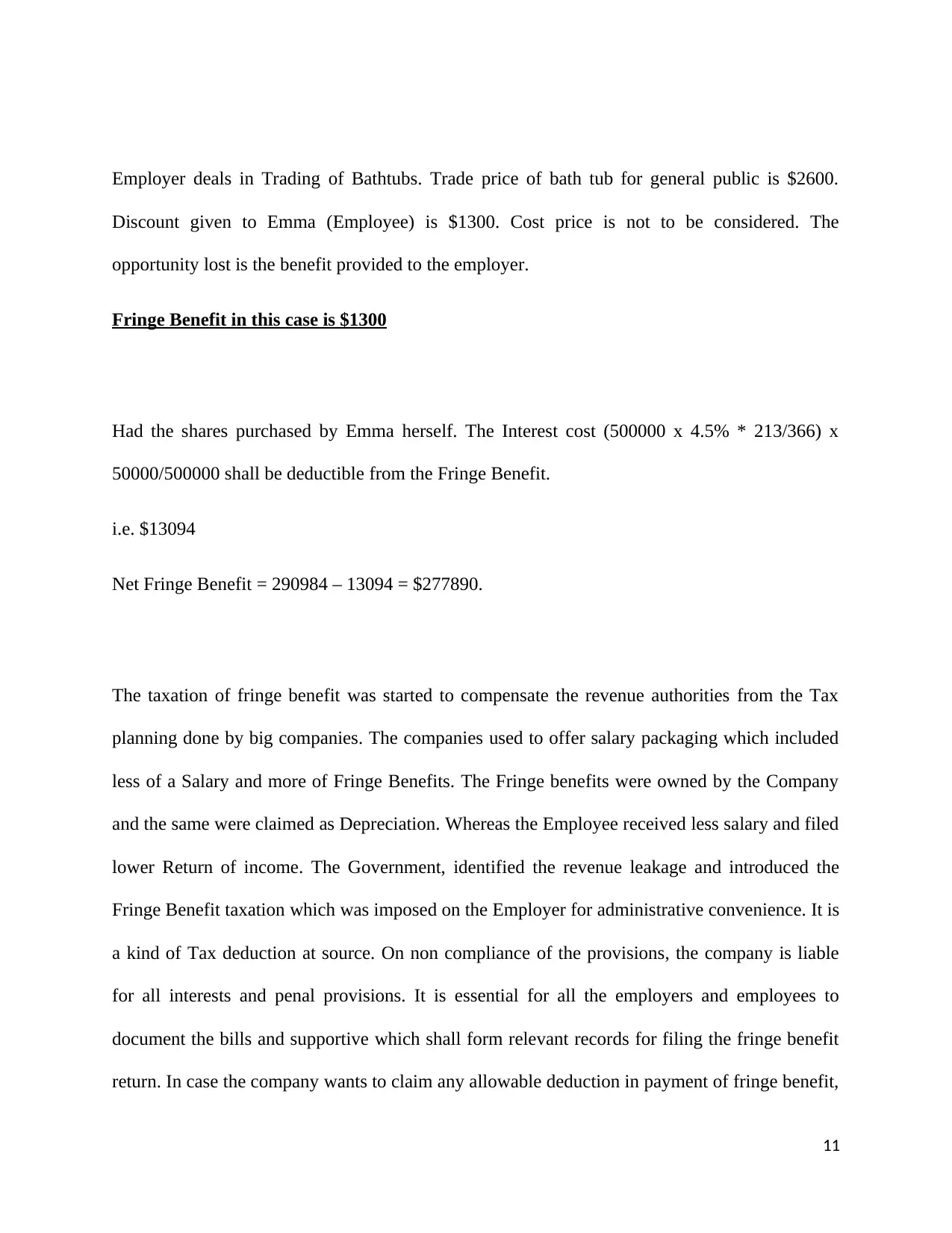
Employer deals in Trading of Bathtubs. Trade price of bath tub for general public is $2600.
Discount given to Emma (Employee) is $1300. Cost price is not to be considered. The
opportunity lost is the benefit provided to the employer.
Fringe Benefit in this case is $1300
Had the shares purchased by Emma herself. The Interest cost (500000 x 4.5% * 213/366) x
50000/500000 shall be deductible from the Fringe Benefit.
i.e. $13094
Net Fringe Benefit = 290984 – 13094 = $277890.
The taxation of fringe benefit was started to compensate the revenue authorities from the Tax
planning done by big companies. The companies used to offer salary packaging which included
less of a Salary and more of Fringe Benefits. The Fringe benefits were owned by the Company
and the same were claimed as Depreciation. Whereas the Employee received less salary and filed
lower Return of income. The Government, identified the revenue leakage and introduced the
Fringe Benefit taxation which was imposed on the Employer for administrative convenience. It is
a kind of Tax deduction at source. On non compliance of the provisions, the company is liable
for all interests and penal provisions. It is essential for all the employers and employees to
document the bills and supportive which shall form relevant records for filing the fringe benefit
return. In case the company wants to claim any allowable deduction in payment of fringe benefit,
11
Discount given to Emma (Employee) is $1300. Cost price is not to be considered. The
opportunity lost is the benefit provided to the employer.
Fringe Benefit in this case is $1300
Had the shares purchased by Emma herself. The Interest cost (500000 x 4.5% * 213/366) x
50000/500000 shall be deductible from the Fringe Benefit.
i.e. $13094
Net Fringe Benefit = 290984 – 13094 = $277890.
The taxation of fringe benefit was started to compensate the revenue authorities from the Tax
planning done by big companies. The companies used to offer salary packaging which included
less of a Salary and more of Fringe Benefits. The Fringe benefits were owned by the Company
and the same were claimed as Depreciation. Whereas the Employee received less salary and filed
lower Return of income. The Government, identified the revenue leakage and introduced the
Fringe Benefit taxation which was imposed on the Employer for administrative convenience. It is
a kind of Tax deduction at source. On non compliance of the provisions, the company is liable
for all interests and penal provisions. It is essential for all the employers and employees to
document the bills and supportive which shall form relevant records for filing the fringe benefit
return. In case the company wants to claim any allowable deduction in payment of fringe benefit,
11
⊘ This is a preview!⊘
Do you want full access?
Subscribe today to unlock all pages.
Trusted by 1+ million students worldwide

1 out of 14


Related Documents


Your All-in-One AI-Powered Toolkit for Academic Success.
+13062052269
info@desklib.com
Available 24*7 on WhatsApp / Email
![[object Object]](/_next/static/media/star-bottom.7253800d.svg)
Unlock your academic potential
Copyright © 2020–2026 A2Z Services. All Rights Reserved. Developed and managed by ZUCOL.