TAXATION 3 Report: Detailed Analysis of Australian Taxation Law Cases
VerifiedAdded on 2020/03/28
|15
|2962
|32
Report
AI Summary
This report provides a comprehensive analysis of various taxation scenarios under Australian tax law. It begins by examining capital gains and losses, specifically addressing the offset of losses from collectibles against other gains, referencing relevant sections of the ITAA 1997. The report then delves into Fringe Benefit Tax (FBT), exploring the implications of loan interest offsets based on Taxation Ruling TR 93/6. The analysis extends to rental property taxation, focusing on the allocation of losses between co-owners, referencing Taxation Ruling TR 93/32 and the case of F.C of T.v Mc Donald (1987). The report also discusses tax avoidance, referencing TRC v Duke of Westminster [1936] AC 1 and WR Ramsey v.IRC principles. Finally, the report assesses the taxation of revenue generated from selling wood cut from land used for sheep grazing, referencing Subsection 6(1) of the Income Tax Assessment Act 1936 and Taxation Ruling 95/6, concluding that the revenue is considered disposable income from primary production.
Running head: TAXATION
Taxation
Name of the Student:
Name of the University:
Author’s Note:
Taxation
Name of the Student:
Name of the University:
Author’s Note:

Paraphrase This Document
Need a fresh take? Get an instant paraphrase of this document with our AI Paraphraser
1
TAXATION
Table of Contents
Answer to Question No 1...........................................................................................................3
Issue:......................................................................................................................................3
Laws:......................................................................................................................................3
Calculations:...........................................................................................................................3
Applications:..........................................................................................................................3
Conclusion..............................................................................................................................4
Answer to Question No 2...........................................................................................................4
Issue:......................................................................................................................................4
Laws:......................................................................................................................................4
Calculations:...........................................................................................................................5
Applications:..........................................................................................................................5
Conclusion..............................................................................................................................6
Answer to Question No 3...........................................................................................................6
Issue:......................................................................................................................................6
Laws:......................................................................................................................................6
Applications:..........................................................................................................................6
Conclusion..............................................................................................................................8
Answer to Question No 4...........................................................................................................8
Answer to Question No 5...........................................................................................................9
Issue:......................................................................................................................................9
Laws.......................................................................................................................................9
TAXATION
Table of Contents
Answer to Question No 1...........................................................................................................3
Issue:......................................................................................................................................3
Laws:......................................................................................................................................3
Calculations:...........................................................................................................................3
Applications:..........................................................................................................................3
Conclusion..............................................................................................................................4
Answer to Question No 2...........................................................................................................4
Issue:......................................................................................................................................4
Laws:......................................................................................................................................4
Calculations:...........................................................................................................................5
Applications:..........................................................................................................................5
Conclusion..............................................................................................................................6
Answer to Question No 3...........................................................................................................6
Issue:......................................................................................................................................6
Laws:......................................................................................................................................6
Applications:..........................................................................................................................6
Conclusion..............................................................................................................................8
Answer to Question No 4...........................................................................................................8
Answer to Question No 5...........................................................................................................9
Issue:......................................................................................................................................9
Laws.......................................................................................................................................9

2
TAXATION
Applications:..........................................................................................................................9
Conclusion............................................................................................................................11
Reference List..........................................................................................................................12
TAXATION
Applications:..........................................................................................................................9
Conclusion............................................................................................................................11
Reference List..........................................................................................................................12
⊘ This is a preview!⊘
Do you want full access?
Subscribe today to unlock all pages.

Trusted by 1+ million students worldwide
3
TAXATION
Answer to Question No 1
Issue:
The key concern with respect to this question has been the purpose for seeking the
capital losses and gains that have been gathered from the sale of numerous assets, which is
depicted in “Section 108-20 of ITAA 1997”. There exist numerous laws that are interlinked
with the case study and hence have been disclosed later.
Laws: Section 108-10 of ITAA 1997 Section 108-20 of ITAA 1997
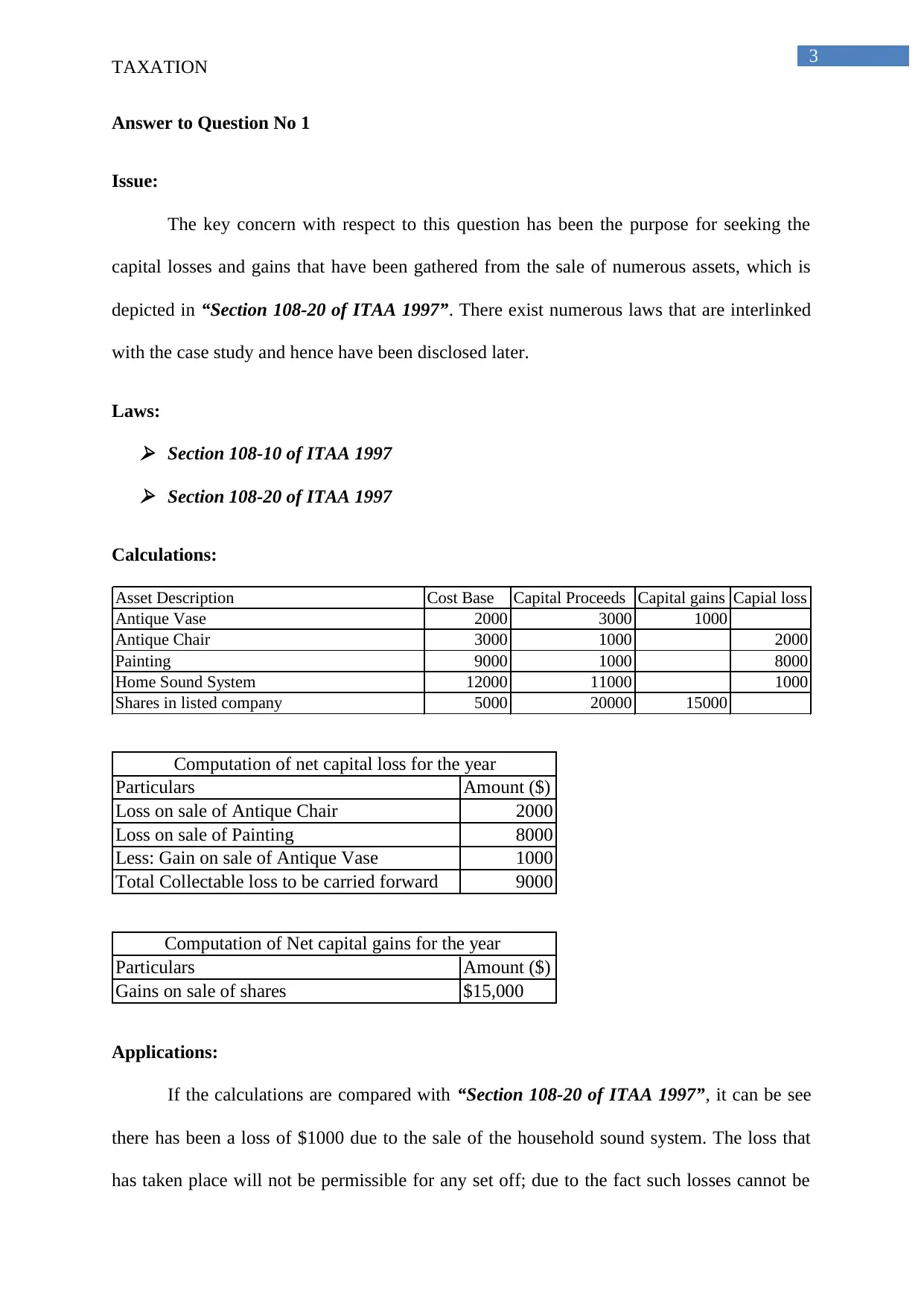
Calculations:
Asset Description Cost Base Capital Proceeds Capital gains Capial loss
Antique Vase 2000 3000 1000
Antique Chair 3000 1000 2000
Painting 9000 1000 8000
Home Sound System 12000 11000 1000
Shares in listed company 5000 20000 15000
Particulars Amount ($)
Loss on sale of Antique Chair 2000
Loss on sale of Painting 8000
Less: Gain on sale of Antique Vase 1000
Total Collectable loss to be carried forward 9000
Computation of net capital loss for the year
Particulars Amount ($)
Gains on sale of shares $15,000
Computation of Net capital gains for the year
Applications:
If the calculations are compared with “Section 108-20 of ITAA 1997”, it can be see
there has been a loss of $1000 due to the sale of the household sound system. The loss that
has taken place will not be permissible for any set off; due to the fact such losses cannot be
TAXATION
Answer to Question No 1
Issue:
The key concern with respect to this question has been the purpose for seeking the
capital losses and gains that have been gathered from the sale of numerous assets, which is
depicted in “Section 108-20 of ITAA 1997”. There exist numerous laws that are interlinked
with the case study and hence have been disclosed later.
Laws: Section 108-10 of ITAA 1997 Section 108-20 of ITAA 1997
Calculations:
Asset Description Cost Base Capital Proceeds Capital gains Capial loss
Antique Vase 2000 3000 1000
Antique Chair 3000 1000 2000
Painting 9000 1000 8000
Home Sound System 12000 11000 1000
Shares in listed company 5000 20000 15000
Particulars Amount ($)
Loss on sale of Antique Chair 2000
Loss on sale of Painting 8000
Less: Gain on sale of Antique Vase 1000
Total Collectable loss to be carried forward 9000
Computation of net capital loss for the year
Particulars Amount ($)
Gains on sale of shares $15,000
Computation of Net capital gains for the year
Applications:
If the calculations are compared with “Section 108-20 of ITAA 1997”, it can be see
there has been a loss of $1000 due to the sale of the household sound system. The loss that
has taken place will not be permissible for any set off; due to the fact such losses cannot be
Paraphrase This Document
Need a fresh take? Get an instant paraphrase of this document with our AI Paraphraser
4
TAXATION
permitted by relying on the disposal of the person making use of the assets. In conformity to
“Section 108-10 of ITAA 1997” the collectable losses may not be set off in regards to the
common gains that takes place from the selling off the shares (Petty et al., 2015).
Additionally, the offset can be considered in comparison to “Section 108-10 of ITAA 1997”.
As Eric has accomplished a profit by discarding the ordinary assets and there is no presence
of general capital or any other types that can be incorporated for deductions. Furthermore, the
capital gains for Eric have a current value of $15,000.
Conclusion
After observing the scenario of the question, it is concluded that Eric does not possess
the capacity to offset his losses that has been gathered from his collectibles as Eric has been
able to gain profit from the disposal of the general asset.
Answer to Question No 2
Issue:
The concern in this question has been to ascertain the Fringe Benefit Tax that is in
relation to “Taxation ruling of TR 93/6”. With respect to this question that rules and the
laws that are applicable are:
Laws: Taxation Rulings of TR 93/6
TAXATION
permitted by relying on the disposal of the person making use of the assets. In conformity to
“Section 108-10 of ITAA 1997” the collectable losses may not be set off in regards to the
common gains that takes place from the selling off the shares (Petty et al., 2015).
Additionally, the offset can be considered in comparison to “Section 108-10 of ITAA 1997”.
As Eric has accomplished a profit by discarding the ordinary assets and there is no presence
of general capital or any other types that can be incorporated for deductions. Furthermore, the
capital gains for Eric have a current value of $15,000.
Conclusion
After observing the scenario of the question, it is concluded that Eric does not possess
the capacity to offset his losses that has been gathered from his collectibles as Eric has been
able to gain profit from the disposal of the general asset.
Answer to Question No 2
Issue:
The concern in this question has been to ascertain the Fringe Benefit Tax that is in
relation to “Taxation ruling of TR 93/6”. With respect to this question that rules and the
laws that are applicable are:
Laws: Taxation Rulings of TR 93/6
5
TAXATION
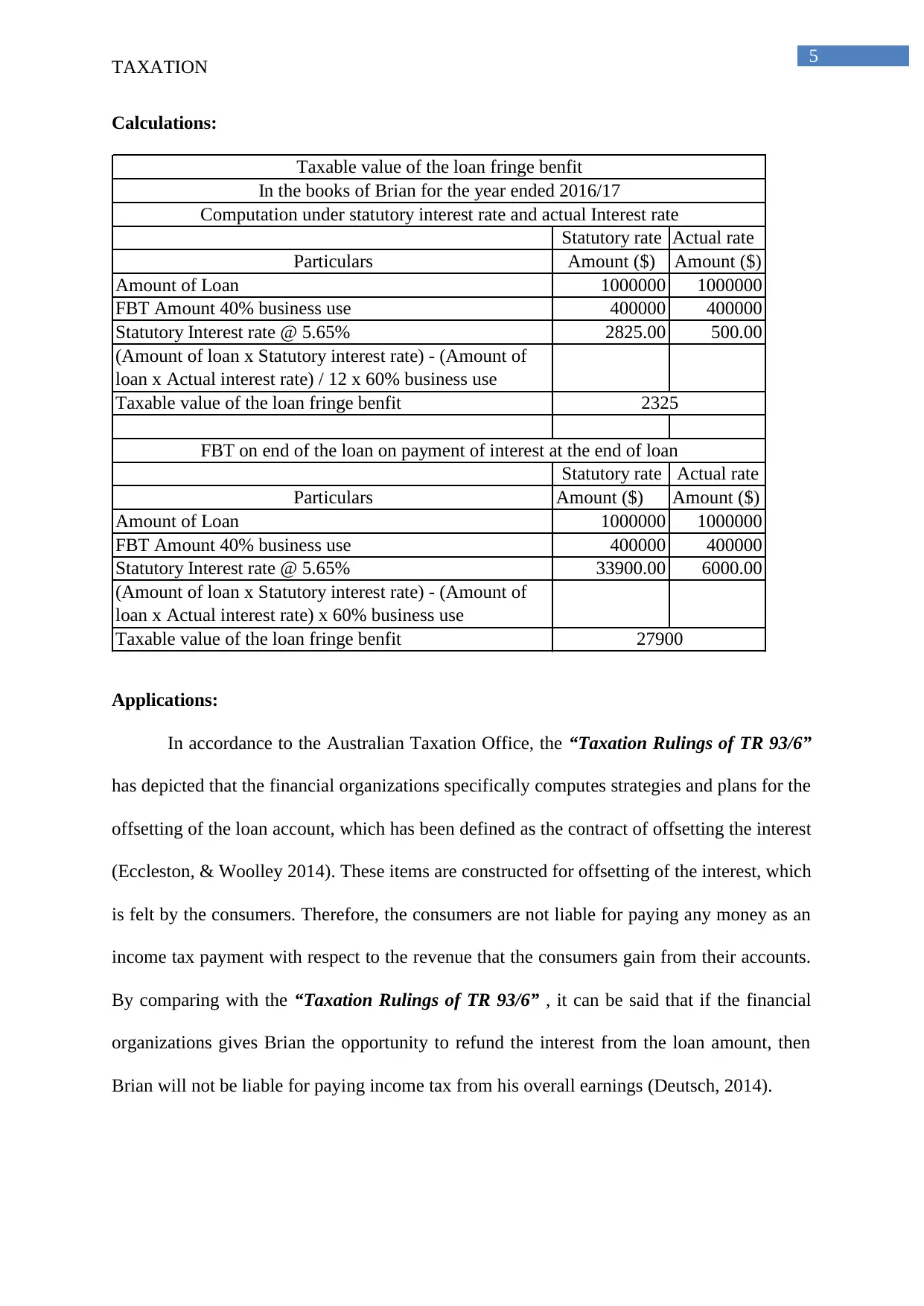
Calculations:
Statutory rate Actual rate
Particulars Amount ($) Amount ($)
Amount of Loan 1000000 1000000
FBT Amount 40% business use 400000 400000
Statutory Interest rate @ 5.65% 2825.00 500.00
(Amount of loan x Statutory interest rate) - (Amount of
loan x Actual interest rate) / 12 x 60% business use
Taxable value of the loan fringe benfit
Statutory rate Actual rate
Particulars Amount ($) Amount ($)
Amount of Loan 1000000 1000000
FBT Amount 40% business use 400000 400000
Statutory Interest rate @ 5.65% 33900.00 6000.00
(Amount of loan x Statutory interest rate) - (Amount of
loan x Actual interest rate) x 60% business use
Taxable value of the loan fringe benfit
2325
27900
FBT on end of the loan on payment of interest at the end of loan
Taxable value of the loan fringe benfit
In the books of Brian for the year ended 2016/17
Computation under statutory interest rate and actual Interest rate
Applications:
In accordance to the Australian Taxation Office, the “Taxation Rulings of TR 93/6”
has depicted that the financial organizations specifically computes strategies and plans for the
offsetting of the loan account, which has been defined as the contract of offsetting the interest
(Eccleston, & Woolley 2014). These items are constructed for offsetting of the interest, which
is felt by the consumers. Therefore, the consumers are not liable for paying any money as an
income tax payment with respect to the revenue that the consumers gain from their accounts.
By comparing with the “Taxation Rulings of TR 93/6” , it can be said that if the financial
organizations gives Brian the opportunity to refund the interest from the loan amount, then
Brian will not be liable for paying income tax from his overall earnings (Deutsch, 2014).
TAXATION
Calculations:
Statutory rate Actual rate
Particulars Amount ($) Amount ($)
Amount of Loan 1000000 1000000
FBT Amount 40% business use 400000 400000
Statutory Interest rate @ 5.65% 2825.00 500.00
(Amount of loan x Statutory interest rate) - (Amount of
loan x Actual interest rate) / 12 x 60% business use
Taxable value of the loan fringe benfit
Statutory rate Actual rate
Particulars Amount ($) Amount ($)
Amount of Loan 1000000 1000000
FBT Amount 40% business use 400000 400000
Statutory Interest rate @ 5.65% 33900.00 6000.00
(Amount of loan x Statutory interest rate) - (Amount of
loan x Actual interest rate) x 60% business use
Taxable value of the loan fringe benfit
2325
27900
FBT on end of the loan on payment of interest at the end of loan
Taxable value of the loan fringe benfit
In the books of Brian for the year ended 2016/17
Computation under statutory interest rate and actual Interest rate
Applications:
In accordance to the Australian Taxation Office, the “Taxation Rulings of TR 93/6”
has depicted that the financial organizations specifically computes strategies and plans for the
offsetting of the loan account, which has been defined as the contract of offsetting the interest
(Eccleston, & Woolley 2014). These items are constructed for offsetting of the interest, which
is felt by the consumers. Therefore, the consumers are not liable for paying any money as an
income tax payment with respect to the revenue that the consumers gain from their accounts.
By comparing with the “Taxation Rulings of TR 93/6” , it can be said that if the financial
organizations gives Brian the opportunity to refund the interest from the loan amount, then
Brian will not be liable for paying income tax from his overall earnings (Deutsch, 2014).
⊘ This is a preview!⊘
Do you want full access?
Subscribe today to unlock all pages.
Trusted by 1+ million students worldwide
6
TAXATION
Conclusion
After the analysis of this question, it can be explained that Brian does not require to
pay any amount of money for the purpose of income tax if Brian is excused from any sort of
banking interest.
Answer to Question No 3
Issue:
The concern in this question has been determining the allocation of the losses that has
been faced from a property that is rented and is even under the co-ownership of Jack and Jill.
The rules ideal for this situation are:
Laws: Taxation Rulings of TR 93/32 FC of the T.v Mc Donald (1987) Section 51 of ITAA 1997
Applications:
“Taxation Rulings of TR 93/32” explains the depiction of the divisionary net losses
or income that is generated from the rental property between the co-owners of the land that
has been discussed in this question. Additionally, the rules for taxation have been essentially
considered for the examination of the taxable scenario of the dual owners who are liable for
transmitting their values into proceedings. The current scenario of Jack and Jill has the goal
of investigating the taxable scenario of the property that is rented in nature. It is being viewed
that Jack has been qualified for a percentage of 10% of the property and on the other hand Jill
has the eligibility of a percentage of 90% of the same property.
TAXATION
Conclusion
After the analysis of this question, it can be explained that Brian does not require to
pay any amount of money for the purpose of income tax if Brian is excused from any sort of
banking interest.
Answer to Question No 3
Issue:
The concern in this question has been determining the allocation of the losses that has
been faced from a property that is rented and is even under the co-ownership of Jack and Jill.
The rules ideal for this situation are:
Laws: Taxation Rulings of TR 93/32 FC of the T.v Mc Donald (1987) Section 51 of ITAA 1997
Applications:
“Taxation Rulings of TR 93/32” explains the depiction of the divisionary net losses
or income that is generated from the rental property between the co-owners of the land that
has been discussed in this question. Additionally, the rules for taxation have been essentially
considered for the examination of the taxable scenario of the dual owners who are liable for
transmitting their values into proceedings. The current scenario of Jack and Jill has the goal
of investigating the taxable scenario of the property that is rented in nature. It is being viewed
that Jack has been qualified for a percentage of 10% of the property and on the other hand Jill
has the eligibility of a percentage of 90% of the same property.
Paraphrase This Document
Need a fresh take? Get an instant paraphrase of this document with our AI Paraphraser
7
TAXATION
By looking at “Taxation Ruling TR 93/32”, it can be said that the co-ownership of
the property that is rented is looked upon as a sort of partnership for the income tax purpose
but this has not been looked down as an personal partnership at the general law, in which the
co-partnership is looked down as a kind of partnership for satisfying the purpose of income
tax (Taylor, & Richardson 2014). The loss that has taken place from the income received
from the rental property is supervised and managed by taking help of the co-ownership of the
rental estate and also from the distribution of the profit and loss of the partnerships. The
current condition of Jack and Jill has depicted that the co-ownership of the rented estate
among each other, which is reliant on the rationale of the income tax and hence will be
regarded as a partnership in accordance to the general law.
The “Taxation Ruling of TR 93/32” has depicted that the co-owners of the estate that
is rented are distinctly not considered as partners if looked in the general. In this respect, the
contract of the partnership, which has been constructed in a written manner or verbally
becomes ineffective on the income shared value and the loss that is incurred from the rented
estate (Lee et al., 2016). Thus, the co-owners of the rented estate in this respect who are Jack
and Jill will hold the property as co-holders and renters due to personal common factor.
By looking at the case of “F.C of T.v Mc Donald (1987) 18 ATR 957”, Mr and Mrs
Mc Donald has the authority to hold two segments of the units of the titles as they have been
regarded as the co-renters. The agreement or the contract that has been prepared among them
has explained that the net profit that has incurred from the rented estate would comprise of
25% to Mr. Mc Donald and on the other hand Mrs Mc Donald would be liable for the rest
75% of the property. In this condition, the total loss value that has been faced is taken up by
Mr Mc Donald.
TAXATION
By looking at “Taxation Ruling TR 93/32”, it can be said that the co-ownership of
the property that is rented is looked upon as a sort of partnership for the income tax purpose
but this has not been looked down as an personal partnership at the general law, in which the
co-partnership is looked down as a kind of partnership for satisfying the purpose of income
tax (Taylor, & Richardson 2014). The loss that has taken place from the income received
from the rental property is supervised and managed by taking help of the co-ownership of the
rental estate and also from the distribution of the profit and loss of the partnerships. The
current condition of Jack and Jill has depicted that the co-ownership of the rented estate
among each other, which is reliant on the rationale of the income tax and hence will be
regarded as a partnership in accordance to the general law.
The “Taxation Ruling of TR 93/32” has depicted that the co-owners of the estate that
is rented are distinctly not considered as partners if looked in the general. In this respect, the
contract of the partnership, which has been constructed in a written manner or verbally
becomes ineffective on the income shared value and the loss that is incurred from the rented
estate (Lee et al., 2016). Thus, the co-owners of the rented estate in this respect who are Jack
and Jill will hold the property as co-holders and renters due to personal common factor.
By looking at the case of “F.C of T.v Mc Donald (1987) 18 ATR 957”, Mr and Mrs
Mc Donald has the authority to hold two segments of the units of the titles as they have been
regarded as the co-renters. The agreement or the contract that has been prepared among them
has explained that the net profit that has incurred from the rented estate would comprise of
25% to Mr. Mc Donald and on the other hand Mrs Mc Donald would be liable for the rest
75% of the property. In this condition, the total loss value that has been faced is taken up by
Mr Mc Donald.
8
TAXATION
Conclusion
The evaluation of the case background has established the solution that Jack and Jill
both requires to distribute the loss incurred equivalently and the co-ownership is not looked
upon as partnership venture.
Answer to Question No 4
The most commonly cited tax avoidance incident has been “TRC v Duke of
Westminster [1936] AC 1”. The case in this question has developed a principle that defines
that every individual is allowed to regulate their operations for granting the taxation
allocation, which has been framed within the Act that has been deemed appropriate. This
taxation allotment is very low with respect to before. Although, it can be said that this ruling
mechanism has been conspicuous for the other consumers who are seeking for the avoidance
of tax with respect to the complicated model of laws and they are moved by taking assistance
of the accomplished cases where the courts or the legal systems have experienced in the total
impact(Isa, 2014). By taking assistance of giving out an instance of the court for the future
aspects that has been much more restrictive and were implemented was in the “WR Ramsey
v.IRC principle”. In these circumstances, the transactions have been ordered at an initial
stage in a false process and this has not been helpful for any nature of commercial intentions.
The efficient rule has always been to charge the tax for broadening the transactions as an
entire proof.
In the scenario, which has been modern in this era, the principle and the rule within
the nation of Australia depicts that in the situation where a person achieves victory for
making sure that this result has been secured, the Inland Revenue has to be due to their
program and they may not be forced to pay for any extra amount of tax. Nevertheless, the
idea has has been incorporated is that this element grants the companies and persons for
TAXATION
Conclusion
The evaluation of the case background has established the solution that Jack and Jill
both requires to distribute the loss incurred equivalently and the co-ownership is not looked
upon as partnership venture.
Answer to Question No 4
The most commonly cited tax avoidance incident has been “TRC v Duke of
Westminster [1936] AC 1”. The case in this question has developed a principle that defines
that every individual is allowed to regulate their operations for granting the taxation
allocation, which has been framed within the Act that has been deemed appropriate. This
taxation allotment is very low with respect to before. Although, it can be said that this ruling
mechanism has been conspicuous for the other consumers who are seeking for the avoidance
of tax with respect to the complicated model of laws and they are moved by taking assistance
of the accomplished cases where the courts or the legal systems have experienced in the total
impact(Isa, 2014). By taking assistance of giving out an instance of the court for the future
aspects that has been much more restrictive and were implemented was in the “WR Ramsey
v.IRC principle”. In these circumstances, the transactions have been ordered at an initial
stage in a false process and this has not been helpful for any nature of commercial intentions.
The efficient rule has always been to charge the tax for broadening the transactions as an
entire proof.
In the scenario, which has been modern in this era, the principle and the rule within
the nation of Australia depicts that in the situation where a person achieves victory for
making sure that this result has been secured, the Inland Revenue has to be due to their
program and they may not be forced to pay for any extra amount of tax. Nevertheless, the
idea has has been incorporated is that this element grants the companies and persons for
⊘ This is a preview!⊘
Do you want full access?
Subscribe today to unlock all pages.
Trusted by 1+ million students worldwide
9
TAXATION
constructing financial agreement in accordance to the goals and objectives that have been set
for reducing the tax liabilities that is reliant on their models under numerous law models.
Answer to Question No 5
Issue:
In the present condition, the assessment of the sales revenue has been ascertained by
selling off the wood that has been cut down from the land in order to herd the sheep. This
scenario has been constructed by taking help of the “Subsection 6(1) of the Income tax
Assessment Act 1936”. The rules that are interlinked with this case are as follows:
Laws McCauley v. The Federal Commissioner of Taxation Subsection 6(1) of the Income tax Assessment Act 1936.
Applications:
With respect to the present business scenario, it is seen that Bill has been the owner of
a vast land where there is the presence of a number of pine trees. The intention of Bill has
been to make use of the land by grazing his sheep and in order to do so; he wants the land to
be cleared off. Bill has disclosed that there is a tree cutting company who have said that they
would be paying Bill $1000 for every 100 meters of the land clear off. The log cutting
company therefore has the opportunity to grasp the portion of Bill’s land. The “Taxation
Ruling of 95/6” has brought forward that the circumstances of income tax that is generated
from the activities of the primary forestry and manufacturing. This mechanism of ruling has
proposed a limitation of the earnings that is gained from the sale of wood. This element
consists of the revenues that is measurable and whether the person who are paying the taxes
are indulged in the activities of the forest business. “Subsection 6 (1) of the Income tax
TAXATION
constructing financial agreement in accordance to the goals and objectives that have been set
for reducing the tax liabilities that is reliant on their models under numerous law models.
Answer to Question No 5
Issue:
In the present condition, the assessment of the sales revenue has been ascertained by
selling off the wood that has been cut down from the land in order to herd the sheep. This
scenario has been constructed by taking help of the “Subsection 6(1) of the Income tax
Assessment Act 1936”. The rules that are interlinked with this case are as follows:
Laws McCauley v. The Federal Commissioner of Taxation Subsection 6(1) of the Income tax Assessment Act 1936.
Applications:
With respect to the present business scenario, it is seen that Bill has been the owner of
a vast land where there is the presence of a number of pine trees. The intention of Bill has
been to make use of the land by grazing his sheep and in order to do so; he wants the land to
be cleared off. Bill has disclosed that there is a tree cutting company who have said that they
would be paying Bill $1000 for every 100 meters of the land clear off. The log cutting
company therefore has the opportunity to grasp the portion of Bill’s land. The “Taxation
Ruling of 95/6” has brought forward that the circumstances of income tax that is generated
from the activities of the primary forestry and manufacturing. This mechanism of ruling has
proposed a limitation of the earnings that is gained from the sale of wood. This element
consists of the revenues that is measurable and whether the person who are paying the taxes
are indulged in the activities of the forest business. “Subsection 6 (1) of the Income tax
Paraphrase This Document
Need a fresh take? Get an instant paraphrase of this document with our AI Paraphraser
10
TAXATION
Assessment Act 1936”, the primary manufacturing is specifically defined as the tree
plantation with an area, which would be used later for the purpose of cutting. By observing
the present situation, Bill has been regarded as the basic producer as he has been busy in
process of primary production in accordance to “Subsection 6 (1) of the Income Tax
Assessment Act 1936”. The functions within the forest include cutting the trees down of a
wood or plantation even though the individuals paying tax are not concerned about the
planted trees.
Bill is the owner of a huge piece of land and in this land he has not planted any trees
but conversely, the total income generated from the land by Bill with the help of the sale of
woods has been identified as income that is disposable and therefore has focused for the aim
of sales that has been created as an income segment that is permissible (McCluskey, &
Franzsen 2017). In spite of these reasons, the sales has been looked upon as a mixture
permanently and partially for the individuals paying tax in accordance to “Subsection 6 (1) of
the Income Tax Assessment Act 1936”.
On the other hand, if the taxpaying personnel was paid an entire amount of 450,000
by proving the power to cut the amount of trees that are necessary, then in that case, the entire
amount that will be earned will be looked upon as the royalties. It is similar to “Section 26
(f)” where the earnings from the royalties by an individual for having the power to sell the
trees that has been logged from his land. In such situations, Bill will not be considered for
undertaking trading operations on the forest. in compliance, it has been considered that the
individual who pays tax did not plant the trees for the cutting purpose in order to gain benefit
out of the same. It has been observed that in “Mc Cauley v. The Federal Commissioner of
Tax”, the payments that are received by the lender come under the supremacy of undertaking
the same. The values that are similar and are gained by Bill as a form of royalty is mixed with
the earnings that is permissible in accordance to “Section 26(f)”.
TAXATION
Assessment Act 1936”, the primary manufacturing is specifically defined as the tree
plantation with an area, which would be used later for the purpose of cutting. By observing
the present situation, Bill has been regarded as the basic producer as he has been busy in
process of primary production in accordance to “Subsection 6 (1) of the Income Tax
Assessment Act 1936”. The functions within the forest include cutting the trees down of a
wood or plantation even though the individuals paying tax are not concerned about the
planted trees.
Bill is the owner of a huge piece of land and in this land he has not planted any trees
but conversely, the total income generated from the land by Bill with the help of the sale of
woods has been identified as income that is disposable and therefore has focused for the aim
of sales that has been created as an income segment that is permissible (McCluskey, &
Franzsen 2017). In spite of these reasons, the sales has been looked upon as a mixture
permanently and partially for the individuals paying tax in accordance to “Subsection 6 (1) of
the Income Tax Assessment Act 1936”.
On the other hand, if the taxpaying personnel was paid an entire amount of 450,000
by proving the power to cut the amount of trees that are necessary, then in that case, the entire
amount that will be earned will be looked upon as the royalties. It is similar to “Section 26
(f)” where the earnings from the royalties by an individual for having the power to sell the
trees that has been logged from his land. In such situations, Bill will not be considered for
undertaking trading operations on the forest. in compliance, it has been considered that the
individual who pays tax did not plant the trees for the cutting purpose in order to gain benefit
out of the same. It has been observed that in “Mc Cauley v. The Federal Commissioner of
Tax”, the payments that are received by the lender come under the supremacy of undertaking
the same. The values that are similar and are gained by Bill as a form of royalty is mixed with
the earnings that is permissible in accordance to “Section 26(f)”.

11
TAXATION
Conclusion
The examination of this case explains that income derived from the logging if the
tress would be looked upon as the earnings that are taxable in accordance to “Subsection 6(1)
of ITAA 1997”.
TAXATION
Conclusion
The examination of this case explains that income derived from the logging if the
tress would be looked upon as the earnings that are taxable in accordance to “Subsection 6(1)
of ITAA 1997”.
⊘ This is a preview!⊘
Do you want full access?
Subscribe today to unlock all pages.
Trusted by 1+ million students worldwide

1 out of 15


Related Documents


Your All-in-One AI-Powered Toolkit for Academic Success.
+13062052269
info@desklib.com
Available 24*7 on WhatsApp / Email
![[object Object]](/_next/static/media/star-bottom.7253800d.svg)
Unlock your academic potential
Copyright © 2020–2026 A2Z Services. All Rights Reserved. Developed and managed by ZUCOL.