Taxation Law Assignment: Ruby Engineering and Betty's Transactions
VerifiedAdded on 2023/06/03
|6
|1444
|366
Homework Assignment
AI Summary
This taxation assignment analyzes two key areas: tax deductible expenses for Ruby Engineering Pty Ltd and the determination of net capital gains or losses for Betty from the sale of her capital assets. The analysis of Ruby Engineering's expenses considers whether expenditures on kitchen fittings, legal expenses related to a rental property, and litigation costs from a business shift are tax deductible, referencing relevant sections of the ITAA 1997 and case law such as TR 97/23 and British Insulated and Helsby Cables Ltd v. Atherton. The assessment of Betty's capital gains and losses involves the sale of a painting, shares, and a violin. The analysis determines the CGT implications based on whether the assets are pre-CGT, the timing of purchase, and the nature of the assets (e.g., collectible). The assignment concludes with a computation of the CGT liability and a list of references used in the analysis. This assignment provides a comprehensive application of taxation principles, including capital gains tax, deductible expenses, and asset classification.
Taxation
STUDENT NAME/ID
[Pick the date]
STUDENT NAME/ID
[Pick the date]
Paraphrase This Document
Need a fresh take? Get an instant paraphrase of this document with our AI Paraphraser

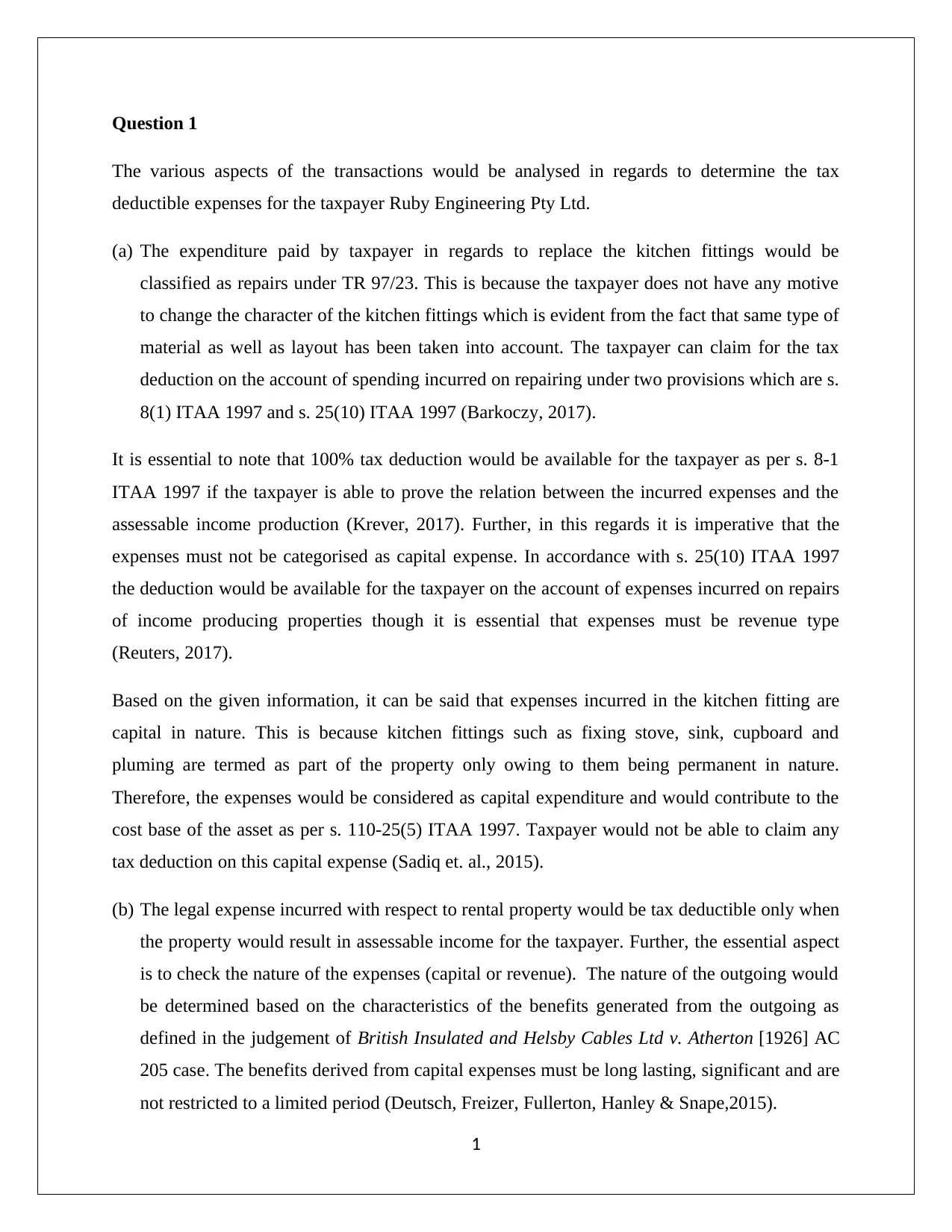
Question 1
The various aspects of the transactions would be analysed in regards to determine the tax
deductible expenses for the taxpayer Ruby Engineering Pty Ltd.
(a) The expenditure paid by taxpayer in regards to replace the kitchen fittings would be
classified as repairs under TR 97/23. This is because the taxpayer does not have any motive
to change the character of the kitchen fittings which is evident from the fact that same type of
material as well as layout has been taken into account. The taxpayer can claim for the tax
deduction on the account of spending incurred on repairing under two provisions which are s.
8(1) ITAA 1997 and s. 25(10) ITAA 1997 (Barkoczy, 2017).
It is essential to note that 100% tax deduction would be available for the taxpayer as per s. 8-1
ITAA 1997 if the taxpayer is able to prove the relation between the incurred expenses and the
assessable income production (Krever, 2017). Further, in this regards it is imperative that the
expenses must not be categorised as capital expense. In accordance with s. 25(10) ITAA 1997
the deduction would be available for the taxpayer on the account of expenses incurred on repairs
of income producing properties though it is essential that expenses must be revenue type
(Reuters, 2017).
Based on the given information, it can be said that expenses incurred in the kitchen fitting are
capital in nature. This is because kitchen fittings such as fixing stove, sink, cupboard and
pluming are termed as part of the property only owing to them being permanent in nature.
Therefore, the expenses would be considered as capital expenditure and would contribute to the
cost base of the asset as per s. 110-25(5) ITAA 1997. Taxpayer would not be able to claim any
tax deduction on this capital expense (Sadiq et. al., 2015).
(b) The legal expense incurred with respect to rental property would be tax deductible only when
the property would result in assessable income for the taxpayer. Further, the essential aspect
is to check the nature of the expenses (capital or revenue). The nature of the outgoing would
be determined based on the characteristics of the benefits generated from the outgoing as
defined in the judgement of British Insulated and Helsby Cables Ltd v. Atherton [1926] AC
205 case. The benefits derived from capital expenses must be long lasting, significant and are
not restricted to a limited period (Deutsch, Freizer, Fullerton, Hanley & Snape,2015).
1
The various aspects of the transactions would be analysed in regards to determine the tax
deductible expenses for the taxpayer Ruby Engineering Pty Ltd.
(a) The expenditure paid by taxpayer in regards to replace the kitchen fittings would be
classified as repairs under TR 97/23. This is because the taxpayer does not have any motive
to change the character of the kitchen fittings which is evident from the fact that same type of
material as well as layout has been taken into account. The taxpayer can claim for the tax
deduction on the account of spending incurred on repairing under two provisions which are s.
8(1) ITAA 1997 and s. 25(10) ITAA 1997 (Barkoczy, 2017).
It is essential to note that 100% tax deduction would be available for the taxpayer as per s. 8-1
ITAA 1997 if the taxpayer is able to prove the relation between the incurred expenses and the
assessable income production (Krever, 2017). Further, in this regards it is imperative that the
expenses must not be categorised as capital expense. In accordance with s. 25(10) ITAA 1997
the deduction would be available for the taxpayer on the account of expenses incurred on repairs
of income producing properties though it is essential that expenses must be revenue type
(Reuters, 2017).
Based on the given information, it can be said that expenses incurred in the kitchen fitting are
capital in nature. This is because kitchen fittings such as fixing stove, sink, cupboard and
pluming are termed as part of the property only owing to them being permanent in nature.
Therefore, the expenses would be considered as capital expenditure and would contribute to the
cost base of the asset as per s. 110-25(5) ITAA 1997. Taxpayer would not be able to claim any
tax deduction on this capital expense (Sadiq et. al., 2015).
(b) The legal expense incurred with respect to rental property would be tax deductible only when
the property would result in assessable income for the taxpayer. Further, the essential aspect
is to check the nature of the expenses (capital or revenue). The nature of the outgoing would
be determined based on the characteristics of the benefits generated from the outgoing as
defined in the judgement of British Insulated and Helsby Cables Ltd v. Atherton [1926] AC
205 case. The benefits derived from capital expenses must be long lasting, significant and are
not restricted to a limited period (Deutsch, Freizer, Fullerton, Hanley & Snape,2015).
1

It can be seen that taxpayer is involved in a real estate business where the negligence related
claim are quite frequent. Further, the legal expenses incurred in this do not provide any long term
benefit to the taxpayer and rather it restricts the negligence liability (Coleman, 2016). Hence, the
expenses are revenue expenses and taxpayer can claim for the tax deduction under s. 8(1) ITAA
1997.
(c) Company has shifted their business from manufacturing company to real estate business.
There is some litigation as customer has been provided with defective engines/associated
parts. Further, due to this litigation the reputation of the company and the financial cash
outflows are also affected and thus, the business of the company is affected negatively. In
accordance with s. 8(1) ITAA 1997 the deduction would not be available for taxpayer
because the expense is capital expense (Sadiq et. al., 2015). Further, if it has been considered
that the claim amount would be an outflow in relation to business operation and therefore,
100% tax deduction would be available for taxpayer under s. 40-880, ITAA 1997 as five
equal annual payments (Barkoczy, 2017).
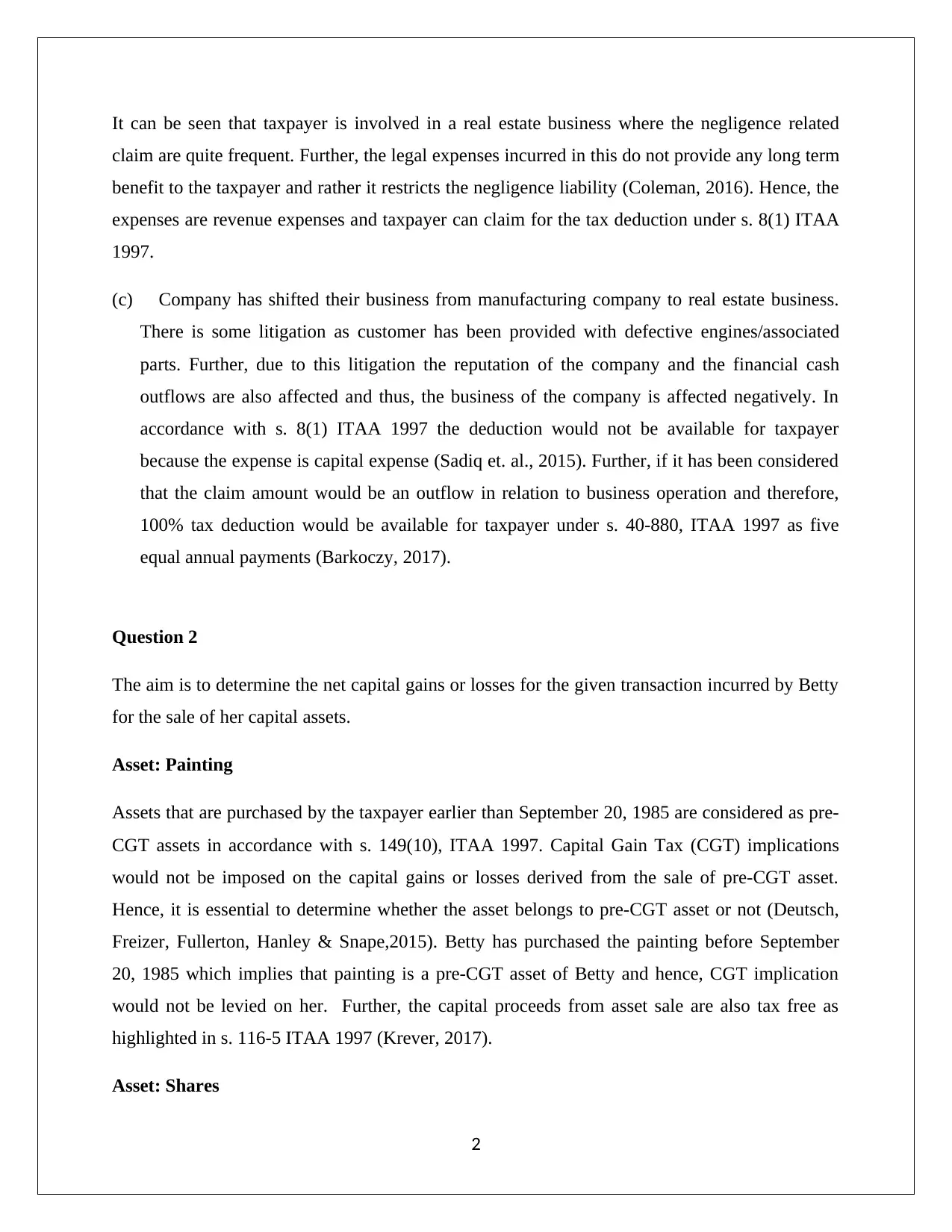
Question 2
The aim is to determine the net capital gains or losses for the given transaction incurred by Betty
for the sale of her capital assets.
Asset: Painting
Assets that are purchased by the taxpayer earlier than September 20, 1985 are considered as pre-
CGT assets in accordance with s. 149(10), ITAA 1997. Capital Gain Tax (CGT) implications
would not be imposed on the capital gains or losses derived from the sale of pre-CGT asset.
Hence, it is essential to determine whether the asset belongs to pre-CGT asset or not (Deutsch,
Freizer, Fullerton, Hanley & Snape,2015). Betty has purchased the painting before September
20, 1985 which implies that painting is a pre-CGT asset of Betty and hence, CGT implication
would not be levied on her. Further, the capital proceeds from asset sale are also tax free as
highlighted in s. 116-5 ITAA 1997 (Krever, 2017).
Asset: Shares
2
claim are quite frequent. Further, the legal expenses incurred in this do not provide any long term
benefit to the taxpayer and rather it restricts the negligence liability (Coleman, 2016). Hence, the
expenses are revenue expenses and taxpayer can claim for the tax deduction under s. 8(1) ITAA
1997.
(c) Company has shifted their business from manufacturing company to real estate business.
There is some litigation as customer has been provided with defective engines/associated
parts. Further, due to this litigation the reputation of the company and the financial cash
outflows are also affected and thus, the business of the company is affected negatively. In
accordance with s. 8(1) ITAA 1997 the deduction would not be available for taxpayer
because the expense is capital expense (Sadiq et. al., 2015). Further, if it has been considered
that the claim amount would be an outflow in relation to business operation and therefore,
100% tax deduction would be available for taxpayer under s. 40-880, ITAA 1997 as five
equal annual payments (Barkoczy, 2017).
Question 2
The aim is to determine the net capital gains or losses for the given transaction incurred by Betty
for the sale of her capital assets.
Asset: Painting
Assets that are purchased by the taxpayer earlier than September 20, 1985 are considered as pre-
CGT assets in accordance with s. 149(10), ITAA 1997. Capital Gain Tax (CGT) implications
would not be imposed on the capital gains or losses derived from the sale of pre-CGT asset.
Hence, it is essential to determine whether the asset belongs to pre-CGT asset or not (Deutsch,
Freizer, Fullerton, Hanley & Snape,2015). Betty has purchased the painting before September
20, 1985 which implies that painting is a pre-CGT asset of Betty and hence, CGT implication
would not be levied on her. Further, the capital proceeds from asset sale are also tax free as
highlighted in s. 116-5 ITAA 1997 (Krever, 2017).
Asset: Shares
2
⊘ This is a preview!⊘
Do you want full access?
Subscribe today to unlock all pages.

Trusted by 1+ million students worldwide

The shares are purchased after September 20, 1985 and hence, they are not categorised as pre-
CGT asset and hence, the CGT implication would be imposed on the taxpayer on the derived
capital gains or losses. The disposal of shares is a CGT event of sub category A1 under s. 104(5),
ITAA 1997 and hence, the procedure for capital gains/loss would include cost base of the asset
and the income from the sale of the asset. Further, the cost base of the asset comprises five main
elements which are defined in s. 110-25 ITAA 1997 (Reuters, 2017).
The capital losses which are unsettled would also be adjusted with the capital gains derived from
the same type of assets. Further, when the taxpayer has held the capital assets for atleast one
year, then the capital gains would be termed as long term capital gains and hence, only 50% of
the produced capital gains would be used for CGT consequences under s. 115 (25), ITAA 1997.
The CGT rate of flat 30% would be applied on the net capital gains/losses to find the net CGT
liability (Coleman, 2016).
Computation
3
CGT asset and hence, the CGT implication would be imposed on the taxpayer on the derived
capital gains or losses. The disposal of shares is a CGT event of sub category A1 under s. 104(5),
ITAA 1997 and hence, the procedure for capital gains/loss would include cost base of the asset
and the income from the sale of the asset. Further, the cost base of the asset comprises five main
elements which are defined in s. 110-25 ITAA 1997 (Reuters, 2017).
The capital losses which are unsettled would also be adjusted with the capital gains derived from
the same type of assets. Further, when the taxpayer has held the capital assets for atleast one
year, then the capital gains would be termed as long term capital gains and hence, only 50% of
the produced capital gains would be used for CGT consequences under s. 115 (25), ITAA 1997.
The CGT rate of flat 30% would be applied on the net capital gains/losses to find the net CGT
liability (Coleman, 2016).
Computation
3
Paraphrase This Document
Need a fresh take? Get an instant paraphrase of this document with our AI Paraphraser

Asset: Violin
In accordance with s. 118(10) ITAA 1977, violin is considered as collectible. It is apparent from
the case facts that Betty has keen interest in playing violin and she plays it regularly and hence, it
can be said that violin is a personal use asset of the taxpayer. The key condition in regards to
CGT implication validity on taxpayer for personal use asset is that the respective asset must be
bought for more than $10,000 (Sadiq et. al., 2015). Here, the asset is purchased after September
20, 1985 which means it is not a pre-CGT asset but the key condition is not satisfied as Betty has
purchased the violin for a consideration of $5,500. Therefore, CGT liability will not be imposed
on the taxpayer for the capital gains/losses received from the sale of violin. Further, the capital
proceeds from asset sale are also tax free as highlighted in s. 116-5 ITAA 1997 (Deutsch,
Freizer, Fullerton, Hanley & Snape,2015).
4
In accordance with s. 118(10) ITAA 1977, violin is considered as collectible. It is apparent from
the case facts that Betty has keen interest in playing violin and she plays it regularly and hence, it
can be said that violin is a personal use asset of the taxpayer. The key condition in regards to
CGT implication validity on taxpayer for personal use asset is that the respective asset must be
bought for more than $10,000 (Sadiq et. al., 2015). Here, the asset is purchased after September
20, 1985 which means it is not a pre-CGT asset but the key condition is not satisfied as Betty has
purchased the violin for a consideration of $5,500. Therefore, CGT liability will not be imposed
on the taxpayer for the capital gains/losses received from the sale of violin. Further, the capital
proceeds from asset sale are also tax free as highlighted in s. 116-5 ITAA 1997 (Deutsch,
Freizer, Fullerton, Hanley & Snape,2015).
4

References
Barkoczy, S. (2017) Foundation of Taxation Law 2017. 9th ed. Sydney: Oxford University Press.
Coleman, C. (2016) Australian Tax Analysis. 4th ed. Sydney: Thomson Reuters (Professional)
Australia.
Deutsch, R., Freizer, M., Fullerton, I., Hanley, P., and Snape, T. (2015) Australian tax handbook.
8th ed. Pymont: Thomson Reuters.
Krever, R. (2017) Australian Taxation Law Cases 2017. 2nd ed. Brisbane: THOMSON
LAWBOOK Company.
Reuters, T. (2017) Australian Tax Legislation (2017). 4th ed. Sydney. THOMSON REUTERS.
Sadiq, K., Coleman, C., Hanegbi, R., Jogarajan, S., Krever, R., Obst, W., and Ting, A.
(2015) Principles of Taxation Law 2015. 7th ed. Pymont: Thomson Reuters.
5
Barkoczy, S. (2017) Foundation of Taxation Law 2017. 9th ed. Sydney: Oxford University Press.
Coleman, C. (2016) Australian Tax Analysis. 4th ed. Sydney: Thomson Reuters (Professional)
Australia.
Deutsch, R., Freizer, M., Fullerton, I., Hanley, P., and Snape, T. (2015) Australian tax handbook.
8th ed. Pymont: Thomson Reuters.
Krever, R. (2017) Australian Taxation Law Cases 2017. 2nd ed. Brisbane: THOMSON
LAWBOOK Company.
Reuters, T. (2017) Australian Tax Legislation (2017). 4th ed. Sydney. THOMSON REUTERS.
Sadiq, K., Coleman, C., Hanegbi, R., Jogarajan, S., Krever, R., Obst, W., and Ting, A.
(2015) Principles of Taxation Law 2015. 7th ed. Pymont: Thomson Reuters.
5
⊘ This is a preview!⊘
Do you want full access?
Subscribe today to unlock all pages.

Trusted by 1+ million students worldwide
1 out of 6
Related Documents
Your All-in-One AI-Powered Toolkit for Academic Success.
+13062052269
info@desklib.com
Available 24*7 on WhatsApp / Email
Unlock your academic potential
Copyright © 2020–2025 A2Z Services. All Rights Reserved. Developed and managed by ZUCOL.


![Taxation Law: CGT, Deductions, and Exemptions - Student ID [Date]](/_next/image/?url=https%3A%2F%2Fdesklib.com%2Fmedia%2Ftaxation-law-computation-explanations_page_2.jpg&w=256&q=75)