Macquarie University BUSL320 Taxation Law and Income Report

Verified

Added on  2022/10/09

|9
|1679
|465
Report
AI Summary
This report analyzes the concept of assessable income within the framework of Australian taxation law, specifically referencing the Income Tax Assessment Act 1997 and the Fringe Benefits Tax Assessment Act 1986. The report examines what constitutes ordinary income and how it is assessed, considering the residency status of individuals and the sources of their income, both within and outside Australia. It delves into the application of fringe benefits, referencing relevant sections of the legislation, and explores compensation for payments as remuneration. The report uses a practical scenario involving a computer-systems engineer, Rod McLean, to illustrate the application of these principles, including the tax implications of salary, income derived from various sources, and fringe benefits such as airline tickets. It references relevant case laws, such as Federal Commissioner of Taxation v Applegate and FCT v. Meeks, to support its arguments. The report concludes by summarizing the assessability of income based on residency and the application of relevant tax laws.
Document Page
Running head: TAXATION LAW
TAXATION LAW
Name of the Student
Name of the University
Author Note
tabler-icon-diamond-filled.svg

Paraphrase This Document

Need a fresh take? Get an instant paraphrase of this document with our AI Paraphraser
Document Page
1TAXATION LAW
Executive Summary
This paper analyses the assessable income that has been mentioned under the statute relating to
Taxation law with respect to a practical scenario and the outcome and result of such scenario is
to be understood or comprehended.
Document Page
2TAXATION LAW
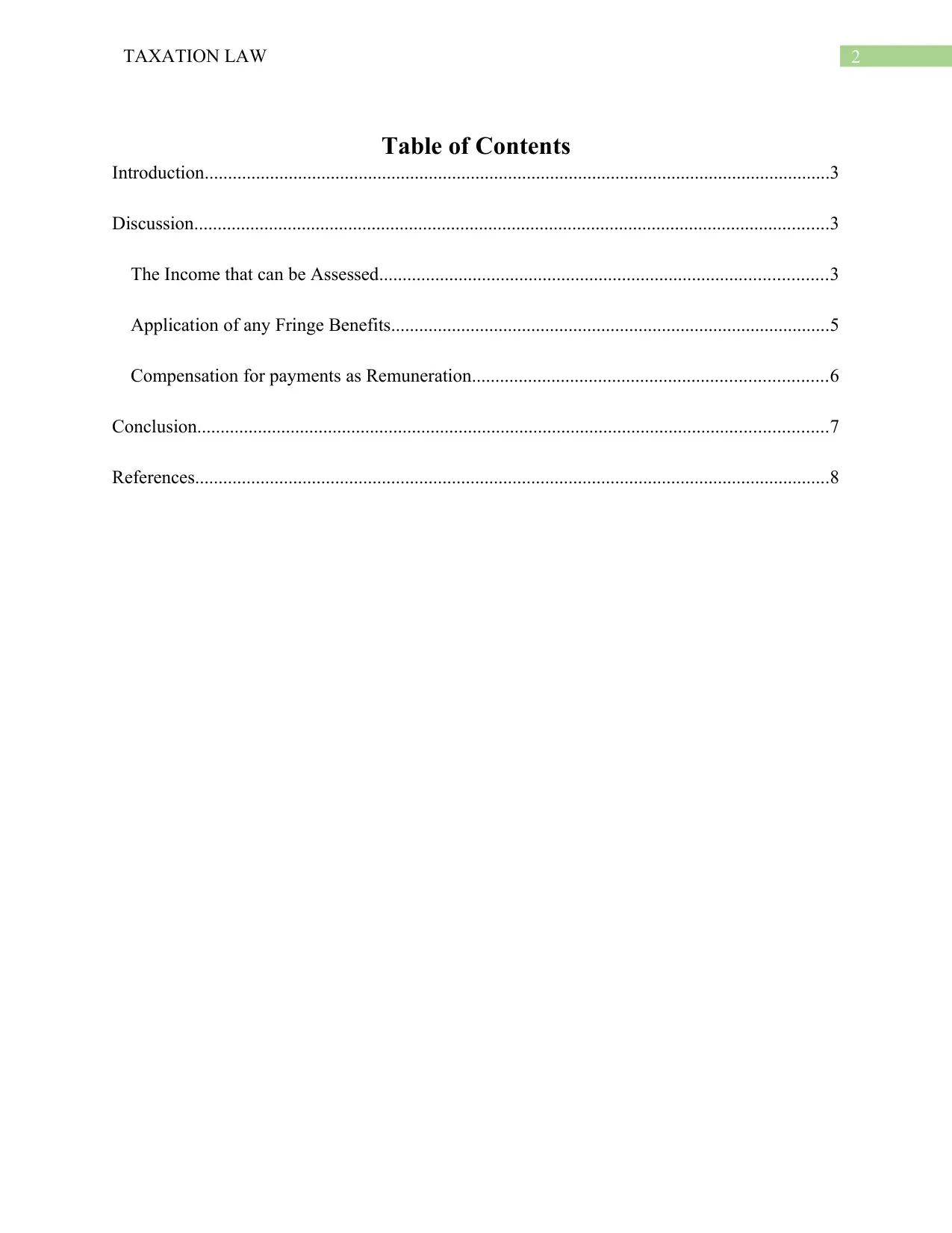
Table of Contents
Introduction......................................................................................................................................3
Discussion........................................................................................................................................3
The Income that can be Assessed................................................................................................3
Application of any Fringe Benefits..............................................................................................5
Compensation for payments as Remuneration............................................................................6
Conclusion.......................................................................................................................................7
References........................................................................................................................................8
Document Page
3TAXATION LAW
Introduction
The paper discusses the assessable income under the Income Tax Assessment Act 1997
and the incomes which can be considered to be ordinary income and thus, be a part of the
assessable income. The income which has been considered to be the income in the year 2018-19
and 2019-20 which is located in Australia whether it would be an income that is taxable. Such
would be assessed on the basis of providing certain provisions which have been mentioned in the
statutes and through giving examples of case laws and trying to apply it with the case.
Discussion
The Income that can be Assessed
Section 6.5 of the Income Tax Assessment Act 1997 talks about the ordinary income or
the income that has been known through the ordinary concepts. Thus, section talks about the
income that is considered to be assessable and been brought through the ordinary concept and is
considered to be known as the ordinary income. According to this section if the person or an
individual is considered to be an Australian resident then the person’s ordinary income which has
been derived through any kind of direct or indirect sources whether it has been derived in
Australia or out of the nation would be assessed and become an assessable income. It also
includes the assessable income of a foreign resident if the ordinary income has been derived
from any kind of Australian source and if there has been any ordinary income which has been
derived not from any Australian source but other than that.
Under section 15-2 of the above-mentioned Act this section deals with the allowances
which are provided to the employees for their service of the employment which includes the
value of all kinds of gratuities, bonuses, premiums, any kind of compensation or benefits which
tabler-icon-diamond-filled.svg

Paraphrase This Document

Need a fresh take? Get an instant paraphrase of this document with our AI Paraphraser
Document Page
4TAXATION LAW
were given to those employees through direct or indirect ways such is to understand whether the
money was provided to the employees or in any other way.
Under section 15-2 (3) of the above Act it does not include any lump sum payment from
the superannuation or any kind of termination payment, any kind of unused long service leave
payment, or any kind of unused annual leave payment the dividend, or any non-share dividend or
any other amount which under the section 6-5 of the Act is assessable as any ordinary income.
The ESS interests of the employees would also apply under this section.
Under the section 15-70 of the Act deals with the reimbursement of the car expenses the
reimbursement of that of the assessable income would be considered under that of section 22 of
the Fringe Benefits Tax Assessment Act 1986 which deals with the exemption of the car
expenses benefit for the payments which would be considered to be a fringe benefit under that
section.
In this particular instance, Rod McLean is 37 years old and is considered to work as
computer-systems engineer. According to section 6.1 of the ITAA 1936 it can be established that
Rod McLean is considered to be a resident of Australia because he has been staying in a foreign
country for less than the period of 183 days and in Hong Kong he does not have any permanent
residence or a place of abode. The same was discussed in
Federal Commissioner of Taxation v
Applegate (1978) 9 ATR 899. This means that he has to pay tax on income that has been
derived from all over the world in the financial year. The salary that consists of 8,000 dollars was
known to be paid in the Manly Branch of that of his Westpac bank where he had his account and
such would be considered to be an assessable income under section 6.5 of the ITAA 97. The
Hong Kong branch’s income which was the Kowloon Branch of the HSBC Bank was received
Document Page
5TAXATION LAW
by Rod and such would also be considered to be an assessable income since it is the income
derived from all over the world.
Application of any Fringe Benefits
The Fringe Benefits Tax Assessment Act 1986 talks about section 20 where it can be
understood that the payment has been made on behalf of others or as an obligation as such duty
was discharged from another person to another person or the third person for the expenses which
had been suffered by the recipient.
Section 22 of the above-mentioned Act talks about the exemption related to the car
expenses payment benefit where the reimbursement has been computed with the distance which
has been travelled by the car.
Under section 136 of the above-mentioned Act the airline transport would be considered
to be a fringe benefit only when it is considered to mean that the in-house property or the in-
house residual is to benefit to the extent that it would apply to the carrier for the passenger
aircraft and any other incidents which occur on board for such transport the provision would be
applicable or the limitations that are imposed which are customary to that airline transport or to
those employees who work in the airline industry.
As it has been mentioned in section 20 of the Fringe Benefits Tax Assessment Act 1986 it
can be understood where the payment has been made on behalf of others or as an obligation as
such duty was discharged from one person to another person and a third person for the expenses
which had been suffered by the recipient. It has also been mentioned that if there is a relation the
reimbursement of expenses of the car then such is exempted.
Document Page
6TAXATION LAW
In this particular scenario Section 22 of the Fringe Benefits Tax Assessment Act would
not be applicable since the transport or the airline ticket which was provided by the company was
for a holiday and such is not applicable under this section. As discussed above in the rule it
airline transport would be considered to be a fringe benefit only when it is considered to mean
that the in-house property or the in-house residual is to benefit to the extent that it would apply to
the carrier for the passenger aircraft and any other incidents which occur on board for such
transport the provision would be applicable or the limitations that are imposed which are
customary to that airline transport or to those employees who work in the airline industry.
FCT
v. Meeks [1915] HCA 34; 19 CLR 568.
Compensation for payments as RemunerationRiley (H.M. Inspector of Taxes) v Coglan(1) (1964-1968) 44 TC 481 it can be
observed that the respondent had stated that the payment was made for the compensation which
were due to the fact of the loss of the amateur status which were not considered to be
remunerations in advance. The payments were considered to be payments for the remuneration.
In this case it was observed the loss which was suffered was compensated by payments and the
loss was paid for.
The section 118-37 of the Act deals with the compensation or the damages that are
considered to be given would be disregarded for any kind of capital gain or any event relating to
CGT if there has been any kind of wrong or any injury that has been caused to any employee
during the period of the occupation or any relatives suffer. If there are any kind of compensation
or the damages that have been received by trustee and any wrong or injury us caused to a
beneficiary or the relative of such beneficiary. If there has been any kind of asset which has been
received as a CGT asset.
tabler-icon-diamond-filled.svg

Paraphrase This Document

Need a fresh take? Get an instant paraphrase of this document with our AI Paraphraser
Document Page
7TAXATION LAW
Under the section 295.155 of the Act it talks about the assessable contributions which are
of three categories. The first being that if there has been any kind of contribution made by the
contributor for some one else. If the contribution is done on the contributor’s behalf considered
to be deductible. If there are any kind of transaction from the foreign superannuation fund to the
Australian superannuation fund.
Under this case the there was an incentive which was provided in order to compensate for
leaving the company named Softmicro where after leaving would permanently settle in Hong
Kong where the offer was considered to be 40,000 dollars and was supposed to be paid in
installments twice which was accepted by Rod in the year 2017.
Conclusion
It can be understood that the assessability of the income is possible under the financial
year 2016-17 and Rod was considered to be a tax resident and thus the income was to be
assessed. The income which has been considered to be the income in the year 2018-19 and 2019-
20 cannot be assessed as Rod was not considered to be a resident of Australia.
Document Page
8TAXATION LAW
References
FCT v. Meeks [1915] HCA 34; 19 CLR 568.
Federal Commissioner of Taxation v Applegate (1978) 9 ATR 899.
Fringe Benefits Tax Assessment Act 1986.
Income Tax Assessment Act 1936.
Income Tax Assessment Act 1997.
Riley (H.M. Inspector of Taxes) v Coglan(1) (1964-1968) 44 TC 481.
chevron_up_icon
1 out of 9
circle_padding
hide_on_mobile
zoom_out_icon
[object Object]