TAX Report: Taxation of Income and Residential Status in Australia

Verified

Added on  2020/02/19

|10
|2042
|193
Report
AI Summary
This report analyzes Australian tax law, focusing on the determination of residential status and the calculation of assessable income. It begins by examining the cases of FCT v Rowe (1997) and FCT v Stone (2005), discussing the deductibility of legal expenses and the treatment of income for professional sportspersons, respectively. The report then delves into the residential status of an individual named Basil, applying the primary/ordinary test, domicile test, superannuation test, and 183-day test to determine his residency for tax purposes. Finally, the report calculates Basil's assessable income, including salary, allowances, fringe benefits, and various income sources such as rent, dividends, and capital gains, based on his residential status. The report references relevant sections of the Income Tax Assessment Act 1936 and 1997, providing a comprehensive overview of Australian tax principles.
Document Page
Running head: TAX
Tax
Name of the Student:
Name of the University:
Authors Note:
tabler-icon-diamond-filled.svg

Paraphrase This Document

Need a fresh take? Get an instant paraphrase of this document with our AI Paraphraser
Document Page
1TAX
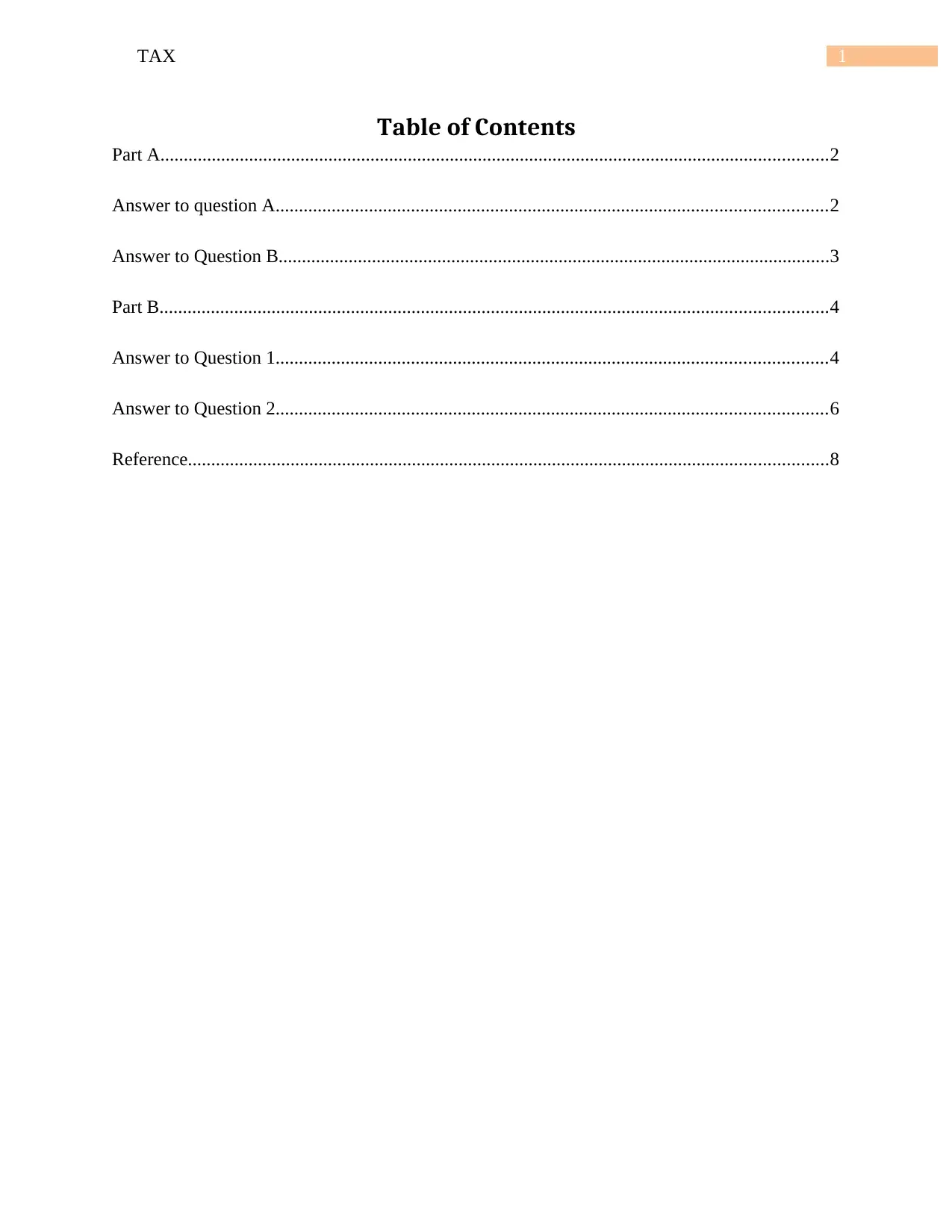
Table of Contents
Part A...............................................................................................................................................2
Answer to question A......................................................................................................................2
Answer to Question B......................................................................................................................3
Part B...............................................................................................................................................4
Answer to Question 1......................................................................................................................4
Answer to Question 2......................................................................................................................6
Reference.........................................................................................................................................8
Document Page
2TAX
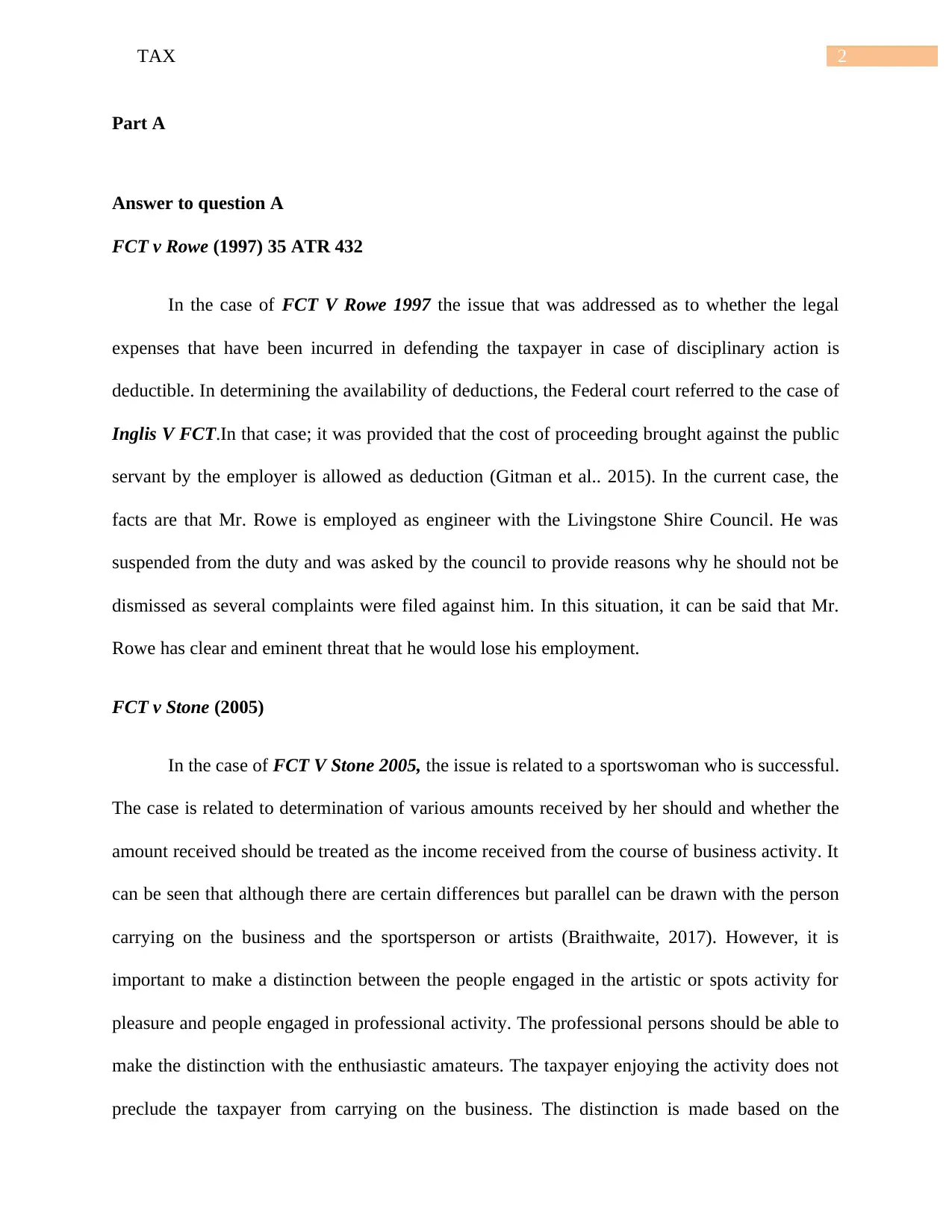
Part A
Answer to question A
FCT v Rowe (1997) 35 ATR 432
In the case of FCT V Rowe 1997 the issue that was addressed as to whether the legal
expenses that have been incurred in defending the taxpayer in case of disciplinary action is
deductible. In determining the availability of deductions, the Federal court referred to the case of
Inglis V FCT.In that case; it was provided that the cost of proceeding brought against the public
servant by the employer is allowed as deduction (Gitman et al.. 2015). In the current case, the
facts are that Mr. Rowe is employed as engineer with the Livingstone Shire Council. He was
suspended from the duty and was asked by the council to provide reasons why he should not be
dismissed as several complaints were filed against him. In this situation, it can be said that Mr.
Rowe has clear and eminent threat that he would lose his employment.
FCT v Stone (2005)
In the case of FCT V Stone 2005, the issue is related to a sportswoman who is successful.
The case is related to determination of various amounts received by her should and whether the
amount received should be treated as the income received from the course of business activity. It
can be seen that although there are certain differences but parallel can be drawn with the person
carrying on the business and the sportsperson or artists (Braithwaite, 2017). However, it is
important to make a distinction between the people engaged in the artistic or spots activity for
pleasure and people engaged in professional activity. The professional persons should be able to
make the distinction with the enthusiastic amateurs. The taxpayer enjoying the activity does not
preclude the taxpayer from carrying on the business. The distinction is made based on the
Document Page
3TAX
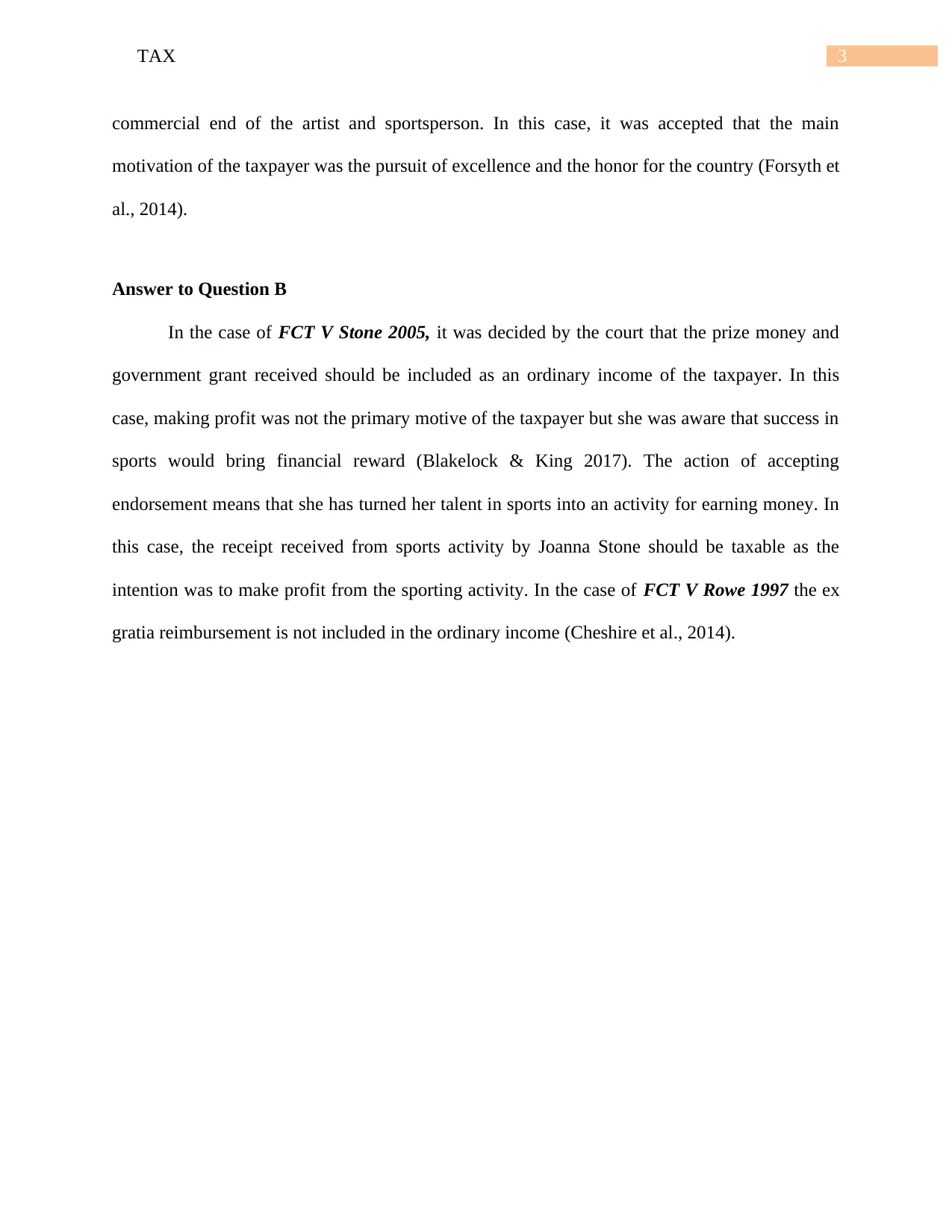
commercial end of the artist and sportsperson. In this case, it was accepted that the main
motivation of the taxpayer was the pursuit of excellence and the honor for the country (Forsyth et
al., 2014).
Answer to Question B
In the case of FCT V Stone 2005, it was decided by the court that the prize money and
government grant received should be included as an ordinary income of the taxpayer. In this
case, making profit was not the primary motive of the taxpayer but she was aware that success in
sports would bring financial reward (Blakelock & King 2017). The action of accepting
endorsement means that she has turned her talent in sports into an activity for earning money. In
this case, the receipt received from sports activity by Joanna Stone should be taxable as the
intention was to make profit from the sporting activity. In the case of FCT V Rowe 1997 the ex
gratia reimbursement is not included in the ordinary income (Cheshire et al., 2014).
tabler-icon-diamond-filled.svg

Paraphrase This Document

Need a fresh take? Get an instant paraphrase of this document with our AI Paraphraser
Document Page
4TAX
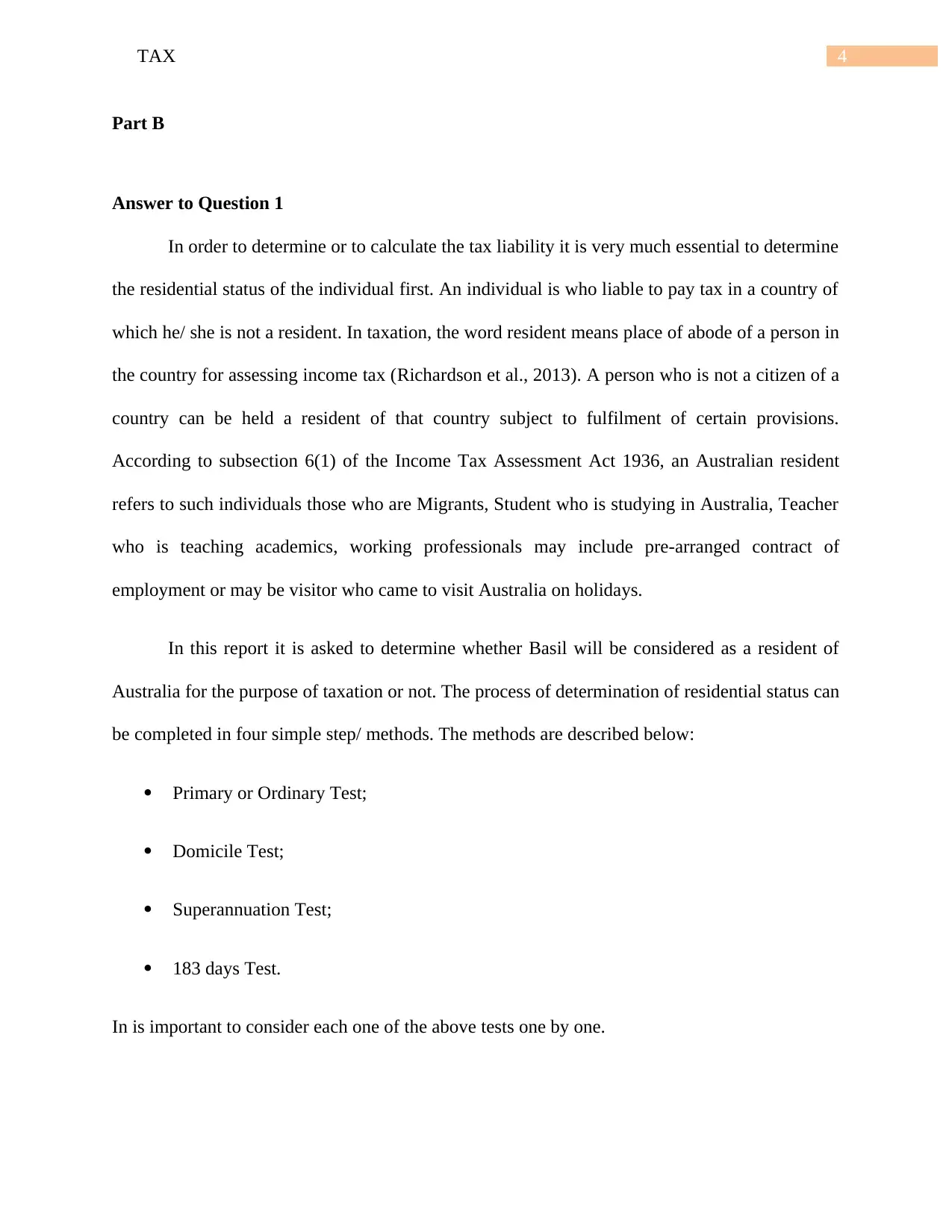
Part B
Answer to Question 1
In order to determine or to calculate the tax liability it is very much essential to determine
the residential status of the individual first. An individual is who liable to pay tax in a country of
which he/ she is not a resident. In taxation, the word resident means place of abode of a person in
the country for assessing income tax (Richardson et al., 2013). A person who is not a citizen of a
country can be held a resident of that country subject to fulfilment of certain provisions.
According to subsection 6(1) of the Income Tax Assessment Act 1936, an Australian resident
refers to such individuals those who are Migrants, Student who is studying in Australia, Teacher
who is teaching academics, working professionals may include pre-arranged contract of
employment or may be visitor who came to visit Australia on holidays.
In this report it is asked to determine whether Basil will be considered as a resident of
Australia for the purpose of taxation or not. The process of determination of residential status can
be completed in four simple step/ methods. The methods are described below:
Primary or Ordinary Test;
Domicile Test;
Superannuation Test;
183 days Test.
In is important to consider each one of the above tests one by one.
Document Page
5TAX
Primary Test or Ordinary Test
If an individual resides in Australia since birth and is not a resident of any abroad country
then the individual will be considered as an Australian resident and he/ she will not need to
perform any further residency tests.
In this case, it is clearly stated that Basil’s permanent place of abode is in England and he
came to Australia for the purpose of employment. Thus, Basil does not satisfy the condition
states under ordinary test. Therefore, in order to prove his residential status Basil needs to appear
for the other remaining tests.
Domicile Test
The word ‘Domicile’ refers to that place where an individual have his/ her permanent
place of stay or abode. As per Australian Taxation Office (ATO) an individual can be regarded
as an Australian domicile only if his/ her permanent place of abode is in Australia. However if it
is spotted by the Commissioner of Taxation in Australia that the individual stays at any foreign
country despite of being a resident of Australia then the individual will not be considered as a
Australian resident (Kucukvar et al., 2014).
It is evident from the fact that Basil came to Australia in August 28, 2015 for
employment purpose and prior to this he was staying in England of where he is also a resident.
Thus according to the law, Basil cannot be regarded as an Australian resident as far as Domicile
test is concerned.
Superannuation Test
Document Page
6TAX
According to ATO, superannuation test confirms that the working employees of the
government of Australia who are posted abroad are considered as the resident of Australia. This
test is clearly not applicable in case of Basil as he not an employees of Government of Australia
and thus he does not qualify the superannuation test.
183 Days Test
As per guidelines mentioned in the ATO, if any individual remains in Australia for a
period of more than or equal to 183 days or half an income year with breaks or without any break
then that person will be considered as a resident of Australia since the time of his/ her arrival.
It is found in the case that Basil came to Australia for employment purpose on 28th
August 2015 to stay for about 3 years. Thus, it is evident that Basil satisfied the conditions
required by 183 days test and hence he can be regarded as an Australian resident for taxation
purpose since his arrival in Australia.
Answer to Question 2
The section 4-1 of the Income Tax Assessment Act 1997 provides that an individual,
company or other entity is required to pay tax on their taxable income. The section 4-15 of the
Income Tax Assessment 1997 clearly provides that taxable income should be calculated by
deduction allowable deductions from the assessable income. The assessable income can be
classified into ordinary income and statutory income. The section 6-5 of the Income Tax
Assessment Act 1997 provides that income according to the ordinary concept is known as
ordinary income and it should be included in the assessable income. The income that is not an
tabler-icon-diamond-filled.svg

Paraphrase This Document

Need a fresh take? Get an instant paraphrase of this document with our AI Paraphraser
Document Page
7TAX
ordinary income should be included as a statutory income as per section 6-10 of the Income Tax
Assessment Act 1997. The income that should be included in the assessable income is dependent
on the residential status of the taxpayer. It is provided that under 6-5 and 6-10 of the Income tax
Assessment Act 1997 income received by the resident taxpayer from all the sources should be
included in the assessable income. On the other hand, if the taxpayer is not resident then income
from Australian sources are only taxable. In this case, as discussed earlier Basil should be treated
as resident for the purpose of tax. Therefore income received by Basil should be treated
accordingly and it is discussed below:
The salary income received should be included in the assessable income. The basic
salary of $12000 per month should be included in the included in assessable under
section 6-5 of the ITAA 97.
The section 15-2 of the Income Tax Assessment Act 1997 states that allowances and
benefits provided by the employer to the employee should be included in the assessable
income. The rent subsidy received from employer is a fringe benefit and should be
included in the assessable income (Lignier et al., 2014).
The motor vehicle is provided for the personal benefit so it is a benefit provided by the
taxpayer and should be included in the assessable income. This should be included in the
assessable income as per section 5-2 of the ITAA 97.
The phone account paid by the employer is a benefit and should be included in the
assessable income.
The holiday trip was received as performance award and should be included as the
assessable income.
Document Page
8TAX
Basil is regarded as a resident of Australia for the tax purpose hence income from any
source should be included as the assessable income. The income received from rent of
house in England should be included as an assessable income.
The dividend income should be included in the assessable income.
The gain made on England and Australian shares should be included in the assessable
income.
The income received from selling antique chair should be included in the assessable
income.
Reference
Blakelock, S., & King, P. (2017). Taxation law: The advance of ATO data matching. Proctor,
The, 37(6), 18.
Braithwaite, V. (Ed.). (2017). Taxing democracy: Understanding tax avoidance and evasion.
Routledge.
Cheshire, L., Everingham, J. A., & Lawrence, G. (2014). Governing the impacts of mining and
the impacts of mining governance: Challenges for rural and regional local governments in
Australia. Journal of Rural Studies, 36, 330-339.
Document Page
9TAX
Forsyth, P., Dwyer, L., Spurr, R., & Pham, T. (2014). The impacts of Australia's departure tax:
Tourism versus the economy?. Tourism Management, 40, 126-136.
Gitman, L. J., Juchau, R., & Flanagan, J. (2015). Principles of managerial finance. Pearson
Higher Education AU.
Kucukvar, M., Egilmez, G., & Tatari, O. (2014). Sustainability assessment of US final
consumption and investments: triple-bottom-line input–output analysis. Journal of
cleaner production, 81, 234-243.
Lignier, P., Evans, C., & Tran-Nam, B. (2014). Tangled up in tape: The continuing tax
compliance plight of the small and medium enterprise business sector.
Richardson, G., Taylor, G., & Lanis, R. (2013). The impact of board of director oversight
characteristics on corporate tax aggressiveness: An empirical analysis. Journal of
Accounting and Public Policy, 32(3), 68-88.
chevron_up_icon
1 out of 10
circle_padding
hide_on_mobile
zoom_out_icon
[object Object]