Taxation Law Assignment: Analysis of Fringe Benefits and Income
VerifiedAdded on 2020/05/28
|12
|2450
|268
Homework Assignment
AI Summary
This assignment solution addresses taxation law, focusing on fringe benefits tax (FBT) and income tax. The first part analyzes the FBT implications for an employee provided with a company car, calculating the taxable value using both the statutory and operating cost methods. It considers various scenarios, including private use, car hire for personal events, and accommodation. The second part examines income tax, addressing the tax liabilities of individuals with diverse income sources including part-time work, locum services, and a barter system. It discusses the distinction between business and hobby activities, as well as the tax treatment of income derived from a barter system. The solution references relevant legislation, case laws, and taxation rulings to support its analysis and calculations.
Running head: TAXATION LAW
Taxation Law
Name of the Student
Name of the University
Authors Note
Course ID
Taxation Law
Name of the Student
Name of the University
Authors Note
Course ID

Paraphrase This Document
Need a fresh take? Get an instant paraphrase of this document with our AI Paraphraser
1TAXATION LAW
Table of Contents
Answer to question 1:.................................................................................................................2
Case Facts:.................................................................................................................................3
Answer to question 2:.................................................................................................................6
Answer to part (A):....................................................................................................................6
Answer to part (B)......................................................................................................................6
Answer to part (c ):....................................................................................................................7
Answer to Part (D):....................................................................................................................7
Reference List:...........................................................................................................................9
Table of Contents
Answer to question 1:.................................................................................................................2
Case Facts:.................................................................................................................................3
Answer to question 2:.................................................................................................................6
Answer to part (A):....................................................................................................................6
Answer to part (B)......................................................................................................................6
Answer to part (c ):....................................................................................................................7
Answer to Part (D):....................................................................................................................7
Reference List:...........................................................................................................................9
2TAXATION LAW
Answer to question 1:
According to the “Fringe Benefit Tax Assessment Act 1986” any form of benefit that
is paid to the employees apart from the salaries and wages is regarded as the fringe benefit
(Legislation.gov.au, 2018). however, the act lay down that there should be an association
among the employer and the employee along with the provider of the fringe benefit tax
legislation. This would help in keeping an account of the tax liabilities originating from such
benefits provided for both the employer and the employee.
As laid down under “Section 6 of the FBTAA 1986” car provided to employee by the
employer and the same is used for the private purpose altogether then it would attract car
fringe benefit tax (Ato.gov.au, 2018). The car fringe benefit tax is applicable at any time of
the day in regard to the occupation of the employee for the car held by the person or it is
taken to be available for the personal usage of the employee or the associate.
As defined under the “sub-section 136 (1) of the taxation ruling MT 2027” usage of
car by the employee which is not directly related to the course of generating the taxable
salary of the associate would be regarded as the personal use. In order to arrive at the
assessable amount of the fringe benefit of the car, the statutory method or the operating cost
formula is employed. Additionally, “section 10A and Section 10 B of the FBTAA 1986”
transacts with the determination of the taxable value of the car based on the operating cost
method (Ato.gov.au, 2018). Under “sub-section 136 (1)”, the method of operating cost
considers the cost that is sustained on the operations of the car and the details of the business
journeys is required to incorporated in the log book if they are used for ascertaining the
proportion of the private use of the car for implementing the operating cost method.
Answer to question 1:
According to the “Fringe Benefit Tax Assessment Act 1986” any form of benefit that
is paid to the employees apart from the salaries and wages is regarded as the fringe benefit
(Legislation.gov.au, 2018). however, the act lay down that there should be an association
among the employer and the employee along with the provider of the fringe benefit tax
legislation. This would help in keeping an account of the tax liabilities originating from such
benefits provided for both the employer and the employee.
As laid down under “Section 6 of the FBTAA 1986” car provided to employee by the
employer and the same is used for the private purpose altogether then it would attract car
fringe benefit tax (Ato.gov.au, 2018). The car fringe benefit tax is applicable at any time of
the day in regard to the occupation of the employee for the car held by the person or it is
taken to be available for the personal usage of the employee or the associate.
As defined under the “sub-section 136 (1) of the taxation ruling MT 2027” usage of
car by the employee which is not directly related to the course of generating the taxable
salary of the associate would be regarded as the personal use. In order to arrive at the
assessable amount of the fringe benefit of the car, the statutory method or the operating cost
formula is employed. Additionally, “section 10A and Section 10 B of the FBTAA 1986”
transacts with the determination of the taxable value of the car based on the operating cost
method (Ato.gov.au, 2018). Under “sub-section 136 (1)”, the method of operating cost
considers the cost that is sustained on the operations of the car and the details of the business
journeys is required to incorporated in the log book if they are used for ascertaining the
proportion of the private use of the car for implementing the operating cost method.
⊘ This is a preview!⊘
Do you want full access?
Subscribe today to unlock all pages.

Trusted by 1+ million students worldwide
3TAXATION LAW
Case Facts:
In the present case study, Charlie is the employee of Shiny Homes Pty Ltd and has
been provided with the car and the same would be liable for fringe benefit tax under the
legislation. As evident Charlie used the car for both private and business purpose and under
“Sub-section 136 (1)” it would attract fringe benefit tax.
The decision laid down in the case of “Lunney and Hayley v FCT (1958)” stated that
the travel from the employee home to the place of work is regarded as the ordinary private
travel (Ato.gov.au, 2018). Additionally, the travel to the place of work is considered as the
necessary “pre-requisite”. Charlie in this circumstance has travelled kilometres from his
home to the place of work and the same cannot be regarded for fringe benefit since they were
not in the course of generating taxable income. The private kilometres travelled by Charlie
would not change the outcome since the place of work is regarded as itinerant in nature.
There are two methods involved in computing the assessable amount of the fringe
benefit tax namely the “statutory method and the operating cost method” (Deutsch, 2014).
The statutory rate for computing the chargeable worth of the fringe benefit of the car is 20%.
The statutory percent is multiplied with the base amount of the car in order ascertain the
assessable value of the fringe benefits. The degree of private use of the car offered to the
employer is not pertinent in the ascertainment of the assessable amount of the fringe benefit
in statutory formula. Whereas under the operating costing method both the work and private
purpose of the car is separated in determining the assessable amount of the car fringe benefit.
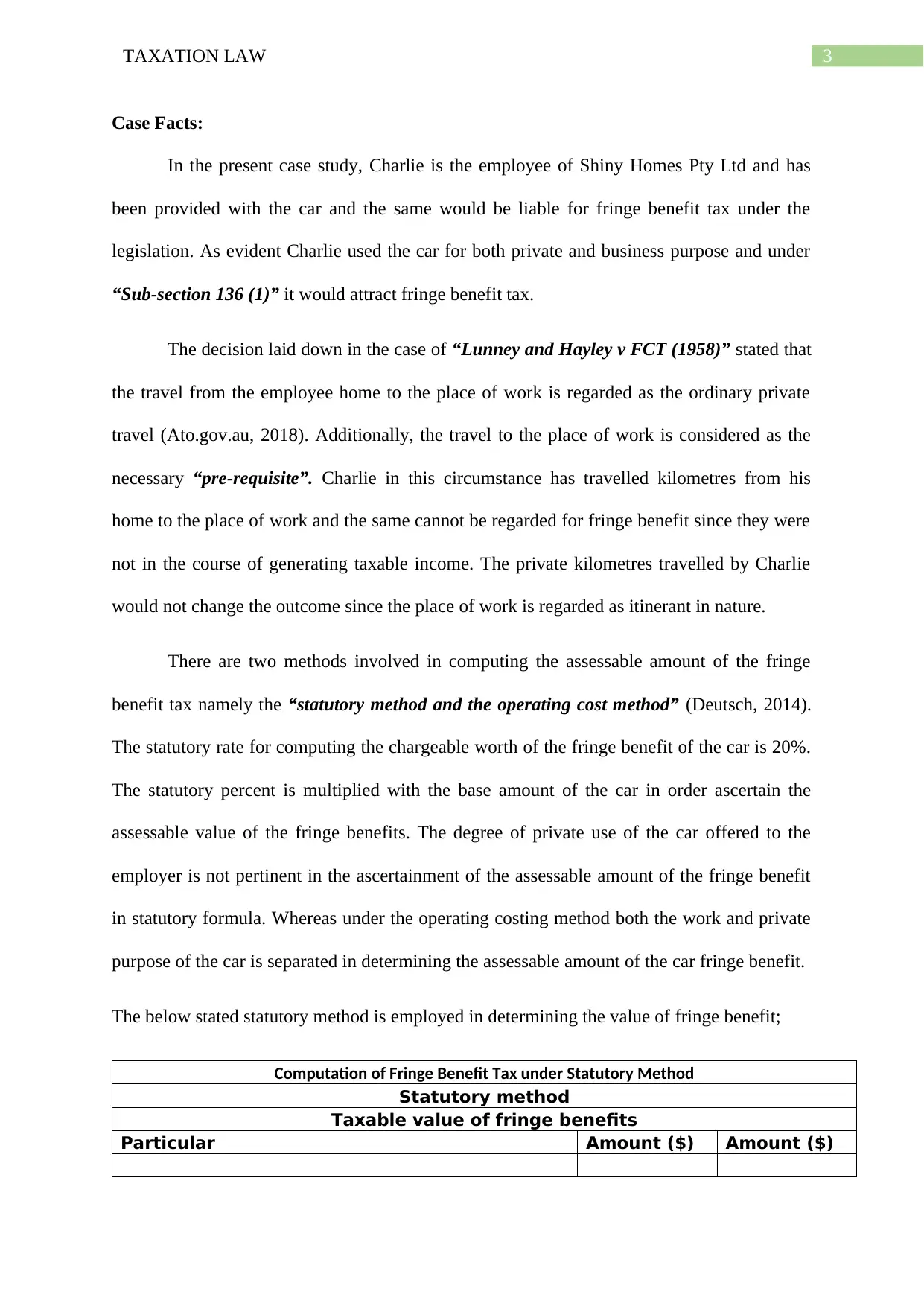
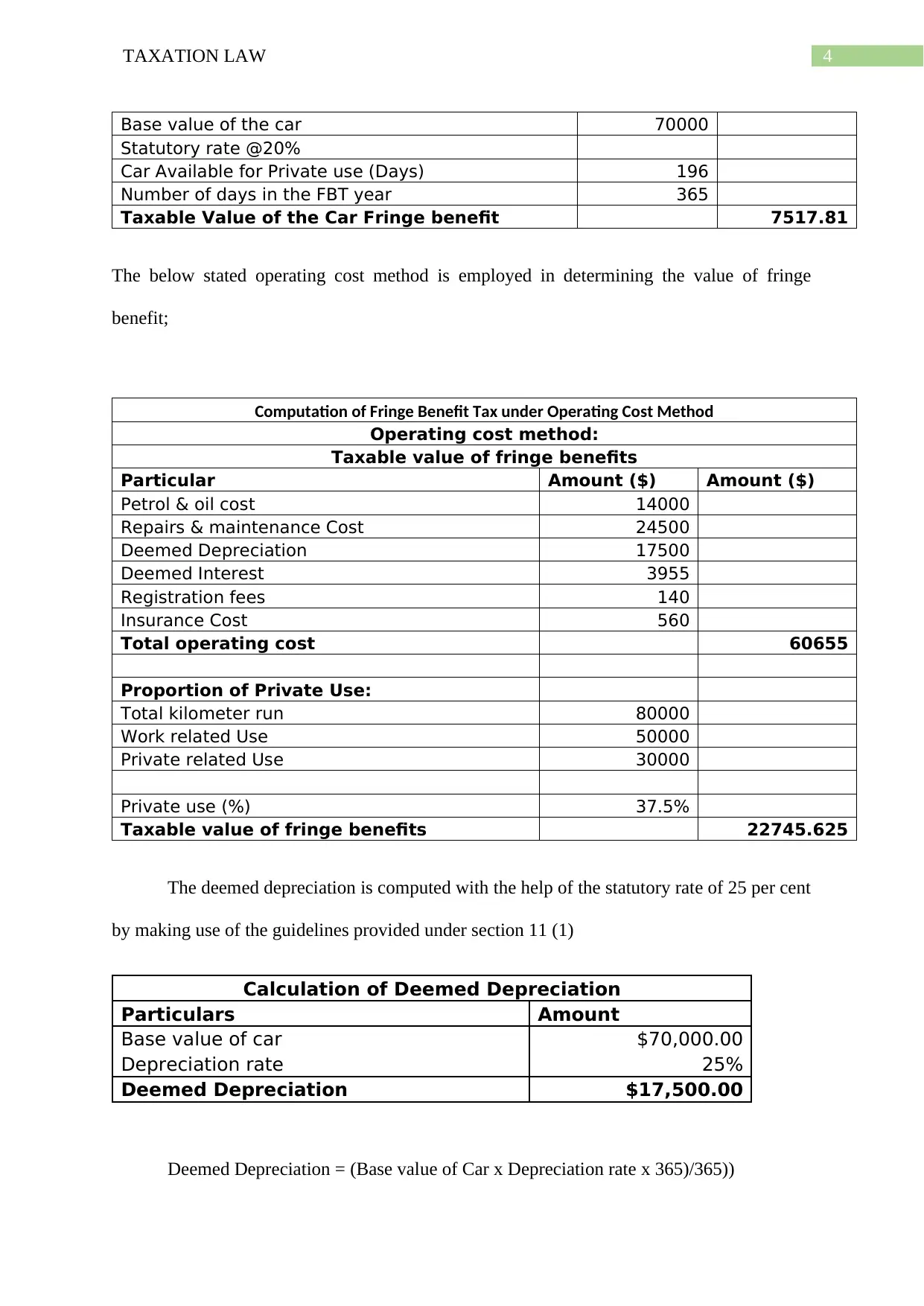
The below stated statutory method is employed in determining the value of fringe benefit;
Computation of Fringe Benefit Tax under Statutory Method
Statutory method
Taxable value of fringe benefits
Particular Amount ($) Amount ($)
Case Facts:
In the present case study, Charlie is the employee of Shiny Homes Pty Ltd and has
been provided with the car and the same would be liable for fringe benefit tax under the
legislation. As evident Charlie used the car for both private and business purpose and under
“Sub-section 136 (1)” it would attract fringe benefit tax.
The decision laid down in the case of “Lunney and Hayley v FCT (1958)” stated that
the travel from the employee home to the place of work is regarded as the ordinary private
travel (Ato.gov.au, 2018). Additionally, the travel to the place of work is considered as the
necessary “pre-requisite”. Charlie in this circumstance has travelled kilometres from his
home to the place of work and the same cannot be regarded for fringe benefit since they were
not in the course of generating taxable income. The private kilometres travelled by Charlie
would not change the outcome since the place of work is regarded as itinerant in nature.
There are two methods involved in computing the assessable amount of the fringe
benefit tax namely the “statutory method and the operating cost method” (Deutsch, 2014).
The statutory rate for computing the chargeable worth of the fringe benefit of the car is 20%.
The statutory percent is multiplied with the base amount of the car in order ascertain the
assessable value of the fringe benefits. The degree of private use of the car offered to the
employer is not pertinent in the ascertainment of the assessable amount of the fringe benefit
in statutory formula. Whereas under the operating costing method both the work and private
purpose of the car is separated in determining the assessable amount of the car fringe benefit.
The below stated statutory method is employed in determining the value of fringe benefit;
Computation of Fringe Benefit Tax under Statutory Method
Statutory method
Taxable value of fringe benefits
Particular Amount ($) Amount ($)
Paraphrase This Document
Need a fresh take? Get an instant paraphrase of this document with our AI Paraphraser
4TAXATION LAW
Base value of the car 70000
Statutory rate @20%
Car Available for Private use (Days) 196
Number of days in the FBT year 365
Taxable Value of the Car Fringe benefit 7517.81
The below stated operating cost method is employed in determining the value of fringe
benefit;
Computation of Fringe Benefit Tax under Operating Cost Method
Operating cost method:
Taxable value of fringe benefits
Particular Amount ($) Amount ($)
Petrol & oil cost 14000
Repairs & maintenance Cost 24500
Deemed Depreciation 17500
Deemed Interest 3955
Registration fees 140
Insurance Cost 560
Total operating cost 60655
Proportion of Private Use:
Total kilometer run 80000
Work related Use 50000
Private related Use 30000
Private use (%) 37.5%
Taxable value of fringe benefits 22745.625
The deemed depreciation is computed with the help of the statutory rate of 25 per cent
by making use of the guidelines provided under section 11 (1)
Calculation of Deemed Depreciation
Particulars Amount
Base value of car $70,000.00
Depreciation rate 25%
Deemed Depreciation $17,500.00
Deemed Depreciation = (Base value of Car x Depreciation rate x 365)/365))
Base value of the car 70000
Statutory rate @20%
Car Available for Private use (Days) 196
Number of days in the FBT year 365
Taxable Value of the Car Fringe benefit 7517.81
The below stated operating cost method is employed in determining the value of fringe
benefit;
Computation of Fringe Benefit Tax under Operating Cost Method
Operating cost method:
Taxable value of fringe benefits
Particular Amount ($) Amount ($)
Petrol & oil cost 14000
Repairs & maintenance Cost 24500
Deemed Depreciation 17500
Deemed Interest 3955
Registration fees 140
Insurance Cost 560
Total operating cost 60655
Proportion of Private Use:
Total kilometer run 80000
Work related Use 50000
Private related Use 30000
Private use (%) 37.5%
Taxable value of fringe benefits 22745.625
The deemed depreciation is computed with the help of the statutory rate of 25 per cent
by making use of the guidelines provided under section 11 (1)
Calculation of Deemed Depreciation
Particulars Amount
Base value of car $70,000.00
Depreciation rate 25%
Deemed Depreciation $17,500.00
Deemed Depreciation = (Base value of Car x Depreciation rate x 365)/365))
5TAXATION LAW
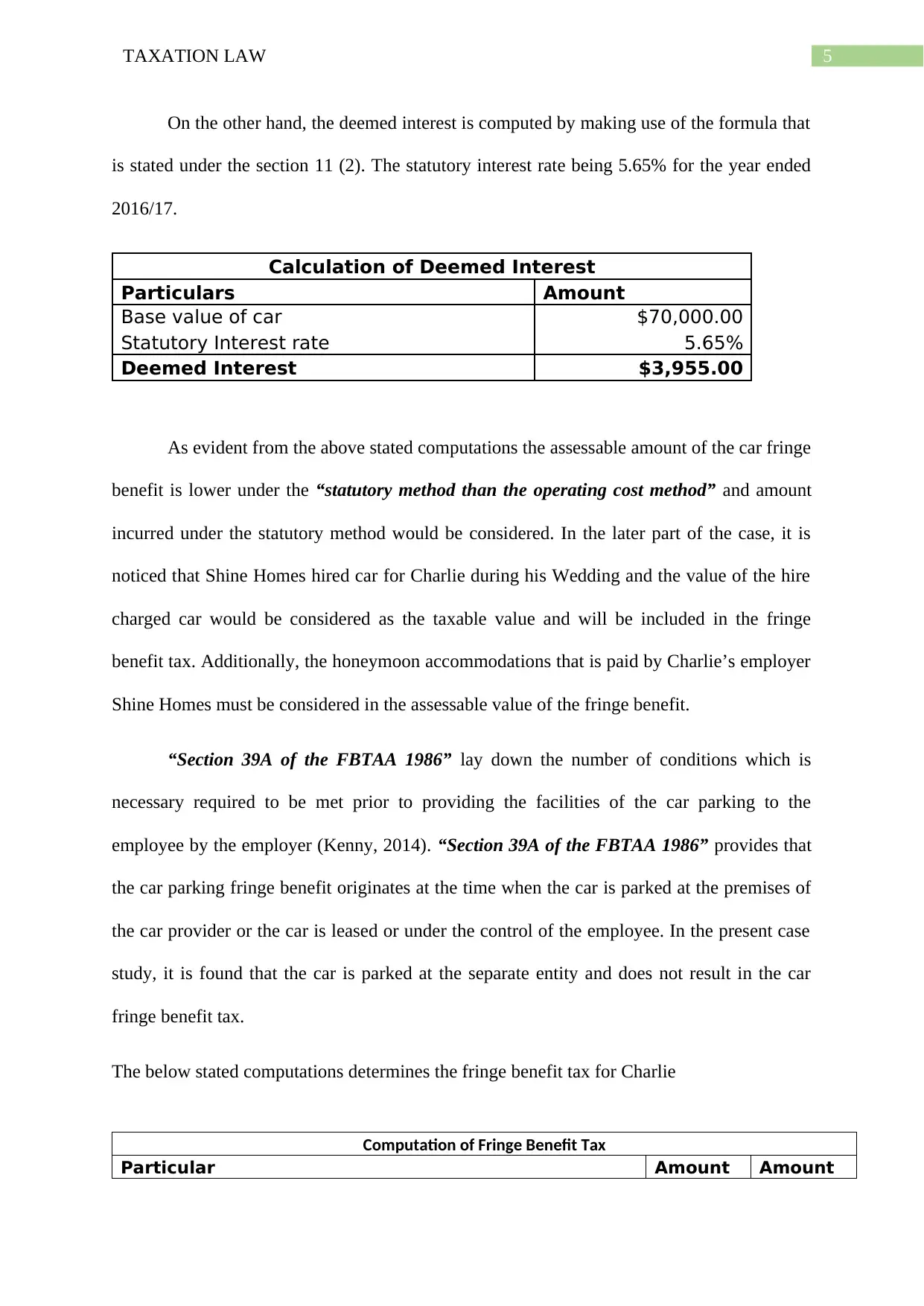
On the other hand, the deemed interest is computed by making use of the formula that
is stated under the section 11 (2). The statutory interest rate being 5.65% for the year ended
2016/17.
Calculation of Deemed Interest
Particulars Amount
Base value of car $70,000.00
Statutory Interest rate 5.65%
Deemed Interest $3,955.00
As evident from the above stated computations the assessable amount of the car fringe
benefit is lower under the “statutory method than the operating cost method” and amount
incurred under the statutory method would be considered. In the later part of the case, it is
noticed that Shine Homes hired car for Charlie during his Wedding and the value of the hire
charged car would be considered as the taxable value and will be included in the fringe
benefit tax. Additionally, the honeymoon accommodations that is paid by Charlie’s employer
Shine Homes must be considered in the assessable value of the fringe benefit.
“Section 39A of the FBTAA 1986” lay down the number of conditions which is
necessary required to be met prior to providing the facilities of the car parking to the
employee by the employer (Kenny, 2014). “Section 39A of the FBTAA 1986” provides that
the car parking fringe benefit originates at the time when the car is parked at the premises of
the car provider or the car is leased or under the control of the employee. In the present case
study, it is found that the car is parked at the separate entity and does not result in the car
fringe benefit tax.
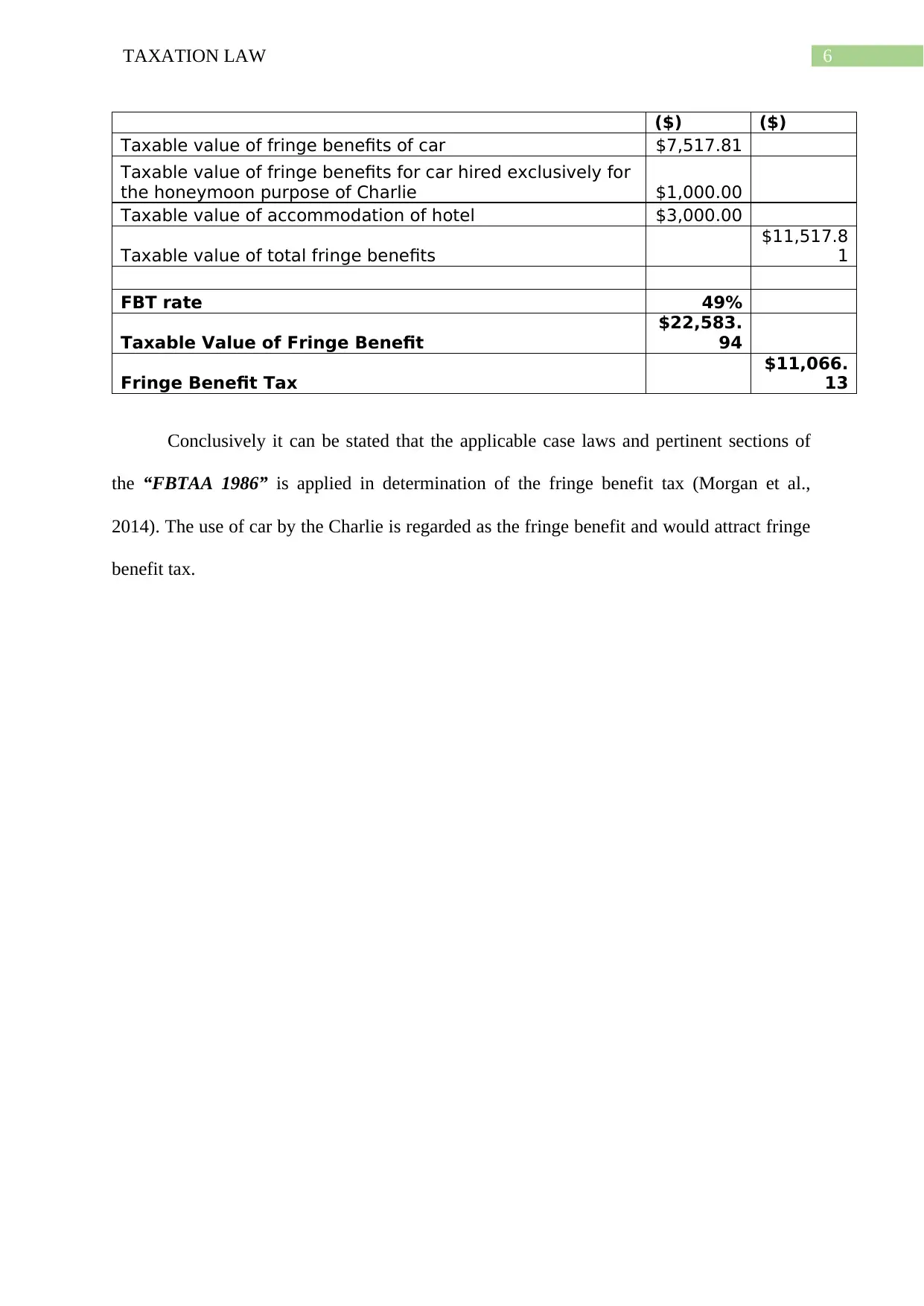
The below stated computations determines the fringe benefit tax for Charlie
Computation of Fringe Benefit Tax
Particular Amount Amount
On the other hand, the deemed interest is computed by making use of the formula that
is stated under the section 11 (2). The statutory interest rate being 5.65% for the year ended
2016/17.
Calculation of Deemed Interest
Particulars Amount
Base value of car $70,000.00
Statutory Interest rate 5.65%
Deemed Interest $3,955.00
As evident from the above stated computations the assessable amount of the car fringe
benefit is lower under the “statutory method than the operating cost method” and amount
incurred under the statutory method would be considered. In the later part of the case, it is
noticed that Shine Homes hired car for Charlie during his Wedding and the value of the hire
charged car would be considered as the taxable value and will be included in the fringe
benefit tax. Additionally, the honeymoon accommodations that is paid by Charlie’s employer
Shine Homes must be considered in the assessable value of the fringe benefit.
“Section 39A of the FBTAA 1986” lay down the number of conditions which is
necessary required to be met prior to providing the facilities of the car parking to the
employee by the employer (Kenny, 2014). “Section 39A of the FBTAA 1986” provides that
the car parking fringe benefit originates at the time when the car is parked at the premises of
the car provider or the car is leased or under the control of the employee. In the present case
study, it is found that the car is parked at the separate entity and does not result in the car
fringe benefit tax.
The below stated computations determines the fringe benefit tax for Charlie
Computation of Fringe Benefit Tax
Particular Amount Amount
⊘ This is a preview!⊘
Do you want full access?
Subscribe today to unlock all pages.
Trusted by 1+ million students worldwide
6TAXATION LAW
($) ($)
Taxable value of fringe benefits of car $7,517.81
Taxable value of fringe benefits for car hired exclusively for
the honeymoon purpose of Charlie $1,000.00
Taxable value of accommodation of hotel $3,000.00
Taxable value of total fringe benefits
$11,517.8
1
FBT rate 49%
Taxable Value of Fringe Benefit
$22,583.
94
Fringe Benefit Tax
$11,066.
13
Conclusively it can be stated that the applicable case laws and pertinent sections of
the “FBTAA 1986” is applied in determination of the fringe benefit tax (Morgan et al.,
2014). The use of car by the Charlie is regarded as the fringe benefit and would attract fringe
benefit tax.
($) ($)
Taxable value of fringe benefits of car $7,517.81
Taxable value of fringe benefits for car hired exclusively for
the honeymoon purpose of Charlie $1,000.00
Taxable value of accommodation of hotel $3,000.00
Taxable value of total fringe benefits
$11,517.8
1
FBT rate 49%
Taxable Value of Fringe Benefit
$22,583.
94
Fringe Benefit Tax
$11,066.
13
Conclusively it can be stated that the applicable case laws and pertinent sections of
the “FBTAA 1986” is applied in determination of the fringe benefit tax (Morgan et al.,
2014). The use of car by the Charlie is regarded as the fringe benefit and would attract fringe
benefit tax.
Paraphrase This Document
Need a fresh take? Get an instant paraphrase of this document with our AI Paraphraser
7TAXATION LAW
Answer to question 2:
Answer to part (A):
As evident from the current case study of Allan and Betty they undertook the decision
of tree change. Additionally, they decided to sell their house located in Melbourne in order to
acquire the country home located in the Central Victoria and the same will be liable for any
tax liability. However, according to the “section 6-5 of the ITAA 1997” income derived
directly from the business or profession will be considered for taxation (Sadiq et al., 2014).
Similarly, the income derived by Allan and Betty as the part time accountant and the Locum
doctor will attract tax liability under the “section 6-5 of the ITAA 1997”.
The case study evidently puts forward that Allan was wide known among his elderly
clients as the locum doctor and charged fees from the patients that visited him. He received a
large number of homemade cakes and food from his patients in the form of token for
appreciation. It is worth mentioning that cakes and food does not attracts tax liability since
they did not possess the nature of commercial goods nor having any commercial value
(Woellner et al., 2014). Apart from this Allan did received wine from one of his customer
that contained commercial value of $36. Therefore, the value of wine that is received by
Allan will attract tax liability and will be included in the taxable revenue in respect of the
ITAA 1997.
Answer to part (B)
The “taxation ruling of TR 97/11” is concerned with the determination of the individuals
indulged in business activities (Woellner et al., 2014). The “taxation ruling of TR 97/11”
helps in distinguishing the differences associated with business and hobbies which is listed
below;
Answer to question 2:
Answer to part (A):
As evident from the current case study of Allan and Betty they undertook the decision
of tree change. Additionally, they decided to sell their house located in Melbourne in order to
acquire the country home located in the Central Victoria and the same will be liable for any
tax liability. However, according to the “section 6-5 of the ITAA 1997” income derived
directly from the business or profession will be considered for taxation (Sadiq et al., 2014).
Similarly, the income derived by Allan and Betty as the part time accountant and the Locum
doctor will attract tax liability under the “section 6-5 of the ITAA 1997”.
The case study evidently puts forward that Allan was wide known among his elderly
clients as the locum doctor and charged fees from the patients that visited him. He received a
large number of homemade cakes and food from his patients in the form of token for
appreciation. It is worth mentioning that cakes and food does not attracts tax liability since
they did not possess the nature of commercial goods nor having any commercial value
(Woellner et al., 2014). Apart from this Allan did received wine from one of his customer
that contained commercial value of $36. Therefore, the value of wine that is received by
Allan will attract tax liability and will be included in the taxable revenue in respect of the
ITAA 1997.
Answer to part (B)
The “taxation ruling of TR 97/11” is concerned with the determination of the individuals
indulged in business activities (Woellner et al., 2014). The “taxation ruling of TR 97/11”
helps in distinguishing the differences associated with business and hobbies which is listed
below;
8TAXATION LAW
a. The objective of the activity forms vital element in ascertaining whether the activity
constituted business or hobby. On finding that the activity holds business objective
then the same will be considered as the business activity.
b. The purpose of the business is to derive profit while the hobby does not holds such
purpose.
c. Business activities generally attracts large number of capital investment whereas
hobby does not contain any capital investment.
d. The business activities contain of the employer and employee relationships however
under hobby there is no such relationships exists.
e. To conduct business there is a need for premises, however no such premises is
required in performing the hobby.
As held in the case of “Cooper Books Pty Ltd vs. Commissioner of Taxation of
Commonwealth of Australia” the court in its decision has stated the necessary criteria to
distinguish between the business activities and the hobby.
Answer to part (c ):
On finding that the hobby of the tax payer transforms into the business activities and
derives profits from the same then it will attract tax liability for any amount of income
derived from the business (Frecknall et al., 2014). As evident in the present case of Allan and
Betty the hobby of gardening has transformed into the business activities and derived the
revenue of approximately $500 to $600 from the sale of Marmalade will be liable for
taxation. Similarly, the barter system of Allan and Betty will additionally attract tax liability
in respect of the ITAA 1997.
a. The objective of the activity forms vital element in ascertaining whether the activity
constituted business or hobby. On finding that the activity holds business objective
then the same will be considered as the business activity.
b. The purpose of the business is to derive profit while the hobby does not holds such
purpose.
c. Business activities generally attracts large number of capital investment whereas
hobby does not contain any capital investment.
d. The business activities contain of the employer and employee relationships however
under hobby there is no such relationships exists.
e. To conduct business there is a need for premises, however no such premises is
required in performing the hobby.
As held in the case of “Cooper Books Pty Ltd vs. Commissioner of Taxation of
Commonwealth of Australia” the court in its decision has stated the necessary criteria to
distinguish between the business activities and the hobby.
Answer to part (c ):
On finding that the hobby of the tax payer transforms into the business activities and
derives profits from the same then it will attract tax liability for any amount of income
derived from the business (Frecknall et al., 2014). As evident in the present case of Allan and
Betty the hobby of gardening has transformed into the business activities and derived the
revenue of approximately $500 to $600 from the sale of Marmalade will be liable for
taxation. Similarly, the barter system of Allan and Betty will additionally attract tax liability
in respect of the ITAA 1997.
⊘ This is a preview!⊘
Do you want full access?
Subscribe today to unlock all pages.
Trusted by 1+ million students worldwide
9TAXATION LAW
Answer to Part (D):
The transactions of the barter system are subjected to the provision of the taxation
under the ITAA 1997 and GSTR1999 given that the transactions holds the nature of the
business transactions (Miller & Oats, 2016). The commercial transaction under the barter
system would be considered at with the transactions conducted under the cash and credit.
Income derived from such transaction would attract tax liability under the ITAA 1997 and
GSTR 1999. The barter system set up Allan and Betty will be considered in respect of the
cash and credit transaction and would be liable for income tax and GST.
Answer to Part (D):
The transactions of the barter system are subjected to the provision of the taxation
under the ITAA 1997 and GSTR1999 given that the transactions holds the nature of the
business transactions (Miller & Oats, 2016). The commercial transaction under the barter
system would be considered at with the transactions conducted under the cash and credit.
Income derived from such transaction would attract tax liability under the ITAA 1997 and
GSTR 1999. The barter system set up Allan and Betty will be considered in respect of the
cash and credit transaction and would be liable for income tax and GST.
Paraphrase This Document
Need a fresh take? Get an instant paraphrase of this document with our AI Paraphraser
10TAXATION LAW
Reference List:
Deutsch, R. (2014). Australian tax handbook 2014. Pyrmont, NSW: Thomson Reuters.
Frecknall-Hughes, J. (2014). The Theory, Principles and Management of Taxation: An
Introduction. Routledge.
Fringe Benefits Tax Assessment Act 1986. (2018). Legislation.gov.au. Retrieved 6 January
2018, from https://www.legislation.gov.au/Details/C2016C00276
Kenny, P. Australian tax 2014.
Legal Database. (2018). Ato.gov.au. Retrieved 6 January 2018, from
https://www.ato.gov.au/law/view/document?docid=PAC/19860039/7
Legal Database. (2018). Ato.gov.au. Retrieved 6 January 2018, from
https://www.ato.gov.au/law/view/document?docid=MTR/MT2027/NAT/ATO/00001
Miller, A., & Oats, L. (2016). Principles of international taxation. Bloomsbury Publishing.
Morgan, A., Mortimer, C., & Pinto, D. A practical introduction to Australian taxation law.
Sadiq, K., Coleman, C., Hanegbi, R., Jogarajan, S., Krever, R., Obst, W., & Ting,
A. Principles of taxation law 2014.
TD 2016/7 - Fringe benefits tax: for the purposes of section 39A of the Fringe Benefits Tax
Assessment Act 1986 what is the car parking threshold for the fringe benefits tax year
commencing on 1 April 2016 (As at 18 May 2016). (2018). Law.ato.gov.au. Retrieved
6 January 2018, from http://law.ato.gov.au/atolaw/view.htm?docid=%22TXD
%2FTD20167%2FNAT%2FATO%2F00001%22
Woellner, R., Barkoczy, S., Murphy, S., Evans, C., & Pinto, D. Australian taxation law select
2014.
Reference List:
Deutsch, R. (2014). Australian tax handbook 2014. Pyrmont, NSW: Thomson Reuters.
Frecknall-Hughes, J. (2014). The Theory, Principles and Management of Taxation: An
Introduction. Routledge.
Fringe Benefits Tax Assessment Act 1986. (2018). Legislation.gov.au. Retrieved 6 January
2018, from https://www.legislation.gov.au/Details/C2016C00276
Kenny, P. Australian tax 2014.
Legal Database. (2018). Ato.gov.au. Retrieved 6 January 2018, from
https://www.ato.gov.au/law/view/document?docid=PAC/19860039/7
Legal Database. (2018). Ato.gov.au. Retrieved 6 January 2018, from
https://www.ato.gov.au/law/view/document?docid=MTR/MT2027/NAT/ATO/00001
Miller, A., & Oats, L. (2016). Principles of international taxation. Bloomsbury Publishing.
Morgan, A., Mortimer, C., & Pinto, D. A practical introduction to Australian taxation law.
Sadiq, K., Coleman, C., Hanegbi, R., Jogarajan, S., Krever, R., Obst, W., & Ting,
A. Principles of taxation law 2014.
TD 2016/7 - Fringe benefits tax: for the purposes of section 39A of the Fringe Benefits Tax
Assessment Act 1986 what is the car parking threshold for the fringe benefits tax year
commencing on 1 April 2016 (As at 18 May 2016). (2018). Law.ato.gov.au. Retrieved
6 January 2018, from http://law.ato.gov.au/atolaw/view.htm?docid=%22TXD
%2FTD20167%2FNAT%2FATO%2F00001%22
Woellner, R., Barkoczy, S., Murphy, S., Evans, C., & Pinto, D. Australian taxation law select
2014.
11TAXATION LAW
Woellner, R., Woellner, R., Barkoczy, S., Murphy, S., Evans, C., & Pinto, D. Australian
Taxation Law 2015.
Woellner, R., Woellner, R., Barkoczy, S., Murphy, S., Evans, C., & Pinto, D. Australian
Taxation Law 2015.
⊘ This is a preview!⊘
Do you want full access?
Subscribe today to unlock all pages.
Trusted by 1+ million students worldwide

1 out of 12


Related Documents


Your All-in-One AI-Powered Toolkit for Academic Success.
+13062052269
info@desklib.com
Available 24*7 on WhatsApp / Email
![[object Object]](/_next/static/media/star-bottom.7253800d.svg)
Unlock your academic potential
Copyright © 2020–2026 A2Z Services. All Rights Reserved. Developed and managed by ZUCOL.