Taxation Law Assignment - Taxation Law 7 - University
VerifiedAdded on 2022/12/29
|8
|1377
|35
Homework Assignment
AI Summary
This Taxation Law assignment provides a comprehensive overview of key concepts and regulations within the field. The solution addresses conflict of interest, outlining the responsibilities of a tax agent according to TASA 2009 and TASR. It delves into government tax policy documents and explanatory materials, including relevant statutes and court decisions. The assignment further explores the documentation aspects of taxation law, covering GST and superannuation, as well as administrative and anti-avoidance rules. It concludes by identifying vital sources of information and data needed to compute taxable income, including income and permissible deductions. The references cited support the analysis and provide further reading on the subject.
Running head: TAXATION LAW
Taxation Law
Name of the Student
Name of the University
Authors Note
Course ID
Taxation Law
Name of the Student
Name of the University
Authors Note
Course ID
Paraphrase This Document
Need a fresh take? Get an instant paraphrase of this document with our AI Paraphraser

1TAXATION LAW
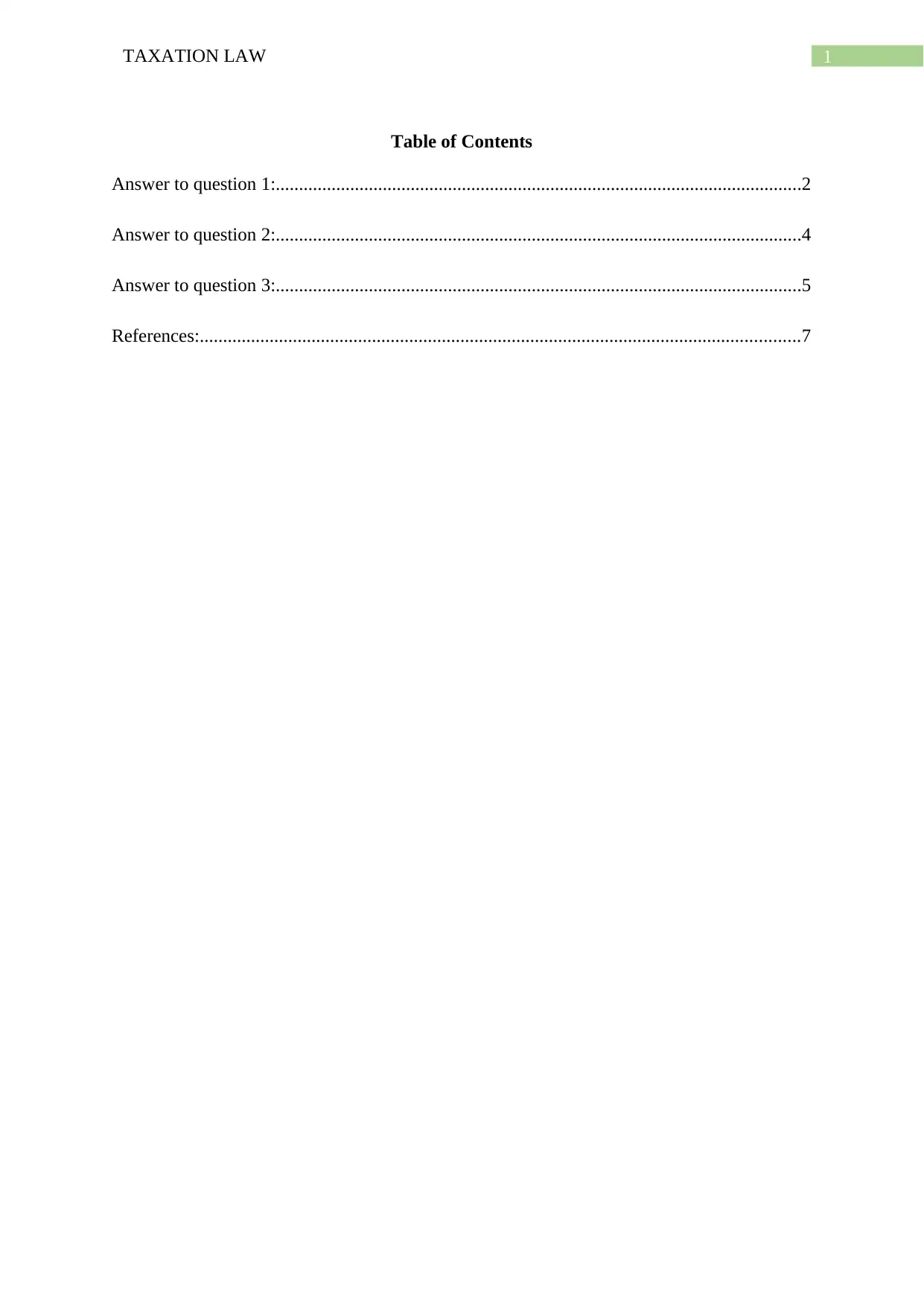
Table of Contents
Answer to question 1:.................................................................................................................2
Answer to question 2:.................................................................................................................4
Answer to question 3:.................................................................................................................5
References:.................................................................................................................................7
Table of Contents
Answer to question 1:.................................................................................................................2
Answer to question 2:.................................................................................................................4
Answer to question 3:.................................................................................................................5
References:.................................................................................................................................7

2TAXATION LAW
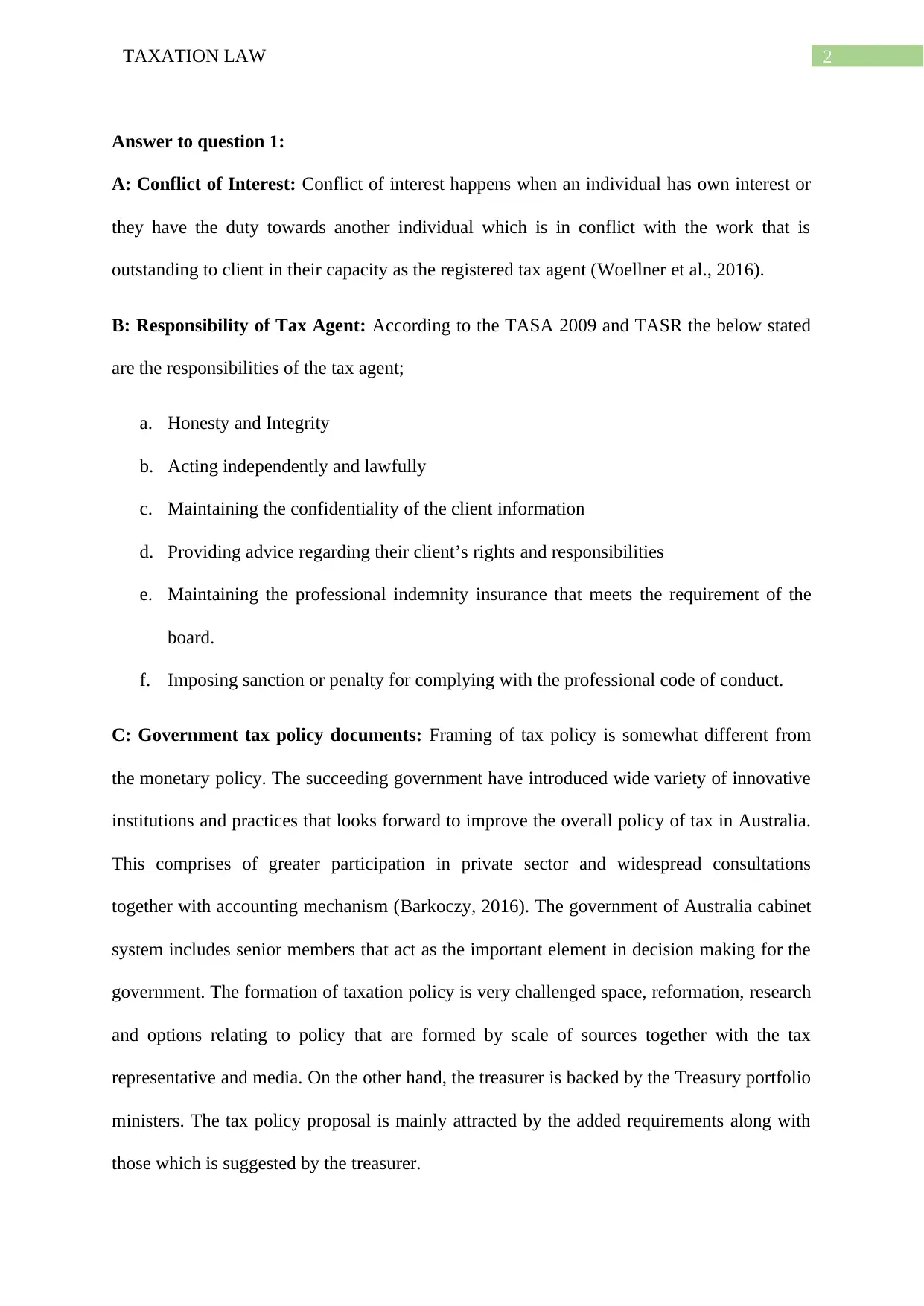
Answer to question 1:
A: Conflict of Interest: Conflict of interest happens when an individual has own interest or
they have the duty towards another individual which is in conflict with the work that is
outstanding to client in their capacity as the registered tax agent (Woellner et al., 2016).
B: Responsibility of Tax Agent: According to the TASA 2009 and TASR the below stated
are the responsibilities of the tax agent;
a. Honesty and Integrity
b. Acting independently and lawfully
c. Maintaining the confidentiality of the client information
d. Providing advice regarding their client’s rights and responsibilities
e. Maintaining the professional indemnity insurance that meets the requirement of the
board.
f. Imposing sanction or penalty for complying with the professional code of conduct.
C: Government tax policy documents: Framing of tax policy is somewhat different from
the monetary policy. The succeeding government have introduced wide variety of innovative
institutions and practices that looks forward to improve the overall policy of tax in Australia.
This comprises of greater participation in private sector and widespread consultations
together with accounting mechanism (Barkoczy, 2016). The government of Australia cabinet
system includes senior members that act as the important element in decision making for the
government. The formation of taxation policy is very challenged space, reformation, research
and options relating to policy that are formed by scale of sources together with the tax
representative and media. On the other hand, the treasurer is backed by the Treasury portfolio
ministers. The tax policy proposal is mainly attracted by the added requirements along with
those which is suggested by the treasurer.
Answer to question 1:
A: Conflict of Interest: Conflict of interest happens when an individual has own interest or
they have the duty towards another individual which is in conflict with the work that is
outstanding to client in their capacity as the registered tax agent (Woellner et al., 2016).
B: Responsibility of Tax Agent: According to the TASA 2009 and TASR the below stated
are the responsibilities of the tax agent;
a. Honesty and Integrity
b. Acting independently and lawfully
c. Maintaining the confidentiality of the client information
d. Providing advice regarding their client’s rights and responsibilities
e. Maintaining the professional indemnity insurance that meets the requirement of the
board.
f. Imposing sanction or penalty for complying with the professional code of conduct.
C: Government tax policy documents: Framing of tax policy is somewhat different from
the monetary policy. The succeeding government have introduced wide variety of innovative
institutions and practices that looks forward to improve the overall policy of tax in Australia.
This comprises of greater participation in private sector and widespread consultations
together with accounting mechanism (Barkoczy, 2016). The government of Australia cabinet
system includes senior members that act as the important element in decision making for the
government. The formation of taxation policy is very challenged space, reformation, research
and options relating to policy that are formed by scale of sources together with the tax
representative and media. On the other hand, the treasurer is backed by the Treasury portfolio
ministers. The tax policy proposal is mainly attracted by the added requirements along with
those which is suggested by the treasurer.
⊘ This is a preview!⊘
Do you want full access?
Subscribe today to unlock all pages.

Trusted by 1+ million students worldwide

3TAXATION LAW
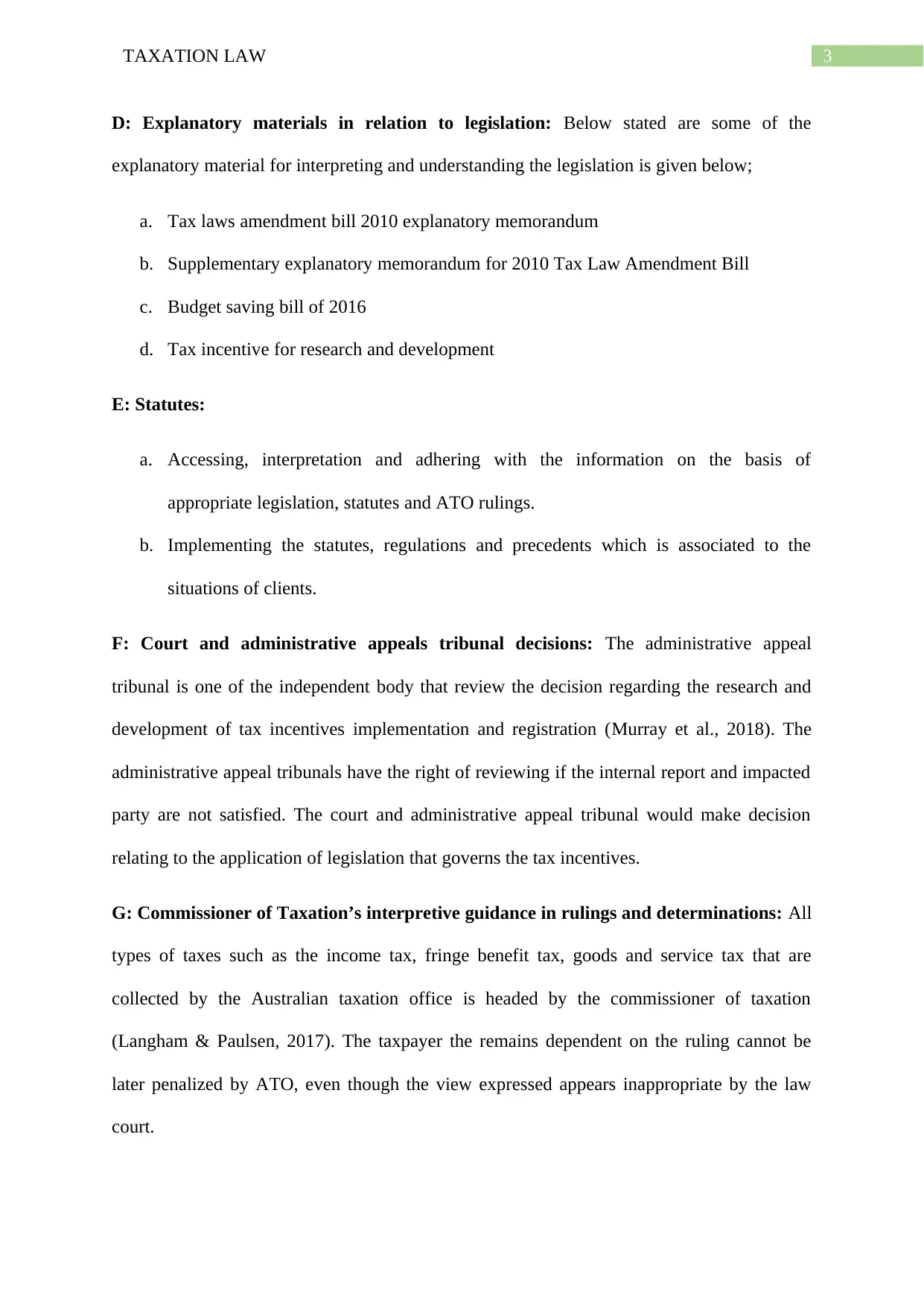
D: Explanatory materials in relation to legislation: Below stated are some of the
explanatory material for interpreting and understanding the legislation is given below;
a. Tax laws amendment bill 2010 explanatory memorandum
b. Supplementary explanatory memorandum for 2010 Tax Law Amendment Bill
c. Budget saving bill of 2016
d. Tax incentive for research and development
E: Statutes:
a. Accessing, interpretation and adhering with the information on the basis of
appropriate legislation, statutes and ATO rulings.
b. Implementing the statutes, regulations and precedents which is associated to the
situations of clients.
F: Court and administrative appeals tribunal decisions: The administrative appeal
tribunal is one of the independent body that review the decision regarding the research and
development of tax incentives implementation and registration (Murray et al., 2018). The
administrative appeal tribunals have the right of reviewing if the internal report and impacted
party are not satisfied. The court and administrative appeal tribunal would make decision
relating to the application of legislation that governs the tax incentives.
G: Commissioner of Taxation’s interpretive guidance in rulings and determinations: All
types of taxes such as the income tax, fringe benefit tax, goods and service tax that are
collected by the Australian taxation office is headed by the commissioner of taxation
(Langham & Paulsen, 2017). The taxpayer the remains dependent on the ruling cannot be
later penalized by ATO, even though the view expressed appears inappropriate by the law
court.
D: Explanatory materials in relation to legislation: Below stated are some of the
explanatory material for interpreting and understanding the legislation is given below;
a. Tax laws amendment bill 2010 explanatory memorandum
b. Supplementary explanatory memorandum for 2010 Tax Law Amendment Bill
c. Budget saving bill of 2016
d. Tax incentive for research and development
E: Statutes:
a. Accessing, interpretation and adhering with the information on the basis of
appropriate legislation, statutes and ATO rulings.
b. Implementing the statutes, regulations and precedents which is associated to the
situations of clients.
F: Court and administrative appeals tribunal decisions: The administrative appeal
tribunal is one of the independent body that review the decision regarding the research and
development of tax incentives implementation and registration (Murray et al., 2018). The
administrative appeal tribunals have the right of reviewing if the internal report and impacted
party are not satisfied. The court and administrative appeal tribunal would make decision
relating to the application of legislation that governs the tax incentives.
G: Commissioner of Taxation’s interpretive guidance in rulings and determinations: All
types of taxes such as the income tax, fringe benefit tax, goods and service tax that are
collected by the Australian taxation office is headed by the commissioner of taxation
(Langham & Paulsen, 2017). The taxpayer the remains dependent on the ruling cannot be
later penalized by ATO, even though the view expressed appears inappropriate by the law
court.
Paraphrase This Document
Need a fresh take? Get an instant paraphrase of this document with our AI Paraphraser

4TAXATION LAW
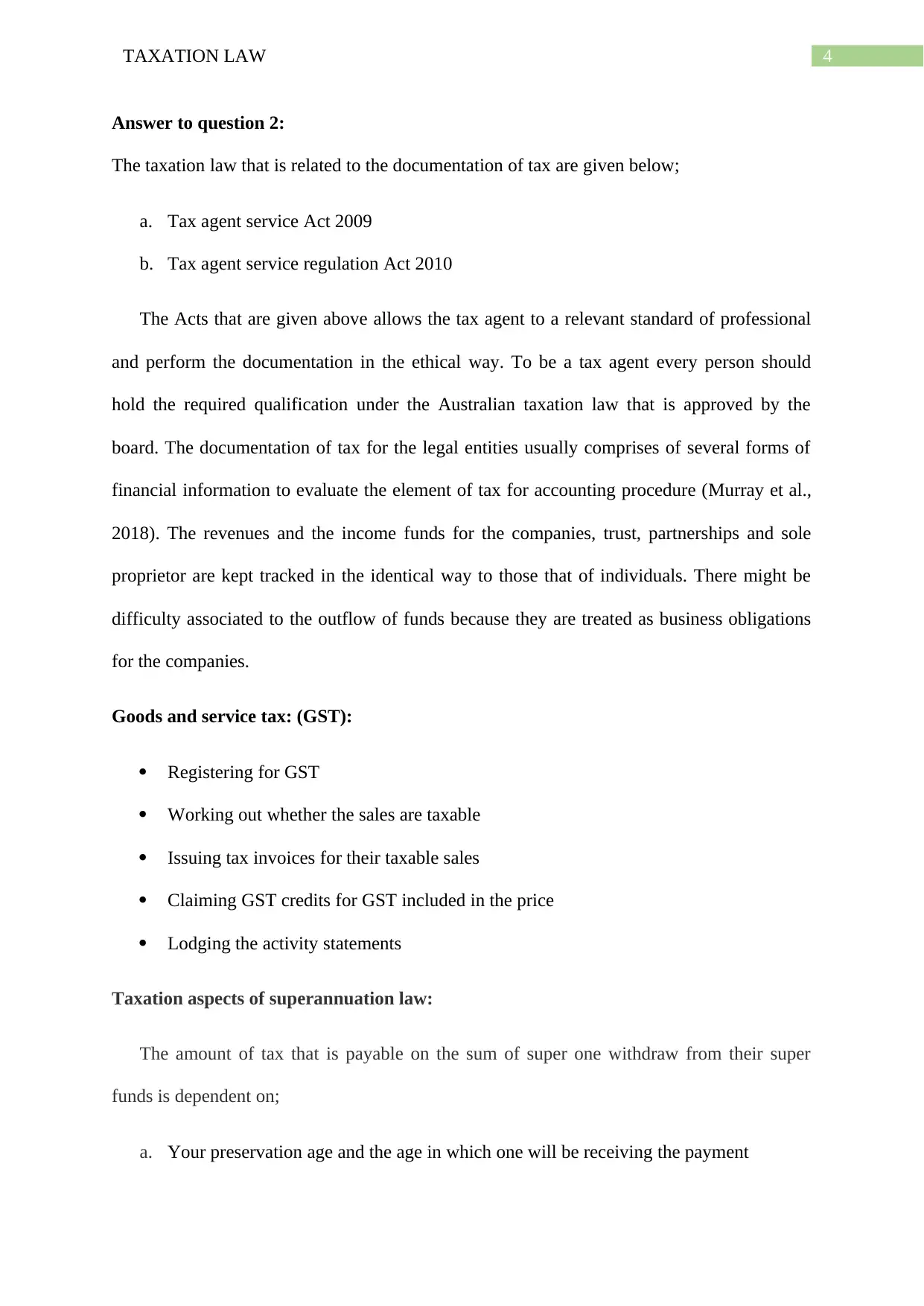
Answer to question 2:
The taxation law that is related to the documentation of tax are given below;
a. Tax agent service Act 2009
b. Tax agent service regulation Act 2010
The Acts that are given above allows the tax agent to a relevant standard of professional
and perform the documentation in the ethical way. To be a tax agent every person should
hold the required qualification under the Australian taxation law that is approved by the
board. The documentation of tax for the legal entities usually comprises of several forms of
financial information to evaluate the element of tax for accounting procedure (Murray et al.,
2018). The revenues and the income funds for the companies, trust, partnerships and sole
proprietor are kept tracked in the identical way to those that of individuals. There might be
difficulty associated to the outflow of funds because they are treated as business obligations
for the companies.
Goods and service tax: (GST):
Registering for GST
Working out whether the sales are taxable
Issuing tax invoices for their taxable sales
Claiming GST credits for GST included in the price
Lodging the activity statements
Taxation aspects of superannuation law:
The amount of tax that is payable on the sum of super one withdraw from their super
funds is dependent on;
a. Your preservation age and the age in which one will be receiving the payment
Answer to question 2:
The taxation law that is related to the documentation of tax are given below;
a. Tax agent service Act 2009
b. Tax agent service regulation Act 2010
The Acts that are given above allows the tax agent to a relevant standard of professional
and perform the documentation in the ethical way. To be a tax agent every person should
hold the required qualification under the Australian taxation law that is approved by the
board. The documentation of tax for the legal entities usually comprises of several forms of
financial information to evaluate the element of tax for accounting procedure (Murray et al.,
2018). The revenues and the income funds for the companies, trust, partnerships and sole
proprietor are kept tracked in the identical way to those that of individuals. There might be
difficulty associated to the outflow of funds because they are treated as business obligations
for the companies.
Goods and service tax: (GST):
Registering for GST
Working out whether the sales are taxable
Issuing tax invoices for their taxable sales
Claiming GST credits for GST included in the price
Lodging the activity statements
Taxation aspects of superannuation law:
The amount of tax that is payable on the sum of super one withdraw from their super
funds is dependent on;
a. Your preservation age and the age in which one will be receiving the payment

5TAXATION LAW
b. Whether the accrued benefit is free from tax or taxable
c. Whether an individual chooses to receive their payment as the income stream or lump
sum (Cavenagh et al., 2018).
Administrative aspects of taxes:
The administrative aspects of taxation that is identified above states that the system of
taxation must be capable of being adequately and effectively administered by the government
and enforced with lowest amount of inconvenience for the taxpayer (Morgan et al., 2018).
The system of taxation should be such that it remains fair to average taxpayer on the basis of
their ability to pay taxes.
Specific and general anti-avoidance rules:
The measures relating to tax avoidance is adopted by individual or company is mainly
for lowering the burden of taxation (Morgan & Castelyn, 2018). General anti-avoidance rules
allow tax officials to deny certain kinds of transaction or arrangement that lacks commercial
substances or considerations apart from providing any type of undue taxation benefits.
Answer to question 3:
The vital source of information and taxable transaction data that is needed to compute
the taxable income are given below;
Income:
a. Income from Salary
b. Income earned from rental property
c. Income derived from capital gains
d. Income earned from business or professions
e. Income derived from other sources
b. Whether the accrued benefit is free from tax or taxable
c. Whether an individual chooses to receive their payment as the income stream or lump
sum (Cavenagh et al., 2018).
Administrative aspects of taxes:
The administrative aspects of taxation that is identified above states that the system of
taxation must be capable of being adequately and effectively administered by the government
and enforced with lowest amount of inconvenience for the taxpayer (Morgan et al., 2018).
The system of taxation should be such that it remains fair to average taxpayer on the basis of
their ability to pay taxes.
Specific and general anti-avoidance rules:
The measures relating to tax avoidance is adopted by individual or company is mainly
for lowering the burden of taxation (Morgan & Castelyn, 2018). General anti-avoidance rules
allow tax officials to deny certain kinds of transaction or arrangement that lacks commercial
substances or considerations apart from providing any type of undue taxation benefits.
Answer to question 3:
The vital source of information and taxable transaction data that is needed to compute
the taxable income are given below;
Income:
a. Income from Salary
b. Income earned from rental property
c. Income derived from capital gains
d. Income earned from business or professions
e. Income derived from other sources
⊘ This is a preview!⊘
Do you want full access?
Subscribe today to unlock all pages.

Trusted by 1+ million students worldwide

6TAXATION LAW
Deductions:
a. Permissible deduction: It is the subtraction of financial expenses to lower the income
that are subjected to tax such as travel allowances
b. Depreciation of assets
c. Payments such as interest and payment to trust
d. Purchases including the payments made for goods and other capital investment
e. Payments relating to financial transaction such as interest, payment to trust
f. Superannuation payment
Deductions:
a. Permissible deduction: It is the subtraction of financial expenses to lower the income
that are subjected to tax such as travel allowances
b. Depreciation of assets
c. Payments such as interest and payment to trust
d. Purchases including the payments made for goods and other capital investment
e. Payments relating to financial transaction such as interest, payment to trust
f. Superannuation payment
Paraphrase This Document
Need a fresh take? Get an instant paraphrase of this document with our AI Paraphraser

7TAXATION LAW
References:
Barkoczy, S. (2016). Foundations of taxation law 2016. OUP Catalogue.
Cavenagh, J., Matley, H., Burke, L., Castles, S., Chesterfield, T., Clare, G., ... & Norris, A.
(2018). Australian legislation concerning matters of international law
2016. Australian Year Book of International Law, 35, 353.
Langham, J.A. & Paulsen, N., (2017). Invisible Taxation: Fantasy or Just Good Service
Design. Austl. Tax F., 32, p.129.
Morgan, A., & Castelyn, D. (2018). Taxation Education in Secondary Schools. J.
Australasian Tax Tchrs. Ass'n, 13, 307.
Morgan, A., Mortimer, C., & Pinto, D. (2018). A practical introduction to Australian
taxation law 2018. Oxford University Press.
Murray, I., Taylor, J., Walpole, M., Burton, M. & Ciro, T., (2018). Understanding Taxation
Law 2019.
Murray, I., Taylor, J., Walpole, M., Burton, M., & Ciro, T. (2018). Understanding Taxation
Law 2019.
Woellner, R., Barkoczy, S., Murphy, S., Evans, C., & Pinto, D. (2016). Australian Taxation
Law 2016. OUP Catalogue.
References:
Barkoczy, S. (2016). Foundations of taxation law 2016. OUP Catalogue.
Cavenagh, J., Matley, H., Burke, L., Castles, S., Chesterfield, T., Clare, G., ... & Norris, A.
(2018). Australian legislation concerning matters of international law
2016. Australian Year Book of International Law, 35, 353.
Langham, J.A. & Paulsen, N., (2017). Invisible Taxation: Fantasy or Just Good Service
Design. Austl. Tax F., 32, p.129.
Morgan, A., & Castelyn, D. (2018). Taxation Education in Secondary Schools. J.
Australasian Tax Tchrs. Ass'n, 13, 307.
Morgan, A., Mortimer, C., & Pinto, D. (2018). A practical introduction to Australian
taxation law 2018. Oxford University Press.
Murray, I., Taylor, J., Walpole, M., Burton, M. & Ciro, T., (2018). Understanding Taxation
Law 2019.
Murray, I., Taylor, J., Walpole, M., Burton, M., & Ciro, T. (2018). Understanding Taxation
Law 2019.
Woellner, R., Barkoczy, S., Murphy, S., Evans, C., & Pinto, D. (2016). Australian Taxation
Law 2016. OUP Catalogue.
1 out of 8
Related Documents
Your All-in-One AI-Powered Toolkit for Academic Success.
+13062052269
info@desklib.com
Available 24*7 on WhatsApp / Email
Unlock your academic potential
Copyright © 2020–2025 A2Z Services. All Rights Reserved. Developed and managed by ZUCOL.