Taxation Law Assignment: Income Tax, Residency, and CGT Analysis

Verified

Added on  2022/08/26

|8
|1802
|24
Homework Assignment
AI Summary
This taxation law assignment analyzes the tax implications for three different individuals: Mustafa, Diebe, and Donna. The assignment delves into the determination of assessable income, including salary, bonuses, tips, interest, rent, dividends, and capital gains from share sales. It applies relevant sections of the ITAA 1997 and ITAA 1936 to assess the taxability of various income sources. Furthermore, the assignment examines the residency status of Diebe, a Dutch rugby player, and its impact on his Australian tax obligations, considering the 183-day test and other relevant factors. Finally, it assesses the tax consequences of Donna's transactions, including share trading, property sales, and isolated transactions, applying CGT rules and relevant rulings. The assignment concludes by summarizing the tax liabilities of each individual based on the provided scenarios and relevant legislation.
Document Page
Running head: TAXATION LAW
Taxation Law
Name of the Student
Name of the University
Author Note
tabler-icon-diamond-filled.svg

Paraphrase This Document

Need a fresh take? Get an instant paraphrase of this document with our AI Paraphraser
Document Page
1
TAXATION LAW
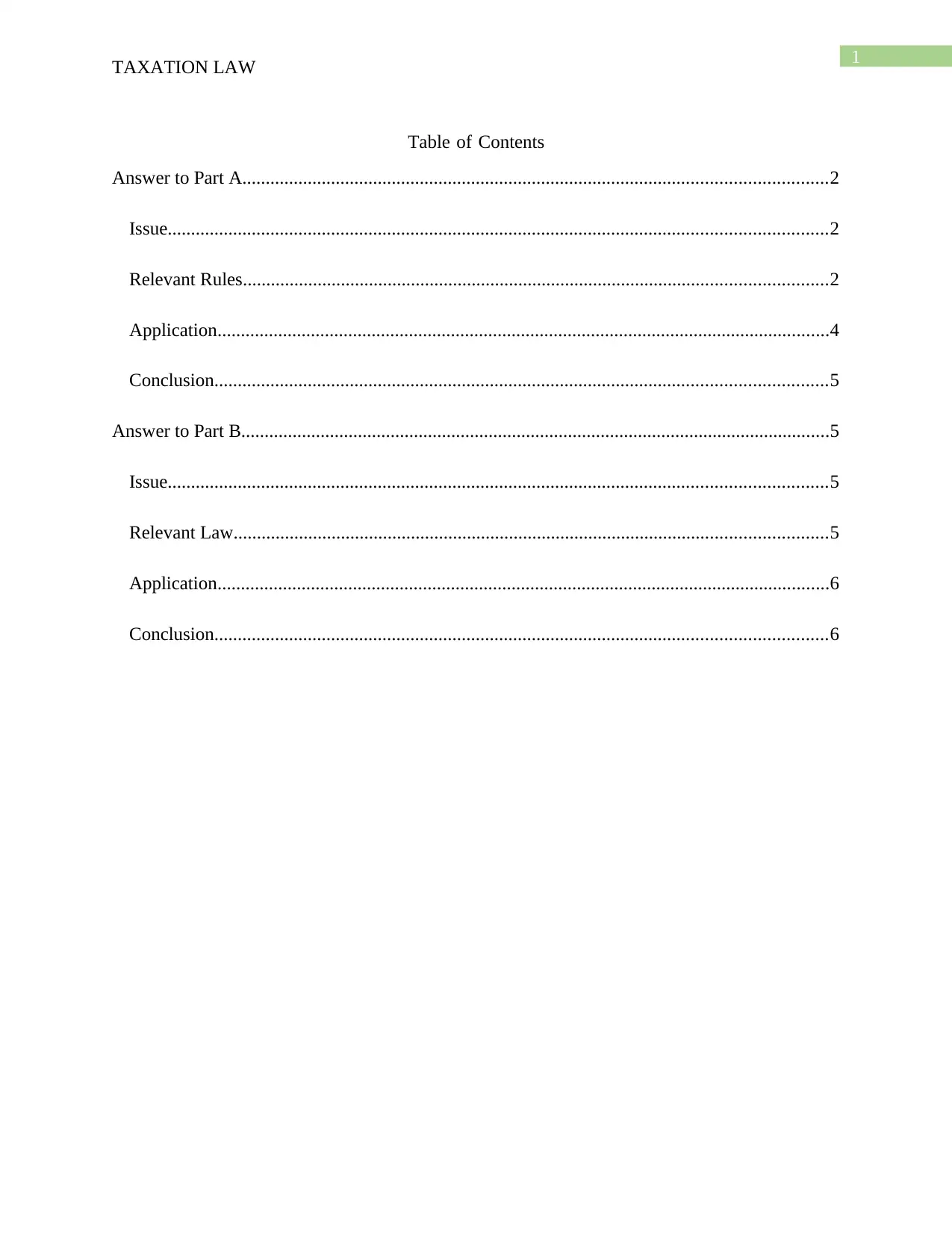
Table of Contents
Answer to Part A.............................................................................................................................2
Issue.............................................................................................................................................2
Relevant Rules.............................................................................................................................2
Application...................................................................................................................................4
Conclusion...................................................................................................................................5
Answer to Part B..............................................................................................................................5
Issue.............................................................................................................................................5
Relevant Law...............................................................................................................................5
Application...................................................................................................................................6
Conclusion...................................................................................................................................6
Document Page
2
TAXATION LAW
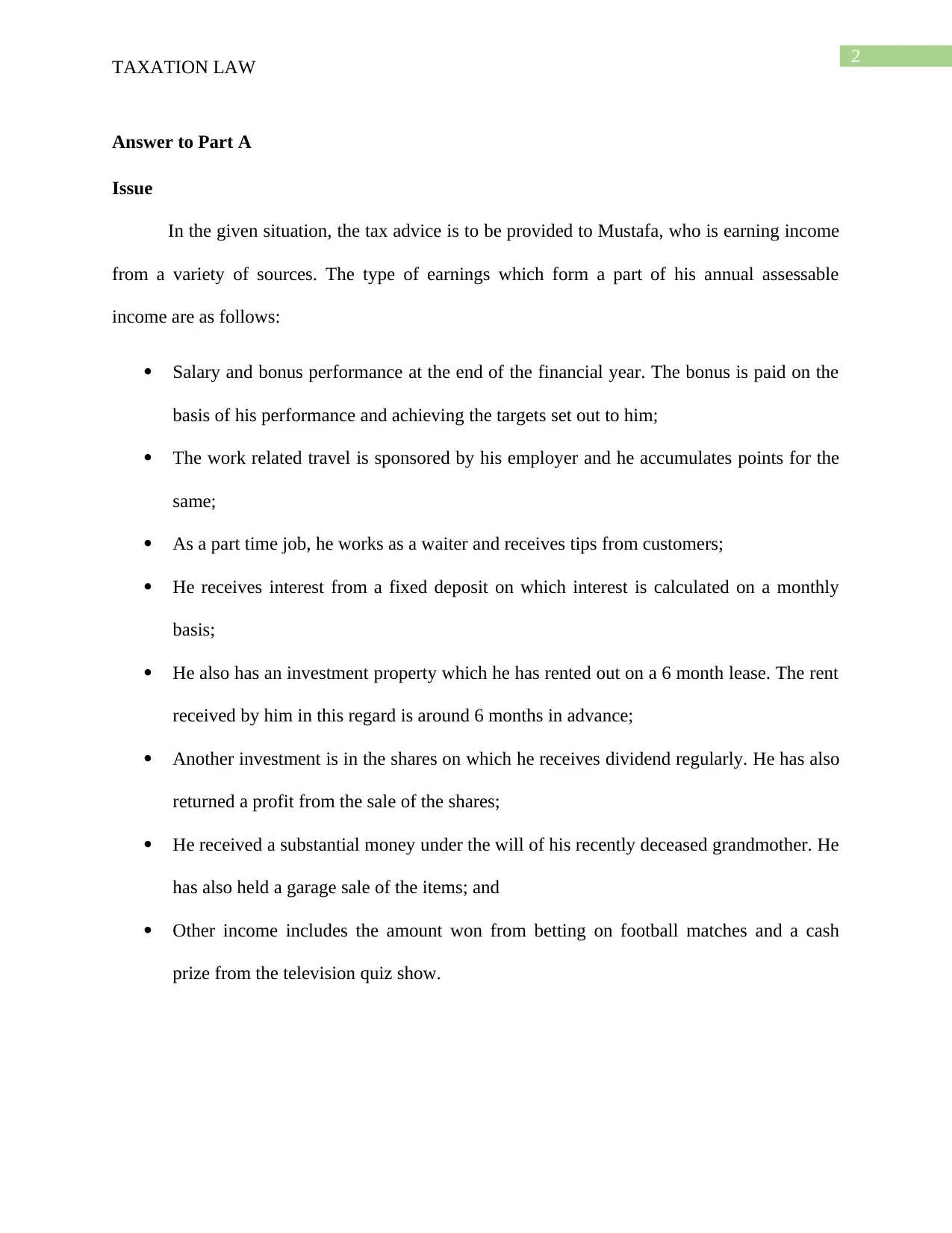
Answer to Part A
Issue
In the given situation, the tax advice is to be provided to Mustafa, who is earning income
from a variety of sources. The type of earnings which form a part of his annual assessable
income are as follows:
Salary and bonus performance at the end of the financial year. The bonus is paid on the
basis of his performance and achieving the targets set out to him;
The work related travel is sponsored by his employer and he accumulates points for the
same;
As a part time job, he works as a waiter and receives tips from customers;
He receives interest from a fixed deposit on which interest is calculated on a monthly
basis;
He also has an investment property which he has rented out on a 6 month lease. The rent
received by him in this regard is around 6 months in advance;
Another investment is in the shares on which he receives dividend regularly. He has also
returned a profit from the sale of the shares;
He received a substantial money under the will of his recently deceased grandmother. He
has also held a garage sale of the items; and
Other income includes the amount won from betting on football matches and a cash
prize from the television quiz show.
Document Page
3
TAXATION LAW
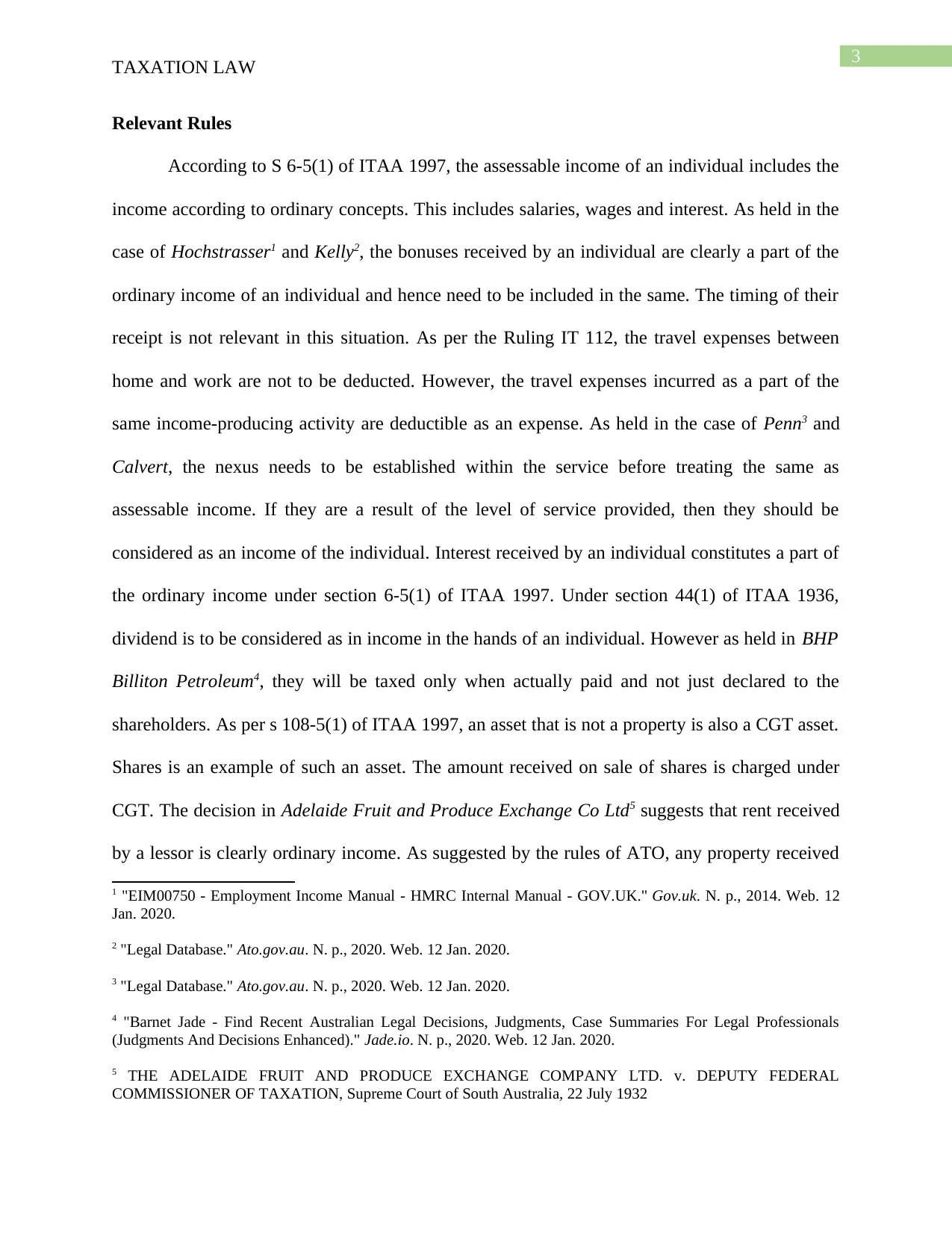
Relevant Rules
According to S 6-5(1) of ITAA 1997, the assessable income of an individual includes the
income according to ordinary concepts. This includes salaries, wages and interest. As held in the
case of Hochstrasser1 and Kelly2, the bonuses received by an individual are clearly a part of the
ordinary income of an individual and hence need to be included in the same. The timing of their
receipt is not relevant in this situation. As per the Ruling IT 112, the travel expenses between
home and work are not to be deducted. However, the travel expenses incurred as a part of the
same income-producing activity are deductible as an expense. As held in the case of Penn3 and
Calvert, the nexus needs to be established within the service before treating the same as
assessable income. If they are a result of the level of service provided, then they should be
considered as an income of the individual. Interest received by an individual constitutes a part of
the ordinary income under section 6-5(1) of ITAA 1997. Under section 44(1) of ITAA 1936,
dividend is to be considered as in income in the hands of an individual. However as held in BHP
Billiton Petroleum4, they will be taxed only when actually paid and not just declared to the
shareholders. As per s 108-5(1) of ITAA 1997, an asset that is not a property is also a CGT asset.
Shares is an example of such an asset. The amount received on sale of shares is charged under
CGT. The decision in Adelaide Fruit and Produce Exchange Co Ltd5 suggests that rent received
by a lessor is clearly ordinary income. As suggested by the rules of ATO, any property received
1 "EIM00750 - Employment Income Manual - HMRC Internal Manual - GOV.UK." Gov.uk. N. p., 2014. Web. 12
Jan. 2020.
2 "Legal Database." Ato.gov.au. N. p., 2020. Web. 12 Jan. 2020.
3 "Legal Database." Ato.gov.au. N. p., 2020. Web. 12 Jan. 2020.
4 "Barnet Jade - Find Recent Australian Legal Decisions, Judgments, Case Summaries For Legal Professionals
(Judgments And Decisions Enhanced)." Jade.io. N. p., 2020. Web. 12 Jan. 2020.
5 THE ADELAIDE FRUIT AND PRODUCE EXCHANGE COMPANY LTD. v. DEPUTY FEDERAL
COMMISSIONER OF TAXATION, Supreme Court of South Australia, 22 July 1932
tabler-icon-diamond-filled.svg

Paraphrase This Document

Need a fresh take? Get an instant paraphrase of this document with our AI Paraphraser
Document Page
4
TAXATION LAW
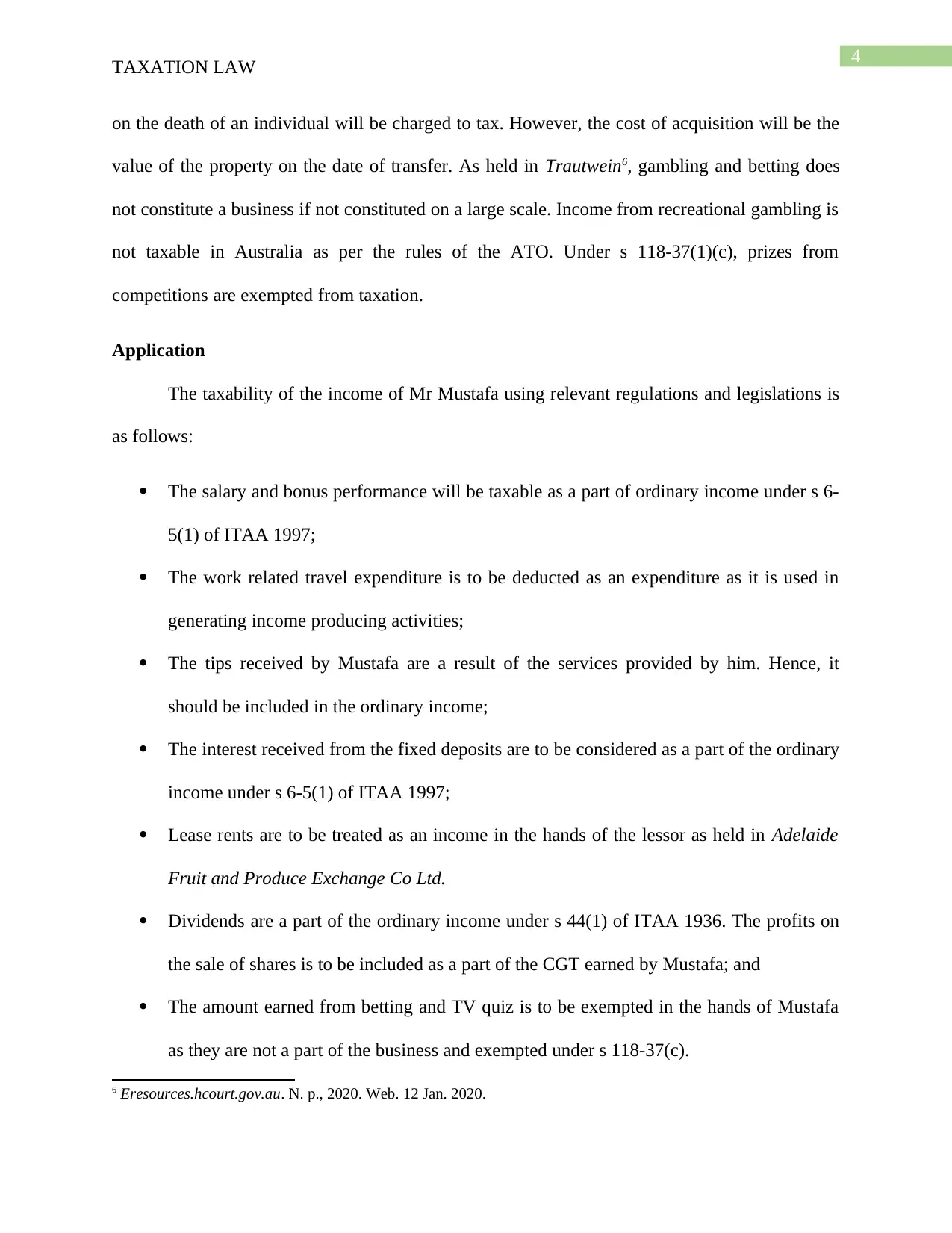
on the death of an individual will be charged to tax. However, the cost of acquisition will be the
value of the property on the date of transfer. As held in Trautwein6, gambling and betting does
not constitute a business if not constituted on a large scale. Income from recreational gambling is
not taxable in Australia as per the rules of the ATO. Under s 118-37(1)(c), prizes from
competitions are exempted from taxation.
Application
The taxability of the income of Mr Mustafa using relevant regulations and legislations is
as follows:
The salary and bonus performance will be taxable as a part of ordinary income under s 6-
5(1) of ITAA 1997;
The work related travel expenditure is to be deducted as an expenditure as it is used in
generating income producing activities;
The tips received by Mustafa are a result of the services provided by him. Hence, it
should be included in the ordinary income;
The interest received from the fixed deposits are to be considered as a part of the ordinary
income under s 6-5(1) of ITAA 1997;
Lease rents are to be treated as an income in the hands of the lessor as held in Adelaide
Fruit and Produce Exchange Co Ltd.
Dividends are a part of the ordinary income under s 44(1) of ITAA 1936. The profits on
the sale of shares is to be included as a part of the CGT earned by Mustafa; and
The amount earned from betting and TV quiz is to be exempted in the hands of Mustafa
as they are not a part of the business and exempted under s 118-37(c).
6 Eresources.hcourt.gov.au. N. p., 2020. Web. 12 Jan. 2020.
Document Page
5
TAXATION LAW
Conclusion
On the basis of the above discussion, it can be concluded that the majority of the income
earned by Mustafa is taxable under the guidelines of ITAA 1997. However, in certain cases like
the amount earned from betting can be exempted from taxation. In case of the assets received
from his grandmother, there can be an increase in the cost of acquisition of the property.
Answer to Part B
Issue
The issue is related to Diebe, a Dutch rugby player currently contracted to play the game
in Australia. In this particular year, he has been out of Australia for 100 days. He also has a
property in Sydney which will be his base for the next 3 years. However, he has a daughter with
his partner, who is staying back in Holland to continue her education without interruption.
Hence, the property in Byron Bay is to be used for the purpose of vacation when the family is in
Australia.
Relevant Law
As per Section 995-1 of ITAA 1997, a person who is a resident of Australia for the
purpose of s 6(1) of ITAA 1936 is considered to be an Australian resident. However, in case of
foreign individuals residing in Australia as a part of their employment contract, the provisions of
TR 98/177 are used in determining the residence of those individuals for taxation purposes. There
are four tests for this purpose. These are known as the Domicile Test, 183-day Test,
Superannuation Test and the temporary residents test. As held in the case of Miller, a lack of
interpretation of the word resides makes it difficult to apply in different cases. However, as
suggested by paragraph 80 to 84 of TR 98/17, the behaviour of an individual depends on whether
7 "Legal Database." Ato.gov.au. N. p., 2020. Web. 12 Jan. 2020.
Document Page
6
TAXATION LAW
they intend to be a permanent or a temporary resident, even if they have resided in Australia for a
period of more than 183 days.
Application
In this case Diebe is nor covered under the definition of an ordinary resident suggested by
s 6(1) of ITAA 1936. However, none of his actions suggest that he intends to be a permanent
resident of Australia. His unit in Sydney is a part of his contract. His daughter is not residing
with him to complete her education. Even the property in Byron Bay is only used as a holiday
home. He is not making any money in Australia except from his contract. Hence, he has not
undertaken any activity to be considered an Australian citizen.
Conclusion
On the basis of the above discussion, it can be suggested that Diebe is not a resident of
Australia for taxation purposes.
Issue
The issue is related to Donna, Diebe’s partner and the tax consequences of the
transactions undertaken by her. She has traded shares of a publicly listed company and made a
healthy profit. She has also sold the property in Byron Bay for a profit of $ 2 million and
incurred costs of $25000 to sell the same. She also has a share of $200000 in a café in Byron Bay
and is receiving $20000 for not opening a similar business.
Relevant Laws
As per section 6-5(3) of ITAA 1997, the income of a foreign resident includes all the
income derived directly or indirectly from all Australian sources in a given income year.
According to s 108-5(1) of ITAA 1997, an asset that is not a property is also a CGT asset. Shares
tabler-icon-diamond-filled.svg

Paraphrase This Document

Need a fresh take? Get an instant paraphrase of this document with our AI Paraphraser
Document Page
7
TAXATION LAW
is an example of such an asset. The amount received on sale of shares is charged under CGT.
Hence, the profits from the sale of the shares is taxable under CGT. As suggested by s 114-10(1)
of ITAA 1997, no indexation will be applicable on the cost of the property purchased before
21/9/1999. However, the additional costs incurred in selling the asset are not allowed as a
deduction from the capital gains earned from the asset. S 25(1) of ITAA 1936 suggests that
profits from isolated transactions are income and hence assessable under the same8. An isolated
transaction is one that takes place outside the ordinary course of a business.
Application
In the given case, the income earned by Donna from sale of shares of the public company
are charged under CGT. The sale of the property is also taxable under CGT and hence, tax is to
be charged on the same. However, as the property is acquired after 21/9/1999, no indexation is
allowed on the same. Hence, the CGT is charged on $ 1 million. The selling costs are also not
deducted. The income of $20000 from the isolated transaction is taxable as per TR 92/3.
Conclusion
The total taxable income of Donna for the year is $ 10,20,000 under the provisions of
ITAA 1936, ITAA 1997 and relevant legislations.
8 "Legal Database." Ato.gov.au. N. p., 2020. Web. 12 Jan. 2020.
chevron_up_icon
1 out of 8
circle_padding
hide_on_mobile
zoom_out_icon
[object Object]