Taxation Law Case Study: Analysis of Deductions and Capital Gains
VerifiedAdded on 2023/06/11
|10
|2425
|484
Case Study
AI Summary
This case study examines two key aspects of Australian taxation law: deductions related to business repairs and improvements, and the calculation of capital gains. The first question addresses whether Ken Fong, the owner of a new restaurant, can claim deductions for various expenses, including repairs and replacements. It determines which expenses are deductible under Australian Taxation Law and which are not. The second question involves calculating Maurice's taxable income from capital gains, considering profits and losses from the sale of various assets like property, shares, furniture, a yacht, and vacant land. It explains the methods for calculating capital gains tax in Australia, including identifying capital gains or losses, calculating costs, and applying discounts where applicable. The report concludes that understanding tax obligations and claiming appropriate deductions are crucial for individuals and businesses.
Assessment 2 Case
Study
Study

Paraphrase This Document
Need a fresh take? Get an instant paraphrase of this document with our AI Paraphraser
Contents
INTRODUCTION...........................................................................................................................3
QUESTION 1..................................................................................................................................3
Advice on the deductions that the business can get which are incurred on the repairs and
improvements..............................................................................................................................3
QUESTION 2..................................................................................................................................5
CONCLUSION................................................................................................................................8
REFERENCES................................................................................................................................9
INTRODUCTION...........................................................................................................................3
QUESTION 1..................................................................................................................................3
Advice on the deductions that the business can get which are incurred on the repairs and
improvements..............................................................................................................................3
QUESTION 2..................................................................................................................................5
CONCLUSION................................................................................................................................8
REFERENCES................................................................................................................................9
INTRODUCTION
Taxation Law is formed for collecting the amount of tax payable by the individuals,
company and many other organisations. This law is formed under which the public
administration is regularised to claim the amount that the tax payers are required to pay on the
part of the property or income they hold. The tax is charged on the assessable income which
could be either, statutory, ordinary or non – statutory income (Williamson and Luke, 2021). In
this report, the case study consists of two questions. First question comprises of the deductions
related to the repair and maintenance incurred by the restaurant of Ken Fong. It consists of the
deductions and through that the taxable income will be computed. In question 2, the capital gain
for the long and short terms is computed.
QUESTION 1
Advice on the deductions that the business can get which are incurred on the repairs and
improvements.
Ken Fong acquired the new restaurant on 17 July, 2020, which be not be considered as the
deductible amount under the Taxation Law of Australia.
In August 2020, Ken spent $ 27000 on the repairing of the restaurant. This will be a part of
the replacement as the space which is acquired for the new business. For instance, the space
which has been acquired should be contain of the parts such as of construction. The amount of $
6400 is costing to ken for the replacement of the cracked tiles of kitchen. It will be allowed as the
deductible expense for the restaurant of Ken Fong (Maxwell, 2018).
In November 2020, the replacement of the cooking equipment was done voluntarily which cost $
30000. It will not be a deductible expense. As it will not be considered under the repairing of
machinery, it is the replacement costs when no hazardous situation was occurred in the
equipment’s of the kitchen. A deduction shall be made for the cost of restoring
corporate belongings, part of properties or a drop in the worth asset reserved for the drive of
creating a judgement income. If the properties are retained or only used in part for that goal, a
assumption may be made in so far as is suitable in the conditions. The assessment specialist
cannot force the proprietor to own the asset or the denigrating asset. It may also be retained by
another administration; though, if the expenditure is for upkeep and the proprietor retains or uses
the belongings or the denigrating asset from the year of revenue for the drive of generating
Taxation Law is formed for collecting the amount of tax payable by the individuals,
company and many other organisations. This law is formed under which the public
administration is regularised to claim the amount that the tax payers are required to pay on the
part of the property or income they hold. The tax is charged on the assessable income which
could be either, statutory, ordinary or non – statutory income (Williamson and Luke, 2021). In
this report, the case study consists of two questions. First question comprises of the deductions
related to the repair and maintenance incurred by the restaurant of Ken Fong. It consists of the
deductions and through that the taxable income will be computed. In question 2, the capital gain
for the long and short terms is computed.
QUESTION 1
Advice on the deductions that the business can get which are incurred on the repairs and
improvements.
Ken Fong acquired the new restaurant on 17 July, 2020, which be not be considered as the
deductible amount under the Taxation Law of Australia.
In August 2020, Ken spent $ 27000 on the repairing of the restaurant. This will be a part of
the replacement as the space which is acquired for the new business. For instance, the space
which has been acquired should be contain of the parts such as of construction. The amount of $
6400 is costing to ken for the replacement of the cracked tiles of kitchen. It will be allowed as the
deductible expense for the restaurant of Ken Fong (Maxwell, 2018).
In November 2020, the replacement of the cooking equipment was done voluntarily which cost $
30000. It will not be a deductible expense. As it will not be considered under the repairing of
machinery, it is the replacement costs when no hazardous situation was occurred in the
equipment’s of the kitchen. A deduction shall be made for the cost of restoring
corporate belongings, part of properties or a drop in the worth asset reserved for the drive of
creating a judgement income. If the properties are retained or only used in part for that goal, a
assumption may be made in so far as is suitable in the conditions. The assessment specialist
cannot force the proprietor to own the asset or the denigrating asset. It may also be retained by
another administration; though, if the expenditure is for upkeep and the proprietor retains or uses
the belongings or the denigrating asset from the year of revenue for the drive of generating
⊘ This is a preview!⊘
Do you want full access?
Subscribe today to unlock all pages.

Trusted by 1+ million students worldwide
a considerable income, the inference is allowable given that the imbursement is produced. There
are in total 3 cases which can be carried by the taxpayer in order to considers the deductions
available, it incurred in the same year when the deduction is incurred or it may regard to a
devaluing asset or a property.
The pest control is also not the deductible expense, as it is also done by the organization by
its voluntary wish for ensuring the health and safety standards of the employees. It will not be
counted in the assessable income (Nasution, Santi, Husaini, Fadli and Pirzada, 2020).
In January 2021, a casualty occurred due to which the roof of the restaurant got damaged. So
the replacement cost of roof which was $ 32000 will be used as a deductible expense form the
assessable income of the restaurant.
Deductions which can be claimed by the business for repair, replacement expenses and
maintenance expenses.
An individual whom have spent an amount for repair and maintenance of business can claim for
deduction for such business expenses which includes,
Conditioning gutters
Repairing electrical appliances
Replacing broken parts of fences or broken glass window
Mending leaks
Repairing machinery
Painting
Maintaining plumbing
Expenses those are incurred by the business but cannot be deducted from the income earned
by the organisation. These are the expenses which cannot be claimed by the organisation.
Repair of machinery, property and tool at the time of purchase.
Improvement for any machine or property (Brown, 2020).
Deduction for claim of deduction of capital expenses:
Capital work provisions
Depreciation provisions
Hence, the advice will be made that the improvement which are related to the equipment or
replacement of the machinery should be done by the organisation, in the case if it is required for
increasing the efficient of the company.
are in total 3 cases which can be carried by the taxpayer in order to considers the deductions
available, it incurred in the same year when the deduction is incurred or it may regard to a
devaluing asset or a property.
The pest control is also not the deductible expense, as it is also done by the organization by
its voluntary wish for ensuring the health and safety standards of the employees. It will not be
counted in the assessable income (Nasution, Santi, Husaini, Fadli and Pirzada, 2020).
In January 2021, a casualty occurred due to which the roof of the restaurant got damaged. So
the replacement cost of roof which was $ 32000 will be used as a deductible expense form the
assessable income of the restaurant.
Deductions which can be claimed by the business for repair, replacement expenses and
maintenance expenses.
An individual whom have spent an amount for repair and maintenance of business can claim for
deduction for such business expenses which includes,
Conditioning gutters
Repairing electrical appliances
Replacing broken parts of fences or broken glass window
Mending leaks
Repairing machinery
Painting
Maintaining plumbing
Expenses those are incurred by the business but cannot be deducted from the income earned
by the organisation. These are the expenses which cannot be claimed by the organisation.
Repair of machinery, property and tool at the time of purchase.
Improvement for any machine or property (Brown, 2020).
Deduction for claim of deduction of capital expenses:
Capital work provisions
Depreciation provisions
Hence, the advice will be made that the improvement which are related to the equipment or
replacement of the machinery should be done by the organisation, in the case if it is required for
increasing the efficient of the company.
Paraphrase This Document
Need a fresh take? Get an instant paraphrase of this document with our AI Paraphraser
QUESTION 2
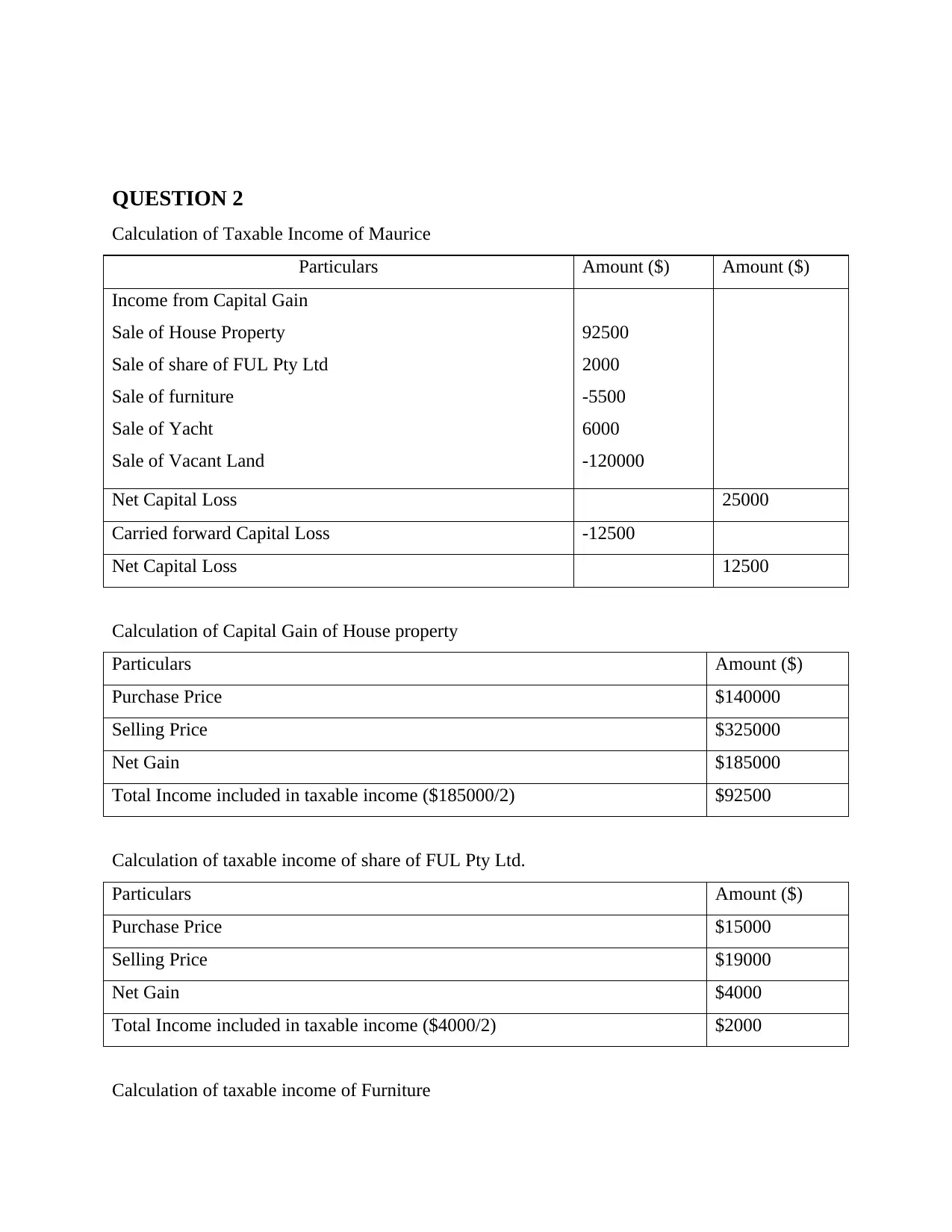
Calculation of Taxable Income of Maurice
Particulars Amount ($) Amount ($)
Income from Capital Gain
Sale of House Property
Sale of share of FUL Pty Ltd
Sale of furniture
Sale of Yacht
Sale of Vacant Land
92500
2000
-5500
6000
-120000
Net Capital Loss 25000
Carried forward Capital Loss -12500
Net Capital Loss 12500
Calculation of Capital Gain of House property
Particulars Amount ($)
Purchase Price $140000
Selling Price $325000
Net Gain $185000
Total Income included in taxable income ($185000/2) $92500
Calculation of taxable income of share of FUL Pty Ltd.
Particulars Amount ($)
Purchase Price $15000
Selling Price $19000
Net Gain $4000
Total Income included in taxable income ($4000/2) $2000
Calculation of taxable income of Furniture
Calculation of Taxable Income of Maurice
Particulars Amount ($) Amount ($)
Income from Capital Gain
Sale of House Property
Sale of share of FUL Pty Ltd
Sale of furniture
Sale of Yacht
Sale of Vacant Land
92500
2000
-5500
6000
-120000
Net Capital Loss 25000
Carried forward Capital Loss -12500
Net Capital Loss 12500
Calculation of Capital Gain of House property
Particulars Amount ($)
Purchase Price $140000
Selling Price $325000
Net Gain $185000
Total Income included in taxable income ($185000/2) $92500
Calculation of taxable income of share of FUL Pty Ltd.
Particulars Amount ($)
Purchase Price $15000
Selling Price $19000
Net Gain $4000
Total Income included in taxable income ($4000/2) $2000
Calculation of taxable income of Furniture
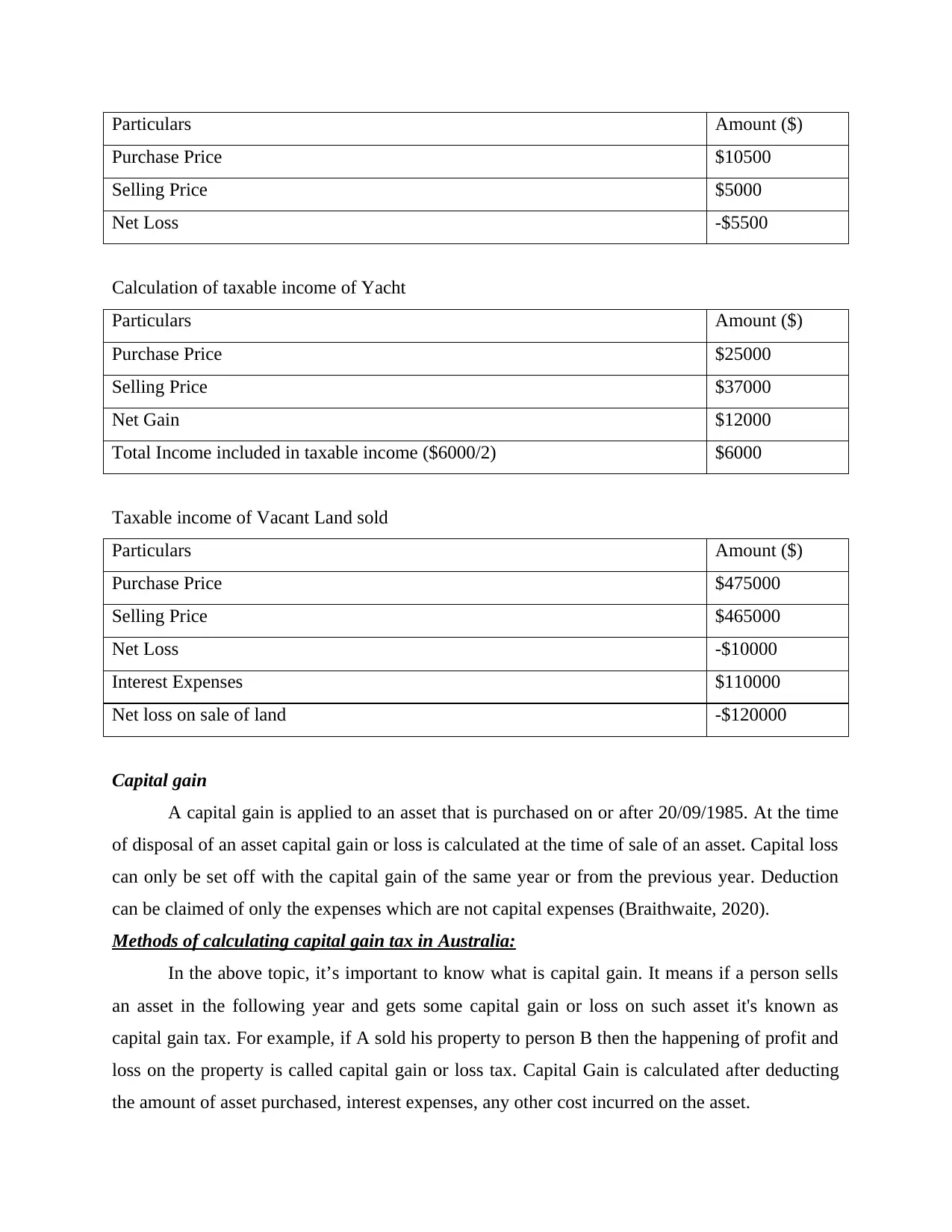
Particulars Amount ($)
Purchase Price $10500
Selling Price $5000
Net Loss -$5500
Calculation of taxable income of Yacht
Particulars Amount ($)
Purchase Price $25000
Selling Price $37000
Net Gain $12000
Total Income included in taxable income ($6000/2) $6000
Taxable income of Vacant Land sold
Particulars Amount ($)
Purchase Price $475000
Selling Price $465000
Net Loss -$10000
Interest Expenses $110000
Net loss on sale of land -$120000
Capital gain
A capital gain is applied to an asset that is purchased on or after 20/09/1985. At the time
of disposal of an asset capital gain or loss is calculated at the time of sale of an asset. Capital loss
can only be set off with the capital gain of the same year or from the previous year. Deduction
can be claimed of only the expenses which are not capital expenses (Braithwaite, 2020).
Methods of calculating capital gain tax in Australia:
In the above topic, it’s important to know what is capital gain. It means if a person sells
an asset in the following year and gets some capital gain or loss on such asset it's known as
capital gain tax. For example, if A sold his property to person B then the happening of profit and
loss on the property is called capital gain or loss tax. Capital Gain is calculated after deducting
the amount of asset purchased, interest expenses, any other cost incurred on the asset.
Purchase Price $10500
Selling Price $5000
Net Loss -$5500
Calculation of taxable income of Yacht
Particulars Amount ($)
Purchase Price $25000
Selling Price $37000
Net Gain $12000
Total Income included in taxable income ($6000/2) $6000
Taxable income of Vacant Land sold
Particulars Amount ($)
Purchase Price $475000
Selling Price $465000
Net Loss -$10000
Interest Expenses $110000
Net loss on sale of land -$120000
Capital gain
A capital gain is applied to an asset that is purchased on or after 20/09/1985. At the time
of disposal of an asset capital gain or loss is calculated at the time of sale of an asset. Capital loss
can only be set off with the capital gain of the same year or from the previous year. Deduction
can be claimed of only the expenses which are not capital expenses (Braithwaite, 2020).
Methods of calculating capital gain tax in Australia:
In the above topic, it’s important to know what is capital gain. It means if a person sells
an asset in the following year and gets some capital gain or loss on such asset it's known as
capital gain tax. For example, if A sold his property to person B then the happening of profit and
loss on the property is called capital gain or loss tax. Capital Gain is calculated after deducting
the amount of asset purchased, interest expenses, any other cost incurred on the asset.
⊘ This is a preview!⊘
Do you want full access?
Subscribe today to unlock all pages.
Trusted by 1+ million students worldwide
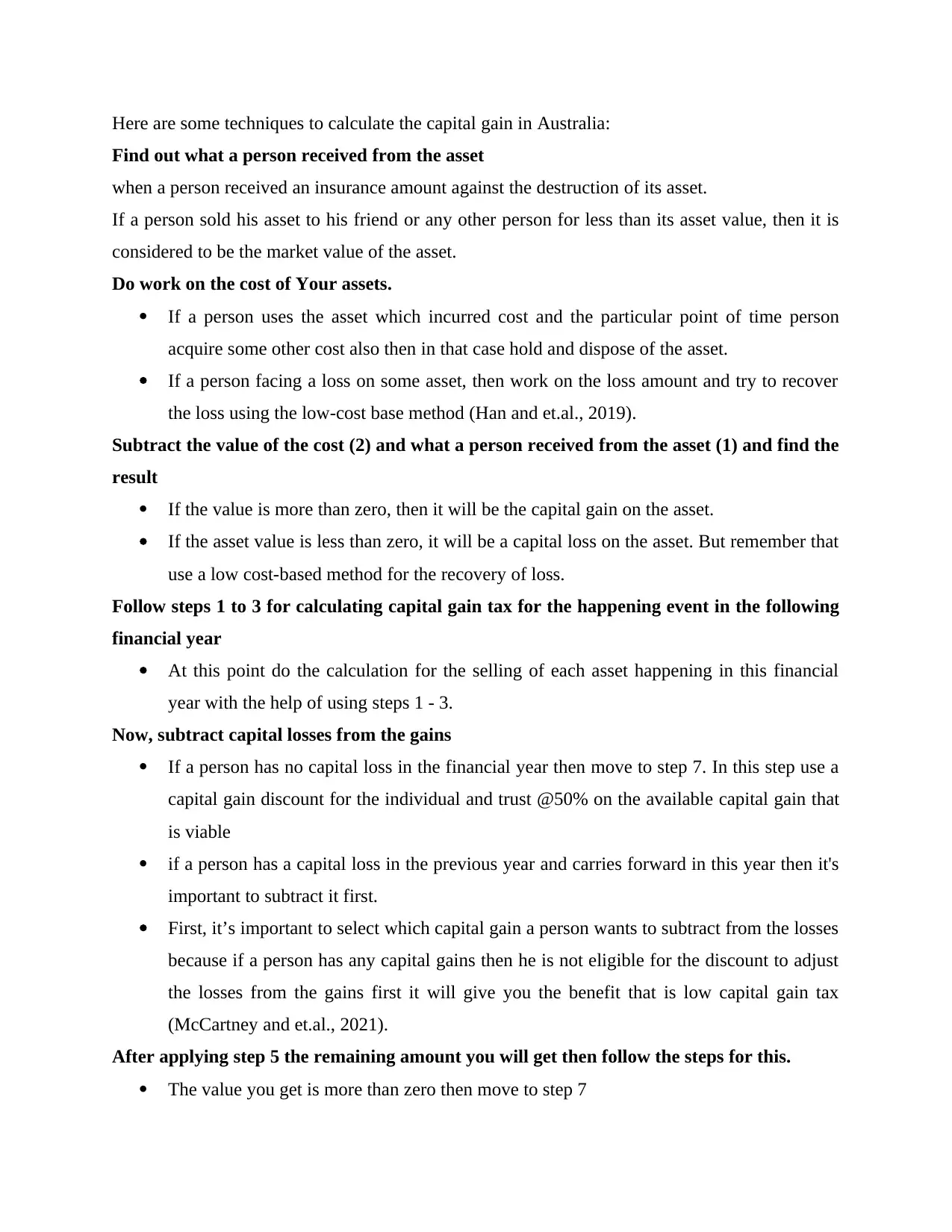
Here are some techniques to calculate the capital gain in Australia:
Find out what a person received from the asset
when a person received an insurance amount against the destruction of its asset.
If a person sold his asset to his friend or any other person for less than its asset value, then it is
considered to be the market value of the asset.
Do work on the cost of Your assets.
If a person uses the asset which incurred cost and the particular point of time person
acquire some other cost also then in that case hold and dispose of the asset.
If a person facing a loss on some asset, then work on the loss amount and try to recover
the loss using the low-cost base method (Han and et.al., 2019).
Subtract the value of the cost (2) and what a person received from the asset (1) and find the
result
If the value is more than zero, then it will be the capital gain on the asset.
If the asset value is less than zero, it will be a capital loss on the asset. But remember that
use a low cost-based method for the recovery of loss.
Follow steps 1 to 3 for calculating capital gain tax for the happening event in the following
financial year
At this point do the calculation for the selling of each asset happening in this financial
year with the help of using steps 1 - 3.
Now, subtract capital losses from the gains
If a person has no capital loss in the financial year then move to step 7. In this step use a
capital gain discount for the individual and trust @50% on the available capital gain that
is viable
if a person has a capital loss in the previous year and carries forward in this year then it's
important to subtract it first.
First, it’s important to select which capital gain a person wants to subtract from the losses
because if a person has any capital gains then he is not eligible for the discount to adjust
the losses from the gains first it will give you the benefit that is low capital gain tax
(McCartney and et.al., 2021).
After applying step 5 the remaining amount you will get then follow the steps for this.
The value you get is more than zero then move to step 7
Find out what a person received from the asset
when a person received an insurance amount against the destruction of its asset.
If a person sold his asset to his friend or any other person for less than its asset value, then it is
considered to be the market value of the asset.
Do work on the cost of Your assets.
If a person uses the asset which incurred cost and the particular point of time person
acquire some other cost also then in that case hold and dispose of the asset.
If a person facing a loss on some asset, then work on the loss amount and try to recover
the loss using the low-cost base method (Han and et.al., 2019).
Subtract the value of the cost (2) and what a person received from the asset (1) and find the
result
If the value is more than zero, then it will be the capital gain on the asset.
If the asset value is less than zero, it will be a capital loss on the asset. But remember that
use a low cost-based method for the recovery of loss.
Follow steps 1 to 3 for calculating capital gain tax for the happening event in the following
financial year
At this point do the calculation for the selling of each asset happening in this financial
year with the help of using steps 1 - 3.
Now, subtract capital losses from the gains
If a person has no capital loss in the financial year then move to step 7. In this step use a
capital gain discount for the individual and trust @50% on the available capital gain that
is viable
if a person has a capital loss in the previous year and carries forward in this year then it's
important to subtract it first.
First, it’s important to select which capital gain a person wants to subtract from the losses
because if a person has any capital gains then he is not eligible for the discount to adjust
the losses from the gains first it will give you the benefit that is low capital gain tax
(McCartney and et.al., 2021).
After applying step 5 the remaining amount you will get then follow the steps for this.
The value you get is more than zero then move to step 7
Paraphrase This Document
Need a fresh take? Get an instant paraphrase of this document with our AI Paraphraser
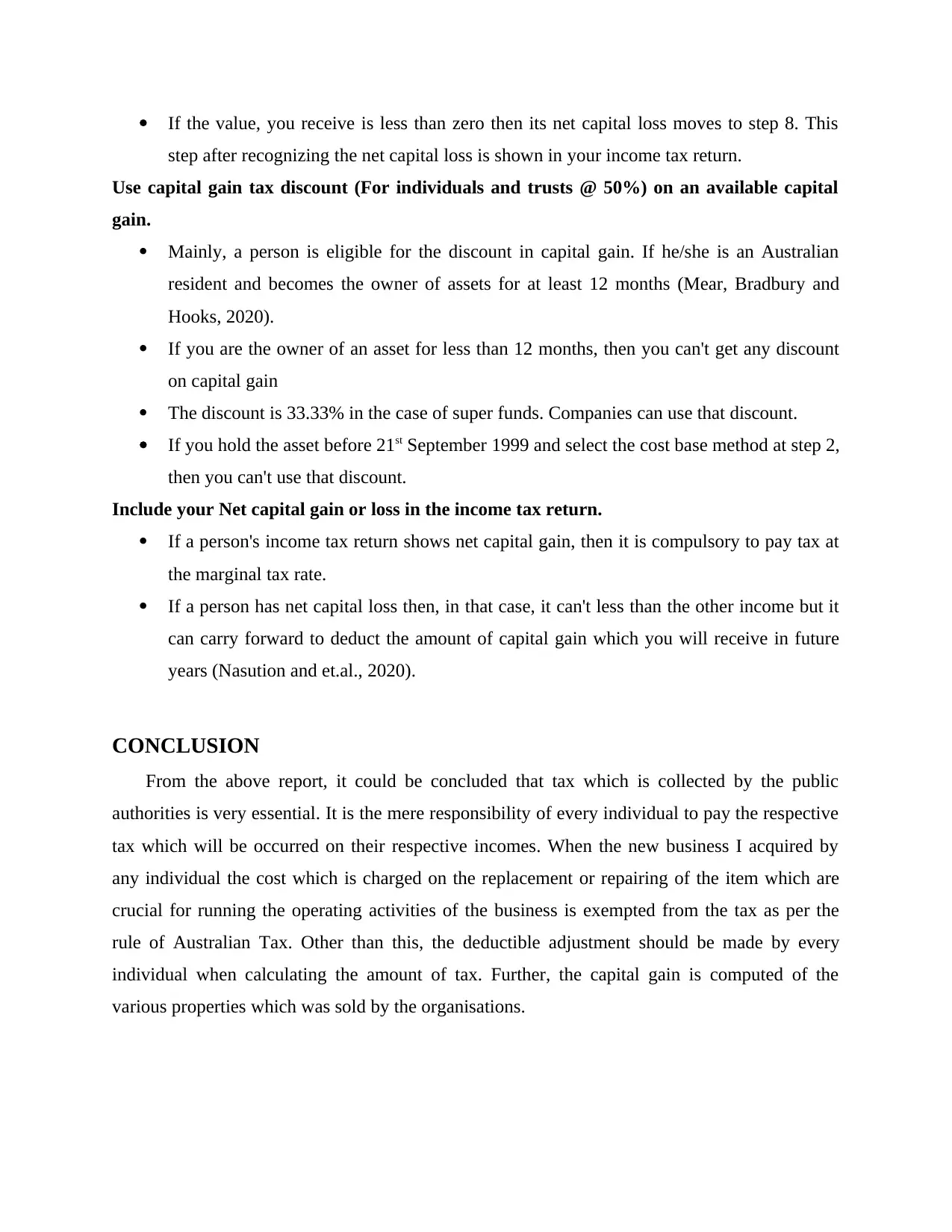
If the value, you receive is less than zero then its net capital loss moves to step 8. This
step after recognizing the net capital loss is shown in your income tax return.
Use capital gain tax discount (For individuals and trusts @ 50%) on an available capital
gain.
Mainly, a person is eligible for the discount in capital gain. If he/she is an Australian
resident and becomes the owner of assets for at least 12 months (Mear, Bradbury and
Hooks, 2020).
If you are the owner of an asset for less than 12 months, then you can't get any discount
on capital gain
The discount is 33.33% in the case of super funds. Companies can use that discount.
If you hold the asset before 21st September 1999 and select the cost base method at step 2,
then you can't use that discount.
Include your Net capital gain or loss in the income tax return.
If a person's income tax return shows net capital gain, then it is compulsory to pay tax at
the marginal tax rate.
If a person has net capital loss then, in that case, it can't less than the other income but it
can carry forward to deduct the amount of capital gain which you will receive in future
years (Nasution and et.al., 2020).
CONCLUSION
From the above report, it could be concluded that tax which is collected by the public
authorities is very essential. It is the mere responsibility of every individual to pay the respective
tax which will be occurred on their respective incomes. When the new business I acquired by
any individual the cost which is charged on the replacement or repairing of the item which are
crucial for running the operating activities of the business is exempted from the tax as per the
rule of Australian Tax. Other than this, the deductible adjustment should be made by every
individual when calculating the amount of tax. Further, the capital gain is computed of the
various properties which was sold by the organisations.
step after recognizing the net capital loss is shown in your income tax return.
Use capital gain tax discount (For individuals and trusts @ 50%) on an available capital
gain.
Mainly, a person is eligible for the discount in capital gain. If he/she is an Australian
resident and becomes the owner of assets for at least 12 months (Mear, Bradbury and
Hooks, 2020).
If you are the owner of an asset for less than 12 months, then you can't get any discount
on capital gain
The discount is 33.33% in the case of super funds. Companies can use that discount.
If you hold the asset before 21st September 1999 and select the cost base method at step 2,
then you can't use that discount.
Include your Net capital gain or loss in the income tax return.
If a person's income tax return shows net capital gain, then it is compulsory to pay tax at
the marginal tax rate.
If a person has net capital loss then, in that case, it can't less than the other income but it
can carry forward to deduct the amount of capital gain which you will receive in future
years (Nasution and et.al., 2020).
CONCLUSION
From the above report, it could be concluded that tax which is collected by the public
authorities is very essential. It is the mere responsibility of every individual to pay the respective
tax which will be occurred on their respective incomes. When the new business I acquired by
any individual the cost which is charged on the replacement or repairing of the item which are
crucial for running the operating activities of the business is exempted from the tax as per the
rule of Australian Tax. Other than this, the deductible adjustment should be made by every
individual when calculating the amount of tax. Further, the capital gain is computed of the
various properties which was sold by the organisations.

REFERENCES
Books and Journals
Braithwaite, V., 2020. Beyond the bubble that is Robodebt: How governments that lose integrity
threaten democracy. Australian Journal of Social Issues, 55(3), pp.242-259.
Brown, R.J., 2020, September. Voluntary tax disclosures and corporate tax avoidance: Evidence
from Australia. In Australian Tax Forum (Vol. 35, No. 3, pp. 391-429).
Evans, V., 2021. Caring for Traumatic Brain Injury Patients: Australian Nursing
Perspectives. Critical Care Nursing Clinics, 33(1), pp.21-36.
Han, J., and et.al., 2019. The wealth effects of the announcement of the Australian carbon
pricing scheme. Pacific-Basin Finance Journal, 53, pp.399-409.
Koong, K.S., and et.al., 2019. Advancements and forecasts of electronic tax return and
informational filings in the US. International Journal of Accounting & Information
Management.
Maxwell, P., 2018. The end of the mining boom? A Western Australian perspective. Mineral
Economics, 31(1), pp.153-170.
McCartney, D., and et.al.,2021. Analysis of dietary intake, diet cost and food group expenditure
from a 24‐hour food record collected in a sample of Australian university
students. Nutrition & Dietetics, 78(2), pp.174-182.
Mear, K., Bradbury, M. and Hooks, J., 2020. Is the balance sheet method of deferred tax
informative?. Pacific Accounting Review.
Nasution, M.K. and et.al., 2020. Determinants of tax compliance: a study on individual taxpayers
in Indonesia. Entrepreneurship and Sustainability Issues, 8(2), p.1401.
Williamson, A.K. and Luke, B.G., 2021. Mapping the field of public ancillary funds. Australian
Journal of Public Administration.
Books and Journals
Braithwaite, V., 2020. Beyond the bubble that is Robodebt: How governments that lose integrity
threaten democracy. Australian Journal of Social Issues, 55(3), pp.242-259.
Brown, R.J., 2020, September. Voluntary tax disclosures and corporate tax avoidance: Evidence
from Australia. In Australian Tax Forum (Vol. 35, No. 3, pp. 391-429).
Evans, V., 2021. Caring for Traumatic Brain Injury Patients: Australian Nursing
Perspectives. Critical Care Nursing Clinics, 33(1), pp.21-36.
Han, J., and et.al., 2019. The wealth effects of the announcement of the Australian carbon
pricing scheme. Pacific-Basin Finance Journal, 53, pp.399-409.
Koong, K.S., and et.al., 2019. Advancements and forecasts of electronic tax return and
informational filings in the US. International Journal of Accounting & Information
Management.
Maxwell, P., 2018. The end of the mining boom? A Western Australian perspective. Mineral
Economics, 31(1), pp.153-170.
McCartney, D., and et.al.,2021. Analysis of dietary intake, diet cost and food group expenditure
from a 24‐hour food record collected in a sample of Australian university
students. Nutrition & Dietetics, 78(2), pp.174-182.
Mear, K., Bradbury, M. and Hooks, J., 2020. Is the balance sheet method of deferred tax
informative?. Pacific Accounting Review.
Nasution, M.K. and et.al., 2020. Determinants of tax compliance: a study on individual taxpayers
in Indonesia. Entrepreneurship and Sustainability Issues, 8(2), p.1401.
Williamson, A.K. and Luke, B.G., 2021. Mapping the field of public ancillary funds. Australian
Journal of Public Administration.
⊘ This is a preview!⊘
Do you want full access?
Subscribe today to unlock all pages.
Trusted by 1+ million students worldwide


1 out of 10


Related Documents


Your All-in-One AI-Powered Toolkit for Academic Success.
+13062052269
info@desklib.com
Available 24*7 on WhatsApp / Email
![[object Object]](/_next/static/media/star-bottom.7253800d.svg)
Unlock your academic potential
Copyright © 2020–2026 A2Z Services. All Rights Reserved. Developed and managed by ZUCOL.