TAXA5002/5014 - Capital Proceeds & Cost Base: A Detailed Analysis

Verified

Added on  2023/04/11

|4
|338
|449
Report
AI Summary
This report provides an overview of cost base and capital proceeds within the context of Australian taxation law, drawing from Topic 4 materials. It covers key aspects such as the timing of asset acquisition, elements comprising the cost base and reduced cost base of an asset, and modifications to cost base rules. The report further discusses capital proceeds, including modifications to general rules, referencing specific sections such as Section 109(10), Section 110-55, Section 112-5(2), and Section 112-20. It highlights the significance of market value in CGT events and addresses rules related to liability assumption and the treatment of split, merged, or changed assets. The document concludes by outlining five important rules concerning capital proceeds: substitution of market value, appointments, non-receipt, repaid rule, and liability assumption. Desklib offers a wealth of resources, including past papers and solved assignments, to aid students in their studies.
Document Page
Running head: TAXATION LAW
Taxation Law
Name of the Student
Name of the University
Authors Note
Course ID
tabler-icon-diamond-filled.svg

Paraphrase This Document

Need a fresh take? Get an instant paraphrase of this document with our AI Paraphraser
Document Page
1TAXATION LAW
Table of Contents
Topic 4: Cost base & Capital Proceeds......................................................................................2
Bibliography:..............................................................................................................................3
Document Page
2TAXATION LAW
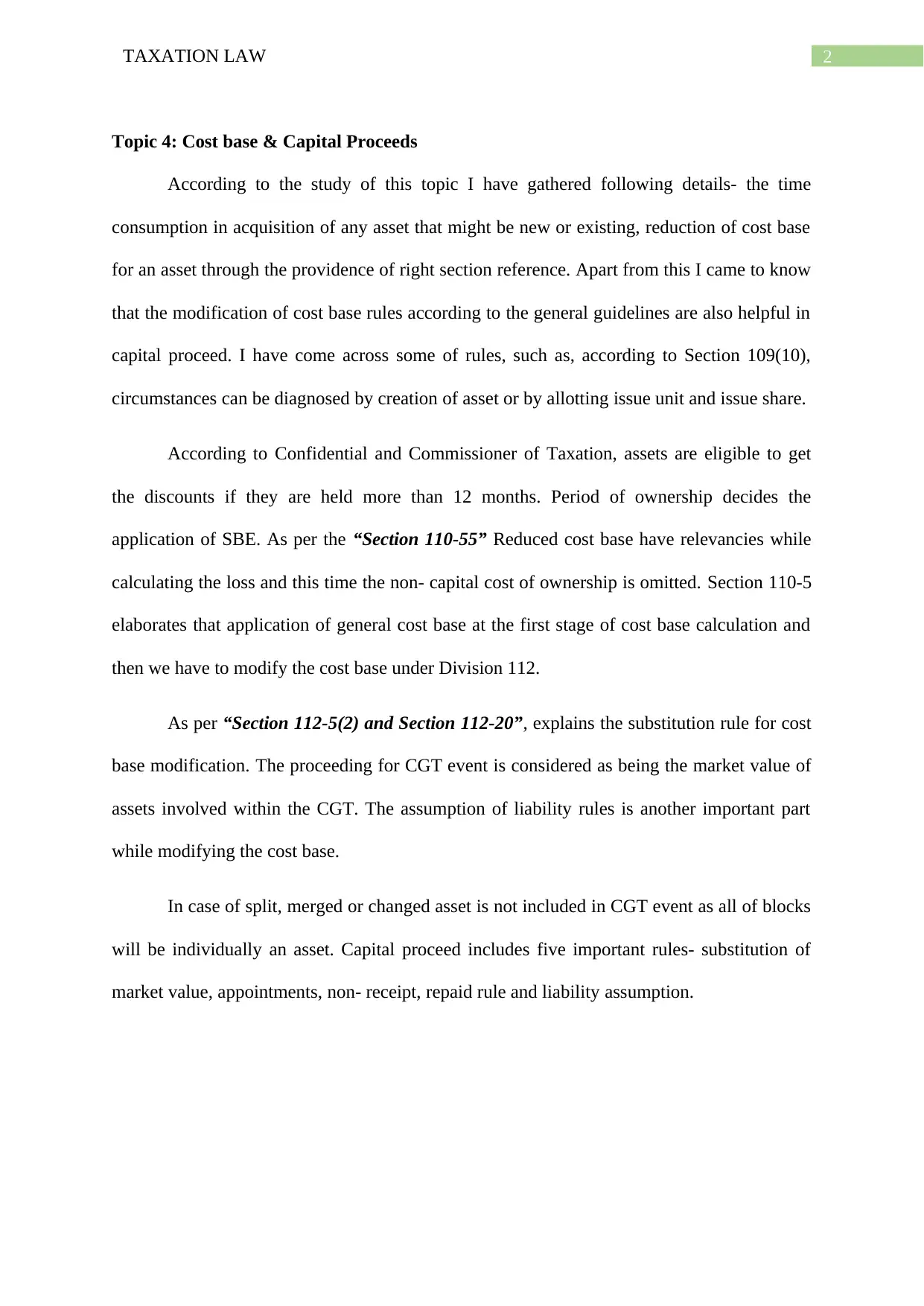
Topic 4: Cost base & Capital Proceeds
According to the study of this topic I have gathered following details- the time
consumption in acquisition of any asset that might be new or existing, reduction of cost base
for an asset through the providence of right section reference. Apart from this I came to know
that the modification of cost base rules according to the general guidelines are also helpful in
capital proceed. I have come across some of rules, such as, according to Section 109(10),
circumstances can be diagnosed by creation of asset or by allotting issue unit and issue share.
According to Confidential and Commissioner of Taxation, assets are eligible to get
the discounts if they are held more than 12 months. Period of ownership decides the
application of SBE. As per the “Section 110-55” Reduced cost base have relevancies while
calculating the loss and this time the non- capital cost of ownership is omitted. Section 110-5
elaborates that application of general cost base at the first stage of cost base calculation and
then we have to modify the cost base under Division 112.
As per “Section 112-5(2) and Section 112-20”, explains the substitution rule for cost
base modification. The proceeding for CGT event is considered as being the market value of
assets involved within the CGT. The assumption of liability rules is another important part
while modifying the cost base.
In case of split, merged or changed asset is not included in CGT event as all of blocks
will be individually an asset. Capital proceed includes five important rules- substitution of
market value, appointments, non- receipt, repaid rule and liability assumption.
Document Page
3TAXATION LAW
Bibliography:
Kenny, P., Blissenden, M. and Villios, S. 2018. Australian Tax.
Woellner, R., Barkoczy, S., Murphy, S., Evans, C. and Pinto, D. 2018. Australian taxation
law 2018.
chevron_up_icon
1 out of 4
circle_padding
hide_on_mobile
zoom_out_icon
[object Object]