Taxation Law Assignment: Income, Deductions, and Tax Liability

Verified

Added on  2022/08/17

|10
|2219
|18
Homework Assignment
AI Summary
This taxation law assignment analyzes a taxpayer's income, deductions, and tax liabilities based on the provided case study. The assignment addresses key issues, including the taxability of salary, work-related benefits, and rental income, as well as the deductibility of various expenses. It examines relevant sections of the Income Tax Assessment Act 1936 (ITAA 1936) and Income Tax Assessment Act 1997 (ITAA 1997), such as those concerning ordinary income, allowable deductions, fringe benefits tax, and capital gains tax. The solution applies these rules to the taxpayer's specific circumstances, including employment income, home office expenses, membership fees, travel expenses, rental income, and the sale of collectables, ultimately calculating the taxpayer's total income tax liability. The assignment also covers the Fringe Benefits Tax Assessment Act 1986 (FBTAA), detailing the tax on fringe benefits for employers and employees. The analysis provides a comprehensive understanding of the tax implications of various income sources and expenses, and provides a step-by-step approach to calculate net capital gains.
Document Page
Running head: TAXATION LAW
Taxation Law
Name of the Student
Name of the University
Authors Note
Course ID
tabler-icon-diamond-filled.svg

Paraphrase This Document

Need a fresh take? Get an instant paraphrase of this document with our AI Paraphraser
Document Page
1TAXATION LAW
Table of Contents
Heading:.....................................................................................................................................2
Issues:.........................................................................................................................................2
Rule:...........................................................................................................................................2
Application:................................................................................................................................5
Conclusion:................................................................................................................................8
References:.................................................................................................................................9
Document Page
2TAXATION LAW
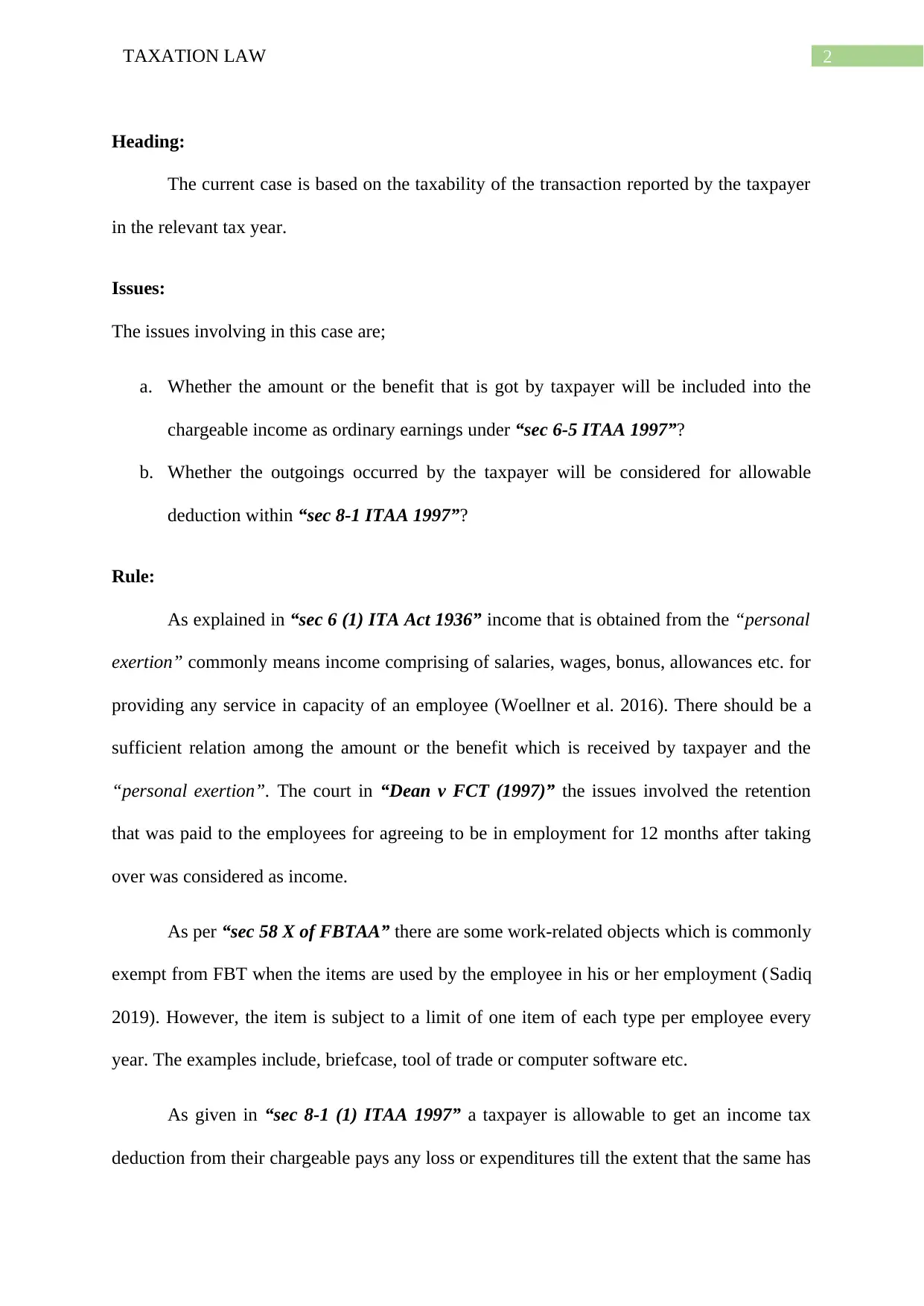
Heading:
The current case is based on the taxability of the transaction reported by the taxpayer
in the relevant tax year.
Issues:
The issues involving in this case are;
a. Whether the amount or the benefit that is got by taxpayer will be included into the
chargeable income as ordinary earnings under “sec 6-5 ITAA 1997”?
b. Whether the outgoings occurred by the taxpayer will be considered for allowable
deduction within “sec 8-1 ITAA 1997”?
Rule:
As explained in “sec 6 (1) ITA Act 1936” income that is obtained from the “personal
exertion” commonly means income comprising of salaries, wages, bonus, allowances etc. for
providing any service in capacity of an employee (Woellner et al. 2016). There should be a
sufficient relation among the amount or the benefit which is received by taxpayer and the
“personal exertion”. The court in “Dean v FCT (1997)” the issues involved the retention
that was paid to the employees for agreeing to be in employment for 12 months after taking
over was considered as income.
As per “sec 58 X of FBTAA” there are some work-related objects which is commonly
exempt from FBT when the items are used by the employee in his or her employment (Sadiq
2019). However, the item is subject to a limit of one item of each type per employee every
year. The examples include, briefcase, tool of trade or computer software etc.
As given in “sec 8-1 (1) ITAA 1997” a taxpayer is allowable to get an income tax
deduction from their chargeable pays any loss or expenditures till the extent that the same has
Document Page
3TAXATION LAW
happened in making the assessable earnings or has essentially happened in conducting the
business with the purpose of making income (Barkoczy 2016). Despite the fact, the
“negative limbs” of “sec 8-1(2)” articulates that no deduction is permissible to taxpayer
when it is found that the outgoings has occurred towards “capital, private or domestic in
nature”.
Within the “taxation ruling of TR 93/30” when a taxpayer uses home as the place of
business then an applicable share of “occupancy and running” outgoing is permissible for
income tax deduction under “sec 8-1”. The taxpayers are allowed deduction for work-related
percentage of heating and electricity (Freudenberg et al. 2017). Furthermore, the taxpayer is
also allowed to claim deduction for the price of objects namely desks, shelves that is used for
the purpose of work. While “sec 26-55” says that payments that is made by the taxpayer for
trade, commercial or expert association is permissible for deduction.
A self-education expenses is permitted for deduction when the outgoings hold
adequate relation with the income making happenings of the taxpayer. Self-education
outgoing is normally allowed for deduction where the outgoing has happened for retaining or
increasing the skill of taxpayer in the job in which they are presently working, predominantly
where the outgoing has happened to improve the future earning prospect of the taxpayer. The
decision made in “FCT v Anstis (2010)” self-education outgoing that has happened by the
taxpayer is potentially allowed for deduction when the receipt of income is based on the
condition that the recipient is making a satisfactory progress in education (Morgan, Mortimer
and Pinto 2018). The examples of outgoings include course fees, books, stationary etc.
As per the common rule of “sec 8-1 ITAA 1997”, where it is found that the taxpayer
has occurred outgoing for travel purpose relating to ordinary home and regular place of work,
no deduction is permitted to taxpayer in this case. While a deduction for “work travel” may
tabler-icon-diamond-filled.svg

Paraphrase This Document

Need a fresh take? Get an instant paraphrase of this document with our AI Paraphraser
Document Page
4TAXATION LAW
be considered under “sec 25-100” if the outgoing is occurred between work places (Payne
2018). Commonly, deduction for travel expenses is permitted to travelling salesman, self-
employed builder that is travelling to give quotes. As noted in “FCT v Weiner (1978)”
deduction was allowed to taxpayer for travelling between place of work as travelling was
itinerant part of the taxpayer’s employment.
The taxpayers are also required to understand that no deduction is allowed for
conventional clothing within “sec 8-1 ITAA 1997”. These outgoing are referred as day-to-
day living outgoing and not related to derivation of income (Lam and Whitney 2016). In
“FCT v Mansfield (1996)” the law court stated that ordinary articles of cloth are not
permitted for deduction notwithstanding of whether such kind of outgoing is suitable for
maintaining appearance.
Receiving of rent is treated as “ordinary incomes” under “sec 6-5 ITAA 1997”. In
“Adelaide Fruit and Produce Exchange Co Ltd v FCT (1932)”, rent is viewed as the price
which is paid by the taxpayer as the right for making use of another person’s property (Robin
and Barkoczy 2020). The rental income is contained within the chargeable pay of the
taxpayer while the expenses incurred on renting the property will be allowable for deduction
under “sec 8-1”.
As per “sec 25-10” a deduction is permitted only for outgoings that happens for
repairs to buildings or the depreciating asset mainly used by the taxpayer for producing
income. The court in “Lurcott v Wakely & Wheeler (1911)” repairs normally comprises of
restoration or replacement of subsidiary parts as whole (Schenk 2017). A repair normally
involves the restoration of the portion of some income generating property. It hardly involves
the replacement of asset completely instead of subsidiary portion or component.
Document Page
5TAXATION LAW
As explained in “sec 108-15 ITAA 1997” set of collectables that is owned as a set
will also be disposed as a set. The set of collectable is normally viewed as set and each sale
would form the part of that collectable.
Application:
As evident Meg has received a salary of $90,000 from his employment with Creative
Co Ltd. Under the “sec 6 (1) ITAA 1936” the salary is income from “personal exertion”.
Mentioning to “Dean v FCT (1997)” the amount is an income and chargeable inside
“ordinary concept” of “sec 6-5 ITAA 1997”.
Creative Co provided Meg with leather briefcase and set of professional design tool.
Creative Co Ltd can obtain exemption from FBT under “sec 58 X of FBTAA” for providing
Meg with a work related tool during her employment. While Meg reports that she has not
been provided with an office and uses 20% of the floor area of her home for her design work.
In the relevant tax year Meg occurred interest on loan of $30,000 for her house and $3,000
for insurance of home. Quoting “Swinford v FCT (1984)” Meg will be permitted deduction
under “sec 8-1 ITAA 1997” for both the occupancy and running expenses relating to interest
and premium up to 20% of the floor area which was used for her design work (Feld 2016).
The expenses relate to home-office purpose for Meg. While the expenses occurred on phone
and internet is related to her work and will be acceptable for tax deduction under “sec 8-1
ITAA 1997”.
Meg also paid a sum of $700 for membership fees and subscription of interior design
journals. Under “sec 26-55” Meg can obtain deduction for the aforementioned expenses as it
is related to her profession and income producing activities. While Meg under the “sec 40-25
(1)” is permitted to claim the deduction for “decline in value” of new design equipment and
can instantly write-off the expenses occurred for home office lamp.
Document Page
6TAXATION LAW
Later Ben enrolled in MBA program and occurred expenses on course fees and
textbooks. Referring to “FCT v Anstis (2010)” the self-education outgoing that is occurred
by Meg relating to course fees and books is potentially permissible for deduction under “sec
8-1 ITAA 1997” since it is related to improving the skill of taxpayer in which she is currently
employed and also to improve her future prospect of getting promotion and earning income.
Meg occasionally incurs travels expenses of $4,000 to client premises for giving on-
site advice. Citing “FCT v Weiner (1978)” the travel expenditures is allowed for deduction
for the reason that it is “work travel” and relates to her income producing activity (Bankman
et al. 2018). While the expenditures occurred by Meg for “all black” clothing is not allowed
for deduction under the “sec 8-1 ITAA 1997”. Stating “FCT v Mansfield (1996)” the
expenses has happened on ordinary dress articles and it is not permissible for deduction
regardless of whether such type of outgoing is vital for Meg to maintain a appropriate
appearance.
Meg also received rental income during the year. citing “Adelaide Fruit and Produce
Exchange Co Ltd v FCT (1932)” the rental income of $25,000 received by Meg is an
ordinary income which will attract tax liability under “sec 6-5” while the annual expenses
incurred on property is a permissible deduction under “sec 8-1”. She also occurs expenses of
$10,000 for repairing the hole in pool lining (Buenker 2018). The repair was carried out by
her brother who charged $10,000 while the market rate is $3,000. Mentioning “Lurcott v
Wakely & Wheeler (1911)” Meg is permitted to claim deduction for repairs under “sec 25-
10” since the work involved restoration of the part of income generating property.
Finally, Meg reported the sale of antique bedroom furniture, 2 bed side tables and a
chest of drawers. These items are classified as collectables under “sec 108-10 (2)”. Referring
to “sec 108-15 ITAA 1997” Meg should dispose the collectables as a set because it was
tabler-icon-diamond-filled.svg

Paraphrase This Document

Need a fresh take? Get an instant paraphrase of this document with our AI Paraphraser
Document Page
7TAXATION LAW
purchased by her as a set. The capital gains made will be considered taxable as statutory
income under “sec 102-5 ITAA 1997”.
Document Page
8TAXATION LAW
Conclusion:
Conclusively, Meg will be required to pay taxes on income associated to his personal
exertion and rental income as they are chargeable under ordinary meaning of “sec 6-5 ITAA
1997”. The total income tax liability payable during the year stands 10,464.
Document Page
9TAXATION LAW
References:
Bankman, J., Shaviro, D.N., Stark, K.J. and Kleinbard, E.D., 2018. Federal Income Taxation.
Aspen Publishers.
Barkoczy, S., 2016. Foundations of Taxation Law 2016. OUP Catalogue.
Buenker, J.D., 2018. The Income Tax and the Progressive Era. Routledge.
Feld, A., 2016. Federal Taxation of State Tax Credits.
Freudenberg, B., Chardon, T., Brimble, M. and Isle, M.B., 2017. Tax literacy of Australian
small businesses. J. Austl. Tax'n, 19, p.21.
Lam, D. and Whitney, A., 2016. Taxation and property: Practical aspects of the new foreign
resident CGT witholding tax. LSJ: Law Society of NSW Journal, (21), p.84.
Morgan, A., Mortimer, C. and Pinto, D., 2018. A practical introduction to Australian
taxation law 2018. Oxford University Press.
Payne, K., 2018. Taxation: Fix it up or trade up?. Company Director, 34(6), p.52.
Robin and Barkoczy Woellner (Stephen & Murphy, Shirley Et Al.), 2020. Australian
Taxation Law 2020. Oxford University Press.
Sadiq, K., 2019. Australian Taxation Law Cases 2019. Thomson Reuters.
Schenk, D.H., 2017. Federal Taxation of S Corporations. Law Journal Press.
Woellner, R., Barkoczy, S., Murphy, S., Evans, C. and Pinto, D., 2016. Australian Taxation
Law 2016. OUP Catalogue.
chevron_up_icon
1 out of 10
circle_padding
hide_on_mobile
zoom_out_icon
[object Object]