Taxation Law: Analyzing Property Sale and Tax Implications - NSW
VerifiedAdded on 2023/06/03
|9
|1982
|425
Case Study
AI Summary
This case study examines the taxation implications for Rob Joseph, owner of Joseph & Sons, concerning potential property sales. It analyzes two options: selling the land to a developer versus subdividing and selling individual lots. The analysis considers relevant sections of the ITAA 1997, taxation rulings, and case law such as McCorkell v FC of T and FC of T v Whitfords Beach Pty Ltd, to determine whether profits from either scenario would be classified as assessable income or capital gains. The study concludes that selling to a developer would likely be considered a capital gain, while subdividing and selling would be treated as income due to the business-like nature of the activity. Desklib provides a platform to access similar case studies and solved assignments for students.
Running head: TAXATION LAW
Taxation Law
Name of the Student
Name of the University
Authors Note
Course ID
Taxation Law
Name of the Student
Name of the University
Authors Note
Course ID
Paraphrase This Document
Need a fresh take? Get an instant paraphrase of this document with our AI Paraphraser

1TAXATION LAW
Table of Contents
Answer to question 1:.................................................................................................................2
Answer to Option 1:...............................................................................................................2
Answer to Option 2:...............................................................................................................4
References:.................................................................................................................................7
Table of Contents
Answer to question 1:.................................................................................................................2
Answer to Option 1:...............................................................................................................2
Answer to Option 2:...............................................................................................................4
References:.................................................................................................................................7

2TAXATION LAW
Answer to question 1:
Answer to Option 1:
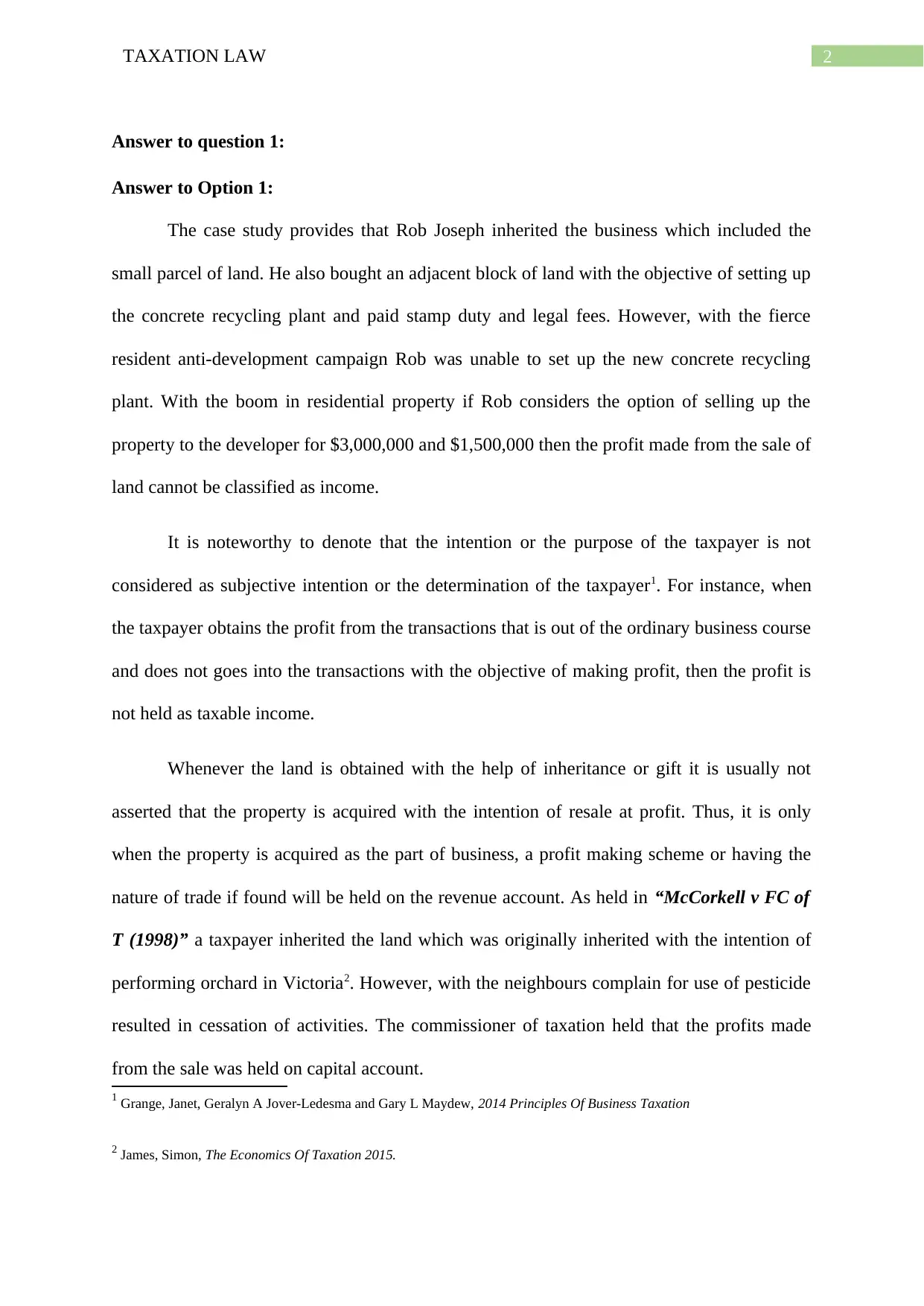
The case study provides that Rob Joseph inherited the business which included the
small parcel of land. He also bought an adjacent block of land with the objective of setting up
the concrete recycling plant and paid stamp duty and legal fees. However, with the fierce
resident anti-development campaign Rob was unable to set up the new concrete recycling
plant. With the boom in residential property if Rob considers the option of selling up the
property to the developer for $3,000,000 and $1,500,000 then the profit made from the sale of
land cannot be classified as income.
It is noteworthy to denote that the intention or the purpose of the taxpayer is not
considered as subjective intention or the determination of the taxpayer1. For instance, when
the taxpayer obtains the profit from the transactions that is out of the ordinary business course
and does not goes into the transactions with the objective of making profit, then the profit is
not held as taxable income.
Whenever the land is obtained with the help of inheritance or gift it is usually not
asserted that the property is acquired with the intention of resale at profit. Thus, it is only
when the property is acquired as the part of business, a profit making scheme or having the
nature of trade if found will be held on the revenue account. As held in “McCorkell v FC of
T (1998)” a taxpayer inherited the land which was originally inherited with the intention of
performing orchard in Victoria2. However, with the neighbours complain for use of pesticide
resulted in cessation of activities. The commissioner of taxation held that the profits made
from the sale was held on capital account.
1 Grange, Janet, Geralyn A Jover-Ledesma and Gary L Maydew, 2014 Principles Of Business Taxation
2 James, Simon, The Economics Of Taxation 2015.
Answer to question 1:
Answer to Option 1:
The case study provides that Rob Joseph inherited the business which included the
small parcel of land. He also bought an adjacent block of land with the objective of setting up
the concrete recycling plant and paid stamp duty and legal fees. However, with the fierce
resident anti-development campaign Rob was unable to set up the new concrete recycling
plant. With the boom in residential property if Rob considers the option of selling up the
property to the developer for $3,000,000 and $1,500,000 then the profit made from the sale of
land cannot be classified as income.
It is noteworthy to denote that the intention or the purpose of the taxpayer is not
considered as subjective intention or the determination of the taxpayer1. For instance, when
the taxpayer obtains the profit from the transactions that is out of the ordinary business course
and does not goes into the transactions with the objective of making profit, then the profit is
not held as taxable income.
Whenever the land is obtained with the help of inheritance or gift it is usually not
asserted that the property is acquired with the intention of resale at profit. Thus, it is only
when the property is acquired as the part of business, a profit making scheme or having the
nature of trade if found will be held on the revenue account. As held in “McCorkell v FC of
T (1998)” a taxpayer inherited the land which was originally inherited with the intention of
performing orchard in Victoria2. However, with the neighbours complain for use of pesticide
resulted in cessation of activities. The commissioner of taxation held that the profits made
from the sale was held on capital account.
1 Grange, Janet, Geralyn A Jover-Ledesma and Gary L Maydew, 2014 Principles Of Business Taxation
2 James, Simon, The Economics Of Taxation 2015.
⊘ This is a preview!⊘
Do you want full access?
Subscribe today to unlock all pages.

Trusted by 1+ million students worldwide

3TAXATION LAW
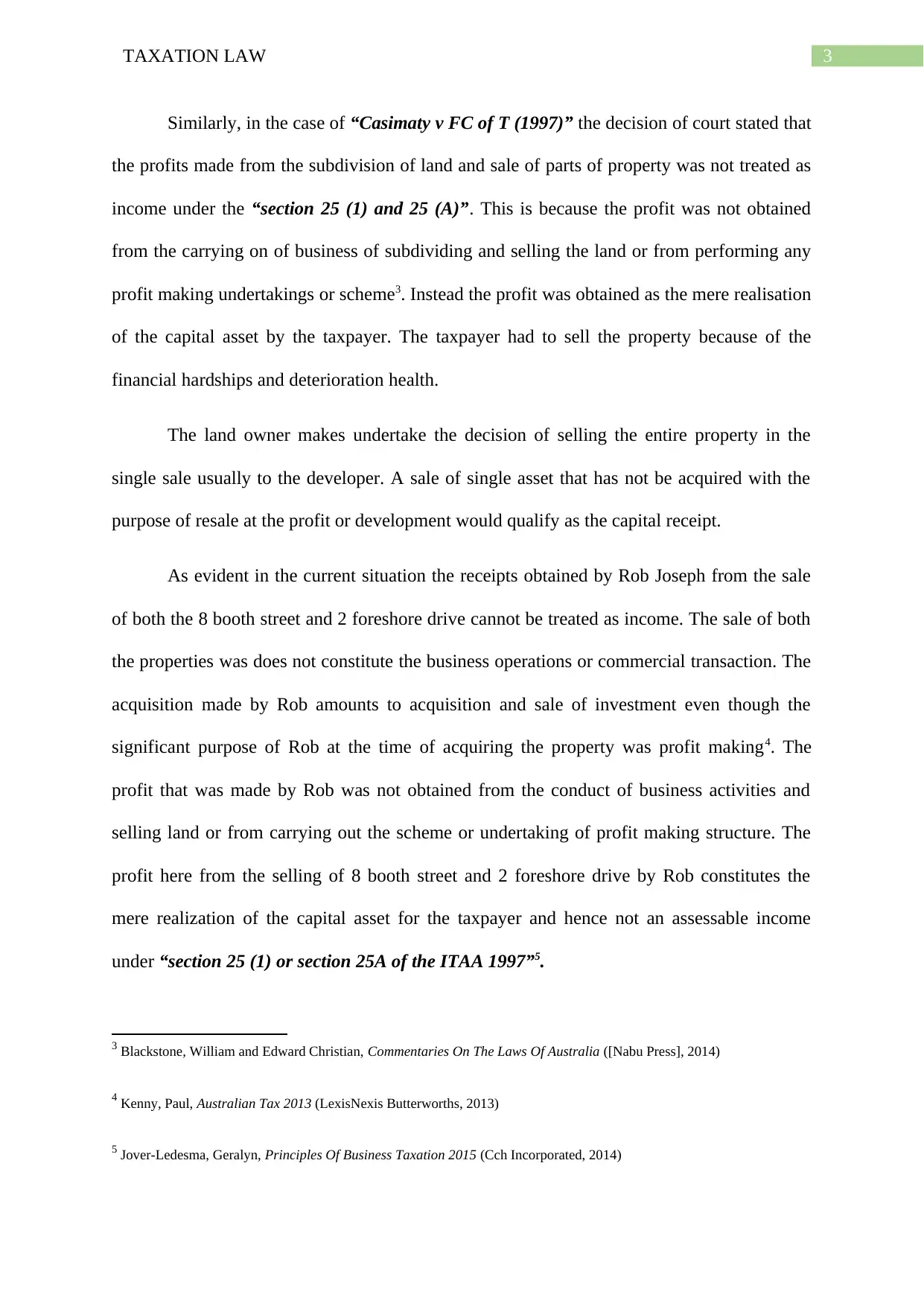
Similarly, in the case of “Casimaty v FC of T (1997)” the decision of court stated that
the profits made from the subdivision of land and sale of parts of property was not treated as
income under the “section 25 (1) and 25 (A)”. This is because the profit was not obtained
from the carrying on of business of subdividing and selling the land or from performing any
profit making undertakings or scheme3. Instead the profit was obtained as the mere realisation
of the capital asset by the taxpayer. The taxpayer had to sell the property because of the
financial hardships and deterioration health.
The land owner makes undertake the decision of selling the entire property in the
single sale usually to the developer. A sale of single asset that has not be acquired with the
purpose of resale at the profit or development would qualify as the capital receipt.
As evident in the current situation the receipts obtained by Rob Joseph from the sale
of both the 8 booth street and 2 foreshore drive cannot be treated as income. The sale of both
the properties was does not constitute the business operations or commercial transaction. The
acquisition made by Rob amounts to acquisition and sale of investment even though the
significant purpose of Rob at the time of acquiring the property was profit making4. The
profit that was made by Rob was not obtained from the conduct of business activities and
selling land or from carrying out the scheme or undertaking of profit making structure. The
profit here from the selling of 8 booth street and 2 foreshore drive by Rob constitutes the
mere realization of the capital asset for the taxpayer and hence not an assessable income
under “section 25 (1) or section 25A of the ITAA 1997”5.
3 Blackstone, William and Edward Christian, Commentaries On The Laws Of Australia ([Nabu Press], 2014)
4 Kenny, Paul, Australian Tax 2013 (LexisNexis Butterworths, 2013)
5 Jover-Ledesma, Geralyn, Principles Of Business Taxation 2015 (Cch Incorporated, 2014)
Similarly, in the case of “Casimaty v FC of T (1997)” the decision of court stated that
the profits made from the subdivision of land and sale of parts of property was not treated as
income under the “section 25 (1) and 25 (A)”. This is because the profit was not obtained
from the carrying on of business of subdividing and selling the land or from performing any
profit making undertakings or scheme3. Instead the profit was obtained as the mere realisation
of the capital asset by the taxpayer. The taxpayer had to sell the property because of the
financial hardships and deterioration health.
The land owner makes undertake the decision of selling the entire property in the
single sale usually to the developer. A sale of single asset that has not be acquired with the
purpose of resale at the profit or development would qualify as the capital receipt.
As evident in the current situation the receipts obtained by Rob Joseph from the sale
of both the 8 booth street and 2 foreshore drive cannot be treated as income. The sale of both
the properties was does not constitute the business operations or commercial transaction. The
acquisition made by Rob amounts to acquisition and sale of investment even though the
significant purpose of Rob at the time of acquiring the property was profit making4. The
profit that was made by Rob was not obtained from the conduct of business activities and
selling land or from carrying out the scheme or undertaking of profit making structure. The
profit here from the selling of 8 booth street and 2 foreshore drive by Rob constitutes the
mere realization of the capital asset for the taxpayer and hence not an assessable income
under “section 25 (1) or section 25A of the ITAA 1997”5.
3 Blackstone, William and Edward Christian, Commentaries On The Laws Of Australia ([Nabu Press], 2014)
4 Kenny, Paul, Australian Tax 2013 (LexisNexis Butterworths, 2013)
5 Jover-Ledesma, Geralyn, Principles Of Business Taxation 2015 (Cch Incorporated, 2014)
Paraphrase This Document
Need a fresh take? Get an instant paraphrase of this document with our AI Paraphraser

4TAXATION LAW
Answer to Option 2:
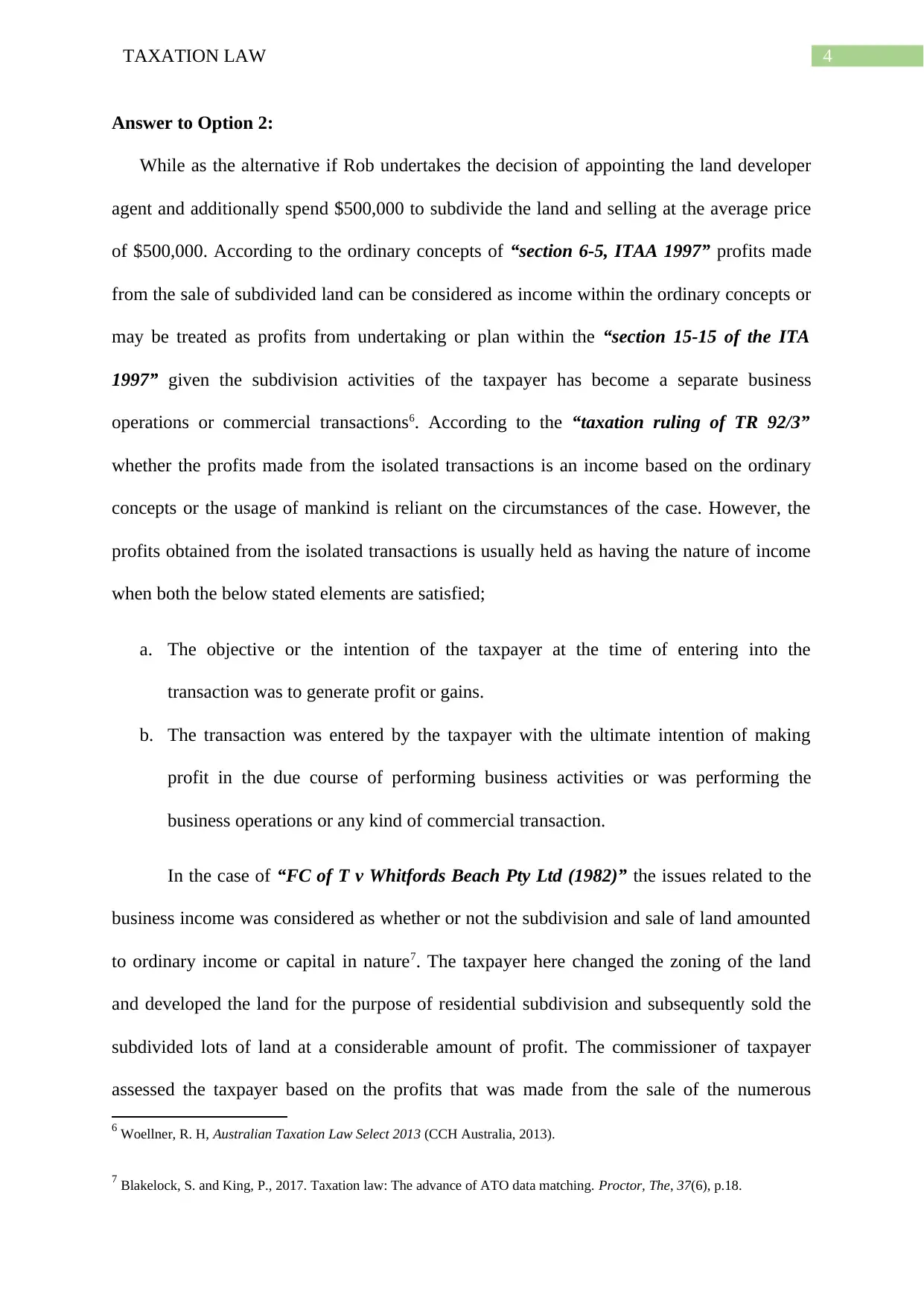
While as the alternative if Rob undertakes the decision of appointing the land developer
agent and additionally spend $500,000 to subdivide the land and selling at the average price
of $500,000. According to the ordinary concepts of “section 6-5, ITAA 1997” profits made
from the sale of subdivided land can be considered as income within the ordinary concepts or
may be treated as profits from undertaking or plan within the “section 15-15 of the ITA
1997” given the subdivision activities of the taxpayer has become a separate business
operations or commercial transactions6. According to the “taxation ruling of TR 92/3”
whether the profits made from the isolated transactions is an income based on the ordinary
concepts or the usage of mankind is reliant on the circumstances of the case. However, the
profits obtained from the isolated transactions is usually held as having the nature of income
when both the below stated elements are satisfied;
a. The objective or the intention of the taxpayer at the time of entering into the
transaction was to generate profit or gains.
b. The transaction was entered by the taxpayer with the ultimate intention of making
profit in the due course of performing business activities or was performing the
business operations or any kind of commercial transaction.
In the case of “FC of T v Whitfords Beach Pty Ltd (1982)” the issues related to the
business income was considered as whether or not the subdivision and sale of land amounted
to ordinary income or capital in nature7. The taxpayer here changed the zoning of the land
and developed the land for the purpose of residential subdivision and subsequently sold the
subdivided lots of land at a considerable amount of profit. The commissioner of taxpayer
assessed the taxpayer based on the profits that was made from the sale of the numerous
6 Woellner, R. H, Australian Taxation Law Select 2013 (CCH Australia, 2013).
7 Blakelock, S. and King, P., 2017. Taxation law: The advance of ATO data matching. Proctor, The, 37(6), p.18.
Answer to Option 2:
While as the alternative if Rob undertakes the decision of appointing the land developer
agent and additionally spend $500,000 to subdivide the land and selling at the average price
of $500,000. According to the ordinary concepts of “section 6-5, ITAA 1997” profits made
from the sale of subdivided land can be considered as income within the ordinary concepts or
may be treated as profits from undertaking or plan within the “section 15-15 of the ITA
1997” given the subdivision activities of the taxpayer has become a separate business
operations or commercial transactions6. According to the “taxation ruling of TR 92/3”
whether the profits made from the isolated transactions is an income based on the ordinary
concepts or the usage of mankind is reliant on the circumstances of the case. However, the
profits obtained from the isolated transactions is usually held as having the nature of income
when both the below stated elements are satisfied;
a. The objective or the intention of the taxpayer at the time of entering into the
transaction was to generate profit or gains.
b. The transaction was entered by the taxpayer with the ultimate intention of making
profit in the due course of performing business activities or was performing the
business operations or any kind of commercial transaction.
In the case of “FC of T v Whitfords Beach Pty Ltd (1982)” the issues related to the
business income was considered as whether or not the subdivision and sale of land amounted
to ordinary income or capital in nature7. The taxpayer here changed the zoning of the land
and developed the land for the purpose of residential subdivision and subsequently sold the
subdivided lots of land at a considerable amount of profit. The commissioner of taxpayer
assessed the taxpayer based on the profits that was made from the sale of the numerous
6 Woellner, R. H, Australian Taxation Law Select 2013 (CCH Australia, 2013).
7 Blakelock, S. and King, P., 2017. Taxation law: The advance of ATO data matching. Proctor, The, 37(6), p.18.

5TAXATION LAW
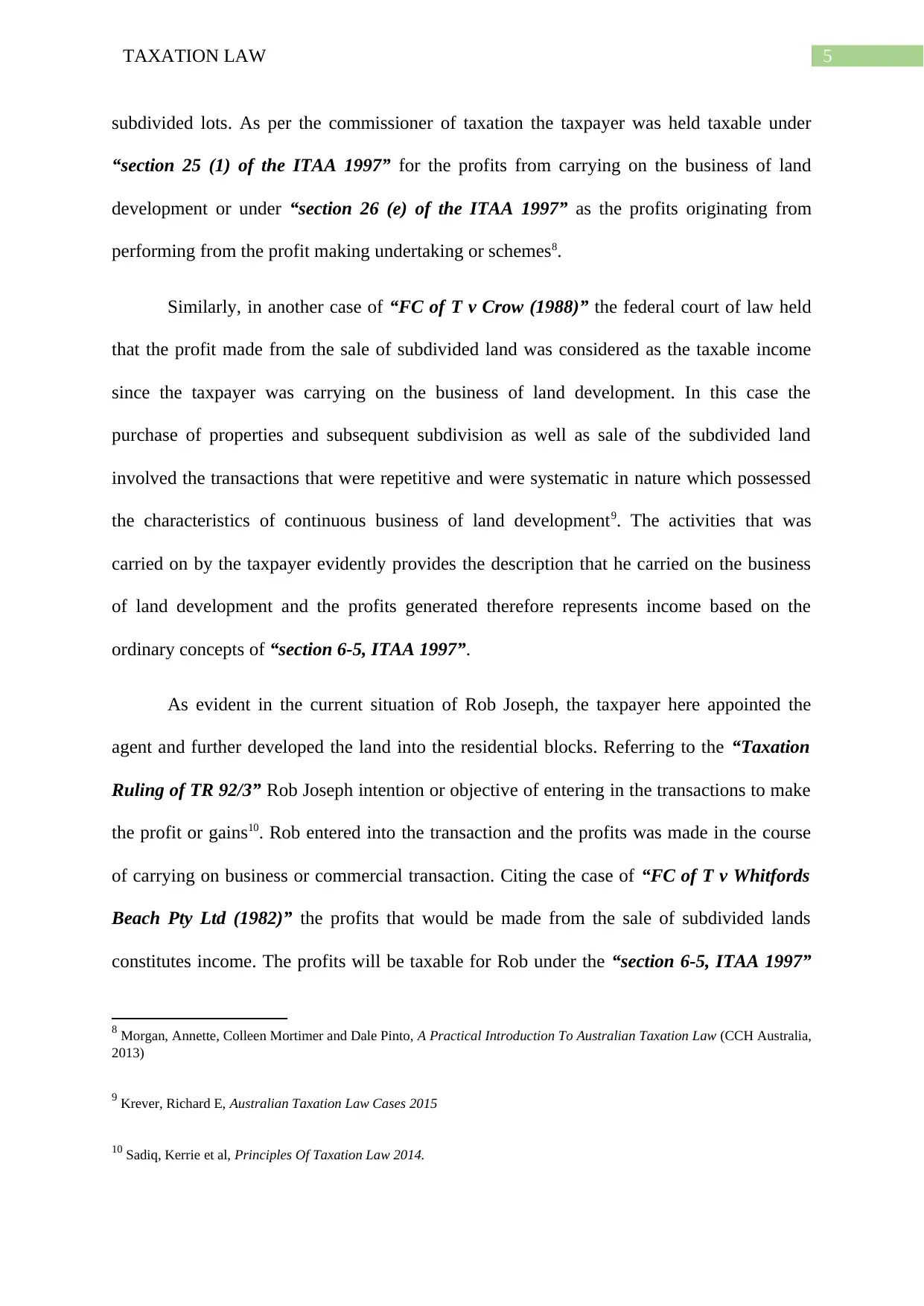
subdivided lots. As per the commissioner of taxation the taxpayer was held taxable under
“section 25 (1) of the ITAA 1997” for the profits from carrying on the business of land
development or under “section 26 (e) of the ITAA 1997” as the profits originating from
performing from the profit making undertaking or schemes8.
Similarly, in another case of “FC of T v Crow (1988)” the federal court of law held
that the profit made from the sale of subdivided land was considered as the taxable income
since the taxpayer was carrying on the business of land development. In this case the
purchase of properties and subsequent subdivision as well as sale of the subdivided land
involved the transactions that were repetitive and were systematic in nature which possessed
the characteristics of continuous business of land development9. The activities that was
carried on by the taxpayer evidently provides the description that he carried on the business
of land development and the profits generated therefore represents income based on the
ordinary concepts of “section 6-5, ITAA 1997”.
As evident in the current situation of Rob Joseph, the taxpayer here appointed the
agent and further developed the land into the residential blocks. Referring to the “Taxation
Ruling of TR 92/3” Rob Joseph intention or objective of entering in the transactions to make
the profit or gains10. Rob entered into the transaction and the profits was made in the course
of carrying on business or commercial transaction. Citing the case of “FC of T v Whitfords
Beach Pty Ltd (1982)” the profits that would be made from the sale of subdivided lands
constitutes income. The profits will be taxable for Rob under the “section 6-5, ITAA 1997”
8 Morgan, Annette, Colleen Mortimer and Dale Pinto, A Practical Introduction To Australian Taxation Law (CCH Australia,
2013)
9 Krever, Richard E, Australian Taxation Law Cases 2015
10 Sadiq, Kerrie et al, Principles Of Taxation Law 2014.
subdivided lots. As per the commissioner of taxation the taxpayer was held taxable under
“section 25 (1) of the ITAA 1997” for the profits from carrying on the business of land
development or under “section 26 (e) of the ITAA 1997” as the profits originating from
performing from the profit making undertaking or schemes8.
Similarly, in another case of “FC of T v Crow (1988)” the federal court of law held
that the profit made from the sale of subdivided land was considered as the taxable income
since the taxpayer was carrying on the business of land development. In this case the
purchase of properties and subsequent subdivision as well as sale of the subdivided land
involved the transactions that were repetitive and were systematic in nature which possessed
the characteristics of continuous business of land development9. The activities that was
carried on by the taxpayer evidently provides the description that he carried on the business
of land development and the profits generated therefore represents income based on the
ordinary concepts of “section 6-5, ITAA 1997”.
As evident in the current situation of Rob Joseph, the taxpayer here appointed the
agent and further developed the land into the residential blocks. Referring to the “Taxation
Ruling of TR 92/3” Rob Joseph intention or objective of entering in the transactions to make
the profit or gains10. Rob entered into the transaction and the profits was made in the course
of carrying on business or commercial transaction. Citing the case of “FC of T v Whitfords
Beach Pty Ltd (1982)” the profits that would be made from the sale of subdivided lands
constitutes income. The profits will be taxable for Rob under the “section 6-5, ITAA 1997”
8 Morgan, Annette, Colleen Mortimer and Dale Pinto, A Practical Introduction To Australian Taxation Law (CCH Australia,
2013)
9 Krever, Richard E, Australian Taxation Law Cases 2015
10 Sadiq, Kerrie et al, Principles Of Taxation Law 2014.
⊘ This is a preview!⊘
Do you want full access?
Subscribe today to unlock all pages.

Trusted by 1+ million students worldwide

6TAXATION LAW
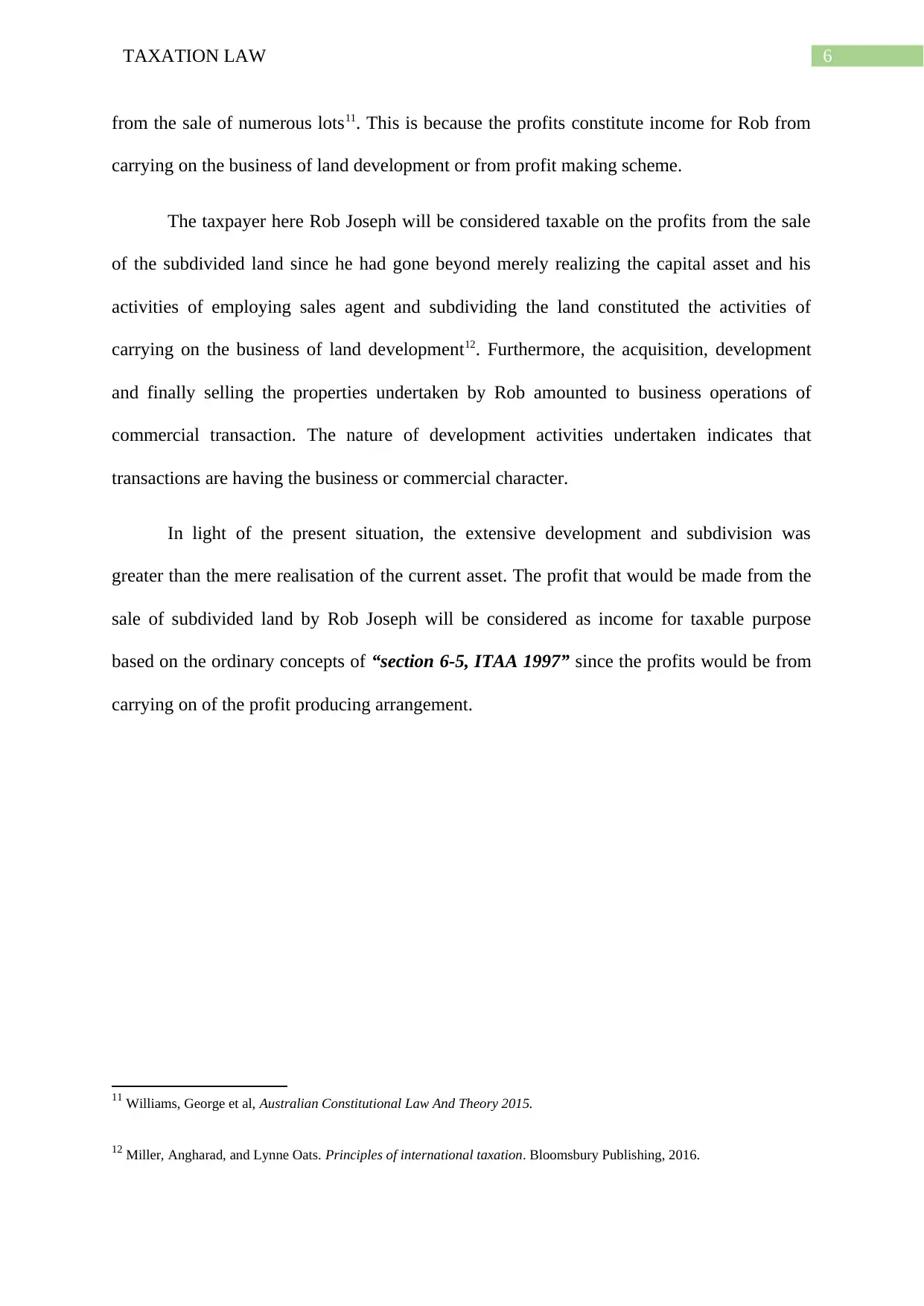
from the sale of numerous lots11. This is because the profits constitute income for Rob from
carrying on the business of land development or from profit making scheme.
The taxpayer here Rob Joseph will be considered taxable on the profits from the sale
of the subdivided land since he had gone beyond merely realizing the capital asset and his
activities of employing sales agent and subdividing the land constituted the activities of
carrying on the business of land development12. Furthermore, the acquisition, development
and finally selling the properties undertaken by Rob amounted to business operations of
commercial transaction. The nature of development activities undertaken indicates that
transactions are having the business or commercial character.
In light of the present situation, the extensive development and subdivision was
greater than the mere realisation of the current asset. The profit that would be made from the
sale of subdivided land by Rob Joseph will be considered as income for taxable purpose
based on the ordinary concepts of “section 6-5, ITAA 1997” since the profits would be from
carrying on of the profit producing arrangement.
11 Williams, George et al, Australian Constitutional Law And Theory 2015.
12 Miller, Angharad, and Lynne Oats. Principles of international taxation. Bloomsbury Publishing, 2016.
from the sale of numerous lots11. This is because the profits constitute income for Rob from
carrying on the business of land development or from profit making scheme.
The taxpayer here Rob Joseph will be considered taxable on the profits from the sale
of the subdivided land since he had gone beyond merely realizing the capital asset and his
activities of employing sales agent and subdividing the land constituted the activities of
carrying on the business of land development12. Furthermore, the acquisition, development
and finally selling the properties undertaken by Rob amounted to business operations of
commercial transaction. The nature of development activities undertaken indicates that
transactions are having the business or commercial character.
In light of the present situation, the extensive development and subdivision was
greater than the mere realisation of the current asset. The profit that would be made from the
sale of subdivided land by Rob Joseph will be considered as income for taxable purpose
based on the ordinary concepts of “section 6-5, ITAA 1997” since the profits would be from
carrying on of the profit producing arrangement.
11 Williams, George et al, Australian Constitutional Law And Theory 2015.
12 Miller, Angharad, and Lynne Oats. Principles of international taxation. Bloomsbury Publishing, 2016.
Paraphrase This Document
Need a fresh take? Get an instant paraphrase of this document with our AI Paraphraser

7TAXATION LAW
References:
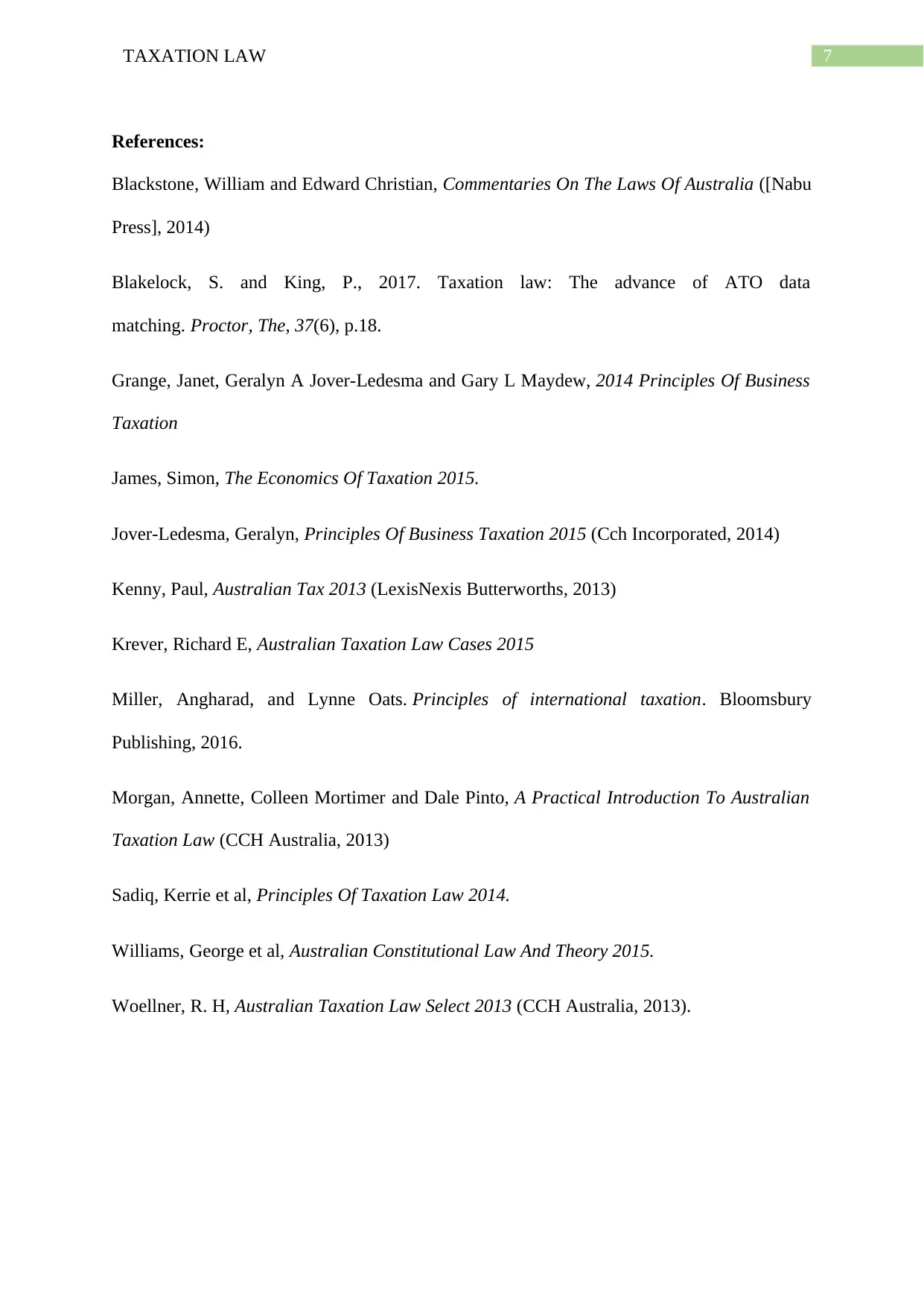
Blackstone, William and Edward Christian, Commentaries On The Laws Of Australia ([Nabu
Press], 2014)
Blakelock, S. and King, P., 2017. Taxation law: The advance of ATO data
matching. Proctor, The, 37(6), p.18.
Grange, Janet, Geralyn A Jover-Ledesma and Gary L Maydew, 2014 Principles Of Business
Taxation
James, Simon, The Economics Of Taxation 2015.
Jover-Ledesma, Geralyn, Principles Of Business Taxation 2015 (Cch Incorporated, 2014)
Kenny, Paul, Australian Tax 2013 (LexisNexis Butterworths, 2013)
Krever, Richard E, Australian Taxation Law Cases 2015
Miller, Angharad, and Lynne Oats. Principles of international taxation. Bloomsbury
Publishing, 2016.
Morgan, Annette, Colleen Mortimer and Dale Pinto, A Practical Introduction To Australian
Taxation Law (CCH Australia, 2013)
Sadiq, Kerrie et al, Principles Of Taxation Law 2014.
Williams, George et al, Australian Constitutional Law And Theory 2015.
Woellner, R. H, Australian Taxation Law Select 2013 (CCH Australia, 2013).
References:
Blackstone, William and Edward Christian, Commentaries On The Laws Of Australia ([Nabu
Press], 2014)
Blakelock, S. and King, P., 2017. Taxation law: The advance of ATO data
matching. Proctor, The, 37(6), p.18.
Grange, Janet, Geralyn A Jover-Ledesma and Gary L Maydew, 2014 Principles Of Business
Taxation
James, Simon, The Economics Of Taxation 2015.
Jover-Ledesma, Geralyn, Principles Of Business Taxation 2015 (Cch Incorporated, 2014)
Kenny, Paul, Australian Tax 2013 (LexisNexis Butterworths, 2013)
Krever, Richard E, Australian Taxation Law Cases 2015
Miller, Angharad, and Lynne Oats. Principles of international taxation. Bloomsbury
Publishing, 2016.
Morgan, Annette, Colleen Mortimer and Dale Pinto, A Practical Introduction To Australian
Taxation Law (CCH Australia, 2013)
Sadiq, Kerrie et al, Principles Of Taxation Law 2014.
Williams, George et al, Australian Constitutional Law And Theory 2015.
Woellner, R. H, Australian Taxation Law Select 2013 (CCH Australia, 2013).

8TAXATION LAW
⊘ This is a preview!⊘
Do you want full access?
Subscribe today to unlock all pages.

Trusted by 1+ million students worldwide
1 out of 9
Related Documents
Your All-in-One AI-Powered Toolkit for Academic Success.
+13062052269
info@desklib.com
Available 24*7 on WhatsApp / Email
Unlock your academic potential
Copyright © 2020–2026 A2Z Services. All Rights Reserved. Developed and managed by ZUCOL.