Taxation Law (HA3042) Tutorial Questions Assignment: Weeks 1-5

Verified

Added on  2023/01/11

|5
|1144
|100
Homework Assignment
AI Summary
This document provides solutions to a Taxation Law assignment, addressing tutorial questions from weeks 1 to 5. The solutions cover various aspects of taxation law, including the calculation of taxable income for an individual (Alex) and tax payable, the application of the New Business Tax System (Alienation of Personal Services Income) Act 2000 to a fitness consultant (Anna), capital gains tax implications for a musician (Alex) regarding the sale of a collectable gramophone, deductible rental expenses for a property investor (Sam), and capital allowances related to the disposal of machinery for a small business (John). Each solution outlines the relevant issues, rules, implementation, and conclusions, demonstrating an understanding of tax law principles and their practical application. The assignment assesses the student's ability to analyze and synthesize complex tax law issues and apply these principles to complex legal problems.
Document Page
Taxation Law
tabler-icon-diamond-filled.svg

Paraphrase This Document

Need a fresh take? Get an instant paraphrase of this document with our AI Paraphraser
Document Page
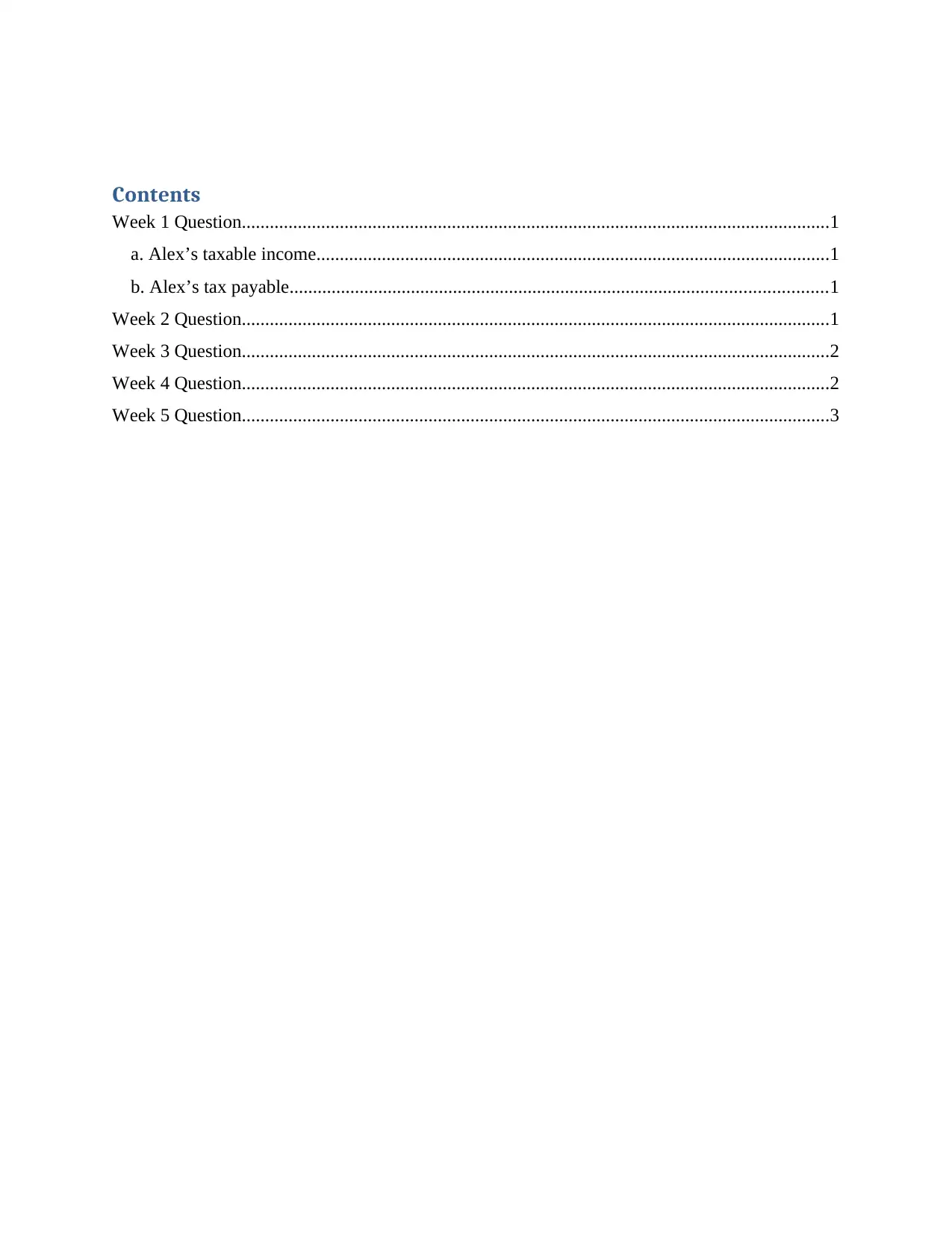
Contents
Week 1 Question..............................................................................................................................1
a. Alex’s taxable income..............................................................................................................1
b. Alex’s tax payable...................................................................................................................1
Week 2 Question..............................................................................................................................1
Week 3 Question..............................................................................................................................2
Week 4 Question..............................................................................................................................2
Week 5 Question..............................................................................................................................3
Document Page
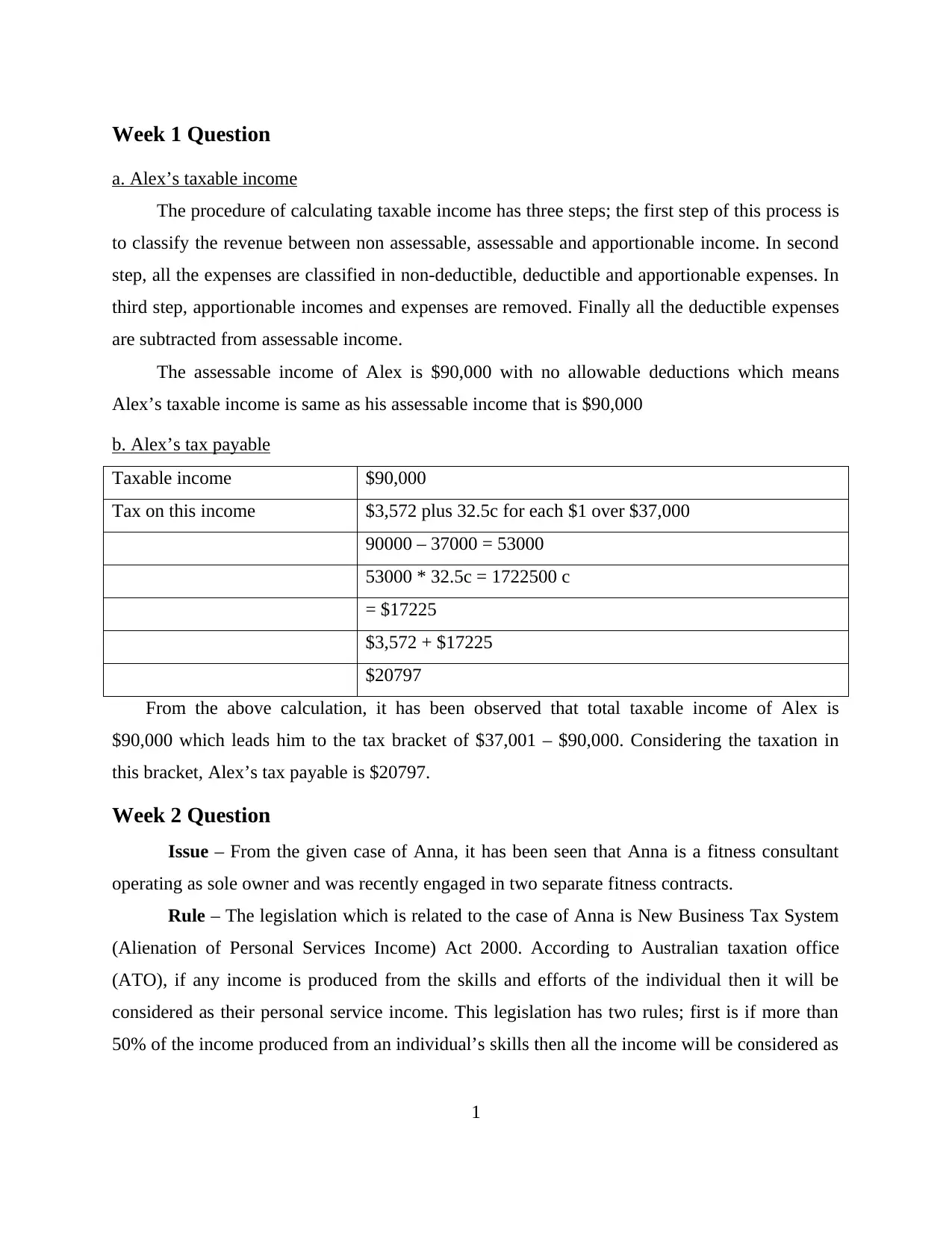
Week 1 Question
a. Alex’s taxable income
The procedure of calculating taxable income has three steps; the first step of this process is
to classify the revenue between non assessable, assessable and apportionable income. In second
step, all the expenses are classified in non-deductible, deductible and apportionable expenses. In
third step, apportionable incomes and expenses are removed. Finally all the deductible expenses
are subtracted from assessable income.
The assessable income of Alex is $90,000 with no allowable deductions which means
Alex’s taxable income is same as his assessable income that is $90,000
b. Alex’s tax payable
Taxable income $90,000
Tax on this income $3,572 plus 32.5c for each $1 over $37,000
90000 – 37000 = 53000
53000 * 32.5c = 1722500 c
= $17225
$3,572 + $17225
$20797
From the above calculation, it has been observed that total taxable income of Alex is
$90,000 which leads him to the tax bracket of $37,001 – $90,000. Considering the taxation in
this bracket, Alex’s tax payable is $20797.
Week 2 Question
Issue – From the given case of Anna, it has been seen that Anna is a fitness consultant
operating as sole owner and was recently engaged in two separate fitness contracts.
Rule – The legislation which is related to the case of Anna is New Business Tax System
(Alienation of Personal Services Income) Act 2000. According to Australian taxation office
(ATO), if any income is produced from the skills and efforts of the individual then it will be
considered as their personal service income. This legislation has two rules; first is if more than
50% of the income produced from an individual’s skills then all the income will be considered as
1
Document Page
PSI. And second rule is if less than 50% income is produced by individual’s skills then no part of
the total income can be considered as PSI.
Implementation – The first contract of Anna resulted in income of $1,000 including
$100 costs of training material. The income produced from Anna’s skills and efforts are $900
(1000-100) which is 90%. The second contract of Anna resulted again in $1000 income
including $200 costs for video recording material. From, it is implemented that the PSI of Anna
from her second contract is $800 which 80% of the total income.
Conclusion – From the above analysis, it has been concluded that in first and second
contract, the PSI of Anna was 90% and 80% which is above from 50% that implies the receipt of
both the contracts are Anna’s income from personal services.
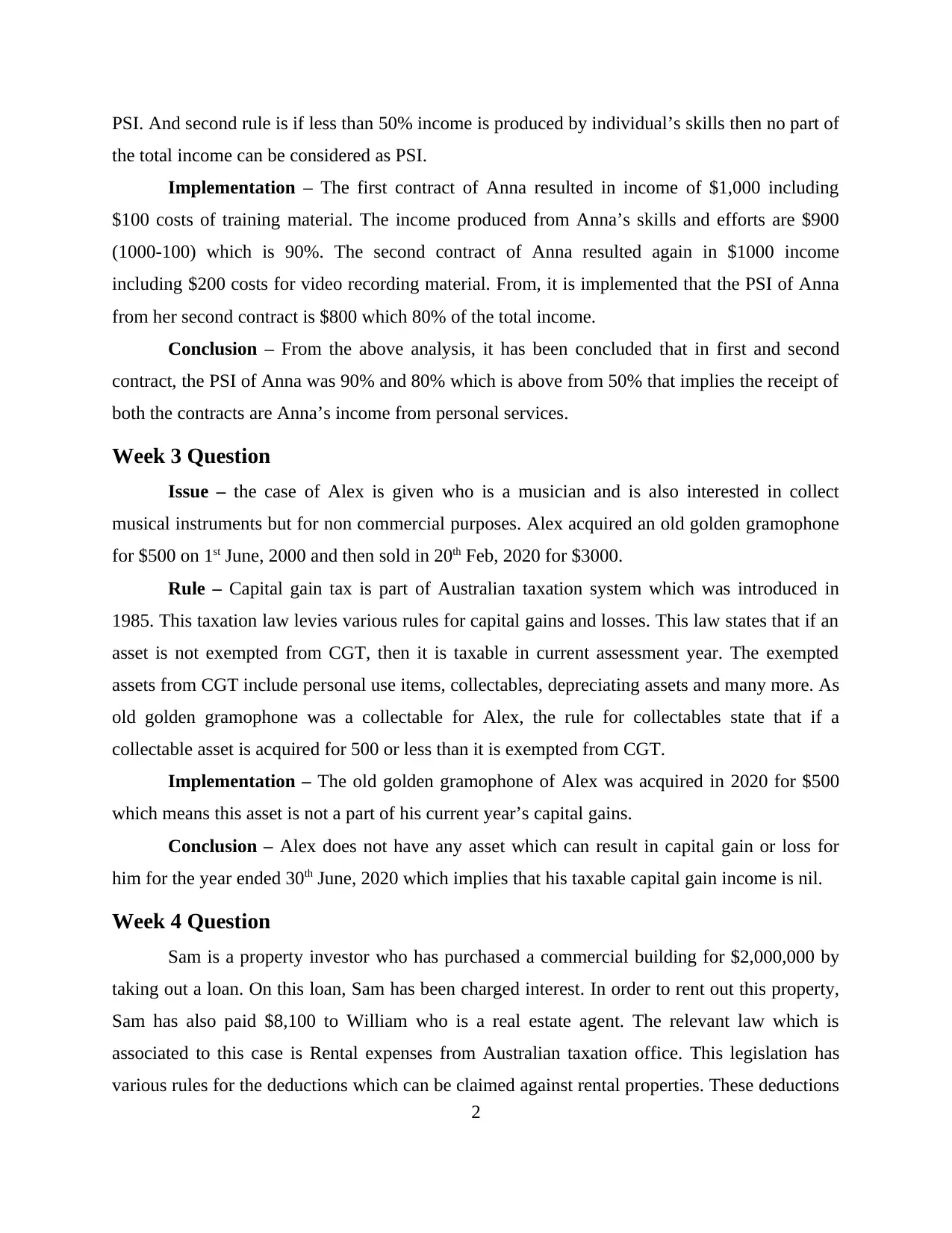
Week 3 Question
Issue – the case of Alex is given who is a musician and is also interested in collect
musical instruments but for non commercial purposes. Alex acquired an old golden gramophone
for $500 on 1st June, 2000 and then sold in 20th Feb, 2020 for $3000.
Rule – Capital gain tax is part of Australian taxation system which was introduced in
1985. This taxation law levies various rules for capital gains and losses. This law states that if an
asset is not exempted from CGT, then it is taxable in current assessment year. The exempted
assets from CGT include personal use items, collectables, depreciating assets and many more. As
old golden gramophone was a collectable for Alex, the rule for collectables state that if a
collectable asset is acquired for 500 or less than it is exempted from CGT.
Implementation – The old golden gramophone of Alex was acquired in 2020 for $500
which means this asset is not a part of his current year’s capital gains.
Conclusion – Alex does not have any asset which can result in capital gain or loss for
him for the year ended 30th June, 2020 which implies that his taxable capital gain income is nil.
Week 4 Question
Sam is a property investor who has purchased a commercial building for $2,000,000 by
taking out a loan. On this loan, Sam has been charged interest. In order to rent out this property,
Sam has also paid $8,100 to William who is a real estate agent. The relevant law which is
associated to this case is Rental expenses from Australian taxation office. This legislation has
various rules for the deductions which can be claimed against rental properties. These deductions
2
tabler-icon-diamond-filled.svg

Paraphrase This Document

Need a fresh take? Get an instant paraphrase of this document with our AI Paraphraser
Document Page
include advertising for tenants, council rates, water charges, cleaning, maintenance and repairs,
interest on loan expenses, insurance, legal expenses and property agent’s fees and commission.
The expenses incurred by Sam include loan interest and William’s management fees.
Both of these expenses are covered from the deduction list stated above. This means the total
amount of loan interest expense incurred by Sam is deductible along with $8,100 management
fees paid to William as agent’s commission.
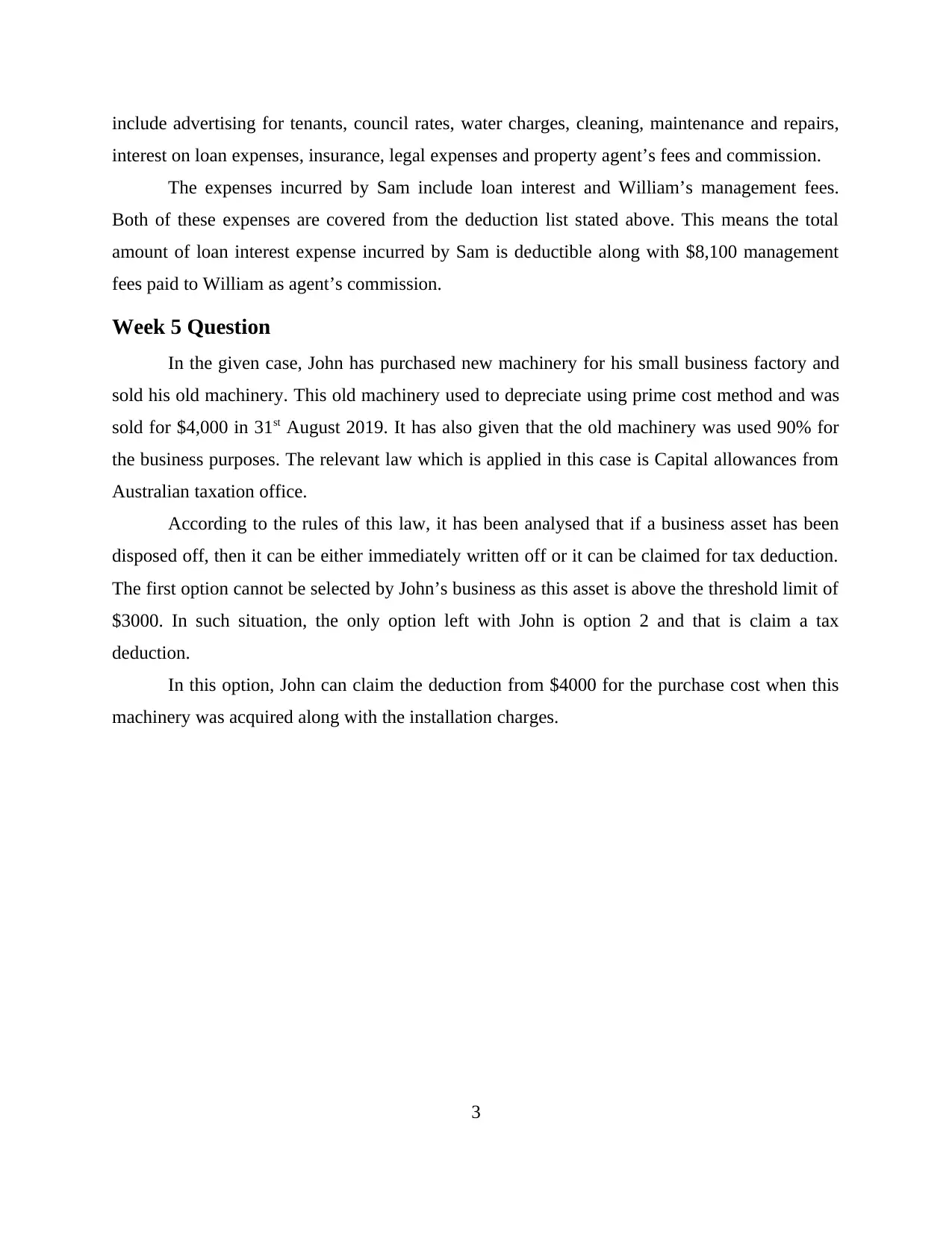
Week 5 Question
In the given case, John has purchased new machinery for his small business factory and
sold his old machinery. This old machinery used to depreciate using prime cost method and was
sold for $4,000 in 31st August 2019. It has also given that the old machinery was used 90% for
the business purposes. The relevant law which is applied in this case is Capital allowances from
Australian taxation office.
According to the rules of this law, it has been analysed that if a business asset has been
disposed off, then it can be either immediately written off or it can be claimed for tax deduction.
The first option cannot be selected by John’s business as this asset is above the threshold limit of
$3000. In such situation, the only option left with John is option 2 and that is claim a tax
deduction.
In this option, John can claim the deduction from $4000 for the purchase cost when this
machinery was acquired along with the installation charges.
3
chevron_up_icon
1 out of 5
circle_padding
hide_on_mobile
zoom_out_icon
[object Object]