Investigating the Effects of Price Control on the Taxi Market

Verified

Added on  2023/01/16

|2
|375
|30
Homework Assignment
AI Summary
This assignment examines the economic effects of price controls in the taxi market. It begins by analyzing the reduction in producer surplus due to decreased fares. The assignment then explores the inefficiencies associated with price controls, such as reduced supply and potential consumer issues. It concludes by providing a quantitative analysis using supply and demand functions, illustrating how a price ceiling can lead to a significant mismatch between supply and demand, ultimately resulting in a lower equilibrium quantity. The analysis highlights the negative consequences of price controls, affecting both producers and consumers. The assignment demonstrates a clear understanding of economic concepts like supply, demand, producer surplus, and market equilibrium in a real-world context.
Document Page
Question 1
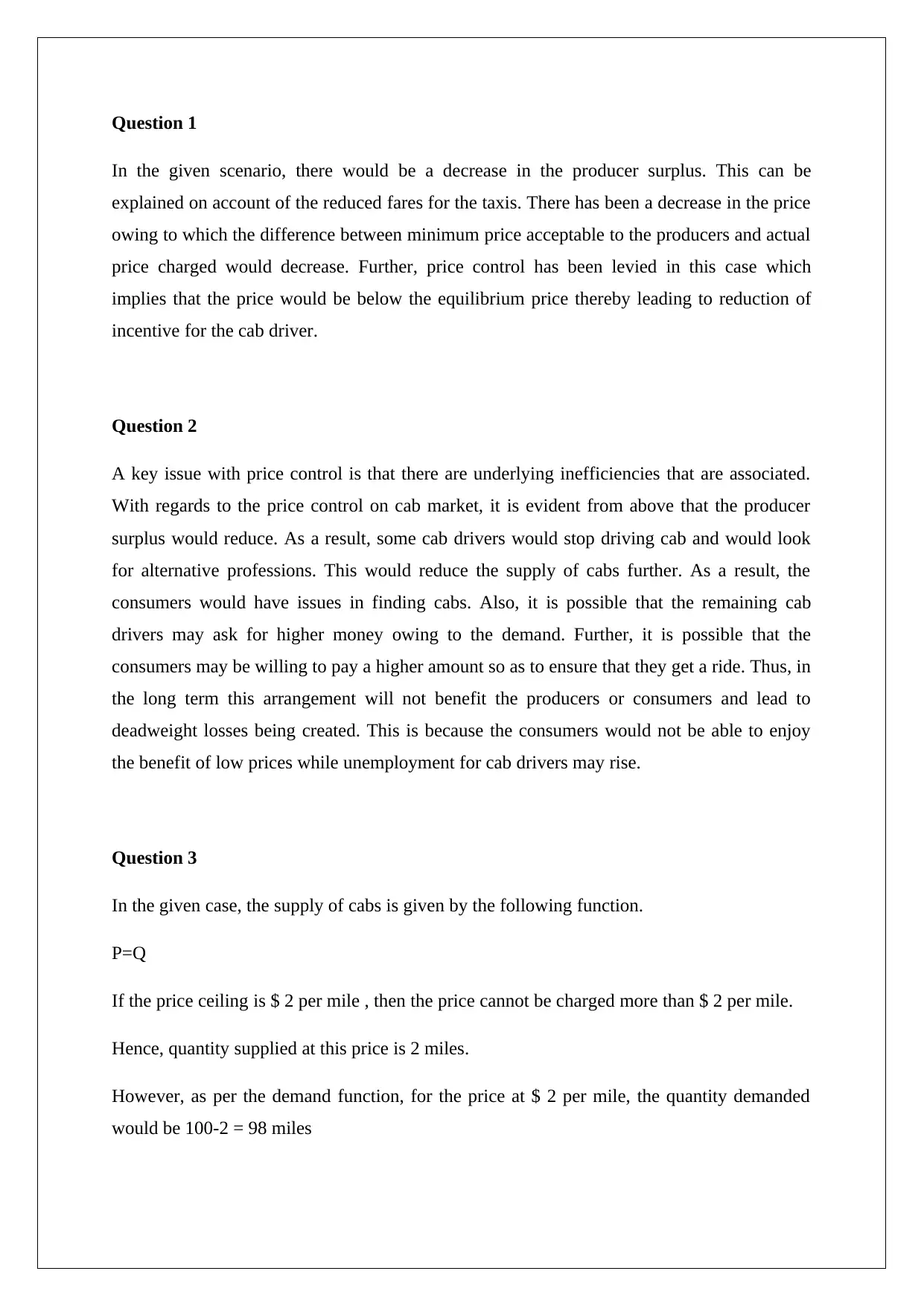
In the given scenario, there would be a decrease in the producer surplus. This can be
explained on account of the reduced fares for the taxis. There has been a decrease in the price
owing to which the difference between minimum price acceptable to the producers and actual
price charged would decrease. Further, price control has been levied in this case which
implies that the price would be below the equilibrium price thereby leading to reduction of
incentive for the cab driver.
Question 2
A key issue with price control is that there are underlying inefficiencies that are associated.
With regards to the price control on cab market, it is evident from above that the producer
surplus would reduce. As a result, some cab drivers would stop driving cab and would look
for alternative professions. This would reduce the supply of cabs further. As a result, the
consumers would have issues in finding cabs. Also, it is possible that the remaining cab
drivers may ask for higher money owing to the demand. Further, it is possible that the
consumers may be willing to pay a higher amount so as to ensure that they get a ride. Thus, in
the long term this arrangement will not benefit the producers or consumers and lead to
deadweight losses being created. This is because the consumers would not be able to enjoy
the benefit of low prices while unemployment for cab drivers may rise.
Question 3
In the given case, the supply of cabs is given by the following function.
P=Q
If the price ceiling is $ 2 per mile , then the price cannot be charged more than $ 2 per mile.
Hence, quantity supplied at this price is 2 miles.
However, as per the demand function, for the price at $ 2 per mile, the quantity demanded
would be 100-2 = 98 miles
tabler-icon-diamond-filled.svg

Paraphrase This Document

Need a fresh take? Get an instant paraphrase of this document with our AI Paraphraser
Document Page
Hence, significant amount of demand supply mismatch would be created by this price ceiling.
As a result, at equilibrium quantity driven at this price would be 2 miles.
chevron_up_icon
1 out of 2
circle_padding
hide_on_mobile
zoom_out_icon
[object Object]