Tax Law Assignment: Objection Form and Letter for Henry's Tax Case

Verified

Added on  2022/11/30

|6
|2011
|343
Homework Assignment
AI Summary
This assignment presents a tax objection case involving a taxpayer named Henry, who is objecting to an amended assessment by the Australian Taxation Office (ATO). The assignment includes a completed objection form detailing Henry's contact information, the decision being objected to, and the reasons for the objection. Henry argues that certain travel expenses, home office expenses, and loan interest should be deductible. The supporting arguments reference relevant sections of the Income Tax Assessment Act 1997 (ITAA 1997) and case law such as "Ure v Federal Commissioner of Taxation (1981)" and "Swinford v Federal Commissioner of Taxation (1984)" to support his claims. The assignment highlights the importance of providing supporting evidence and documentation, and it outlines the process for lodging the objection. The assignment also includes a letter format for communication with the Commissioner of Taxation and provides an overview of the objection process, emphasizing its complexity and the need for a strong legal foundation. The assignment also includes a marking guide that outlines the key elements of the assignment, including the use of the correct objection form, the correct statement of objection grounds, use of relevant legislation and cases, and the quality of the analysis and recommendations.
Document Page
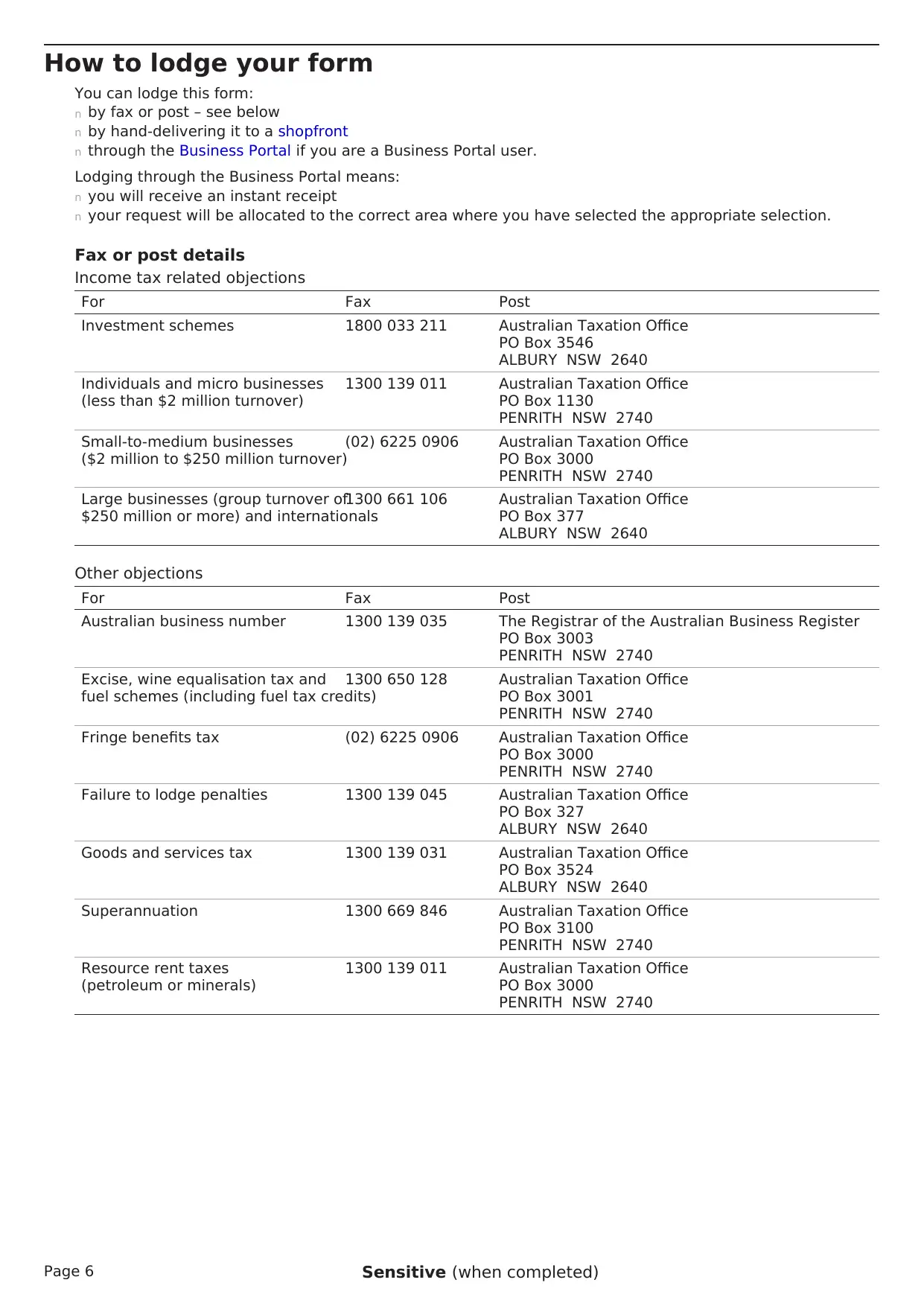
Page 1Sensitive (when completed)NAT 13471-09.2012
Objection form – for taxpayers
Use this form if you want to object to a decision we have made
about your tax affairs, or those of another taxpayer. If you are a
tax professional, use the Objection form – for tax professionals
(NAT 13044).
If you want to correct a mistake on a tax return you have
lodged, you should request an amendment.
For more information on lodging an objection,
refer to Dispute (object to) an ATO decision.
We are authorised by the Taxation Administration Act 1953 to
ask for the information on this form. We need this information
to help us administer the tax laws, primarily to decide your
objection. Where authorised by law to do so, we may give this
information to other government agencies. These agencies
could include assistance agencies such as Centrelink, the Chi
Support Agency, law enforcement agencies and the Australian
Bureau of Statistics.
Section A: Authorisation
1 Is this objection for you or another taxpayer?
Self
Do you have a signed declaration and authorisation from the individual or entity?Other
Yes
If you do not have written authorisation, we cannot consider this objection.No
Section B: Your details (or details of other person/entity the objection
3
We are authorised by the Taxation Administration Act 1953 to collect your tax file number (TFN).
You do not have to provide your tax file number or Australian business number but failure to provide
either may result in a delay in processing your objection.
Australian business number (ABN)Tax file number (TFN) OR
4 If you have engaged with the ATO on this matter previously, provide your reference number
2 Provide the full name of taxpayer
HENRY
tabler-icon-diamond-filled.svg

Paraphrase This Document

Need a fresh take? Get an instant paraphrase of this document with our AI Paraphraser
Document Page
Page 2 Sensitive (when completed)
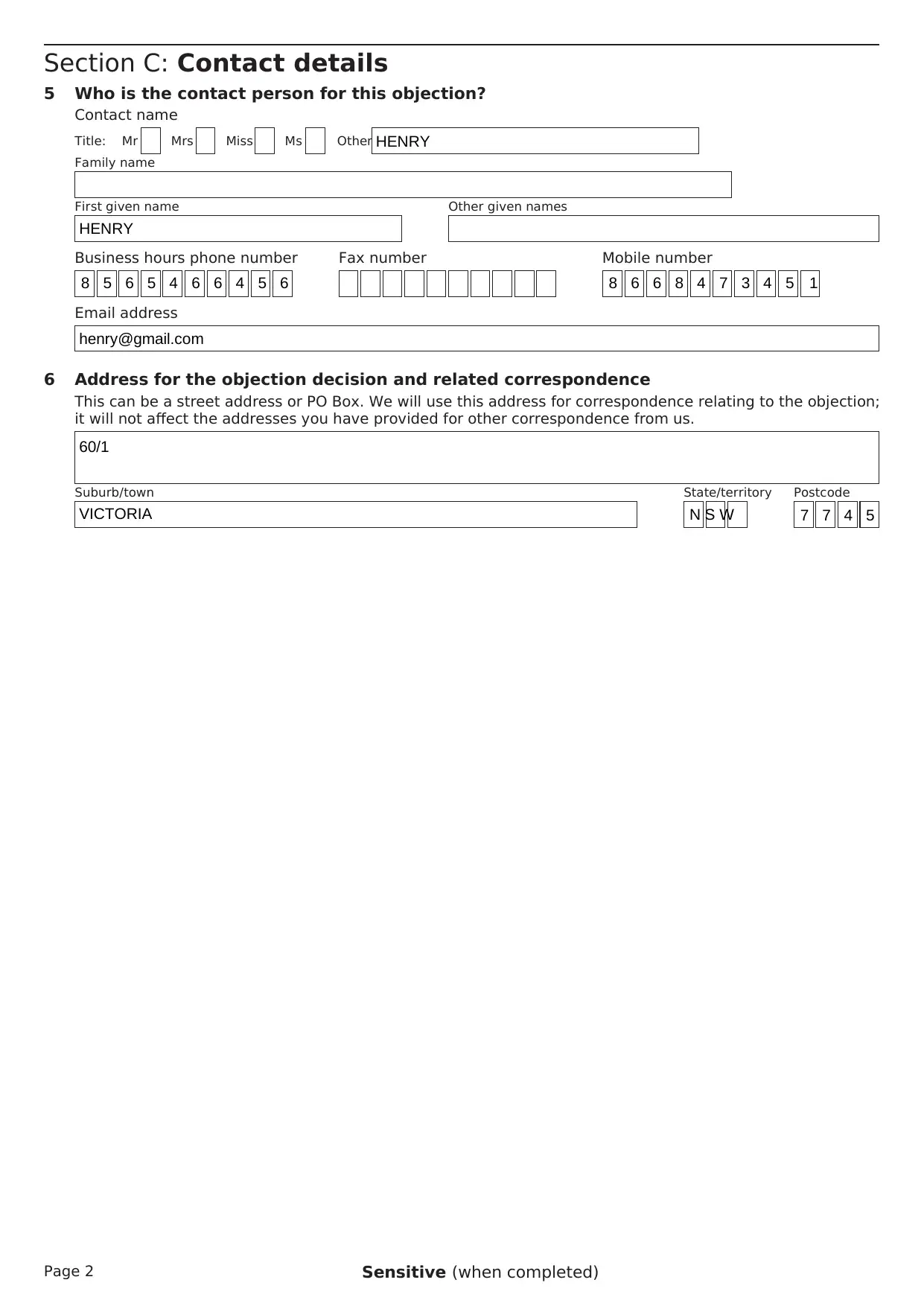
Section C: Contact details
5 Who is the contact person for this objection?
Email address
Fax numberBusiness hours phone number Mobile number
Contact name
Family name
First given name Other given names
Title: Mrs Miss Ms OtherMr
Suburb/town State/territory Postcode
6 Address for the objection decision and related correspondence
This can be a street address or PO Box. We will use this address for correspondence relating to the objection;
it will not affect the addresses you have provided for other correspondence from us.
HENRY
HENRY
8 5 6 5 4 6 6 4 5 6 8 6 6 8 4 7 3 4 5 1
henry@gmail.com
60/1
VICTORIA N S W 7 7 4 5
Document Page
Page 3Sensitive (when completed)
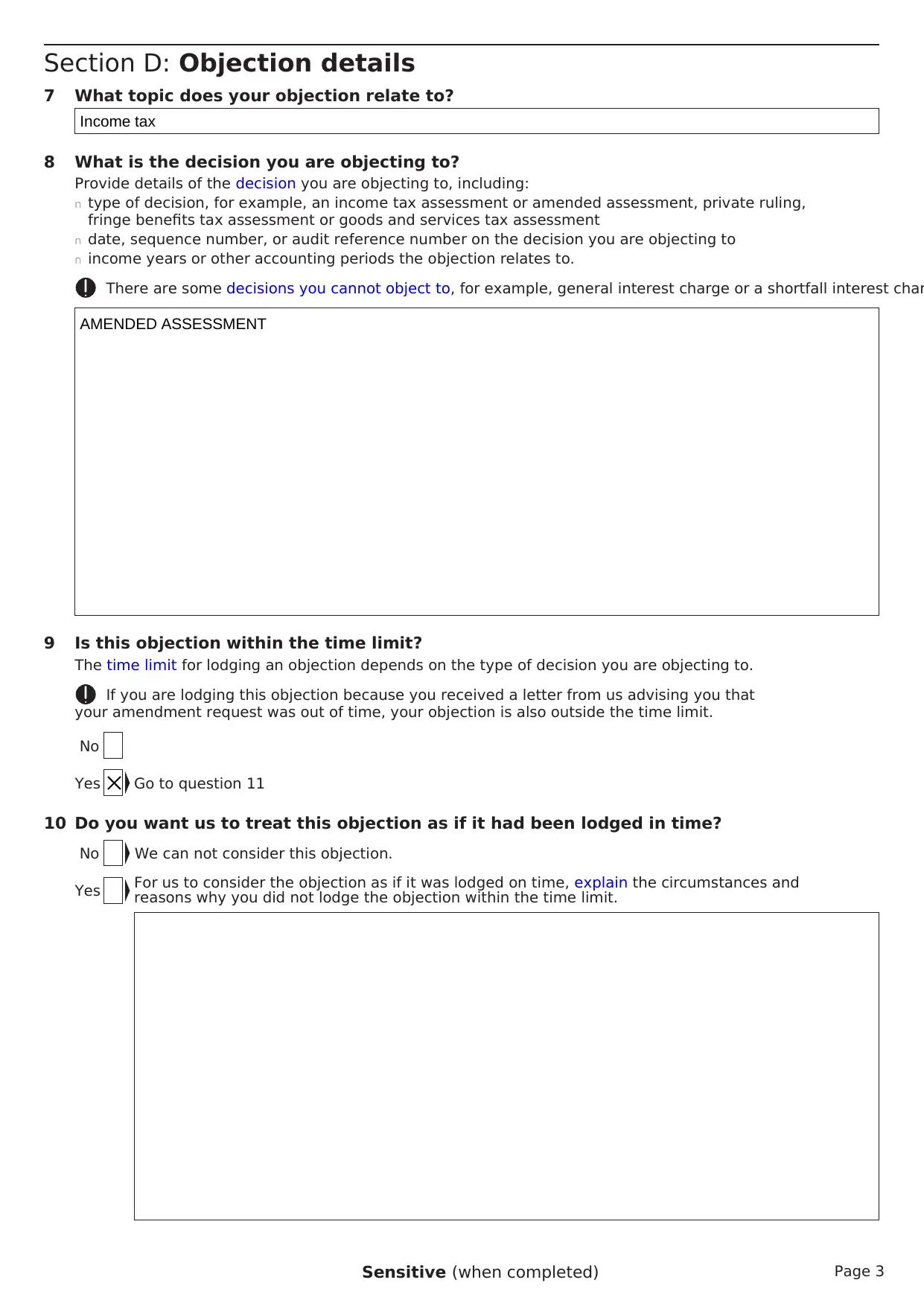
8 What is the decision you are objecting to?
Provide details of the decision you are objecting to, including:
n type of decision, for example, an income tax assessment or amended assessment, private ruling,
fringe benefits tax assessment or goods and services tax assessment
n date, sequence number, or audit reference number on the decision you are objecting to
n income years or other accounting periods the objection relates to.
There are some decisions you cannot object to, for example, general interest charge or a shortfall interest char
Section D: Objection details
7 What topic does your objection relate to?
9 Is this objection within the time limit?
The time limit for lodging an objection depends on the type of decision you are objecting to.
If you are lodging this objection because you received a letter from us advising you that
your amendment request was out of time, your objection is also outside the time limit.
Yes Go to question 11
No
10 Do you want us to treat this objection as if it had been lodged in time?
Yes For us to consider the objection as if it was lodged on time, explain the circumstances and
reasons why you did not lodge the objection within the time limit.
We can not consider this objection.No
Income tax
AMENDED ASSESSMENT
Document Page
Page 4 Sensitive (when completed)
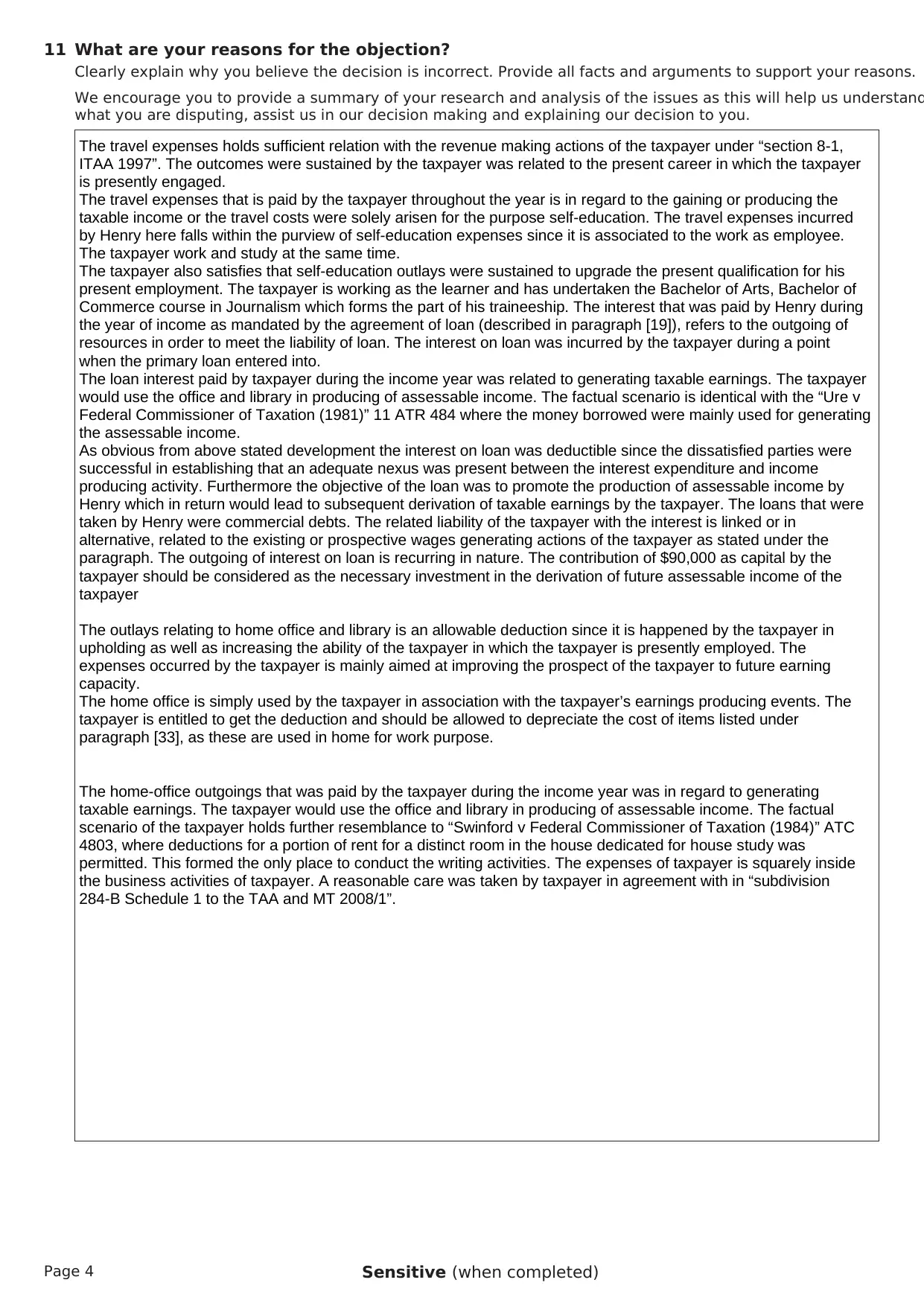
11 What are your reasons for the objection?
Clearly explain why you believe the decision is incorrect. Provide all facts and arguments to support your reasons.
We encourage you to provide a summary of your research and analysis of the issues as this will help us understand
what you are disputing, assist us in our decision making and explaining our decision to you.
The travel expenses holds sufficient relation with the revenue making actions of the taxpayer under “section 8-1,
ITAA 1997”. The outcomes were sustained by the taxpayer was related to the present career in which the taxpayer
is presently engaged.
The travel expenses that is paid by the taxpayer throughout the year is in regard to the gaining or producing the
taxable income or the travel costs were solely arisen for the purpose self-education. The travel expenses incurred
by Henry here falls within the purview of self-education expenses since it is associated to the work as employee.
The taxpayer work and study at the same time.
The taxpayer also satisfies that self-education outlays were sustained to upgrade the present qualification for his
present employment. The taxpayer is working as the learner and has undertaken the Bachelor of Arts, Bachelor of
Commerce course in Journalism which forms the part of his traineeship. The interest that was paid by Henry during
the year of income as mandated by the agreement of loan (described in paragraph [19]), refers to the outgoing of
resources in order to meet the liability of loan. The interest on loan was incurred by the taxpayer during a point
when the primary loan entered into.
The loan interest paid by taxpayer during the income year was related to generating taxable earnings. The taxpayer
would use the office and library in producing of assessable income. The factual scenario is identical with the “Ure v
Federal Commissioner of Taxation (1981)” 11 ATR 484 where the money borrowed were mainly used for generating
the assessable income.
As obvious from above stated development the interest on loan was deductible since the dissatisfied parties were
successful in establishing that an adequate nexus was present between the interest expenditure and income
producing activity. Furthermore the objective of the loan was to promote the production of assessable income by
Henry which in return would lead to subsequent derivation of taxable earnings by the taxpayer. The loans that were
taken by Henry were commercial debts. The related liability of the taxpayer with the interest is linked or in
alternative, related to the existing or prospective wages generating actions of the taxpayer as stated under the
paragraph. The outgoing of interest on loan is recurring in nature. The contribution of $90,000 as capital by the
taxpayer should be considered as the necessary investment in the derivation of future assessable income of the
taxpayer
The outlays relating to home office and library is an allowable deduction since it is happened by the taxpayer in
upholding as well as increasing the ability of the taxpayer in which the taxpayer is presently employed. The
expenses occurred by the taxpayer is mainly aimed at improving the prospect of the taxpayer to future earning
capacity.
The home office is simply used by the taxpayer in association with the taxpayer’s earnings producing events. The
taxpayer is entitled to get the deduction and should be allowed to depreciate the cost of items listed under
paragraph [33], as these are used in home for work purpose.
The home-office outgoings that was paid by the taxpayer during the income year was in regard to generating
taxable earnings. The taxpayer would use the office and library in producing of assessable income. The factual
scenario of the taxpayer holds further resemblance to “Swinford v Federal Commissioner of Taxation (1984)” ATC
4803, where deductions for a portion of rent for a distinct room in the house dedicated for house study was
permitted. This formed the only place to conduct the writing activities. The expenses of taxpayer is squarely inside
the business activities of taxpayer. A reasonable care was taken by taxpayer in agreement with in “subdivision
284-B Schedule 1 to the TAA and MT 2008/1”.
tabler-icon-diamond-filled.svg

Paraphrase This Document

Need a fresh take? Get an instant paraphrase of this document with our AI Paraphraser
Document Page
Page 5Sensitive (when completed)
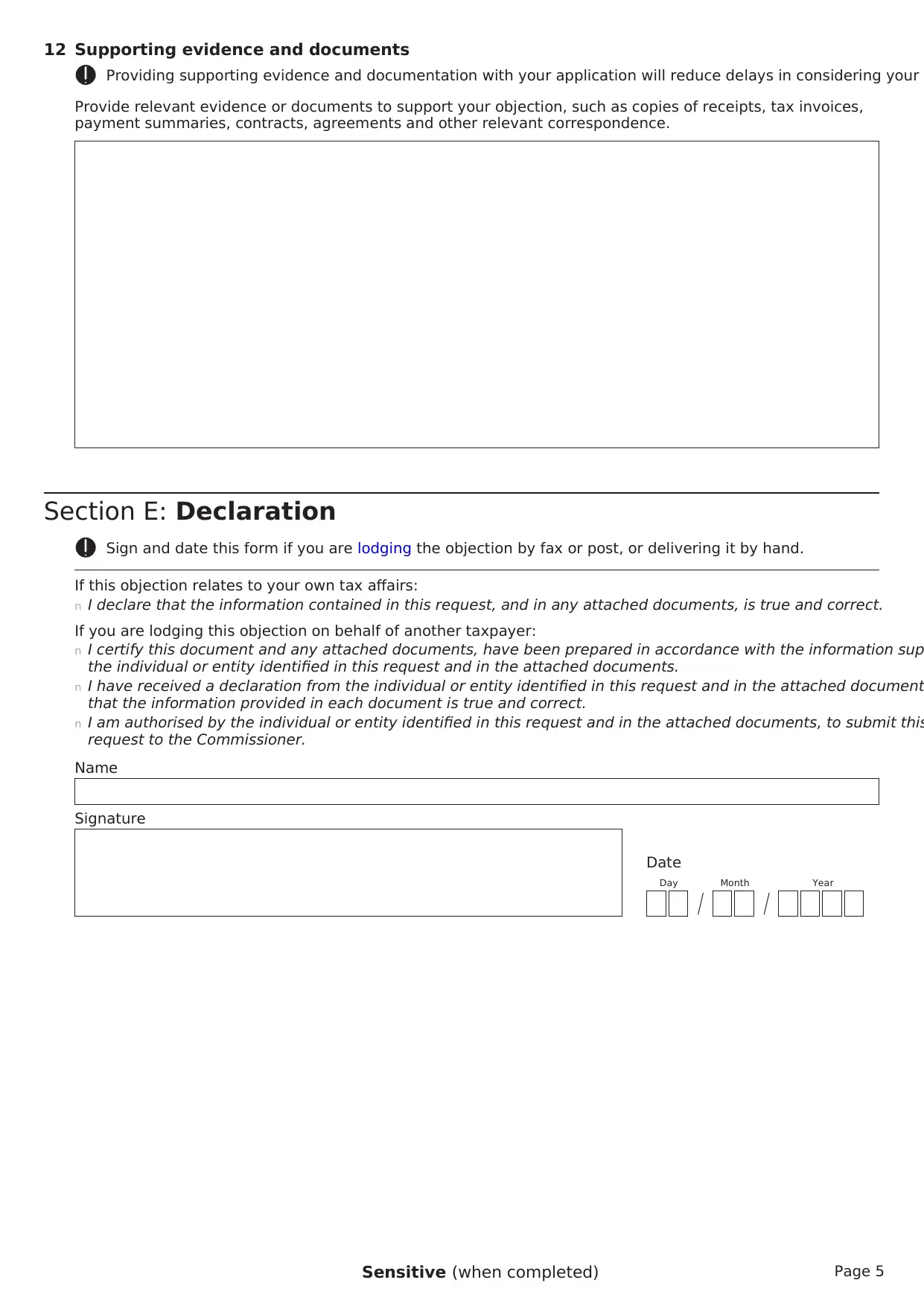
Section E: Declaration
If this objection relates to your own tax affairs:
n I declare that the information contained in this request, and in any attached documents, is true and correct.
If you are lodging this objection on behalf of another taxpayer:
n I certify this document and any attached documents, have been prepared in accordance with the information sup
the individual or entity identified in this request and in the attached documents.
n I have received a declaration from the individual or entity identified in this request and in the attached document
that the information provided in each document is true and correct.
n I am authorised by the individual or entity identified in this request and in the attached documents, to submit this
request to the Commissioner.
Name
Signature
Date
Day Month Year
Sign and date this form if you are lodging the objection by fax or post, or delivering it by hand.
12 Supporting evidence and documents
Providing supporting evidence and documentation with your application will reduce delays in considering your
Provide relevant evidence or documents to support your objection, such as copies of receipts, tax invoices,
payment summaries, contracts, agreements and other relevant correspondence.
Document Page
Page 6 Sensitive (when completed)
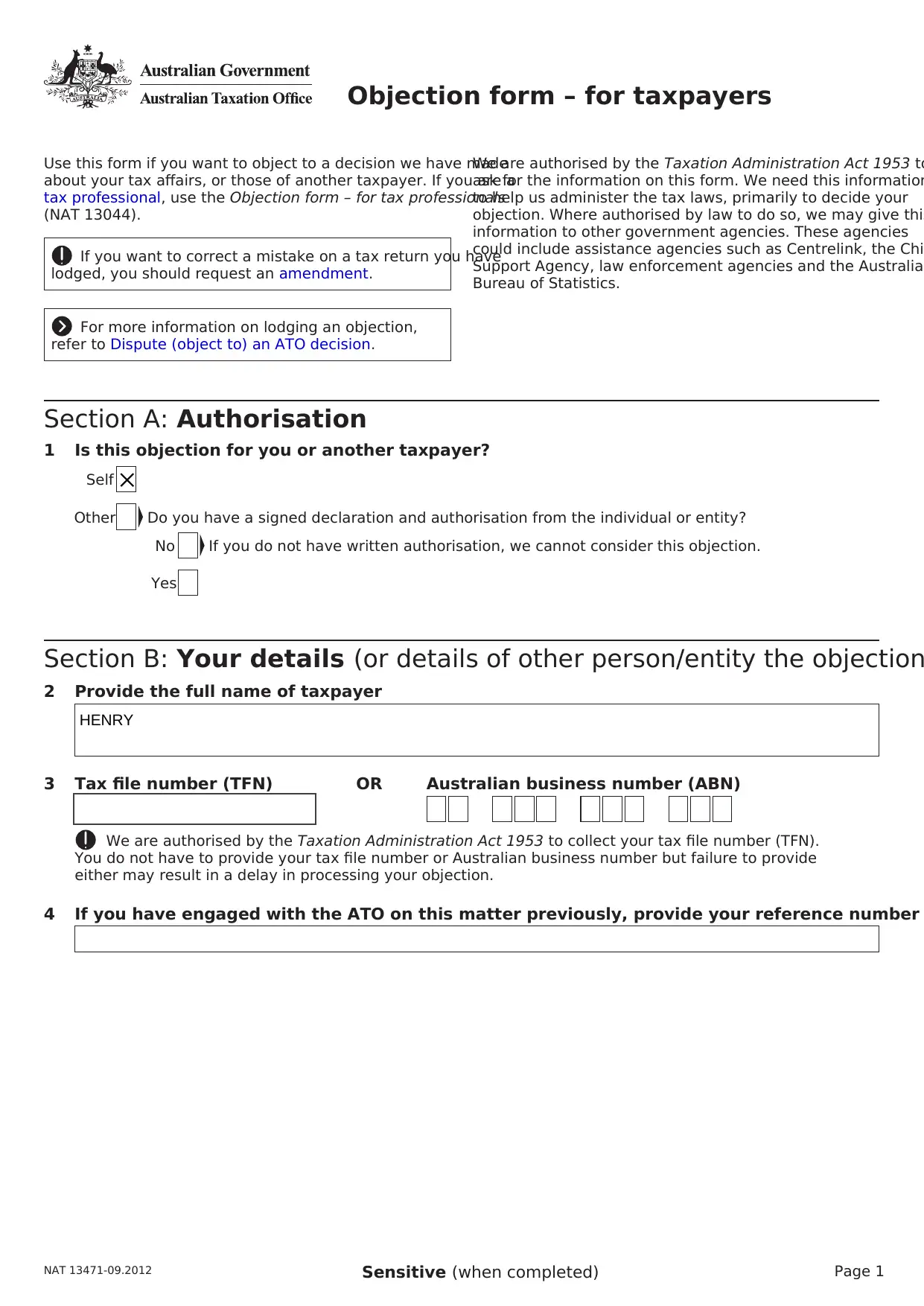
How to lodge your form
You can lodge this form:
n by fax or post – see below
n by hand-delivering it to a shopfront
n through the Business Portal if you are a Business Portal user.
Lodging through the Business Portal means:
n you will receive an instant receipt
n your request will be allocated to the correct area where you have selected the appropriate selection.
Fax or post details
Income tax related objections
For Fax Post
Investment schemes 1800 033 211 Australian Taxation Office
PO Box 3546
ALBURY NSW 2640
Individuals and micro businesses
(less than $2 million turnover)
1300 139 011 Australian Taxation Office
PO Box 1130
PENRITH NSW 2740
Small-to-medium businesses
($2 million to $250 million turnover)
(02) 6225 0906 Australian Taxation Office
PO Box 3000
PENRITH NSW 2740
Large businesses (group turnover of
$250 million or more) and internationals
1300 661 106 Australian Taxation Office
PO Box 377
ALBURY NSW 2640
Other objections
For Fax Post
Australian business number 1300 139 035 The Registrar of the Australian Business Register
PO Box 3003
PENRITH NSW 2740
Excise, wine equalisation tax and
fuel schemes (including fuel tax credits)
1300 650 128 Australian Taxation Office
PO Box 3001
PENRITH NSW 2740
Fringe benefits tax (02) 6225 0906 Australian Taxation Office
PO Box 3000
PENRITH NSW 2740
Failure to lodge penalties 1300 139 045 Australian Taxation Office
PO Box 327
ALBURY NSW 2640
Goods and services tax 1300 139 031 Australian Taxation Office
PO Box 3524
ALBURY NSW 2640
Superannuation 1300 669 846 Australian Taxation Office
PO Box 3100
PENRITH NSW 2740
Resource rent taxes
(petroleum or minerals)
1300 139 011 Australian Taxation Office
PO Box 3000
PENRITH NSW 2740
chevron_up_icon
1 out of 6
circle_padding
hide_on_mobile
zoom_out_icon
[object Object]