Policy Brief on Tuberculosis: Strategies and Implications for India
VerifiedAdded on 2023/06/15
|6
|3471
|348
Report
AI Summary
This policy brief analyzes the tuberculosis (TB) situation in India, including demographic trends, disease burden, and the existing health system. It identifies factors contributing to the high prevalence of TB, such as HIV, malnutrition, and socio-economic conditions. The report examines public health strategies like the DOTS program and the End TB Strategy, highlighting their strengths and weaknesses. It also discusses data collection methods and provides recommendations for improving patient-centered care, implementing bold policies, and intensifying research and innovation to achieve TB elimination in India by 2025. The brief concludes by emphasizing the need for a multi-faceted approach involving government initiatives, healthcare providers, and community engagement to effectively combat TB.
POLICY BRIEF
ANALYSIS
ANALYSIS

Paraphrase This Document
Need a fresh take? Get an instant paraphrase of this document with our AI Paraphraser
Table of Contents
INTRODUCTION...........................................................................................................................1
MAIN BODY...................................................................................................................................1
Introduction to the country and tuberculosis disease..................................................................1
EXECUTIVE SUMMARY.............................................................................................................2
Factors that are increasing tuberculosis problem in India...........................................................2
RESEARCH FINDINGS.................................................................................................................4
Public health strategies to address the Tuberculosis issue in India.............................................4
Unique way to collect the data....................................................................................................5
Findings of the studies along with recommendations.................................................................7
POLICY IMPLICATIONS AND RECOMMENDATIONS..........................................................7
CONCLUSION................................................................................................................................9
REFERENCES..............................................................................................................................10
INTRODUCTION...........................................................................................................................1
MAIN BODY...................................................................................................................................1
Introduction to the country and tuberculosis disease..................................................................1
EXECUTIVE SUMMARY.............................................................................................................2
Factors that are increasing tuberculosis problem in India...........................................................2
RESEARCH FINDINGS.................................................................................................................4
Public health strategies to address the Tuberculosis issue in India.............................................4
Unique way to collect the data....................................................................................................5
Findings of the studies along with recommendations.................................................................7
POLICY IMPLICATIONS AND RECOMMENDATIONS..........................................................7
CONCLUSION................................................................................................................................9
REFERENCES..............................................................................................................................10
INTRODUCTION
A policy brief is an overall summary of a particular issue as this study is going to discuss tuberculosis disease within India and
impacts of this (World Health Organization, 2018). This study will discuss demographic trends and health system of India in order to know life
expectancy and disease burden. Further, it will discuss some causing factors as why tuberculosis disease is increasing within India. Along with
this, it will discuss some interventions and health care policies by which this problem and healthcare challenge can be decreased.
MAIN BODY
Introduction to the country and tuberculosis disease
In regard to India, seventh largest country by area, it can be said that population of this country grew from 361 million in 1951 to
around 1.211 billion in 2011. This drastic change and increasing rate shows that this country grew in all fields to the great extent.
Demographic: In regard to this, it is found that India has more than 50% of its population below the age of 25 and more than 65%
below the age of 35. On this basis, it can be said that India’s majority of population is young (McQuaid and et.al., 2021). Its birth as
well as death rates is both near the global average. In India, more than half of the population is under the age of 30 and less than ¼
populations is age of 45 and older. People in India at high risk for tuberculosis exposure and it includes: those people who have
malutriyion, poor immune, HIV and those who use tobacco to the great extent.
Disease burden: On the basis of above discussion of demographic in India, it can be said that life expectancy of people within India
is about 68 for men and for women, it is 70. Disease burden of this India has also been measured and on the basis of measurement, it
is found that it is 61% due to communicable, neonatal, nutritional and maternal diseases. But as compared to data of 1990, disease
rate dropped to around 33% in 2016 (Bhargava and Shewade, 2020). The India state level disease burden initiative was launched in
October 2015 with the main aim of addressing the crucial knowledge gap with support from the ministry of Health and Family
Welfare. India has the highest burden of tuberculosis worldwide as estimated TB cases rate in India was around 204 per 1 lac
population.
Health system: On the basis of above discussed disease burden as well as demographic trends, it can be said that government and
people of this country need to focus on improving health of people. Otherwise, it may have negative impacts on them and can
decrease life expectancy rate. India has a mixed health care system including private health system and inclusive of public health care
system. Government has taken initiative for improving health of people and for increasing awareness among people, first population
program was being announced in the year of 1951. The first National Health Policy of India got formulated in the year of 1983. In
health care system of India, private as well as public healthcare system providers focused on using non-allopathic form of medicines
include: Unani and siddha and Ayurveda. Indian government has banned the use of serological, antibody based TB test.
Tuberculosis is also one of the major health problem that has affected number of people of India and there is requirement of taking
effective actions by the government and associated healthcare bodies. Overall, it can be said that India has an effective health care system but
need to improvise more for decreasing healthcare challenges and improving life expectancy.
EXECUTIVE SUMMARY
This study will discuss causing factors of tuberculosis problem within India along with data collection methods. It will then discuss
some effective interventions and polices that have been developed by healthcare service association of India for decreasing disease burden and
healthcare challenges.
Factors that are increasing tuberculosis problem in India
Problem: In regard to tuberculosis, it can be said that it is a disease that is caused by germs, spread from person to person through the
air. This serious infectious disease affects lungs that are why it is called one of the dangerous diseases. Some main causes of this
disease is emergence of HIV, the virus that causes AIDS. It is known that HIV weakens immune system of people so, people’s body
become unable to fight TB germs. As this disease was affecting number of people and it has caused death to the great extent. Due to
this, governments have taken actions for decreasing this problem (Harding, 2020). Interventions and policies, developed by
government were very effective and it was the reason as this disease began to decrease again in 1993 but still it is the big concern that
needs to be considered.
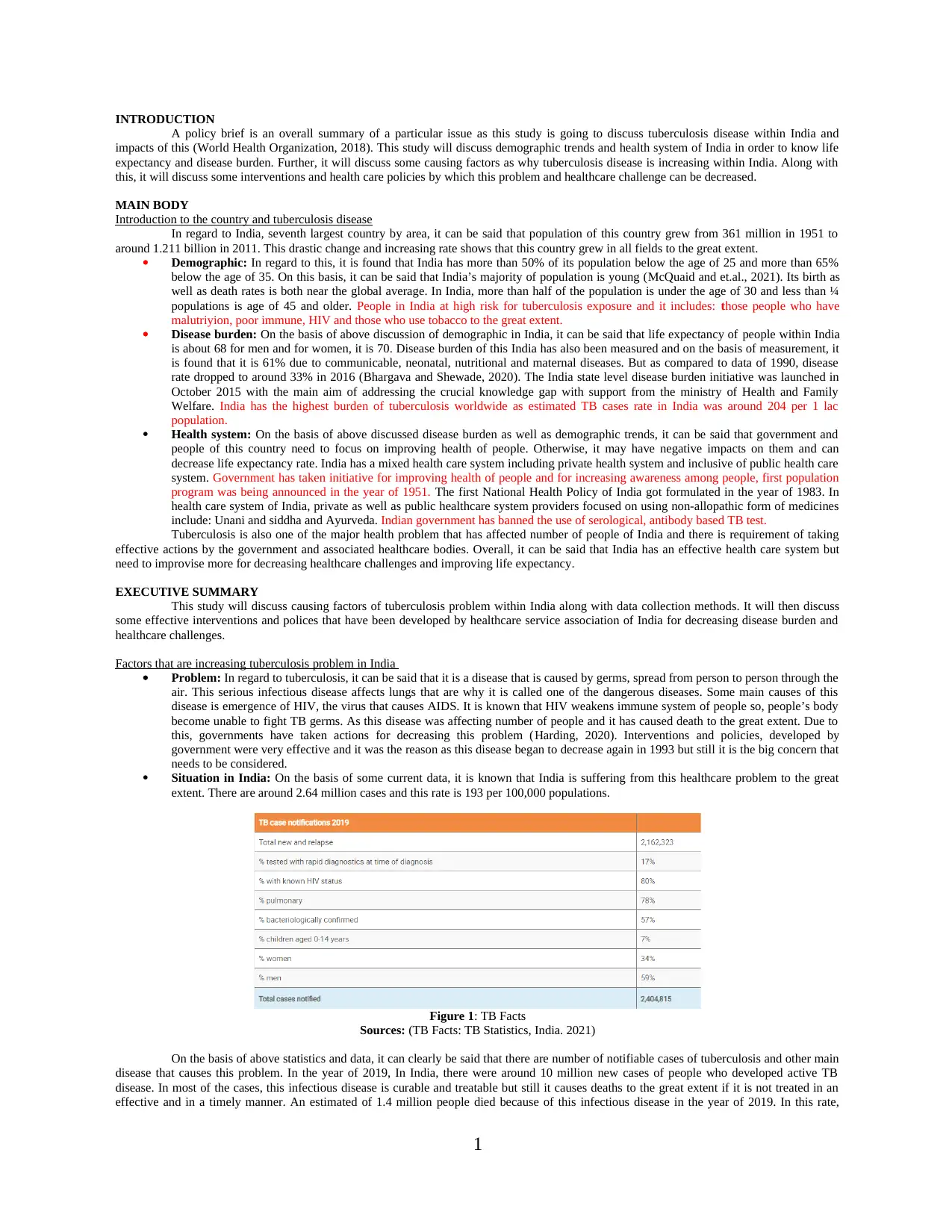
Situation in India: On the basis of some current data, it is known that India is suffering from this healthcare problem to the great
extent. There are around 2.64 million cases and this rate is 193 per 100,000 populations.
Figure 1: TB Facts
Sources: (TB Facts: TB Statistics, India. 2021)
On the basis of above statistics and data, it can clearly be said that there are number of notifiable cases of tuberculosis and other main
disease that causes this problem. In the year of 2019, In India, there were around 10 million new cases of people who developed active TB
disease. In most of the cases, this infectious disease is curable and treatable but still it causes deaths to the great extent if it is not treated in an
effective and in a timely manner. An estimated of 1.4 million people died because of this infectious disease in the year of 2019. In this rate,
1
A policy brief is an overall summary of a particular issue as this study is going to discuss tuberculosis disease within India and
impacts of this (World Health Organization, 2018). This study will discuss demographic trends and health system of India in order to know life
expectancy and disease burden. Further, it will discuss some causing factors as why tuberculosis disease is increasing within India. Along with
this, it will discuss some interventions and health care policies by which this problem and healthcare challenge can be decreased.
MAIN BODY
Introduction to the country and tuberculosis disease
In regard to India, seventh largest country by area, it can be said that population of this country grew from 361 million in 1951 to
around 1.211 billion in 2011. This drastic change and increasing rate shows that this country grew in all fields to the great extent.
Demographic: In regard to this, it is found that India has more than 50% of its population below the age of 25 and more than 65%
below the age of 35. On this basis, it can be said that India’s majority of population is young (McQuaid and et.al., 2021). Its birth as
well as death rates is both near the global average. In India, more than half of the population is under the age of 30 and less than ¼
populations is age of 45 and older. People in India at high risk for tuberculosis exposure and it includes: those people who have
malutriyion, poor immune, HIV and those who use tobacco to the great extent.
Disease burden: On the basis of above discussion of demographic in India, it can be said that life expectancy of people within India
is about 68 for men and for women, it is 70. Disease burden of this India has also been measured and on the basis of measurement, it
is found that it is 61% due to communicable, neonatal, nutritional and maternal diseases. But as compared to data of 1990, disease
rate dropped to around 33% in 2016 (Bhargava and Shewade, 2020). The India state level disease burden initiative was launched in
October 2015 with the main aim of addressing the crucial knowledge gap with support from the ministry of Health and Family
Welfare. India has the highest burden of tuberculosis worldwide as estimated TB cases rate in India was around 204 per 1 lac
population.
Health system: On the basis of above discussed disease burden as well as demographic trends, it can be said that government and
people of this country need to focus on improving health of people. Otherwise, it may have negative impacts on them and can
decrease life expectancy rate. India has a mixed health care system including private health system and inclusive of public health care
system. Government has taken initiative for improving health of people and for increasing awareness among people, first population
program was being announced in the year of 1951. The first National Health Policy of India got formulated in the year of 1983. In
health care system of India, private as well as public healthcare system providers focused on using non-allopathic form of medicines
include: Unani and siddha and Ayurveda. Indian government has banned the use of serological, antibody based TB test.
Tuberculosis is also one of the major health problem that has affected number of people of India and there is requirement of taking
effective actions by the government and associated healthcare bodies. Overall, it can be said that India has an effective health care system but
need to improvise more for decreasing healthcare challenges and improving life expectancy.
EXECUTIVE SUMMARY
This study will discuss causing factors of tuberculosis problem within India along with data collection methods. It will then discuss
some effective interventions and polices that have been developed by healthcare service association of India for decreasing disease burden and
healthcare challenges.
Factors that are increasing tuberculosis problem in India
Problem: In regard to tuberculosis, it can be said that it is a disease that is caused by germs, spread from person to person through the
air. This serious infectious disease affects lungs that are why it is called one of the dangerous diseases. Some main causes of this
disease is emergence of HIV, the virus that causes AIDS. It is known that HIV weakens immune system of people so, people’s body
become unable to fight TB germs. As this disease was affecting number of people and it has caused death to the great extent. Due to
this, governments have taken actions for decreasing this problem (Harding, 2020). Interventions and policies, developed by
government were very effective and it was the reason as this disease began to decrease again in 1993 but still it is the big concern that
needs to be considered.
Situation in India: On the basis of some current data, it is known that India is suffering from this healthcare problem to the great
extent. There are around 2.64 million cases and this rate is 193 per 100,000 populations.
Figure 1: TB Facts
Sources: (TB Facts: TB Statistics, India. 2021)
On the basis of above statistics and data, it can clearly be said that there are number of notifiable cases of tuberculosis and other main
disease that causes this problem. In the year of 2019, In India, there were around 10 million new cases of people who developed active TB
disease. In most of the cases, this infectious disease is curable and treatable but still it causes deaths to the great extent if it is not treated in an
effective and in a timely manner. An estimated of 1.4 million people died because of this infectious disease in the year of 2019. In this rate,
1
⊘ This is a preview!⊘
Do you want full access?
Subscribe today to unlock all pages.

Trusted by 1+ million students worldwide
around 208,000 people were those who were HIV positive (Bhargava and Shewade, 2020). So, on the basis of this, it can clearly be said that
tuberculosis is dangerous when people are HIV positive.
Causing factors: On the basis of above discussion, it can clearly be said that tuberculosis is one of the dangerous infectious diseases
so, it is important to decrease this rate and it is possible when people know causing factors. Risk factors that have caused this problem
especially within India include: HIV infection, malnutrition, tobacco, diabetes and tumour. Along with these bio medical factors,
there are number of environmental factors that also cause this infectious problem such as: lack of ventilation and air pollution. Some
socio economic factors that also need to be considered for decreasing this disease include: poverty, urbanisation, migration as people
find difficulties in getting appropriate and qualitative healthcare services. Mycobacterium tuberculosis is the main causing factor of
this in India. Overall, it can be said that Government and associated institutes need to focus on all these factors.
Interventions: As it s known that tuberculosis has caused number of deaths and for increasing life expectancy, government of India
has announced its plan. The target of developing this plan is to eliminate TB by 2025. Along with this, associated institutions are
taking an active part for increasing awareness among people regarding using good ventilation, decreasing tobacco usage and taking
other precautionary measures (Killian and et.al., 2019).
Overall, it can be said that this disease can be eliminated if government focus on factors, discussed above.
RESEARCH FINDINGS
Public health strategies to address the Tuberculosis issue in India
Tuberculosis is a major health issue within the India as the country has the largest number of cases all across the world in context of
this specific problem. From previous studies, it had been identified that there are more than 850,000 cases related to tuberculosis come across
each year in India there are either undetected or untreated and diagnosed or treated by private healthcare centres with potentially substandard
drugs and treatment programmes. However, these drugs and treatment programmes not only fail to completely eliminate the tuberculosis
bacteria, but they also contribute their part into increasing level of incidences of drug resistant TB including both multi drug resistant TB and
extensively drug resistant TB. But with implementation of the Stop TB (DOTS) strategy that are able to cure millions of patients with TB and
undoubtedly saved lives, the impact of this specific strategy over reducing TB cases. The TB epidemic is declining at the rate of 1.6 percent per
year which is much more slower than what the mathematical models predicted (World Health Organization, 2018). DOTS although cures various
patients as well as saves lives but it does not seem to be very effective in interrupting TB transmissions.
However, still the TB incidents in India remains high. Thus, in 2014, the World Health Assembly endorsed a new and bold plan
known as “The End TB Strategy” with a vision to see the World free from TB i.e. zero TB deaths, zero TB diseases, as well as zero TB
suffering. The goal of the system is to end the global TB epidemic. The programme is based upon three main pillar or strategies such as How can
India improve patient centred TB care and prevention, how can India make and implement bold plans and how can India intensify research and
innovation. The first strategy involves certain aspects that are related to early diagnosis of tuberculosis which also includes universal drug
susceptibility testing and systematic screening of contacts and high risk groups. It also includes the treatment related things according to which
all people with tuberculosis including drug resistant tuberculosis and patient support also has been provided in highly effectual manner. Apart
from this, a collaborative tuberculosis activities needs to be adopted within the health care centres along with the effective management practices
into co-morbidities. It also involves certain and specified preventive treatments of the people who are at high risk, and they have to take
vaccinations at utmost priority in order to fight against tuberculosis (Kushwah and et.al., 2020). Second strategy illustrates that certain bold
policies and supportive system needs to be developed which involves political commitment with adequate amount of resources for tuberculosis
care and prevention. It also includes engagement among varied communities, civil society organizations along with public and private care
providers. This strategy also persists universal health coverage policy as well as rules and regulations in terms of structured manner for easy case
notification, vital registration, quality and rational utilization of medicines along with infection control. According to this strategy, the social
protection, poverty alleviation and actions on other determinants of tuberculosis.
Third public health strategy refers to intensified research and innovation which consists of discovery, development and rapid uptake
of new and innovative tools, strategies along with interpretations. It also consists of research in order to optimize implementation as well as their
impacts due to which it promotes innovative strategies in order to reduce the overall number of Tuberculosis patients all across the India.
Unique way to collect the data
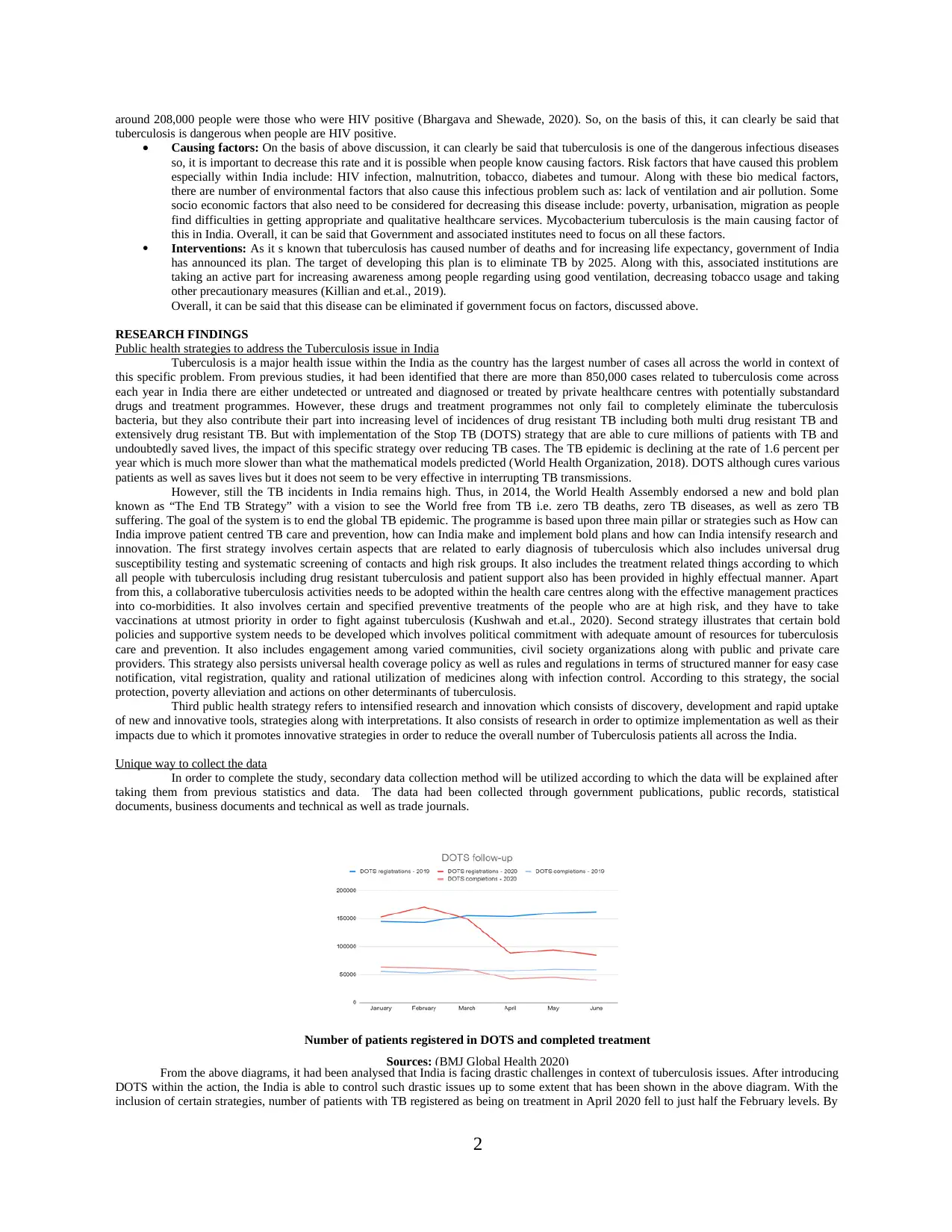
In order to complete the study, secondary data collection method will be utilized according to which the data will be explained after
taking them from previous statistics and data. The data had been collected through government publications, public records, statistical
documents, business documents and technical as well as trade journals.
From the above diagrams, it had been analysed that India is facing drastic challenges in context of tuberculosis issues. After introducing
DOTS within the action, the India is able to control such drastic issues up to some extent that has been shown in the above diagram. With the
inclusion of certain strategies, number of patients with TB registered as being on treatment in April 2020 fell to just half the February levels. By
2
Number of patients registered in DOTS and completed treatment
Sources: (BMJ Global Health 2020)
tuberculosis is dangerous when people are HIV positive.
Causing factors: On the basis of above discussion, it can clearly be said that tuberculosis is one of the dangerous infectious diseases
so, it is important to decrease this rate and it is possible when people know causing factors. Risk factors that have caused this problem
especially within India include: HIV infection, malnutrition, tobacco, diabetes and tumour. Along with these bio medical factors,
there are number of environmental factors that also cause this infectious problem such as: lack of ventilation and air pollution. Some
socio economic factors that also need to be considered for decreasing this disease include: poverty, urbanisation, migration as people
find difficulties in getting appropriate and qualitative healthcare services. Mycobacterium tuberculosis is the main causing factor of
this in India. Overall, it can be said that Government and associated institutes need to focus on all these factors.
Interventions: As it s known that tuberculosis has caused number of deaths and for increasing life expectancy, government of India
has announced its plan. The target of developing this plan is to eliminate TB by 2025. Along with this, associated institutions are
taking an active part for increasing awareness among people regarding using good ventilation, decreasing tobacco usage and taking
other precautionary measures (Killian and et.al., 2019).
Overall, it can be said that this disease can be eliminated if government focus on factors, discussed above.
RESEARCH FINDINGS
Public health strategies to address the Tuberculosis issue in India
Tuberculosis is a major health issue within the India as the country has the largest number of cases all across the world in context of
this specific problem. From previous studies, it had been identified that there are more than 850,000 cases related to tuberculosis come across
each year in India there are either undetected or untreated and diagnosed or treated by private healthcare centres with potentially substandard
drugs and treatment programmes. However, these drugs and treatment programmes not only fail to completely eliminate the tuberculosis
bacteria, but they also contribute their part into increasing level of incidences of drug resistant TB including both multi drug resistant TB and
extensively drug resistant TB. But with implementation of the Stop TB (DOTS) strategy that are able to cure millions of patients with TB and
undoubtedly saved lives, the impact of this specific strategy over reducing TB cases. The TB epidemic is declining at the rate of 1.6 percent per
year which is much more slower than what the mathematical models predicted (World Health Organization, 2018). DOTS although cures various
patients as well as saves lives but it does not seem to be very effective in interrupting TB transmissions.
However, still the TB incidents in India remains high. Thus, in 2014, the World Health Assembly endorsed a new and bold plan
known as “The End TB Strategy” with a vision to see the World free from TB i.e. zero TB deaths, zero TB diseases, as well as zero TB
suffering. The goal of the system is to end the global TB epidemic. The programme is based upon three main pillar or strategies such as How can
India improve patient centred TB care and prevention, how can India make and implement bold plans and how can India intensify research and
innovation. The first strategy involves certain aspects that are related to early diagnosis of tuberculosis which also includes universal drug
susceptibility testing and systematic screening of contacts and high risk groups. It also includes the treatment related things according to which
all people with tuberculosis including drug resistant tuberculosis and patient support also has been provided in highly effectual manner. Apart
from this, a collaborative tuberculosis activities needs to be adopted within the health care centres along with the effective management practices
into co-morbidities. It also involves certain and specified preventive treatments of the people who are at high risk, and they have to take
vaccinations at utmost priority in order to fight against tuberculosis (Kushwah and et.al., 2020). Second strategy illustrates that certain bold
policies and supportive system needs to be developed which involves political commitment with adequate amount of resources for tuberculosis
care and prevention. It also includes engagement among varied communities, civil society organizations along with public and private care
providers. This strategy also persists universal health coverage policy as well as rules and regulations in terms of structured manner for easy case
notification, vital registration, quality and rational utilization of medicines along with infection control. According to this strategy, the social
protection, poverty alleviation and actions on other determinants of tuberculosis.
Third public health strategy refers to intensified research and innovation which consists of discovery, development and rapid uptake
of new and innovative tools, strategies along with interpretations. It also consists of research in order to optimize implementation as well as their
impacts due to which it promotes innovative strategies in order to reduce the overall number of Tuberculosis patients all across the India.
Unique way to collect the data
In order to complete the study, secondary data collection method will be utilized according to which the data will be explained after
taking them from previous statistics and data. The data had been collected through government publications, public records, statistical
documents, business documents and technical as well as trade journals.
From the above diagrams, it had been analysed that India is facing drastic challenges in context of tuberculosis issues. After introducing
DOTS within the action, the India is able to control such drastic issues up to some extent that has been shown in the above diagram. With the
inclusion of certain strategies, number of patients with TB registered as being on treatment in April 2020 fell to just half the February levels. By
2
Number of patients registered in DOTS and completed treatment
Sources: (BMJ Global Health 2020)
Paraphrase This Document
Need a fresh take? Get an instant paraphrase of this document with our AI Paraphraser
June 2020, over 23000 fewer patients had completed the Tb therapy successfully than in January 2020. With the help of appropriate strategies,
India's national TB case notification system show that notifications fell most sharply in April (Arora and et.al., 2021).
Findings of the studies along with recommendations
From the complete evaluation, it has been evaluated that India is dealing with large scale syndemic of TB and hence required specific
need to anticipate and prevent poor outcome among affected people along with the possibility of enhance in the spread of infection with
households and close contacts. It is because TB also requires certain distancing between the people to stop spreading among others. Hence, by
constantly doing modifications in time to time manner, the India will able to reach the point which has been set by them that by 2025, 50%
reduction will occur in context of TB cases, 75% reduction in mortality, and completes the overall target of 90% reduction in incidence of
tuberculosis and 95% reduction in mortality (Pande and et.al., 2017).
POLICY IMPLICATIONS AND RECOMMENDATIONS
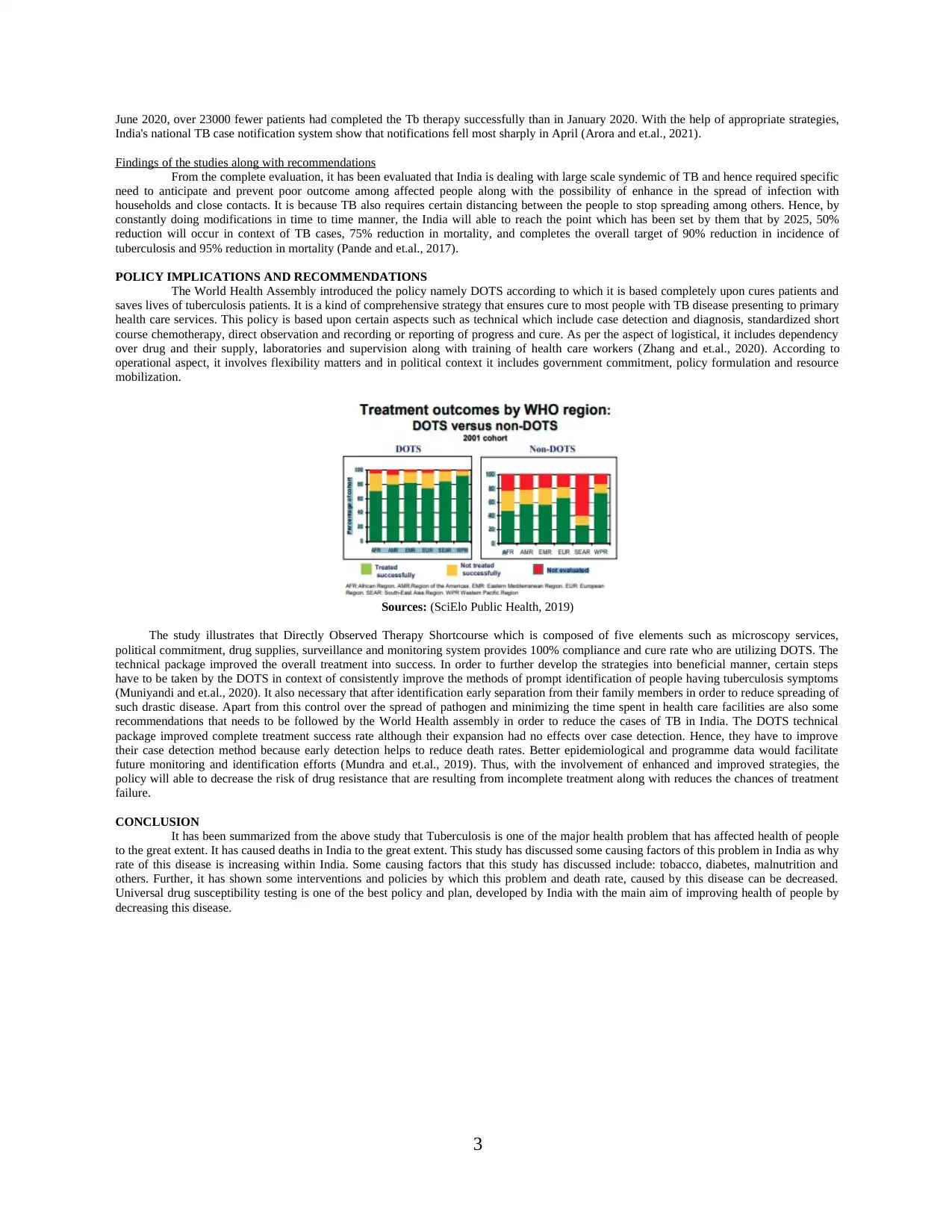
The World Health Assembly introduced the policy namely DOTS according to which it is based completely upon cures patients and
saves lives of tuberculosis patients. It is a kind of comprehensive strategy that ensures cure to most people with TB disease presenting to primary
health care services. This policy is based upon certain aspects such as technical which include case detection and diagnosis, standardized short
course chemotherapy, direct observation and recording or reporting of progress and cure. As per the aspect of logistical, it includes dependency
over drug and their supply, laboratories and supervision along with training of health care workers (Zhang and et.al., 2020). According to
operational aspect, it involves flexibility matters and in political context it includes government commitment, policy formulation and resource
mobilization.
Sources: (SciElo Public Health, 2019)
The study illustrates that Directly Observed Therapy Shortcourse which is composed of five elements such as microscopy services,
political commitment, drug supplies, surveillance and monitoring system provides 100% compliance and cure rate who are utilizing DOTS. The
technical package improved the overall treatment into success. In order to further develop the strategies into beneficial manner, certain steps
have to be taken by the DOTS in context of consistently improve the methods of prompt identification of people having tuberculosis symptoms
(Muniyandi and et.al., 2020). It also necessary that after identification early separation from their family members in order to reduce spreading of
such drastic disease. Apart from this control over the spread of pathogen and minimizing the time spent in health care facilities are also some
recommendations that needs to be followed by the World Health assembly in order to reduce the cases of TB in India. The DOTS technical
package improved complete treatment success rate although their expansion had no effects over case detection. Hence, they have to improve
their case detection method because early detection helps to reduce death rates. Better epidemiological and programme data would facilitate
future monitoring and identification efforts (Mundra and et.al., 2019). Thus, with the involvement of enhanced and improved strategies, the
policy will able to decrease the risk of drug resistance that are resulting from incomplete treatment along with reduces the chances of treatment
failure.
CONCLUSION
It has been summarized from the above study that Tuberculosis is one of the major health problem that has affected health of people
to the great extent. It has caused deaths in India to the great extent. This study has discussed some causing factors of this problem in India as why
rate of this disease is increasing within India. Some causing factors that this study has discussed include: tobacco, diabetes, malnutrition and
others. Further, it has shown some interventions and policies by which this problem and death rate, caused by this disease can be decreased.
Universal drug susceptibility testing is one of the best policy and plan, developed by India with the main aim of improving health of people by
decreasing this disease.
3
India's national TB case notification system show that notifications fell most sharply in April (Arora and et.al., 2021).
Findings of the studies along with recommendations
From the complete evaluation, it has been evaluated that India is dealing with large scale syndemic of TB and hence required specific
need to anticipate and prevent poor outcome among affected people along with the possibility of enhance in the spread of infection with
households and close contacts. It is because TB also requires certain distancing between the people to stop spreading among others. Hence, by
constantly doing modifications in time to time manner, the India will able to reach the point which has been set by them that by 2025, 50%
reduction will occur in context of TB cases, 75% reduction in mortality, and completes the overall target of 90% reduction in incidence of
tuberculosis and 95% reduction in mortality (Pande and et.al., 2017).
POLICY IMPLICATIONS AND RECOMMENDATIONS
The World Health Assembly introduced the policy namely DOTS according to which it is based completely upon cures patients and
saves lives of tuberculosis patients. It is a kind of comprehensive strategy that ensures cure to most people with TB disease presenting to primary
health care services. This policy is based upon certain aspects such as technical which include case detection and diagnosis, standardized short
course chemotherapy, direct observation and recording or reporting of progress and cure. As per the aspect of logistical, it includes dependency
over drug and their supply, laboratories and supervision along with training of health care workers (Zhang and et.al., 2020). According to
operational aspect, it involves flexibility matters and in political context it includes government commitment, policy formulation and resource
mobilization.
Sources: (SciElo Public Health, 2019)
The study illustrates that Directly Observed Therapy Shortcourse which is composed of five elements such as microscopy services,
political commitment, drug supplies, surveillance and monitoring system provides 100% compliance and cure rate who are utilizing DOTS. The
technical package improved the overall treatment into success. In order to further develop the strategies into beneficial manner, certain steps
have to be taken by the DOTS in context of consistently improve the methods of prompt identification of people having tuberculosis symptoms
(Muniyandi and et.al., 2020). It also necessary that after identification early separation from their family members in order to reduce spreading of
such drastic disease. Apart from this control over the spread of pathogen and minimizing the time spent in health care facilities are also some
recommendations that needs to be followed by the World Health assembly in order to reduce the cases of TB in India. The DOTS technical
package improved complete treatment success rate although their expansion had no effects over case detection. Hence, they have to improve
their case detection method because early detection helps to reduce death rates. Better epidemiological and programme data would facilitate
future monitoring and identification efforts (Mundra and et.al., 2019). Thus, with the involvement of enhanced and improved strategies, the
policy will able to decrease the risk of drug resistance that are resulting from incomplete treatment along with reduces the chances of treatment
failure.
CONCLUSION
It has been summarized from the above study that Tuberculosis is one of the major health problem that has affected health of people
to the great extent. It has caused deaths in India to the great extent. This study has discussed some causing factors of this problem in India as why
rate of this disease is increasing within India. Some causing factors that this study has discussed include: tobacco, diabetes, malnutrition and
others. Further, it has shown some interventions and policies by which this problem and death rate, caused by this disease can be decreased.
Universal drug susceptibility testing is one of the best policy and plan, developed by India with the main aim of improving health of people by
decreasing this disease.
3
REFERENCES
Books and Journals
Arora, R., and et.al., 2021. Early implementation challenges in electronic referral and feedback mechanism for patients with tuberculosis using
Nikshay–A mixed-methods study from a medical college TB referral unit of Delhi, India. Journal of Family Medicine and Primary
Care, 10(4), p.1678.
Bhargava, A. and Shewade, H.D., 2020. The potential impact of the COVID-19 response related lockdown on TB incidence and mortality in
India. Indian Journal of Tuberculosis.
Bhargava, A. and Shewade, H.D., 2020. The potential impact of the COVID-19 response related lockdown on TB incidence and mortality in
India. Indian Journal of Tuberculosis.
Harding, E., 2020. WHO global progress report on tuberculosis elimination. The Lancet Respiratory Medicine, 8(1), p.19.
Killian, J.A. and et.al., 2019, July. Learning to prescribe interventions for tuberculosis patients using digital adherence data. In Proceedings of
the 25th ACM SIGKDD International Conference on Knowledge Discovery & Data Mining (pp. 2430-2438).
Kushwah, R.K., and et.al., 2020. A clinico-epidemiological study of cutaneous tuberculosis at tertiary care centre of western India.
McQuaid, C.F.and et.al., 2021. The impact of COVID-19 on TB: a review of the data. The International Journal of Tuberculosis and Lung
Disease, 25(6), pp.436-446.
Mundra, A., and et.al., 2019. Why tuberculosis patients under revised national tuberculosis control programme delay in health-care seeking? A
mixed-methods research from Wardha District, Maharashtra. Indian journal of public health, 63(2), p.94.
Muniyandi, M., and et.al., 2020. Catastrophic costs due to tuberculosis in South India: comparison between active and passive case
finding. Transactions of the Royal Society of Tropical Medicine and Hygiene, 114(3), pp.185-192.
Pande, T., and et.al., 2017. Evaluating clinicians’ user experience and acceptability of LearnTB, a smartphone application for tuberculosis in
India. Mhealth, 3.
World Health Organization, 2018. Driving commitment for nutrition within the UN Decade of Action on Nutrition: policy brief (No.
WHO/NMH/NHD/17.11). World Health Organization.
Zhang, W., and et.al., 2020. Feasibility and Effectiveness of Mobile App for Active Case Finding for Tuberculosis in India. Telehealth and
Medicine Today.
Online
TB Facts: TB Statistics, India. 2021. [Online]. Available through: < https://tbfacts.org/tb-statistics-india/>
BMJ Global Health, 2020. [Online]. Available Through:< https://gh.bmj.com/content/5/11/e003979/>.
SciElo Public Health, 2019. [Online]. Available Through:< https://scielosp.org/article/bwho/2006.v84n6/437-445/>.
4
Books and Journals
Arora, R., and et.al., 2021. Early implementation challenges in electronic referral and feedback mechanism for patients with tuberculosis using
Nikshay–A mixed-methods study from a medical college TB referral unit of Delhi, India. Journal of Family Medicine and Primary
Care, 10(4), p.1678.
Bhargava, A. and Shewade, H.D., 2020. The potential impact of the COVID-19 response related lockdown on TB incidence and mortality in
India. Indian Journal of Tuberculosis.
Bhargava, A. and Shewade, H.D., 2020. The potential impact of the COVID-19 response related lockdown on TB incidence and mortality in
India. Indian Journal of Tuberculosis.
Harding, E., 2020. WHO global progress report on tuberculosis elimination. The Lancet Respiratory Medicine, 8(1), p.19.
Killian, J.A. and et.al., 2019, July. Learning to prescribe interventions for tuberculosis patients using digital adherence data. In Proceedings of
the 25th ACM SIGKDD International Conference on Knowledge Discovery & Data Mining (pp. 2430-2438).
Kushwah, R.K., and et.al., 2020. A clinico-epidemiological study of cutaneous tuberculosis at tertiary care centre of western India.
McQuaid, C.F.and et.al., 2021. The impact of COVID-19 on TB: a review of the data. The International Journal of Tuberculosis and Lung
Disease, 25(6), pp.436-446.
Mundra, A., and et.al., 2019. Why tuberculosis patients under revised national tuberculosis control programme delay in health-care seeking? A
mixed-methods research from Wardha District, Maharashtra. Indian journal of public health, 63(2), p.94.
Muniyandi, M., and et.al., 2020. Catastrophic costs due to tuberculosis in South India: comparison between active and passive case
finding. Transactions of the Royal Society of Tropical Medicine and Hygiene, 114(3), pp.185-192.
Pande, T., and et.al., 2017. Evaluating clinicians’ user experience and acceptability of LearnTB, a smartphone application for tuberculosis in
India. Mhealth, 3.
World Health Organization, 2018. Driving commitment for nutrition within the UN Decade of Action on Nutrition: policy brief (No.
WHO/NMH/NHD/17.11). World Health Organization.
Zhang, W., and et.al., 2020. Feasibility and Effectiveness of Mobile App for Active Case Finding for Tuberculosis in India. Telehealth and
Medicine Today.
Online
TB Facts: TB Statistics, India. 2021. [Online]. Available through: < https://tbfacts.org/tb-statistics-india/>
BMJ Global Health, 2020. [Online]. Available Through:< https://gh.bmj.com/content/5/11/e003979/>.
SciElo Public Health, 2019. [Online]. Available Through:< https://scielosp.org/article/bwho/2006.v84n6/437-445/>.
4
⊘ This is a preview!⊘
Do you want full access?
Subscribe today to unlock all pages.
Trusted by 1+ million students worldwide

1 out of 6


Related Documents


Your All-in-One AI-Powered Toolkit for Academic Success.
+13062052269
info@desklib.com
Available 24*7 on WhatsApp / Email
![[object Object]](/_next/static/media/star-bottom.7253800d.svg)
Unlock your academic potential
Copyright © 2020–2026 A2Z Services. All Rights Reserved. Developed and managed by ZUCOL.