Strategies for Teaching Diverse Students: A Module 3 Analysis
VerifiedAdded on 2020/04/21
|29
|6374
|142
Discussion Board Post
AI Summary
This assignment delves into the complexities of teaching diverse student populations within a higher education context. It comprises discussions across multiple modules, exploring various facets of inclusive education. Module 3 focuses on personalizing learning for all students, examining the components of diversity and the importance of differentiated instruction. It highlights the need for inclusive classrooms and addresses the specific needs of diverse learners, including those with disabilities and EAL/D students. The assignment further explores the selection of resources, emphasizing cultural sensitivity and the need to overcome personal biases. Subsequent modules delve into critical pedagogy and literacy approaches, examining how these frameworks can be implemented in the classroom to foster a more equitable and inclusive learning environment. The assignment emphasizes the importance of teacher training, resource allocation, and continuous evaluation in creating a supportive and effective learning environment for all students. The author draws on examples and case studies to illustrate practical strategies for addressing the unique needs of diverse learners.
Running head: TEACHING TO DIVERSE STUDENTS
Teaching to diverse students
Name of the student:
Name of the university:
Author note:
Teaching to diverse students
Name of the student:
Name of the university:
Author note:

Paraphrase This Document
Need a fresh take? Get an instant paraphrase of this document with our AI Paraphraser
1
TEACHING TO DIVERSE STUDENTS
Table of contents
Module 3..........................................................................................................................................2
Discussion 1: Personalizing learning for all students..................................................................2
Discussion 2: Differentiated Instruction for Diverse learners.....................................................4
Discussion 3: An inclusive classroom.........................................................................................7
Module 4..........................................................................................................................................9
Discussion 1: Learning about your students and staff.................................................................9
Discussion 2: EAL/D students...................................................................................................10
Discussion 3: Providing greater English access to the EAL/D students.......................................11
Module 5........................................................................................................................................11
Discussion 1: Honoring diversity through the selection of resources.......................................11
Discussion 2: Developing cultural sensitivity and awareness through selection of resources. .11
Discussion 3: Overcoming personal bias...................................................................................12
Module 6........................................................................................................................................13
Discussion 1: Closer look at the critical pedagogy....................................................................13
Discussion 2: Critical literacy....................................................................................................14
Discussion 3: Critical literacy approaches in classroom...........................................................14
References and bibliography.........................................................................................................15
TEACHING TO DIVERSE STUDENTS
Table of contents
Module 3..........................................................................................................................................2
Discussion 1: Personalizing learning for all students..................................................................2
Discussion 2: Differentiated Instruction for Diverse learners.....................................................4
Discussion 3: An inclusive classroom.........................................................................................7
Module 4..........................................................................................................................................9
Discussion 1: Learning about your students and staff.................................................................9
Discussion 2: EAL/D students...................................................................................................10
Discussion 3: Providing greater English access to the EAL/D students.......................................11
Module 5........................................................................................................................................11
Discussion 1: Honoring diversity through the selection of resources.......................................11
Discussion 2: Developing cultural sensitivity and awareness through selection of resources. .11
Discussion 3: Overcoming personal bias...................................................................................12
Module 6........................................................................................................................................13
Discussion 1: Closer look at the critical pedagogy....................................................................13
Discussion 2: Critical literacy....................................................................................................14
Discussion 3: Critical literacy approaches in classroom...........................................................14
References and bibliography.........................................................................................................15
2
TEACHING TO DIVERSE STUDENTS
Module 3
Discussion 1: Personalizing learning for all students
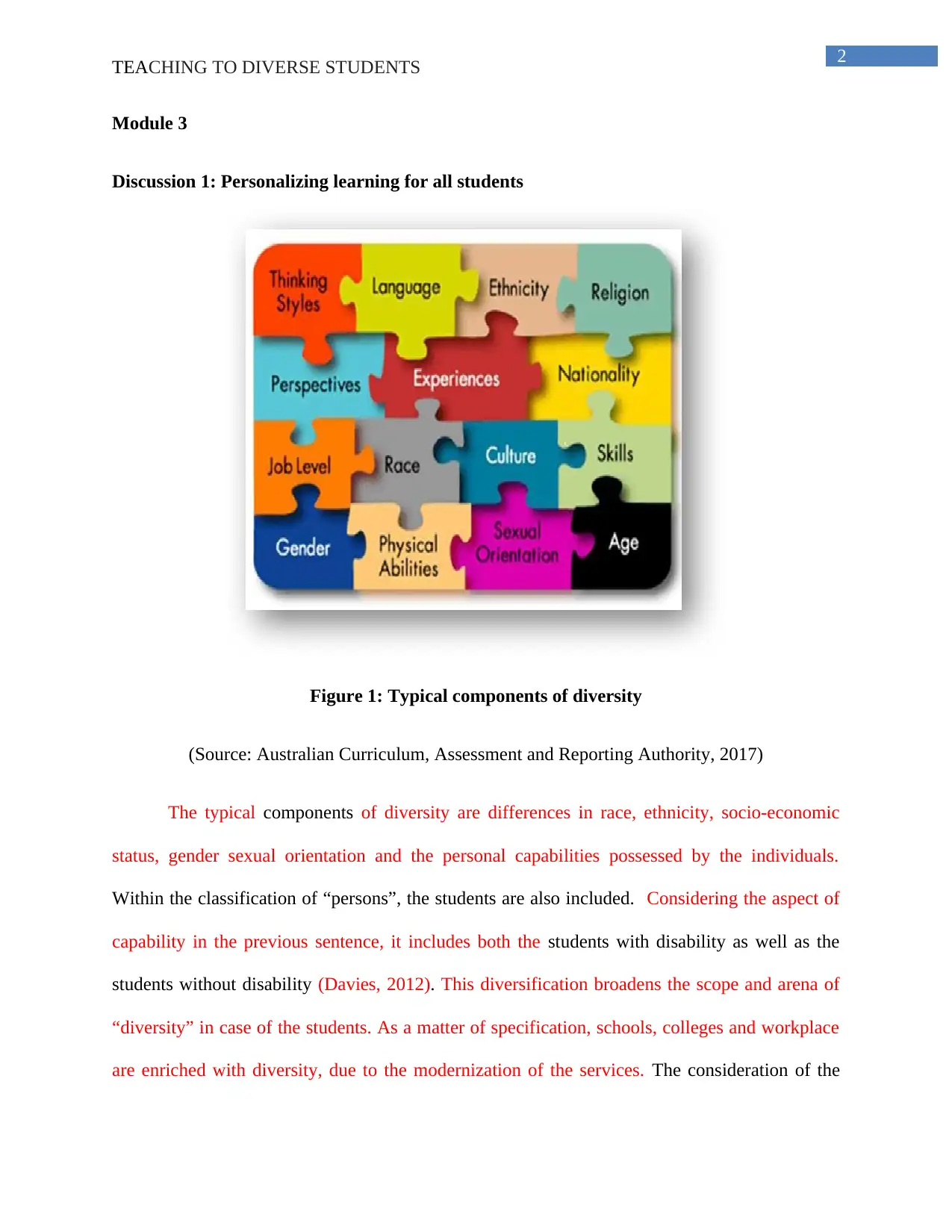
Figure 1: Typical components of diversity
(Source: Australian Curriculum, Assessment and Reporting Authority, 2017)
The typical components of diversity are differences in race, ethnicity, socio-economic
status, gender sexual orientation and the personal capabilities possessed by the individuals.
Within the classification of “persons”, the students are also included. Considering the aspect of
capability in the previous sentence, it includes both the students with disability as well as the
students without disability (Davies, 2012). This diversification broadens the scope and arena of
“diversity” in case of the students. As a matter of specification, schools, colleges and workplace
are enriched with diversity, due to the modernization of the services. The consideration of the
TEACHING TO DIVERSE STUDENTS
Module 3
Discussion 1: Personalizing learning for all students
Figure 1: Typical components of diversity
(Source: Australian Curriculum, Assessment and Reporting Authority, 2017)
The typical components of diversity are differences in race, ethnicity, socio-economic
status, gender sexual orientation and the personal capabilities possessed by the individuals.
Within the classification of “persons”, the students are also included. Considering the aspect of
capability in the previous sentence, it includes both the students with disability as well as the
students without disability (Davies, 2012). This diversification broadens the scope and arena of
“diversity” in case of the students. As a matter of specification, schools, colleges and workplace
are enriched with diversity, due to the modernization of the services. The consideration of the
⊘ This is a preview!⊘
Do you want full access?
Subscribe today to unlock all pages.

Trusted by 1+ million students worldwide
3
TEACHING TO DIVERSE STUDENTS
special or gifted students in the category of Student Diversity is a kind of degradation towards
the purity of education (Australiancurriculum.edu.au, 2017). This is because in schools, the
children hail from different socio-cultural backgrounds. Inclusion of the special and gifted
children within the curriculum enhances the intensity of the term “diversity”.
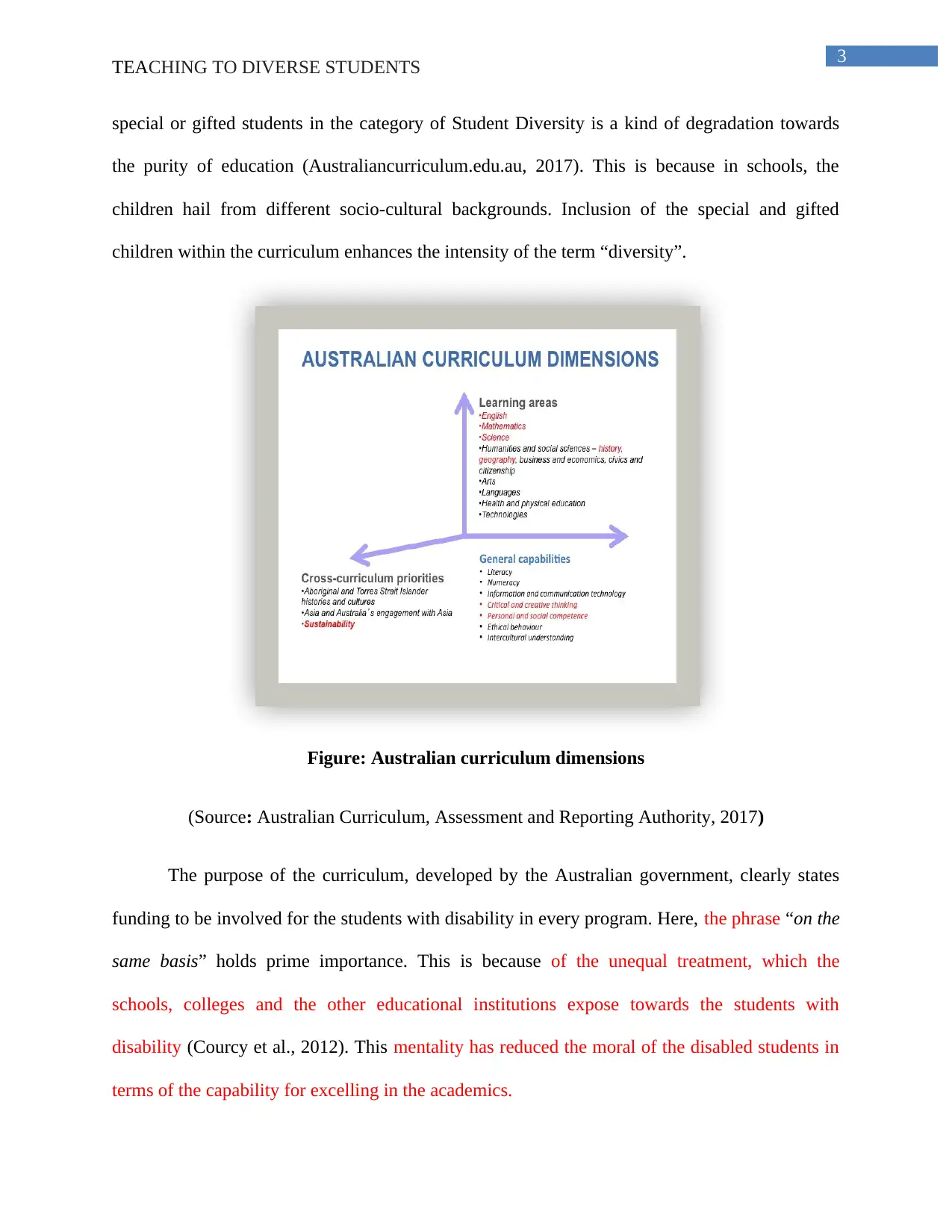
Figure: Australian curriculum dimensions
(Source: Australian Curriculum, Assessment and Reporting Authority, 2017)
The purpose of the curriculum, developed by the Australian government, clearly states
funding to be involved for the students with disability in every program. Here, the phrase “on the
same basis” holds prime importance. This is because of the unequal treatment, which the
schools, colleges and the other educational institutions expose towards the students with
disability (Courcy et al., 2012). This mentality has reduced the moral of the disabled students in
terms of the capability for excelling in the academics.
TEACHING TO DIVERSE STUDENTS
special or gifted students in the category of Student Diversity is a kind of degradation towards
the purity of education (Australiancurriculum.edu.au, 2017). This is because in schools, the
children hail from different socio-cultural backgrounds. Inclusion of the special and gifted
children within the curriculum enhances the intensity of the term “diversity”.
Figure: Australian curriculum dimensions
(Source: Australian Curriculum, Assessment and Reporting Authority, 2017)
The purpose of the curriculum, developed by the Australian government, clearly states
funding to be involved for the students with disability in every program. Here, the phrase “on the
same basis” holds prime importance. This is because of the unequal treatment, which the
schools, colleges and the other educational institutions expose towards the students with
disability (Courcy et al., 2012). This mentality has reduced the moral of the disabled students in
terms of the capability for excelling in the academics.
Paraphrase This Document
Need a fresh take? Get an instant paraphrase of this document with our AI Paraphraser
4
TEACHING TO DIVERSE STUDENTS
Consideration also connotes evaluating and ensuring that students with disability receive
quality education for their proper development. Herein lays the appropriateness of the word
“advice” in the title of the curriculum. This is because exposure of rationality in providing
education to the specially challenged students is of utmost importance. This rationality needs
evaluation for managing the process of educational pedagogy for the students with disability.
Here, maintenance of legislations such as Disability Standard for Education (2005) helps the
teachers to look after the educational needs of the disabled students according to the prescribed
standards (Australiancurriculum.edu.au, 2017).
Personalized learning is the provision of educational needs to the disabled students,
according to their needs. For this, development of standards and frameworks are very important
in order to assess the approaches of the teachers and the guides for levying proper education to
the students with disabilities. Herein, communication is a vital element, which results in the
transfer of knowledge from the teachers to the students. However, the definition of
communication attains a different parameter in case of the disabled students (Hill, 2012).
Written, sign languages and gestures are the different forms, through which the special children
are made familiar with their surroundings.
In the video, Uluru: A Landform in Landscape, the teacher Deb Loveday makes the
students touch the sand and feel the characteristics of the place, Uluru. First she touches the sand,
and gives her hand to the students to feel the texture. Along with this, the hard square like shapes
are used for making the students acquainted with the rocks. In terms of communication, it is seen
that she loudly speaks the words, so that the students can grasp the basic concepts regarding the
landscapes of Uluru (ACARA). The pedagogical method of instruction shown in the video seems
apt in terms of catering to the needs of the specially challenged students. In view of this
TEACHING TO DIVERSE STUDENTS
Consideration also connotes evaluating and ensuring that students with disability receive
quality education for their proper development. Herein lays the appropriateness of the word
“advice” in the title of the curriculum. This is because exposure of rationality in providing
education to the specially challenged students is of utmost importance. This rationality needs
evaluation for managing the process of educational pedagogy for the students with disability.
Here, maintenance of legislations such as Disability Standard for Education (2005) helps the
teachers to look after the educational needs of the disabled students according to the prescribed
standards (Australiancurriculum.edu.au, 2017).
Personalized learning is the provision of educational needs to the disabled students,
according to their needs. For this, development of standards and frameworks are very important
in order to assess the approaches of the teachers and the guides for levying proper education to
the students with disabilities. Herein, communication is a vital element, which results in the
transfer of knowledge from the teachers to the students. However, the definition of
communication attains a different parameter in case of the disabled students (Hill, 2012).
Written, sign languages and gestures are the different forms, through which the special children
are made familiar with their surroundings.
In the video, Uluru: A Landform in Landscape, the teacher Deb Loveday makes the
students touch the sand and feel the characteristics of the place, Uluru. First she touches the sand,
and gives her hand to the students to feel the texture. Along with this, the hard square like shapes
are used for making the students acquainted with the rocks. In terms of communication, it is seen
that she loudly speaks the words, so that the students can grasp the basic concepts regarding the
landscapes of Uluru (ACARA). The pedagogical method of instruction shown in the video seems
apt in terms of catering to the needs of the specially challenged students. In view of this
5
TEACHING TO DIVERSE STUDENTS
perspective, intentional communication relates to the means adopted by the teacher of Clifford
Park Special School to transmit quality education to the gifted children.
Delving deep into the pedagogy, verbal communication is used for developing the
communication skills of the students. Drawing the landforms create wonder among the students
regarding the shapes. Wonder in this sense can be considered as the approach of the students
towards the lectures delivered by the teachers and the professors to the students, including the
specially challenged ones (ACARA). This type of pedagogy is in perfect alignment with the
standards and frameworks included within the educational curriculum by the Australian
government. This is because the teachers indulge in meetings with the board of directors for
chalking out plans regarding catering to the needs, demands and requirements of the disabled
students. The meetings can be considered as an important component of the educational
curriculum prepared by the Australian government.
The teacher in the video seemed very close to the students for making them understand
the basic geographical concepts. She seemed motherly, which is flexible enough for the specially
challenged students in terms of developing their skills, expertise and knowledge (ACARA). This
type of approach acts as the main agent for the gifted students in terms of enhancing their
learning process.
TEACHING TO DIVERSE STUDENTS
perspective, intentional communication relates to the means adopted by the teacher of Clifford
Park Special School to transmit quality education to the gifted children.
Delving deep into the pedagogy, verbal communication is used for developing the
communication skills of the students. Drawing the landforms create wonder among the students
regarding the shapes. Wonder in this sense can be considered as the approach of the students
towards the lectures delivered by the teachers and the professors to the students, including the
specially challenged ones (ACARA). This type of pedagogy is in perfect alignment with the
standards and frameworks included within the educational curriculum by the Australian
government. This is because the teachers indulge in meetings with the board of directors for
chalking out plans regarding catering to the needs, demands and requirements of the disabled
students. The meetings can be considered as an important component of the educational
curriculum prepared by the Australian government.
The teacher in the video seemed very close to the students for making them understand
the basic geographical concepts. She seemed motherly, which is flexible enough for the specially
challenged students in terms of developing their skills, expertise and knowledge (ACARA). This
type of approach acts as the main agent for the gifted students in terms of enhancing their
learning process.
⊘ This is a preview!⊘
Do you want full access?
Subscribe today to unlock all pages.
Trusted by 1+ million students worldwide
6
TEACHING TO DIVERSE STUDENTS
Discussion 2: Differentiated Instruction for Diverse learners
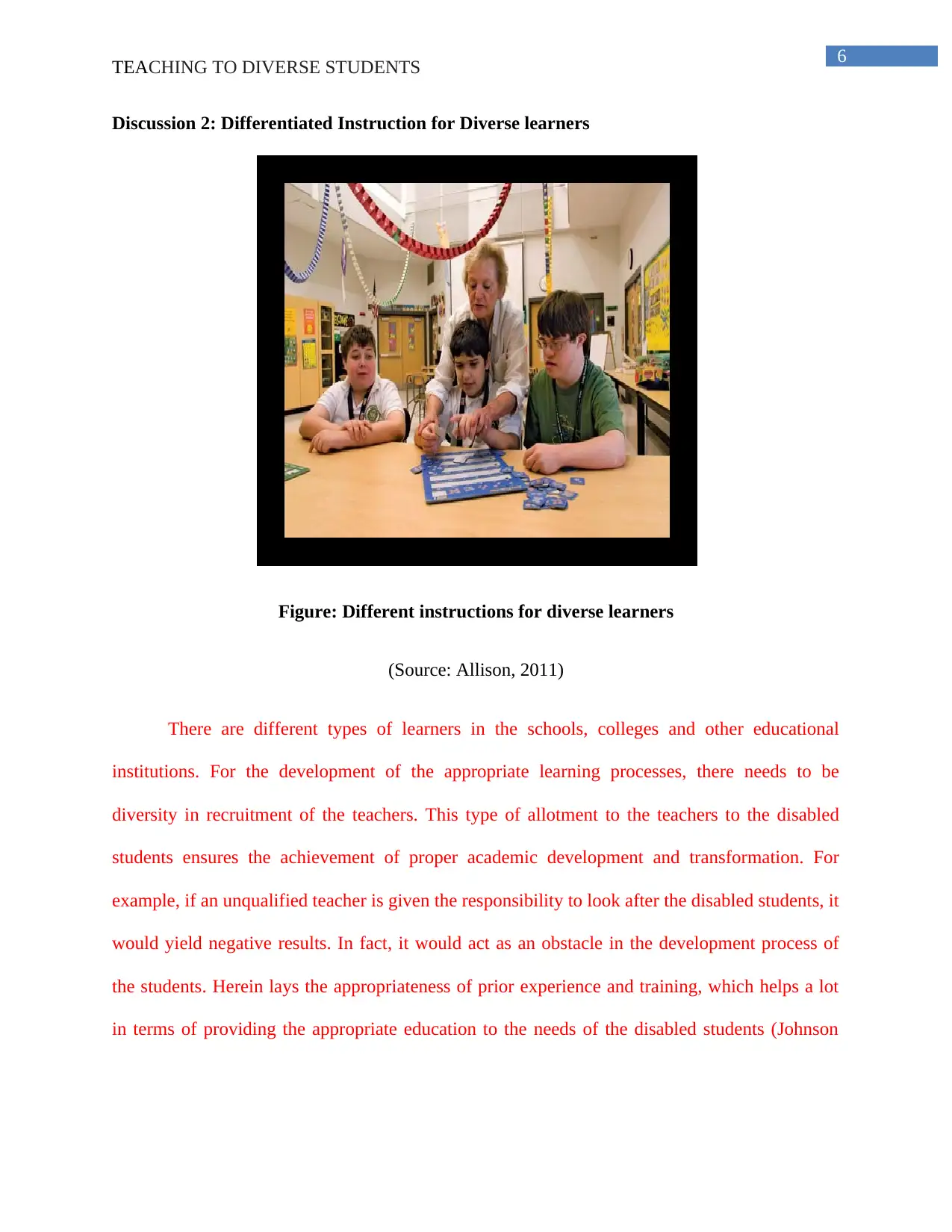
Figure: Different instructions for diverse learners
(Source: Allison, 2011)
There are different types of learners in the schools, colleges and other educational
institutions. For the development of the appropriate learning processes, there needs to be
diversity in recruitment of the teachers. This type of allotment to the teachers to the disabled
students ensures the achievement of proper academic development and transformation. For
example, if an unqualified teacher is given the responsibility to look after the disabled students, it
would yield negative results. In fact, it would act as an obstacle in the development process of
the students. Herein lays the appropriateness of prior experience and training, which helps a lot
in terms of providing the appropriate education to the needs of the disabled students (Johnson
TEACHING TO DIVERSE STUDENTS
Discussion 2: Differentiated Instruction for Diverse learners
Figure: Different instructions for diverse learners
(Source: Allison, 2011)
There are different types of learners in the schools, colleges and other educational
institutions. For the development of the appropriate learning processes, there needs to be
diversity in recruitment of the teachers. This type of allotment to the teachers to the disabled
students ensures the achievement of proper academic development and transformation. For
example, if an unqualified teacher is given the responsibility to look after the disabled students, it
would yield negative results. In fact, it would act as an obstacle in the development process of
the students. Herein lays the appropriateness of prior experience and training, which helps a lot
in terms of providing the appropriate education to the needs of the disabled students (Johnson
Paraphrase This Document
Need a fresh take? Get an instant paraphrase of this document with our AI Paraphraser
7
TEACHING TO DIVERSE STUDENTS
& Vasudevan, 2012). Rational and oriental approach needs to be followed in this direction for
bestowing a quality life on the disabled students.
At the first instance, plans need to be developed for providing the students with quality
education. Countering this, prior to the development of the plans, financial condition of the
schools need to be reviewed. If it is found that there is financial flexibility, then the
administrative authorities can construct beneficial offers and schemes, so that the students could
make right progress towards their educational establishment (ACARA, 2013). On the contrary, if
it is found that the school authorities lack adequate financial resources, it would add an
interrogative parameter to the plans made for levying quality education to the students. Delving
deep into the aspect, it acts as a compromise with the academic establishment of the children.
Herein lays the appropriateness of the means of feedbacks and surveys, which enhance the
awareness of the government officials in terms of the specific needs possessed by the gifted
children.
Adopting one pedagogical method for instructing the special students makes the teachers
aware of the effectiveness, appropriateness and feasibility of the prepared plans. This
experimentation needs to be done very cautiously, as it is related with the development of the
children (Schmidt, 2012). Maintaining rationality in this type of pedagogy enhances the
personality of the teachers in terms of taking the children much closer to their academic
development. Typical component of this rationality is thinking about the individual sentiments of
these children. For example, in the video, it is seen that the teacher is asking the students to touch
and feel the hard square like thing. In this type of experiments, it is the duty of the teachers to
first check whether the thing, which the students are being given to touch, would not cause any
TEACHING TO DIVERSE STUDENTS
& Vasudevan, 2012). Rational and oriental approach needs to be followed in this direction for
bestowing a quality life on the disabled students.
At the first instance, plans need to be developed for providing the students with quality
education. Countering this, prior to the development of the plans, financial condition of the
schools need to be reviewed. If it is found that there is financial flexibility, then the
administrative authorities can construct beneficial offers and schemes, so that the students could
make right progress towards their educational establishment (ACARA, 2013). On the contrary, if
it is found that the school authorities lack adequate financial resources, it would add an
interrogative parameter to the plans made for levying quality education to the students. Delving
deep into the aspect, it acts as a compromise with the academic establishment of the children.
Herein lays the appropriateness of the means of feedbacks and surveys, which enhance the
awareness of the government officials in terms of the specific needs possessed by the gifted
children.
Adopting one pedagogical method for instructing the special students makes the teachers
aware of the effectiveness, appropriateness and feasibility of the prepared plans. This
experimentation needs to be done very cautiously, as it is related with the development of the
children (Schmidt, 2012). Maintaining rationality in this type of pedagogy enhances the
personality of the teachers in terms of taking the children much closer to their academic
development. Typical component of this rationality is thinking about the individual sentiments of
these children. For example, in the video, it is seen that the teacher is asking the students to touch
and feel the hard square like thing. In this type of experiments, it is the duty of the teachers to
first check whether the thing, which the students are being given to touch, would not cause any
8
TEACHING TO DIVERSE STUDENTS
harm to them. Therefore, to be on the safe side, the teachers need to act in a very rational manner
(Windle & Miller, 2012).
Organizing meetings with directors and principals helps the teachers to develop
frameworks and programs for gifting a quality educational phase in the lives of the specially
challenged people. Division of the lectures into segments helps the students to learn the things
easily. Moreover, the teachers, while teaching, need to check whether the gifted children are
bring able to understand. Herein lays the effectiveness of the sign languages and gestures, which
the teacher at Clifford Park Special School used for enhancing knowledge of the children about
the basic geographical landforms (ACARA). Maintaining consistency in these meetings is
crucial in terms of assessing the effectiveness of the adopted pedagogical method. This
assessment makes the administrative authorities of the schools aware of the appropriateness of
the recruitment and selection of the teachers. If it is found that the students are not performing
well under the guidance of the appointed teacher, modifications need to be made in the selection
plans. Keeping adequate time in hand is a wise step for the administrative authorities in terms of
aligning with the standards of the curriculum (Krashen, 1981).
In case the teachers find that the students are not being able to grasp the lessons, after a
certain point of time, the teachers should not stretch the lectures. This is because, there are
limitations to the retaining capacity of the children. However, in case of the special children, the
retaining capacity is even less, therefore, the duration of the lectures needs to be planned
accordingly. Here, experimentation proves fruitful provided there is an oriental approach behind
development of the frameworks and standards. Inclusion of these standards and frameworks
within the curriculum keeps the directors informed about the steps taken by the administrative
authorities to promote the development of the specially challenged students (Commonwealth of
TEACHING TO DIVERSE STUDENTS
harm to them. Therefore, to be on the safe side, the teachers need to act in a very rational manner
(Windle & Miller, 2012).
Organizing meetings with directors and principals helps the teachers to develop
frameworks and programs for gifting a quality educational phase in the lives of the specially
challenged people. Division of the lectures into segments helps the students to learn the things
easily. Moreover, the teachers, while teaching, need to check whether the gifted children are
bring able to understand. Herein lays the effectiveness of the sign languages and gestures, which
the teacher at Clifford Park Special School used for enhancing knowledge of the children about
the basic geographical landforms (ACARA). Maintaining consistency in these meetings is
crucial in terms of assessing the effectiveness of the adopted pedagogical method. This
assessment makes the administrative authorities of the schools aware of the appropriateness of
the recruitment and selection of the teachers. If it is found that the students are not performing
well under the guidance of the appointed teacher, modifications need to be made in the selection
plans. Keeping adequate time in hand is a wise step for the administrative authorities in terms of
aligning with the standards of the curriculum (Krashen, 1981).
In case the teachers find that the students are not being able to grasp the lessons, after a
certain point of time, the teachers should not stretch the lectures. This is because, there are
limitations to the retaining capacity of the children. However, in case of the special children, the
retaining capacity is even less, therefore, the duration of the lectures needs to be planned
accordingly. Here, experimentation proves fruitful provided there is an oriental approach behind
development of the frameworks and standards. Inclusion of these standards and frameworks
within the curriculum keeps the directors informed about the steps taken by the administrative
authorities to promote the development of the specially challenged students (Commonwealth of
⊘ This is a preview!⊘
Do you want full access?
Subscribe today to unlock all pages.
Trusted by 1+ million students worldwide
9
TEACHING TO DIVERSE STUDENTS
Australia, 2013). The teachers need to conduct self-assessment for evaluating their performance
towards the disabled students. Consciousness towards the efficient execution of this assessment
reflects the inner urge of the teachers towards transforming the plight of the disabled students.
On the contrary, lackadaisical attitude towards this assessment is a kind of shedding off the
assigned responsibilities. This type of mentality is against the functionalities of a teacher, which
pushes the future of the disabled children into utter darkness (Lotherington & Chow, 2006).
The teacher, in order to levy quality education to the students, uses different and wide-
ranging resources. Planning and evaluation are needed for selecting and evaluating the resources
used for teaching the students. Here, oriental approach is needed for achieving positive
outcomes. For example, one of the primary resources here is the setting, in which the specially
challenged students are being given the education. The classroom of the video is apt for the
students to learn the basic geographical landforms. The charts in the wall create an educative
ambience, which is perfect for the students, especially the specially challenged ones to enrich
their learning skills (Commonwealth of Australia, 2013).
Blackboard is one of the other resources, which the teachers use for making the concepts
clear to the specially challenged students. In terms of the blind students, blackboard is of no use.
Making the students sit in the front benches enhances the vision of the blind students. Countering
this, if the teachers draw the figures on the blackboard in bigger forms, it would enable the
students to understand the shapes clearly. In the video, the students are seen sitting like the
members in a round table conference (Lotherington & Chow, 2006). The teacher stands and
explains the characteristics of the geographical landforms. This helps the teacher to view the
expressions of the students while the lessons are being delivered. The teachers should walk
around the classrooms to see whether the students are being able to follow the lessons properly.
TEACHING TO DIVERSE STUDENTS
Australia, 2013). The teachers need to conduct self-assessment for evaluating their performance
towards the disabled students. Consciousness towards the efficient execution of this assessment
reflects the inner urge of the teachers towards transforming the plight of the disabled students.
On the contrary, lackadaisical attitude towards this assessment is a kind of shedding off the
assigned responsibilities. This type of mentality is against the functionalities of a teacher, which
pushes the future of the disabled children into utter darkness (Lotherington & Chow, 2006).
The teacher, in order to levy quality education to the students, uses different and wide-
ranging resources. Planning and evaluation are needed for selecting and evaluating the resources
used for teaching the students. Here, oriental approach is needed for achieving positive
outcomes. For example, one of the primary resources here is the setting, in which the specially
challenged students are being given the education. The classroom of the video is apt for the
students to learn the basic geographical landforms. The charts in the wall create an educative
ambience, which is perfect for the students, especially the specially challenged ones to enrich
their learning skills (Commonwealth of Australia, 2013).
Blackboard is one of the other resources, which the teachers use for making the concepts
clear to the specially challenged students. In terms of the blind students, blackboard is of no use.
Making the students sit in the front benches enhances the vision of the blind students. Countering
this, if the teachers draw the figures on the blackboard in bigger forms, it would enable the
students to understand the shapes clearly. In the video, the students are seen sitting like the
members in a round table conference (Lotherington & Chow, 2006). The teacher stands and
explains the characteristics of the geographical landforms. This helps the teacher to view the
expressions of the students while the lessons are being delivered. The teachers should walk
around the classrooms to see whether the students are being able to follow the lessons properly.
Paraphrase This Document
Need a fresh take? Get an instant paraphrase of this document with our AI Paraphraser
10
TEACHING TO DIVERSE STUDENTS
If it is found that the students are facing problems in understanding, the teachers should begin the
lectures from the starting. This would distort the time schedules of the curriculum; however, in
terms of enhancing the understanding of the specially challenged students, this distortion is
nullified (ACARA, 2014).
Discussion 3: An inclusive classroom
Figure: Inclusive classroom
(Source: Australiancurriculum.edu.au, 2017)
The students within a classroom need to be given equal treatment. This is applicable
specifically for the disabled students, as they tend to suffer from depression and isolation, if not
provided with the needed care, love and attention. This isolation is harmful for their health, as it
inculcates negative thoughts within them to cause self-harm or harm to others (Meidl & Meidl,
2011). This perspective creates inequality and discriminations between the disabled and the other
students, affecting their academic development. In order to provide equal treatment to all the
students, the school authorities need to conduct constant evaluations in terms of upgrading the
standards of educational curriculum. This is applicable also for the specially challenged students.
A rational approach is needed in terms of making plans for making the classroom inclusive.
TEACHING TO DIVERSE STUDENTS
If it is found that the students are facing problems in understanding, the teachers should begin the
lectures from the starting. This would distort the time schedules of the curriculum; however, in
terms of enhancing the understanding of the specially challenged students, this distortion is
nullified (ACARA, 2014).
Discussion 3: An inclusive classroom
Figure: Inclusive classroom
(Source: Australiancurriculum.edu.au, 2017)
The students within a classroom need to be given equal treatment. This is applicable
specifically for the disabled students, as they tend to suffer from depression and isolation, if not
provided with the needed care, love and attention. This isolation is harmful for their health, as it
inculcates negative thoughts within them to cause self-harm or harm to others (Meidl & Meidl,
2011). This perspective creates inequality and discriminations between the disabled and the other
students, affecting their academic development. In order to provide equal treatment to all the
students, the school authorities need to conduct constant evaluations in terms of upgrading the
standards of educational curriculum. This is applicable also for the specially challenged students.
A rational approach is needed in terms of making plans for making the classroom inclusive.
11
TEACHING TO DIVERSE STUDENTS
Organizing group discussions can be one of the ways. Supervision of the external inspectors in
these group discussions would help the administrative authorities to study the situation and make
plans the next courses of action accordingly (Allison, 2011). Along with this, taking the students
for outdoor activities would act as another parameters for the teachers in terms of assessing the
approach of the students towards the offered lessons. However, attention needs to be equally
placed upon the students.
Assigning different types of projects to the students is one of the other ways, which
would help the teachers to assess the capability of the students to grasp the basic things. This
projects needs to be set according to the grasping capability of the students. For example, if a
student, suffering from stage fright, is told to perform something in front of the other students
and the higher authorities, it reflects the immature mentality of the administrative authorities
towards the development of the students (Hammond, 2012). On the other hand, assigning the
projects to the students and supervising their performance by constantly guiding them reflects the
conscious attitude of the teachers towards the proper development of the specially challenged
students.
Taking into consideration the previous research and studies, regarding student
diversity, is one of the other means of expanding the scope and arena of the educational
curriculum. As a matter of specification, the previous research and studies helps the
administrative authorities of the schools to make innovative planning for the educational
establishment of the specially challenged students. Application of theoretical perspective to the
propositions made in the previous research would enhance the clarity of the administrative
authorities regarding the consideration of the new avenues, which can be offered to the specially
challenged students (Malcolm, 2013).
TEACHING TO DIVERSE STUDENTS
Organizing group discussions can be one of the ways. Supervision of the external inspectors in
these group discussions would help the administrative authorities to study the situation and make
plans the next courses of action accordingly (Allison, 2011). Along with this, taking the students
for outdoor activities would act as another parameters for the teachers in terms of assessing the
approach of the students towards the offered lessons. However, attention needs to be equally
placed upon the students.
Assigning different types of projects to the students is one of the other ways, which
would help the teachers to assess the capability of the students to grasp the basic things. This
projects needs to be set according to the grasping capability of the students. For example, if a
student, suffering from stage fright, is told to perform something in front of the other students
and the higher authorities, it reflects the immature mentality of the administrative authorities
towards the development of the students (Hammond, 2012). On the other hand, assigning the
projects to the students and supervising their performance by constantly guiding them reflects the
conscious attitude of the teachers towards the proper development of the specially challenged
students.
Taking into consideration the previous research and studies, regarding student
diversity, is one of the other means of expanding the scope and arena of the educational
curriculum. As a matter of specification, the previous research and studies helps the
administrative authorities of the schools to make innovative planning for the educational
establishment of the specially challenged students. Application of theoretical perspective to the
propositions made in the previous research would enhance the clarity of the administrative
authorities regarding the consideration of the new avenues, which can be offered to the specially
challenged students (Malcolm, 2013).
⊘ This is a preview!⊘
Do you want full access?
Subscribe today to unlock all pages.
Trusted by 1+ million students worldwide

1 out of 29


Related Documents


Your All-in-One AI-Powered Toolkit for Academic Success.
+13062052269
info@desklib.com
Available 24*7 on WhatsApp / Email
![[object Object]](/_next/static/media/star-bottom.7253800d.svg)
Unlock your academic potential
Copyright © 2020–2026 A2Z Services. All Rights Reserved. Developed and managed by ZUCOL.