Report: Unit 2 Teaching, Learning and Assessment in Education
VerifiedAdded on 2023/06/08
|18
|6036
|59
Report
AI Summary
This report provides a comprehensive overview of teaching, learning, and assessment within an educational and training context. It addresses key aspects such as the roles and responsibilities of teachers, relevant legislation, and the importance of professional boundaries. The report emphasizes the significance of identifying and meeting the individual needs of learners through initial and diagnostic assessments, and highlights various methods for conducting these assessments. It also details the creation of schemes of work and lesson plans, and explores how these plans can be adapted to cater to diverse learning needs, including the use of inclusive practices and feedback mechanisms. Furthermore, the report examines the promotion of appropriate behavior, equality, and diversity within educational settings. It analyzes the effectiveness of different teaching and learning approaches, communication methods, and resources, while advocating for the use of inclusive strategies. The report also covers the purpose and types of assessment, including peer and self-assessment, and emphasizes the importance of effective questioning and feedback. Finally, it discusses the demonstration of minimum core elements in teaching practice and the review of one's own practice for continuous improvement.
Unit 2 Teaching
Learning and
Assessment in
Education and
Training
Learning and
Assessment in
Education and
Training

Paraphrase This Document
Need a fresh take? Get an instant paraphrase of this document with our AI Paraphraser
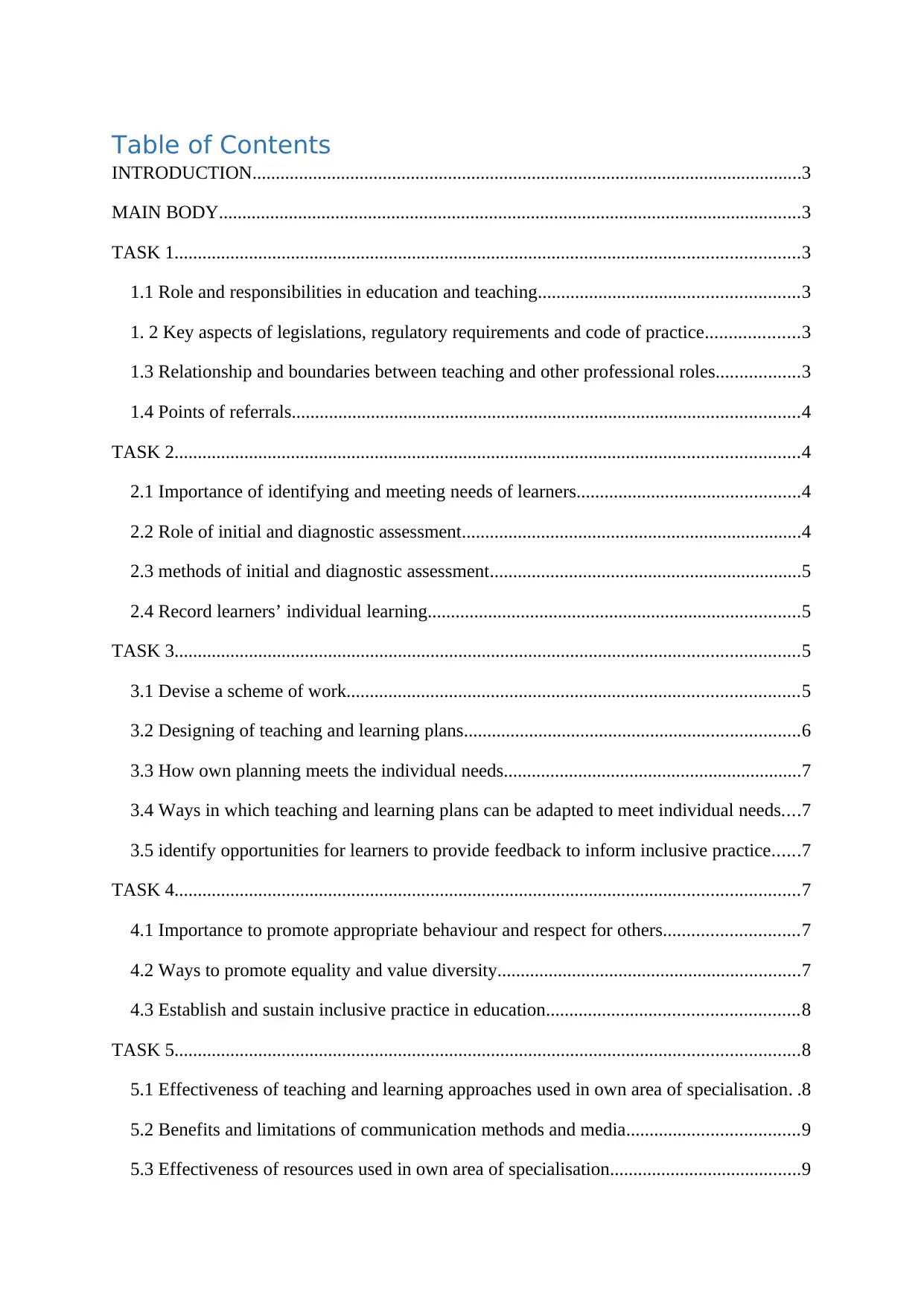
Table of Contents
INTRODUCTION......................................................................................................................3
MAIN BODY.............................................................................................................................3
TASK 1......................................................................................................................................3
1.1 Role and responsibilities in education and teaching........................................................3
1. 2 Key aspects of legislations, regulatory requirements and code of practice....................3
1.3 Relationship and boundaries between teaching and other professional roles..................3
1.4 Points of referrals.............................................................................................................4
TASK 2......................................................................................................................................4
2.1 Importance of identifying and meeting needs of learners................................................4
2.2 Role of initial and diagnostic assessment.........................................................................4
2.3 methods of initial and diagnostic assessment...................................................................5
2.4 Record learners’ individual learning................................................................................5
TASK 3......................................................................................................................................5
3.1 Devise a scheme of work.................................................................................................5
3.2 Designing of teaching and learning plans........................................................................6
3.3 How own planning meets the individual needs................................................................7
3.4 Ways in which teaching and learning plans can be adapted to meet individual needs....7
3.5 identify opportunities for learners to provide feedback to inform inclusive practice......7
TASK 4......................................................................................................................................7
4.1 Importance to promote appropriate behaviour and respect for others.............................7
4.2 Ways to promote equality and value diversity.................................................................7
4.3 Establish and sustain inclusive practice in education......................................................8
TASK 5......................................................................................................................................8
5.1 Effectiveness of teaching and learning approaches used in own area of specialisation. .8
5.2 Benefits and limitations of communication methods and media.....................................9
5.3 Effectiveness of resources used in own area of specialisation.........................................9
INTRODUCTION......................................................................................................................3
MAIN BODY.............................................................................................................................3
TASK 1......................................................................................................................................3
1.1 Role and responsibilities in education and teaching........................................................3
1. 2 Key aspects of legislations, regulatory requirements and code of practice....................3
1.3 Relationship and boundaries between teaching and other professional roles..................3
1.4 Points of referrals.............................................................................................................4
TASK 2......................................................................................................................................4
2.1 Importance of identifying and meeting needs of learners................................................4
2.2 Role of initial and diagnostic assessment.........................................................................4
2.3 methods of initial and diagnostic assessment...................................................................5
2.4 Record learners’ individual learning................................................................................5
TASK 3......................................................................................................................................5
3.1 Devise a scheme of work.................................................................................................5
3.2 Designing of teaching and learning plans........................................................................6
3.3 How own planning meets the individual needs................................................................7
3.4 Ways in which teaching and learning plans can be adapted to meet individual needs....7
3.5 identify opportunities for learners to provide feedback to inform inclusive practice......7
TASK 4......................................................................................................................................7
4.1 Importance to promote appropriate behaviour and respect for others.............................7
4.2 Ways to promote equality and value diversity.................................................................7
4.3 Establish and sustain inclusive practice in education......................................................8
TASK 5......................................................................................................................................8
5.1 Effectiveness of teaching and learning approaches used in own area of specialisation. .8
5.2 Benefits and limitations of communication methods and media.....................................9
5.3 Effectiveness of resources used in own area of specialisation.........................................9
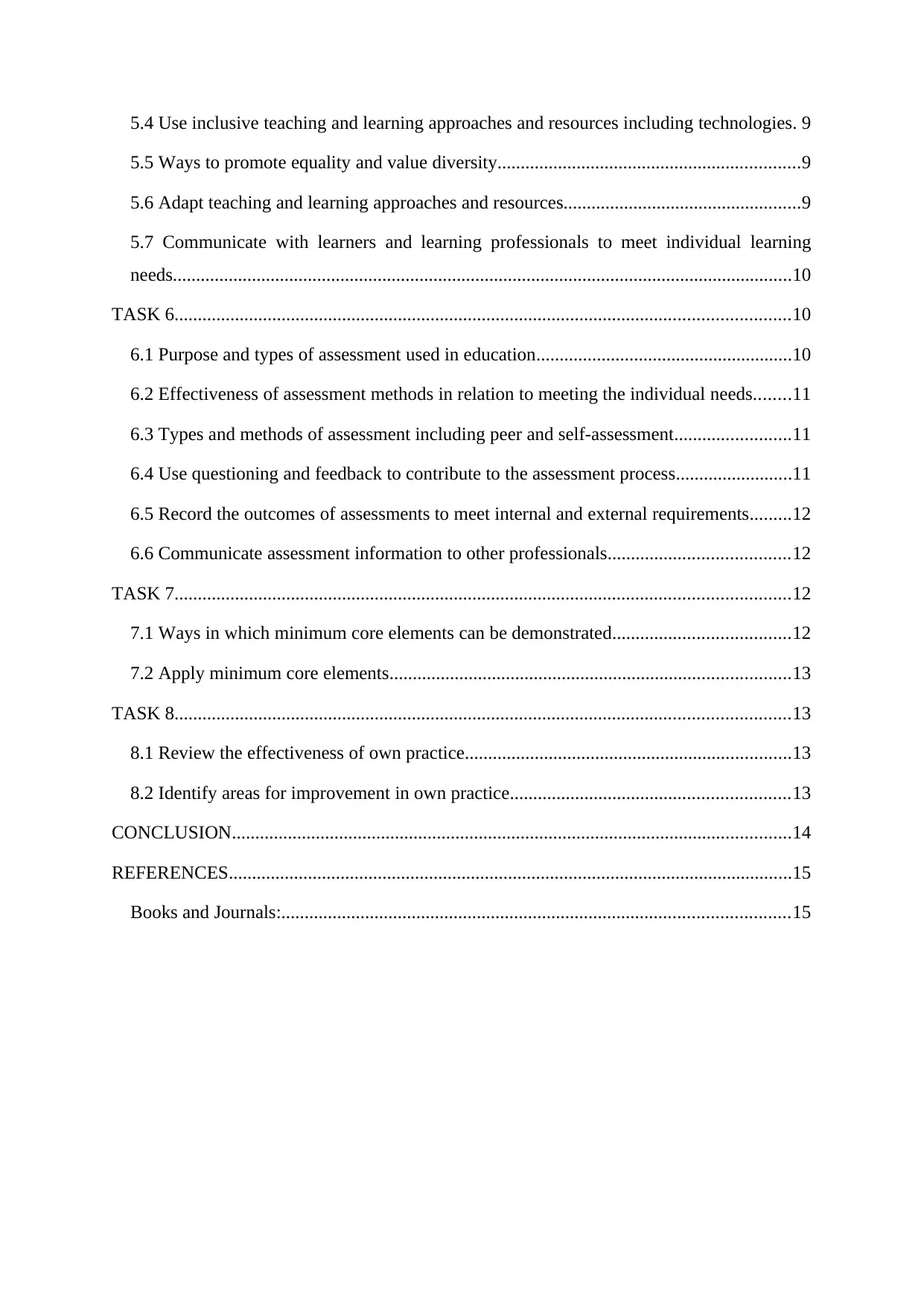
5.4 Use inclusive teaching and learning approaches and resources including technologies. 9
5.5 Ways to promote equality and value diversity.................................................................9
5.6 Adapt teaching and learning approaches and resources...................................................9
5.7 Communicate with learners and learning professionals to meet individual learning
needs.....................................................................................................................................10
TASK 6....................................................................................................................................10
6.1 Purpose and types of assessment used in education.......................................................10
6.2 Effectiveness of assessment methods in relation to meeting the individual needs........11
6.3 Types and methods of assessment including peer and self-assessment.........................11
6.4 Use questioning and feedback to contribute to the assessment process.........................11
6.5 Record the outcomes of assessments to meet internal and external requirements.........12
6.6 Communicate assessment information to other professionals.......................................12
TASK 7....................................................................................................................................12
7.1 Ways in which minimum core elements can be demonstrated......................................12
7.2 Apply minimum core elements......................................................................................13
TASK 8....................................................................................................................................13
8.1 Review the effectiveness of own practice......................................................................13
8.2 Identify areas for improvement in own practice............................................................13
CONCLUSION........................................................................................................................14
REFERENCES.........................................................................................................................15
Books and Journals:.............................................................................................................15
5.5 Ways to promote equality and value diversity.................................................................9
5.6 Adapt teaching and learning approaches and resources...................................................9
5.7 Communicate with learners and learning professionals to meet individual learning
needs.....................................................................................................................................10
TASK 6....................................................................................................................................10
6.1 Purpose and types of assessment used in education.......................................................10
6.2 Effectiveness of assessment methods in relation to meeting the individual needs........11
6.3 Types and methods of assessment including peer and self-assessment.........................11
6.4 Use questioning and feedback to contribute to the assessment process.........................11
6.5 Record the outcomes of assessments to meet internal and external requirements.........12
6.6 Communicate assessment information to other professionals.......................................12
TASK 7....................................................................................................................................12
7.1 Ways in which minimum core elements can be demonstrated......................................12
7.2 Apply minimum core elements......................................................................................13
TASK 8....................................................................................................................................13
8.1 Review the effectiveness of own practice......................................................................13
8.2 Identify areas for improvement in own practice............................................................13
CONCLUSION........................................................................................................................14
REFERENCES.........................................................................................................................15
Books and Journals:.............................................................................................................15
⊘ This is a preview!⊘
Do you want full access?
Subscribe today to unlock all pages.

Trusted by 1+ million students worldwide
INTRODUCTION
MAIN BODY
TASK 1
1.1 Role and responsibilities in education and teaching
Teacher plays various role in teaching they become trainer, mentor, instructor, or as
well as assessor as per the situation. The teacher's responsibility is to give the best
information to learners. They make policies and procedures for the organizations or also they
support learners for their learning. The teacher also plays an assessor role they assess learner
learning outcomes as per previous knowledge (Cahyono and Ludwig 2018). They give
feedback to learners. The teacher is recording all the tests it gives information about the
learner level. Teacher creates an environment where they teach equally to all learners, they
provide the various task to learners which create interest in the class. Teachers' responsibility
is to encourage their learners to participate in the various task.
1. 2 Key aspects of legislations, regulatory requirements and code of practice
Code of conduct is the requirement of the educational organizations it gives
information about educational organization discipline and their work (Rose 2018). Code of
conduct and legislation safeguards the organization when any learner does any mistake so
they punish by code of conduct and legislation. The code of conduct is a safeguard for the
teacher also it gives direction and information to the teacher when they know about the rules
so they can easily teach in class. Every teacher must follow these rules and regulations which
help to retain in the organization. The code of conduct and legislation is made for the safety
and health of the organization as well as its secure data and organization software. The rules
are made for the organization's welfare if any teacher and learner follow the rules.
1.3 Relationship and boundaries between teaching and other professional roles
Personal boundaries include teacher skills, confidence, and experience. The teacher
can increase the confidence and experience by giving time to teaching. The personal
boundaries are increased by the teacher's hard work also (García-Carrión, and et.al., 2020).
Profession boundaries are related to the job it depends on the teacher how they performed
how they work this is professional boundaries are set because the teacher can communicate
MAIN BODY
TASK 1
1.1 Role and responsibilities in education and teaching
Teacher plays various role in teaching they become trainer, mentor, instructor, or as
well as assessor as per the situation. The teacher's responsibility is to give the best
information to learners. They make policies and procedures for the organizations or also they
support learners for their learning. The teacher also plays an assessor role they assess learner
learning outcomes as per previous knowledge (Cahyono and Ludwig 2018). They give
feedback to learners. The teacher is recording all the tests it gives information about the
learner level. Teacher creates an environment where they teach equally to all learners, they
provide the various task to learners which create interest in the class. Teachers' responsibility
is to encourage their learners to participate in the various task.
1. 2 Key aspects of legislations, regulatory requirements and code of practice
Code of conduct is the requirement of the educational organizations it gives
information about educational organization discipline and their work (Rose 2018). Code of
conduct and legislation safeguards the organization when any learner does any mistake so
they punish by code of conduct and legislation. The code of conduct is a safeguard for the
teacher also it gives direction and information to the teacher when they know about the rules
so they can easily teach in class. Every teacher must follow these rules and regulations which
help to retain in the organization. The code of conduct and legislation is made for the safety
and health of the organization as well as its secure data and organization software. The rules
are made for the organization's welfare if any teacher and learner follow the rules.
1.3 Relationship and boundaries between teaching and other professional roles
Personal boundaries include teacher skills, confidence, and experience. The teacher
can increase the confidence and experience by giving time to teaching. The personal
boundaries are increased by the teacher's hard work also (García-Carrión, and et.al., 2020).
Profession boundaries are related to the job it depends on the teacher how they performed
how they work this is professional boundaries are set because the teacher can communicate
Paraphrase This Document
Need a fresh take? Get an instant paraphrase of this document with our AI Paraphraser
personal issues in class. Professional boundaries also clear the information in teaching. Every
professional teacher communicates professionally and also, supports learners. If there is a
problem in content, they give preference to the learner it is professionalism in teaching.
1.4 Points of referrals
Educational organization is understanding the need of the individual because in
modern times they can give information as per their need. Many learners are very slow in
learning so teachers use various methods in the class for the learner they motivate, and
support learners in their learning (Susanto and Nanda 2018). The educational organization
provides seminars in schools for teachers in the seminars they tell the methods and
approaches that teachers use in teaching. Education organizations and externals give
information about the related course to add some specialist and expert for the subject which
give guidance and path to relate with the course.
TASK 2
2.1 Importance of identifying and meeting needs of learners
Educational organizations identify the need of the learner it is very important for the
organization as well as the teacher also when they identify the need they can satisfy this
process in the way. Now education is dependent on a learner-centric approach where teachers
give information about the subject content (Miño Puigcercós, and et.al., 2019). The teacher
gives information according to learner level. It motivates the learner to increase their learning
capacity. Education organization is meet the learner's previous knowledge which helps to
diagnose the learner level they develop skills in learners for becoming a good learner. When a
teacher identifies the learner's end, they satisfy the need for giving the various information.
2.2 Role of initial and diagnostic assessment
Initial assessment and diagnosis assessment are part of individual learning life. The
initial assessment is used when the learner is available for the course. The initial assessment
is giving information about the learner's eligibility for the course (Visvizi, Lytras, and
Daniela 2018). Diagnostic assessment is used by teachers in the class to diagnose the
previous information which learn in the previous class. Diagnostic assessment is very
important for filling the gap in the learner. Teachers use diagnosis assessment to assess the
learner's need or knowledge when teachers understand the learner's level, they give
information as per their assessment. Teachers use initial and diagnostic assessments for
professional teacher communicates professionally and also, supports learners. If there is a
problem in content, they give preference to the learner it is professionalism in teaching.
1.4 Points of referrals
Educational organization is understanding the need of the individual because in
modern times they can give information as per their need. Many learners are very slow in
learning so teachers use various methods in the class for the learner they motivate, and
support learners in their learning (Susanto and Nanda 2018). The educational organization
provides seminars in schools for teachers in the seminars they tell the methods and
approaches that teachers use in teaching. Education organizations and externals give
information about the related course to add some specialist and expert for the subject which
give guidance and path to relate with the course.
TASK 2
2.1 Importance of identifying and meeting needs of learners
Educational organizations identify the need of the learner it is very important for the
organization as well as the teacher also when they identify the need they can satisfy this
process in the way. Now education is dependent on a learner-centric approach where teachers
give information about the subject content (Miño Puigcercós, and et.al., 2019). The teacher
gives information according to learner level. It motivates the learner to increase their learning
capacity. Education organization is meet the learner's previous knowledge which helps to
diagnose the learner level they develop skills in learners for becoming a good learner. When a
teacher identifies the learner's end, they satisfy the need for giving the various information.
2.2 Role of initial and diagnostic assessment
Initial assessment and diagnosis assessment are part of individual learning life. The
initial assessment is used when the learner is available for the course. The initial assessment
is giving information about the learner's eligibility for the course (Visvizi, Lytras, and
Daniela 2018). Diagnostic assessment is used by teachers in the class to diagnose the
previous information which learn in the previous class. Diagnostic assessment is very
important for filling the gap in the learner. Teachers use diagnosis assessment to assess the
learner's need or knowledge when teachers understand the learner's level, they give
information as per their assessment. Teachers use initial and diagnostic assessments for
reaching learning goals. It is important to understand the learning goals of an individual so it
gives information about the learner's level. Teacher any questions at the start of the course.
2.3 methods of initial and diagnostic assessment
Initial and diagnostic assessment is an important process it is used before starting a
new course. An initial assessment is taken place before commencing the course. This
assessment is very important to a sure the learners are on the right path (Gresse von
Wangenheim, and et.al., 2021). Diagnostic assessment occurs after the initial assessment it is
highlighted those areas where learners need extra support many learners required
development. Learners are weak in those areas so they require extra support they go to extra
classes and cover the all information. Discovery of the weakness and strengths in determining
the goal and target of the learner. When teachers understand the situation so they give
information to learners. Many learners go to various universities but they can't reach because
they don't have enough information about the course when institutions assess problems so
they give information and the right path to reach their goal.
2.4 Record learners’ individual learning
Every education organization records the learner's learning goals it is very important
for the educational organization because they understand the learner's needs, and they give a
path which is an essential part of any course it is possible by records of data (Gresse von
Wangenheim, and et.al., 2021). Organizations record all data by software which records the
individual learning goals if any vacancy occurs in the organization so they adopt those
learners who are eligible for the job it is can possible by the records. The teacher gathers
various information related to the learner. The organization needs data so they record all
information record assessment marks and learner personal information. The organization
recodes all work done by teachers and staff.
TASK 3
3.1 Devise a scheme of work
Week Learning Outcome Learning and teaching
activity
Which
assessment
criteria does
the session
relate to?
1 Introduce the organisation Groups discussions LO1: P1, M1
gives information about the learner's level. Teacher any questions at the start of the course.
2.3 methods of initial and diagnostic assessment
Initial and diagnostic assessment is an important process it is used before starting a
new course. An initial assessment is taken place before commencing the course. This
assessment is very important to a sure the learners are on the right path (Gresse von
Wangenheim, and et.al., 2021). Diagnostic assessment occurs after the initial assessment it is
highlighted those areas where learners need extra support many learners required
development. Learners are weak in those areas so they require extra support they go to extra
classes and cover the all information. Discovery of the weakness and strengths in determining
the goal and target of the learner. When teachers understand the situation so they give
information to learners. Many learners go to various universities but they can't reach because
they don't have enough information about the course when institutions assess problems so
they give information and the right path to reach their goal.
2.4 Record learners’ individual learning
Every education organization records the learner's learning goals it is very important
for the educational organization because they understand the learner's needs, and they give a
path which is an essential part of any course it is possible by records of data (Gresse von
Wangenheim, and et.al., 2021). Organizations record all data by software which records the
individual learning goals if any vacancy occurs in the organization so they adopt those
learners who are eligible for the job it is can possible by the records. The teacher gathers
various information related to the learner. The organization needs data so they record all
information record assessment marks and learner personal information. The organization
recodes all work done by teachers and staff.
TASK 3
3.1 Devise a scheme of work
Week Learning Outcome Learning and teaching
activity
Which
assessment
criteria does
the session
relate to?
1 Introduce the organisation Groups discussions LO1: P1, M1
⊘ This is a preview!⊘
Do you want full access?
Subscribe today to unlock all pages.
Trusted by 1+ million students worldwide
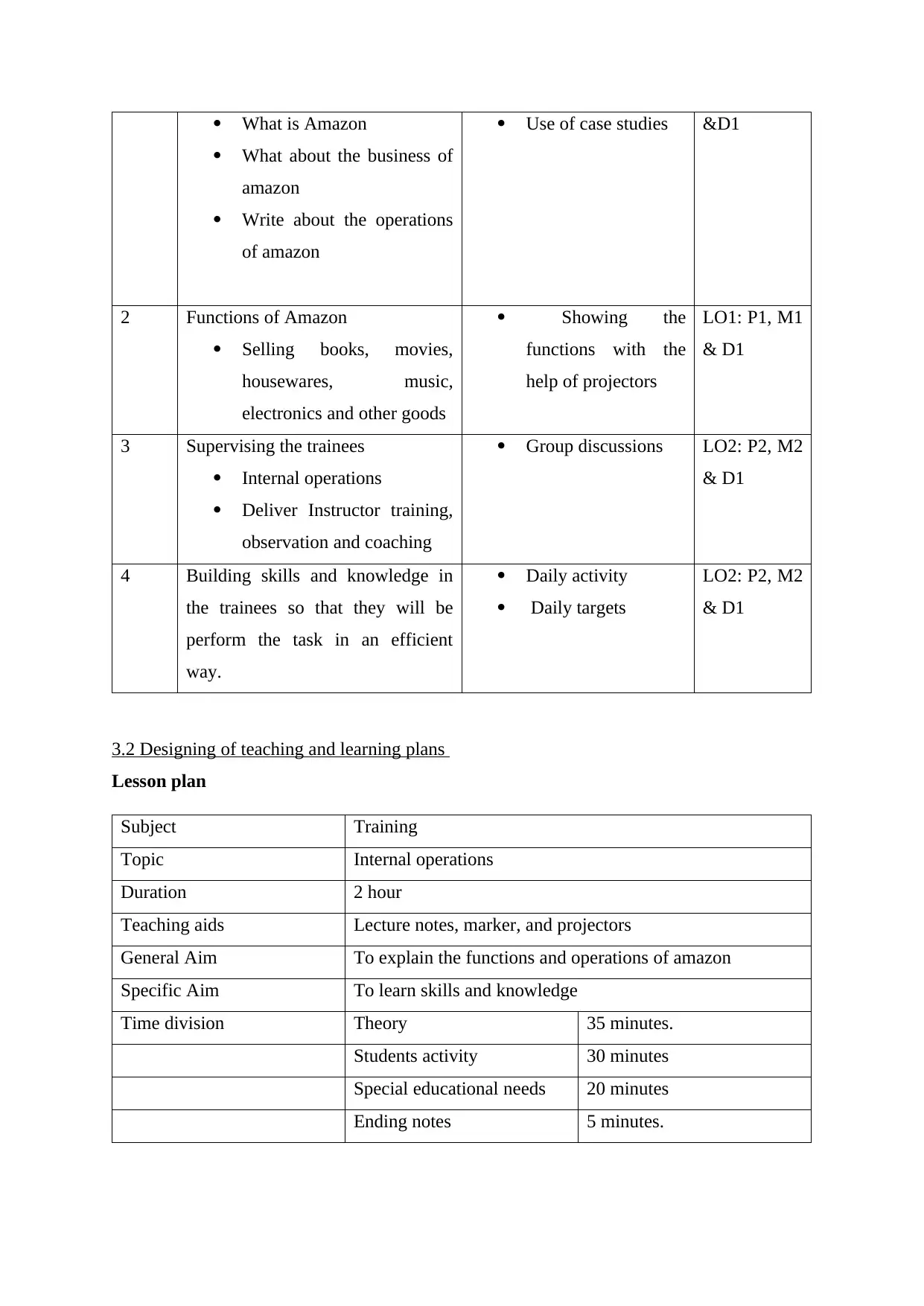
What is Amazon
What about the business of
amazon
Write about the operations
of amazon
Use of case studies &D1
2 Functions of Amazon
Selling books, movies,
housewares, music,
electronics and other goods
Showing the
functions with the
help of projectors
LO1: P1, M1
& D1
3 Supervising the trainees
Internal operations
Deliver Instructor training,
observation and coaching
Group discussions LO2: P2, M2
& D1
4 Building skills and knowledge in
the trainees so that they will be
perform the task in an efficient
way.
Daily activity
Daily targets
LO2: P2, M2
& D1
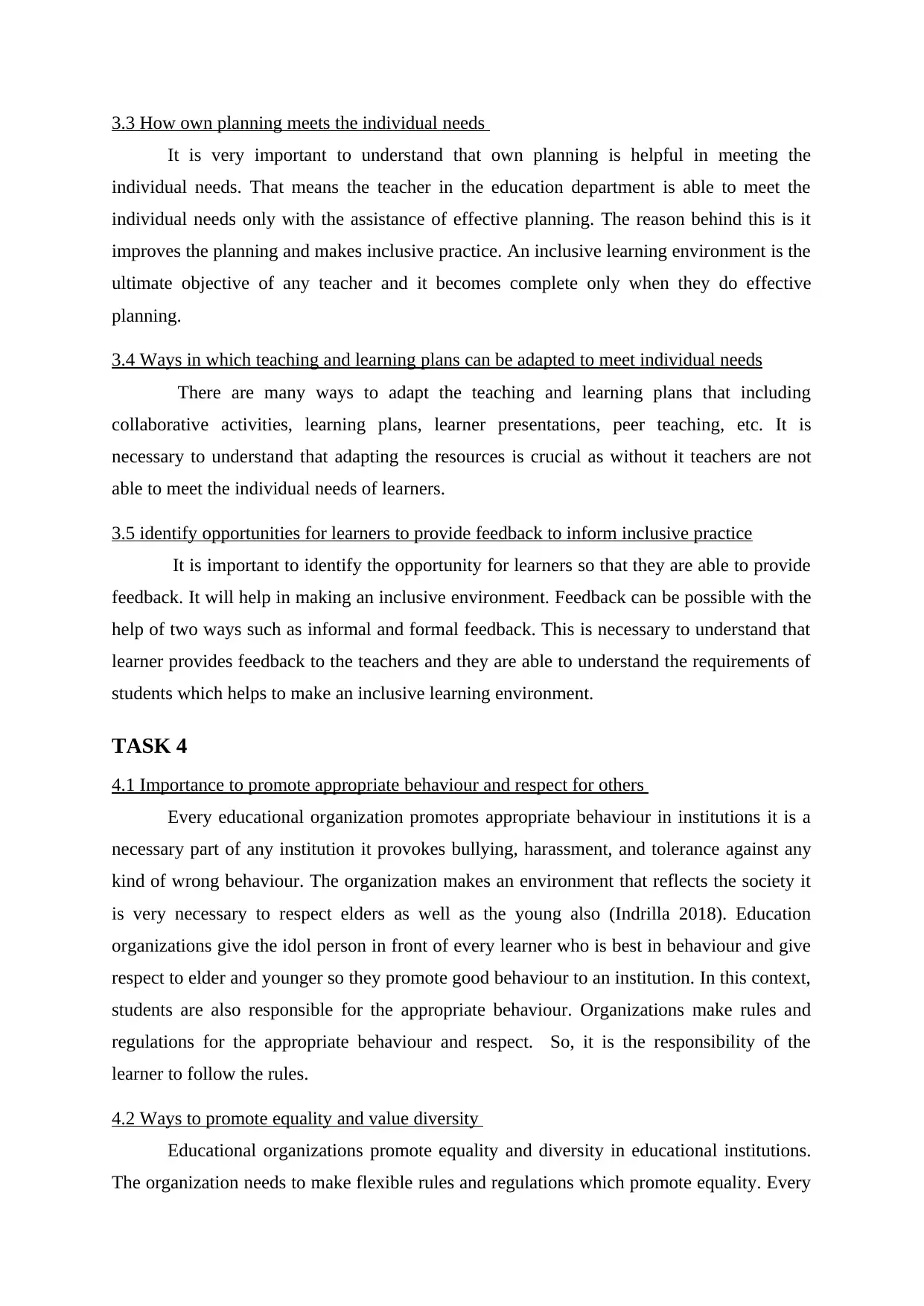
3.2 Designing of teaching and learning plans
Lesson plan
Subject Training
Topic Internal operations
Duration 2 hour
Teaching aids Lecture notes, marker, and projectors
General Aim To explain the functions and operations of amazon
Specific Aim To learn skills and knowledge
Time division Theory 35 minutes.
Students activity 30 minutes
Special educational needs 20 minutes
Ending notes 5 minutes.
What about the business of
amazon
Write about the operations
of amazon
Use of case studies &D1
2 Functions of Amazon
Selling books, movies,
housewares, music,
electronics and other goods
Showing the
functions with the
help of projectors
LO1: P1, M1
& D1
3 Supervising the trainees
Internal operations
Deliver Instructor training,
observation and coaching
Group discussions LO2: P2, M2
& D1
4 Building skills and knowledge in
the trainees so that they will be
perform the task in an efficient
way.
Daily activity
Daily targets
LO2: P2, M2
& D1
3.2 Designing of teaching and learning plans
Lesson plan
Subject Training
Topic Internal operations
Duration 2 hour
Teaching aids Lecture notes, marker, and projectors
General Aim To explain the functions and operations of amazon
Specific Aim To learn skills and knowledge
Time division Theory 35 minutes.
Students activity 30 minutes
Special educational needs 20 minutes
Ending notes 5 minutes.
Paraphrase This Document
Need a fresh take? Get an instant paraphrase of this document with our AI Paraphraser
3.3 How own planning meets the individual needs
It is very important to understand that own planning is helpful in meeting the
individual needs. That means the teacher in the education department is able to meet the
individual needs only with the assistance of effective planning. The reason behind this is it
improves the planning and makes inclusive practice. An inclusive learning environment is the
ultimate objective of any teacher and it becomes complete only when they do effective
planning.
3.4 Ways in which teaching and learning plans can be adapted to meet individual needs
There are many ways to adapt the teaching and learning plans that including
collaborative activities, learning plans, learner presentations, peer teaching, etc. It is
necessary to understand that adapting the resources is crucial as without it teachers are not
able to meet the individual needs of learners.
3.5 identify opportunities for learners to provide feedback to inform inclusive practice
It is important to identify the opportunity for learners so that they are able to provide
feedback. It will help in making an inclusive environment. Feedback can be possible with the
help of two ways such as informal and formal feedback. This is necessary to understand that
learner provides feedback to the teachers and they are able to understand the requirements of
students which helps to make an inclusive learning environment.
TASK 4
4.1 Importance to promote appropriate behaviour and respect for others
Every educational organization promotes appropriate behaviour in institutions it is a
necessary part of any institution it provokes bullying, harassment, and tolerance against any
kind of wrong behaviour. The organization makes an environment that reflects the society it
is very necessary to respect elders as well as the young also (Indrilla 2018). Education
organizations give the idol person in front of every learner who is best in behaviour and give
respect to elder and younger so they promote good behaviour to an institution. In this context,
students are also responsible for the appropriate behaviour. Organizations make rules and
regulations for the appropriate behaviour and respect. So, it is the responsibility of the
learner to follow the rules.
4.2 Ways to promote equality and value diversity
Educational organizations promote equality and diversity in educational institutions.
The organization needs to make flexible rules and regulations which promote equality. Every
It is very important to understand that own planning is helpful in meeting the
individual needs. That means the teacher in the education department is able to meet the
individual needs only with the assistance of effective planning. The reason behind this is it
improves the planning and makes inclusive practice. An inclusive learning environment is the
ultimate objective of any teacher and it becomes complete only when they do effective
planning.
3.4 Ways in which teaching and learning plans can be adapted to meet individual needs
There are many ways to adapt the teaching and learning plans that including
collaborative activities, learning plans, learner presentations, peer teaching, etc. It is
necessary to understand that adapting the resources is crucial as without it teachers are not
able to meet the individual needs of learners.
3.5 identify opportunities for learners to provide feedback to inform inclusive practice
It is important to identify the opportunity for learners so that they are able to provide
feedback. It will help in making an inclusive environment. Feedback can be possible with the
help of two ways such as informal and formal feedback. This is necessary to understand that
learner provides feedback to the teachers and they are able to understand the requirements of
students which helps to make an inclusive learning environment.
TASK 4
4.1 Importance to promote appropriate behaviour and respect for others
Every educational organization promotes appropriate behaviour in institutions it is a
necessary part of any institution it provokes bullying, harassment, and tolerance against any
kind of wrong behaviour. The organization makes an environment that reflects the society it
is very necessary to respect elders as well as the young also (Indrilla 2018). Education
organizations give the idol person in front of every learner who is best in behaviour and give
respect to elder and younger so they promote good behaviour to an institution. In this context,
students are also responsible for the appropriate behaviour. Organizations make rules and
regulations for the appropriate behaviour and respect. So, it is the responsibility of the
learner to follow the rules.
4.2 Ways to promote equality and value diversity
Educational organizations promote equality and diversity in educational institutions.
The organization needs to make flexible rules and regulations which promote equality. Every
organization recognizes equality it giving the chance to every learner to achieve something in
the organization (Lam 2018). Teacher creates equality in the classroom they give the various
task in the group which creates understanding in class. Equality and diversity are called
multi-culturalism the concept behind equality and diversity is promoting and accepting
people's differences. In the education sector, every organization promotes equality and
diversity in curriculum because they promote equality and diversity and create awareness
programs. Origination makes sure about all individuals are treated equally. Promote diversity
in the classroom they can give a various range of activities and principles for the learners.
Teacher teaches respect and recognizes people's differences which can create an inclusive
atmosphere in the organization.
4.3 Establish and sustain inclusive practice in education
Safe and inclusive environment is very important for any organization because every
learner wanted to a safe environment for their learning (Thu 2020). When learners go for
learning in the institution day wanted to discipline and piece of environment where they of
adapt knowledge given by teachers. The organization is maintaining the safest environment
for the learners as well as teachers and their staff. It is required by an organization. They
maintain or follow the policies which reduce risk in the organization. These rules and policies
play a vital role in a safe environment. Every person who belongs to teachers and learners
they are wanted to health and safety in the institution when they follow the rules, they reduce
risk or increase productivity in an institution.
TASK 5
5.1 Effectiveness of teaching and learning approaches used in own area of specialisation
Teachers use the best method and teaching styles in learning which helps the learners
in getting appropriate skills required by the organization. Teachers use those teaching
methods by which they can provide full subject knowledge to the learners. Teachers teaches
learner how they can open the door of opportunities for themselves. The lessons plan has
been designed by the teachers are according to the requirement of learners. Teachers uses
several small group activities by which learners understand how to build opportunities and
vocational qualification. Teachers understand the needs of the learners so they use learner
cantered methods by which they make learners achieve their required goals. Teachers use
range of learning styles and case studies by which learners understand and promote goals of
themselves.
the organization (Lam 2018). Teacher creates equality in the classroom they give the various
task in the group which creates understanding in class. Equality and diversity are called
multi-culturalism the concept behind equality and diversity is promoting and accepting
people's differences. In the education sector, every organization promotes equality and
diversity in curriculum because they promote equality and diversity and create awareness
programs. Origination makes sure about all individuals are treated equally. Promote diversity
in the classroom they can give a various range of activities and principles for the learners.
Teacher teaches respect and recognizes people's differences which can create an inclusive
atmosphere in the organization.
4.3 Establish and sustain inclusive practice in education
Safe and inclusive environment is very important for any organization because every
learner wanted to a safe environment for their learning (Thu 2020). When learners go for
learning in the institution day wanted to discipline and piece of environment where they of
adapt knowledge given by teachers. The organization is maintaining the safest environment
for the learners as well as teachers and their staff. It is required by an organization. They
maintain or follow the policies which reduce risk in the organization. These rules and policies
play a vital role in a safe environment. Every person who belongs to teachers and learners
they are wanted to health and safety in the institution when they follow the rules, they reduce
risk or increase productivity in an institution.
TASK 5
5.1 Effectiveness of teaching and learning approaches used in own area of specialisation
Teachers use the best method and teaching styles in learning which helps the learners
in getting appropriate skills required by the organization. Teachers use those teaching
methods by which they can provide full subject knowledge to the learners. Teachers teaches
learner how they can open the door of opportunities for themselves. The lessons plan has
been designed by the teachers are according to the requirement of learners. Teachers uses
several small group activities by which learners understand how to build opportunities and
vocational qualification. Teachers understand the needs of the learners so they use learner
cantered methods by which they make learners achieve their required goals. Teachers use
range of learning styles and case studies by which learners understand and promote goals of
themselves.
⊘ This is a preview!⊘
Do you want full access?
Subscribe today to unlock all pages.
Trusted by 1+ million students worldwide
5.2 Benefits and limitations of communication methods and media
Teachers use various communication methods and media in teaching which include
verbal and media depending on the subject. Teachers ask various open and close-ended
questions to the learners and they also give the presentation in the class they also ask
questions related to the presentation. Teachers often organize a discussion in class. Teachers
also use media in teaching they use printed material teaching and also provide images.
Nowadays teachers use ICT which includes PowerPoint and they also use VLE which is an
audio-visual ad. When teachers use these methods in teaching this gives deep subject
knowledge and better understanding to the learners. But there are some limitations also like
the teachers will not do hard work in writing the notes by themselves they will rely on
computerized notes and when a teacher writes notes by themselves this gives teachers more
confidence and it increases their efficiency in teaching also.
5.3 Effectiveness of resources used in own area of specialisation
There are various approaches that I use as a teacher which also suit the learning style
of the learners. I use methods that give a memorable impact on the learners and learners can
easily adapt to the methods. But if these types of resources and approaches have been used
the teacher first must think about the cost efficiency if the cost increases teachers cannot use
the methods properly. I use the presentation method which gives the learners a good
experience and better learning to the learners.
5.4 Use inclusive teaching and learning approaches and resources including technologies
Inclusive teachers are very useful for the teachers that’s why teachers use them, it is a
learner-cantered technique. Many resources help the teachers like PowerPoint, which helps to
learn in practice their skills. There are so many important resources like ICT, VLE,
approaches like workshops, use of PowerPoint, and group work that are also included in
inclusive teaching.
5.5 Ways to promote equality and value diversity
There are so many ways by which I can promote equality and value diversity like I
can focus on engaging all learners in a peer activity so that they will feel equality, engaging
all learners in a learning activity will make them feel that I am not doing an inequality among
them.
Teachers use various communication methods and media in teaching which include
verbal and media depending on the subject. Teachers ask various open and close-ended
questions to the learners and they also give the presentation in the class they also ask
questions related to the presentation. Teachers often organize a discussion in class. Teachers
also use media in teaching they use printed material teaching and also provide images.
Nowadays teachers use ICT which includes PowerPoint and they also use VLE which is an
audio-visual ad. When teachers use these methods in teaching this gives deep subject
knowledge and better understanding to the learners. But there are some limitations also like
the teachers will not do hard work in writing the notes by themselves they will rely on
computerized notes and when a teacher writes notes by themselves this gives teachers more
confidence and it increases their efficiency in teaching also.
5.3 Effectiveness of resources used in own area of specialisation
There are various approaches that I use as a teacher which also suit the learning style
of the learners. I use methods that give a memorable impact on the learners and learners can
easily adapt to the methods. But if these types of resources and approaches have been used
the teacher first must think about the cost efficiency if the cost increases teachers cannot use
the methods properly. I use the presentation method which gives the learners a good
experience and better learning to the learners.
5.4 Use inclusive teaching and learning approaches and resources including technologies
Inclusive teachers are very useful for the teachers that’s why teachers use them, it is a
learner-cantered technique. Many resources help the teachers like PowerPoint, which helps to
learn in practice their skills. There are so many important resources like ICT, VLE,
approaches like workshops, use of PowerPoint, and group work that are also included in
inclusive teaching.
5.5 Ways to promote equality and value diversity
There are so many ways by which I can promote equality and value diversity like I
can focus on engaging all learners in a peer activity so that they will feel equality, engaging
all learners in a learning activity will make them feel that I am not doing an inequality among
them.
Paraphrase This Document
Need a fresh take? Get an instant paraphrase of this document with our AI Paraphraser
5.6 Adapt teaching and learning approaches and resources
Passing the subject knowledge is one part of teaching. Educators also need an
attitude, practical skills, or general academics. Various approaches use in teaching and
learning the aim of the teaching method is sure learners are actively engaged in learning. The
teacher teaches the same lesson in different groups at this time teacher required other
methods they don't apply the same method in different groups (Abdulrahaman, and et.al.,
2020). Educators make lesson plans according to learner preference they concentrate on
Learner level. When teachers use teaching methods, they use different types of teaching
methods because they consider the whole group. Teachers' responsibility is that they use
various methods but a clear explanation. Every teacher uses the lecture method with practical
skills it is very important to give any information to the learner so teachers try to make class
interesting and innovative. When a teacher teaches practical subjects, the learner is not
destructed but when the teacher teaches theory subjects learner are going to sleep in that case
teacher create interest in class so they work hard to make a lesson plan.
5.7 Communicate with learners and learning professionals to meet individual learning needs
Communication is an essential part of learning when learners learn new concepts,
they communicate with the teacher because through communication they build their
relationship and understanding. The teacher gives information with a practical concept. Now
at the time, teachers' hard work for their learners is to show professionalism they wanted to
meet individual learning needs through communication. When communication is strong
learner give their best. A teacher has good communication skills so they easily understand the
learner's problems. teacher teach learner with various learning styles they motivate the learner
and increase their cognitive power every teacher want that their Learner is evaluated, analyse,
and create new things. The teacher develops a baseline before giving a lesson. The teacher set
goals for learners and according to their goal, they start teaching. The teacher includes
various approaches according to the subject student enjoys learning by visual or auditory
methods they create interest in learning. The teacher understands the need for a Learner.
TASK 6
6.1 Purpose and types of assessment used in education
Assessment is an internal part of instructions. It determines whether the goal of
education is met or not. Assessment affect decision about placement and curriculum (Okoye
and et.al., 2021). Assessment is very important in teaching and learning it motivate learners
Passing the subject knowledge is one part of teaching. Educators also need an
attitude, practical skills, or general academics. Various approaches use in teaching and
learning the aim of the teaching method is sure learners are actively engaged in learning. The
teacher teaches the same lesson in different groups at this time teacher required other
methods they don't apply the same method in different groups (Abdulrahaman, and et.al.,
2020). Educators make lesson plans according to learner preference they concentrate on
Learner level. When teachers use teaching methods, they use different types of teaching
methods because they consider the whole group. Teachers' responsibility is that they use
various methods but a clear explanation. Every teacher uses the lecture method with practical
skills it is very important to give any information to the learner so teachers try to make class
interesting and innovative. When a teacher teaches practical subjects, the learner is not
destructed but when the teacher teaches theory subjects learner are going to sleep in that case
teacher create interest in class so they work hard to make a lesson plan.
5.7 Communicate with learners and learning professionals to meet individual learning needs
Communication is an essential part of learning when learners learn new concepts,
they communicate with the teacher because through communication they build their
relationship and understanding. The teacher gives information with a practical concept. Now
at the time, teachers' hard work for their learners is to show professionalism they wanted to
meet individual learning needs through communication. When communication is strong
learner give their best. A teacher has good communication skills so they easily understand the
learner's problems. teacher teach learner with various learning styles they motivate the learner
and increase their cognitive power every teacher want that their Learner is evaluated, analyse,
and create new things. The teacher develops a baseline before giving a lesson. The teacher set
goals for learners and according to their goal, they start teaching. The teacher includes
various approaches according to the subject student enjoys learning by visual or auditory
methods they create interest in learning. The teacher understands the need for a Learner.
TASK 6
6.1 Purpose and types of assessment used in education
Assessment is an internal part of instructions. It determines whether the goal of
education is met or not. Assessment affect decision about placement and curriculum (Okoye
and et.al., 2021). Assessment is very important in teaching and learning it motivate learners
for their learning when assessment is used by teachers it provides valuable information to
learners it provides information about learner capacity the weak points are the strength and
weakness known by assessment. The assessment tool used by modern teachers is used in a
variety of forms it can be written, oral, multiple choice, project, and teacher give the task of
self-assessment also. Assessment types are wide assessment is necessary for the learner to
check their strength and weakness.
6.2 Effectiveness of assessment methods in relation to meeting the individual needs
Assessment methods are very wide so teachers use them in different forms. It gives
various effectiveness which shown by learner outcome (Miño Puigcercós, Domingo-
Coscollola and JUANA MARIA 2019). Assessments match with learner needs because every
teacher adds assessments according to the requirement of the subject. Use assessment for
checking learner strengths or weaknesses its effectiveness shows in learner results. When the
learner performs well it is shown in assessment give confidence within task now learner
eligible for another task, they wanted to take another task this is effectiveness. The learner
learns new things and becomes more confident in the subject it is a practical approach where
Learner learns by doing things.
6.3 Types and methods of assessment including peer and self-assessment
There are a number of methods used in the assessment two are the most important
such as peer and self-assessment. Both types of assessment are very important as it helps to
involve the learners in the assessment. In addition to this, it will also be helpful in meeting
the individual needs of learners and enable them to produce assessment evidence and meet
the internal and external requirements.
6.4 Use questioning and feedback to contribute to the assessment process
Questioning is an internal part of the assessment it is very important to ask questions
from learners it gives information about existing knowledge. Every teacher uses effective
questions which give variety and benefits in class. When the teacher asks questions, it
discovers knowledge. Questions are important to develop understanding when teacher ask
questions in classrooms every learner become very integrated and listen carefully to
questions. The effectiveness series of questions start with close questions or is followed by
open questions. Bloom taxonomy is help in effective questions they add cognitive domain
affective domain psycho motor domain these domains create effective questions. The teacher
asks any question from learners with equal respect when the sometimes learner does not
learners it provides information about learner capacity the weak points are the strength and
weakness known by assessment. The assessment tool used by modern teachers is used in a
variety of forms it can be written, oral, multiple choice, project, and teacher give the task of
self-assessment also. Assessment types are wide assessment is necessary for the learner to
check their strength and weakness.
6.2 Effectiveness of assessment methods in relation to meeting the individual needs
Assessment methods are very wide so teachers use them in different forms. It gives
various effectiveness which shown by learner outcome (Miño Puigcercós, Domingo-
Coscollola and JUANA MARIA 2019). Assessments match with learner needs because every
teacher adds assessments according to the requirement of the subject. Use assessment for
checking learner strengths or weaknesses its effectiveness shows in learner results. When the
learner performs well it is shown in assessment give confidence within task now learner
eligible for another task, they wanted to take another task this is effectiveness. The learner
learns new things and becomes more confident in the subject it is a practical approach where
Learner learns by doing things.
6.3 Types and methods of assessment including peer and self-assessment
There are a number of methods used in the assessment two are the most important
such as peer and self-assessment. Both types of assessment are very important as it helps to
involve the learners in the assessment. In addition to this, it will also be helpful in meeting
the individual needs of learners and enable them to produce assessment evidence and meet
the internal and external requirements.
6.4 Use questioning and feedback to contribute to the assessment process
Questioning is an internal part of the assessment it is very important to ask questions
from learners it gives information about existing knowledge. Every teacher uses effective
questions which give variety and benefits in class. When the teacher asks questions, it
discovers knowledge. Questions are important to develop understanding when teacher ask
questions in classrooms every learner become very integrated and listen carefully to
questions. The effectiveness series of questions start with close questions or is followed by
open questions. Bloom taxonomy is help in effective questions they add cognitive domain
affective domain psycho motor domain these domains create effective questions. The teacher
asks any question from learners with equal respect when the sometimes learner does not
⊘ This is a preview!⊘
Do you want full access?
Subscribe today to unlock all pages.
Trusted by 1+ million students worldwide

1 out of 18


Related Documents


Your All-in-One AI-Powered Toolkit for Academic Success.
+13062052269
info@desklib.com
Available 24*7 on WhatsApp / Email
![[object Object]](/_next/static/media/star-bottom.7253800d.svg)
Unlock your academic potential
Copyright © 2020–2026 A2Z Services. All Rights Reserved. Developed and managed by ZUCOL.