Organisational Behaviour: Analysing Team Dynamics at Sainsbury's
VerifiedAdded on 2023/06/04
|17
|5007
|127
Report
AI Summary
This report provides an analysis of organisational behaviour within Sainsbury's, focusing on how organisational politics, culture, and power dynamics influence individual and team performance. It evaluates motivational theories, such as Maslow's hierarchy of needs and Vroom's expectancy theory, and their effectiveness in achieving organisational goals. The report also examines the impact of power, culture, and politics on employee behaviour, delving into the characteristics of effective versus ineffective teams, the benefits of teamwork, and the application of organisational behaviour philosophies. It critically evaluates the relevance of theories, concepts, and philosophies for enhancing productivity within the organisation.
Organisational
behaviour
behaviour

Paraphrase This Document
Need a fresh take? Get an instant paraphrase of this document with our AI Paraphraser
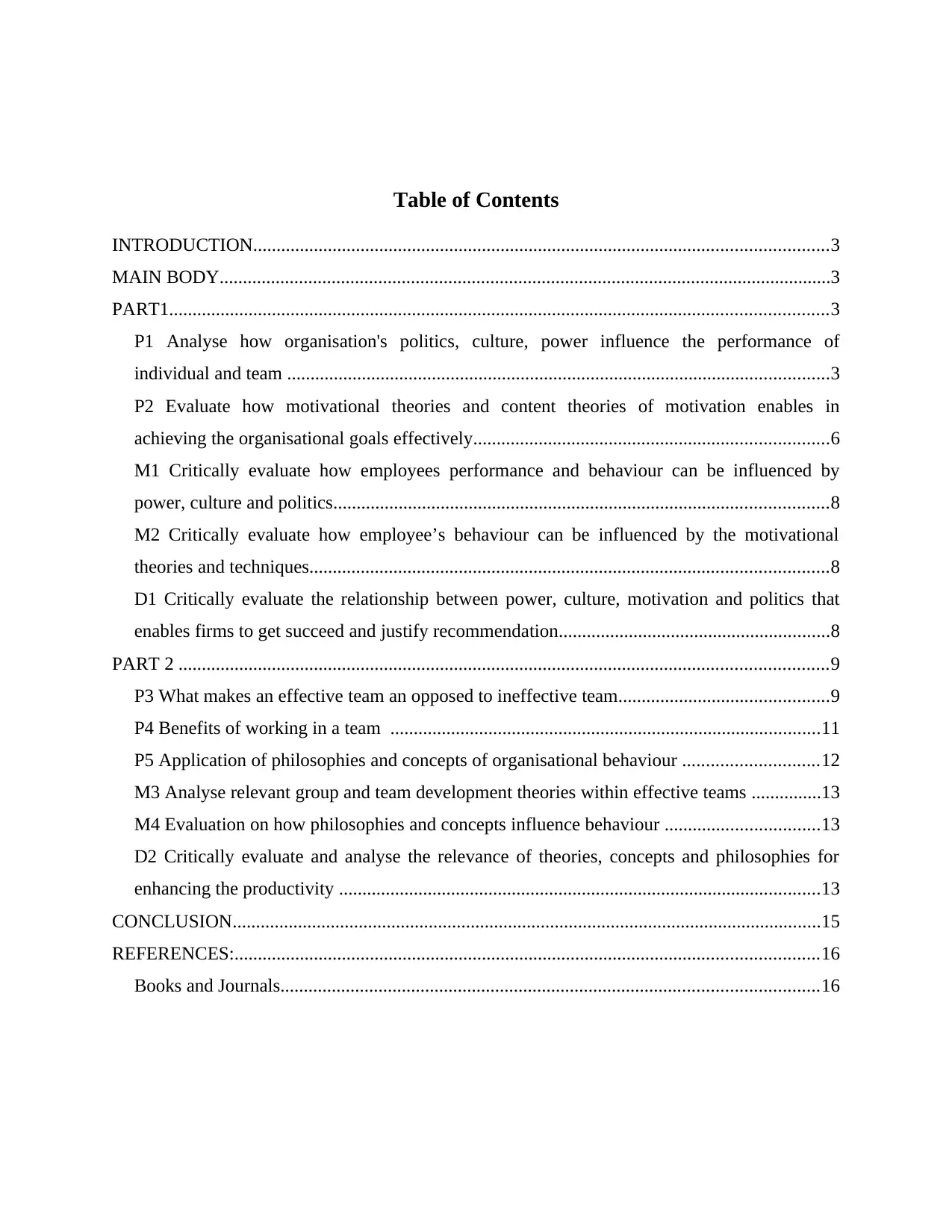
Table of Contents
INTRODUCTION...........................................................................................................................3
MAIN BODY...................................................................................................................................3
PART1.............................................................................................................................................3
P1 Analyse how organisation's politics, culture, power influence the performance of
individual and team ....................................................................................................................3
P2 Evaluate how motivational theories and content theories of motivation enables in
achieving the organisational goals effectively............................................................................6
M1 Critically evaluate how employees performance and behaviour can be influenced by
power, culture and politics..........................................................................................................8
M2 Critically evaluate how employee’s behaviour can be influenced by the motivational
theories and techniques...............................................................................................................8
D1 Critically evaluate the relationship between power, culture, motivation and politics that
enables firms to get succeed and justify recommendation..........................................................8
PART 2 ...........................................................................................................................................9
P3 What makes an effective team an opposed to ineffective team.............................................9
P4 Benefits of working in a team ............................................................................................11
P5 Application of philosophies and concepts of organisational behaviour .............................12
M3 Analyse relevant group and team development theories within effective teams ...............13
M4 Evaluation on how philosophies and concepts influence behaviour .................................13
D2 Critically evaluate and analyse the relevance of theories, concepts and philosophies for
enhancing the productivity .......................................................................................................13
CONCLUSION..............................................................................................................................15
REFERENCES:.............................................................................................................................16
Books and Journals...................................................................................................................16
INTRODUCTION...........................................................................................................................3
MAIN BODY...................................................................................................................................3
PART1.............................................................................................................................................3
P1 Analyse how organisation's politics, culture, power influence the performance of
individual and team ....................................................................................................................3
P2 Evaluate how motivational theories and content theories of motivation enables in
achieving the organisational goals effectively............................................................................6
M1 Critically evaluate how employees performance and behaviour can be influenced by
power, culture and politics..........................................................................................................8
M2 Critically evaluate how employee’s behaviour can be influenced by the motivational
theories and techniques...............................................................................................................8
D1 Critically evaluate the relationship between power, culture, motivation and politics that
enables firms to get succeed and justify recommendation..........................................................8
PART 2 ...........................................................................................................................................9
P3 What makes an effective team an opposed to ineffective team.............................................9
P4 Benefits of working in a team ............................................................................................11
P5 Application of philosophies and concepts of organisational behaviour .............................12
M3 Analyse relevant group and team development theories within effective teams ...............13
M4 Evaluation on how philosophies and concepts influence behaviour .................................13
D2 Critically evaluate and analyse the relevance of theories, concepts and philosophies for
enhancing the productivity .......................................................................................................13
CONCLUSION..............................................................................................................................15
REFERENCES:.............................................................................................................................16
Books and Journals...................................................................................................................16
INTRODUCTION
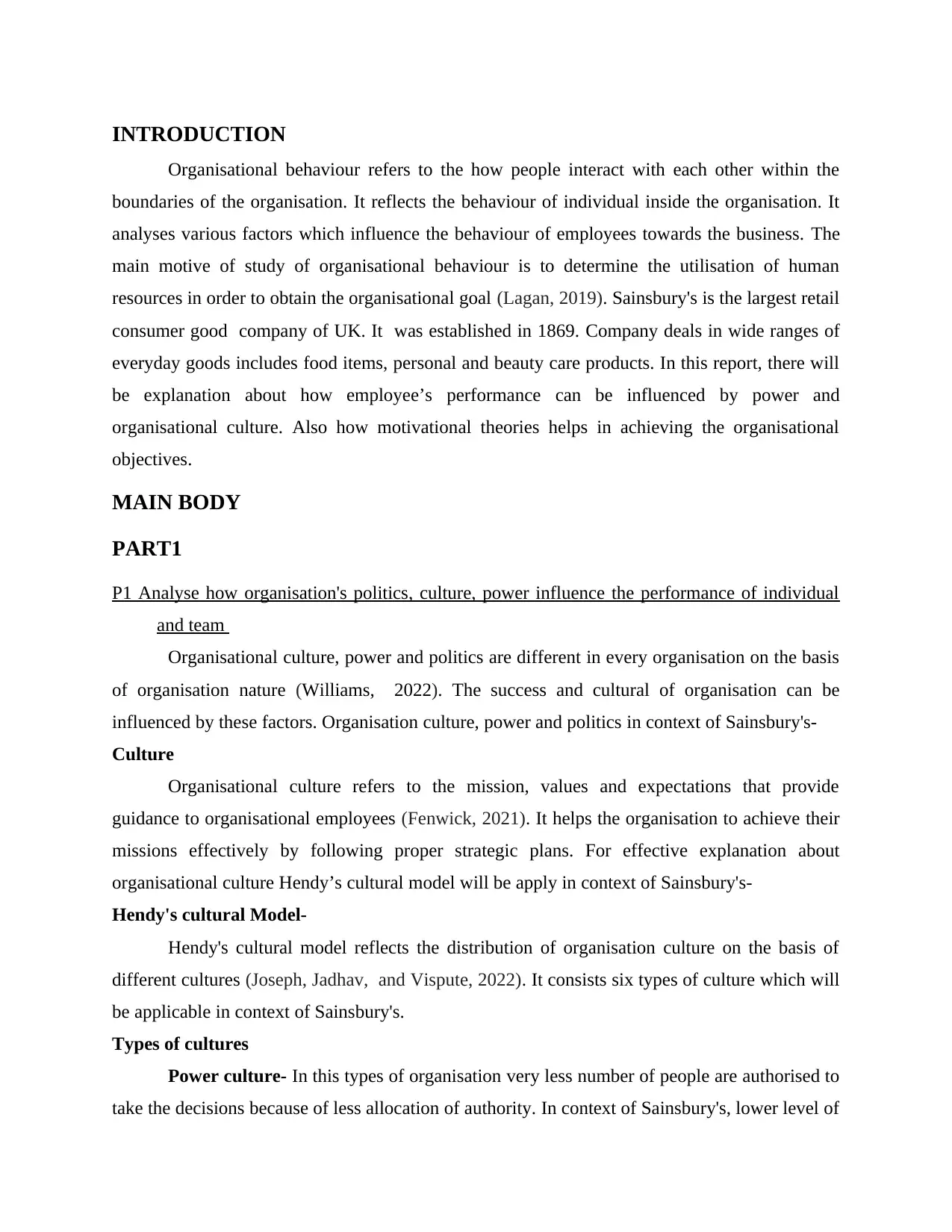
Organisational behaviour refers to the how people interact with each other within the
boundaries of the organisation. It reflects the behaviour of individual inside the organisation. It
analyses various factors which influence the behaviour of employees towards the business. The
main motive of study of organisational behaviour is to determine the utilisation of human
resources in order to obtain the organisational goal (Lagan, 2019). Sainsbury's is the largest retail
consumer good company of UK. It was established in 1869. Company deals in wide ranges of
everyday goods includes food items, personal and beauty care products. In this report, there will
be explanation about how employee’s performance can be influenced by power and
organisational culture. Also how motivational theories helps in achieving the organisational
objectives.
MAIN BODY
PART1
P1 Analyse how organisation's politics, culture, power influence the performance of individual
and team
Organisational culture, power and politics are different in every organisation on the basis
of organisation nature (Williams, 2022). The success and cultural of organisation can be
influenced by these factors. Organisation culture, power and politics in context of Sainsbury's-
Culture
Organisational culture refers to the mission, values and expectations that provide
guidance to organisational employees (Fenwick, 2021). It helps the organisation to achieve their
missions effectively by following proper strategic plans. For effective explanation about
organisational culture Hendy’s cultural model will be apply in context of Sainsbury's-
Hendy's cultural Model-
Hendy's cultural model reflects the distribution of organisation culture on the basis of
different cultures (Joseph, Jadhav, and Vispute, 2022). It consists six types of culture which will
be applicable in context of Sainsbury's.
Types of cultures
Power culture- In this types of organisation very less number of people are authorised to
take the decisions because of less allocation of authority. In context of Sainsbury's, lower level of
Organisational behaviour refers to the how people interact with each other within the
boundaries of the organisation. It reflects the behaviour of individual inside the organisation. It
analyses various factors which influence the behaviour of employees towards the business. The
main motive of study of organisational behaviour is to determine the utilisation of human
resources in order to obtain the organisational goal (Lagan, 2019). Sainsbury's is the largest retail
consumer good company of UK. It was established in 1869. Company deals in wide ranges of
everyday goods includes food items, personal and beauty care products. In this report, there will
be explanation about how employee’s performance can be influenced by power and
organisational culture. Also how motivational theories helps in achieving the organisational
objectives.
MAIN BODY
PART1
P1 Analyse how organisation's politics, culture, power influence the performance of individual
and team
Organisational culture, power and politics are different in every organisation on the basis
of organisation nature (Williams, 2022). The success and cultural of organisation can be
influenced by these factors. Organisation culture, power and politics in context of Sainsbury's-
Culture
Organisational culture refers to the mission, values and expectations that provide
guidance to organisational employees (Fenwick, 2021). It helps the organisation to achieve their
missions effectively by following proper strategic plans. For effective explanation about
organisational culture Hendy’s cultural model will be apply in context of Sainsbury's-
Hendy's cultural Model-
Hendy's cultural model reflects the distribution of organisation culture on the basis of
different cultures (Joseph, Jadhav, and Vispute, 2022). It consists six types of culture which will
be applicable in context of Sainsbury's.
Types of cultures
Power culture- In this types of organisation very less number of people are authorised to
take the decisions because of less allocation of authority. In context of Sainsbury's, lower level of
⊘ This is a preview!⊘
Do you want full access?
Subscribe today to unlock all pages.

Trusted by 1+ million students worldwide
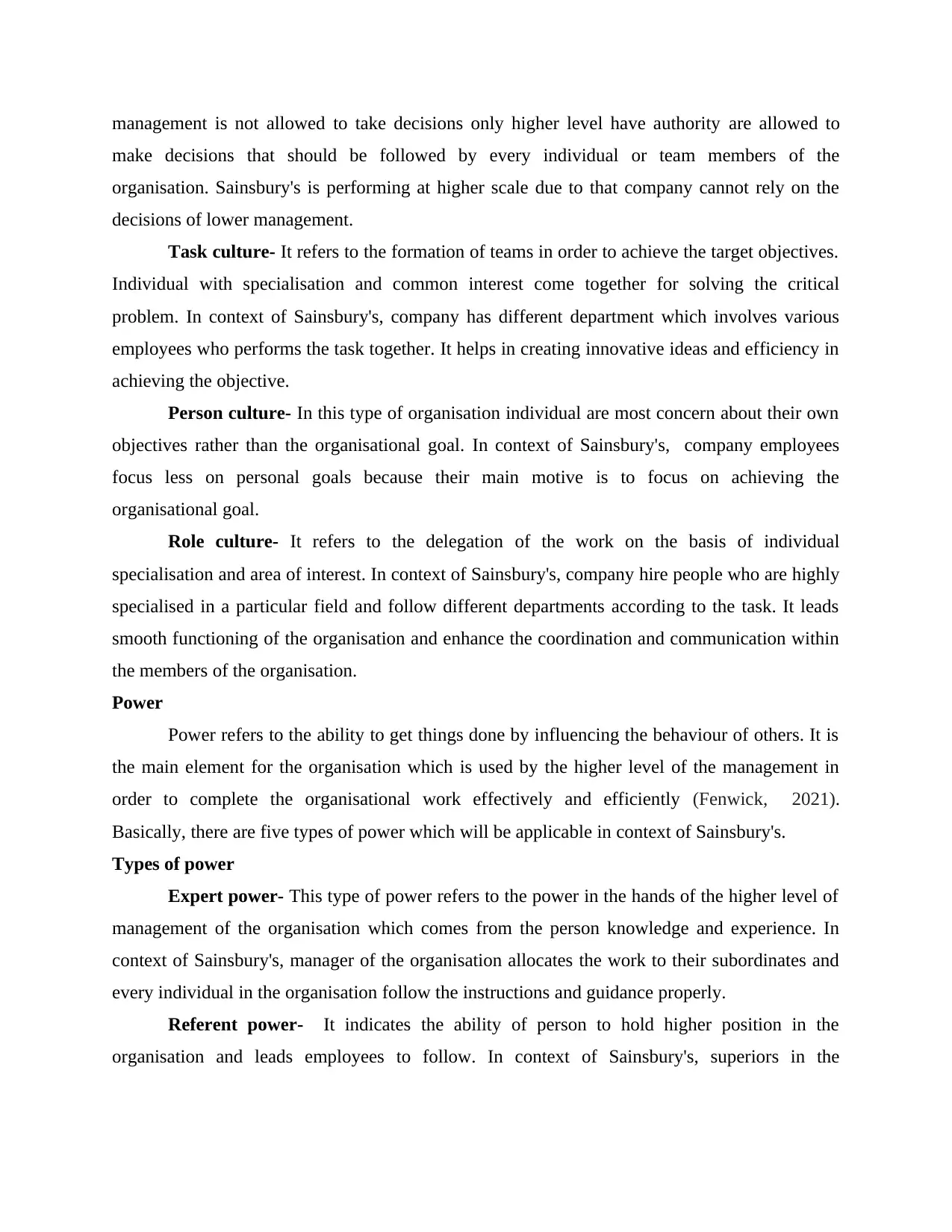
management is not allowed to take decisions only higher level have authority are allowed to
make decisions that should be followed by every individual or team members of the
organisation. Sainsbury's is performing at higher scale due to that company cannot rely on the
decisions of lower management.
Task culture- It refers to the formation of teams in order to achieve the target objectives.
Individual with specialisation and common interest come together for solving the critical
problem. In context of Sainsbury's, company has different department which involves various
employees who performs the task together. It helps in creating innovative ideas and efficiency in
achieving the objective.
Person culture- In this type of organisation individual are most concern about their own
objectives rather than the organisational goal. In context of Sainsbury's, company employees
focus less on personal goals because their main motive is to focus on achieving the
organisational goal.
Role culture- It refers to the delegation of the work on the basis of individual
specialisation and area of interest. In context of Sainsbury's, company hire people who are highly
specialised in a particular field and follow different departments according to the task. It leads
smooth functioning of the organisation and enhance the coordination and communication within
the members of the organisation.
Power
Power refers to the ability to get things done by influencing the behaviour of others. It is
the main element for the organisation which is used by the higher level of the management in
order to complete the organisational work effectively and efficiently (Fenwick, 2021).
Basically, there are five types of power which will be applicable in context of Sainsbury's.
Types of power
Expert power- This type of power refers to the power in the hands of the higher level of
management of the organisation which comes from the person knowledge and experience. In
context of Sainsbury's, manager of the organisation allocates the work to their subordinates and
every individual in the organisation follow the instructions and guidance properly.
Referent power- It indicates the ability of person to hold higher position in the
organisation and leads employees to follow. In context of Sainsbury's, superiors in the
make decisions that should be followed by every individual or team members of the
organisation. Sainsbury's is performing at higher scale due to that company cannot rely on the
decisions of lower management.
Task culture- It refers to the formation of teams in order to achieve the target objectives.
Individual with specialisation and common interest come together for solving the critical
problem. In context of Sainsbury's, company has different department which involves various
employees who performs the task together. It helps in creating innovative ideas and efficiency in
achieving the objective.
Person culture- In this type of organisation individual are most concern about their own
objectives rather than the organisational goal. In context of Sainsbury's, company employees
focus less on personal goals because their main motive is to focus on achieving the
organisational goal.
Role culture- It refers to the delegation of the work on the basis of individual
specialisation and area of interest. In context of Sainsbury's, company hire people who are highly
specialised in a particular field and follow different departments according to the task. It leads
smooth functioning of the organisation and enhance the coordination and communication within
the members of the organisation.
Power
Power refers to the ability to get things done by influencing the behaviour of others. It is
the main element for the organisation which is used by the higher level of the management in
order to complete the organisational work effectively and efficiently (Fenwick, 2021).
Basically, there are five types of power which will be applicable in context of Sainsbury's.
Types of power
Expert power- This type of power refers to the power in the hands of the higher level of
management of the organisation which comes from the person knowledge and experience. In
context of Sainsbury's, manager of the organisation allocates the work to their subordinates and
every individual in the organisation follow the instructions and guidance properly.
Referent power- It indicates the ability of person to hold higher position in the
organisation and leads employees to follow. In context of Sainsbury's, superiors in the
Paraphrase This Document
Need a fresh take? Get an instant paraphrase of this document with our AI Paraphraser
organisations at different positions formulate all the strategies, rules that subordinates needs to
follow in order to achieve organisational goal.
Legitimate power- It refers to the monitoring the organisational resources in order to
have effective working of the organisation. In context of Sainsbury's, CEO of the business
controls the functioning of the firm and take all decisions of organisation.
Coercive power- This type of power reflects the negative effect on the organisation
culture and considered as punish power. Sainsbury top management do not use coercive power
like employees terminations, salary deduction when employees made any mistakes.
Reward power- This types of power involves allocation of financial and non-financial
incentives to employees of the organisation in order to motivate them for effective working of
the organisation. It includes salary, wages, promotion, health and safety securities to employees.
In context of Unilever, they provide health and safety benefits to employees of the organisation
for motivating them. It helps employees to contribute their best efforts towards the working of
the organisation that will enhance the productivity.
Politics
Politics refers to individual focus on attaining the personal interest rather than
organisational goal. Politics creates the negative impact on the organisation culture and builds
negative outcomes (Carlisle, and Ramudu, 2019). In every organisation there are different types
of people and their interest are also different from each other. Politics basically occurs due to
inequality, competitiveness and wrong decision in business. Organisation which consist politics
at their workplace creates job anxiety, depression among the members of the organisation. It
automatically creates a negative impact on the performance of the organisation and decrease the
productivity level of organisation. There are four types of politics which are applicable in context
of Sainsbury's.
Types of politics
Weeds- It refers to the creation of informal networks and groups within the boundaries of
the organisation. It reflects the flow of messages, communication among the members of the
business. Sainsbury's follow this type of politics at their workplace between the employees of the
firm.
follow in order to achieve organisational goal.
Legitimate power- It refers to the monitoring the organisational resources in order to
have effective working of the organisation. In context of Sainsbury's, CEO of the business
controls the functioning of the firm and take all decisions of organisation.
Coercive power- This type of power reflects the negative effect on the organisation
culture and considered as punish power. Sainsbury top management do not use coercive power
like employees terminations, salary deduction when employees made any mistakes.
Reward power- This types of power involves allocation of financial and non-financial
incentives to employees of the organisation in order to motivate them for effective working of
the organisation. It includes salary, wages, promotion, health and safety securities to employees.
In context of Unilever, they provide health and safety benefits to employees of the organisation
for motivating them. It helps employees to contribute their best efforts towards the working of
the organisation that will enhance the productivity.
Politics
Politics refers to individual focus on attaining the personal interest rather than
organisational goal. Politics creates the negative impact on the organisation culture and builds
negative outcomes (Carlisle, and Ramudu, 2019). In every organisation there are different types
of people and their interest are also different from each other. Politics basically occurs due to
inequality, competitiveness and wrong decision in business. Organisation which consist politics
at their workplace creates job anxiety, depression among the members of the organisation. It
automatically creates a negative impact on the performance of the organisation and decrease the
productivity level of organisation. There are four types of politics which are applicable in context
of Sainsbury's.
Types of politics
Weeds- It refers to the creation of informal networks and groups within the boundaries of
the organisation. It reflects the flow of messages, communication among the members of the
business. Sainsbury's follow this type of politics at their workplace between the employees of the
firm.
The rock- It refers to centralised system of the organisation where there is formal
network follow by the members of the business. Sainsbury's follow proper hierarchy of
authorities and communication from higher to lower level of management.
The high ground- It refers to the formal structure of the organisation. In context of
Sainsbury's, mangers set rules that subordinates need to follow and involves proper delegation of
authorities and work among the members of the organisation.
The woods- It refers to the hidden policies and assumptions that can affect the
organisational positioning. Sainsbury's also involves this type of politics at their workplace like
if employees are not able to perform their tasks in a given time period then they need to perform
for long hours.
P2 Evaluate how motivational theories and content theories of motivation enables in achieving
the organisational goals effectively
Motivation is considered as a necessary tool which enables employees to contributes their
best efforts towards achieving the goal of the organisation (Huberts, and van Montfort, 2020).
Organisations provide financial and non-financial incentives of motivation to employees that
influence the behaviour of employees towards the business. In context of Sainsbury’s, the two
types of motivational and content theory will be applicable.
Maslow's need hierarchy theory
Maslow's need hierarchy theory of motivation indicates five different stages of needs and
wants of individuals and fulfilment of those stages brings productivity level in an organisation.
Psychological needs- This need is considered as a basic needs of people and it includes
food, shelter and clothes. In context of Sainsbury's, company provides fair wages and salary to
their employees so that they can fulfils their basic needs easily. This helps in motivating
employees and enables them to contribute their best efforts towards achieving the organisational
goal.
Safety and security- It refers to the providing protection against safety and health of
employee. In context of Sainsbury's company follow health and safety act 1974 in order to
protect the interest of employees regarding their health and safety in case of any accident and
injuries. It helps in enhancing the motivation level among the employees and that will directly
create positive impact on organisational performance.
network follow by the members of the business. Sainsbury's follow proper hierarchy of
authorities and communication from higher to lower level of management.
The high ground- It refers to the formal structure of the organisation. In context of
Sainsbury's, mangers set rules that subordinates need to follow and involves proper delegation of
authorities and work among the members of the organisation.
The woods- It refers to the hidden policies and assumptions that can affect the
organisational positioning. Sainsbury's also involves this type of politics at their workplace like
if employees are not able to perform their tasks in a given time period then they need to perform
for long hours.
P2 Evaluate how motivational theories and content theories of motivation enables in achieving
the organisational goals effectively
Motivation is considered as a necessary tool which enables employees to contributes their
best efforts towards achieving the goal of the organisation (Huberts, and van Montfort, 2020).
Organisations provide financial and non-financial incentives of motivation to employees that
influence the behaviour of employees towards the business. In context of Sainsbury’s, the two
types of motivational and content theory will be applicable.
Maslow's need hierarchy theory
Maslow's need hierarchy theory of motivation indicates five different stages of needs and
wants of individuals and fulfilment of those stages brings productivity level in an organisation.
Psychological needs- This need is considered as a basic needs of people and it includes
food, shelter and clothes. In context of Sainsbury's, company provides fair wages and salary to
their employees so that they can fulfils their basic needs easily. This helps in motivating
employees and enables them to contribute their best efforts towards achieving the organisational
goal.
Safety and security- It refers to the providing protection against safety and health of
employee. In context of Sainsbury's company follow health and safety act 1974 in order to
protect the interest of employees regarding their health and safety in case of any accident and
injuries. It helps in enhancing the motivation level among the employees and that will directly
create positive impact on organisational performance.
⊘ This is a preview!⊘
Do you want full access?
Subscribe today to unlock all pages.
Trusted by 1+ million students worldwide
Social needs- It refers to the interpersonal relation of employees with other members and
building respect with each other. In context of Sainsbury's, employees of the organisation are
allowed to maintain their relation with other member of the business in order to maintain good
relation with employees. The top level management allows their subordinates to take part in
decision making process so that employees will feel part of the organisation.
Self-esteem- It indicates receiving dignity, acknowledgment, prestige and reward from
other people. Sainsbury's provide rewards and promotions to their employees in order to
motivate them and its directly helps in increasing the productivity level of the organisation.
Self-actualisation- This need is considered as a highest level of need which includes
self-fulfilment and achievement of personal growth. In context of Sainsbury's, it provides
promotion opportunity to employees who give their best efforts in work and also the person who
is highly skilled and knowledgeable. Organisations can increase their business growth through
fulfilling needs of the employees.
Vroom expectancy theory
Vroom's expectancy theory evaluates the performance level of the employees on the basis
of different factors like knowledge, skills and ability of an individual. It shows inter relation
between motivation, performance and efforts of an individual’s (Lee, and Lu, 2022). The
explanation on factors of Vroom' expectancy theory is described below in context of Sainsbury's.
Expectancy- It indicates that if employees give their effort then they will receive certain
outcome . In context of Sainsbury's, company provides all information, resources to their
employees for effective working of the organisation. These factors help organisation to achieve
their objectives and achieve competitive advantage.
Valence- It refers that the rewards provided to employees on the basis of their
preferences. In context of Sainsbury’s, it provides various types of rewards in monetary or non-
monetary form on the basis of employee’s best performance. It helps organisation to create good
brand image in the mind of employees.
Instrumentality- It shows the connection between outcome and performance of an
individual. Good efforts of employees towards the work leads effective outcomes. In context of
Sainsbury's, higher level of authorities provides training and development sessions to their
employees for enhancing the skills and knowledge of individuals. For example- if employees
building respect with each other. In context of Sainsbury's, employees of the organisation are
allowed to maintain their relation with other member of the business in order to maintain good
relation with employees. The top level management allows their subordinates to take part in
decision making process so that employees will feel part of the organisation.
Self-esteem- It indicates receiving dignity, acknowledgment, prestige and reward from
other people. Sainsbury's provide rewards and promotions to their employees in order to
motivate them and its directly helps in increasing the productivity level of the organisation.
Self-actualisation- This need is considered as a highest level of need which includes
self-fulfilment and achievement of personal growth. In context of Sainsbury's, it provides
promotion opportunity to employees who give their best efforts in work and also the person who
is highly skilled and knowledgeable. Organisations can increase their business growth through
fulfilling needs of the employees.
Vroom expectancy theory
Vroom's expectancy theory evaluates the performance level of the employees on the basis
of different factors like knowledge, skills and ability of an individual. It shows inter relation
between motivation, performance and efforts of an individual’s (Lee, and Lu, 2022). The
explanation on factors of Vroom' expectancy theory is described below in context of Sainsbury's.
Expectancy- It indicates that if employees give their effort then they will receive certain
outcome . In context of Sainsbury's, company provides all information, resources to their
employees for effective working of the organisation. These factors help organisation to achieve
their objectives and achieve competitive advantage.
Valence- It refers that the rewards provided to employees on the basis of their
preferences. In context of Sainsbury’s, it provides various types of rewards in monetary or non-
monetary form on the basis of employee’s best performance. It helps organisation to create good
brand image in the mind of employees.
Instrumentality- It shows the connection between outcome and performance of an
individual. Good efforts of employees towards the work leads effective outcomes. In context of
Sainsbury's, higher level of authorities provides training and development sessions to their
employees for enhancing the skills and knowledge of individuals. For example- if employees
Paraphrase This Document
Need a fresh take? Get an instant paraphrase of this document with our AI Paraphraser
learned new skills for promotions and then they will not rewarded for higher job position. Then
their existing skills will helps them to future promotions..
M1 Critically evaluate how employees performance and behaviour can be influenced by power,
culture and politics
Employees behaviour and performance can be influenced by power, culture and politics.
Organisation culture consist the norms, value and ethics also there are different types of culture
exist in the organisation on the basis of organisation nature with the help of Hendy's cultural
model (Shah, and Shome, 2022). Power also play role in influencing the behaviour and
performance of employees. In organisations higher level of authorities uses different types of
powers according to the business situation. Every organisation consist politics at workplace
which enables individuals to focus on personal interest rather than organisation goals.
Sainsbury's involves different types of powers, cultures and politics for analysing the
organisational employee’s behaviour and performance. Also affects the internal environment of
the organisation that directly creates impact on positioning of the company.
M2 Critically evaluate how employee’s behaviour can be influenced by the motivational theories
and techniques
Motivation is they key element for organisation which enables employees to contribute
their best towards the working of the organisation. Maslow's need hierarchy theory and Vroom's
expectancy theory applied in organisation for motivating the employees and increasing the
productivity level of organisation. These theories enables firms to identify the needs of the
employees and fulfilling those needs and wants of the individuals by providing financial and
non-financial incentives to them (Sapie, Hussain, Ishak, and Yusof, 2019). Vroom's expectancy
theory helps in analysing the performance level of employees on the basis of their skills and
abilities. Sainsbury's uses various motivational techniques in order to motivate the employees
and also provides training session for increasing the knowledge and skills of the them.
D1 Critically evaluate the relationship between power, culture, motivation and politics that
enables firms to get succeed and justify recommendation
Organisational success can be influenced by the power, culture, motivation and politics.
Mangers of the organisation use power for analysing the performances of the employees and use
of motivational factors enables their employees to provide innovative and effective efforts
their existing skills will helps them to future promotions..
M1 Critically evaluate how employees performance and behaviour can be influenced by power,
culture and politics
Employees behaviour and performance can be influenced by power, culture and politics.
Organisation culture consist the norms, value and ethics also there are different types of culture
exist in the organisation on the basis of organisation nature with the help of Hendy's cultural
model (Shah, and Shome, 2022). Power also play role in influencing the behaviour and
performance of employees. In organisations higher level of authorities uses different types of
powers according to the business situation. Every organisation consist politics at workplace
which enables individuals to focus on personal interest rather than organisation goals.
Sainsbury's involves different types of powers, cultures and politics for analysing the
organisational employee’s behaviour and performance. Also affects the internal environment of
the organisation that directly creates impact on positioning of the company.
M2 Critically evaluate how employee’s behaviour can be influenced by the motivational theories
and techniques
Motivation is they key element for organisation which enables employees to contribute
their best towards the working of the organisation. Maslow's need hierarchy theory and Vroom's
expectancy theory applied in organisation for motivating the employees and increasing the
productivity level of organisation. These theories enables firms to identify the needs of the
employees and fulfilling those needs and wants of the individuals by providing financial and
non-financial incentives to them (Sapie, Hussain, Ishak, and Yusof, 2019). Vroom's expectancy
theory helps in analysing the performance level of employees on the basis of their skills and
abilities. Sainsbury's uses various motivational techniques in order to motivate the employees
and also provides training session for increasing the knowledge and skills of the them.
D1 Critically evaluate the relationship between power, culture, motivation and politics that
enables firms to get succeed and justify recommendation
Organisational success can be influenced by the power, culture, motivation and politics.
Mangers of the organisation use power for analysing the performances of the employees and use
of motivational factors enables their employees to provide innovative and effective efforts
towards the organisation (Mehmood, Macky, and Le Fevre, 2022). Organisation should
minimise the scope of politics within the boundaries of the firm that will helps the employers to
focus more on organisational objectives rather than personal goals. Also leads employees to free
from depression and competitions. Top level management should follow motivational techniques
in organisation for effective working of the organisation.
PART 2
P3 What makes an effective team an opposed to ineffective team
It is necessary for every organisation to have an effective team management in their
organisation because it directly contributes towards the business success. Effective team refers to
the proper hierarchy of communication and flow of authorities from high to lower level of
management. Also involves allocation of resources and interpersonal relation within the internal
environment of organisation. In context of Sainsbury's, proper delegation of authorities from
high to lower level of management and allocation of resources to employees (Lazányi, and
Danaj, 2022). Also company focuses on building interpersonal relation with their employees
which helps in creating a healthy working environment. The difference between effective and
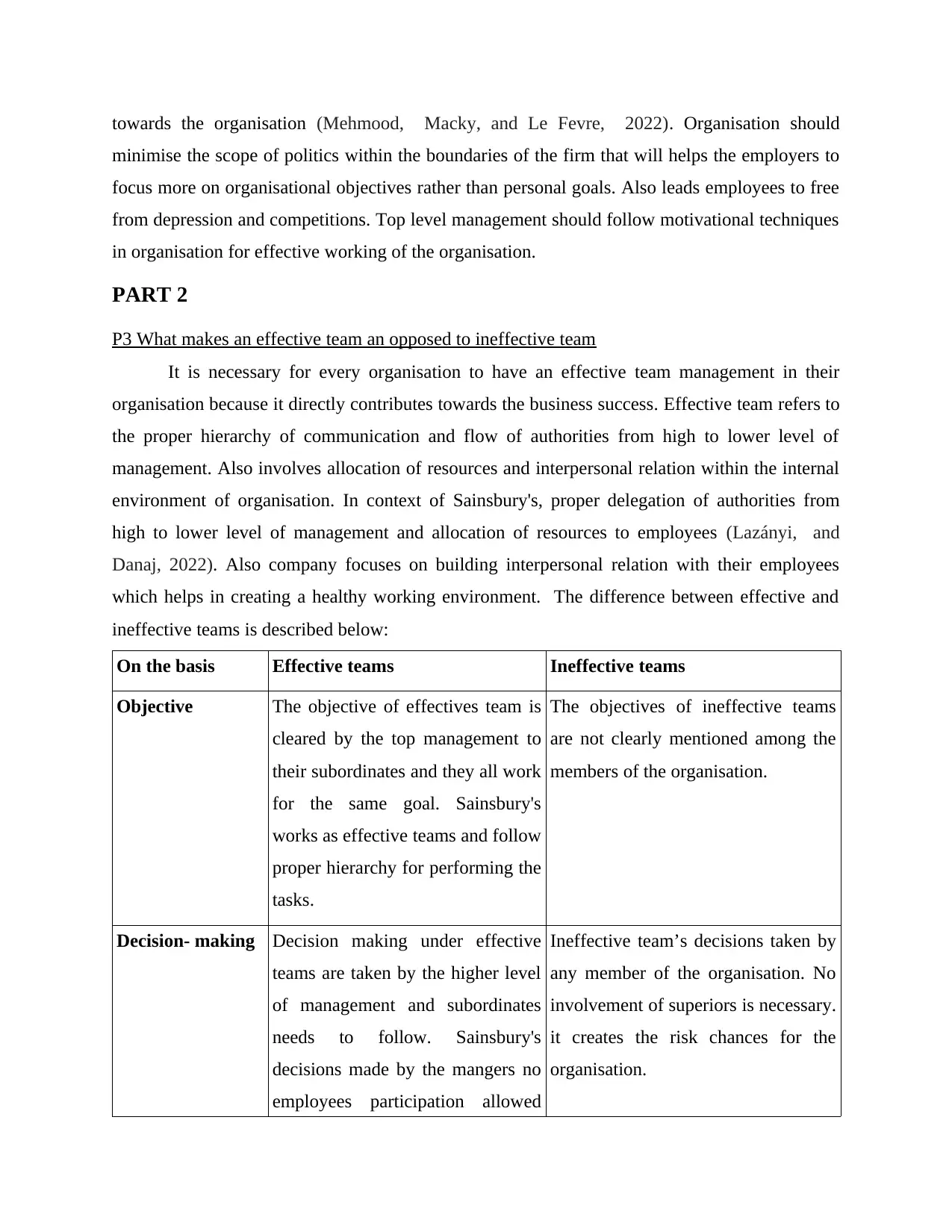
ineffective teams is described below:
On the basis Effective teams Ineffective teams
Objective The objective of effectives team is
cleared by the top management to
their subordinates and they all work
for the same goal. Sainsbury's
works as effective teams and follow
proper hierarchy for performing the
tasks.
The objectives of ineffective teams
are not clearly mentioned among the
members of the organisation.
Decision- making Decision making under effective
teams are taken by the higher level
of management and subordinates
needs to follow. Sainsbury's
decisions made by the mangers no
employees participation allowed
Ineffective team’s decisions taken by
any member of the organisation. No
involvement of superiors is necessary.
it creates the risk chances for the
organisation.
minimise the scope of politics within the boundaries of the firm that will helps the employers to
focus more on organisational objectives rather than personal goals. Also leads employees to free
from depression and competitions. Top level management should follow motivational techniques
in organisation for effective working of the organisation.
PART 2
P3 What makes an effective team an opposed to ineffective team
It is necessary for every organisation to have an effective team management in their
organisation because it directly contributes towards the business success. Effective team refers to
the proper hierarchy of communication and flow of authorities from high to lower level of
management. Also involves allocation of resources and interpersonal relation within the internal
environment of organisation. In context of Sainsbury's, proper delegation of authorities from
high to lower level of management and allocation of resources to employees (Lazányi, and
Danaj, 2022). Also company focuses on building interpersonal relation with their employees
which helps in creating a healthy working environment. The difference between effective and
ineffective teams is described below:
On the basis Effective teams Ineffective teams
Objective The objective of effectives team is
cleared by the top management to
their subordinates and they all work
for the same goal. Sainsbury's
works as effective teams and follow
proper hierarchy for performing the
tasks.
The objectives of ineffective teams
are not clearly mentioned among the
members of the organisation.
Decision- making Decision making under effective
teams are taken by the higher level
of management and subordinates
needs to follow. Sainsbury's
decisions made by the mangers no
employees participation allowed
Ineffective team’s decisions taken by
any member of the organisation. No
involvement of superiors is necessary.
it creates the risk chances for the
organisation.
⊘ This is a preview!⊘
Do you want full access?
Subscribe today to unlock all pages.
Trusted by 1+ million students worldwide
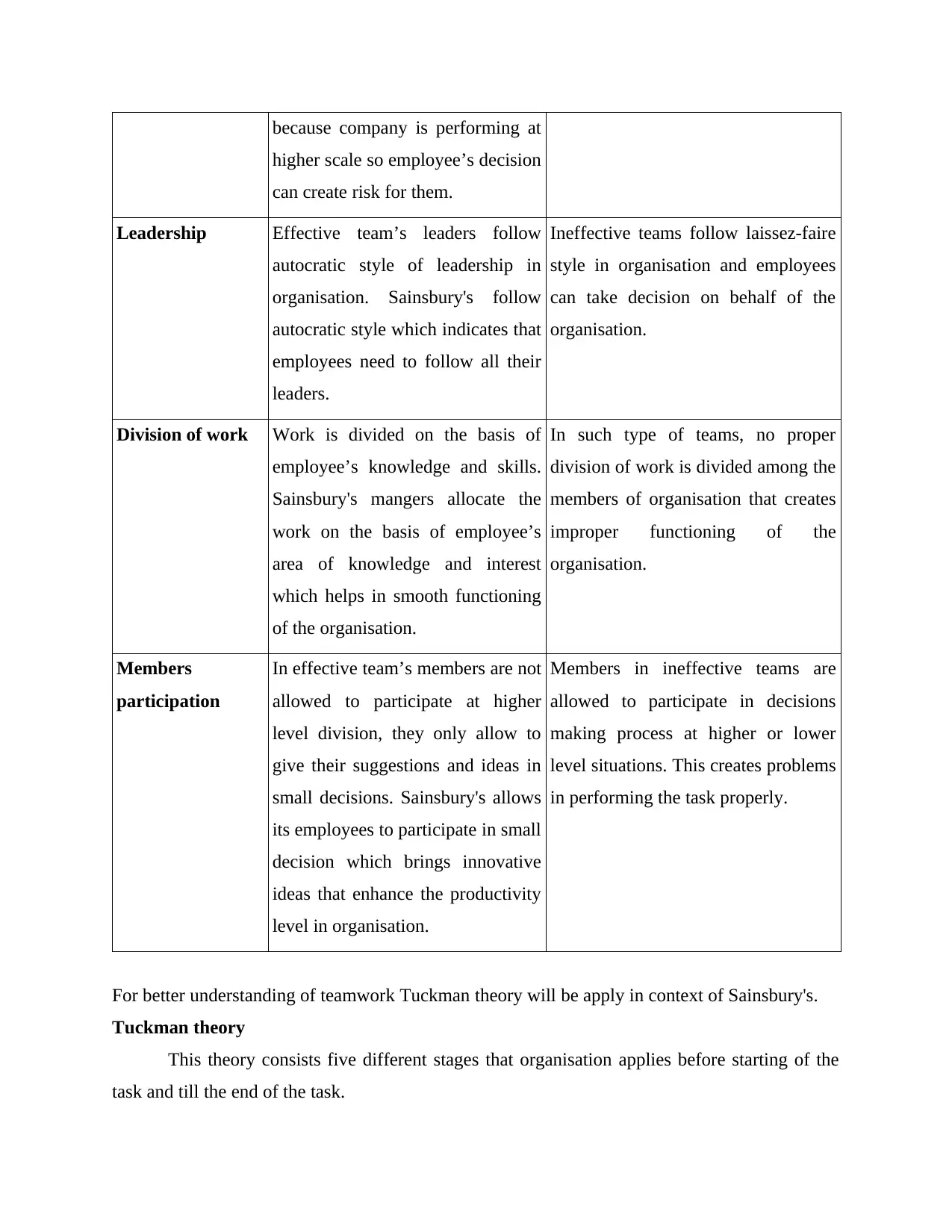
because company is performing at
higher scale so employee’s decision
can create risk for them.
Leadership Effective team’s leaders follow
autocratic style of leadership in
organisation. Sainsbury's follow
autocratic style which indicates that
employees need to follow all their
leaders.
Ineffective teams follow laissez-faire
style in organisation and employees
can take decision on behalf of the
organisation.
Division of work Work is divided on the basis of
employee’s knowledge and skills.
Sainsbury's mangers allocate the
work on the basis of employee’s
area of knowledge and interest
which helps in smooth functioning
of the organisation.
In such type of teams, no proper
division of work is divided among the
members of organisation that creates
improper functioning of the
organisation.
Members
participation
In effective team’s members are not
allowed to participate at higher
level division, they only allow to
give their suggestions and ideas in
small decisions. Sainsbury's allows
its employees to participate in small
decision which brings innovative
ideas that enhance the productivity
level in organisation.
Members in ineffective teams are
allowed to participate in decisions
making process at higher or lower
level situations. This creates problems
in performing the task properly.
For better understanding of teamwork Tuckman theory will be apply in context of Sainsbury's.
Tuckman theory
This theory consists five different stages that organisation applies before starting of the
task and till the end of the task.
higher scale so employee’s decision
can create risk for them.
Leadership Effective team’s leaders follow
autocratic style of leadership in
organisation. Sainsbury's follow
autocratic style which indicates that
employees need to follow all their
leaders.
Ineffective teams follow laissez-faire
style in organisation and employees
can take decision on behalf of the
organisation.
Division of work Work is divided on the basis of
employee’s knowledge and skills.
Sainsbury's mangers allocate the
work on the basis of employee’s
area of knowledge and interest
which helps in smooth functioning
of the organisation.
In such type of teams, no proper
division of work is divided among the
members of organisation that creates
improper functioning of the
organisation.
Members
participation
In effective team’s members are not
allowed to participate at higher
level division, they only allow to
give their suggestions and ideas in
small decisions. Sainsbury's allows
its employees to participate in small
decision which brings innovative
ideas that enhance the productivity
level in organisation.
Members in ineffective teams are
allowed to participate in decisions
making process at higher or lower
level situations. This creates problems
in performing the task properly.
For better understanding of teamwork Tuckman theory will be apply in context of Sainsbury's.
Tuckman theory
This theory consists five different stages that organisation applies before starting of the
task and till the end of the task.
Paraphrase This Document
Need a fresh take? Get an instant paraphrase of this document with our AI Paraphraser
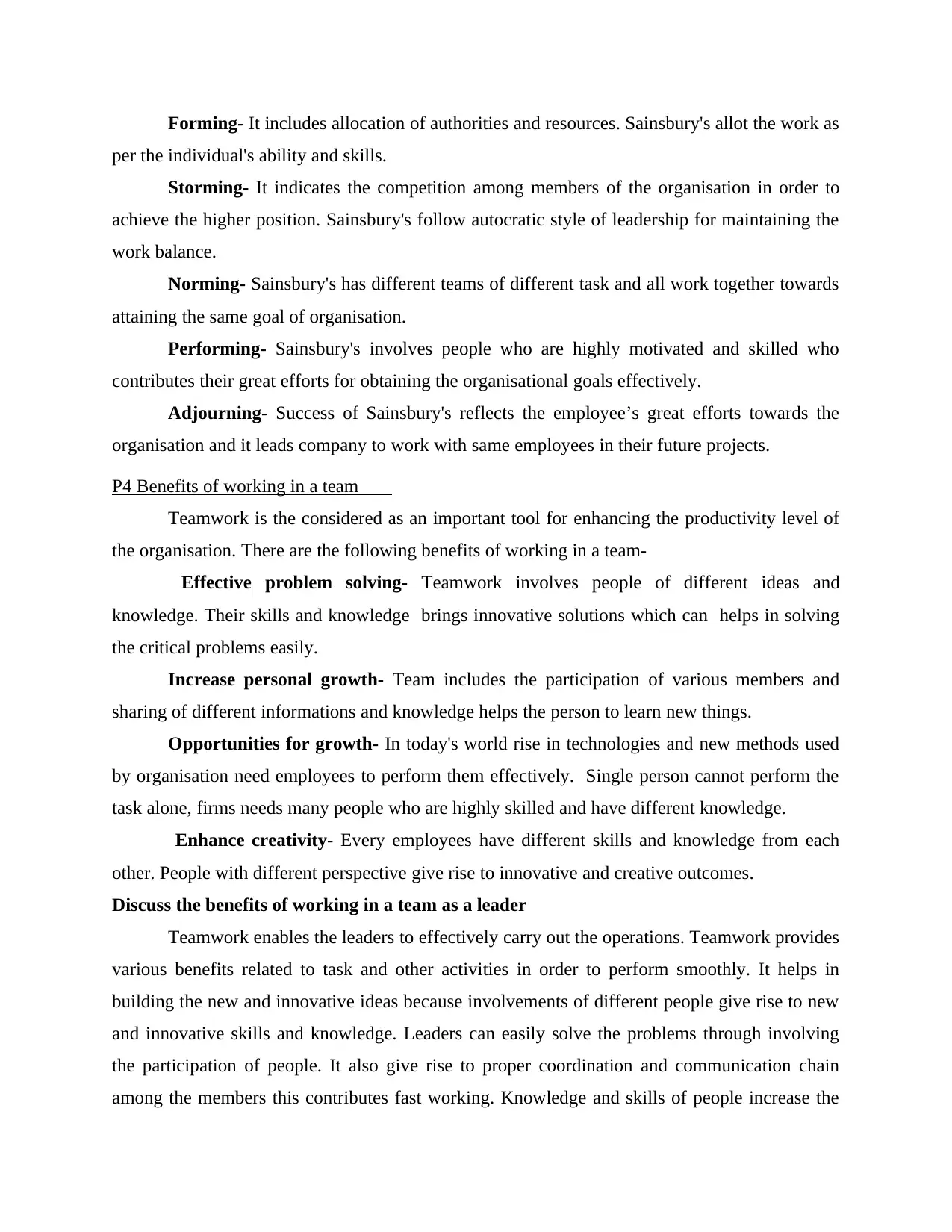
Forming- It includes allocation of authorities and resources. Sainsbury's allot the work as
per the individual's ability and skills.
Storming- It indicates the competition among members of the organisation in order to
achieve the higher position. Sainsbury's follow autocratic style of leadership for maintaining the
work balance.
Norming- Sainsbury's has different teams of different task and all work together towards
attaining the same goal of organisation.
Performing- Sainsbury's involves people who are highly motivated and skilled who
contributes their great efforts for obtaining the organisational goals effectively.
Adjourning- Success of Sainsbury's reflects the employee’s great efforts towards the
organisation and it leads company to work with same employees in their future projects.
P4 Benefits of working in a team
Teamwork is the considered as an important tool for enhancing the productivity level of
the organisation. There are the following benefits of working in a team-
Effective problem solving- Teamwork involves people of different ideas and
knowledge. Their skills and knowledge brings innovative solutions which can helps in solving
the critical problems easily.
Increase personal growth- Team includes the participation of various members and
sharing of different informations and knowledge helps the person to learn new things.
Opportunities for growth- In today's world rise in technologies and new methods used
by organisation need employees to perform them effectively. Single person cannot perform the
task alone, firms needs many people who are highly skilled and have different knowledge.
Enhance creativity- Every employees have different skills and knowledge from each
other. People with different perspective give rise to innovative and creative outcomes.
Discuss the benefits of working in a team as a leader
Teamwork enables the leaders to effectively carry out the operations. Teamwork provides
various benefits related to task and other activities in order to perform smoothly. It helps in
building the new and innovative ideas because involvements of different people give rise to new
and innovative skills and knowledge. Leaders can easily solve the problems through involving
the participation of people. It also give rise to proper coordination and communication chain
among the members this contributes fast working. Knowledge and skills of people increase the
per the individual's ability and skills.
Storming- It indicates the competition among members of the organisation in order to
achieve the higher position. Sainsbury's follow autocratic style of leadership for maintaining the
work balance.
Norming- Sainsbury's has different teams of different task and all work together towards
attaining the same goal of organisation.
Performing- Sainsbury's involves people who are highly motivated and skilled who
contributes their great efforts for obtaining the organisational goals effectively.
Adjourning- Success of Sainsbury's reflects the employee’s great efforts towards the
organisation and it leads company to work with same employees in their future projects.
P4 Benefits of working in a team
Teamwork is the considered as an important tool for enhancing the productivity level of
the organisation. There are the following benefits of working in a team-
Effective problem solving- Teamwork involves people of different ideas and
knowledge. Their skills and knowledge brings innovative solutions which can helps in solving
the critical problems easily.
Increase personal growth- Team includes the participation of various members and
sharing of different informations and knowledge helps the person to learn new things.
Opportunities for growth- In today's world rise in technologies and new methods used
by organisation need employees to perform them effectively. Single person cannot perform the
task alone, firms needs many people who are highly skilled and have different knowledge.
Enhance creativity- Every employees have different skills and knowledge from each
other. People with different perspective give rise to innovative and creative outcomes.
Discuss the benefits of working in a team as a leader
Teamwork enables the leaders to effectively carry out the operations. Teamwork provides
various benefits related to task and other activities in order to perform smoothly. It helps in
building the new and innovative ideas because involvements of different people give rise to new
and innovative skills and knowledge. Leaders can easily solve the problems through involving
the participation of people. It also give rise to proper coordination and communication chain
among the members this contributes fast working. Knowledge and skills of people increase the
innovative and creativity level of the organisation and helps in performing work in better
manner. For leaders it get easy to maintain coordination and share the information with people
clearly. Teamwork overall contributes towards enhancing the productivity of the organisation.
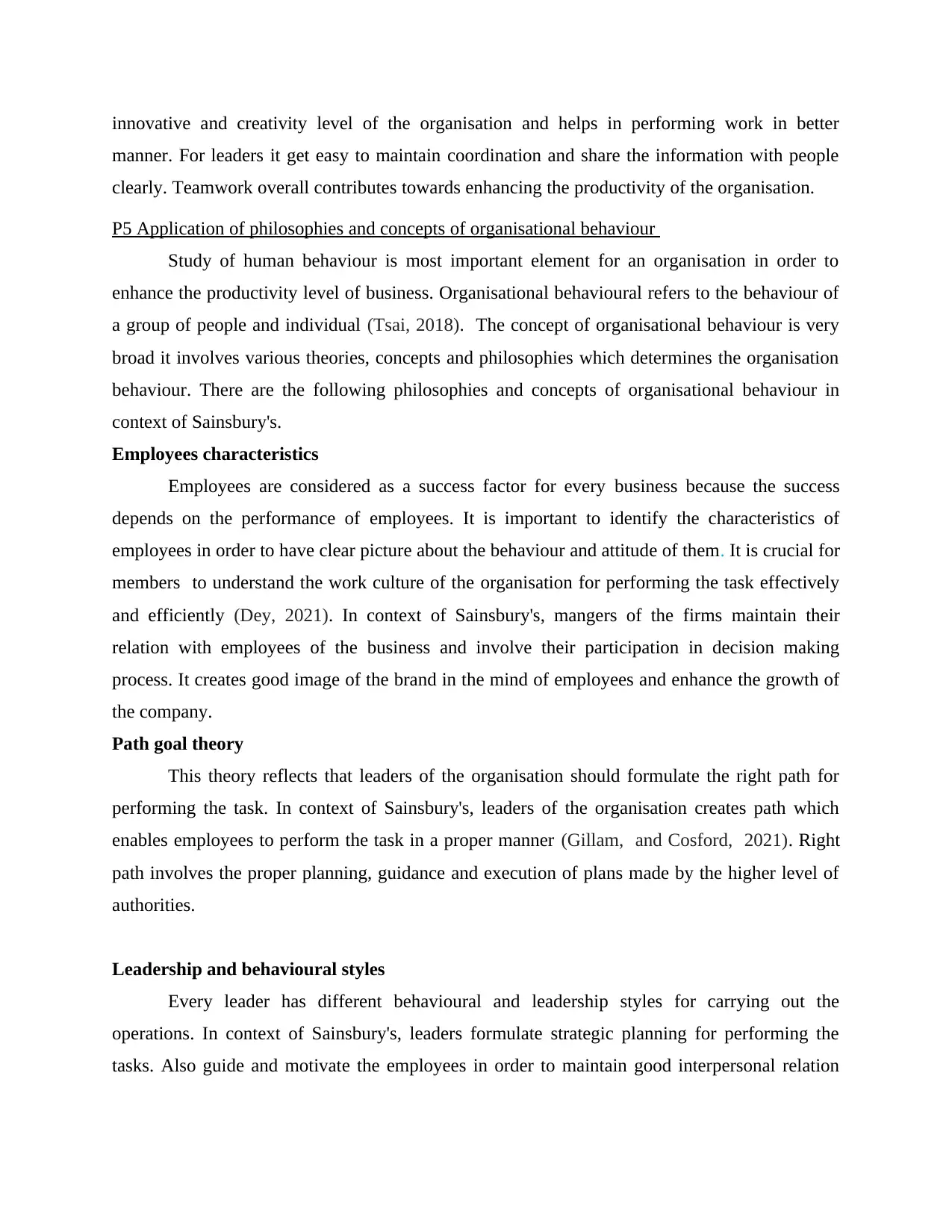
P5 Application of philosophies and concepts of organisational behaviour
Study of human behaviour is most important element for an organisation in order to
enhance the productivity level of business. Organisational behavioural refers to the behaviour of
a group of people and individual (Tsai, 2018). The concept of organisational behaviour is very
broad it involves various theories, concepts and philosophies which determines the organisation
behaviour. There are the following philosophies and concepts of organisational behaviour in
context of Sainsbury's.
Employees characteristics
Employees are considered as a success factor for every business because the success
depends on the performance of employees. It is important to identify the characteristics of
employees in order to have clear picture about the behaviour and attitude of them. It is crucial for
members to understand the work culture of the organisation for performing the task effectively
and efficiently (Dey, 2021). In context of Sainsbury's, mangers of the firms maintain their
relation with employees of the business and involve their participation in decision making
process. It creates good image of the brand in the mind of employees and enhance the growth of
the company.
Path goal theory
This theory reflects that leaders of the organisation should formulate the right path for
performing the task. In context of Sainsbury's, leaders of the organisation creates path which
enables employees to perform the task in a proper manner (Gillam, and Cosford, 2021). Right
path involves the proper planning, guidance and execution of plans made by the higher level of
authorities.
Leadership and behavioural styles
Every leader has different behavioural and leadership styles for carrying out the
operations. In context of Sainsbury's, leaders formulate strategic planning for performing the
tasks. Also guide and motivate the employees in order to maintain good interpersonal relation
manner. For leaders it get easy to maintain coordination and share the information with people
clearly. Teamwork overall contributes towards enhancing the productivity of the organisation.
P5 Application of philosophies and concepts of organisational behaviour
Study of human behaviour is most important element for an organisation in order to
enhance the productivity level of business. Organisational behavioural refers to the behaviour of
a group of people and individual (Tsai, 2018). The concept of organisational behaviour is very
broad it involves various theories, concepts and philosophies which determines the organisation
behaviour. There are the following philosophies and concepts of organisational behaviour in
context of Sainsbury's.
Employees characteristics
Employees are considered as a success factor for every business because the success
depends on the performance of employees. It is important to identify the characteristics of
employees in order to have clear picture about the behaviour and attitude of them. It is crucial for
members to understand the work culture of the organisation for performing the task effectively
and efficiently (Dey, 2021). In context of Sainsbury's, mangers of the firms maintain their
relation with employees of the business and involve their participation in decision making
process. It creates good image of the brand in the mind of employees and enhance the growth of
the company.
Path goal theory
This theory reflects that leaders of the organisation should formulate the right path for
performing the task. In context of Sainsbury's, leaders of the organisation creates path which
enables employees to perform the task in a proper manner (Gillam, and Cosford, 2021). Right
path involves the proper planning, guidance and execution of plans made by the higher level of
authorities.
Leadership and behavioural styles
Every leader has different behavioural and leadership styles for carrying out the
operations. In context of Sainsbury's, leaders formulate strategic planning for performing the
tasks. Also guide and motivate the employees in order to maintain good interpersonal relation
⊘ This is a preview!⊘
Do you want full access?
Subscribe today to unlock all pages.
Trusted by 1+ million students worldwide

1 out of 17


Related Documents


Your All-in-One AI-Powered Toolkit for Academic Success.
+13062052269
info@desklib.com
Available 24*7 on WhatsApp / Email
![[object Object]](/_next/static/media/star-bottom.7253800d.svg)
Unlock your academic potential
Copyright © 2020–2026 A2Z Services. All Rights Reserved. Developed and managed by ZUCOL.