Seneca College: Team Dynamics Reflection and Group Process Evaluation
VerifiedAdded on 2023/04/17
|9
|1865
|230
Report
AI Summary
This report is a reflection and evaluation of a student's experience in a group project, focusing on team dynamics and communication within the context of a Social Service Worker program at Seneca College. The student analyzes their role in the group, examining behaviors, and striving for more effective participation. The report is divided into two parts: a personal reflection utilizing weekly reflections and a self-evaluation of their contributions to the group. The student discusses the observed group dynamics, communication styles, and how they contributed to team harmony, problem-solving, and innovation. The self-evaluation provides a grade justification and specific examples of their involvement. The report concludes with a summary of key learnings and suggestions for future improvement in team dynamics and leadership.
Running Head: TEAM DYNAMICS REFLECTION
0
Team Dynamics Reflection
REFLECTION AND EVALUATION OF GROUP PROCESS
(Student details :)
3/26/2019
0
Team Dynamics Reflection
REFLECTION AND EVALUATION OF GROUP PROCESS
(Student details :)
3/26/2019

Paraphrase This Document
Need a fresh take? Get an instant paraphrase of this document with our AI Paraphraser
Team Dynamics Reflection
1
Contents
Reflection and Evaluation of Group Process.............................................................................2
Introduction................................................................................................................................2
PART ONE – Personal Reflection.............................................................................................2
PART TWO - Self Evaluation.................................................................................................5
Conclusion..................................................................................................................................6
References..................................................................................................................................8
1
Contents
Reflection and Evaluation of Group Process.............................................................................2
Introduction................................................................................................................................2
PART ONE – Personal Reflection.............................................................................................2
PART TWO - Self Evaluation.................................................................................................5
Conclusion..................................................................................................................................6
References..................................................................................................................................8
Team Dynamics Reflection
2
Reflection and Evaluation of Group Process
Introduction
The reflective journal is based on reflection as well as evaluation of my group
process. During this course I got an opportunity to participate in a group experience which
was held in-class. Hence, while reflecting my experiences of the course I will reflect on my
own learning, along with the level of responsibility I took to acquire that learning. To do so,
within my group experience, I will examine my own role in a group, recognize behaviors I
exhibited as well as strived for becoming a more effective group participant. In this way, my
reflective writing will be further divided into two main parts include personal reflection and
self-evaluation based on what I have learned within the class about effective group processes.
In this context, I would like to mention that my college is Seneca College, Canada
and my enrolled program is Social Service Worker SSW. Hence, from the future career
development perspective this reflection will add to my skill set in terms of learning like
teamwork, team-harmony, team-dynamics, group process, conflicts management and many
more (Han & Harms, 2010).
2
Reflection and Evaluation of Group Process
Introduction
The reflective journal is based on reflection as well as evaluation of my group
process. During this course I got an opportunity to participate in a group experience which
was held in-class. Hence, while reflecting my experiences of the course I will reflect on my
own learning, along with the level of responsibility I took to acquire that learning. To do so,
within my group experience, I will examine my own role in a group, recognize behaviors I
exhibited as well as strived for becoming a more effective group participant. In this way, my
reflective writing will be further divided into two main parts include personal reflection and
self-evaluation based on what I have learned within the class about effective group processes.
In this context, I would like to mention that my college is Seneca College, Canada
and my enrolled program is Social Service Worker SSW. Hence, from the future career
development perspective this reflection will add to my skill set in terms of learning like
teamwork, team-harmony, team-dynamics, group process, conflicts management and many
more (Han & Harms, 2010).
⊘ This is a preview!⊘
Do you want full access?
Subscribe today to unlock all pages.

Trusted by 1+ million students worldwide
Team Dynamics Reflection
3
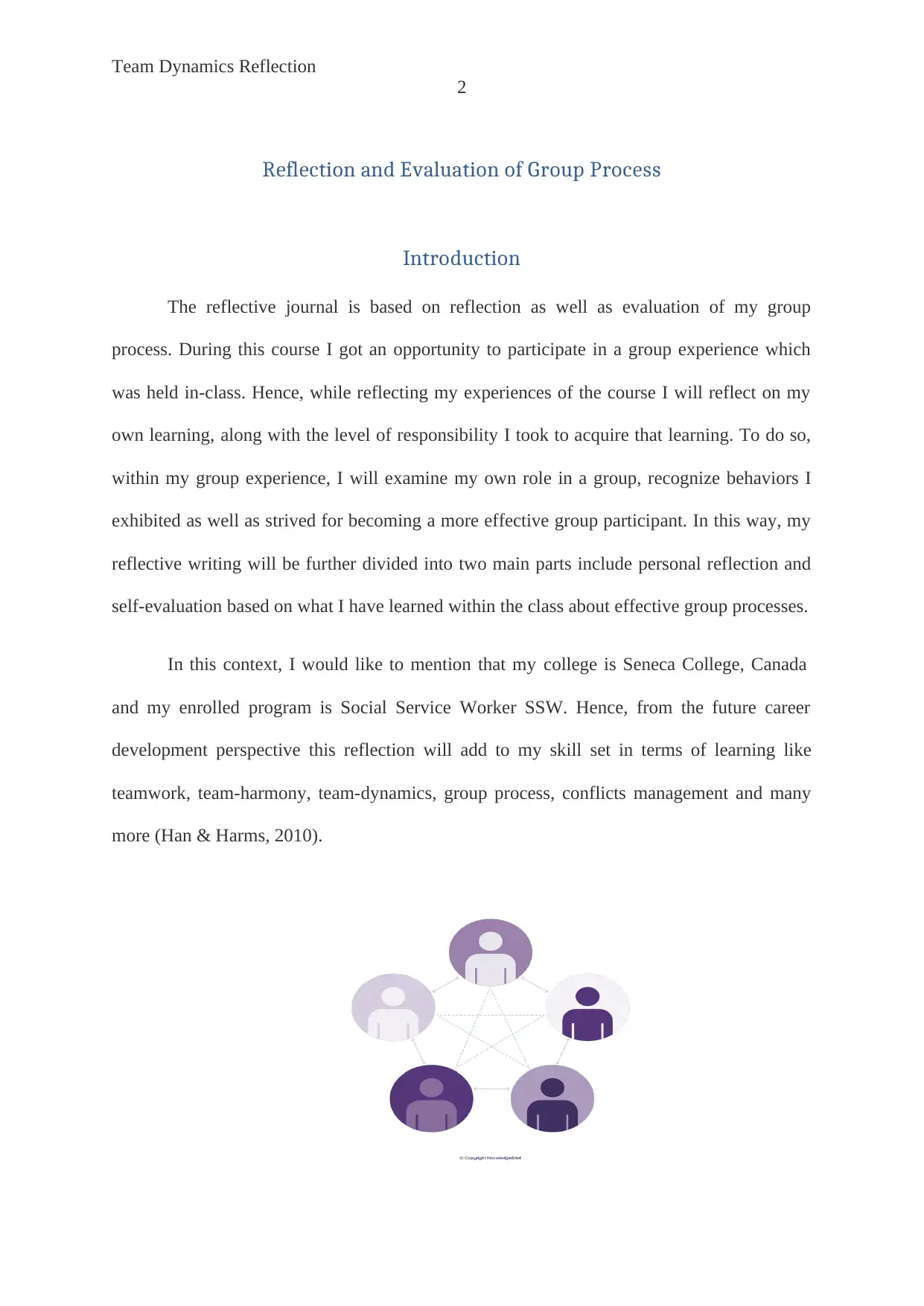
Source: (Lubeck, Lois, & Heidi, 2013)
PART ONE – Personal Reflection
In this discussion, I am utilizing the weekly reflections which I have been completing
during the module. As my group and other groups went through the fishbowl activity in the
class so hence we all experienced a team-dynamics and cohesion within our team. In general,
in a fishbowl activity, a group of learners are selected to discuss a particular topic while the
rest of the participative groups watches, reads or listens the transcript of the on-going
discussion. Later then, a secondary discussion happens focusing the outcomes as well as
procedure of the former one. While thinking about my experience being a group participant
inside the fishbowl as well as an observer outside the fishbowl observing the other group, I
can easily state that it was a life-long experience for my future career.
From the perspective of group dynamics and effective communication, I observed all
of the other groups critically so as to learn how to implement all of the two on my own team.
As per my reviews after observing being an observer in fishbowl, the higher the loyalty of
group members is towards their group, the bigger is the team motivation amid the group
members for achieving the goals of the team. I also observed that the probability that a group
will achieve their team goals totally depends upon the team harmony while performing tasks.
Furthermore, I observed with the help of other teams that confirming or disconfirming
climates, the group's Emotional Climate, verbal and non-verbal communication and power
and influence are the key factors of team dynamics.
Now coming to my own group, feelings about team dynamics and effective
communications get strong as my own team demonstrated good practice of team dynamics
for the rest of the others. I and my team members tried our best to communicate in a clear and
3
Source: (Lubeck, Lois, & Heidi, 2013)
PART ONE – Personal Reflection
In this discussion, I am utilizing the weekly reflections which I have been completing
during the module. As my group and other groups went through the fishbowl activity in the
class so hence we all experienced a team-dynamics and cohesion within our team. In general,
in a fishbowl activity, a group of learners are selected to discuss a particular topic while the
rest of the participative groups watches, reads or listens the transcript of the on-going
discussion. Later then, a secondary discussion happens focusing the outcomes as well as
procedure of the former one. While thinking about my experience being a group participant
inside the fishbowl as well as an observer outside the fishbowl observing the other group, I
can easily state that it was a life-long experience for my future career.
From the perspective of group dynamics and effective communication, I observed all
of the other groups critically so as to learn how to implement all of the two on my own team.
As per my reviews after observing being an observer in fishbowl, the higher the loyalty of
group members is towards their group, the bigger is the team motivation amid the group
members for achieving the goals of the team. I also observed that the probability that a group
will achieve their team goals totally depends upon the team harmony while performing tasks.
Furthermore, I observed with the help of other teams that confirming or disconfirming
climates, the group's Emotional Climate, verbal and non-verbal communication and power
and influence are the key factors of team dynamics.
Now coming to my own group, feelings about team dynamics and effective
communications get strong as my own team demonstrated good practice of team dynamics
for the rest of the others. I and my team members tried our best to communicate in a clear and
Paraphrase This Document
Need a fresh take? Get an instant paraphrase of this document with our AI Paraphraser
Team Dynamics Reflection
4
concise way so that our team could effectively communicate with each other. In this context,
while working with my group I realized that group dynamics can easily be utilised as a way
for problem-solving, team work, as well as for becoming more productive and innovative as
whole. The reason behind is that all of my group members demonstrated team strengths,
success factors as well as measures of group dynamics, along with professional
communication in my group.
For my group process, I worked hard to become an effective group participant as I
always loved to work in teams since my childhood. In this context, two attributes of my
personality helped me a lot to effectively participate and maintain team dynamics in my own
group. The two attributes are soft skills and relatedness. Besides, my relatedness made
effectively understand all of my group members through listening to the needs of one
another. With my efforts to maintain harmony in my group, I used my soft skills to a large
extent. Hence, I felt that my group really worked at a level of identity where the difference
amid the self and group is meaningless.
Although I worked hard to become an active and good participant of my team, yet
there are some things which I need to improve to enhance my participation within the group.
Hence, as per my reflection over this context I think I should spend more time with the group
in order to discuss the team-meetings and tasks.
In future sessions, our group can lead the other groups by strengthening our team in
more effective way like we can plan effective group meetings. In group meetings, our group
members need to discuss their flaws and strengths with the 100 % transparency so that we all
group members can help each other as well as can become complement to one another. Thus,
it will help us to become a more effective group in near future sessions (Rita, Neda, &
Nasrin, 2016).
4
concise way so that our team could effectively communicate with each other. In this context,
while working with my group I realized that group dynamics can easily be utilised as a way
for problem-solving, team work, as well as for becoming more productive and innovative as
whole. The reason behind is that all of my group members demonstrated team strengths,
success factors as well as measures of group dynamics, along with professional
communication in my group.
For my group process, I worked hard to become an effective group participant as I
always loved to work in teams since my childhood. In this context, two attributes of my
personality helped me a lot to effectively participate and maintain team dynamics in my own
group. The two attributes are soft skills and relatedness. Besides, my relatedness made
effectively understand all of my group members through listening to the needs of one
another. With my efforts to maintain harmony in my group, I used my soft skills to a large
extent. Hence, I felt that my group really worked at a level of identity where the difference
amid the self and group is meaningless.
Although I worked hard to become an active and good participant of my team, yet
there are some things which I need to improve to enhance my participation within the group.
Hence, as per my reflection over this context I think I should spend more time with the group
in order to discuss the team-meetings and tasks.
In future sessions, our group can lead the other groups by strengthening our team in
more effective way like we can plan effective group meetings. In group meetings, our group
members need to discuss their flaws and strengths with the 100 % transparency so that we all
group members can help each other as well as can become complement to one another. Thus,
it will help us to become a more effective group in near future sessions (Rita, Neda, &
Nasrin, 2016).
Team Dynamics Reflection
5
Moreover, in order to maximize the participation of others our team can suggest more
interesting and knowledge giving activities post interacting with the other team members.
Besides, I observed that our group reflected the course discussions and readings in terms of
fostering team-work, effective leadership, collaboration and conflicts management. For an
example, in a task during in-class activities our team reflected power and influence key skill
of a true leader. In this context, given activity task seemed difficult to some of my group
members hence they showed resistant towards doing it. At that time, our group leader used
his power to influence the team members for good and made all of them ready to do the task
together.
PART TWO - Self Evaluation
In this paragraph, I am going to explain what my participation ranks among the grades
provided are and why it belongs there. For evaluating my self-work in the group work, I
would like to mention that I consider that coming together as a team is a beginning while
keeping together is a progress of the future tasks. Finally, working together makes team
success in any group task or project. Therefore, I worked on the above principle and
contributed every part of my skill set in order to make my group successful while doing any
team project. I enabled constant effective communication among all of the group members
through suggesting a group on social media messaging platform. In addition, I helped my
team while focusing on right direction. In this context, after gathered a huge numbers of ideas
I assisted my team to categorize as well as examine them for fishbowl. Hence, my group
chose one idea among all of the team’s ideas. Later then, we all discussed the advantages as
well as disadvantages of each of them in a way that we can be sure about selecting the one.
Besides, I am giving a grade of ‘A’ while self-evaluating my own performance due to the
reason that I asked group members to vote for different ideas which helped us to avert team-
5
Moreover, in order to maximize the participation of others our team can suggest more
interesting and knowledge giving activities post interacting with the other team members.
Besides, I observed that our group reflected the course discussions and readings in terms of
fostering team-work, effective leadership, collaboration and conflicts management. For an
example, in a task during in-class activities our team reflected power and influence key skill
of a true leader. In this context, given activity task seemed difficult to some of my group
members hence they showed resistant towards doing it. At that time, our group leader used
his power to influence the team members for good and made all of them ready to do the task
together.
PART TWO - Self Evaluation
In this paragraph, I am going to explain what my participation ranks among the grades
provided are and why it belongs there. For evaluating my self-work in the group work, I
would like to mention that I consider that coming together as a team is a beginning while
keeping together is a progress of the future tasks. Finally, working together makes team
success in any group task or project. Therefore, I worked on the above principle and
contributed every part of my skill set in order to make my group successful while doing any
team project. I enabled constant effective communication among all of the group members
through suggesting a group on social media messaging platform. In addition, I helped my
team while focusing on right direction. In this context, after gathered a huge numbers of ideas
I assisted my team to categorize as well as examine them for fishbowl. Hence, my group
chose one idea among all of the team’s ideas. Later then, we all discussed the advantages as
well as disadvantages of each of them in a way that we can be sure about selecting the one.
Besides, I am giving a grade of ‘A’ while self-evaluating my own performance due to the
reason that I asked group members to vote for different ideas which helped us to avert team-
⊘ This is a preview!⊘
Do you want full access?
Subscribe today to unlock all pages.
Trusted by 1+ million students worldwide
Team Dynamics Reflection
6
conflicts considerably. Additionally, my idea of voting for many group functions we could
rank the ideas in a priority order as well as then finalized them easily which kept our team
members happy and satisfied (Lubeck, Lois, & Heidi, 2013).
Hence, because of all above reasons I am feeling like I deserve an “A” grade within
my self-evaluation. Besides, within my group tasks I have consistently expressed, shared,
discussed as well as commented on the every topic being discussed. I also contributed my
efforts on numerous occasions for helping other team-members (Han & Harms, 2010). For an
example, in the beginning of the team formation there was an instance when our group
supposed to introduce the leader as well as team in front of the whole class. At that time, our
group leader was not decided hence nobody was aware about how and what to introduce
about our group in front of the class (Belbin, 2012). Therefore, based on (Berlin, Carlstrom,
& Sandberg, 2012) I took initiative to start the conversation as well as guided my whole team
for responding to others in the starting phase of the group formation. In this way, I have
often initiated conversations or responded to other groups for attempting initiation. Moreover,
I have also demonstrated great team-participation through my behavior of being fully present
when other team-members are talking with others (Colenso, 2012).
In this way, post examining my role within my group I have recognized that I well-
understood the requirements of the group as well as actively attempted for helping my group
meeting their needs. On the other hand, I have also recognized areas my group can improve
on in future, while actively engaged to improve my participation during each week.
Therefore, ranking my self-work within the group as ‘A’ has been justified with the help of
above supported incidents and contributions made by me for my team.
6
conflicts considerably. Additionally, my idea of voting for many group functions we could
rank the ideas in a priority order as well as then finalized them easily which kept our team
members happy and satisfied (Lubeck, Lois, & Heidi, 2013).
Hence, because of all above reasons I am feeling like I deserve an “A” grade within
my self-evaluation. Besides, within my group tasks I have consistently expressed, shared,
discussed as well as commented on the every topic being discussed. I also contributed my
efforts on numerous occasions for helping other team-members (Han & Harms, 2010). For an
example, in the beginning of the team formation there was an instance when our group
supposed to introduce the leader as well as team in front of the whole class. At that time, our
group leader was not decided hence nobody was aware about how and what to introduce
about our group in front of the class (Belbin, 2012). Therefore, based on (Berlin, Carlstrom,
& Sandberg, 2012) I took initiative to start the conversation as well as guided my whole team
for responding to others in the starting phase of the group formation. In this way, I have
often initiated conversations or responded to other groups for attempting initiation. Moreover,
I have also demonstrated great team-participation through my behavior of being fully present
when other team-members are talking with others (Colenso, 2012).
In this way, post examining my role within my group I have recognized that I well-
understood the requirements of the group as well as actively attempted for helping my group
meeting their needs. On the other hand, I have also recognized areas my group can improve
on in future, while actively engaged to improve my participation during each week.
Therefore, ranking my self-work within the group as ‘A’ has been justified with the help of
above supported incidents and contributions made by me for my team.
Paraphrase This Document
Need a fresh take? Get an instant paraphrase of this document with our AI Paraphraser
Team Dynamics Reflection
7
Conclusion
In conclusion, with the help of this paper personal reflection and views over team-
working in a group along with a self-evaluation has been covered successfully. This paper
has assessed many aspects and core elements of team-dynamics include Verbal and Non-
Verbal Communication, Confirming or Disconfirming Climates, our group's Emotional
Climate as well as Participation levels. Besides, with the help of examples focused on Power
and Influence of true leadership, I utilized my past experiences within team-work in class to
extract the key learning related to team-dynamic and communication skills. In addition, I also
evaluated myself by ranking my efforts and contributions towards team-building and
functioning. With the help of suggesting probable improvements in my group to become
more effective and leading into future sessions, I again contributed my team from the
perspective of future development and learning. Besides, this reflective journal has
successfully demonstrated the importance of learning by doing and its significance for an
individual’s future career development. Finally, through reflecting upon group work
experiences and self-evaluation I assessed my team’s dynamics, harmony and effective
working team-working skills in order to get best out of it.
7
Conclusion
In conclusion, with the help of this paper personal reflection and views over team-
working in a group along with a self-evaluation has been covered successfully. This paper
has assessed many aspects and core elements of team-dynamics include Verbal and Non-
Verbal Communication, Confirming or Disconfirming Climates, our group's Emotional
Climate as well as Participation levels. Besides, with the help of examples focused on Power
and Influence of true leadership, I utilized my past experiences within team-work in class to
extract the key learning related to team-dynamic and communication skills. In addition, I also
evaluated myself by ranking my efforts and contributions towards team-building and
functioning. With the help of suggesting probable improvements in my group to become
more effective and leading into future sessions, I again contributed my team from the
perspective of future development and learning. Besides, this reflective journal has
successfully demonstrated the importance of learning by doing and its significance for an
individual’s future career development. Finally, through reflecting upon group work
experiences and self-evaluation I assessed my team’s dynamics, harmony and effective
working team-working skills in order to get best out of it.
Team Dynamics Reflection
8
References
Belbin, R. (2012). Team roles at work. London: Routledge.
Berlin, J., Carlstrom, E., & Sandberg, H. (2012). Models of teamwork: ideal or not? A critical
study of theoretical team models. Team Performance Management: An International
Journal, 18(5), 328-340.
Colenso, M. (2012). High performing teams in brief. London: Routledge.
Han, G., & Harms, P. (2010). Team identification, trust and conflict: A mediation model.
International Journal of conflict management, 21(1), 20-43.
Lubeck, P., Lois, T., & Heidi, M. (2013). Team-Based Learning: An Innovative Approach to
Teaching Maternal-Newborn Nursing Care. Journal of Nursing Education, 52(2),
112-15.
Rita, R., Neda, M., & Nasrin, S. (2016). Team-Based Learning: A New Approach Toward
Improving Education. Acta Medica Iranica, 54(10), 678-82.
8
References
Belbin, R. (2012). Team roles at work. London: Routledge.
Berlin, J., Carlstrom, E., & Sandberg, H. (2012). Models of teamwork: ideal or not? A critical
study of theoretical team models. Team Performance Management: An International
Journal, 18(5), 328-340.
Colenso, M. (2012). High performing teams in brief. London: Routledge.
Han, G., & Harms, P. (2010). Team identification, trust and conflict: A mediation model.
International Journal of conflict management, 21(1), 20-43.
Lubeck, P., Lois, T., & Heidi, M. (2013). Team-Based Learning: An Innovative Approach to
Teaching Maternal-Newborn Nursing Care. Journal of Nursing Education, 52(2),
112-15.
Rita, R., Neda, M., & Nasrin, S. (2016). Team-Based Learning: A New Approach Toward
Improving Education. Acta Medica Iranica, 54(10), 678-82.
⊘ This is a preview!⊘
Do you want full access?
Subscribe today to unlock all pages.
Trusted by 1+ million students worldwide

1 out of 9


Related Documents


Your All-in-One AI-Powered Toolkit for Academic Success.
+13062052269
info@desklib.com
Available 24*7 on WhatsApp / Email
![[object Object]](/_next/static/media/star-bottom.7253800d.svg)
Unlock your academic potential
Copyright © 2020–2026 A2Z Services. All Rights Reserved. Developed and managed by ZUCOL.