Critical Analysis of Team Learning in Human Resource Development
VerifiedAdded on 2020/02/18
|8
|2043
|33
Essay
AI Summary
This essay critically examines team learning within the context of Human Resource Development (HRD). It defines team learning as a collaborative process where individuals share opinions, learn together, and collectively enhance skills. The essay discusses the advantages, such as equal division of labor and reduced workload, while also addressing potential challenges like blame games and communication issues. It highlights the importance of communication, leadership styles, and the implementation of learning agendas to foster team learning. The author reflects on the significance of team learning for effective management, emphasizing its positive impact on HRD, the resolution of conflicts, and the development of a collaborative organizational culture, ultimately recommending its adoption for improved organizational efficiency. The essay references various academic sources to support its arguments and analysis.
Running Head: Team Learning in Human Resource Development
Developing People and High Performance Organizations
Paraphrase This Document
Need a fresh take? Get an instant paraphrase of this document with our AI Paraphraser

Team Learning in Human Resource Development 1
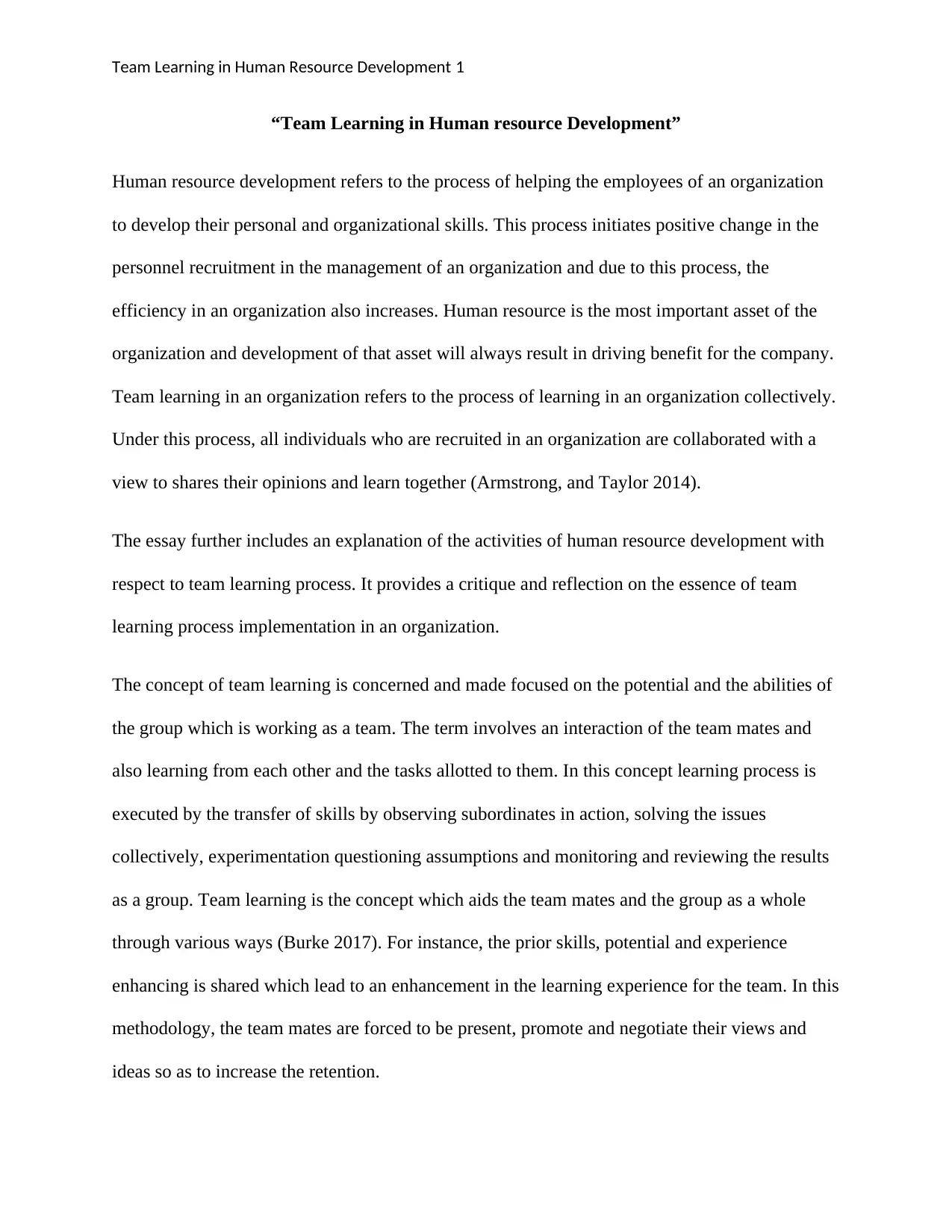
“Team Learning in Human resource Development”
Human resource development refers to the process of helping the employees of an organization
to develop their personal and organizational skills. This process initiates positive change in the
personnel recruitment in the management of an organization and due to this process, the
efficiency in an organization also increases. Human resource is the most important asset of the
organization and development of that asset will always result in driving benefit for the company.
Team learning in an organization refers to the process of learning in an organization collectively.
Under this process, all individuals who are recruited in an organization are collaborated with a
view to shares their opinions and learn together (Armstrong, and Taylor 2014).
The essay further includes an explanation of the activities of human resource development with
respect to team learning process. It provides a critique and reflection on the essence of team
learning process implementation in an organization.
The concept of team learning is concerned and made focused on the potential and the abilities of
the group which is working as a team. The term involves an interaction of the team mates and
also learning from each other and the tasks allotted to them. In this concept learning process is
executed by the transfer of skills by observing subordinates in action, solving the issues
collectively, experimentation questioning assumptions and monitoring and reviewing the results
as a group. Team learning is the concept which aids the team mates and the group as a whole
through various ways (Burke 2017). For instance, the prior skills, potential and experience
enhancing is shared which lead to an enhancement in the learning experience for the team. In this
methodology, the team mates are forced to be present, promote and negotiate their views and
ideas so as to increase the retention.
“Team Learning in Human resource Development”
Human resource development refers to the process of helping the employees of an organization
to develop their personal and organizational skills. This process initiates positive change in the
personnel recruitment in the management of an organization and due to this process, the
efficiency in an organization also increases. Human resource is the most important asset of the
organization and development of that asset will always result in driving benefit for the company.
Team learning in an organization refers to the process of learning in an organization collectively.
Under this process, all individuals who are recruited in an organization are collaborated with a
view to shares their opinions and learn together (Armstrong, and Taylor 2014).
The essay further includes an explanation of the activities of human resource development with
respect to team learning process. It provides a critique and reflection on the essence of team
learning process implementation in an organization.
The concept of team learning is concerned and made focused on the potential and the abilities of
the group which is working as a team. The term involves an interaction of the team mates and
also learning from each other and the tasks allotted to them. In this concept learning process is
executed by the transfer of skills by observing subordinates in action, solving the issues
collectively, experimentation questioning assumptions and monitoring and reviewing the results
as a group. Team learning is the concept which aids the team mates and the group as a whole
through various ways (Burke 2017). For instance, the prior skills, potential and experience
enhancing is shared which lead to an enhancement in the learning experience for the team. In this
methodology, the team mates are forced to be present, promote and negotiate their views and
ideas so as to increase the retention.

Team Learning in Human Resource Development 2
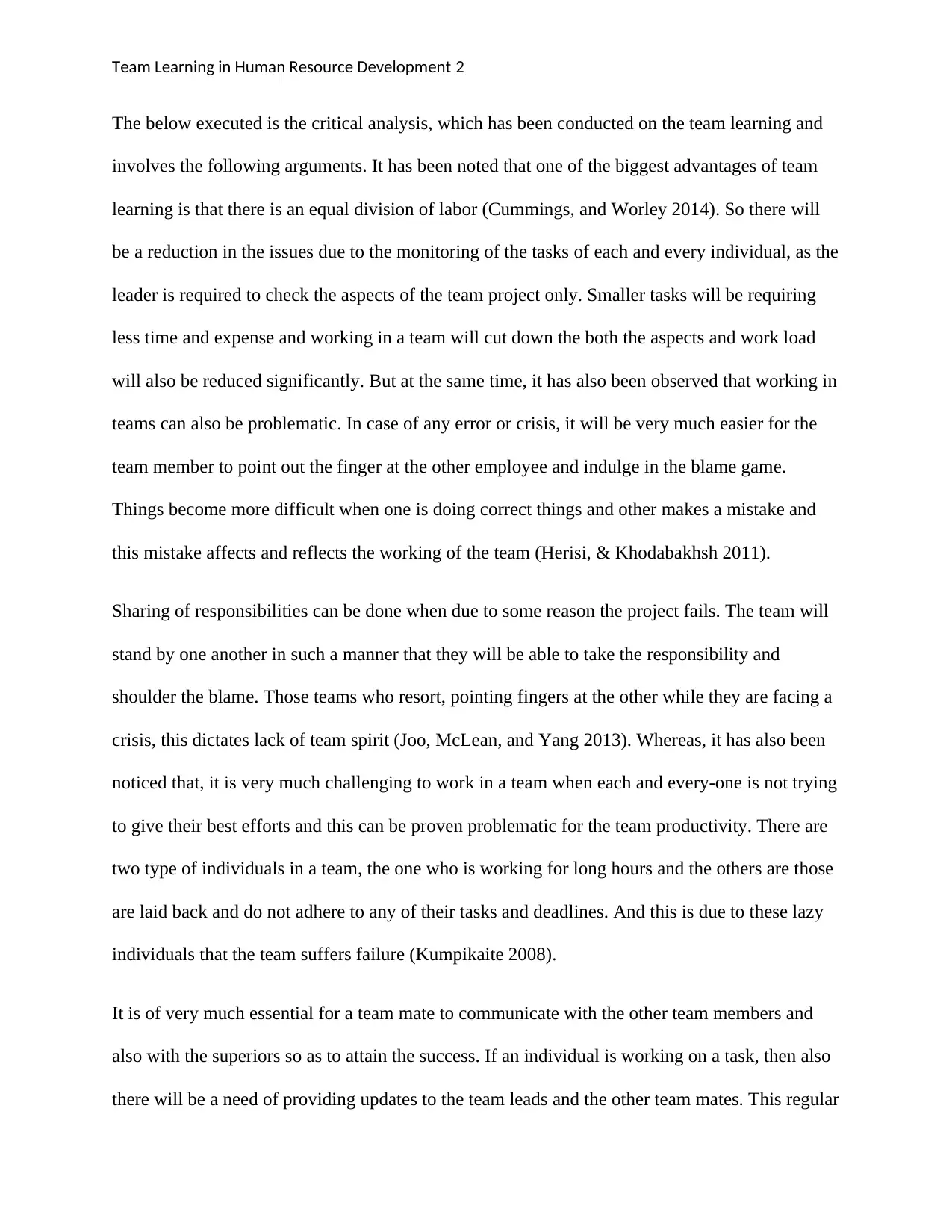
The below executed is the critical analysis, which has been conducted on the team learning and
involves the following arguments. It has been noted that one of the biggest advantages of team
learning is that there is an equal division of labor (Cummings, and Worley 2014). So there will
be a reduction in the issues due to the monitoring of the tasks of each and every individual, as the
leader is required to check the aspects of the team project only. Smaller tasks will be requiring
less time and expense and working in a team will cut down the both the aspects and work load
will also be reduced significantly. But at the same time, it has also been observed that working in
teams can also be problematic. In case of any error or crisis, it will be very much easier for the
team member to point out the finger at the other employee and indulge in the blame game.
Things become more difficult when one is doing correct things and other makes a mistake and
this mistake affects and reflects the working of the team (Herisi, & Khodabakhsh 2011).
Sharing of responsibilities can be done when due to some reason the project fails. The team will
stand by one another in such a manner that they will be able to take the responsibility and
shoulder the blame. Those teams who resort, pointing fingers at the other while they are facing a
crisis, this dictates lack of team spirit (Joo, McLean, and Yang 2013). Whereas, it has also been
noticed that, it is very much challenging to work in a team when each and every-one is not trying
to give their best efforts and this can be proven problematic for the team productivity. There are
two type of individuals in a team, the one who is working for long hours and the others are those
are laid back and do not adhere to any of their tasks and deadlines. And this is due to these lazy
individuals that the team suffers failure (Kumpikaite 2008).
It is of very much essential for a team mate to communicate with the other team members and
also with the superiors so as to attain the success. If an individual is working on a task, then also
there will be a need of providing updates to the team leads and the other team mates. This regular
The below executed is the critical analysis, which has been conducted on the team learning and
involves the following arguments. It has been noted that one of the biggest advantages of team
learning is that there is an equal division of labor (Cummings, and Worley 2014). So there will
be a reduction in the issues due to the monitoring of the tasks of each and every individual, as the
leader is required to check the aspects of the team project only. Smaller tasks will be requiring
less time and expense and working in a team will cut down the both the aspects and work load
will also be reduced significantly. But at the same time, it has also been observed that working in
teams can also be problematic. In case of any error or crisis, it will be very much easier for the
team member to point out the finger at the other employee and indulge in the blame game.
Things become more difficult when one is doing correct things and other makes a mistake and
this mistake affects and reflects the working of the team (Herisi, & Khodabakhsh 2011).
Sharing of responsibilities can be done when due to some reason the project fails. The team will
stand by one another in such a manner that they will be able to take the responsibility and
shoulder the blame. Those teams who resort, pointing fingers at the other while they are facing a
crisis, this dictates lack of team spirit (Joo, McLean, and Yang 2013). Whereas, it has also been
noticed that, it is very much challenging to work in a team when each and every-one is not trying
to give their best efforts and this can be proven problematic for the team productivity. There are
two type of individuals in a team, the one who is working for long hours and the others are those
are laid back and do not adhere to any of their tasks and deadlines. And this is due to these lazy
individuals that the team suffers failure (Kumpikaite 2008).
It is of very much essential for a team mate to communicate with the other team members and
also with the superiors so as to attain the success. If an individual is working on a task, then also
there will be a need of providing updates to the team leads and the other team mates. This regular
⊘ This is a preview!⊘
Do you want full access?
Subscribe today to unlock all pages.

Trusted by 1+ million students worldwide

Team Learning in Human Resource Development 3
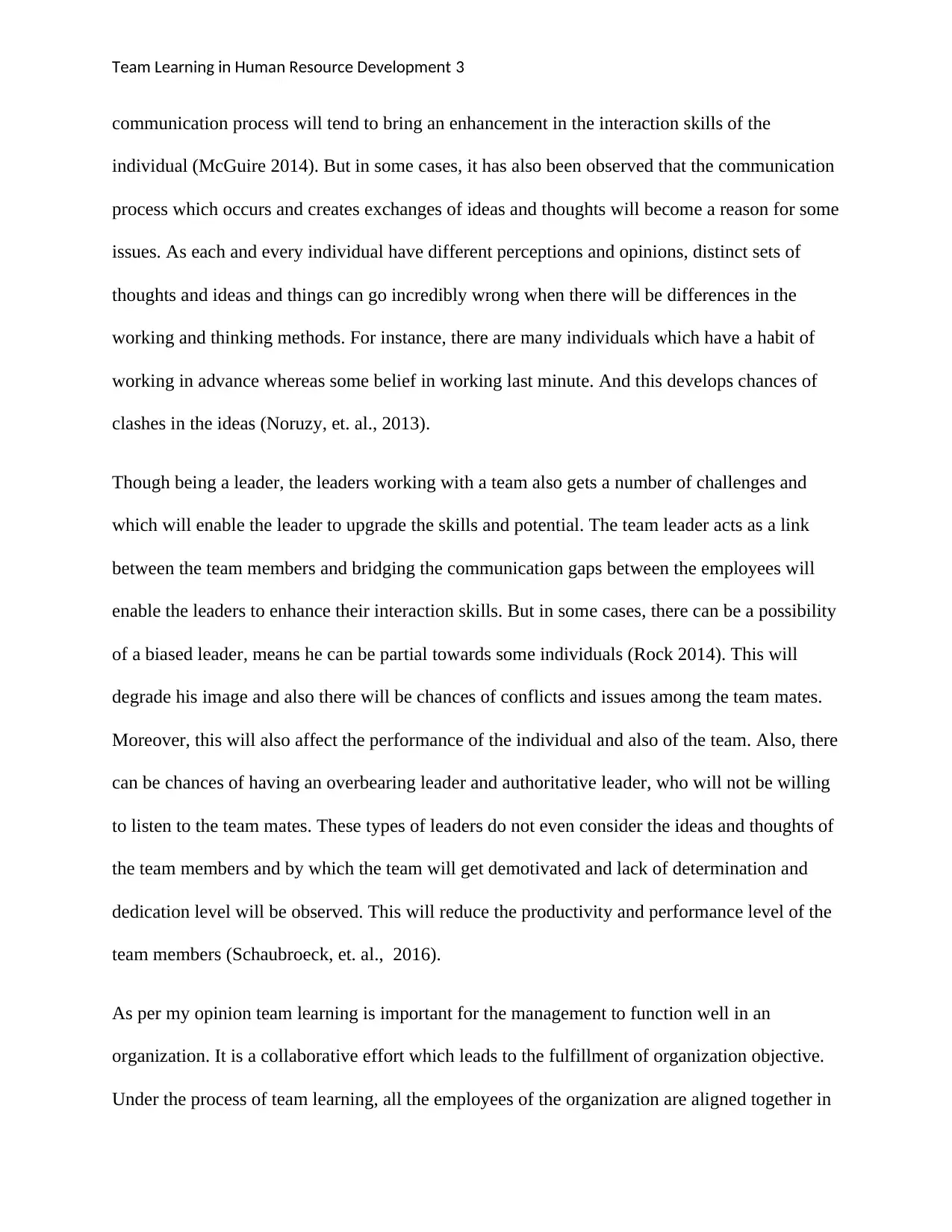
communication process will tend to bring an enhancement in the interaction skills of the
individual (McGuire 2014). But in some cases, it has also been observed that the communication
process which occurs and creates exchanges of ideas and thoughts will become a reason for some
issues. As each and every individual have different perceptions and opinions, distinct sets of
thoughts and ideas and things can go incredibly wrong when there will be differences in the
working and thinking methods. For instance, there are many individuals which have a habit of
working in advance whereas some belief in working last minute. And this develops chances of
clashes in the ideas (Noruzy, et. al., 2013).
Though being a leader, the leaders working with a team also gets a number of challenges and
which will enable the leader to upgrade the skills and potential. The team leader acts as a link
between the team members and bridging the communication gaps between the employees will
enable the leaders to enhance their interaction skills. But in some cases, there can be a possibility
of a biased leader, means he can be partial towards some individuals (Rock 2014). This will
degrade his image and also there will be chances of conflicts and issues among the team mates.
Moreover, this will also affect the performance of the individual and also of the team. Also, there
can be chances of having an overbearing leader and authoritative leader, who will not be willing
to listen to the team mates. These types of leaders do not even consider the ideas and thoughts of
the team members and by which the team will get demotivated and lack of determination and
dedication level will be observed. This will reduce the productivity and performance level of the
team members (Schaubroeck, et. al., 2016).
As per my opinion team learning is important for the management to function well in an
organization. It is a collaborative effort which leads to the fulfillment of organization objective.
Under the process of team learning, all the employees of the organization are aligned together in
communication process will tend to bring an enhancement in the interaction skills of the
individual (McGuire 2014). But in some cases, it has also been observed that the communication
process which occurs and creates exchanges of ideas and thoughts will become a reason for some
issues. As each and every individual have different perceptions and opinions, distinct sets of
thoughts and ideas and things can go incredibly wrong when there will be differences in the
working and thinking methods. For instance, there are many individuals which have a habit of
working in advance whereas some belief in working last minute. And this develops chances of
clashes in the ideas (Noruzy, et. al., 2013).
Though being a leader, the leaders working with a team also gets a number of challenges and
which will enable the leader to upgrade the skills and potential. The team leader acts as a link
between the team members and bridging the communication gaps between the employees will
enable the leaders to enhance their interaction skills. But in some cases, there can be a possibility
of a biased leader, means he can be partial towards some individuals (Rock 2014). This will
degrade his image and also there will be chances of conflicts and issues among the team mates.
Moreover, this will also affect the performance of the individual and also of the team. Also, there
can be chances of having an overbearing leader and authoritative leader, who will not be willing
to listen to the team mates. These types of leaders do not even consider the ideas and thoughts of
the team members and by which the team will get demotivated and lack of determination and
dedication level will be observed. This will reduce the productivity and performance level of the
team members (Schaubroeck, et. al., 2016).
As per my opinion team learning is important for the management to function well in an
organization. It is a collaborative effort which leads to the fulfillment of organization objective.
Under the process of team learning, all the employees of the organization are aligned together in
Paraphrase This Document
Need a fresh take? Get an instant paraphrase of this document with our AI Paraphraser

Team Learning in Human Resource Development 4
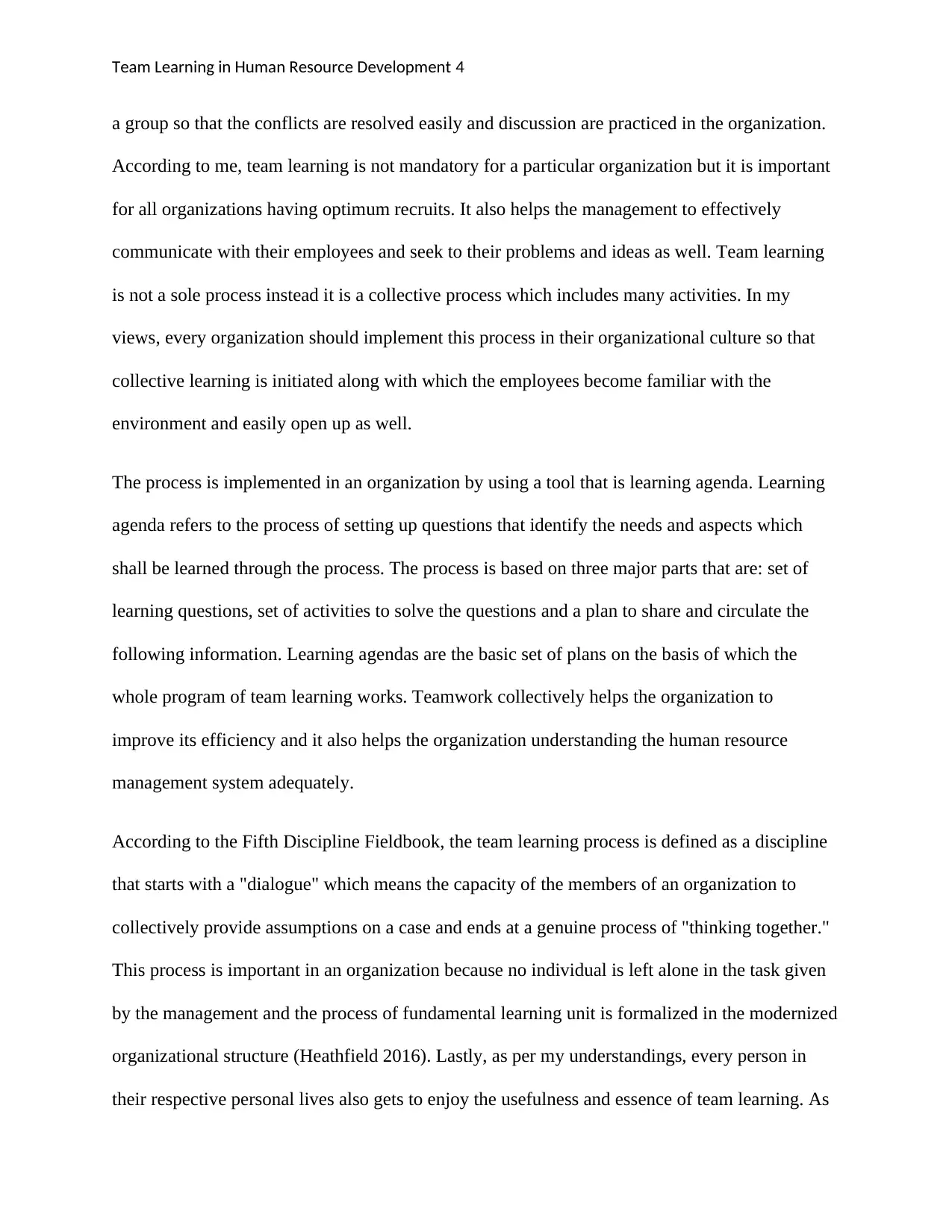
a group so that the conflicts are resolved easily and discussion are practiced in the organization.
According to me, team learning is not mandatory for a particular organization but it is important
for all organizations having optimum recruits. It also helps the management to effectively
communicate with their employees and seek to their problems and ideas as well. Team learning
is not a sole process instead it is a collective process which includes many activities. In my
views, every organization should implement this process in their organizational culture so that
collective learning is initiated along with which the employees become familiar with the
environment and easily open up as well.
The process is implemented in an organization by using a tool that is learning agenda. Learning
agenda refers to the process of setting up questions that identify the needs and aspects which
shall be learned through the process. The process is based on three major parts that are: set of
learning questions, set of activities to solve the questions and a plan to share and circulate the
following information. Learning agendas are the basic set of plans on the basis of which the
whole program of team learning works. Teamwork collectively helps the organization to
improve its efficiency and it also helps the organization understanding the human resource
management system adequately.
According to the Fifth Discipline Fieldbook, the team learning process is defined as a discipline
that starts with a "dialogue" which means the capacity of the members of an organization to
collectively provide assumptions on a case and ends at a genuine process of "thinking together."
This process is important in an organization because no individual is left alone in the task given
by the management and the process of fundamental learning unit is formalized in the modernized
organizational structure (Heathfield 2016). Lastly, as per my understandings, every person in
their respective personal lives also gets to enjoy the usefulness and essence of team learning. As
a group so that the conflicts are resolved easily and discussion are practiced in the organization.
According to me, team learning is not mandatory for a particular organization but it is important
for all organizations having optimum recruits. It also helps the management to effectively
communicate with their employees and seek to their problems and ideas as well. Team learning
is not a sole process instead it is a collective process which includes many activities. In my
views, every organization should implement this process in their organizational culture so that
collective learning is initiated along with which the employees become familiar with the
environment and easily open up as well.
The process is implemented in an organization by using a tool that is learning agenda. Learning
agenda refers to the process of setting up questions that identify the needs and aspects which
shall be learned through the process. The process is based on three major parts that are: set of
learning questions, set of activities to solve the questions and a plan to share and circulate the
following information. Learning agendas are the basic set of plans on the basis of which the
whole program of team learning works. Teamwork collectively helps the organization to
improve its efficiency and it also helps the organization understanding the human resource
management system adequately.
According to the Fifth Discipline Fieldbook, the team learning process is defined as a discipline
that starts with a "dialogue" which means the capacity of the members of an organization to
collectively provide assumptions on a case and ends at a genuine process of "thinking together."
This process is important in an organization because no individual is left alone in the task given
by the management and the process of fundamental learning unit is formalized in the modernized
organizational structure (Heathfield 2016). Lastly, as per my understandings, every person in
their respective personal lives also gets to enjoy the usefulness and essence of team learning. As

Team Learning in Human Resource Development 5
this process helps them individually to adapt with people of different natures and share and
receive ideas of people coming from different communities. The human resource behavior is
improved with the initiation of this process (Gold, et. al., 2013).
With the above-mentioned analysis, the fact that shall be noted is that team work is the essence
of efficient management in an organization. The process of team works provides a positive
impact on the human resource development of an organization, it has the potential to create and
change a complex organization culture into a simple organizational culture. Participation of team
in learning and development phase helps the organization to share views and initiate
development of the whole team, not just one person. Thus, it shall be noted that every
organization shall take the initiative to develop and implement team learning in their
organization system so as to improve its efficiency.
this process helps them individually to adapt with people of different natures and share and
receive ideas of people coming from different communities. The human resource behavior is
improved with the initiation of this process (Gold, et. al., 2013).
With the above-mentioned analysis, the fact that shall be noted is that team work is the essence
of efficient management in an organization. The process of team works provides a positive
impact on the human resource development of an organization, it has the potential to create and
change a complex organization culture into a simple organizational culture. Participation of team
in learning and development phase helps the organization to share views and initiate
development of the whole team, not just one person. Thus, it shall be noted that every
organization shall take the initiative to develop and implement team learning in their
organization system so as to improve its efficiency.
⊘ This is a preview!⊘
Do you want full access?
Subscribe today to unlock all pages.

Trusted by 1+ million students worldwide

Team Learning in Human Resource Development 6
References
Armstrong, M. and Taylor, S., 2014. Armstrong's handbook of human resource management
practice. Kogan Page Publishers.
Burke, W.W., 2017. Organization change: Theory and practice. Sage Publications.
Cummings, T.G. and Worley, C.G., 2014. Organization development and change. Cengage
learning.
Gold, J., Holden, R., Iles, P., Stewart, J. and Beardwell, J. eds., 2013. Human resource
development: Theory and practice. Palgrave Macmillan.
Heathfield, S. M., 2016. What Is Human Resource Development (HRD)?. Viewed on September
13, 2017 from https://www.thebalance.com/what-is-human-resource-development-hrd-1918142
Herisi, M. M., & Khodabakhsh, M., 2011. Learning Organizations and Human Resource
Development. Viewed on September 13, 2017 from https://www.wbiconpro.com/472-
Mahboubeh.pdf
Joo, B.K., McLean, G.N. and Yang, B., 2013. Creativity and human resource development: An
integrative literature review and a conceptual framework for future research. Human Resource
Development Review, 12(4), pp.390-421.
Kumpikaite, V., 2008. Human resource development in learning organization. Journal of
Business Economics and Management, 9(1). Pp. 25-31
McGuire, D., 2014. Human resource development. Sage.
References
Armstrong, M. and Taylor, S., 2014. Armstrong's handbook of human resource management
practice. Kogan Page Publishers.
Burke, W.W., 2017. Organization change: Theory and practice. Sage Publications.
Cummings, T.G. and Worley, C.G., 2014. Organization development and change. Cengage
learning.
Gold, J., Holden, R., Iles, P., Stewart, J. and Beardwell, J. eds., 2013. Human resource
development: Theory and practice. Palgrave Macmillan.
Heathfield, S. M., 2016. What Is Human Resource Development (HRD)?. Viewed on September
13, 2017 from https://www.thebalance.com/what-is-human-resource-development-hrd-1918142
Herisi, M. M., & Khodabakhsh, M., 2011. Learning Organizations and Human Resource
Development. Viewed on September 13, 2017 from https://www.wbiconpro.com/472-
Mahboubeh.pdf
Joo, B.K., McLean, G.N. and Yang, B., 2013. Creativity and human resource development: An
integrative literature review and a conceptual framework for future research. Human Resource
Development Review, 12(4), pp.390-421.
Kumpikaite, V., 2008. Human resource development in learning organization. Journal of
Business Economics and Management, 9(1). Pp. 25-31
McGuire, D., 2014. Human resource development. Sage.
Paraphrase This Document
Need a fresh take? Get an instant paraphrase of this document with our AI Paraphraser

Team Learning in Human Resource Development 7
Noruzy, A., Dalfard, V.M., Azhdari, B., Nazari-Shirkouhi, S. and Rezazadeh, A., 2013.
Relations between transformational leadership, organizational learning, knowledge management,
organizational innovation, and organizational performance: an empirical investigation of
manufacturing firms. The International Journal of Advanced Manufacturing Technology, pp.1-
13.
Rock, D., 2014. Quiet leadership. HarperCollins e-books.
Schaubroeck, J., Carmeli, A., Bhatia, S. and Paz, E., 2016. Enabling team learning when
members are prone to contentious communication: The role of team leader coaching. human
relations, 69(8), pp.1709-1727.
Noruzy, A., Dalfard, V.M., Azhdari, B., Nazari-Shirkouhi, S. and Rezazadeh, A., 2013.
Relations between transformational leadership, organizational learning, knowledge management,
organizational innovation, and organizational performance: an empirical investigation of
manufacturing firms. The International Journal of Advanced Manufacturing Technology, pp.1-
13.
Rock, D., 2014. Quiet leadership. HarperCollins e-books.
Schaubroeck, J., Carmeli, A., Bhatia, S. and Paz, E., 2016. Enabling team learning when
members are prone to contentious communication: The role of team leader coaching. human
relations, 69(8), pp.1709-1727.
1 out of 8
Related Documents
Your All-in-One AI-Powered Toolkit for Academic Success.
+13062052269
info@desklib.com
Available 24*7 on WhatsApp / Email
Unlock your academic potential
Copyright © 2020–2025 A2Z Services. All Rights Reserved. Developed and managed by ZUCOL.