Team Management & Leadership: Strategic Management and Roles
VerifiedAdded on 2023/05/30
|8
|1602
|169
Essay
AI Summary
This essay explores the concepts of organizational behavior at individual, interpersonal, and group levels, highlighting the importance of understanding organizational behavior for creating a friendly work environment and improving organizational performance. It discusses the differences between managerial skills at supervisory and middle levels, emphasizing the manager's role in understanding subordinates through effective communication and conflict resolution. The essay also examines the significance of interpersonal roles of a police chief and the responsibilities of a new strategic manager in developing strategies, providing leadership, and ensuring compliance. The document provides insights into effective team management and leadership practices within organizations, offering valuable information for students and professionals in the field. Desklib provides access to similar solved assignments and resources for students.
Running Head: TEAM MANAGEMENT & LEADERSHIP 0
Team Management and Leadership
Student Details
11/29/2018
Team Management and Leadership
Student Details
11/29/2018
Paraphrase This Document
Need a fresh take? Get an instant paraphrase of this document with our AI Paraphraser

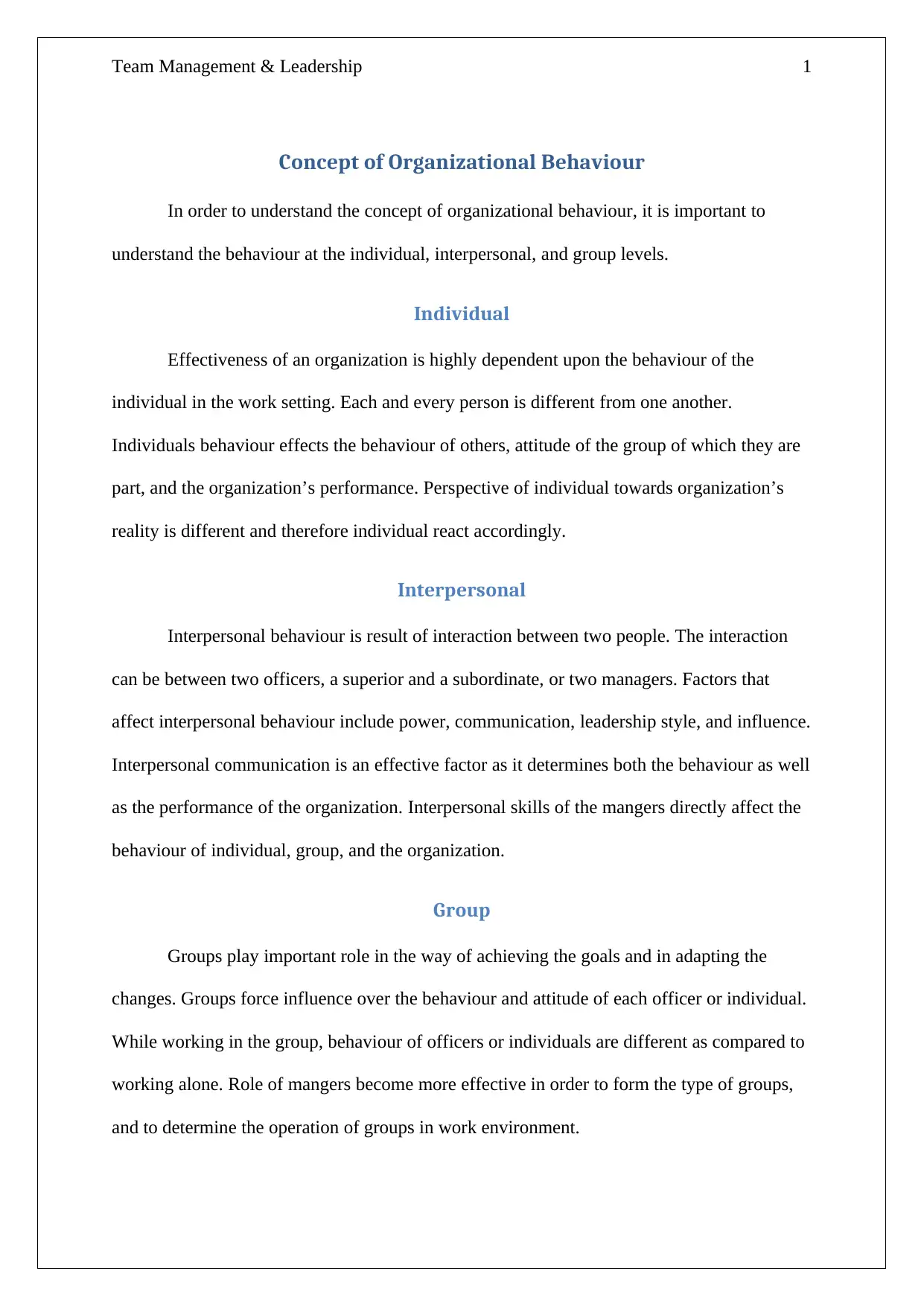
Team Management & Leadership 1
Concept of Organizational Behaviour
In order to understand the concept of organizational behaviour, it is important to
understand the behaviour at the individual, interpersonal, and group levels.
Individual
Effectiveness of an organization is highly dependent upon the behaviour of the
individual in the work setting. Each and every person is different from one another.
Individuals behaviour effects the behaviour of others, attitude of the group of which they are
part, and the organization’s performance. Perspective of individual towards organization’s
reality is different and therefore individual react accordingly.
Interpersonal
Interpersonal behaviour is result of interaction between two people. The interaction
can be between two officers, a superior and a subordinate, or two managers. Factors that
affect interpersonal behaviour include power, communication, leadership style, and influence.
Interpersonal communication is an effective factor as it determines both the behaviour as well
as the performance of the organization. Interpersonal skills of the mangers directly affect the
behaviour of individual, group, and the organization.
Group
Groups play important role in the way of achieving the goals and in adapting the
changes. Groups force influence over the behaviour and attitude of each officer or individual.
While working in the group, behaviour of officers or individuals are different as compared to
working alone. Role of mangers become more effective in order to form the type of groups,
and to determine the operation of groups in work environment.
Concept of Organizational Behaviour
In order to understand the concept of organizational behaviour, it is important to
understand the behaviour at the individual, interpersonal, and group levels.
Individual
Effectiveness of an organization is highly dependent upon the behaviour of the
individual in the work setting. Each and every person is different from one another.
Individuals behaviour effects the behaviour of others, attitude of the group of which they are
part, and the organization’s performance. Perspective of individual towards organization’s
reality is different and therefore individual react accordingly.
Interpersonal
Interpersonal behaviour is result of interaction between two people. The interaction
can be between two officers, a superior and a subordinate, or two managers. Factors that
affect interpersonal behaviour include power, communication, leadership style, and influence.
Interpersonal communication is an effective factor as it determines both the behaviour as well
as the performance of the organization. Interpersonal skills of the mangers directly affect the
behaviour of individual, group, and the organization.
Group
Groups play important role in the way of achieving the goals and in adapting the
changes. Groups force influence over the behaviour and attitude of each officer or individual.
While working in the group, behaviour of officers or individuals are different as compared to
working alone. Role of mangers become more effective in order to form the type of groups,
and to determine the operation of groups in work environment.

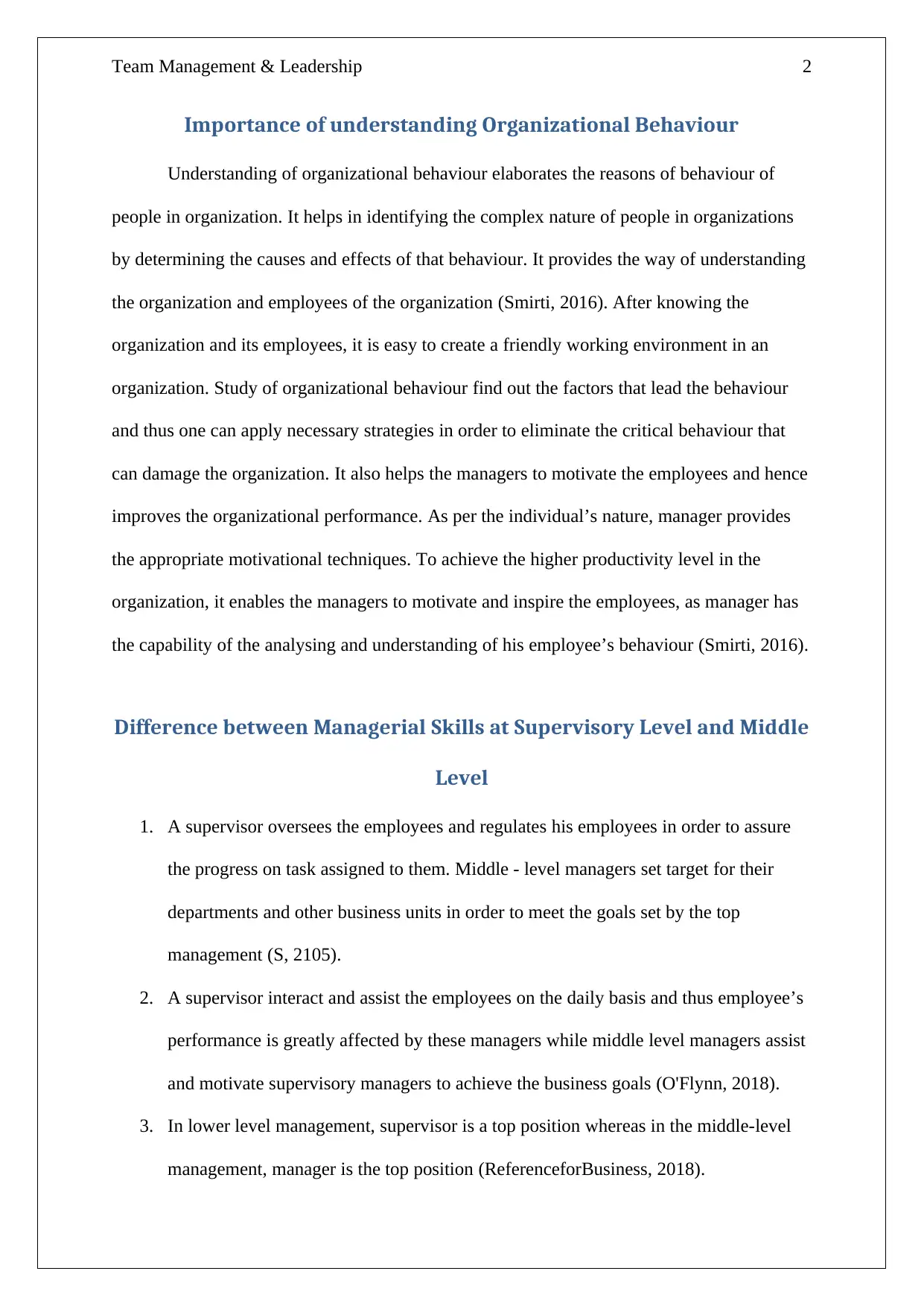
Team Management & Leadership 2
Importance of understanding Organizational Behaviour
Understanding of organizational behaviour elaborates the reasons of behaviour of
people in organization. It helps in identifying the complex nature of people in organizations
by determining the causes and effects of that behaviour. It provides the way of understanding
the organization and employees of the organization (Smirti, 2016). After knowing the
organization and its employees, it is easy to create a friendly working environment in an
organization. Study of organizational behaviour find out the factors that lead the behaviour
and thus one can apply necessary strategies in order to eliminate the critical behaviour that
can damage the organization. It also helps the managers to motivate the employees and hence
improves the organizational performance. As per the individual’s nature, manager provides
the appropriate motivational techniques. To achieve the higher productivity level in the
organization, it enables the managers to motivate and inspire the employees, as manager has
the capability of the analysing and understanding of his employee’s behaviour (Smirti, 2016).
Difference between Managerial Skills at Supervisory Level and Middle
Level
1. A supervisor oversees the employees and regulates his employees in order to assure
the progress on task assigned to them. Middle - level managers set target for their
departments and other business units in order to meet the goals set by the top
management (S, 2105).
2. A supervisor interact and assist the employees on the daily basis and thus employee’s
performance is greatly affected by these managers while middle level managers assist
and motivate supervisory managers to achieve the business goals (O'Flynn, 2018).
3. In lower level management, supervisor is a top position whereas in the middle-level
management, manager is the top position (ReferenceforBusiness, 2018).
Importance of understanding Organizational Behaviour
Understanding of organizational behaviour elaborates the reasons of behaviour of
people in organization. It helps in identifying the complex nature of people in organizations
by determining the causes and effects of that behaviour. It provides the way of understanding
the organization and employees of the organization (Smirti, 2016). After knowing the
organization and its employees, it is easy to create a friendly working environment in an
organization. Study of organizational behaviour find out the factors that lead the behaviour
and thus one can apply necessary strategies in order to eliminate the critical behaviour that
can damage the organization. It also helps the managers to motivate the employees and hence
improves the organizational performance. As per the individual’s nature, manager provides
the appropriate motivational techniques. To achieve the higher productivity level in the
organization, it enables the managers to motivate and inspire the employees, as manager has
the capability of the analysing and understanding of his employee’s behaviour (Smirti, 2016).
Difference between Managerial Skills at Supervisory Level and Middle
Level
1. A supervisor oversees the employees and regulates his employees in order to assure
the progress on task assigned to them. Middle - level managers set target for their
departments and other business units in order to meet the goals set by the top
management (S, 2105).
2. A supervisor interact and assist the employees on the daily basis and thus employee’s
performance is greatly affected by these managers while middle level managers assist
and motivate supervisory managers to achieve the business goals (O'Flynn, 2018).
3. In lower level management, supervisor is a top position whereas in the middle-level
management, manager is the top position (ReferenceforBusiness, 2018).
⊘ This is a preview!⊘
Do you want full access?
Subscribe today to unlock all pages.

Trusted by 1+ million students worldwide

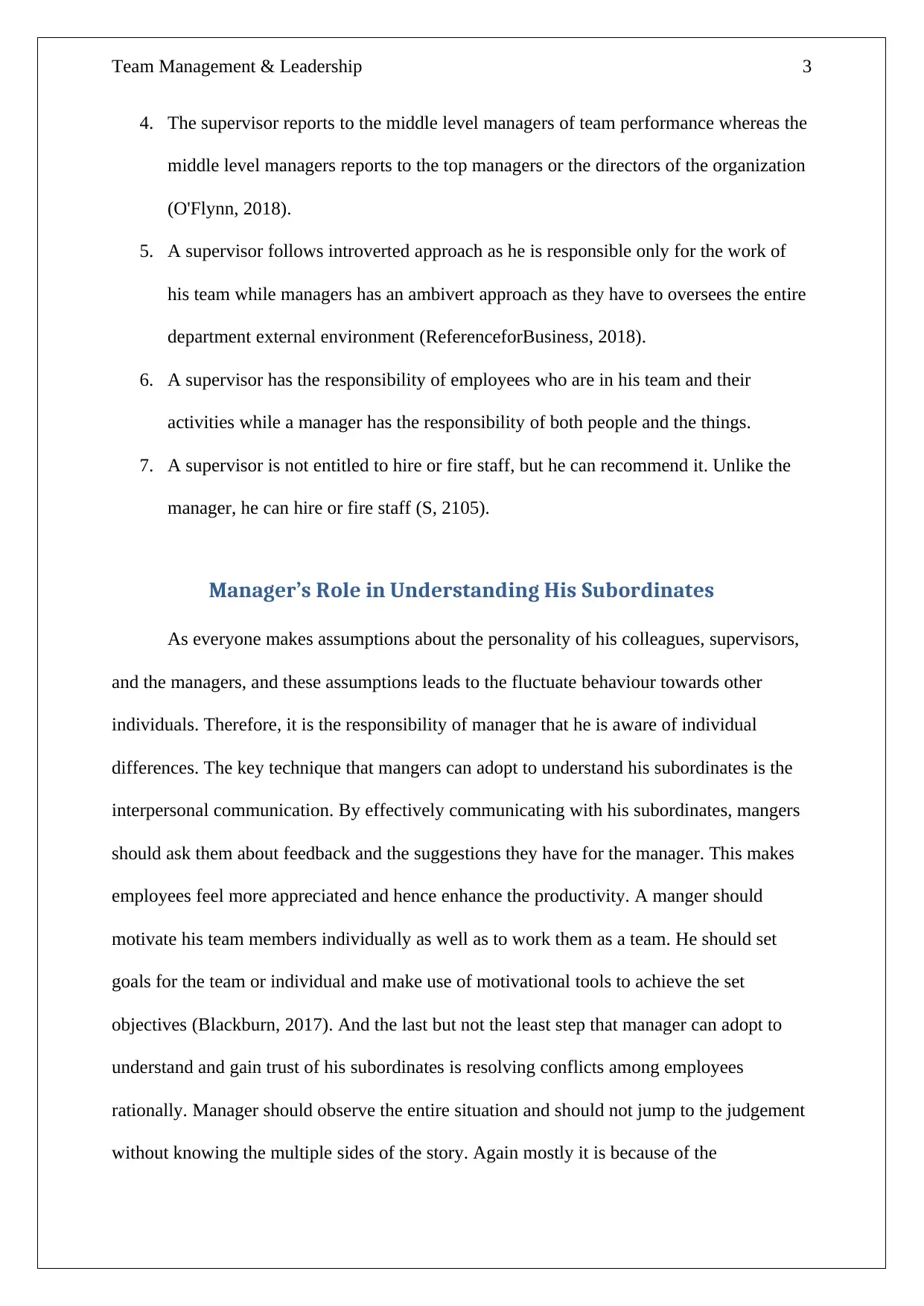
Team Management & Leadership 3
4. The supervisor reports to the middle level managers of team performance whereas the
middle level managers reports to the top managers or the directors of the organization
(O'Flynn, 2018).
5. A supervisor follows introverted approach as he is responsible only for the work of
his team while managers has an ambivert approach as they have to oversees the entire
department external environment (ReferenceforBusiness, 2018).
6. A supervisor has the responsibility of employees who are in his team and their
activities while a manager has the responsibility of both people and the things.
7. A supervisor is not entitled to hire or fire staff, but he can recommend it. Unlike the
manager, he can hire or fire staff (S, 2105).
Manager’s Role in Understanding His Subordinates
As everyone makes assumptions about the personality of his colleagues, supervisors,
and the managers, and these assumptions leads to the fluctuate behaviour towards other
individuals. Therefore, it is the responsibility of manager that he is aware of individual
differences. The key technique that mangers can adopt to understand his subordinates is the
interpersonal communication. By effectively communicating with his subordinates, mangers
should ask them about feedback and the suggestions they have for the manager. This makes
employees feel more appreciated and hence enhance the productivity. A manger should
motivate his team members individually as well as to work them as a team. He should set
goals for the team or individual and make use of motivational tools to achieve the set
objectives (Blackburn, 2017). And the last but not the least step that manager can adopt to
understand and gain trust of his subordinates is resolving conflicts among employees
rationally. Manager should observe the entire situation and should not jump to the judgement
without knowing the multiple sides of the story. Again mostly it is because of the
4. The supervisor reports to the middle level managers of team performance whereas the
middle level managers reports to the top managers or the directors of the organization
(O'Flynn, 2018).
5. A supervisor follows introverted approach as he is responsible only for the work of
his team while managers has an ambivert approach as they have to oversees the entire
department external environment (ReferenceforBusiness, 2018).
6. A supervisor has the responsibility of employees who are in his team and their
activities while a manager has the responsibility of both people and the things.
7. A supervisor is not entitled to hire or fire staff, but he can recommend it. Unlike the
manager, he can hire or fire staff (S, 2105).
Manager’s Role in Understanding His Subordinates
As everyone makes assumptions about the personality of his colleagues, supervisors,
and the managers, and these assumptions leads to the fluctuate behaviour towards other
individuals. Therefore, it is the responsibility of manager that he is aware of individual
differences. The key technique that mangers can adopt to understand his subordinates is the
interpersonal communication. By effectively communicating with his subordinates, mangers
should ask them about feedback and the suggestions they have for the manager. This makes
employees feel more appreciated and hence enhance the productivity. A manger should
motivate his team members individually as well as to work them as a team. He should set
goals for the team or individual and make use of motivational tools to achieve the set
objectives (Blackburn, 2017). And the last but not the least step that manager can adopt to
understand and gain trust of his subordinates is resolving conflicts among employees
rationally. Manager should observe the entire situation and should not jump to the judgement
without knowing the multiple sides of the story. Again mostly it is because of the
Paraphrase This Document
Need a fresh take? Get an instant paraphrase of this document with our AI Paraphraser

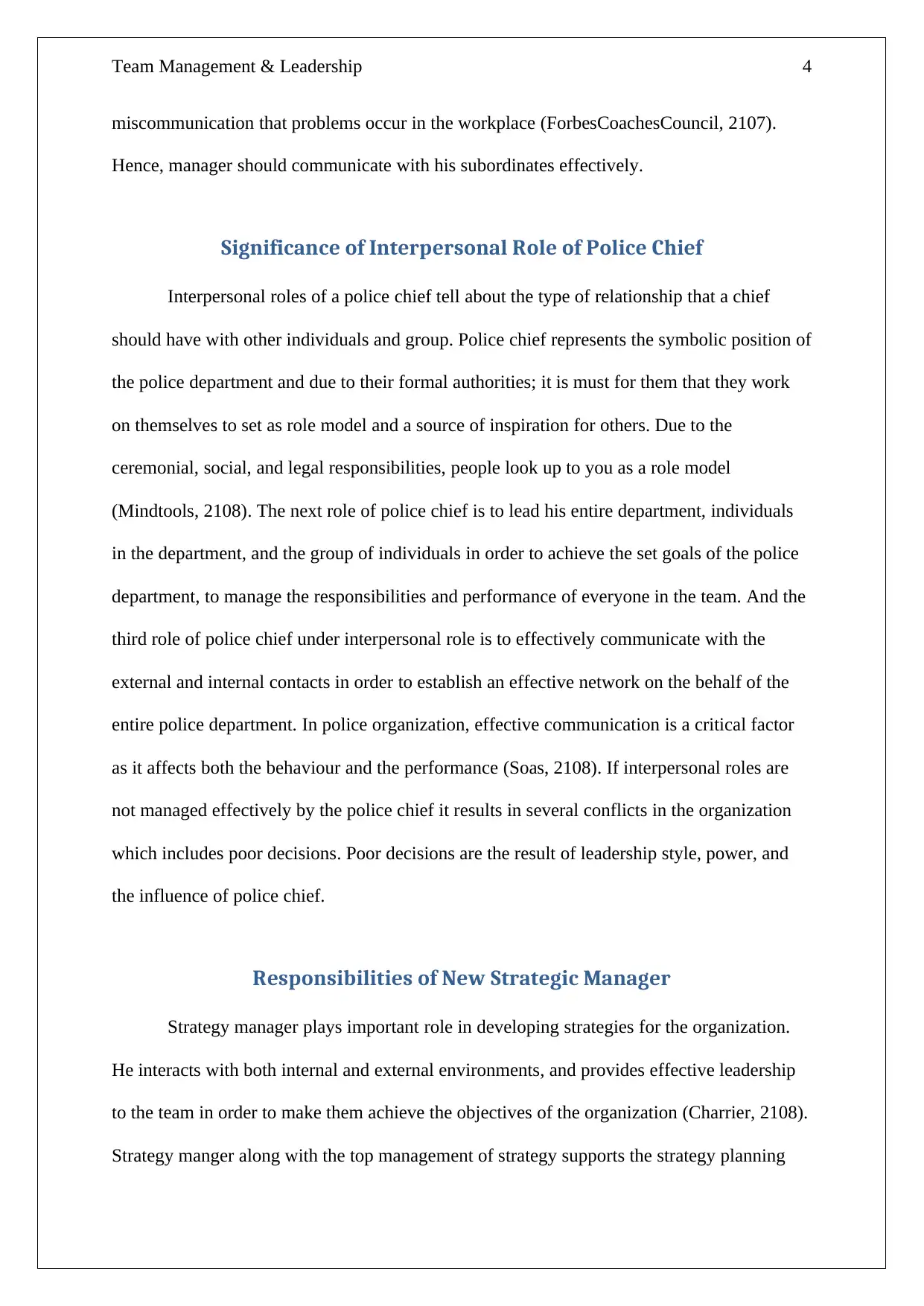
Team Management & Leadership 4
miscommunication that problems occur in the workplace (ForbesCoachesCouncil, 2107).
Hence, manager should communicate with his subordinates effectively.
Significance of Interpersonal Role of Police Chief
Interpersonal roles of a police chief tell about the type of relationship that a chief
should have with other individuals and group. Police chief represents the symbolic position of
the police department and due to their formal authorities; it is must for them that they work
on themselves to set as role model and a source of inspiration for others. Due to the
ceremonial, social, and legal responsibilities, people look up to you as a role model
(Mindtools, 2108). The next role of police chief is to lead his entire department, individuals
in the department, and the group of individuals in order to achieve the set goals of the police
department, to manage the responsibilities and performance of everyone in the team. And the
third role of police chief under interpersonal role is to effectively communicate with the
external and internal contacts in order to establish an effective network on the behalf of the
entire police department. In police organization, effective communication is a critical factor
as it affects both the behaviour and the performance (Soas, 2108). If interpersonal roles are
not managed effectively by the police chief it results in several conflicts in the organization
which includes poor decisions. Poor decisions are the result of leadership style, power, and
the influence of police chief.
Responsibilities of New Strategic Manager
Strategy manager plays important role in developing strategies for the organization.
He interacts with both internal and external environments, and provides effective leadership
to the team in order to make them achieve the objectives of the organization (Charrier, 2108).
Strategy manger along with the top management of strategy supports the strategy planning
miscommunication that problems occur in the workplace (ForbesCoachesCouncil, 2107).
Hence, manager should communicate with his subordinates effectively.
Significance of Interpersonal Role of Police Chief
Interpersonal roles of a police chief tell about the type of relationship that a chief
should have with other individuals and group. Police chief represents the symbolic position of
the police department and due to their formal authorities; it is must for them that they work
on themselves to set as role model and a source of inspiration for others. Due to the
ceremonial, social, and legal responsibilities, people look up to you as a role model
(Mindtools, 2108). The next role of police chief is to lead his entire department, individuals
in the department, and the group of individuals in order to achieve the set goals of the police
department, to manage the responsibilities and performance of everyone in the team. And the
third role of police chief under interpersonal role is to effectively communicate with the
external and internal contacts in order to establish an effective network on the behalf of the
entire police department. In police organization, effective communication is a critical factor
as it affects both the behaviour and the performance (Soas, 2108). If interpersonal roles are
not managed effectively by the police chief it results in several conflicts in the organization
which includes poor decisions. Poor decisions are the result of leadership style, power, and
the influence of police chief.
Responsibilities of New Strategic Manager
Strategy manager plays important role in developing strategies for the organization.
He interacts with both internal and external environments, and provides effective leadership
to the team in order to make them achieve the objectives of the organization (Charrier, 2108).
Strategy manger along with the top management of strategy supports the strategy planning

Team Management & Leadership 5
process. He analyse the plan and ensure that all the plans of the organization are executed
timely and effectively that results in the profit or growth of the organization. He develops and
manages the performance report for the business leaders. If any risk or harm arises for the
organization, then it is the responsibility of strategy manager to identify the threats and finds
a solution for the problem. He provides leadership for his department and provides necessary
knowledge and support to ensure the compliance of strategies (Cleverism, 2108).
process. He analyse the plan and ensure that all the plans of the organization are executed
timely and effectively that results in the profit or growth of the organization. He develops and
manages the performance report for the business leaders. If any risk or harm arises for the
organization, then it is the responsibility of strategy manager to identify the threats and finds
a solution for the problem. He provides leadership for his department and provides necessary
knowledge and support to ensure the compliance of strategies (Cleverism, 2108).
⊘ This is a preview!⊘
Do you want full access?
Subscribe today to unlock all pages.

Trusted by 1+ million students worldwide

Team Management & Leadership 6
Reference
Blackburn, A. (2017). How to Improve Relations Between Your Managers and Employees.
Retrieved from https://www.business.com/articles/how-to-improve-relations-between-
your-managers-and-employees/
Charrier, K. (2108). Strategic Management in Policing: The Role of the Strategic Manager.
Retrieved from http://www.policechiefmagazine.org/strategic-management-in-
policing-the-role/
Cleverism. (2108). Strategy Manager. Retrieved from https://www.cleverism.com/job-
profiles/strategy-manager/
ForbesCoachesCouncil. (2107). 12 Ways Managers Can Establish A Trusting Relationship
With Employees. Retrieved from
https://www.forbes.com/sites/forbescoachescouncil/2017/04/28/12-ways-managers-
can-establish-a-trusting-relationship-with-employees/#34158a34c297
Mindtools. (2108). Mintzberg's Management Roles. Retrieved from
https://www.mindtools.com/pages/article/management-roles.htm
O'Flynn, K. (2018). What Are the Differences in the Responsibilities of Top Managers Vs.
Middle Managers? Retrieved from https://smallbusiness.chron.com/differences-
responsibilities-top-managers-vs-middle-managers-32256.html
ReferenceforBusiness. (2018). Management Levels. Retrieved from
https://www.referenceforbusiness.com/management/Log-Mar/Management-
Levels.html
Reference
Blackburn, A. (2017). How to Improve Relations Between Your Managers and Employees.
Retrieved from https://www.business.com/articles/how-to-improve-relations-between-
your-managers-and-employees/
Charrier, K. (2108). Strategic Management in Policing: The Role of the Strategic Manager.
Retrieved from http://www.policechiefmagazine.org/strategic-management-in-
policing-the-role/
Cleverism. (2108). Strategy Manager. Retrieved from https://www.cleverism.com/job-
profiles/strategy-manager/
ForbesCoachesCouncil. (2107). 12 Ways Managers Can Establish A Trusting Relationship
With Employees. Retrieved from
https://www.forbes.com/sites/forbescoachescouncil/2017/04/28/12-ways-managers-
can-establish-a-trusting-relationship-with-employees/#34158a34c297
Mindtools. (2108). Mintzberg's Management Roles. Retrieved from
https://www.mindtools.com/pages/article/management-roles.htm
O'Flynn, K. (2018). What Are the Differences in the Responsibilities of Top Managers Vs.
Middle Managers? Retrieved from https://smallbusiness.chron.com/differences-
responsibilities-top-managers-vs-middle-managers-32256.html
ReferenceforBusiness. (2018). Management Levels. Retrieved from
https://www.referenceforbusiness.com/management/Log-Mar/Management-
Levels.html
Paraphrase This Document
Need a fresh take? Get an instant paraphrase of this document with our AI Paraphraser

Team Management & Leadership 7
S, S. (2105). Difference between Supervisior and Manger. Retrieved from
https://keydifferences.com/difference-between-supervisor-and-manager.html
Smirti. (2016). Importance of Organizational Behaviour. Retrieved from
https://www.managementnote.com/importance-of-ob/
Soas. (2108). Management, Organisations and Performance. Retrieved from
https://www.soas.ac.uk/cedep-demos/000_P531_MRD_K3736-Demo/unit1/page_10.
htm
S, S. (2105). Difference between Supervisior and Manger. Retrieved from
https://keydifferences.com/difference-between-supervisor-and-manager.html
Smirti. (2016). Importance of Organizational Behaviour. Retrieved from
https://www.managementnote.com/importance-of-ob/
Soas. (2108). Management, Organisations and Performance. Retrieved from
https://www.soas.ac.uk/cedep-demos/000_P531_MRD_K3736-Demo/unit1/page_10.
htm
1 out of 8
Related Documents
Your All-in-One AI-Powered Toolkit for Academic Success.
+13062052269
info@desklib.com
Available 24*7 on WhatsApp / Email
Unlock your academic potential
Copyright © 2020–2025 A2Z Services. All Rights Reserved. Developed and managed by ZUCOL.