Detailed Analysis: Managing Team Performance to Support Strategy
VerifiedAdded on 2023/01/06
|19
|4820
|1
Report
AI Summary
This report provides a comprehensive analysis of team performance management, focusing on its alignment with strategic objectives. The report begins with an executive summary and introduction, followed by an assessment of the links between team performance and strategic objectives. It evaluates various tools and techniques for setting and measuring team performance targets, including KPIs, management by objectives, and balanced scorecards. The report then delves into the importance of individual commitment to team performance, exploring influencing methodologies such as motivational theories. Furthermore, the report examines delegation, mentoring, and coaching in achieving strategic objectives, and evaluates a team performance plan to meet these objectives. Tools and methodologies for monitoring team performance and addressing problematic performances are also identified. The case study of Airdri is used to illustrate the concepts and provide practical examples throughout the report.
Manage Team
Performance to Support
Strategy
Performance to Support
Strategy

Paraphrase This Document
Need a fresh take? Get an instant paraphrase of this document with our AI Paraphraser

Executive summary:
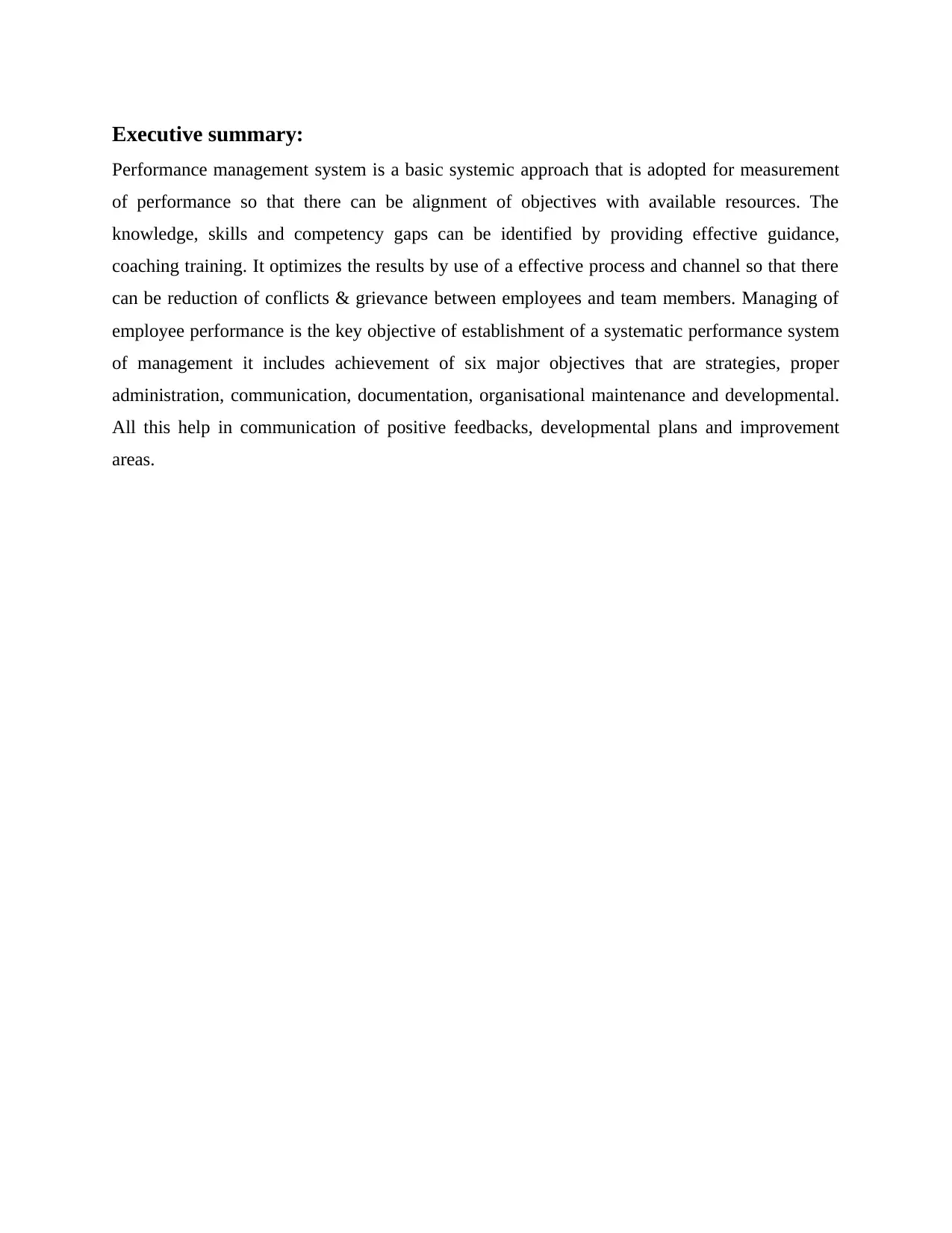
Performance management system is a basic systemic approach that is adopted for measurement
of performance so that there can be alignment of objectives with available resources. The
knowledge, skills and competency gaps can be identified by providing effective guidance,
coaching training. It optimizes the results by use of a effective process and channel so that there
can be reduction of conflicts & grievance between employees and team members. Managing of
employee performance is the key objective of establishment of a systematic performance system
of management it includes achievement of six major objectives that are strategies, proper
administration, communication, documentation, organisational maintenance and developmental.
All this help in communication of positive feedbacks, developmental plans and improvement
areas.
Performance management system is a basic systemic approach that is adopted for measurement
of performance so that there can be alignment of objectives with available resources. The
knowledge, skills and competency gaps can be identified by providing effective guidance,
coaching training. It optimizes the results by use of a effective process and channel so that there
can be reduction of conflicts & grievance between employees and team members. Managing of
employee performance is the key objective of establishment of a systematic performance system
of management it includes achievement of six major objectives that are strategies, proper
administration, communication, documentation, organisational maintenance and developmental.
All this help in communication of positive feedbacks, developmental plans and improvement
areas.
⊘ This is a preview!⊘
Do you want full access?
Subscribe today to unlock all pages.

Trusted by 1+ million students worldwide
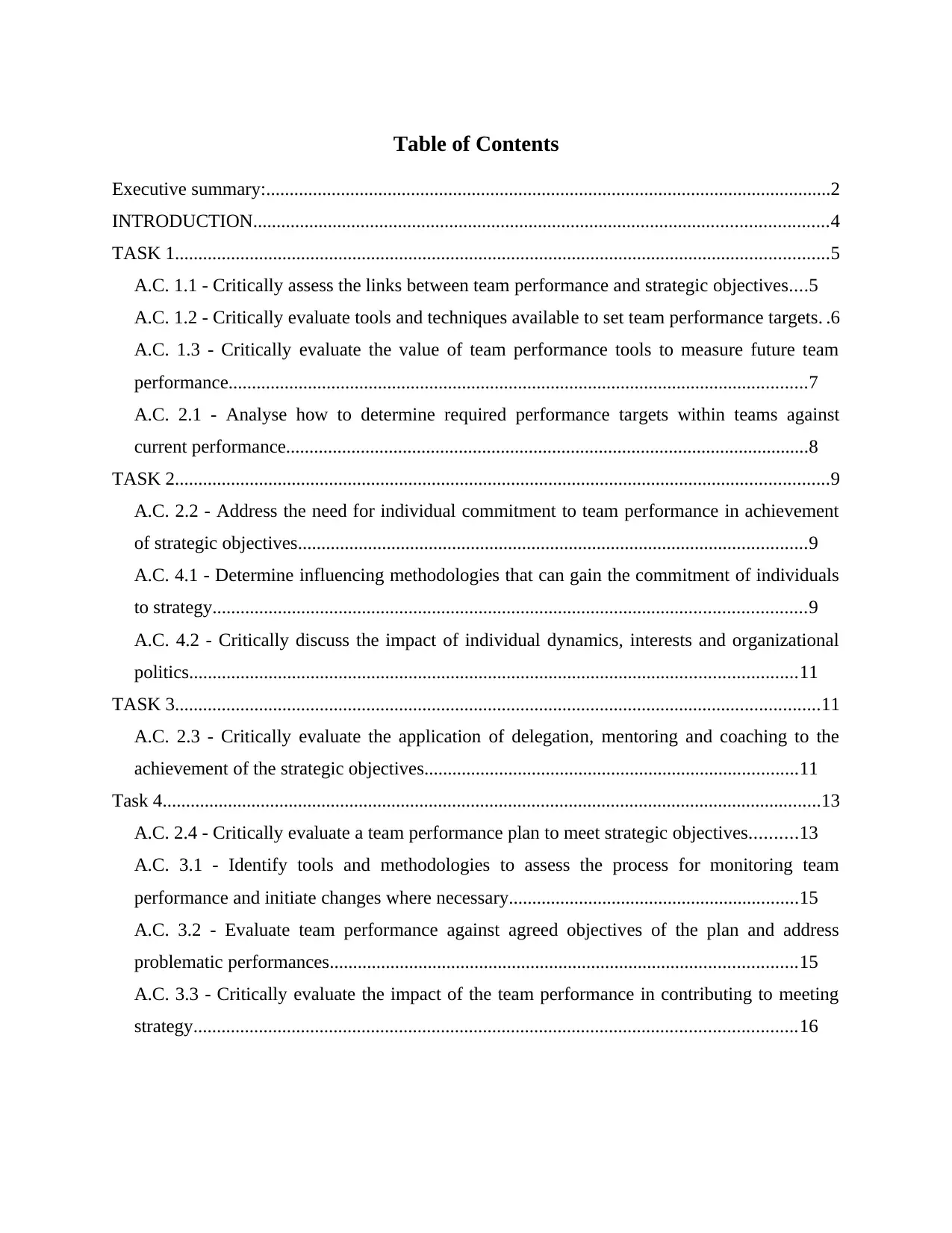
Table of Contents
Executive summary:.........................................................................................................................2
INTRODUCTION...........................................................................................................................4
TASK 1............................................................................................................................................5
A.C. 1.1 - Critically assess the links between team performance and strategic objectives....5
A.C. 1.2 - Critically evaluate tools and techniques available to set team performance targets. .6
A.C. 1.3 - Critically evaluate the value of team performance tools to measure future team
performance............................................................................................................................7
A.C. 2.1 - Analyse how to determine required performance targets within teams against
current performance................................................................................................................8
TASK 2............................................................................................................................................9
A.C. 2.2 - Address the need for individual commitment to team performance in achievement
of strategic objectives.............................................................................................................9
A.C. 4.1 - Determine influencing methodologies that can gain the commitment of individuals
to strategy...............................................................................................................................9
A.C. 4.2 - Critically discuss the impact of individual dynamics, interests and organizational
politics..................................................................................................................................11
TASK 3..........................................................................................................................................11
A.C. 2.3 - Critically evaluate the application of delegation, mentoring and coaching to the
achievement of the strategic objectives................................................................................11
Task 4.............................................................................................................................................13
A.C. 2.4 - Critically evaluate a team performance plan to meet strategic objectives..........13
A.C. 3.1 - Identify tools and methodologies to assess the process for monitoring team
performance and initiate changes where necessary..............................................................15
A.C. 3.2 - Evaluate team performance against agreed objectives of the plan and address
problematic performances....................................................................................................15
A.C. 3.3 - Critically evaluate the impact of the team performance in contributing to meeting
strategy.................................................................................................................................16
Executive summary:.........................................................................................................................2
INTRODUCTION...........................................................................................................................4
TASK 1............................................................................................................................................5
A.C. 1.1 - Critically assess the links between team performance and strategic objectives....5
A.C. 1.2 - Critically evaluate tools and techniques available to set team performance targets. .6
A.C. 1.3 - Critically evaluate the value of team performance tools to measure future team
performance............................................................................................................................7
A.C. 2.1 - Analyse how to determine required performance targets within teams against
current performance................................................................................................................8
TASK 2............................................................................................................................................9
A.C. 2.2 - Address the need for individual commitment to team performance in achievement
of strategic objectives.............................................................................................................9
A.C. 4.1 - Determine influencing methodologies that can gain the commitment of individuals
to strategy...............................................................................................................................9
A.C. 4.2 - Critically discuss the impact of individual dynamics, interests and organizational
politics..................................................................................................................................11
TASK 3..........................................................................................................................................11
A.C. 2.3 - Critically evaluate the application of delegation, mentoring and coaching to the
achievement of the strategic objectives................................................................................11
Task 4.............................................................................................................................................13
A.C. 2.4 - Critically evaluate a team performance plan to meet strategic objectives..........13
A.C. 3.1 - Identify tools and methodologies to assess the process for monitoring team
performance and initiate changes where necessary..............................................................15
A.C. 3.2 - Evaluate team performance against agreed objectives of the plan and address
problematic performances....................................................................................................15
A.C. 3.3 - Critically evaluate the impact of the team performance in contributing to meeting
strategy.................................................................................................................................16
Paraphrase This Document
Need a fresh take? Get an instant paraphrase of this document with our AI Paraphraser
INTRODUCTION
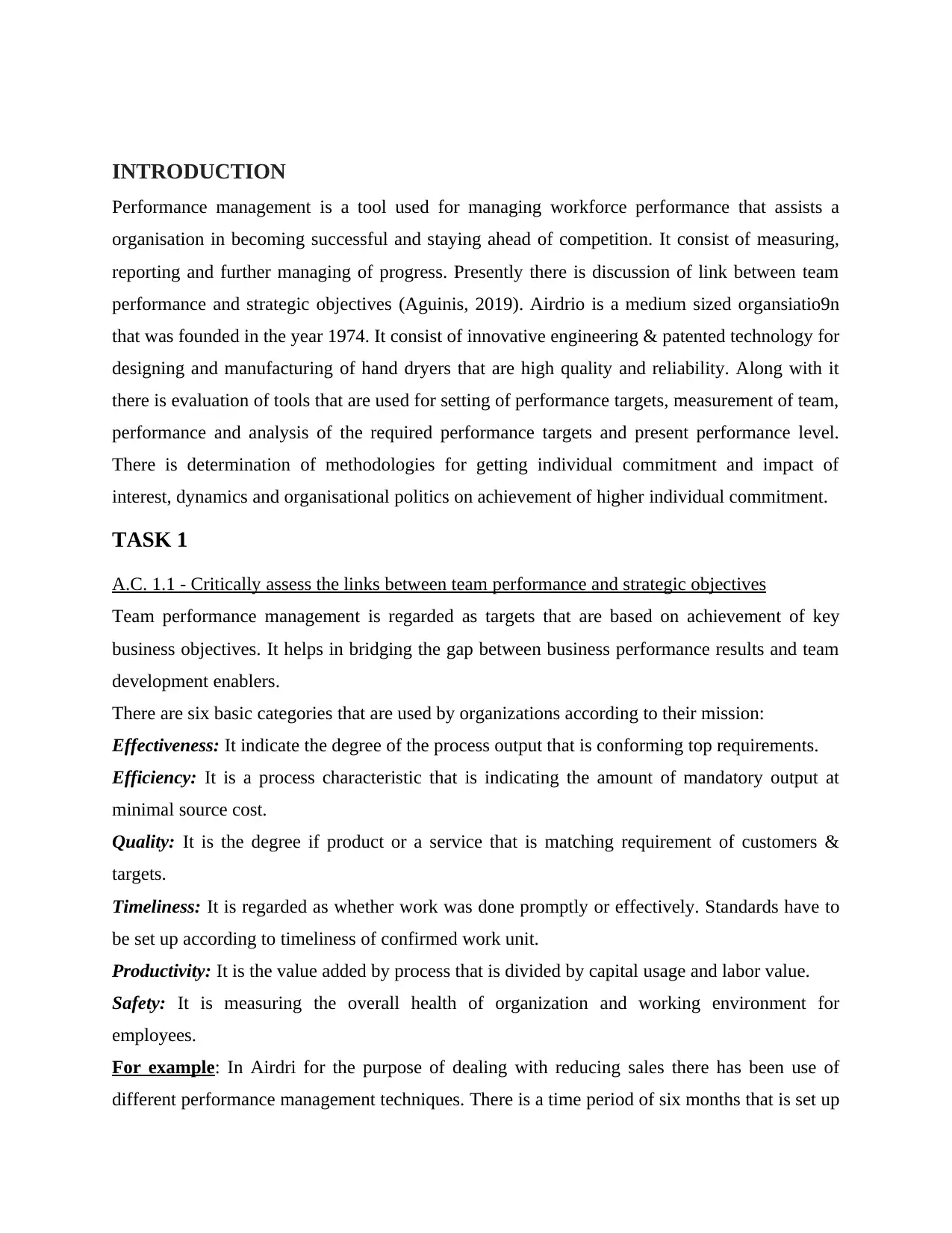
Performance management is a tool used for managing workforce performance that assists a
organisation in becoming successful and staying ahead of competition. It consist of measuring,
reporting and further managing of progress. Presently there is discussion of link between team
performance and strategic objectives (Aguinis, 2019). Airdrio is a medium sized organsiatio9n
that was founded in the year 1974. It consist of innovative engineering & patented technology for
designing and manufacturing of hand dryers that are high quality and reliability. Along with it
there is evaluation of tools that are used for setting of performance targets, measurement of team,
performance and analysis of the required performance targets and present performance level.
There is determination of methodologies for getting individual commitment and impact of
interest, dynamics and organisational politics on achievement of higher individual commitment.
TASK 1
A.C. 1.1 - Critically assess the links between team performance and strategic objectives
Team performance management is regarded as targets that are based on achievement of key
business objectives. It helps in bridging the gap between business performance results and team
development enablers.
There are six basic categories that are used by organizations according to their mission:
Effectiveness: It indicate the degree of the process output that is conforming top requirements.
Efficiency: It is a process characteristic that is indicating the amount of mandatory output at
minimal source cost.
Quality: It is the degree if product or a service that is matching requirement of customers &
targets.
Timeliness: It is regarded as whether work was done promptly or effectively. Standards have to
be set up according to timeliness of confirmed work unit.
Productivity: It is the value added by process that is divided by capital usage and labor value.
Safety: It is measuring the overall health of organization and working environment for
employees.
For example: In Airdri for the purpose of dealing with reducing sales there has been use of
different performance management techniques. There is a time period of six months that is set up
Performance management is a tool used for managing workforce performance that assists a
organisation in becoming successful and staying ahead of competition. It consist of measuring,
reporting and further managing of progress. Presently there is discussion of link between team
performance and strategic objectives (Aguinis, 2019). Airdrio is a medium sized organsiatio9n
that was founded in the year 1974. It consist of innovative engineering & patented technology for
designing and manufacturing of hand dryers that are high quality and reliability. Along with it
there is evaluation of tools that are used for setting of performance targets, measurement of team,
performance and analysis of the required performance targets and present performance level.
There is determination of methodologies for getting individual commitment and impact of
interest, dynamics and organisational politics on achievement of higher individual commitment.
TASK 1
A.C. 1.1 - Critically assess the links between team performance and strategic objectives
Team performance management is regarded as targets that are based on achievement of key
business objectives. It helps in bridging the gap between business performance results and team
development enablers.
There are six basic categories that are used by organizations according to their mission:
Effectiveness: It indicate the degree of the process output that is conforming top requirements.
Efficiency: It is a process characteristic that is indicating the amount of mandatory output at
minimal source cost.
Quality: It is the degree if product or a service that is matching requirement of customers &
targets.
Timeliness: It is regarded as whether work was done promptly or effectively. Standards have to
be set up according to timeliness of confirmed work unit.
Productivity: It is the value added by process that is divided by capital usage and labor value.
Safety: It is measuring the overall health of organization and working environment for
employees.
For example: In Airdri for the purpose of dealing with reducing sales there has been use of
different performance management techniques. There is a time period of six months that is set up
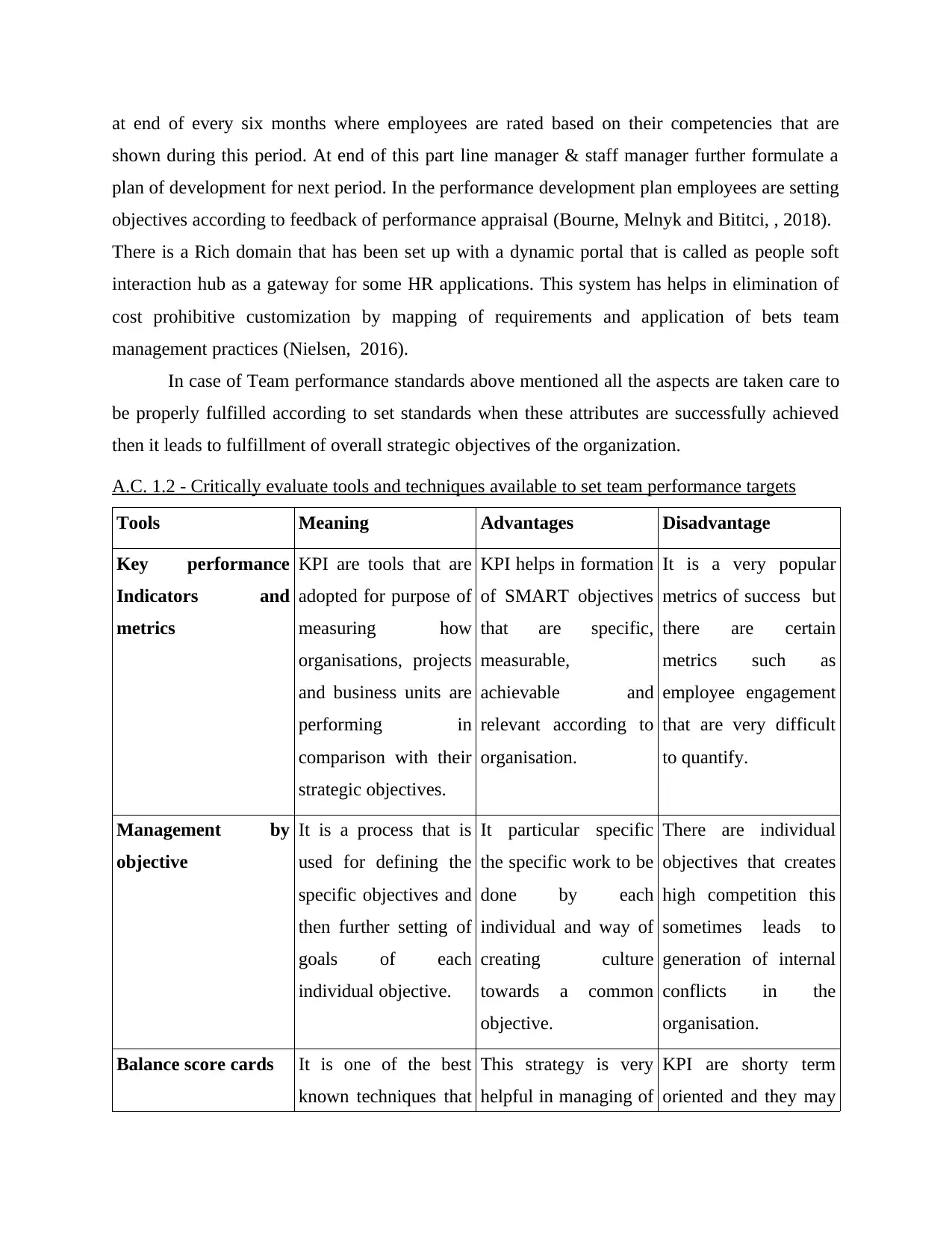
at end of every six months where employees are rated based on their competencies that are
shown during this period. At end of this part line manager & staff manager further formulate a
plan of development for next period. In the performance development plan employees are setting
objectives according to feedback of performance appraisal (Bourne, Melnyk and Bititci, , 2018).
There is a Rich domain that has been set up with a dynamic portal that is called as people soft
interaction hub as a gateway for some HR applications. This system has helps in elimination of
cost prohibitive customization by mapping of requirements and application of bets team
management practices (Nielsen, 2016).
In case of Team performance standards above mentioned all the aspects are taken care to
be properly fulfilled according to set standards when these attributes are successfully achieved
then it leads to fulfillment of overall strategic objectives of the organization.
A.C. 1.2 - Critically evaluate tools and techniques available to set team performance targets
Tools Meaning Advantages Disadvantage
Key performance
Indicators and
metrics
KPI are tools that are
adopted for purpose of
measuring how
organisations, projects
and business units are
performing in
comparison with their
strategic objectives.
KPI helps in formation
of SMART objectives
that are specific,
measurable,
achievable and
relevant according to
organisation.
It is a very popular
metrics of success but
there are certain
metrics such as
employee engagement
that are very difficult
to quantify.
Management by
objective
It is a process that is
used for defining the
specific objectives and
then further setting of
goals of each
individual objective.
It particular specific
the specific work to be
done by each
individual and way of
creating culture
towards a common
objective.
There are individual
objectives that creates
high competition this
sometimes leads to
generation of internal
conflicts in the
organisation.
Balance score cards It is one of the best
known techniques that
This strategy is very
helpful in managing of
KPI are shorty term
oriented and they may
shown during this period. At end of this part line manager & staff manager further formulate a
plan of development for next period. In the performance development plan employees are setting
objectives according to feedback of performance appraisal (Bourne, Melnyk and Bititci, , 2018).
There is a Rich domain that has been set up with a dynamic portal that is called as people soft
interaction hub as a gateway for some HR applications. This system has helps in elimination of
cost prohibitive customization by mapping of requirements and application of bets team
management practices (Nielsen, 2016).
In case of Team performance standards above mentioned all the aspects are taken care to
be properly fulfilled according to set standards when these attributes are successfully achieved
then it leads to fulfillment of overall strategic objectives of the organization.
A.C. 1.2 - Critically evaluate tools and techniques available to set team performance targets
Tools Meaning Advantages Disadvantage
Key performance
Indicators and
metrics
KPI are tools that are
adopted for purpose of
measuring how
organisations, projects
and business units are
performing in
comparison with their
strategic objectives.
KPI helps in formation
of SMART objectives
that are specific,
measurable,
achievable and
relevant according to
organisation.
It is a very popular
metrics of success but
there are certain
metrics such as
employee engagement
that are very difficult
to quantify.
Management by
objective
It is a process that is
used for defining the
specific objectives and
then further setting of
goals of each
individual objective.
It particular specific
the specific work to be
done by each
individual and way of
creating culture
towards a common
objective.
There are individual
objectives that creates
high competition this
sometimes leads to
generation of internal
conflicts in the
organisation.
Balance score cards It is one of the best
known techniques that
This strategy is very
helpful in managing of
KPI are shorty term
oriented and they may
⊘ This is a preview!⊘
Do you want full access?
Subscribe today to unlock all pages.
Trusted by 1+ million students worldwide
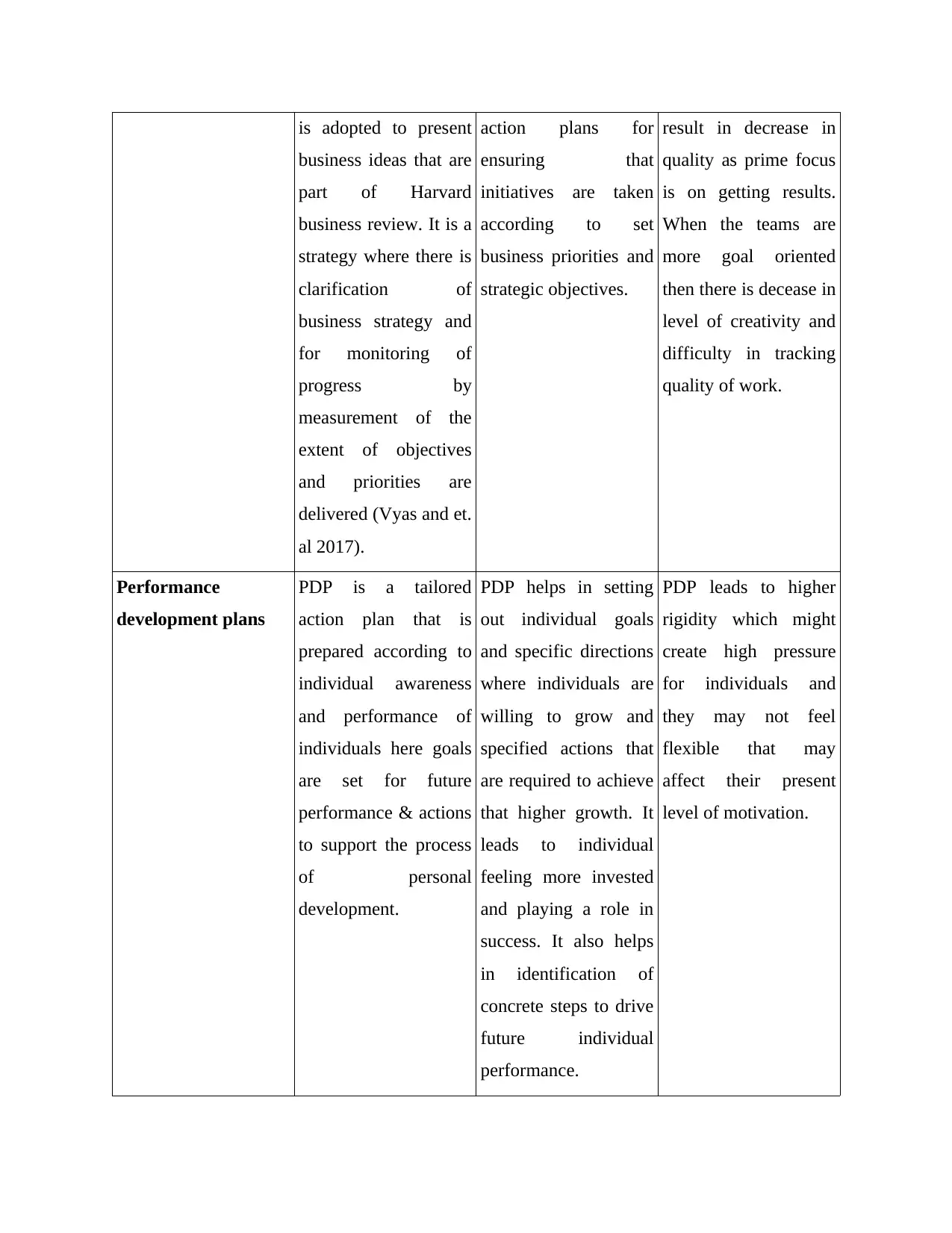
is adopted to present
business ideas that are
part of Harvard
business review. It is a
strategy where there is
clarification of
business strategy and
for monitoring of
progress by
measurement of the
extent of objectives
and priorities are
delivered (Vyas and et.
al 2017).
action plans for
ensuring that
initiatives are taken
according to set
business priorities and
strategic objectives.
result in decrease in
quality as prime focus
is on getting results.
When the teams are
more goal oriented
then there is decease in
level of creativity and
difficulty in tracking
quality of work.
Performance
development plans
PDP is a tailored
action plan that is
prepared according to
individual awareness
and performance of
individuals here goals
are set for future
performance & actions
to support the process
of personal
development.
PDP helps in setting
out individual goals
and specific directions
where individuals are
willing to grow and
specified actions that
are required to achieve
that higher growth. It
leads to individual
feeling more invested
and playing a role in
success. It also helps
in identification of
concrete steps to drive
future individual
performance.
PDP leads to higher
rigidity which might
create high pressure
for individuals and
they may not feel
flexible that may
affect their present
level of motivation.
business ideas that are
part of Harvard
business review. It is a
strategy where there is
clarification of
business strategy and
for monitoring of
progress by
measurement of the
extent of objectives
and priorities are
delivered (Vyas and et.
al 2017).
action plans for
ensuring that
initiatives are taken
according to set
business priorities and
strategic objectives.
result in decrease in
quality as prime focus
is on getting results.
When the teams are
more goal oriented
then there is decease in
level of creativity and
difficulty in tracking
quality of work.
Performance
development plans
PDP is a tailored
action plan that is
prepared according to
individual awareness
and performance of
individuals here goals
are set for future
performance & actions
to support the process
of personal
development.
PDP helps in setting
out individual goals
and specific directions
where individuals are
willing to grow and
specified actions that
are required to achieve
that higher growth. It
leads to individual
feeling more invested
and playing a role in
success. It also helps
in identification of
concrete steps to drive
future individual
performance.
PDP leads to higher
rigidity which might
create high pressure
for individuals and
they may not feel
flexible that may
affect their present
level of motivation.
Paraphrase This Document
Need a fresh take? Get an instant paraphrase of this document with our AI Paraphraser
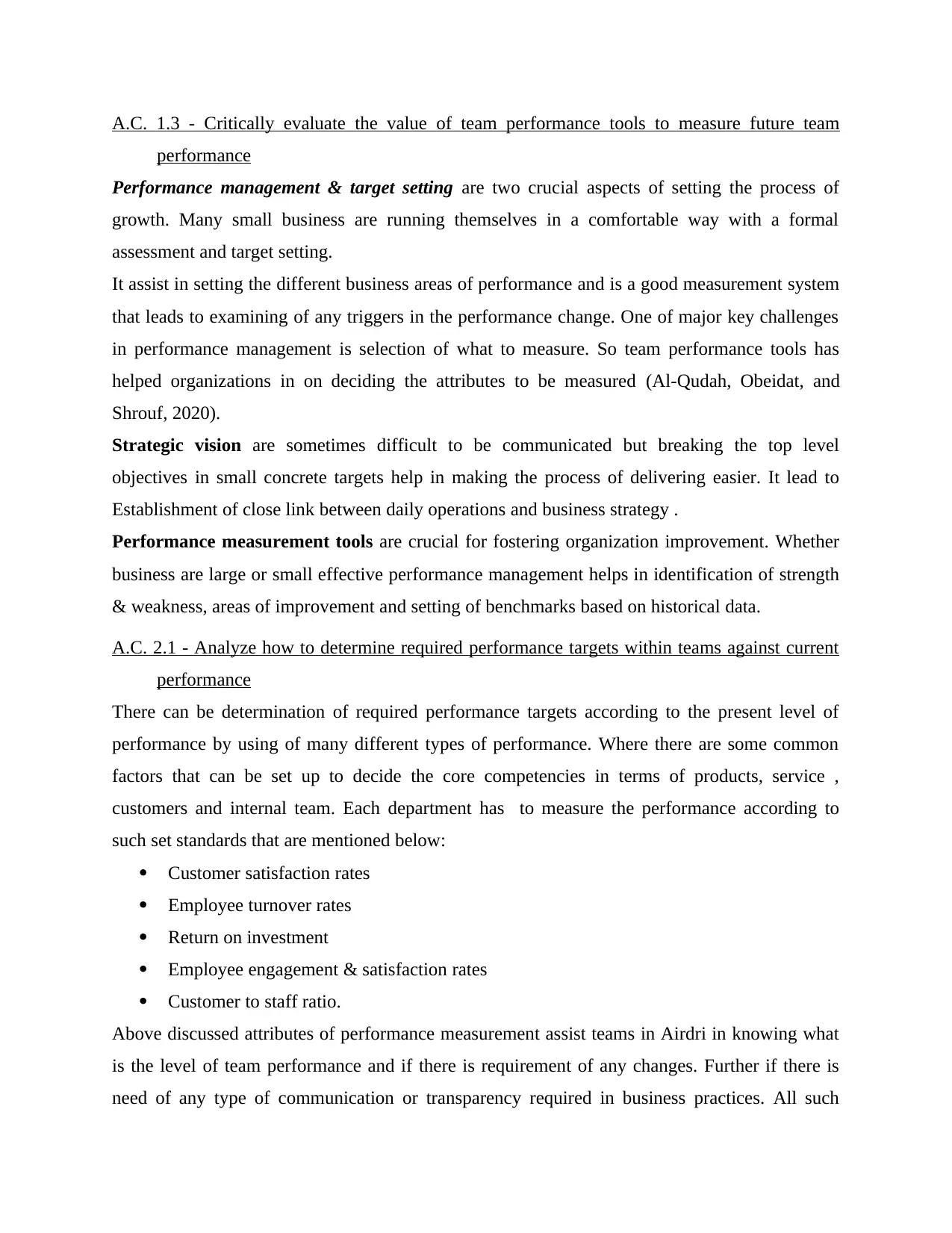
A.C. 1.3 - Critically evaluate the value of team performance tools to measure future team
performance
Performance management & target setting are two crucial aspects of setting the process of
growth. Many small business are running themselves in a comfortable way with a formal
assessment and target setting.
It assist in setting the different business areas of performance and is a good measurement system
that leads to examining of any triggers in the performance change. One of major key challenges
in performance management is selection of what to measure. So team performance tools has
helped organizations in on deciding the attributes to be measured (Al-Qudah, Obeidat, and
Shrouf, 2020).
Strategic vision are sometimes difficult to be communicated but breaking the top level
objectives in small concrete targets help in making the process of delivering easier. It lead to
Establishment of close link between daily operations and business strategy .
Performance measurement tools are crucial for fostering organization improvement. Whether
business are large or small effective performance management helps in identification of strength
& weakness, areas of improvement and setting of benchmarks based on historical data.
A.C. 2.1 - Analyze how to determine required performance targets within teams against current
performance
There can be determination of required performance targets according to the present level of
performance by using of many different types of performance. Where there are some common
factors that can be set up to decide the core competencies in terms of products, service ,
customers and internal team. Each department has to measure the performance according to
such set standards that are mentioned below:
Customer satisfaction rates
Employee turnover rates
Return on investment
Employee engagement & satisfaction rates
Customer to staff ratio.
Above discussed attributes of performance measurement assist teams in Airdri in knowing what
is the level of team performance and if there is requirement of any changes. Further if there is
need of any type of communication or transparency required in business practices. All such
performance
Performance management & target setting are two crucial aspects of setting the process of
growth. Many small business are running themselves in a comfortable way with a formal
assessment and target setting.
It assist in setting the different business areas of performance and is a good measurement system
that leads to examining of any triggers in the performance change. One of major key challenges
in performance management is selection of what to measure. So team performance tools has
helped organizations in on deciding the attributes to be measured (Al-Qudah, Obeidat, and
Shrouf, 2020).
Strategic vision are sometimes difficult to be communicated but breaking the top level
objectives in small concrete targets help in making the process of delivering easier. It lead to
Establishment of close link between daily operations and business strategy .
Performance measurement tools are crucial for fostering organization improvement. Whether
business are large or small effective performance management helps in identification of strength
& weakness, areas of improvement and setting of benchmarks based on historical data.
A.C. 2.1 - Analyze how to determine required performance targets within teams against current
performance
There can be determination of required performance targets according to the present level of
performance by using of many different types of performance. Where there are some common
factors that can be set up to decide the core competencies in terms of products, service ,
customers and internal team. Each department has to measure the performance according to
such set standards that are mentioned below:
Customer satisfaction rates
Employee turnover rates
Return on investment
Employee engagement & satisfaction rates
Customer to staff ratio.
Above discussed attributes of performance measurement assist teams in Airdri in knowing what
is the level of team performance and if there is requirement of any changes. Further if there is
need of any type of communication or transparency required in business practices. All such
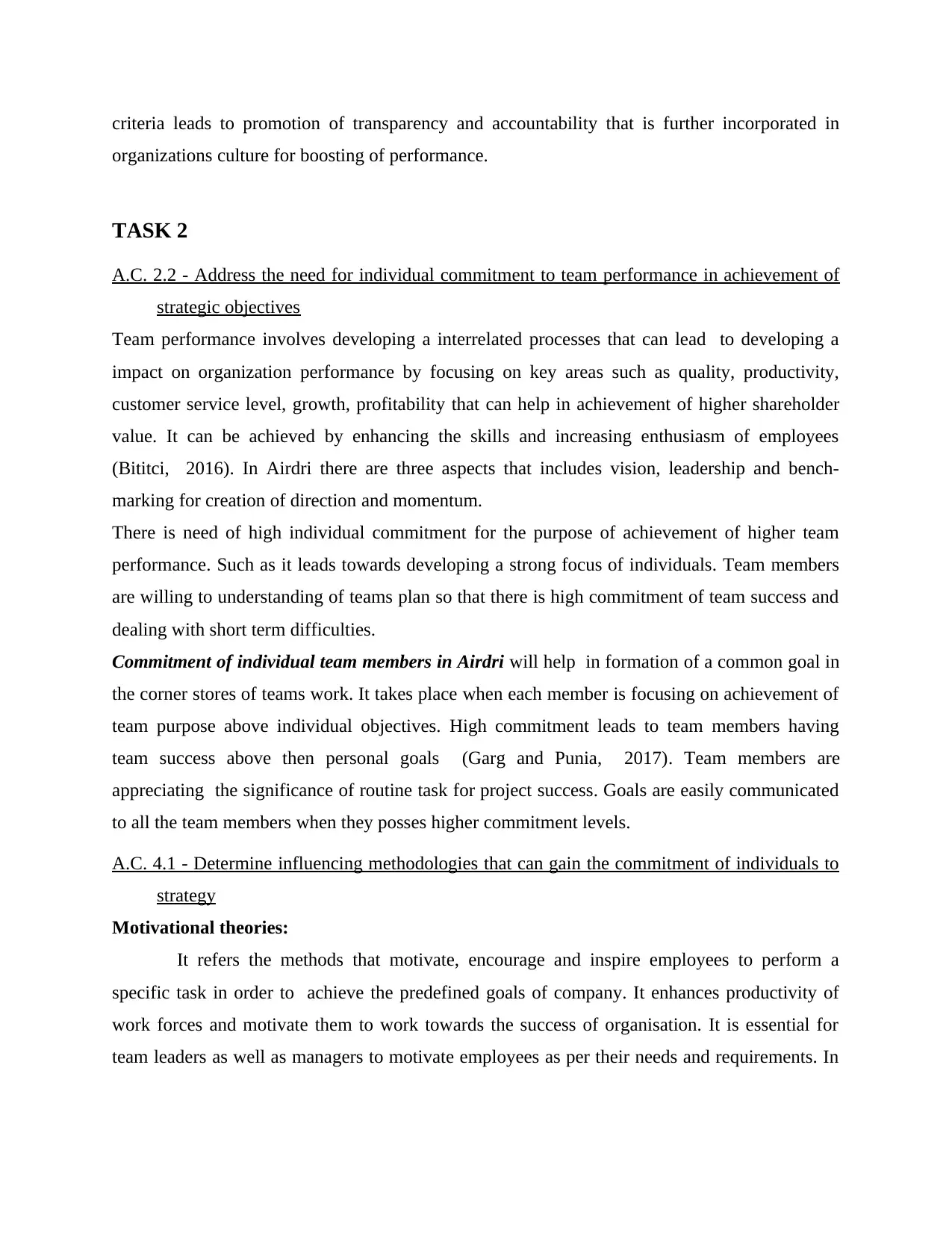
criteria leads to promotion of transparency and accountability that is further incorporated in
organizations culture for boosting of performance.
TASK 2
A.C. 2.2 - Address the need for individual commitment to team performance in achievement of
strategic objectives
Team performance involves developing a interrelated processes that can lead to developing a
impact on organization performance by focusing on key areas such as quality, productivity,
customer service level, growth, profitability that can help in achievement of higher shareholder
value. It can be achieved by enhancing the skills and increasing enthusiasm of employees
(Bititci, 2016). In Airdri there are three aspects that includes vision, leadership and bench-
marking for creation of direction and momentum.
There is need of high individual commitment for the purpose of achievement of higher team
performance. Such as it leads towards developing a strong focus of individuals. Team members
are willing to understanding of teams plan so that there is high commitment of team success and
dealing with short term difficulties.
Commitment of individual team members in Airdri will help in formation of a common goal in
the corner stores of teams work. It takes place when each member is focusing on achievement of
team purpose above individual objectives. High commitment leads to team members having
team success above then personal goals (Garg and Punia, 2017). Team members are
appreciating the significance of routine task for project success. Goals are easily communicated
to all the team members when they posses higher commitment levels.
A.C. 4.1 - Determine influencing methodologies that can gain the commitment of individuals to
strategy
Motivational theories:
It refers the methods that motivate, encourage and inspire employees to perform a
specific task in order to achieve the predefined goals of company. It enhances productivity of
work forces and motivate them to work towards the success of organisation. It is essential for
team leaders as well as managers to motivate employees as per their needs and requirements. In
organizations culture for boosting of performance.
TASK 2
A.C. 2.2 - Address the need for individual commitment to team performance in achievement of
strategic objectives
Team performance involves developing a interrelated processes that can lead to developing a
impact on organization performance by focusing on key areas such as quality, productivity,
customer service level, growth, profitability that can help in achievement of higher shareholder
value. It can be achieved by enhancing the skills and increasing enthusiasm of employees
(Bititci, 2016). In Airdri there are three aspects that includes vision, leadership and bench-
marking for creation of direction and momentum.
There is need of high individual commitment for the purpose of achievement of higher team
performance. Such as it leads towards developing a strong focus of individuals. Team members
are willing to understanding of teams plan so that there is high commitment of team success and
dealing with short term difficulties.
Commitment of individual team members in Airdri will help in formation of a common goal in
the corner stores of teams work. It takes place when each member is focusing on achievement of
team purpose above individual objectives. High commitment leads to team members having
team success above then personal goals (Garg and Punia, 2017). Team members are
appreciating the significance of routine task for project success. Goals are easily communicated
to all the team members when they posses higher commitment levels.
A.C. 4.1 - Determine influencing methodologies that can gain the commitment of individuals to
strategy
Motivational theories:
It refers the methods that motivate, encourage and inspire employees to perform a
specific task in order to achieve the predefined goals of company. It enhances productivity of
work forces and motivate them to work towards the success of organisation. It is essential for
team leaders as well as managers to motivate employees as per their needs and requirements. In
⊘ This is a preview!⊘
Do you want full access?
Subscribe today to unlock all pages.
Trusted by 1+ million students worldwide
Marks ans Spencer, managers of company facilitate staff members to enhance their work
efficiency. Motivational theories undertake by them are elaborated below:
Maslow's theory: It refers to motivate employee through their unsatisfied needs and
requirements. As per this theory staff members will be inspired to perform task when they have
some unfulfilled needs (Valmohammadi, 2017). Team leaders of Airdri emphasis on the
fulfilment of unsatisfied needs of work force to improve their performance. The hierarchy of
need arousal as per this model is given below:
Physiological needs: It consist the basic needs that are essential for survival such as
food,clothes, shelter.
Safety needs: Human want to be safe and protected. It refers requirement of security from
uncertain and contingent situations.
Social Needs: As human resources are social element they have need of socialisation,
belongingness and so on. They want association and affiliation from others in society.
Self-esteem: It refers requirement of recognition, acknowledgement, appraisal within
organization.
Self- actualization:It arises when there is any potential or extra capability in person. It
provides a sense of fulfilment to human resources.
Needs as well as requirements are arise in the above stated hierarchy and managers of
Airdri undertake Maslow's Theory to boost the morale of team members.
Herzberg' motivation theory: This theory bifurcate all motivational elements in two
factors such as Hygiene and motivators. It is important to analyse this factors and their impact in
order to motivate work force in an efficient manner. Team leaders of Airdri apply this theory of
motivation. The important factor of this model are as follows:
Hygiene Factors: These are essential to keep employees motivated for a longer period of time. It
involves elements like working condition, job security,monetary pay and other benefits
(Elshaikh, Jiao and Yang, , 2018). Team leader of Airdri make sure that these all elements exist
at work place to keep team members motivated and inspired towards the goals of organization.
Motivational Factors: These factors encourage employees to enhance their performance and to
attain the objectives. In selected company, managers give opportunities to work force for
recognition,growth, enhancement to improve their productivity and to create positive
environment at work place.
efficiency. Motivational theories undertake by them are elaborated below:
Maslow's theory: It refers to motivate employee through their unsatisfied needs and
requirements. As per this theory staff members will be inspired to perform task when they have
some unfulfilled needs (Valmohammadi, 2017). Team leaders of Airdri emphasis on the
fulfilment of unsatisfied needs of work force to improve their performance. The hierarchy of
need arousal as per this model is given below:
Physiological needs: It consist the basic needs that are essential for survival such as
food,clothes, shelter.
Safety needs: Human want to be safe and protected. It refers requirement of security from
uncertain and contingent situations.
Social Needs: As human resources are social element they have need of socialisation,
belongingness and so on. They want association and affiliation from others in society.
Self-esteem: It refers requirement of recognition, acknowledgement, appraisal within
organization.
Self- actualization:It arises when there is any potential or extra capability in person. It
provides a sense of fulfilment to human resources.
Needs as well as requirements are arise in the above stated hierarchy and managers of
Airdri undertake Maslow's Theory to boost the morale of team members.
Herzberg' motivation theory: This theory bifurcate all motivational elements in two
factors such as Hygiene and motivators. It is important to analyse this factors and their impact in
order to motivate work force in an efficient manner. Team leaders of Airdri apply this theory of
motivation. The important factor of this model are as follows:
Hygiene Factors: These are essential to keep employees motivated for a longer period of time. It
involves elements like working condition, job security,monetary pay and other benefits
(Elshaikh, Jiao and Yang, , 2018). Team leader of Airdri make sure that these all elements exist
at work place to keep team members motivated and inspired towards the goals of organization.
Motivational Factors: These factors encourage employees to enhance their performance and to
attain the objectives. In selected company, managers give opportunities to work force for
recognition,growth, enhancement to improve their productivity and to create positive
environment at work place.
Paraphrase This Document
Need a fresh take? Get an instant paraphrase of this document with our AI Paraphraser
McClelland Theory: According to this model, three important factors that are essential
to facilitate staff members to perform certain task (Morrissette, and Kisamore, 2020). Team
leader of selected organization adopt practice in the following manner:
Achievement: They provide opportunities to employees to achieve high end results and to
take responsibilities of task perform by them.
Affiliation: Mangers of company believe to provide such a working conditions to work
force where they can interact and exchange opinions with each other.
Power: They ensure to provide the status and authority to employees for the work
assigned to them. This enables them to maintain minimum retention rate of team members
A.C. 4.2 - Critically discuss the impact of individual dynamics, interests and organizational
politics
Individual dynamics: Individual dynamics us affecting the aspects like productivity creativity
and effectiveness. Team work is integral to organizations, business leaders so that there can be
better outcomes, high customer satisfaction and improvement of bottom line. Individual
dynamics consist of factors such as personality styles that is different in each individual. Such as
some team members are extrovert and some are introvert according to individual behavior
further group activities are framed in a organization (Prinz and Wicker, 2016).
Organizational politics: Organizational politics is generally related to negativity in the overall
working environment. It creates rum-ours and internal conflicts that may affect the regular
course of functioning in organizations. In Airdri leaders are willing to minimize the possibility of
organizational conflicts so that concentration level of employees is not affected. It also helps
organization to deal with changing attitude of employees.
to facilitate staff members to perform certain task (Morrissette, and Kisamore, 2020). Team
leader of selected organization adopt practice in the following manner:
Achievement: They provide opportunities to employees to achieve high end results and to
take responsibilities of task perform by them.
Affiliation: Mangers of company believe to provide such a working conditions to work
force where they can interact and exchange opinions with each other.
Power: They ensure to provide the status and authority to employees for the work
assigned to them. This enables them to maintain minimum retention rate of team members
A.C. 4.2 - Critically discuss the impact of individual dynamics, interests and organizational
politics
Individual dynamics: Individual dynamics us affecting the aspects like productivity creativity
and effectiveness. Team work is integral to organizations, business leaders so that there can be
better outcomes, high customer satisfaction and improvement of bottom line. Individual
dynamics consist of factors such as personality styles that is different in each individual. Such as
some team members are extrovert and some are introvert according to individual behavior
further group activities are framed in a organization (Prinz and Wicker, 2016).
Organizational politics: Organizational politics is generally related to negativity in the overall
working environment. It creates rum-ours and internal conflicts that may affect the regular
course of functioning in organizations. In Airdri leaders are willing to minimize the possibility of
organizational conflicts so that concentration level of employees is not affected. It also helps
organization to deal with changing attitude of employees.
TASK 3
A.C. 2.3 - Critically evaluate the application of delegation, mentoring and coaching to the
achievement of the strategic objectives
Delegation: Delegation of authority in a organization assist on providing a space and room to
subordinates according to their skills and abilities. With delegation of power subordinates feel
important and helps in breaking of monotony of subordinates so that they can be more efficient
and creative.
Impact of delegation on managing team performance:
In Airdri Delegation affects the team performance in two ways: Firstly ot improves
efficiency of entire team and ability to be more productive with minimum requirement of
guidance & expertise (Wang and Lei, 2018).
Second way in which delegation affects team performance is through development. When
subordinates are assigned tasks then they can work towards development of their skill set by
improvement of team performance and deal with better set of skill set with increasing challenges.
Mentoring: Mentoring software assist in tracking and reporting of progress at workplace by
mentoring of objectives and goals. There can be mentoring of mentor-mentee schedules and
simplify the process of communication (Noguera Guerrero-Roldán, and Masó, 2018). It further
leads to creation of program that are customized according to goals in Airdri.
Impact of Mentoring on managing team performance:
In Airdri mentoring serves to broaden the staff insights to build stronger relationship. It
contributes towards success of men-tee by increasing of confidence, improving performance and
addressing of weakness and strengths.
A.C. 2.3 - Critically evaluate the application of delegation, mentoring and coaching to the
achievement of the strategic objectives
Delegation: Delegation of authority in a organization assist on providing a space and room to
subordinates according to their skills and abilities. With delegation of power subordinates feel
important and helps in breaking of monotony of subordinates so that they can be more efficient
and creative.
Impact of delegation on managing team performance:
In Airdri Delegation affects the team performance in two ways: Firstly ot improves
efficiency of entire team and ability to be more productive with minimum requirement of
guidance & expertise (Wang and Lei, 2018).
Second way in which delegation affects team performance is through development. When
subordinates are assigned tasks then they can work towards development of their skill set by
improvement of team performance and deal with better set of skill set with increasing challenges.
Mentoring: Mentoring software assist in tracking and reporting of progress at workplace by
mentoring of objectives and goals. There can be mentoring of mentor-mentee schedules and
simplify the process of communication (Noguera Guerrero-Roldán, and Masó, 2018). It further
leads to creation of program that are customized according to goals in Airdri.
Impact of Mentoring on managing team performance:
In Airdri mentoring serves to broaden the staff insights to build stronger relationship. It
contributes towards success of men-tee by increasing of confidence, improving performance and
addressing of weakness and strengths.
⊘ This is a preview!⊘
Do you want full access?
Subscribe today to unlock all pages.
Trusted by 1+ million students worldwide

1 out of 19


Related Documents


Your All-in-One AI-Powered Toolkit for Academic Success.
+13062052269
info@desklib.com
Available 24*7 on WhatsApp / Email
![[object Object]](/_next/static/media/star-bottom.7253800d.svg)
Unlock your academic potential
Copyright © 2020–2026 A2Z Services. All Rights Reserved. Developed and managed by ZUCOL.