Detailed Report: Leading and Managing Teams in Health and Social Care

Verified

Added on  2020/06/05

|8
|1812
|289
Report
AI Summary
This report delves into the critical aspects of team management within health and social care settings. It begins by explaining the factors contributing to effective team performance, such as communication, leadership, and trust. It identifies common challenges faced by both developing and established teams, including diverse interests, communication breakdowns, and conflicts. The report then explores methods to overcome these challenges, emphasizing effective communication and appropriate management styles, including autocratic and coaching styles. It analyzes strategies for developing and maintaining trust and accountability, as well as methods for addressing conflicts. The report also identifies components of a positive team culture, including attitude, mindset, and positivism, and examines how team vision and strategic direction influence team practices. Furthermore, it outlines team objectives and analyzes how team skills and expertise can meet those objectives, and explains how to manage team members when performance does not meet the requirements. Finally, it provides references to support the findings.
Document Page
Lead and manage a team in Health and Social Care
tabler-icon-diamond-filled.svg

Paraphrase This Document

Need a fresh take? Get an instant paraphrase of this document with our AI Paraphraser
Document Page
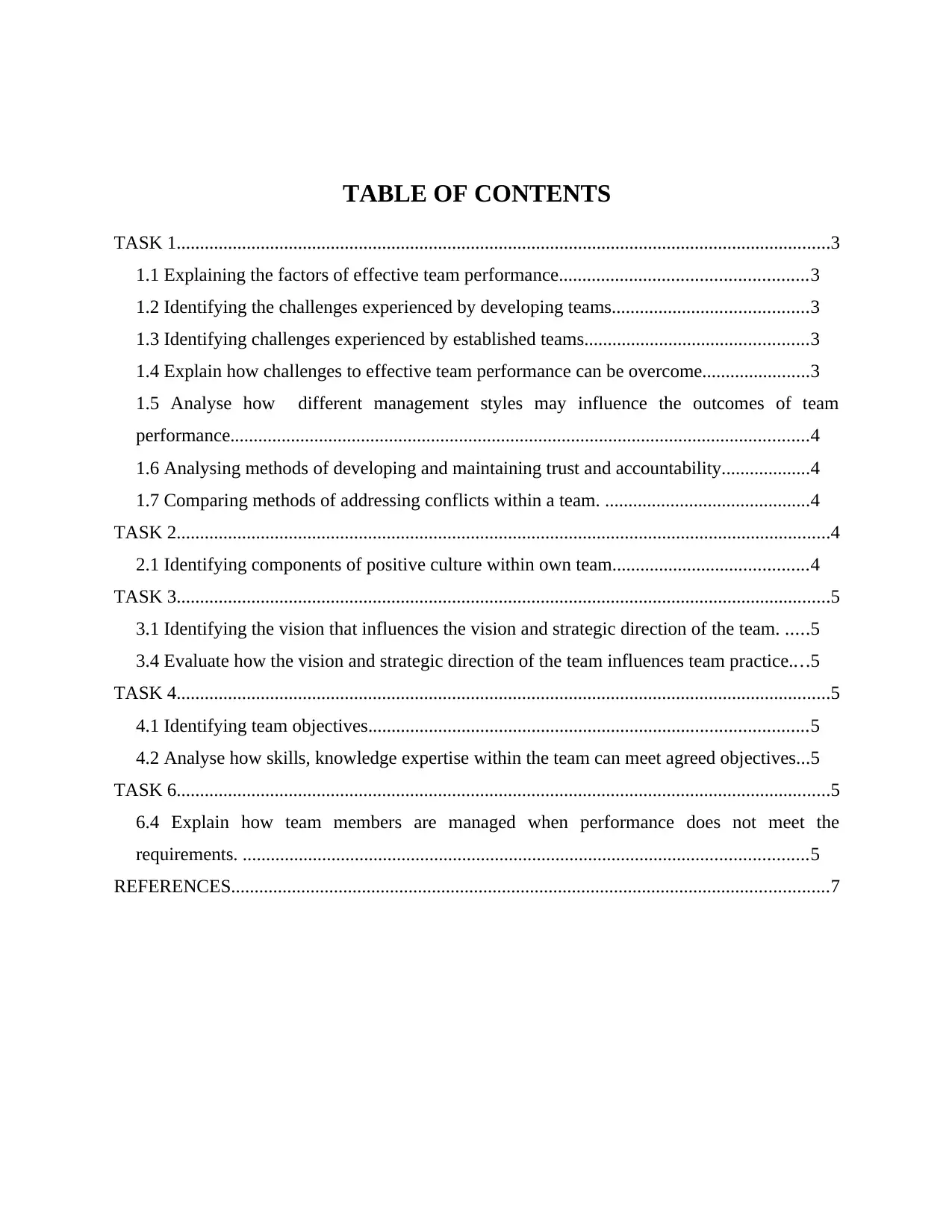
TABLE OF CONTENTS
TASK 1............................................................................................................................................3
1.1 Explaining the factors of effective team performance.....................................................3
1.2 Identifying the challenges experienced by developing teams..........................................3
1.3 Identifying challenges experienced by established teams................................................3
1.4 Explain how challenges to effective team performance can be overcome.......................3
1.5 Analyse how different management styles may influence the outcomes of team
performance............................................................................................................................4
1.6 Analysing methods of developing and maintaining trust and accountability...................4
1.7 Comparing methods of addressing conflicts within a team. ............................................4
TASK 2............................................................................................................................................4
2.1 Identifying components of positive culture within own team..........................................4
TASK 3............................................................................................................................................5
3.1 Identifying the vision that influences the vision and strategic direction of the team. .....5
3.4 Evaluate how the vision and strategic direction of the team influences team practice....5
TASK 4............................................................................................................................................5
4.1 Identifying team objectives..............................................................................................5
4.2 Analyse how skills, knowledge expertise within the team can meet agreed objectives...5
TASK 6............................................................................................................................................5
6.4 Explain how team members are managed when performance does not meet the
requirements. .........................................................................................................................5
REFERENCES................................................................................................................................7
Document Page
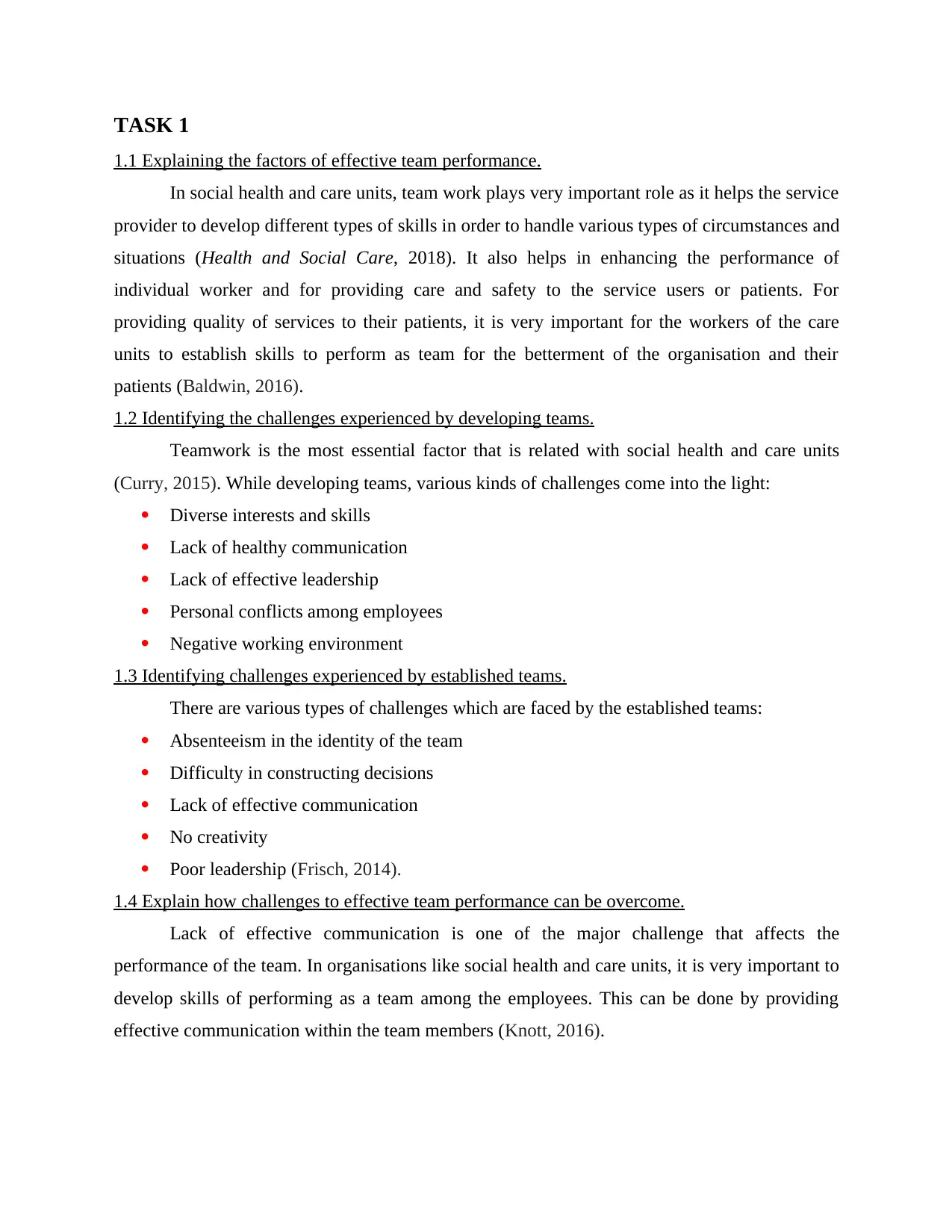
TASK 1
1.1 Explaining the factors of effective team performance.
In social health and care units, team work plays very important role as it helps the service
provider to develop different types of skills in order to handle various types of circumstances and
situations (Health and Social Care, 2018). It also helps in enhancing the performance of
individual worker and for providing care and safety to the service users or patients. For
providing quality of services to their patients, it is very important for the workers of the care
units to establish skills to perform as team for the betterment of the organisation and their
patients (Baldwin, 2016).
1.2 Identifying the challenges experienced by developing teams.
Teamwork is the most essential factor that is related with social health and care units
(Curry, 2015). While developing teams, various kinds of challenges come into the light:
Diverse interests and skills
Lack of healthy communication
Lack of effective leadership
Personal conflicts among employees
Negative working environment
1.3 Identifying challenges experienced by established teams.
There are various types of challenges which are faced by the established teams:
Absenteeism in the identity of the team
Difficulty in constructing decisions
Lack of effective communication
No creativity
Poor leadership (Frisch, 2014).
1.4 Explain how challenges to effective team performance can be overcome.
Lack of effective communication is one of the major challenge that affects the
performance of the team. In organisations like social health and care units, it is very important to
develop skills of performing as a team among the employees. This can be done by providing
effective communication within the team members (Knott, 2016).
Document Page
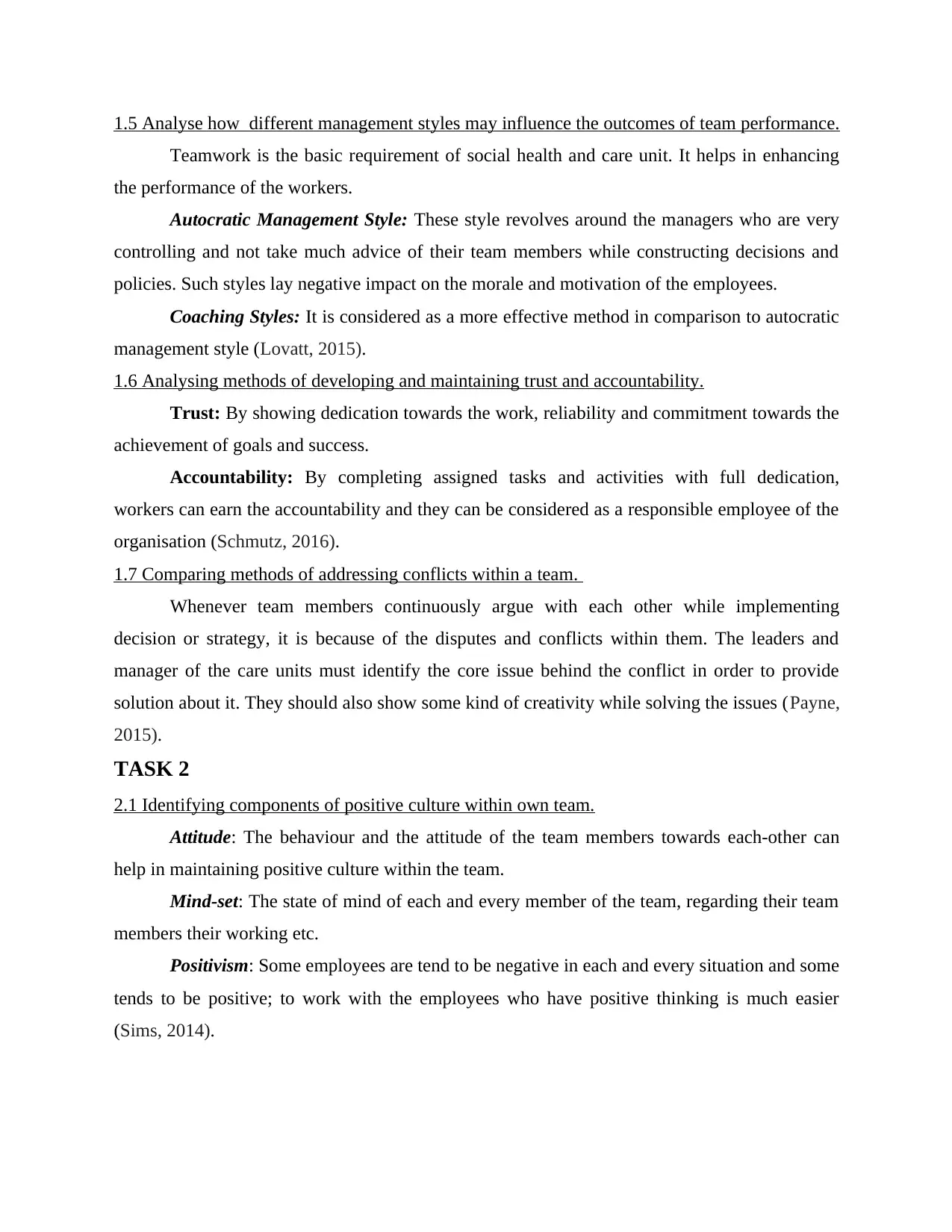
1.5 Analyse how different management styles may influence the outcomes of team performance.
Teamwork is the basic requirement of social health and care unit. It helps in enhancing
the performance of the workers.
Autocratic Management Style: These style revolves around the managers who are very
controlling and not take much advice of their team members while constructing decisions and
policies. Such styles lay negative impact on the morale and motivation of the employees.
Coaching Styles: It is considered as a more effective method in comparison to autocratic
management style (Lovatt, 2015).
1.6 Analysing methods of developing and maintaining trust and accountability.
Trust: By showing dedication towards the work, reliability and commitment towards the
achievement of goals and success.
Accountability: By completing assigned tasks and activities with full dedication,
workers can earn the accountability and they can be considered as a responsible employee of the
organisation (Schmutz, 2016).
1.7 Comparing methods of addressing conflicts within a team.
Whenever team members continuously argue with each other while implementing
decision or strategy, it is because of the disputes and conflicts within them. The leaders and
manager of the care units must identify the core issue behind the conflict in order to provide
solution about it. They should also show some kind of creativity while solving the issues (Payne,
2015).
TASK 2
2.1 Identifying components of positive culture within own team.
Attitude: The behaviour and the attitude of the team members towards each-other can
help in maintaining positive culture within the team.
Mind-set: The state of mind of each and every member of the team, regarding their team
members their working etc.
Positivism: Some employees are tend to be negative in each and every situation and some
tends to be positive; to work with the employees who have positive thinking is much easier
(Sims, 2014).
tabler-icon-diamond-filled.svg

Paraphrase This Document

Need a fresh take? Get an instant paraphrase of this document with our AI Paraphraser
Document Page
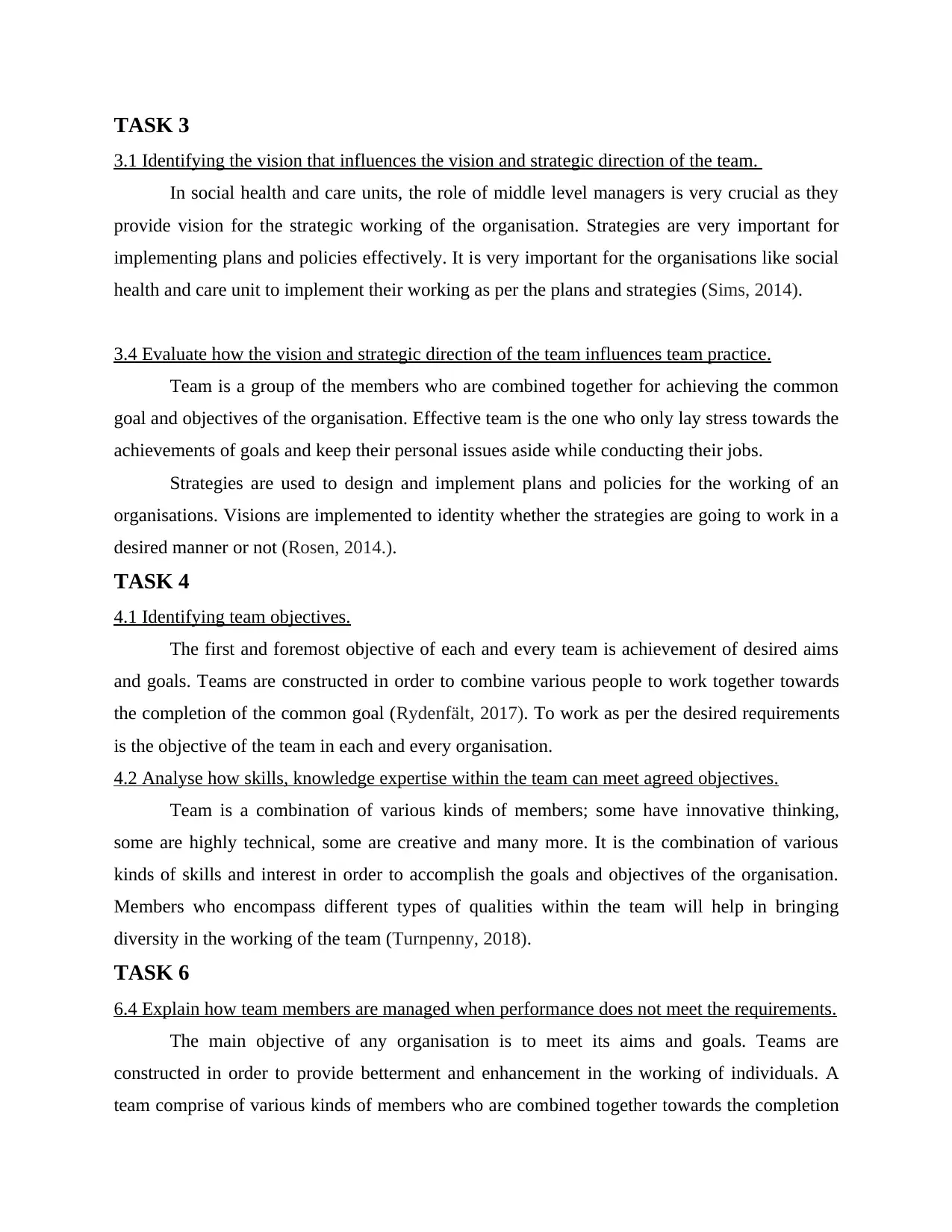
TASK 3
3.1 Identifying the vision that influences the vision and strategic direction of the team.
In social health and care units, the role of middle level managers is very crucial as they
provide vision for the strategic working of the organisation. Strategies are very important for
implementing plans and policies effectively. It is very important for the organisations like social
health and care unit to implement their working as per the plans and strategies (Sims, 2014).
3.4 Evaluate how the vision and strategic direction of the team influences team practice.
Team is a group of the members who are combined together for achieving the common
goal and objectives of the organisation. Effective team is the one who only lay stress towards the
achievements of goals and keep their personal issues aside while conducting their jobs.
Strategies are used to design and implement plans and policies for the working of an
organisations. Visions are implemented to identity whether the strategies are going to work in a
desired manner or not (Rosen, 2014.).
TASK 4
4.1 Identifying team objectives.
The first and foremost objective of each and every team is achievement of desired aims
and goals. Teams are constructed in order to combine various people to work together towards
the completion of the common goal (Rydenfält, 2017). To work as per the desired requirements
is the objective of the team in each and every organisation.
4.2 Analyse how skills, knowledge expertise within the team can meet agreed objectives.
Team is a combination of various kinds of members; some have innovative thinking,
some are highly technical, some are creative and many more. It is the combination of various
kinds of skills and interest in order to accomplish the goals and objectives of the organisation.
Members who encompass different types of qualities within the team will help in bringing
diversity in the working of the team (Turnpenny, 2018).
TASK 6
6.4 Explain how team members are managed when performance does not meet the requirements.
The main objective of any organisation is to meet its aims and goals. Teams are
constructed in order to provide betterment and enhancement in the working of individuals. A
team comprise of various kinds of members who are combined together towards the completion
Document Page
of common goal. In case, team is not working in a desired manner, then it is very important for
the leader and managers of the social health care centres to analyse the problem in order to apply
the desired solution. This can be because of the inefficiency of the team members and due to the
conflict within them (Schmutz, 2016 ).
Leaders and Managers should identity the core reason behind, why performance of the
team members does not meet the requirements and they should apply appropriate measure
regarding the same (Webber, 2015).
Document Page
REFERENCES
Books and Journals:
Baldwin, M., 2016. Social work, critical rSims, D., 2014. Reflection and the learning
organization. Routledge.
Curry, S.R., 2015. Housing and social support for youth aging out of foster care: State of the
research literature and directions for future inquiry. Child and Adolescent Social Work
Journal. 32(2). pp.143-153.
Frisch, J.U., 2014. Making support work: The interplay between social support and social
identity. Journal of Experimental Social Psychology. 55. pp.154-161.
Knott, C., 2016. Reflective practice in social work. Learning Matters.
Lovatt, M., 2015. The provision of emotional labour by health care assistants caring for dying
cancer patients in the community: A qualitative study into the experiences of health care
assistants and bereaved family carers. International journal of nursing studies. 52(1).
pp.271-279.
Payne, M., 2015. Modern social work theory. Oxford University Press.
Rosen, M.A., 2014. An integrative framework for sensor-based measurement of teamwork in
healthcare. Journal of the American Medical Informatics Association. 22(1). pp.11-18.
Rydenfält, C., 2017. Organizing for teamwork in healthcare: an alternative to team
training?. Journal of health organization and management. 31(3). pp.347-362.
Schmutz, J., 2016. Teamwork in healthcare organizations. In Management Innovations for
Health Care Organizations: Adopt, Abandon or Adapt? (Vol. 18. pp. 359-377).
Routledge.
Sims, D., 2014. A scoping review of personalisation in the UK: approaches to social work and
people with learning disabilities. Health & social care in the community. 22(1). pp.13-
21.
Turnpenny, A., 2018. Developing an easy read version of the adult social care outcomes toolkit
(ASCOT). Journal of Applied Research in Intellectual Disabilities. 31(1).
Webber, M., 2015. Enhancing social networks: a qualitative study of health and social care
practice in UK mental health services. Health & social care in the community. 23(2).
pp.180-189.
Online:
Health and Social Care. 2018. [Online]. Available through :
<https://www.worldskills.org/what/career/skills-explained/social-and-personal-services/
health-and-social-care/ >
tabler-icon-diamond-filled.svg

Paraphrase This Document

Need a fresh take? Get an instant paraphrase of this document with our AI Paraphraser
Document Page
chevron_up_icon
1 out of 8
circle_padding
hide_on_mobile
zoom_out_icon
[object Object]