MBS538 - Teaming: Benefits and Challenges in Organisational Dynamics

Verified

Added on  2023/04/25

|4
|431
|455
Essay
AI Summary
This essay discusses the benefits and challenges of teaming within an organizational behaviour context, drawing upon Nelson & Quick (2013). It defines a team as a group with shared values, complementary skills, and a common objective. The essay highlights the advantages of teaming, such as higher quality output due to the combination of skills and faster execution of tasks through the division of labor. However, it also addresses challenges like poor leadership, which can lead to a lack of direction, dissatisfied team members, internal conflicts, and a lack of commitment. The essay concludes that the effectiveness of a team depends on its ability to minimize these challenges and maximize the benefits, ultimately influencing its performance and success.
Document Page
Running Head: TEAMING 1
Teaming Benefits and Challenges
By
University Affiliation
Date
tabler-icon-diamond-filled.svg

Paraphrase This Document

Need a fresh take? Get an instant paraphrase of this document with our AI Paraphraser
Document Page
TEAMING 2
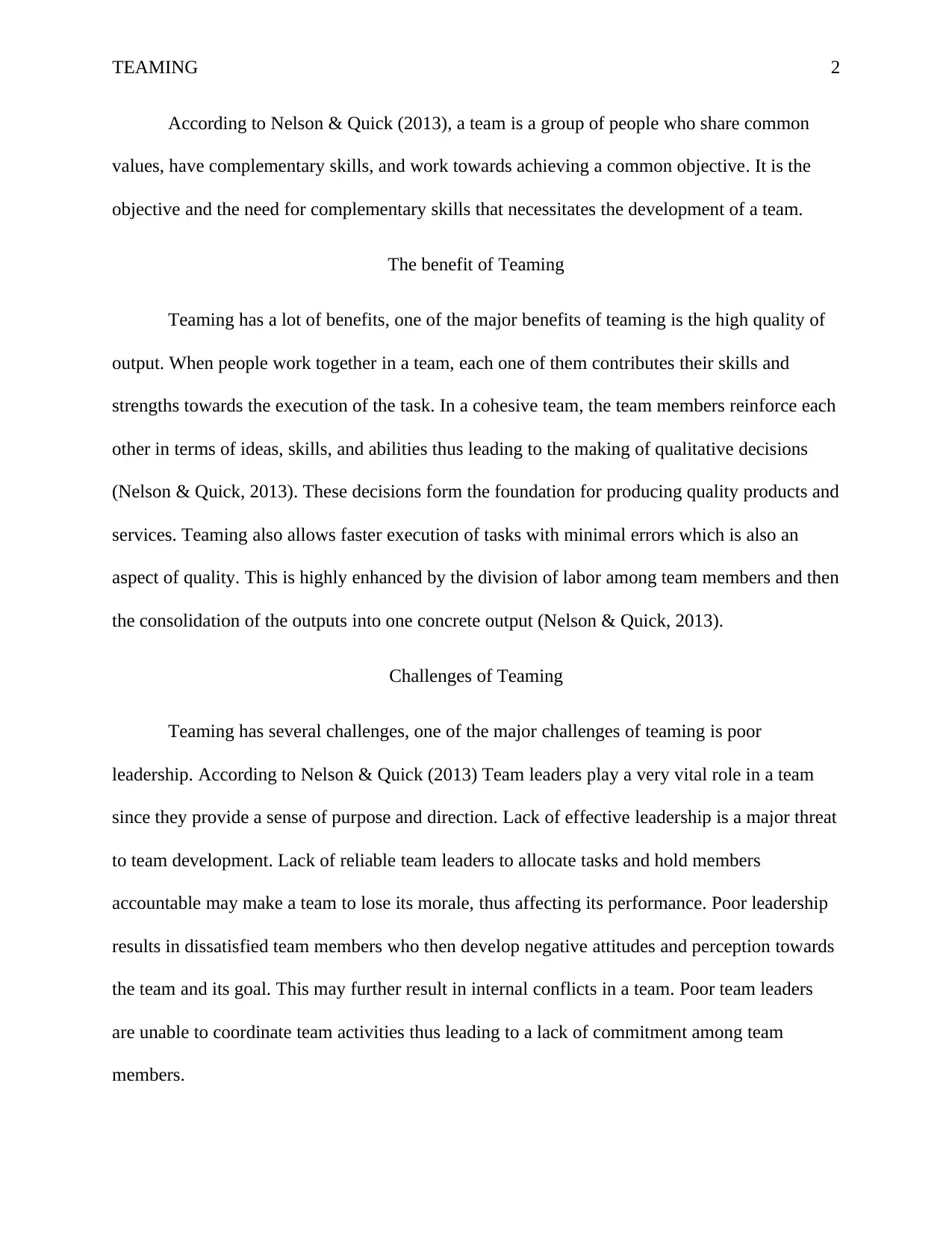
According to Nelson & Quick (2013), a team is a group of people who share common
values, have complementary skills, and work towards achieving a common objective. It is the
objective and the need for complementary skills that necessitates the development of a team.
The benefit of Teaming
Teaming has a lot of benefits, one of the major benefits of teaming is the high quality of
output. When people work together in a team, each one of them contributes their skills and
strengths towards the execution of the task. In a cohesive team, the team members reinforce each
other in terms of ideas, skills, and abilities thus leading to the making of qualitative decisions
(Nelson & Quick, 2013). These decisions form the foundation for producing quality products and
services. Teaming also allows faster execution of tasks with minimal errors which is also an
aspect of quality. This is highly enhanced by the division of labor among team members and then
the consolidation of the outputs into one concrete output (Nelson & Quick, 2013).
Challenges of Teaming
Teaming has several challenges, one of the major challenges of teaming is poor
leadership. According to Nelson & Quick (2013) Team leaders play a very vital role in a team
since they provide a sense of purpose and direction. Lack of effective leadership is a major threat
to team development. Lack of reliable team leaders to allocate tasks and hold members
accountable may make a team to lose its morale, thus affecting its performance. Poor leadership
results in dissatisfied team members who then develop negative attitudes and perception towards
the team and its goal. This may further result in internal conflicts in a team. Poor team leaders
are unable to coordinate team activities thus leading to a lack of commitment among team
members.
Document Page
TEAMING 3
From the above discussion on teaming, it is clear that teaming has both benefits and challenges.
The effectiveness of any team depends mainly on how the team is able to overcome or minimize
the challenges and maximize the benefits.
Document Page
TEAMING 4
References
Nelson, D. L. & Quick, J.C. (2013). Organizational behavior: Science, the real world, and you.
(8th ed.). Mason, OH: Cengage.
chevron_up_icon
1 out of 4
circle_padding
hide_on_mobile
zoom_out_icon
[object Object]