Teamwork & Communication: A Report on Effective Team Management
VerifiedAdded on 2023/06/13
|10
|2988
|398
Report
AI Summary
This report critically discusses team management problems faced by Abdul and proposes methods to enhance his team's effectiveness. It highlights the GRIP model for improved team development and Belbin's 9 team roles for optimized member performance. The report identifies challenges hindering the team's progress and explores the positive impacts of effective teamwork on overall success, emphasizing better problem-solving, innovation, motivation, and productivity. It also focuses on the importance of goal identification, role assignment, positive mindset, and effective communication within the team.
Team Working and
Communication
Communication

Paraphrase This Document
Need a fresh take? Get an instant paraphrase of this document with our AI Paraphraser
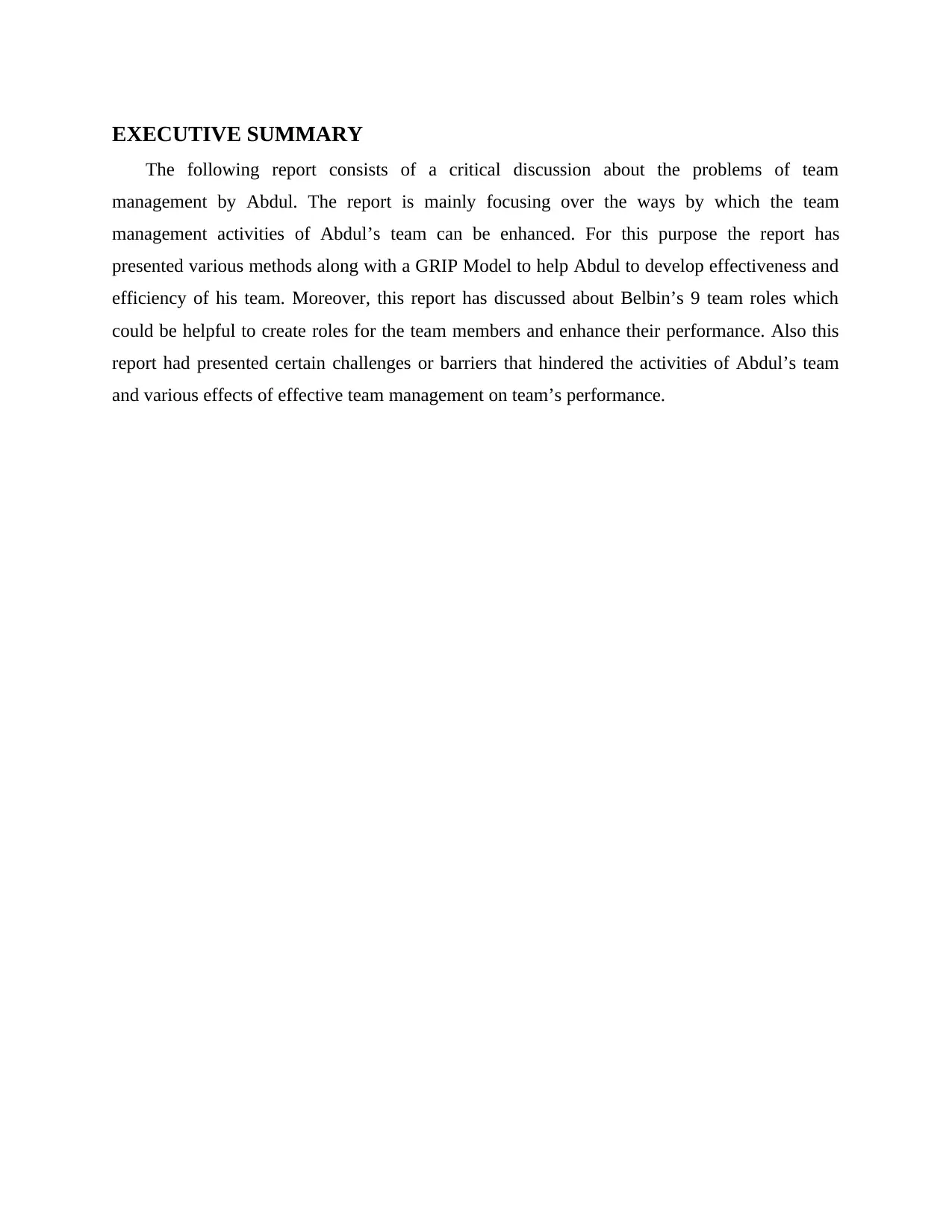
EXECUTIVE SUMMARY
The following report consists of a critical discussion about the problems of team
management by Abdul. The report is mainly focusing over the ways by which the team
management activities of Abdul’s team can be enhanced. For this purpose the report has
presented various methods along with a GRIP Model to help Abdul to develop effectiveness and
efficiency of his team. Moreover, this report has discussed about Belbin’s 9 team roles which
could be helpful to create roles for the team members and enhance their performance. Also this
report had presented certain challenges or barriers that hindered the activities of Abdul’s team
and various effects of effective team management on team’s performance.
The following report consists of a critical discussion about the problems of team
management by Abdul. The report is mainly focusing over the ways by which the team
management activities of Abdul’s team can be enhanced. For this purpose the report has
presented various methods along with a GRIP Model to help Abdul to develop effectiveness and
efficiency of his team. Moreover, this report has discussed about Belbin’s 9 team roles which
could be helpful to create roles for the team members and enhance their performance. Also this
report had presented certain challenges or barriers that hindered the activities of Abdul’s team
and various effects of effective team management on team’s performance.
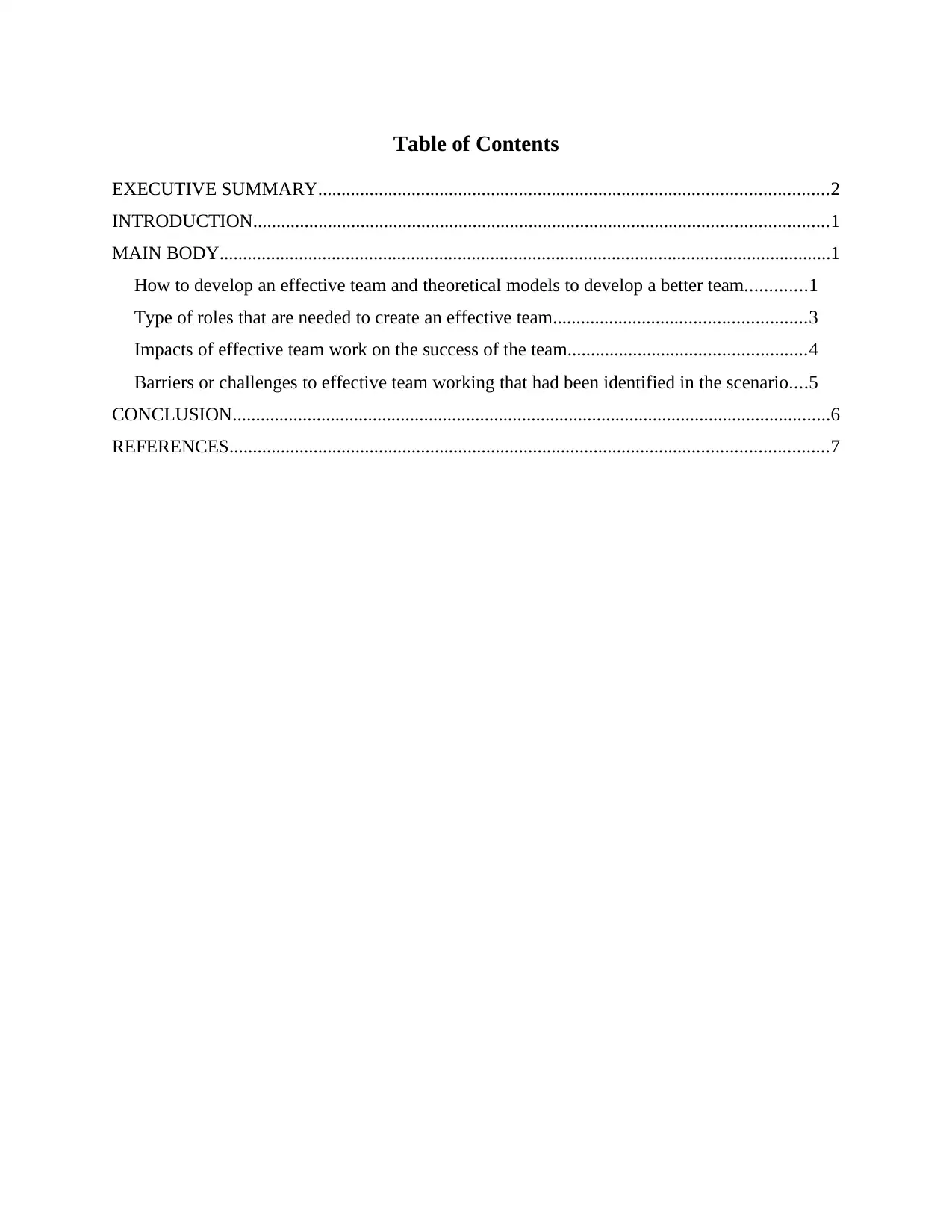
Table of Contents
EXECUTIVE SUMMARY.............................................................................................................2
INTRODUCTION...........................................................................................................................1
MAIN BODY...................................................................................................................................1
How to develop an effective team and theoretical models to develop a better team.............1
Type of roles that are needed to create an effective team......................................................3
Impacts of effective team work on the success of the team...................................................4
Barriers or challenges to effective team working that had been identified in the scenario....5
CONCLUSION................................................................................................................................6
REFERENCES................................................................................................................................7
EXECUTIVE SUMMARY.............................................................................................................2
INTRODUCTION...........................................................................................................................1
MAIN BODY...................................................................................................................................1
How to develop an effective team and theoretical models to develop a better team.............1
Type of roles that are needed to create an effective team......................................................3
Impacts of effective team work on the success of the team...................................................4
Barriers or challenges to effective team working that had been identified in the scenario....5
CONCLUSION................................................................................................................................6
REFERENCES................................................................................................................................7
⊘ This is a preview!⊘
Do you want full access?
Subscribe today to unlock all pages.

Trusted by 1+ million students worldwide
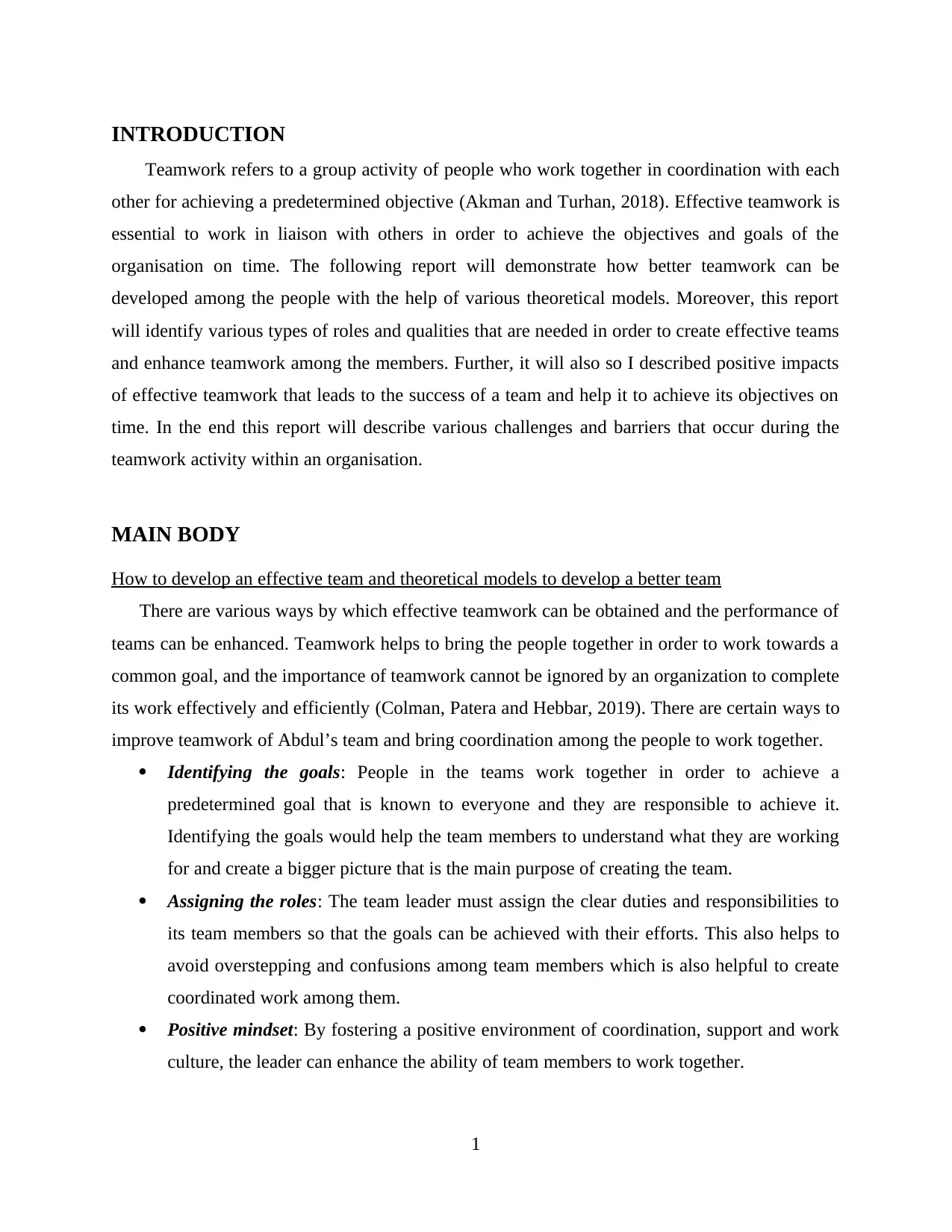
INTRODUCTION
Teamwork refers to a group activity of people who work together in coordination with each
other for achieving a predetermined objective (Akman and Turhan, 2018). Effective teamwork is
essential to work in liaison with others in order to achieve the objectives and goals of the
organisation on time. The following report will demonstrate how better teamwork can be
developed among the people with the help of various theoretical models. Moreover, this report
will identify various types of roles and qualities that are needed in order to create effective teams
and enhance teamwork among the members. Further, it will also so I described positive impacts
of effective teamwork that leads to the success of a team and help it to achieve its objectives on
time. In the end this report will describe various challenges and barriers that occur during the
teamwork activity within an organisation.
MAIN BODY
How to develop an effective team and theoretical models to develop a better team
There are various ways by which effective teamwork can be obtained and the performance of
teams can be enhanced. Teamwork helps to bring the people together in order to work towards a
common goal, and the importance of teamwork cannot be ignored by an organization to complete
its work effectively and efficiently (Colman, Patera and Hebbar, 2019). There are certain ways to
improve teamwork of Abdul’s team and bring coordination among the people to work together.
Identifying the goals: People in the teams work together in order to achieve a
predetermined goal that is known to everyone and they are responsible to achieve it.
Identifying the goals would help the team members to understand what they are working
for and create a bigger picture that is the main purpose of creating the team.
Assigning the roles: The team leader must assign the clear duties and responsibilities to
its team members so that the goals can be achieved with their efforts. This also helps to
avoid overstepping and confusions among team members which is also helpful to create
coordinated work among them.
Positive mindset: By fostering a positive environment of coordination, support and work
culture, the leader can enhance the ability of team members to work together.
1
Teamwork refers to a group activity of people who work together in coordination with each
other for achieving a predetermined objective (Akman and Turhan, 2018). Effective teamwork is
essential to work in liaison with others in order to achieve the objectives and goals of the
organisation on time. The following report will demonstrate how better teamwork can be
developed among the people with the help of various theoretical models. Moreover, this report
will identify various types of roles and qualities that are needed in order to create effective teams
and enhance teamwork among the members. Further, it will also so I described positive impacts
of effective teamwork that leads to the success of a team and help it to achieve its objectives on
time. In the end this report will describe various challenges and barriers that occur during the
teamwork activity within an organisation.
MAIN BODY
How to develop an effective team and theoretical models to develop a better team
There are various ways by which effective teamwork can be obtained and the performance of
teams can be enhanced. Teamwork helps to bring the people together in order to work towards a
common goal, and the importance of teamwork cannot be ignored by an organization to complete
its work effectively and efficiently (Colman, Patera and Hebbar, 2019). There are certain ways to
improve teamwork of Abdul’s team and bring coordination among the people to work together.
Identifying the goals: People in the teams work together in order to achieve a
predetermined goal that is known to everyone and they are responsible to achieve it.
Identifying the goals would help the team members to understand what they are working
for and create a bigger picture that is the main purpose of creating the team.
Assigning the roles: The team leader must assign the clear duties and responsibilities to
its team members so that the goals can be achieved with their efforts. This also helps to
avoid overstepping and confusions among team members which is also helpful to create
coordinated work among them.
Positive mindset: By fostering a positive environment of coordination, support and work
culture, the leader can enhance the ability of team members to work together.
1
Paraphrase This Document
Need a fresh take? Get an instant paraphrase of this document with our AI Paraphraser
Effectiveness of work: Effectiveness can be described as using the time more accurately
and precisely without any wastage. In order to work in team time management it is a
crucial factor because the activity of one person is relied on the activity of another which
means that delay in the activity of one person will result in the overall delay of the
project. Therefore, effectiveness of work must be developed by every individual in the
team.
Share enthusiasm: The team leader must be enthusiastic and should enhance the ability
of others. The team leader must appreciate and value their teammates in order to create
enthusiasm among them (Ekmekcioglu, Aydintan and Celebi, 2018).
Exercise together: The team members should work together which means that they
should work on a single idea to achieve a given goal. The ideas of individual thought
must be avoided because this may lead to overall coordination of team members to work
effectively and efficiently with each other.
Establishing rules and purposes: Teamwork should be bounded by certain rules and
regulations that it should be defined to achieve the objectives effectively and efficiently.
People in the team should feel free to share their ideas and opinions with one another
without crossing these rules and regulations for their effective and efficient working.
Avoid complaints: Due to the complaints and criticisms a lot of energy and time is wasted
to solve certain queries, therefore it is necessary to avoid these complaints. Instead of
complaining about something the team must work together to identify the solutions.
Giving credit to the work of others: By celebrating small victories and providing credit to
everyone the teamwork becomes more efficient. By this the people are more likely to
work together and complete their activities more quickly (Firstenberg and Stawicki eds.,
2021).
GRIP Model
In order to enhance effective team working certain models are developed which can be
helpful in improving team development and work. The most effective theoretical model that
could be helpful in improving Abdul’s team teamwork is the GRIP model, which outlines
interrelated components to enhance the effective teamwork among the members:
Goals: According to this the team members must be aware of the goals and must
understand their commitment towards achievement of that goal. The goal of every team
2
and precisely without any wastage. In order to work in team time management it is a
crucial factor because the activity of one person is relied on the activity of another which
means that delay in the activity of one person will result in the overall delay of the
project. Therefore, effectiveness of work must be developed by every individual in the
team.
Share enthusiasm: The team leader must be enthusiastic and should enhance the ability
of others. The team leader must appreciate and value their teammates in order to create
enthusiasm among them (Ekmekcioglu, Aydintan and Celebi, 2018).
Exercise together: The team members should work together which means that they
should work on a single idea to achieve a given goal. The ideas of individual thought
must be avoided because this may lead to overall coordination of team members to work
effectively and efficiently with each other.
Establishing rules and purposes: Teamwork should be bounded by certain rules and
regulations that it should be defined to achieve the objectives effectively and efficiently.
People in the team should feel free to share their ideas and opinions with one another
without crossing these rules and regulations for their effective and efficient working.
Avoid complaints: Due to the complaints and criticisms a lot of energy and time is wasted
to solve certain queries, therefore it is necessary to avoid these complaints. Instead of
complaining about something the team must work together to identify the solutions.
Giving credit to the work of others: By celebrating small victories and providing credit to
everyone the teamwork becomes more efficient. By this the people are more likely to
work together and complete their activities more quickly (Firstenberg and Stawicki eds.,
2021).
GRIP Model
In order to enhance effective team working certain models are developed which can be
helpful in improving team development and work. The most effective theoretical model that
could be helpful in improving Abdul’s team teamwork is the GRIP model, which outlines
interrelated components to enhance the effective teamwork among the members:
Goals: According to this the team members must be aware of the goals and must
understand their commitment towards achievement of that goal. The goal of every team
2
member must be a line to the common goal of the organization to establish trust, make
enhancement and achieve desired results or outcomes.
Roles: According to this all the team members must know their part and understand their
responsibility in achieving the goal of the organization (Gharaveis, Hamilton and Pati,
2018). Every team member must be aware of what they should do to achieve the goal.
Interpersonal: All the team members must be collaborative and coordinated so that their
activities do not overlap the activities of other people in the team. The team members
must trust each other, be sensible and flexible in the time when other team members
require them in order to avoid delays in achieving their target.
Process: A process of work must be decided so that contradictions among the work can
be avoided and accountability for a particular task can be given to a single person. It
means a proper flow of work must be achieved so that conflicts and problems can be
avoided easily by the team members.
Type of roles that are needed to create an effective team
Belbin's 9 team role
In order to work in a team there are certain roles that must be performed by a team. Dr.
Meredith Belbin developed the team role theory based on the behavioral attributes that could be
helpful to create a balance in Abdul’s team. Belbin's 9 rules are discussed in order to create a
balanced team so that their efficiency and productivity can be improved.
Shaper: These people are responsible to drive and lead the team in forward direction.
They possess certain qualities such as self-motivation, natural leaders, solution seekers
and action oriented, so that they can face any problems that arise.
Implementer: These team members are mainly responsible for maintaining order and
sequence of the work in the team (Hanley and et. al., 2019). They are mainly the people
who work for the team as its backbone and provide every support to its team members.
Completer finisher: These people in the team are mainly responsible to enhance the
abilities of all the team members to the top level. The focus is on improvising and
creating the value of work and putting their team members to work efficiently.
3
enhancement and achieve desired results or outcomes.
Roles: According to this all the team members must know their part and understand their
responsibility in achieving the goal of the organization (Gharaveis, Hamilton and Pati,
2018). Every team member must be aware of what they should do to achieve the goal.
Interpersonal: All the team members must be collaborative and coordinated so that their
activities do not overlap the activities of other people in the team. The team members
must trust each other, be sensible and flexible in the time when other team members
require them in order to avoid delays in achieving their target.
Process: A process of work must be decided so that contradictions among the work can
be avoided and accountability for a particular task can be given to a single person. It
means a proper flow of work must be achieved so that conflicts and problems can be
avoided easily by the team members.
Type of roles that are needed to create an effective team
Belbin's 9 team role
In order to work in a team there are certain roles that must be performed by a team. Dr.
Meredith Belbin developed the team role theory based on the behavioral attributes that could be
helpful to create a balance in Abdul’s team. Belbin's 9 rules are discussed in order to create a
balanced team so that their efficiency and productivity can be improved.
Shaper: These people are responsible to drive and lead the team in forward direction.
They possess certain qualities such as self-motivation, natural leaders, solution seekers
and action oriented, so that they can face any problems that arise.
Implementer: These team members are mainly responsible for maintaining order and
sequence of the work in the team (Hanley and et. al., 2019). They are mainly the people
who work for the team as its backbone and provide every support to its team members.
Completer finisher: These people in the team are mainly responsible to enhance the
abilities of all the team members to the top level. The focus is on improvising and
creating the value of work and putting their team members to work efficiently.
3
⊘ This is a preview!⊘
Do you want full access?
Subscribe today to unlock all pages.
Trusted by 1+ million students worldwide
Plant: These people in the team are the creative thinkers and innovators who brainstorm
and solidify the ideas of the team. They may prefer to work alone but bring valuable input
even when they're outspoken as other team members.
Monitor evaluator: These people in the team are critical thinkers who could put their
emotions aside in order to fix certain problems. The monitor evaluators have high
knowledge of strategic planning and they push their ideas for the betterment of the team
(Kirschbaumphd, 2018)(Lee and Kim, 2020).
Specialist: These people are the most knowledgeable individuals in the team in a
particular field and have a certain high level of experience in that field. These people are
responsible for enhancing the performance of others by sharing their experience and
knowledge at the workplace with the help of their specific skill set.
Coordinator: These types of people are mainly responsible to align the activities of all
the people in a single line to achieve the goal of the team. These people I have good
communication skills and motivate team members to work together in order to achieve
the goals effectively and efficiently.
Team worker: They are the people who work with others and listen to their team mates
for their grievances and problems. These people adapt easily to the changes around them
and create a suitable work environment by enhancing others to work better.
Resource investigator: These people are the true explorers of opportunities arising in the
market. They keep record of their work and the external environment in order to attain
the best opportunities that may arise in the market.
Impacts of effective team work on the success of the team
There are many impacts of teamwork that help to achieve and enhance the performance of
a team to reach their target. There are certain benefits that Abdul’s teams can gain with the help
of better teamwork, which are as follows:
Better problem solving ability: According to Murphy, a team can have better
performance and higher problem solving ability for practical questions that may arise in
the business. With the help of effective teamwork all the people try to think of solutions
and resonate to generate quick solutions for the problems that may arise.
4
and solidify the ideas of the team. They may prefer to work alone but bring valuable input
even when they're outspoken as other team members.
Monitor evaluator: These people in the team are critical thinkers who could put their
emotions aside in order to fix certain problems. The monitor evaluators have high
knowledge of strategic planning and they push their ideas for the betterment of the team
(Kirschbaumphd, 2018)(Lee and Kim, 2020).
Specialist: These people are the most knowledgeable individuals in the team in a
particular field and have a certain high level of experience in that field. These people are
responsible for enhancing the performance of others by sharing their experience and
knowledge at the workplace with the help of their specific skill set.
Coordinator: These types of people are mainly responsible to align the activities of all
the people in a single line to achieve the goal of the team. These people I have good
communication skills and motivate team members to work together in order to achieve
the goals effectively and efficiently.
Team worker: They are the people who work with others and listen to their team mates
for their grievances and problems. These people adapt easily to the changes around them
and create a suitable work environment by enhancing others to work better.
Resource investigator: These people are the true explorers of opportunities arising in the
market. They keep record of their work and the external environment in order to attain
the best opportunities that may arise in the market.
Impacts of effective team work on the success of the team
There are many impacts of teamwork that help to achieve and enhance the performance of
a team to reach their target. There are certain benefits that Abdul’s teams can gain with the help
of better teamwork, which are as follows:
Better problem solving ability: According to Murphy, a team can have better
performance and higher problem solving ability for practical questions that may arise in
the business. With the help of effective teamwork all the people try to think of solutions
and resonate to generate quick solutions for the problems that may arise.
4
Paraphrase This Document
Need a fresh take? Get an instant paraphrase of this document with our AI Paraphraser
Opportunities for innovation: If more people are working together the chances of
bringing up new ideas and innovations increases. Similarly the teamwork also surrounds
everyone with a cooperative team who pushes everyone to grow and create new ways for
improvement.
Motivated team members: The people working in a team are found to be more honest,
confident, respectful and happy as compared to the people working individually. This
means that the people who work in teams are more likely to be motivated than
individuals, which improve the quality of work.
Improve personal and professional development: The people who work in a team grow
with the help of others because everyone in the team helps to enhance the performance of
others and create better results.
Less workload: The people working in a team have less burnout because the work is
distributed among all the members and they feel encouraged by the support of others for a
given work. Because of less workload the efficiency of the workforce improves and the
work is completed on time.
Opportunities for growth: When the team members work in collaboration it may happen
that everyone brings Excellency in their performance to compete with others. This may
lead to the improvement of their performance and there are opportunities for growth also
rises.
Higher productivity: When the employees work with their teammates the productivity
increases and they perform better. All the team members work in collaboration to assist
each other and complete the work with minimum resources and time.
Reduction in mistakes: It is seen that people who work in teams improve the quality of
their work because someone else will have a look on what they have done (Oreopoulou,
2019).
Maximum creativity: There are people who work better in teams because their creativity
and ability to generate new ideas improves. The people working in groups can develop
more creative solutions and propose the best ideas to enhance their work.
Barriers or challenges to effective team working that had been identified in the scenario
There are certain barriers or challenges that faced by Abdul’s team, which are as follows:
5
bringing up new ideas and innovations increases. Similarly the teamwork also surrounds
everyone with a cooperative team who pushes everyone to grow and create new ways for
improvement.
Motivated team members: The people working in a team are found to be more honest,
confident, respectful and happy as compared to the people working individually. This
means that the people who work in teams are more likely to be motivated than
individuals, which improve the quality of work.
Improve personal and professional development: The people who work in a team grow
with the help of others because everyone in the team helps to enhance the performance of
others and create better results.
Less workload: The people working in a team have less burnout because the work is
distributed among all the members and they feel encouraged by the support of others for a
given work. Because of less workload the efficiency of the workforce improves and the
work is completed on time.
Opportunities for growth: When the team members work in collaboration it may happen
that everyone brings Excellency in their performance to compete with others. This may
lead to the improvement of their performance and there are opportunities for growth also
rises.
Higher productivity: When the employees work with their teammates the productivity
increases and they perform better. All the team members work in collaboration to assist
each other and complete the work with minimum resources and time.
Reduction in mistakes: It is seen that people who work in teams improve the quality of
their work because someone else will have a look on what they have done (Oreopoulou,
2019).
Maximum creativity: There are people who work better in teams because their creativity
and ability to generate new ideas improves. The people working in groups can develop
more creative solutions and propose the best ideas to enhance their work.
Barriers or challenges to effective team working that had been identified in the scenario
There are certain barriers or challenges that faced by Abdul’s team, which are as follows:
5
Communication gaps: One issue that has been identified is the lack of communication
among the team members which is the main reason for the failure of the team.
Lack of trust: The team members were not having trust in each other which was another
factor that influenced their activities and led them towards critical failure (Saville and et.
al., 2021).
Accountability issues: In the team the most critical factor that turned out to be the failure
was accountability issues. The people working in the group were not accountable for their
work due to inefficiency of proper coordination of work and employees.
Physical separation: The major reason was the physical separation of team members due
to the pandemic situation which led to the critical failure of team management activity by
the leader. Due to this the team leader Abdul was able to lead the team effectively and
efficiently in the starting but was not able to look after the activities that were continued
forward the by the team members
Mismanagement of work: It has been identified that it the team leader was not absolutely
prepares to manage teams from home because the start was very good but the leader
didn't follow the sequential checkup of the overall work.
CONCLUSION
From the above report it has been obtained that teamwork is very essential in order to
coordinate the activities of team members and achieve goals of the organisation effectively and
efficiently. The report had been describing various ways and models such as the GRIP model by
which effective teamwork can be obtained. Moreover, the report had been providing Belbin’s 9
roles in order to create an effective team to accomplish the target on time. Further, it has
identified various impacts such as problem solving ability, opportunities for innovation, higher
motivation etc. that an effective teamwork can provide to the team. There are certain barriers and
challenges to the effective team working that have been identified such as communication gaps,
lack of trust etc.
6
among the team members which is the main reason for the failure of the team.
Lack of trust: The team members were not having trust in each other which was another
factor that influenced their activities and led them towards critical failure (Saville and et.
al., 2021).
Accountability issues: In the team the most critical factor that turned out to be the failure
was accountability issues. The people working in the group were not accountable for their
work due to inefficiency of proper coordination of work and employees.
Physical separation: The major reason was the physical separation of team members due
to the pandemic situation which led to the critical failure of team management activity by
the leader. Due to this the team leader Abdul was able to lead the team effectively and
efficiently in the starting but was not able to look after the activities that were continued
forward the by the team members
Mismanagement of work: It has been identified that it the team leader was not absolutely
prepares to manage teams from home because the start was very good but the leader
didn't follow the sequential checkup of the overall work.
CONCLUSION
From the above report it has been obtained that teamwork is very essential in order to
coordinate the activities of team members and achieve goals of the organisation effectively and
efficiently. The report had been describing various ways and models such as the GRIP model by
which effective teamwork can be obtained. Moreover, the report had been providing Belbin’s 9
roles in order to create an effective team to accomplish the target on time. Further, it has
identified various impacts such as problem solving ability, opportunities for innovation, higher
motivation etc. that an effective teamwork can provide to the team. There are certain barriers and
challenges to the effective team working that have been identified such as communication gaps,
lack of trust etc.
6
⊘ This is a preview!⊘
Do you want full access?
Subscribe today to unlock all pages.
Trusted by 1+ million students worldwide
REFERENCES
Books and Journals
Akman, I. and Turhan, C., 2018. Investigation of employers’ performance expectations for new
IT graduates in individual and team work settings for software development. Information
Technology & People.
Colman, N., Patera, A. and Hebbar, K. B., 2019. Promoting teamwork for rapid response teams
through simulation training. The Journal of Continuing Education in Nursing, 50(11).
pp.523-528.
Ekmekcioglu, E. B., Aydintan, B. and Celebi, M., 2018. The effect of charismatic leadership on
coordinated teamwork: a study in Turkey. Leadership & Organization Development
Journal.
Firstenberg, M. S. and Stawicki, S. P. eds., 2021. Teamwork in Healthcare. BoD–Books on
Demand.
Gharaveis, A., Hamilton, D. K. and Pati, D., 2018. The impact of environmental design on
teamwork and communication in healthcare facilities: a systematic literature
review. HERD: Health Environments Research & Design Journal, 11(1). pp.119-137.
Hanley, A. and et. al., 2019. Impact of Team Communication Training on Performance and Self-
Assessment of Team Functioning during Sophomore Surgery. Journal of Veterinary
Medical Education, 46(1). pp.45-55.
Kirschbaumphd, K., 2018. Team communication in the operating room: a measure of latent
factors from a national sample of nurse anesthetists. AANA journal, 86(1). pp.11-18.
Lee, K. R. and Kim, E. J., 2020. Relationship between interprofessional communication and
team task performance. Clinical Simulation in Nursing, 43. pp.44-50.
Oreopoulou, A., 2019. Research, Connection, Teamwork, and a Journey. International Body
Psychotherapy Journal, 18(1). pp.11-13.
Saville, J. D. and et. al., 2021, July. Exploration of team communication behaviors from a live
training event. In International Conference on Applied Human Factors and
Ergonomics (pp. 101-108). Springer, Cham.
7
Books and Journals
Akman, I. and Turhan, C., 2018. Investigation of employers’ performance expectations for new
IT graduates in individual and team work settings for software development. Information
Technology & People.
Colman, N., Patera, A. and Hebbar, K. B., 2019. Promoting teamwork for rapid response teams
through simulation training. The Journal of Continuing Education in Nursing, 50(11).
pp.523-528.
Ekmekcioglu, E. B., Aydintan, B. and Celebi, M., 2018. The effect of charismatic leadership on
coordinated teamwork: a study in Turkey. Leadership & Organization Development
Journal.
Firstenberg, M. S. and Stawicki, S. P. eds., 2021. Teamwork in Healthcare. BoD–Books on
Demand.
Gharaveis, A., Hamilton, D. K. and Pati, D., 2018. The impact of environmental design on
teamwork and communication in healthcare facilities: a systematic literature
review. HERD: Health Environments Research & Design Journal, 11(1). pp.119-137.
Hanley, A. and et. al., 2019. Impact of Team Communication Training on Performance and Self-
Assessment of Team Functioning during Sophomore Surgery. Journal of Veterinary
Medical Education, 46(1). pp.45-55.
Kirschbaumphd, K., 2018. Team communication in the operating room: a measure of latent
factors from a national sample of nurse anesthetists. AANA journal, 86(1). pp.11-18.
Lee, K. R. and Kim, E. J., 2020. Relationship between interprofessional communication and
team task performance. Clinical Simulation in Nursing, 43. pp.44-50.
Oreopoulou, A., 2019. Research, Connection, Teamwork, and a Journey. International Body
Psychotherapy Journal, 18(1). pp.11-13.
Saville, J. D. and et. al., 2021, July. Exploration of team communication behaviors from a live
training event. In International Conference on Applied Human Factors and
Ergonomics (pp. 101-108). Springer, Cham.
7

1 out of 10


Related Documents


Your All-in-One AI-Powered Toolkit for Academic Success.
+13062052269
info@desklib.com
Available 24*7 on WhatsApp / Email
![[object Object]](/_next/static/media/star-bottom.7253800d.svg)
Unlock your academic potential
Copyright © 2020–2026 A2Z Services. All Rights Reserved. Developed and managed by ZUCOL.