Teamwork Impact: Empowerment or Managerial Control? Essay
VerifiedAdded on 2019/12/17
|4
|1096
|167
Essay
AI Summary
This essay delves into the complex relationship between teamwork, employee empowerment, and managerial control within organizations. It defines teamwork as a collaborative process aimed at achieving specific goals, emphasizing its importance in fostering cohesion and leveraging individual strengths. The essay contrasts teamwork with empowerment, which involves sharing information and authority with workers to foster initiative and improve performance. It also explores the concept of managerial control, which involves setting standards and monitoring performance. The analysis examines the advantages and disadvantages of each approach, highlighting how teamwork can enhance coordination but may lead to communication barriers, while managerial control can ensure smooth operations but potentially stifle employee morale. The essay references several academic sources to support its arguments, providing a comprehensive overview of the debate surrounding teamwork, empowerment, and control in the workplace.
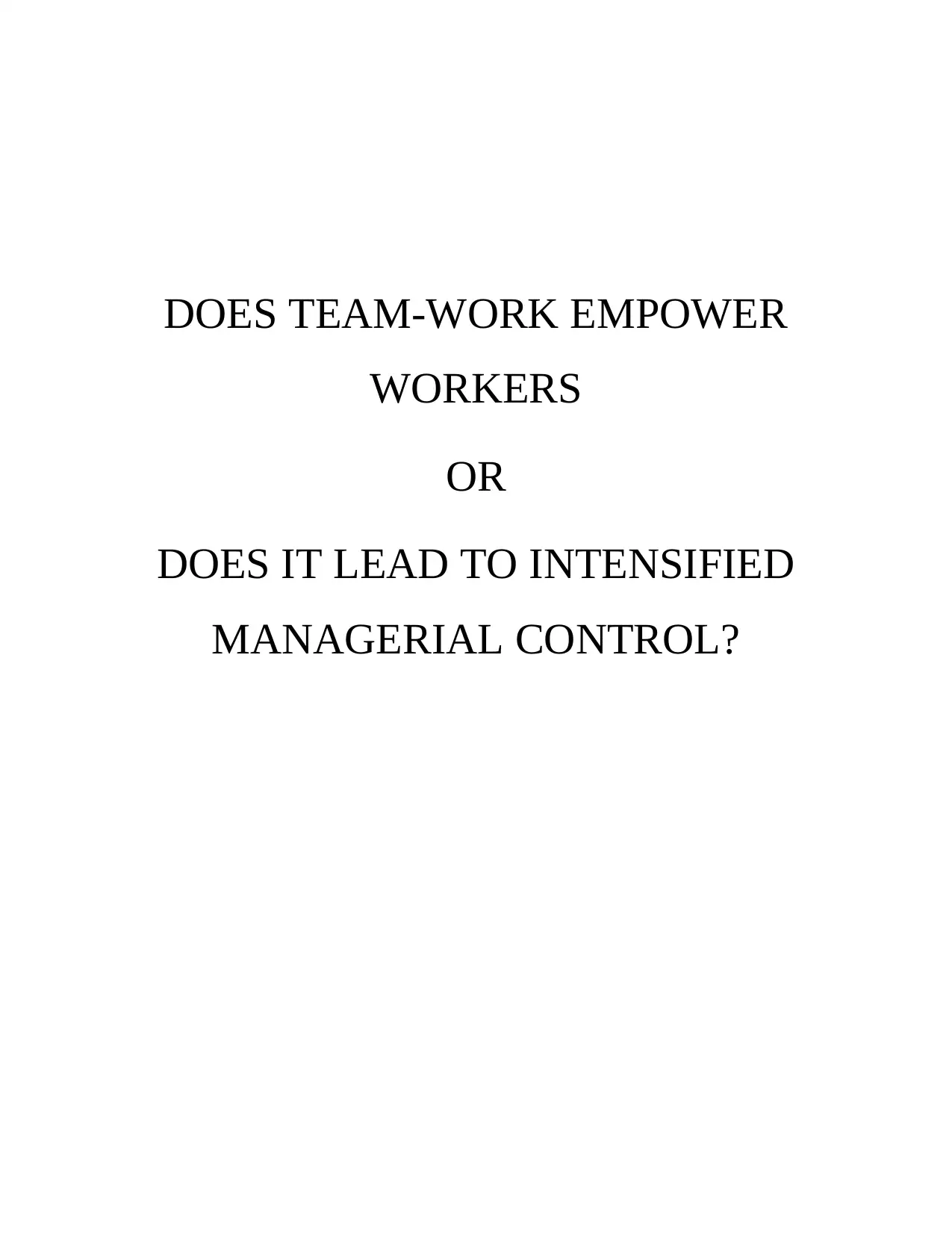
DOES TEAM-WORK EMPOWER
WORKERS
OR
DOES IT LEAD TO INTENSIFIED
MANAGERIAL CONTROL?
WORKERS
OR
DOES IT LEAD TO INTENSIFIED
MANAGERIAL CONTROL?
Paraphrase This Document
Need a fresh take? Get an instant paraphrase of this document with our AI Paraphraser

ESSAY
Team work can be defined as a process of working collaboratively with group of people
in order to achieve some goals and objectives of some specific purpose. Teamwork can be treat
as a crucial part of business as it is utmost necessary for the employees to work with bond of
togetherness and try best of their efforts in meeting the mission and vision of firm. A team is
exist when the strengths and skills of individuals are combined and provide an effective team
work (Brock and et.al., 2013). Team in an organization comprises different individuals who
usually from different background. Their way of completing a task may differ from one
individual to another. It is necessary for a team leader to guide and take their employee’s upto
that level so that there exist prior coordination and cooperation among them.
With teamwork, there exist that people in the organization work in an atmosphere where
there is mutual trust, support and working together cohesively. The strength of each and every
employee in the group is valued and this foster increasing coordination among the employees
who are working in team. With the real teamwork, we used to see kind of positive attitude and
behaviors in form of trust in colleagues so that they deliver what is promised; willing to help
when required; sharing a common vision for the future; positive attitude provide brilliant support
and encouragement; open communication, etc (West, 2012).
On the contrary side, empowerment can be seen as a management practice of sharing
major information, rewards and power with the workers so that their talented workforce can take
initiative in order to solve problems and improve organization service as well as performance.
Moreover, empowerment is usually based on major ideas which provide employee skills,
resources, authority, motivation, opportunity (Employee Empowerment: Meaning, Advantages &
Disadvantages, 2016.). Further, by giving empowerment, employees become much more
dedicated and accountable which has been assigned to them. Working in clear and effective
manner will lead into achievement of individual and organizational goals and objectives.
Empowerment can also be seen as a concept which is usually characterized as a moving element
from deficit oriented thing towards more strength oriented perception.
Management control can be seen in form of bounding employees to follow certain norms
and policies. The perception of individuals working in a venture differs from one person to
Team work can be defined as a process of working collaboratively with group of people
in order to achieve some goals and objectives of some specific purpose. Teamwork can be treat
as a crucial part of business as it is utmost necessary for the employees to work with bond of
togetherness and try best of their efforts in meeting the mission and vision of firm. A team is
exist when the strengths and skills of individuals are combined and provide an effective team
work (Brock and et.al., 2013). Team in an organization comprises different individuals who
usually from different background. Their way of completing a task may differ from one
individual to another. It is necessary for a team leader to guide and take their employee’s upto
that level so that there exist prior coordination and cooperation among them.
With teamwork, there exist that people in the organization work in an atmosphere where
there is mutual trust, support and working together cohesively. The strength of each and every
employee in the group is valued and this foster increasing coordination among the employees
who are working in team. With the real teamwork, we used to see kind of positive attitude and
behaviors in form of trust in colleagues so that they deliver what is promised; willing to help
when required; sharing a common vision for the future; positive attitude provide brilliant support
and encouragement; open communication, etc (West, 2012).
On the contrary side, empowerment can be seen as a management practice of sharing
major information, rewards and power with the workers so that their talented workforce can take
initiative in order to solve problems and improve organization service as well as performance.
Moreover, empowerment is usually based on major ideas which provide employee skills,
resources, authority, motivation, opportunity (Employee Empowerment: Meaning, Advantages &
Disadvantages, 2016.). Further, by giving empowerment, employees become much more
dedicated and accountable which has been assigned to them. Working in clear and effective
manner will lead into achievement of individual and organizational goals and objectives.
Empowerment can also be seen as a concept which is usually characterized as a moving element
from deficit oriented thing towards more strength oriented perception.
Management control can be seen in form of bounding employees to follow certain norms
and policies. The perception of individuals working in a venture differs from one person to

another (Bryde, Broquetas and Volm, 2013). With this, some tends to get in roll how boss orders
them and wants to finish their task while some goes against them and tell them how a work is
done in clear and effective manner. Management functions aims in achieving the defined goals
within established timetable and also focus on understanding some major components. These are
setting up of clear standards, measuring up of actual performance and taking correct and
preventive actions (Valentine, Nembhard and Edmondson, 2015). However, if there exist
intensified management control then workers who are working in the venture will not be able to
give their best output and will always be pressurized. This pressure will reduce their morale and
they will not be able to work with best of their efforts and dedication to meet the organizational
goals and objectives. Moreover, managers should provide autonomy to their employees for the
task and duties which are allotted to them. With this, they will feel motivated and also believe
that their manager have trust in them. They will contribute their best in improving the efficiency
and productivity of the business enterprise (Appelbaum and et.al., 2015).
Advantages of team work can be seen in form of coordination and mutual understanding
among the members in team. While working in team, work which is allotted by top authority gets
completed because it is divided equally in terms of knowledge and skills which employees
possess. However, the major drawback in team work can be seen in form of misunderstanding
and communication barrier. Sometimes information so communicated gets wrongly understood
by employees and with this there exist chances of conflict situation among employees. On the
contrary side, advantages of managerial control can be seen in smooth flow of working in
organization because all the work is circulated in form of orders and decision given by the top
authority (Fernandez and Moldogaziev, 2013). Further, there exists smooth flow of channels for
communicating from one department to the another. However, sometimes managerial control
acts as a burden on employee and with this they usually not able to give best of the outcome
which is usually expected from them.
them and wants to finish their task while some goes against them and tell them how a work is
done in clear and effective manner. Management functions aims in achieving the defined goals
within established timetable and also focus on understanding some major components. These are
setting up of clear standards, measuring up of actual performance and taking correct and
preventive actions (Valentine, Nembhard and Edmondson, 2015). However, if there exist
intensified management control then workers who are working in the venture will not be able to
give their best output and will always be pressurized. This pressure will reduce their morale and
they will not be able to work with best of their efforts and dedication to meet the organizational
goals and objectives. Moreover, managers should provide autonomy to their employees for the
task and duties which are allotted to them. With this, they will feel motivated and also believe
that their manager have trust in them. They will contribute their best in improving the efficiency
and productivity of the business enterprise (Appelbaum and et.al., 2015).
Advantages of team work can be seen in form of coordination and mutual understanding
among the members in team. While working in team, work which is allotted by top authority gets
completed because it is divided equally in terms of knowledge and skills which employees
possess. However, the major drawback in team work can be seen in form of misunderstanding
and communication barrier. Sometimes information so communicated gets wrongly understood
by employees and with this there exist chances of conflict situation among employees. On the
contrary side, advantages of managerial control can be seen in smooth flow of working in
organization because all the work is circulated in form of orders and decision given by the top
authority (Fernandez and Moldogaziev, 2013). Further, there exists smooth flow of channels for
communicating from one department to the another. However, sometimes managerial control
acts as a burden on employee and with this they usually not able to give best of the outcome
which is usually expected from them.
⊘ This is a preview!⊘
Do you want full access?
Subscribe today to unlock all pages.

Trusted by 1+ million students worldwide

REFERENCES
Journals and Books
Appelbaum, S.H. and et.al., 2015. Employee empowerment: factors affecting the consequent
success or failure (Part II). Industrial and commercial training. 47(1). pp. 23-30.
Brock, D. and et.al., 2013. Interprofessional education in team communication: working together
to improve patient safety. BMJ Quality & Safety. 22(5). pp. 414-423.
Bryde, D., Broquetas, M. and Volm, J.M., 2013. The project benefits of building information
modelling (BIM). International Journal of Project Management. 31(7). pp. 971-980.
Fernandez, S. and Moldogaziev, T., 2013. Employee empowerment, employee attitudes, and
performance: Testing a causal model. Public Administration Review. 73(3). pp. 490-506.
Valentine, M.A., Nembhard, I.M. and Edmondson, A.C., 2015. Measuring teamwork in health
care settings: a review of survey instruments. Medical Care. 53(4). pp. e16-e30.
West, M.A., 2012. Effective teamwork: Practical lessons from organizational research. John
Wiley & Sons.
Online
Employee Empowerment: Meaning, Advantages & Disadvantages. 2016. [Online]. Available
through: <http://content.wisestep.com/employee-empowerment-meaning-advantages-
disadvantages/>. [Accessed 19th December 2016]
Journals and Books
Appelbaum, S.H. and et.al., 2015. Employee empowerment: factors affecting the consequent
success or failure (Part II). Industrial and commercial training. 47(1). pp. 23-30.
Brock, D. and et.al., 2013. Interprofessional education in team communication: working together
to improve patient safety. BMJ Quality & Safety. 22(5). pp. 414-423.
Bryde, D., Broquetas, M. and Volm, J.M., 2013. The project benefits of building information
modelling (BIM). International Journal of Project Management. 31(7). pp. 971-980.
Fernandez, S. and Moldogaziev, T., 2013. Employee empowerment, employee attitudes, and
performance: Testing a causal model. Public Administration Review. 73(3). pp. 490-506.
Valentine, M.A., Nembhard, I.M. and Edmondson, A.C., 2015. Measuring teamwork in health
care settings: a review of survey instruments. Medical Care. 53(4). pp. e16-e30.
West, M.A., 2012. Effective teamwork: Practical lessons from organizational research. John
Wiley & Sons.
Online
Employee Empowerment: Meaning, Advantages & Disadvantages. 2016. [Online]. Available
through: <http://content.wisestep.com/employee-empowerment-meaning-advantages-
disadvantages/>. [Accessed 19th December 2016]
1 out of 4
Related Documents
Your All-in-One AI-Powered Toolkit for Academic Success.
+13062052269
info@desklib.com
Available 24*7 on WhatsApp / Email
Unlock your academic potential
Copyright © 2020–2025 A2Z Services. All Rights Reserved. Developed and managed by ZUCOL.