Impact of Technology on Manufacturing: Quality, Speed, and Challenges
VerifiedAdded on 2022/01/07
|9
|2161
|27
Report
AI Summary
This report analyzes the transformative impact of technology on the manufacturing industry. It explores how technologies such as robotics and the Internet of Things (IoT) have significantly improved product quality and production speed. The report details the benefits of these technologies, including enhanced precision, automation of repetitive tasks, real-time feedback, and efficient data processing. Furthermore, it discusses how technology-based decisions are made, considering factors like the scale of technology, automation levels, and the balance between flexibility and cost. The report also addresses the challenges associated with adopting new technologies, such as resistance to change from employees and the complexities of managing the implementation process. The study concludes by emphasizing the importance of technology adoption in maintaining competitiveness within the globalized manufacturing landscape.
Student’s Last Name 1
Business in Operations Management
By (Name)
Course
Professor
University
Date
Business in Operations Management
By (Name)
Course
Professor
University
Date

Paraphrase This Document
Need a fresh take? Get an instant paraphrase of this document with our AI Paraphraser
Student’s Last Name 2
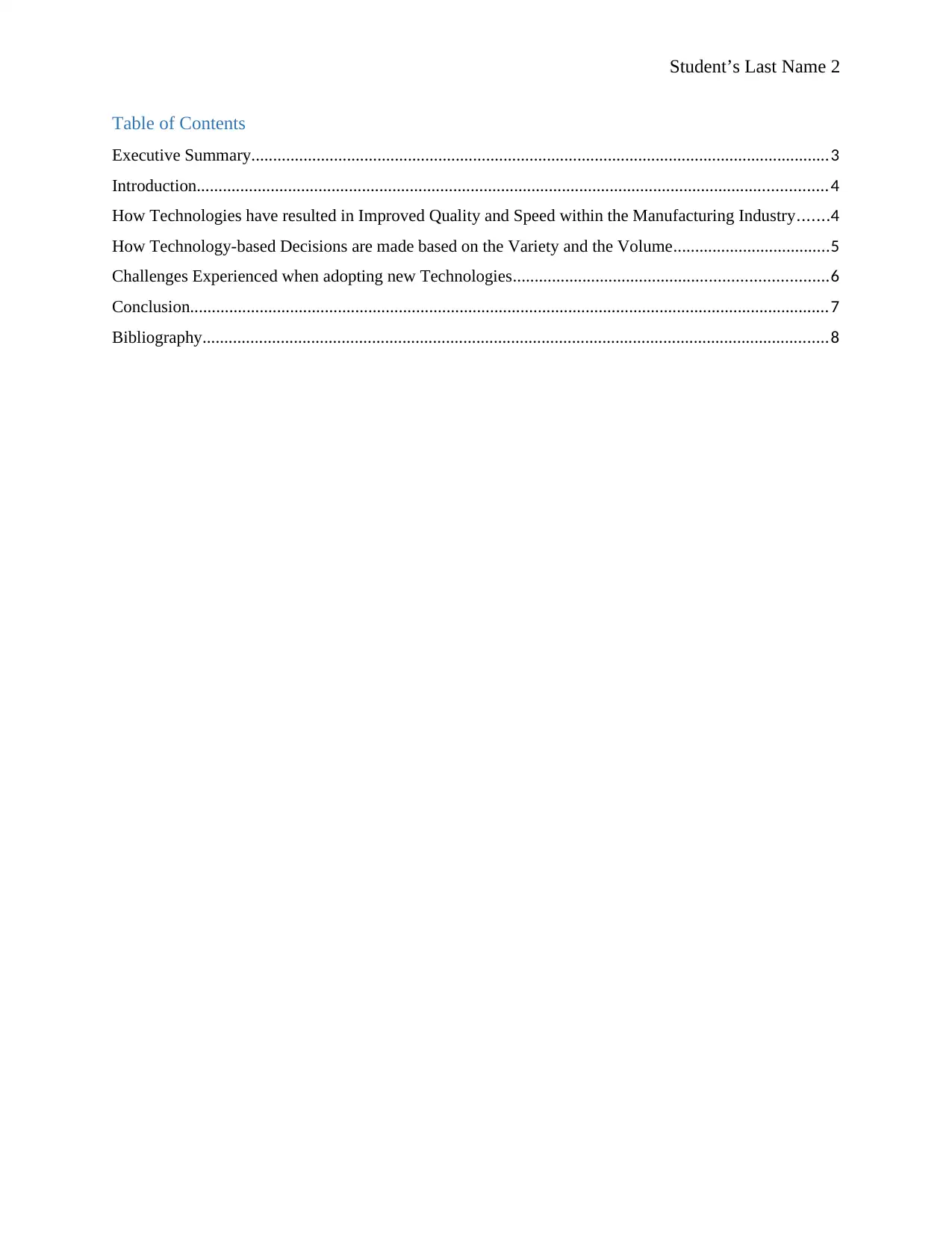
Table of Contents
Executive Summary.....................................................................................................................................3
Introduction.................................................................................................................................................4
How Technologies have resulted in Improved Quality and Speed within the Manufacturing Industry.......4
How Technology-based Decisions are made based on the Variety and the Volume....................................5
Challenges Experienced when adopting new Technologies........................................................................6
Conclusion...................................................................................................................................................7
Bibliography................................................................................................................................................8
Table of Contents
Executive Summary.....................................................................................................................................3
Introduction.................................................................................................................................................4
How Technologies have resulted in Improved Quality and Speed within the Manufacturing Industry.......4
How Technology-based Decisions are made based on the Variety and the Volume....................................5
Challenges Experienced when adopting new Technologies........................................................................6
Conclusion...................................................................................................................................................7
Bibliography................................................................................................................................................8
Student’s Last Name 3
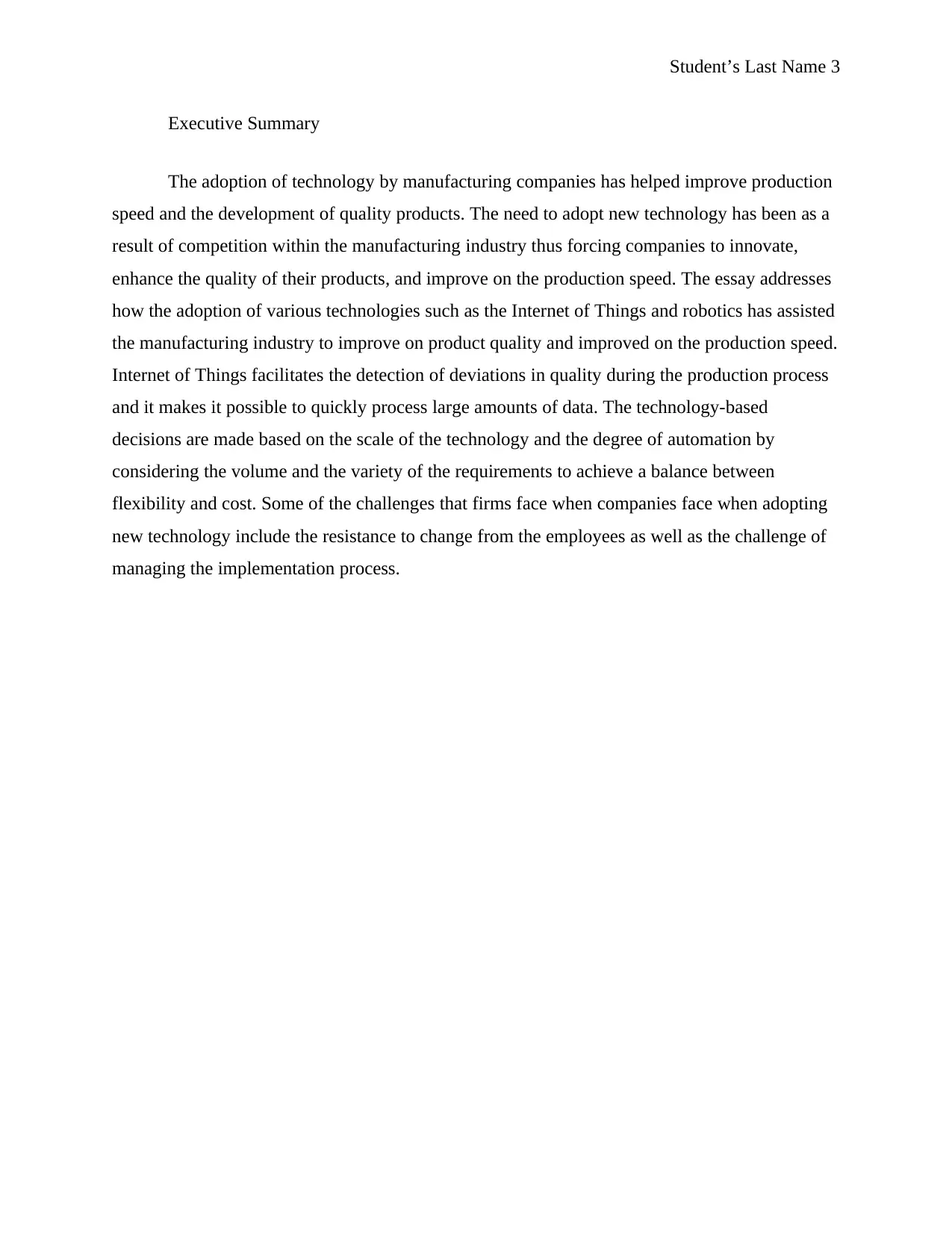
Executive Summary
The adoption of technology by manufacturing companies has helped improve production
speed and the development of quality products. The need to adopt new technology has been as a
result of competition within the manufacturing industry thus forcing companies to innovate,
enhance the quality of their products, and improve on the production speed. The essay addresses
how the adoption of various technologies such as the Internet of Things and robotics has assisted
the manufacturing industry to improve on product quality and improved on the production speed.
Internet of Things facilitates the detection of deviations in quality during the production process
and it makes it possible to quickly process large amounts of data. The technology-based
decisions are made based on the scale of the technology and the degree of automation by
considering the volume and the variety of the requirements to achieve a balance between
flexibility and cost. Some of the challenges that firms face when companies face when adopting
new technology include the resistance to change from the employees as well as the challenge of
managing the implementation process.
Executive Summary
The adoption of technology by manufacturing companies has helped improve production
speed and the development of quality products. The need to adopt new technology has been as a
result of competition within the manufacturing industry thus forcing companies to innovate,
enhance the quality of their products, and improve on the production speed. The essay addresses
how the adoption of various technologies such as the Internet of Things and robotics has assisted
the manufacturing industry to improve on product quality and improved on the production speed.
Internet of Things facilitates the detection of deviations in quality during the production process
and it makes it possible to quickly process large amounts of data. The technology-based
decisions are made based on the scale of the technology and the degree of automation by
considering the volume and the variety of the requirements to achieve a balance between
flexibility and cost. Some of the challenges that firms face when companies face when adopting
new technology include the resistance to change from the employees as well as the challenge of
managing the implementation process.
⊘ This is a preview!⊘
Do you want full access?
Subscribe today to unlock all pages.

Trusted by 1+ million students worldwide
Student’s Last Name 4
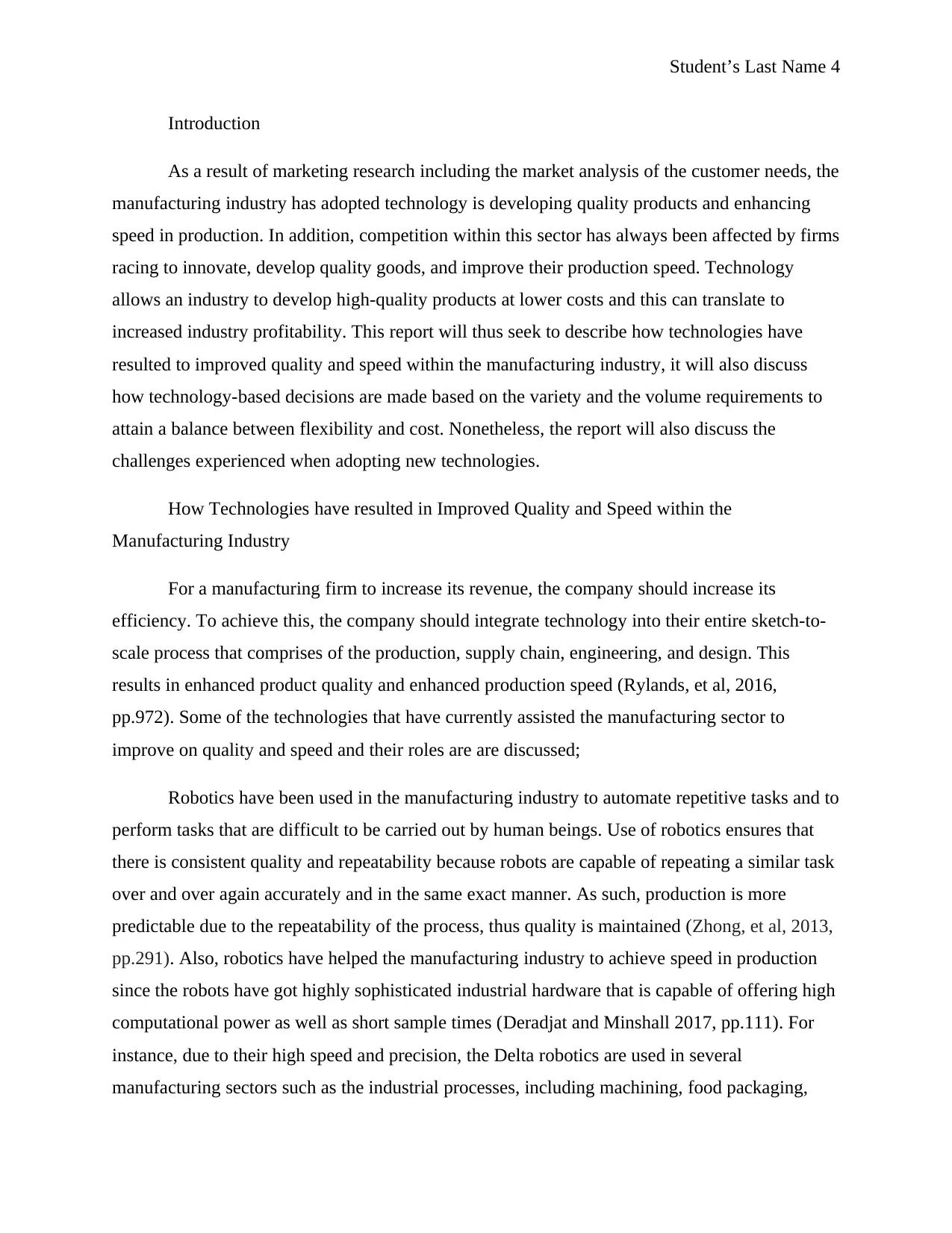
Introduction
As a result of marketing research including the market analysis of the customer needs, the
manufacturing industry has adopted technology is developing quality products and enhancing
speed in production. In addition, competition within this sector has always been affected by firms
racing to innovate, develop quality goods, and improve their production speed. Technology
allows an industry to develop high-quality products at lower costs and this can translate to
increased industry profitability. This report will thus seek to describe how technologies have
resulted to improved quality and speed within the manufacturing industry, it will also discuss
how technology-based decisions are made based on the variety and the volume requirements to
attain a balance between flexibility and cost. Nonetheless, the report will also discuss the
challenges experienced when adopting new technologies.
How Technologies have resulted in Improved Quality and Speed within the
Manufacturing Industry
For a manufacturing firm to increase its revenue, the company should increase its
efficiency. To achieve this, the company should integrate technology into their entire sketch-to-
scale process that comprises of the production, supply chain, engineering, and design. This
results in enhanced product quality and enhanced production speed (Rylands, et al, 2016,
pp.972). Some of the technologies that have currently assisted the manufacturing sector to
improve on quality and speed and their roles are are discussed;
Robotics have been used in the manufacturing industry to automate repetitive tasks and to
perform tasks that are difficult to be carried out by human beings. Use of robotics ensures that
there is consistent quality and repeatability because robots are capable of repeating a similar task
over and over again accurately and in the same exact manner. As such, production is more
predictable due to the repeatability of the process, thus quality is maintained (Zhong, et al, 2013,
pp.291). Also, robotics have helped the manufacturing industry to achieve speed in production
since the robots have got highly sophisticated industrial hardware that is capable of offering high
computational power as well as short sample times (Deradjat and Minshall 2017, pp.111). For
instance, due to their high speed and precision, the Delta robotics are used in several
manufacturing sectors such as the industrial processes, including machining, food packaging,
Introduction
As a result of marketing research including the market analysis of the customer needs, the
manufacturing industry has adopted technology is developing quality products and enhancing
speed in production. In addition, competition within this sector has always been affected by firms
racing to innovate, develop quality goods, and improve their production speed. Technology
allows an industry to develop high-quality products at lower costs and this can translate to
increased industry profitability. This report will thus seek to describe how technologies have
resulted to improved quality and speed within the manufacturing industry, it will also discuss
how technology-based decisions are made based on the variety and the volume requirements to
attain a balance between flexibility and cost. Nonetheless, the report will also discuss the
challenges experienced when adopting new technologies.
How Technologies have resulted in Improved Quality and Speed within the
Manufacturing Industry
For a manufacturing firm to increase its revenue, the company should increase its
efficiency. To achieve this, the company should integrate technology into their entire sketch-to-
scale process that comprises of the production, supply chain, engineering, and design. This
results in enhanced product quality and enhanced production speed (Rylands, et al, 2016,
pp.972). Some of the technologies that have currently assisted the manufacturing sector to
improve on quality and speed and their roles are are discussed;
Robotics have been used in the manufacturing industry to automate repetitive tasks and to
perform tasks that are difficult to be carried out by human beings. Use of robotics ensures that
there is consistent quality and repeatability because robots are capable of repeating a similar task
over and over again accurately and in the same exact manner. As such, production is more
predictable due to the repeatability of the process, thus quality is maintained (Zhong, et al, 2013,
pp.291). Also, robotics have helped the manufacturing industry to achieve speed in production
since the robots have got highly sophisticated industrial hardware that is capable of offering high
computational power as well as short sample times (Deradjat and Minshall 2017, pp.111). For
instance, due to their high speed and precision, the Delta robotics are used in several
manufacturing sectors such as the industrial processes, including machining, food packaging,
Paraphrase This Document
Need a fresh take? Get an instant paraphrase of this document with our AI Paraphraser
Student’s Last Name 5
pick-and-place assemblies, and welding. Use of robotic technology in the manufacturing industry
increases insights and intelligence. This is because robots have got an increased layer of
intelligence as well as automation integration into the production process.
Nonetheless, the Internet of Things such as having sensors in the production line provide
real-time feedback of the entire production process hence providing an extended visibility into
the entire process. If there are deviations in the desired quality, using the Internet of Things, the
deviation can easily be identified, thus providing feedback and the production process is halted,
making sure that quality is achieved (Kasie, Bright and Walker 2017, pp.207). This technology is
also effective in increasing the speed of processing a large volume of data. When the Internet of
Things is combined with the analytics software, manufacturers are able to access a larger pool of
data.
How Technology-based Decisions are made based on the Variety and the Volume
Requirements
In making technology-based decisions by putting into consideration the volume and the
variety of the requirements to achieve a balance between flexibility and cost, an organization
should put into consideration the scale, automation, and the level of integration. For instance, the
scale of technology refers to the individual capacity of every unit of process technology (Yu, et
al., 2014, pp.3059). An organization may either decide to adopt large scale or small scale units of
technology. The large-scale units of technology entail investing in large-scale technology which
is capital intensive but has got a reduced operating cost (Forum 2016). However, investing in the
small-scale units of technology is considered more flexible. This is because it involves an
organization having many small units that are under different configurations rather than having
them in one large unit. The degree of automation of the technology also influences the decisions
made. The degree of automation refers to the ability of the technology to operate without human
intervention. When an organization is making the technology-based decision, it may consider the
advantages that are associated with automation along with disadvantages of automation (Caputo,
Marzi and Pellegrini, 2016, pp.391). Some benefits include permitting precise execution of
repetitive tasks at improved speed and power, while at the same time lowering the labor costs.
The disadvantages of automation include the possibility of having increased support costs, loss
of creativity and flexibility.
pick-and-place assemblies, and welding. Use of robotic technology in the manufacturing industry
increases insights and intelligence. This is because robots have got an increased layer of
intelligence as well as automation integration into the production process.
Nonetheless, the Internet of Things such as having sensors in the production line provide
real-time feedback of the entire production process hence providing an extended visibility into
the entire process. If there are deviations in the desired quality, using the Internet of Things, the
deviation can easily be identified, thus providing feedback and the production process is halted,
making sure that quality is achieved (Kasie, Bright and Walker 2017, pp.207). This technology is
also effective in increasing the speed of processing a large volume of data. When the Internet of
Things is combined with the analytics software, manufacturers are able to access a larger pool of
data.
How Technology-based Decisions are made based on the Variety and the Volume
Requirements
In making technology-based decisions by putting into consideration the volume and the
variety of the requirements to achieve a balance between flexibility and cost, an organization
should put into consideration the scale, automation, and the level of integration. For instance, the
scale of technology refers to the individual capacity of every unit of process technology (Yu, et
al., 2014, pp.3059). An organization may either decide to adopt large scale or small scale units of
technology. The large-scale units of technology entail investing in large-scale technology which
is capital intensive but has got a reduced operating cost (Forum 2016). However, investing in the
small-scale units of technology is considered more flexible. This is because it involves an
organization having many small units that are under different configurations rather than having
them in one large unit. The degree of automation of the technology also influences the decisions
made. The degree of automation refers to the ability of the technology to operate without human
intervention. When an organization is making the technology-based decision, it may consider the
advantages that are associated with automation along with disadvantages of automation (Caputo,
Marzi and Pellegrini, 2016, pp.391). Some benefits include permitting precise execution of
repetitive tasks at improved speed and power, while at the same time lowering the labor costs.
The disadvantages of automation include the possibility of having increased support costs, loss
of creativity and flexibility.
Student’s Last Name 6
Challenges Experienced when adopting new Technologies
When adopting new technology, organizations are faced with several challenges that
result from the employees or the organization itself. For instance, there is resistance to change is
a result of the dynamics from which an organization operates, and it is essential for a company
that intends to flourish. As such, an organization seeking to flourish should regularly upgrade its
tools and make sure that these changes are accepted by the staff (Polygerinos, et al., 2017).
Changes in an organization can result in disruptions in behaviors which may replace the
customary social structures along with the familiar relationships or even lead to loss of
continuity. Introducing new technology may be intimidating to the staff who are comfortable
doing things the way they are used to doing them. Adopting such a new technology may mean
changing the job responsibilities, adding personnel and requiring additional training, along with
adding workload to the employees. Hence, resistance to change is one of the challenges that
organizations face when introducing a new technology
Additionally, there is the challenge of managing the implementation of a technology
change. Once a firm selects and approves to introduce a new technology tool, this technology
should be implemented and introduced to the staff. A firm that is not in a position to successfully
introduce the planned change may end up losing a lot of finances, thus translating to the loss of
its market position, loss of skilled staff, reduced employee morale, lost credibility, and it may
also lose its stakeholders (Tao, et al., 2014, pp.1439). Implementing a new technology
successfully requires that a company has got visionary leaders who have considered the
technology’s benefits, sought advice from the influential leaders from all the level to determine
the unintended consequences, determined some sources of resistance, and come up with a
strategic plan for implementing the new technology over time. The key success to the
implementation of the new technology involves having leaders who are able to spend their time
to develop a well-thought-out plan to be used in implementing the technology (Liu, et al, 2013,
pp.2413). The thoughts should be capable of demonstrating how the technology will not only
serve the management but all the employees. Failing to communicate this to the employees may
result in failure of the implementation efforts regardless of the efforts and the time spent on the
rollout.
Challenges Experienced when adopting new Technologies
When adopting new technology, organizations are faced with several challenges that
result from the employees or the organization itself. For instance, there is resistance to change is
a result of the dynamics from which an organization operates, and it is essential for a company
that intends to flourish. As such, an organization seeking to flourish should regularly upgrade its
tools and make sure that these changes are accepted by the staff (Polygerinos, et al., 2017).
Changes in an organization can result in disruptions in behaviors which may replace the
customary social structures along with the familiar relationships or even lead to loss of
continuity. Introducing new technology may be intimidating to the staff who are comfortable
doing things the way they are used to doing them. Adopting such a new technology may mean
changing the job responsibilities, adding personnel and requiring additional training, along with
adding workload to the employees. Hence, resistance to change is one of the challenges that
organizations face when introducing a new technology
Additionally, there is the challenge of managing the implementation of a technology
change. Once a firm selects and approves to introduce a new technology tool, this technology
should be implemented and introduced to the staff. A firm that is not in a position to successfully
introduce the planned change may end up losing a lot of finances, thus translating to the loss of
its market position, loss of skilled staff, reduced employee morale, lost credibility, and it may
also lose its stakeholders (Tao, et al., 2014, pp.1439). Implementing a new technology
successfully requires that a company has got visionary leaders who have considered the
technology’s benefits, sought advice from the influential leaders from all the level to determine
the unintended consequences, determined some sources of resistance, and come up with a
strategic plan for implementing the new technology over time. The key success to the
implementation of the new technology involves having leaders who are able to spend their time
to develop a well-thought-out plan to be used in implementing the technology (Liu, et al, 2013,
pp.2413). The thoughts should be capable of demonstrating how the technology will not only
serve the management but all the employees. Failing to communicate this to the employees may
result in failure of the implementation efforts regardless of the efforts and the time spent on the
rollout.
⊘ This is a preview!⊘
Do you want full access?
Subscribe today to unlock all pages.
Trusted by 1+ million students worldwide
Student’s Last Name 7
Conclusion
Adopting technology is effective in ensuring that the manufacturing sector achieves high
quality and speed in the production of goods. The reason behind the need to have high-quality
products and improved production speed is due to globalization which has resulted in enhanced
competition. Organizations in the manufacturing industry have been able to achieve quality and
improve production speed by making use of technologies such as the Internet of Things and
robotics. Robots are effective in achieving quality because they can do repetitive tasks by
maintaining the same standards. IoT also is effective in determining deviations in quality during
production. Technology-based decisions are made by considering the scale of the technology and
the technology’s degree of integration. Some challenges faced when adopting new changes
include resistance to change by the employees along with the challenge of managing the
implementation of the new technology.
Conclusion
Adopting technology is effective in ensuring that the manufacturing sector achieves high
quality and speed in the production of goods. The reason behind the need to have high-quality
products and improved production speed is due to globalization which has resulted in enhanced
competition. Organizations in the manufacturing industry have been able to achieve quality and
improve production speed by making use of technologies such as the Internet of Things and
robotics. Robots are effective in achieving quality because they can do repetitive tasks by
maintaining the same standards. IoT also is effective in determining deviations in quality during
production. Technology-based decisions are made by considering the scale of the technology and
the technology’s degree of integration. Some challenges faced when adopting new changes
include resistance to change by the employees along with the challenge of managing the
implementation of the new technology.
Paraphrase This Document
Need a fresh take? Get an instant paraphrase of this document with our AI Paraphraser
Student’s Last Name 8
Bibliography
Brogan Rylands, Tillmann Böhme, Robert III Gorkin, Joshua Fan, Thomas Birtchnell, 2016 "The
adoption process and impact of additive manufacturing on manufacturing systems", Journal of
Manufacturing Technology Management, vol. 27, no. 7, pp.969-989.
Caputo, A., Marzi, G. and Pellegrini, M.M., 2016. The internet of things in manufacturing
innovation processes: development and application of a conceptual framework. Business Process
Management Journal, 22(2), pp.383-402.
Dominik Deradjat, Tim Minshall 2017 "Implementation of rapid manufacturing for mass
customisation", Journal of Manufacturing Technology Management, vol. 28, no. 1, pp.95-121
Fentahun Moges Kasie, Glen Bright, Anthony Walker 2017, "An intelligent decision support
system for on-demand fixture retrieval, adaptation and manufacture", Journal of Manufacturing
TechnologyManagement, vol. 28, no. 2, pp.189-211.
Fujitsu Forum 2016, The next generation of manufacturing as the key focus of Japanese Industry
- Latest trends and in-house practices, Fujitsu Journal, viewed 24th July 2017<
http://journal.jp.fujitsu.com/en/2016/06/24/02/>
Liu, C., Chau, K.T., Wu, D. and Gao, S., 2013. Opportunities and Challenges of Vehicle-to-
Home, Vehicle-to-Vehicle, and Vehicle-to-Grid Technologies. Proceedings of the
IEEE, 101(11), pp.2409-2427.
Polygerinos, P., Correll, N., Morin, S.A., Mosadegh, B., Onal, C.D., Petersen, K., Cianchetti, M.,
Tolley, M.T. and Shepherd, R.F., 2017. Soft robotics: Review of fluid‐driven intrinsically soft
devices; manufacturing, sensing, control, and applications in human‐robot interaction. Advanced
Engineering Materials, 19(12), p.1700016.
Tao, F., Cheng, Y., Da Xu, L., Zhang, L. and Li, B.H., 2014. CCIoT-CMfg: cloud computing
and internet of things-based cloud manufacturing service system. IEEE Transactions on
Industrial Informatics, 10(2), pp.1435-1442.
Bibliography
Brogan Rylands, Tillmann Böhme, Robert III Gorkin, Joshua Fan, Thomas Birtchnell, 2016 "The
adoption process and impact of additive manufacturing on manufacturing systems", Journal of
Manufacturing Technology Management, vol. 27, no. 7, pp.969-989.
Caputo, A., Marzi, G. and Pellegrini, M.M., 2016. The internet of things in manufacturing
innovation processes: development and application of a conceptual framework. Business Process
Management Journal, 22(2), pp.383-402.
Dominik Deradjat, Tim Minshall 2017 "Implementation of rapid manufacturing for mass
customisation", Journal of Manufacturing Technology Management, vol. 28, no. 1, pp.95-121
Fentahun Moges Kasie, Glen Bright, Anthony Walker 2017, "An intelligent decision support
system for on-demand fixture retrieval, adaptation and manufacture", Journal of Manufacturing
TechnologyManagement, vol. 28, no. 2, pp.189-211.
Fujitsu Forum 2016, The next generation of manufacturing as the key focus of Japanese Industry
- Latest trends and in-house practices, Fujitsu Journal, viewed 24th July 2017<
http://journal.jp.fujitsu.com/en/2016/06/24/02/>
Liu, C., Chau, K.T., Wu, D. and Gao, S., 2013. Opportunities and Challenges of Vehicle-to-
Home, Vehicle-to-Vehicle, and Vehicle-to-Grid Technologies. Proceedings of the
IEEE, 101(11), pp.2409-2427.
Polygerinos, P., Correll, N., Morin, S.A., Mosadegh, B., Onal, C.D., Petersen, K., Cianchetti, M.,
Tolley, M.T. and Shepherd, R.F., 2017. Soft robotics: Review of fluid‐driven intrinsically soft
devices; manufacturing, sensing, control, and applications in human‐robot interaction. Advanced
Engineering Materials, 19(12), p.1700016.
Tao, F., Cheng, Y., Da Xu, L., Zhang, L. and Li, B.H., 2014. CCIoT-CMfg: cloud computing
and internet of things-based cloud manufacturing service system. IEEE Transactions on
Industrial Informatics, 10(2), pp.1435-1442.
Student’s Last Name 9
Yu, L., Lee, Y.H., Ling, X., Santos, E.J., Shin, Y.C., Lin, Y., Dubey, M., Kaxiras, E., Kong, J.,
Wang, H. and Palacios, T., 2014. Graphene/MoS2 hybrid technology for large-scale two-
dimensional electronics. Nano letters, 14(6), pp.3055-3063.
Zhong, R.Y., Dai, Q.Y., Qu, T., Hu, G.J. and Huang, G.Q., 2013. RFID-enabled real-time
manufacturing execution system for mass-customization production. Robotics and Computer-
Integrated Manufacturing, 29(2), pp.283-292.
Yu, L., Lee, Y.H., Ling, X., Santos, E.J., Shin, Y.C., Lin, Y., Dubey, M., Kaxiras, E., Kong, J.,
Wang, H. and Palacios, T., 2014. Graphene/MoS2 hybrid technology for large-scale two-
dimensional electronics. Nano letters, 14(6), pp.3055-3063.
Zhong, R.Y., Dai, Q.Y., Qu, T., Hu, G.J. and Huang, G.Q., 2013. RFID-enabled real-time
manufacturing execution system for mass-customization production. Robotics and Computer-
Integrated Manufacturing, 29(2), pp.283-292.
⊘ This is a preview!⊘
Do you want full access?
Subscribe today to unlock all pages.
Trusted by 1+ million students worldwide

1 out of 9


Related Documents


Your All-in-One AI-Powered Toolkit for Academic Success.
+13062052269
info@desklib.com
Available 24*7 on WhatsApp / Email
![[object Object]](/_next/static/media/star-bottom.7253800d.svg)
Unlock your academic potential
Copyright © 2020–2026 A2Z Services. All Rights Reserved. Developed and managed by ZUCOL.