Techno Greats Case Study Analysis: Improving Leadership Effectiveness
VerifiedAdded on 2021/05/31
|9
|1880
|40
Case Study
AI Summary
This case study analyzes the challenges faced by Ed Worth, the General Manager of Techno Greats, highlighting issues of prioritization, work-life balance, and ineffective leadership. The analysis identifies dissatisfaction, inability to fulfill the executive role, and lack of work-life balance as key problems. The root cause is attributed to Ed's difficulty in prioritizing tasks and being the single point of contact for all organizational matters. The case evaluates three options: prioritizing work, establishing more points of contact, and clarifying roles, ultimately recommending the implementation of more leadership roles to improve efficiency, allow Ed to focus on strategic decisions, and foster employee development. The implementation plan outlines steps, timelines, and methods for measuring success, including tracking Ed's time allocation, communication between leaders and their teams, and departmental performance reports. The analysis references relevant literature on job satisfaction, leadership, and organizational behavior.
Techno Greats
Case Study Analysis
Case Study Analysis
Paraphrase This Document
Need a fresh take? Get an instant paraphrase of this document with our AI Paraphraser

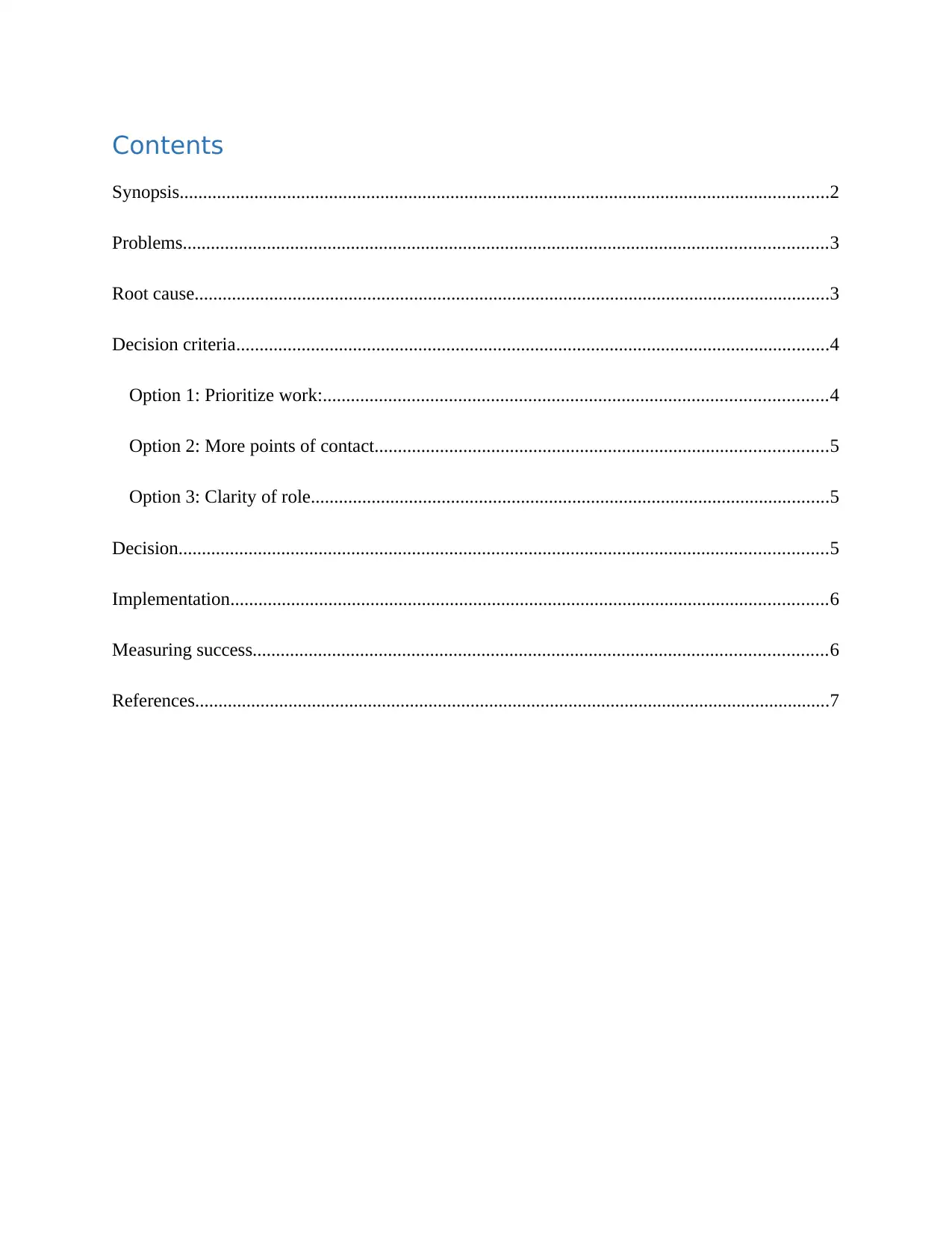
Contents
Synopsis...........................................................................................................................................2
Problems..........................................................................................................................................3
Root cause........................................................................................................................................3
Decision criteria...............................................................................................................................4
Option 1: Prioritize work:............................................................................................................4
Option 2: More points of contact.................................................................................................5
Option 3: Clarity of role...............................................................................................................5
Decision...........................................................................................................................................5
Implementation................................................................................................................................6
Measuring success...........................................................................................................................6
References........................................................................................................................................7
Synopsis...........................................................................................................................................2
Problems..........................................................................................................................................3
Root cause........................................................................................................................................3
Decision criteria...............................................................................................................................4
Option 1: Prioritize work:............................................................................................................4
Option 2: More points of contact.................................................................................................5
Option 3: Clarity of role...............................................................................................................5
Decision...........................................................................................................................................5
Implementation................................................................................................................................6
Measuring success...........................................................................................................................6
References........................................................................................................................................7

Synopsis
This particular case highlights upon a single day of Ed Worth, G.M. at Techno Greats. Ed is a
motivated, responsible and dedicated employee who has been associated with Techno Great
since the last ten years. He began his career in Vancouver as a research analyst. Within three
years, he was promoted to the position of a lab supervisor. He was further promoted as an
assistant to manager two years after that. Upon the retirement of the GM, he was offered the
same position and since then he has been serving as General Manager at the Calgary division of
Techno Greats.
The case helps us understand that Ed has been unsuccessful to devote time to execute an idea
that was apprehended a couple of years ago. The idea relates to an investment and stock option
plan that needs Ed’s urgent attention. He also needs to brainstorm and think of a simpler
procedure to record various blood tests and settle upon a new courier partner for Techno Greats.
These three things are currently taking a priority on his list of To-Dos. Nevertheless, from the
moment he set foot in his office till the time he left for home, his day was packed with work and
he could not get himself to focus on either of these tasks. He spend his time fulfilling other
responsibilities of the job like discussing the brochures with Jean, taking feedback from
supervisors, assisting Jon in getting some extra space for chemical storage, brainstorming on a
new marketing plan with the marketing director, taking a review of a researcher, sorting
enquiries received from client hospitals as well as medical schools, investigating some regulatory
changes with the safety supervisor, handling a bunch of HR concerns, responding to the Vice
President’s questions aimed at the launch of phase 2 trials, organizing activities for various
organizational departments and communicating with Jill.
While returning home, he felt furious for being unable to work as per the plan he had set in the
morning. Soon, he realized that important and strategic tasks are being delayed in order to cater
to small projects. Upon realizing this, he felt he would not be able to do justice to his role if he
continued to push strategic tasks for later. His lack of time spent with his family is also troubling
him.
This particular case highlights upon a single day of Ed Worth, G.M. at Techno Greats. Ed is a
motivated, responsible and dedicated employee who has been associated with Techno Great
since the last ten years. He began his career in Vancouver as a research analyst. Within three
years, he was promoted to the position of a lab supervisor. He was further promoted as an
assistant to manager two years after that. Upon the retirement of the GM, he was offered the
same position and since then he has been serving as General Manager at the Calgary division of
Techno Greats.
The case helps us understand that Ed has been unsuccessful to devote time to execute an idea
that was apprehended a couple of years ago. The idea relates to an investment and stock option
plan that needs Ed’s urgent attention. He also needs to brainstorm and think of a simpler
procedure to record various blood tests and settle upon a new courier partner for Techno Greats.
These three things are currently taking a priority on his list of To-Dos. Nevertheless, from the
moment he set foot in his office till the time he left for home, his day was packed with work and
he could not get himself to focus on either of these tasks. He spend his time fulfilling other
responsibilities of the job like discussing the brochures with Jean, taking feedback from
supervisors, assisting Jon in getting some extra space for chemical storage, brainstorming on a
new marketing plan with the marketing director, taking a review of a researcher, sorting
enquiries received from client hospitals as well as medical schools, investigating some regulatory
changes with the safety supervisor, handling a bunch of HR concerns, responding to the Vice
President’s questions aimed at the launch of phase 2 trials, organizing activities for various
organizational departments and communicating with Jill.
While returning home, he felt furious for being unable to work as per the plan he had set in the
morning. Soon, he realized that important and strategic tasks are being delayed in order to cater
to small projects. Upon realizing this, he felt he would not be able to do justice to his role if he
continued to push strategic tasks for later. His lack of time spent with his family is also troubling
him.
⊘ This is a preview!⊘
Do you want full access?
Subscribe today to unlock all pages.

Trusted by 1+ million students worldwide

Problems
Clearly, Ed is battling with a lot of problems. The three major problems reflected from the case
are as below:
Dissatisfaction: One of the first problems highlighted in the case is the fact that Ed is highly
dissatisfied with his own performance. Job satisfaction plays a significant role in the any
individual’s career (Aziri, 2011). There are various theories in organizational behavior that
highlight upon the importance of job satisfaction. McClelland stated that employees have a need
for power, achievement and affiliation (Miner, 2015). This essay suggests that Ed’s need for
power is fulfilled but his need for achievement and affiliation have a long way to go. This is
what creates a lack of satisfaction. He feels he is not performing to his fullest potential. He
doesn’t find himself innovating new things and hence this is a source of demotivation.
Unable to do justice to an executive role: A manager in the job role has to be effective and
efficient. By being efficient, a manager does the things right and by being effective a manager
does the right things (Daley, 2012). Most of Ed’s strategic tasks have not be done. Therefore it
can be said that he is efficient but not effective. This reflects upon his inability to do justice to his
role as an executive.
Missing work-life balance: It has been observed in the case that Ed is the last employee to leave
from office despite reaching early on a daily basis. Clearly, the extra hours of work that he is
putting in are impacting his personal life. A lack of work life balance adversely impacts
employee’s level of motivation and may even lead to hindered performance (Delecta, 2012).
Root cause
There is no single reason behind the problems faced by Ed. Majority of such problems faced by
employees in the work place are caused by a combination of two or three factors. It is
understandable from the case that Ed needs to prioritize his work better and enhance his focus on
important tasks. He is a senior level executive and it is critical that managers are able to identify
and understand what requires their immediate attention. A manager must possess technical skills,
human skills and conceptual skills (Lussier, 2011). A top level manager essentially requires a
Clearly, Ed is battling with a lot of problems. The three major problems reflected from the case
are as below:
Dissatisfaction: One of the first problems highlighted in the case is the fact that Ed is highly
dissatisfied with his own performance. Job satisfaction plays a significant role in the any
individual’s career (Aziri, 2011). There are various theories in organizational behavior that
highlight upon the importance of job satisfaction. McClelland stated that employees have a need
for power, achievement and affiliation (Miner, 2015). This essay suggests that Ed’s need for
power is fulfilled but his need for achievement and affiliation have a long way to go. This is
what creates a lack of satisfaction. He feels he is not performing to his fullest potential. He
doesn’t find himself innovating new things and hence this is a source of demotivation.
Unable to do justice to an executive role: A manager in the job role has to be effective and
efficient. By being efficient, a manager does the things right and by being effective a manager
does the right things (Daley, 2012). Most of Ed’s strategic tasks have not be done. Therefore it
can be said that he is efficient but not effective. This reflects upon his inability to do justice to his
role as an executive.
Missing work-life balance: It has been observed in the case that Ed is the last employee to leave
from office despite reaching early on a daily basis. Clearly, the extra hours of work that he is
putting in are impacting his personal life. A lack of work life balance adversely impacts
employee’s level of motivation and may even lead to hindered performance (Delecta, 2012).
Root cause
There is no single reason behind the problems faced by Ed. Majority of such problems faced by
employees in the work place are caused by a combination of two or three factors. It is
understandable from the case that Ed needs to prioritize his work better and enhance his focus on
important tasks. He is a senior level executive and it is critical that managers are able to identify
and understand what requires their immediate attention. A manager must possess technical skills,
human skills and conceptual skills (Lussier, 2011). A top level manager essentially requires a
Paraphrase This Document
Need a fresh take? Get an instant paraphrase of this document with our AI Paraphraser

high level of conceptual skills since he is hired with the purpose of performing tasks that are
strategically important.
Secondly, Ed is the point of contact for everything and everyone. Therefore there is an excessive
dependency on Ed of the remaining employees. He is the one point contact for storage issues,
employee performances, brochures, stocks or even work timings of a field placement student.
This high dependency makes Ed unable to prioritize his work.
Option analysis
Prioritize work: The foremost thing that Ed needs to do is prioritize his work by making and
maintaining a planner on a daily basis. It is important that he sincerely devotes his time to more
strategic decisions of the firm. Secondly, it is important he gives time to his family and does his
best at maintaining his work life balance.
More points of contact: It has been noticed that Ed has been a single point of contact for a lot of
people in the organization. Therefore, it is important that every department must have a point of
contact. Leaders should be hired who need to take responsibility of an entire department (Yukl,
2013). These leaders can then report to Ed. This would increase the efficacy of coordination
within the organization and the overall culture would become more professional.
Clarity of roles: It is important that executive level employees should have clear roles and that
is only way that these employees would be clear about their roles, responsibilities and what is
expected from them (Caillier, 2014). At present, Ed has been not been able to manage his work
because employees do not have a clear job description.
Decision criteria
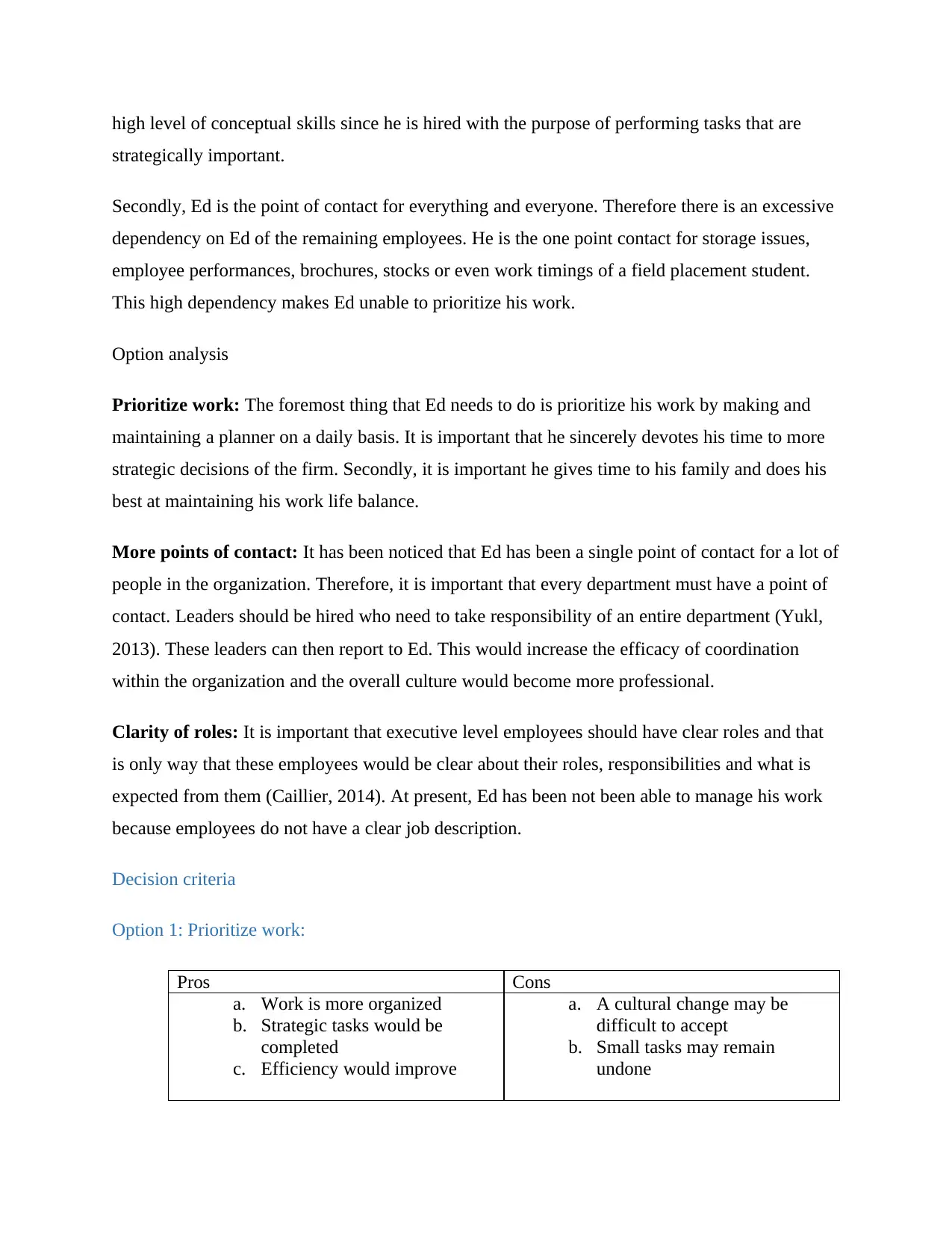
Option 1: Prioritize work:
Pros Cons
a. Work is more organized
b. Strategic tasks would be
completed
c. Efficiency would improve
a. A cultural change may be
difficult to accept
b. Small tasks may remain
undone
strategically important.
Secondly, Ed is the point of contact for everything and everyone. Therefore there is an excessive
dependency on Ed of the remaining employees. He is the one point contact for storage issues,
employee performances, brochures, stocks or even work timings of a field placement student.
This high dependency makes Ed unable to prioritize his work.
Option analysis
Prioritize work: The foremost thing that Ed needs to do is prioritize his work by making and
maintaining a planner on a daily basis. It is important that he sincerely devotes his time to more
strategic decisions of the firm. Secondly, it is important he gives time to his family and does his
best at maintaining his work life balance.
More points of contact: It has been noticed that Ed has been a single point of contact for a lot of
people in the organization. Therefore, it is important that every department must have a point of
contact. Leaders should be hired who need to take responsibility of an entire department (Yukl,
2013). These leaders can then report to Ed. This would increase the efficacy of coordination
within the organization and the overall culture would become more professional.
Clarity of roles: It is important that executive level employees should have clear roles and that
is only way that these employees would be clear about their roles, responsibilities and what is
expected from them (Caillier, 2014). At present, Ed has been not been able to manage his work
because employees do not have a clear job description.
Decision criteria
Option 1: Prioritize work:
Pros Cons
a. Work is more organized
b. Strategic tasks would be
completed
c. Efficiency would improve
a. A cultural change may be
difficult to accept
b. Small tasks may remain
undone

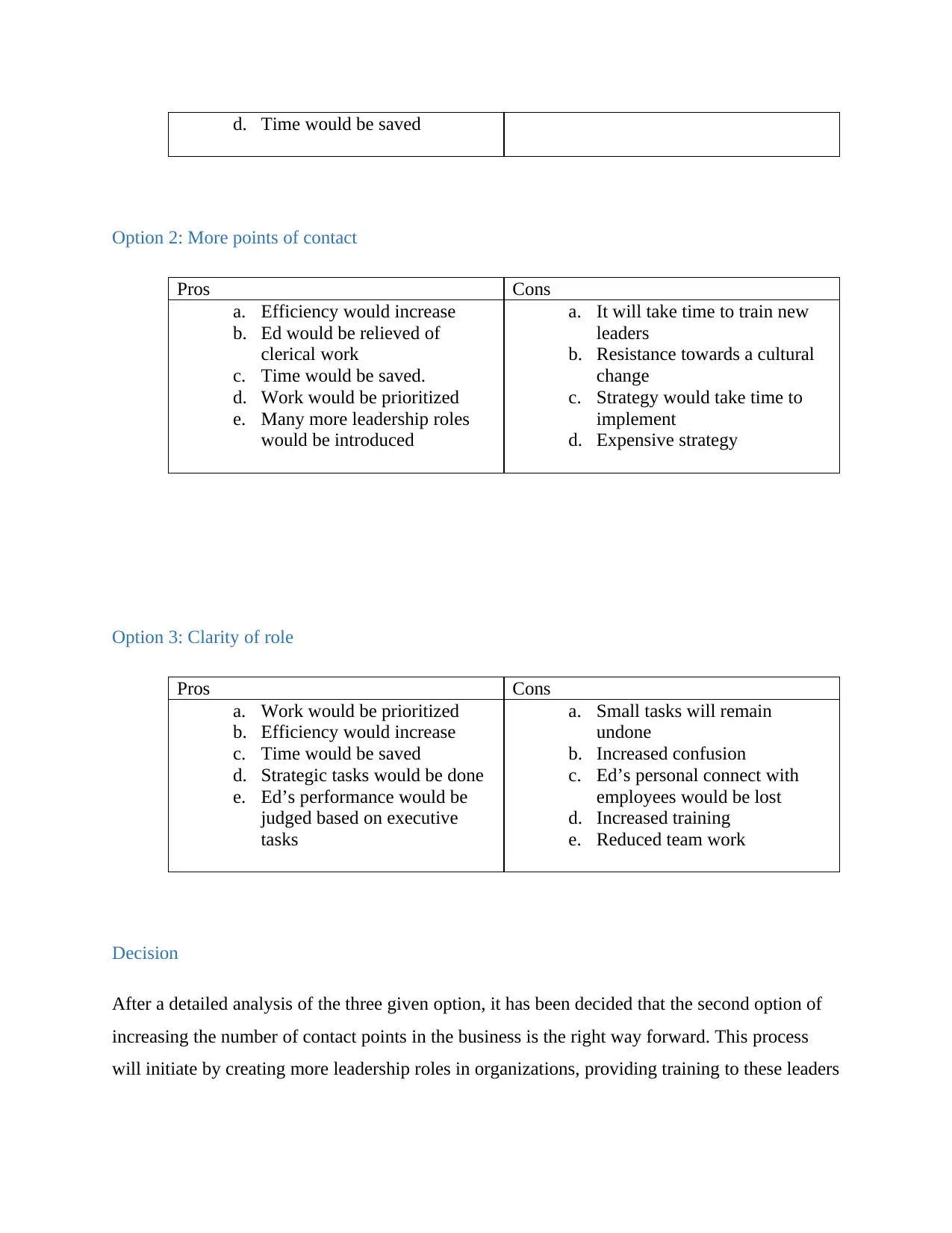
d. Time would be saved
Option 2: More points of contact
Pros Cons
a. Efficiency would increase
b. Ed would be relieved of
clerical work
c. Time would be saved.
d. Work would be prioritized
e. Many more leadership roles
would be introduced
a. It will take time to train new
leaders
b. Resistance towards a cultural
change
c. Strategy would take time to
implement
d. Expensive strategy
Option 3: Clarity of role
Pros Cons
a. Work would be prioritized
b. Efficiency would increase
c. Time would be saved
d. Strategic tasks would be done
e. Ed’s performance would be
judged based on executive
tasks
a. Small tasks will remain
undone
b. Increased confusion
c. Ed’s personal connect with
employees would be lost
d. Increased training
e. Reduced team work
Decision
After a detailed analysis of the three given option, it has been decided that the second option of
increasing the number of contact points in the business is the right way forward. This process
will initiate by creating more leadership roles in organizations, providing training to these leaders
Option 2: More points of contact
Pros Cons
a. Efficiency would increase
b. Ed would be relieved of
clerical work
c. Time would be saved.
d. Work would be prioritized
e. Many more leadership roles
would be introduced
a. It will take time to train new
leaders
b. Resistance towards a cultural
change
c. Strategy would take time to
implement
d. Expensive strategy
Option 3: Clarity of role
Pros Cons
a. Work would be prioritized
b. Efficiency would increase
c. Time would be saved
d. Strategic tasks would be done
e. Ed’s performance would be
judged based on executive
tasks
a. Small tasks will remain
undone
b. Increased confusion
c. Ed’s personal connect with
employees would be lost
d. Increased training
e. Reduced team work
Decision
After a detailed analysis of the three given option, it has been decided that the second option of
increasing the number of contact points in the business is the right way forward. This process
will initiate by creating more leadership roles in organizations, providing training to these leaders
⊘ This is a preview!⊘
Do you want full access?
Subscribe today to unlock all pages.

Trusted by 1+ million students worldwide

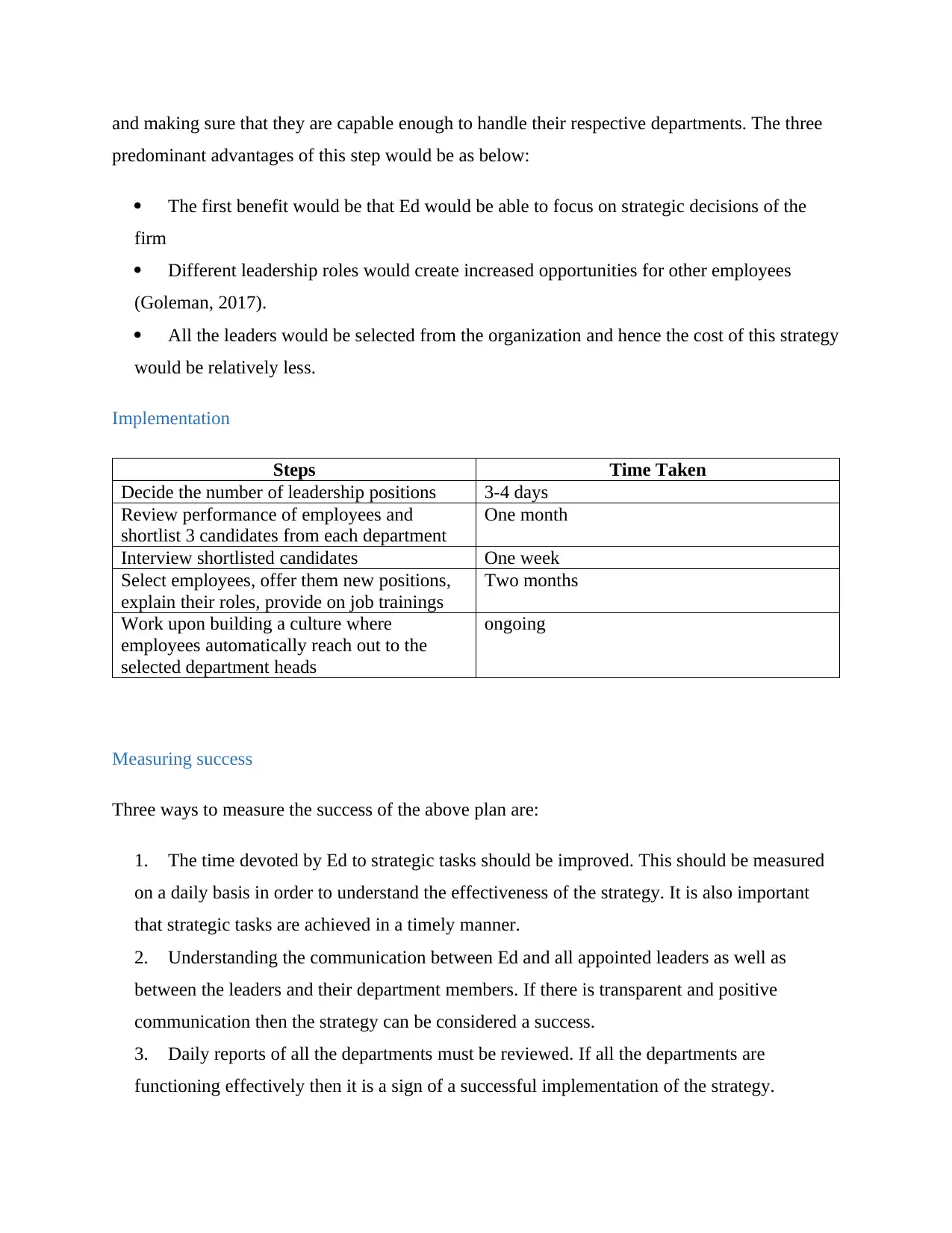
and making sure that they are capable enough to handle their respective departments. The three
predominant advantages of this step would be as below:
The first benefit would be that Ed would be able to focus on strategic decisions of the
firm
Different leadership roles would create increased opportunities for other employees
(Goleman, 2017).
All the leaders would be selected from the organization and hence the cost of this strategy
would be relatively less.
Implementation
Steps Time Taken
Decide the number of leadership positions 3-4 days
Review performance of employees and
shortlist 3 candidates from each department
One month
Interview shortlisted candidates One week
Select employees, offer them new positions,
explain their roles, provide on job trainings
Two months
Work upon building a culture where
employees automatically reach out to the
selected department heads
ongoing
Measuring success
Three ways to measure the success of the above plan are:
1. The time devoted by Ed to strategic tasks should be improved. This should be measured
on a daily basis in order to understand the effectiveness of the strategy. It is also important
that strategic tasks are achieved in a timely manner.
2. Understanding the communication between Ed and all appointed leaders as well as
between the leaders and their department members. If there is transparent and positive
communication then the strategy can be considered a success.
3. Daily reports of all the departments must be reviewed. If all the departments are
functioning effectively then it is a sign of a successful implementation of the strategy.
predominant advantages of this step would be as below:
The first benefit would be that Ed would be able to focus on strategic decisions of the
firm
Different leadership roles would create increased opportunities for other employees
(Goleman, 2017).
All the leaders would be selected from the organization and hence the cost of this strategy
would be relatively less.
Implementation
Steps Time Taken
Decide the number of leadership positions 3-4 days
Review performance of employees and
shortlist 3 candidates from each department
One month
Interview shortlisted candidates One week
Select employees, offer them new positions,
explain their roles, provide on job trainings
Two months
Work upon building a culture where
employees automatically reach out to the
selected department heads
ongoing
Measuring success
Three ways to measure the success of the above plan are:
1. The time devoted by Ed to strategic tasks should be improved. This should be measured
on a daily basis in order to understand the effectiveness of the strategy. It is also important
that strategic tasks are achieved in a timely manner.
2. Understanding the communication between Ed and all appointed leaders as well as
between the leaders and their department members. If there is transparent and positive
communication then the strategy can be considered a success.
3. Daily reports of all the departments must be reviewed. If all the departments are
functioning effectively then it is a sign of a successful implementation of the strategy.
Paraphrase This Document
Need a fresh take? Get an instant paraphrase of this document with our AI Paraphraser


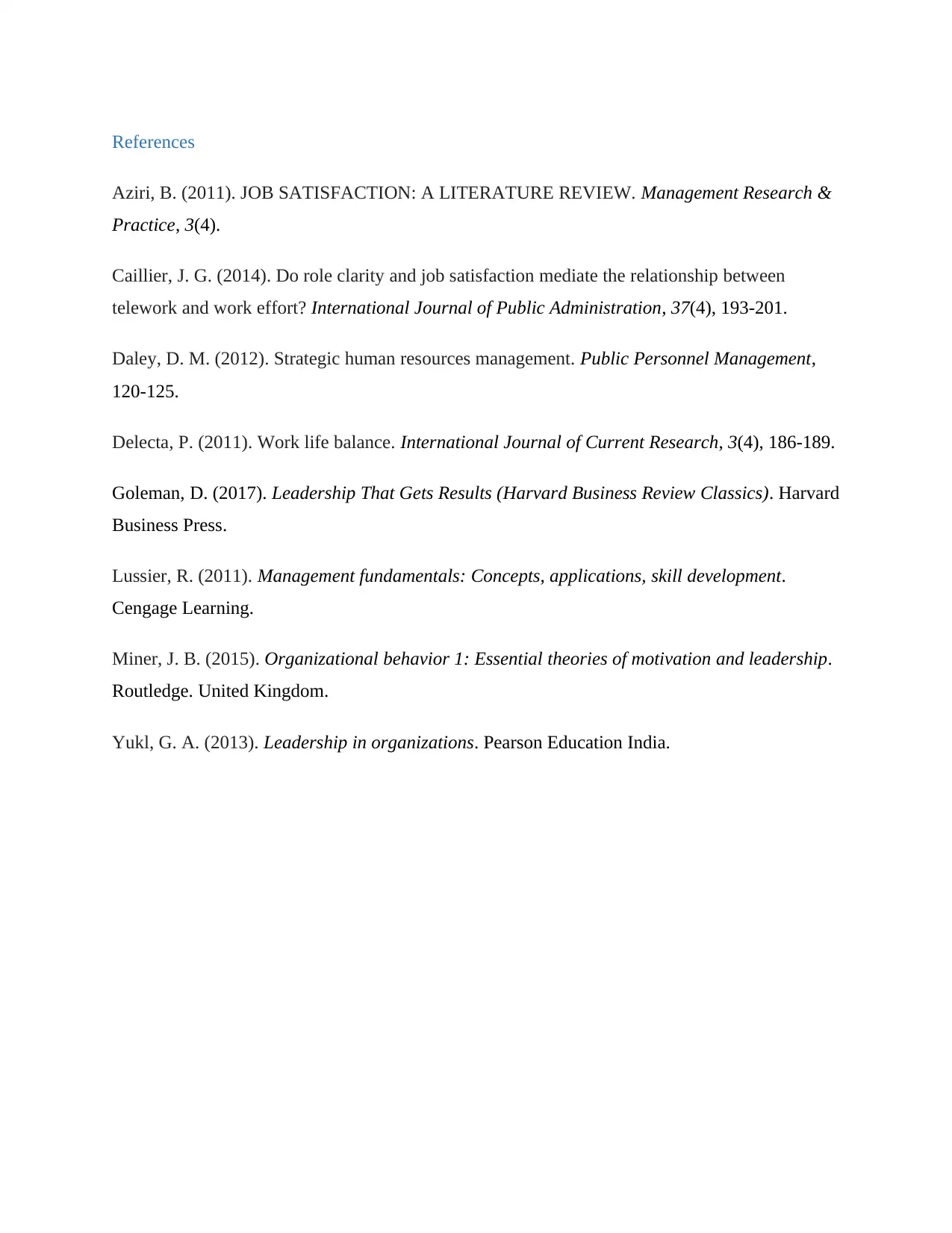
References
Aziri, B. (2011). JOB SATISFACTION: A LITERATURE REVIEW. Management Research &
Practice, 3(4).
Caillier, J. G. (2014). Do role clarity and job satisfaction mediate the relationship between
telework and work effort? International Journal of Public Administration, 37(4), 193-201.
Daley, D. M. (2012). Strategic human resources management. Public Personnel Management,
120-125.
Delecta, P. (2011). Work life balance. International Journal of Current Research, 3(4), 186-189.
Goleman, D. (2017). Leadership That Gets Results (Harvard Business Review Classics). Harvard
Business Press.
Lussier, R. (2011). Management fundamentals: Concepts, applications, skill development.
Cengage Learning.
Miner, J. B. (2015). Organizational behavior 1: Essential theories of motivation and leadership.
Routledge. United Kingdom.
Yukl, G. A. (2013). Leadership in organizations. Pearson Education India.
Aziri, B. (2011). JOB SATISFACTION: A LITERATURE REVIEW. Management Research &
Practice, 3(4).
Caillier, J. G. (2014). Do role clarity and job satisfaction mediate the relationship between
telework and work effort? International Journal of Public Administration, 37(4), 193-201.
Daley, D. M. (2012). Strategic human resources management. Public Personnel Management,
120-125.
Delecta, P. (2011). Work life balance. International Journal of Current Research, 3(4), 186-189.
Goleman, D. (2017). Leadership That Gets Results (Harvard Business Review Classics). Harvard
Business Press.
Lussier, R. (2011). Management fundamentals: Concepts, applications, skill development.
Cengage Learning.
Miner, J. B. (2015). Organizational behavior 1: Essential theories of motivation and leadership.
Routledge. United Kingdom.
Yukl, G. A. (2013). Leadership in organizations. Pearson Education India.
⊘ This is a preview!⊘
Do you want full access?
Subscribe today to unlock all pages.

Trusted by 1+ million students worldwide
1 out of 9
Related Documents
Your All-in-One AI-Powered Toolkit for Academic Success.
+13062052269
info@desklib.com
Available 24*7 on WhatsApp / Email
Unlock your academic potential
Copyright © 2020–2025 A2Z Services. All Rights Reserved. Developed and managed by ZUCOL.