University Research Proposal: Technology's Impact on Education
VerifiedAdded on 2023/01/10
|13
|3432
|99
Project
AI Summary
This document presents a research proposal investigating the multifaceted impact of technology on education. The proposal begins with an introduction highlighting the pervasive influence of digital technology on teaching and learning, including the shift towards digital resources and the rise of digital natives. A literature review synthesizes existing research on the positive and negative impacts of technology, examining its effects across different educational levels, from primary to higher education, and exploring the challenges faced by students and educators. The methodology section outlines a constructivist research paradigm, employing a deductive approach and utilizing interviews and systematic literature reviews as research instruments. Data analysis will involve frequency distribution methods. Ethical considerations, including anonymity, confidentiality, and informed consent, are also addressed. The proposal aims to understand the extent to which technology affects education, its positive contributions, and the challenges it presents, providing a comprehensive framework for the proposed research.

Proposal

Paraphrase This Document
Need a fresh take? Get an instant paraphrase of this document with our AI Paraphraser
Table of Contents
INTRODUCTION...........................................................................................................................3
LITERATURE REVIEW................................................................................................................3
METHODOLOGY..........................................................................................................................5
REFERENCES................................................................................................................................1
APPENDICES.................................................................................................................................1
ETHICAL APPROVAL FORM 2019/20...................................................................................1
INTRODUCTION...........................................................................................................................3
LITERATURE REVIEW................................................................................................................3
METHODOLOGY..........................................................................................................................5
REFERENCES................................................................................................................................1
APPENDICES.................................................................................................................................1
ETHICAL APPROVAL FORM 2019/20...................................................................................1
INTRODUCTION
Technology has an impact on almost each and every aspect of the life and as education is
important part it has impact on it as well. The impact of digital technology is in context of the
way things are presented before the students and the way they are taught within the classrooms,
this has made the children digital native as they are growing around the technological or digital
system (Thakran and Verma, 2013). The material which has been used by the teachers for
teaching as well as by the students in the learning process has been impacted tremendously as
they are available in other formats than the physical books such as online material in pdf formats,
stored file in the computers that can be used for reading and learning rather than books etc. The
affect of the technology on education can be considered in context of better understanding of the
mechanism that is crucial for the students which can facilitate them in future such as they have
different sources for gathering better knowledge through various secondary sources. Children
now can search the information on Google directly rather than focussing upon the books
(Manning, 2017). With the emergence of the Internet the globalisation has become possible that
facilitate connection among people on local and national level as with this the students can learn
from teachers in different nations, universities and can participate in activities worldwide that
enhances the capabilities and understanding of the students regarding the prevailing
circumstances within the world economy. This is because the students can learn about the
economic impact of different nations that can offer them opportunity or become threat. Such
transformation within the method of learning has affected the education in both positive and
negative manner due to which it is crucial for them to take into consideration both so that the
advantage of the positive aspect can be taken while the adverse impact of the negative side of the
emerging technology on the dedication industry can be managed well (Howitt, 2016). The
impact is not specifically on the particular segment or the level of education it has affected the
studies at all the level as the online medium is taken into consideration from primary classes to
higher education. In this research the trends in the education industry attracted for the study
which can be done by taking into consideration both positive and adverse impact of it with the
help of devising various aims and objectives for the research (Kaplin, 2020). The research
question to be taken into consideration for the research includes:
What is the extent to which the technology is affecting education at different level?
What is the positive impact of the technology on the education?
Technology has an impact on almost each and every aspect of the life and as education is
important part it has impact on it as well. The impact of digital technology is in context of the
way things are presented before the students and the way they are taught within the classrooms,
this has made the children digital native as they are growing around the technological or digital
system (Thakran and Verma, 2013). The material which has been used by the teachers for
teaching as well as by the students in the learning process has been impacted tremendously as
they are available in other formats than the physical books such as online material in pdf formats,
stored file in the computers that can be used for reading and learning rather than books etc. The
affect of the technology on education can be considered in context of better understanding of the
mechanism that is crucial for the students which can facilitate them in future such as they have
different sources for gathering better knowledge through various secondary sources. Children
now can search the information on Google directly rather than focussing upon the books
(Manning, 2017). With the emergence of the Internet the globalisation has become possible that
facilitate connection among people on local and national level as with this the students can learn
from teachers in different nations, universities and can participate in activities worldwide that
enhances the capabilities and understanding of the students regarding the prevailing
circumstances within the world economy. This is because the students can learn about the
economic impact of different nations that can offer them opportunity or become threat. Such
transformation within the method of learning has affected the education in both positive and
negative manner due to which it is crucial for them to take into consideration both so that the
advantage of the positive aspect can be taken while the adverse impact of the negative side of the
emerging technology on the dedication industry can be managed well (Howitt, 2016). The
impact is not specifically on the particular segment or the level of education it has affected the
studies at all the level as the online medium is taken into consideration from primary classes to
higher education. In this research the trends in the education industry attracted for the study
which can be done by taking into consideration both positive and adverse impact of it with the
help of devising various aims and objectives for the research (Kaplin, 2020). The research
question to be taken into consideration for the research includes:
What is the extent to which the technology is affecting education at different level?
What is the positive impact of the technology on the education?
⊘ This is a preview!⊘
Do you want full access?
Subscribe today to unlock all pages.

Trusted by 1+ million students worldwide
What are various challenges that are faced by the students and the professional in the
education sector due to emerging technology?
LITERATURE REVIEW
To identify the level to which the technology is affecting education at different level.
According to Dennis Frezzo, 2017 fourth industrial revolution has embarked the role of
technology in each and every aspect of the life. Taking into consideration various social, cultural
and environmental factors is crucial as they have impact on how the new science of learning has
been emerging with time. The academic models that enable learning of the value system are
based upon various interdisciplinary researches which make the learning environment creative
for the students (Tømte, 2019). The emergence of technology has contributed to collaboration as
well as deep learning so that the academic experience of the student can be improved. This
further facilitate in discussion and better understanding of the topics that enables them in taking
better decisions for them with better understanding. It has enhanced the potential to learn
different concepts as with these children at different level can understand the changes taking
place at their level such as at primary level the use of smart board develop practical
understanding such as they exactly learn how different shapes looks like rather than just learning
them while at higher education level the students can learn different courses through distant
learning program etc. But it has affected the way some in context of easy access to the
innovation and the changing technology, changing the pedagogy like instead of books teachers
uses laptops for notes and many more (The role of technology in the education of the future,
2017).
To analyse the positive impact of the technology on the education.
According to William McCoy 2019, the affects of the technology depends upon the ways
it has been perceived and the author believed that it has positive impact on the entire education
sector at all the level. The distance learning model enabled the students in improving their
learning abilities by continuing their studies through better universities and tutors worldwide
over the internet at their convenience along with the certification. Further the technology ensure
the local learning and the global reach concept as with the help of video conferencing is made
possible that reduces the requirement of meetings as well as make the learning possible
education sector due to emerging technology?
LITERATURE REVIEW
To identify the level to which the technology is affecting education at different level.
According to Dennis Frezzo, 2017 fourth industrial revolution has embarked the role of
technology in each and every aspect of the life. Taking into consideration various social, cultural
and environmental factors is crucial as they have impact on how the new science of learning has
been emerging with time. The academic models that enable learning of the value system are
based upon various interdisciplinary researches which make the learning environment creative
for the students (Tømte, 2019). The emergence of technology has contributed to collaboration as
well as deep learning so that the academic experience of the student can be improved. This
further facilitate in discussion and better understanding of the topics that enables them in taking
better decisions for them with better understanding. It has enhanced the potential to learn
different concepts as with these children at different level can understand the changes taking
place at their level such as at primary level the use of smart board develop practical
understanding such as they exactly learn how different shapes looks like rather than just learning
them while at higher education level the students can learn different courses through distant
learning program etc. But it has affected the way some in context of easy access to the
innovation and the changing technology, changing the pedagogy like instead of books teachers
uses laptops for notes and many more (The role of technology in the education of the future,
2017).
To analyse the positive impact of the technology on the education.
According to William McCoy 2019, the affects of the technology depends upon the ways
it has been perceived and the author believed that it has positive impact on the entire education
sector at all the level. The distance learning model enabled the students in improving their
learning abilities by continuing their studies through better universities and tutors worldwide
over the internet at their convenience along with the certification. Further the technology ensure
the local learning and the global reach concept as with the help of video conferencing is made
possible that reduces the requirement of meetings as well as make the learning possible
Paraphrase This Document
Need a fresh take? Get an instant paraphrase of this document with our AI Paraphraser
efficiently with face off but without any requirement of mobility. Easy access to the
informational background is ensured which facilitate in depth learning and understanding of the
related fact and figures. Also academic assistance is made possible through world wide web
(McCoy, 2019). In addition to this the physical and political boundaries for the interaction over
the social media platforms now does not exist with enhances the sharing of the opinions and thus
enables the people to learn the behaviour, perception and attitude of others.
To ascertain various challenges that are faced by the students and the professional in the
education sector due to emerging technology.
According to the David Nagel, with the adoption of the technology in each and every
aspect of education various challenges has been faced by the students as well as the educators
because the way which has been used by them for teaching changes with change in the
technology as well as the requirement of the education industry. Various challenges includes the
professional development in context of the understanding of implementation of the technological
aspects within the classroom, the resistance to change is another challenge (Calvino and
Criscuolo, 2019). The resistance to adopt the technology is in context of the comfort with the
status quo, technological experimentation so required for the implementation of the techniques
can be beyond the scope of the job description. The impact of the technology is on the
assessment method as well because the use of the formative assessment with the learning
programs within the educational practices has been increasing and the incapability of both the
educators and the students affect the objectives. Due to non-accessibility of the technology such
as webcams, webinars etc. to each and every related individual has impact on the peer
observation for which they the pedagogy of the educators further gets influenced (Technology
Challenges Facing Education, 2013).
METHODOLOGY
The research methodology is considered to be the procedure or techniques that can be
used by the researcher for identifying, selecting, processing and analysing the information
regarding the topic of the research. With the help of this the reliability and validity of the overall
study can be ensured as in this various methods and techniques used by the research are
identified (Thakran and Verma, 2013). The research methodology can be well understood with
the help of research onion framework which is given below:
informational background is ensured which facilitate in depth learning and understanding of the
related fact and figures. Also academic assistance is made possible through world wide web
(McCoy, 2019). In addition to this the physical and political boundaries for the interaction over
the social media platforms now does not exist with enhances the sharing of the opinions and thus
enables the people to learn the behaviour, perception and attitude of others.
To ascertain various challenges that are faced by the students and the professional in the
education sector due to emerging technology.
According to the David Nagel, with the adoption of the technology in each and every
aspect of education various challenges has been faced by the students as well as the educators
because the way which has been used by them for teaching changes with change in the
technology as well as the requirement of the education industry. Various challenges includes the
professional development in context of the understanding of implementation of the technological
aspects within the classroom, the resistance to change is another challenge (Calvino and
Criscuolo, 2019). The resistance to adopt the technology is in context of the comfort with the
status quo, technological experimentation so required for the implementation of the techniques
can be beyond the scope of the job description. The impact of the technology is on the
assessment method as well because the use of the formative assessment with the learning
programs within the educational practices has been increasing and the incapability of both the
educators and the students affect the objectives. Due to non-accessibility of the technology such
as webcams, webinars etc. to each and every related individual has impact on the peer
observation for which they the pedagogy of the educators further gets influenced (Technology
Challenges Facing Education, 2013).
METHODOLOGY
The research methodology is considered to be the procedure or techniques that can be
used by the researcher for identifying, selecting, processing and analysing the information
regarding the topic of the research. With the help of this the reliability and validity of the overall
study can be ensured as in this various methods and techniques used by the research are
identified (Thakran and Verma, 2013). The research methodology can be well understood with
the help of research onion framework which is given below:
Research Paradigm: Research paradigm is considered to be the set of common beliefs
as well as agreements that can help of understand that how a problem can be understood and
addressed. The research paradigm includes various factors that has to be taken into consideration
such as ontology, epistemology and the methodology which develops an understanding in
relation to what is the reality, how can we get to know about it, how the content for the issue can
be found out. The three commonly used parading includes positivists, constructivists and
pragmatists (Carins, Rundle-Thiele and Fidock, 2016).
The constructivist paradigm have a belief that their is no single reality or truth which
implies that the interpretation need to be done. For managing it efficiently it is crucial that they
take into consideration qualitative methods for analysing multiple realities related to the research
topic (Tække and Paulsen, 2017).
The pragmatist paradigm facilitates to believe that the reality related with research topic
can be renegotiated, interpreted and analysed. Accordingly suitable method is adopted so that the
problem considered in the research is resolved. The positivists paradigm believes that their exist
single reality which can be measured and known to other due to which it take into consideration
quantitative methods so that the measurement can be done efficiently by considering the reality
(Pesonen and Horster, 2012).
For undertaking this positivists paradigm will be taken into consideration by the research
as with the help of this they can ensure that one reality is assessed with the help of quantitative
method.
Research Approach: The research approach includes two methods in the second layer of
the onion framework i.e., deductive approach and inductive approach. The deductive approach
enables to develop the hypothesis on the basis of the literature review which has been observed
by the researcher as part of their collection of the information related to the research. With the
help of this it can be analysed that whether the hypothesis is in context of research topic or not
through quantitative method. The inductive approach is associated with developing new theory
instead of taking into consideration any existing theory. In this the move of the research is from
specific to general with the qualitative methods (Banyai and Glover, 2012).
For undertaking this research the researcher will be taking into consideration the
deductive approach.
as well as agreements that can help of understand that how a problem can be understood and
addressed. The research paradigm includes various factors that has to be taken into consideration
such as ontology, epistemology and the methodology which develops an understanding in
relation to what is the reality, how can we get to know about it, how the content for the issue can
be found out. The three commonly used parading includes positivists, constructivists and
pragmatists (Carins, Rundle-Thiele and Fidock, 2016).
The constructivist paradigm have a belief that their is no single reality or truth which
implies that the interpretation need to be done. For managing it efficiently it is crucial that they
take into consideration qualitative methods for analysing multiple realities related to the research
topic (Tække and Paulsen, 2017).
The pragmatist paradigm facilitates to believe that the reality related with research topic
can be renegotiated, interpreted and analysed. Accordingly suitable method is adopted so that the
problem considered in the research is resolved. The positivists paradigm believes that their exist
single reality which can be measured and known to other due to which it take into consideration
quantitative methods so that the measurement can be done efficiently by considering the reality
(Pesonen and Horster, 2012).
For undertaking this positivists paradigm will be taken into consideration by the research
as with the help of this they can ensure that one reality is assessed with the help of quantitative
method.
Research Approach: The research approach includes two methods in the second layer of
the onion framework i.e., deductive approach and inductive approach. The deductive approach
enables to develop the hypothesis on the basis of the literature review which has been observed
by the researcher as part of their collection of the information related to the research. With the
help of this it can be analysed that whether the hypothesis is in context of research topic or not
through quantitative method. The inductive approach is associated with developing new theory
instead of taking into consideration any existing theory. In this the move of the research is from
specific to general with the qualitative methods (Banyai and Glover, 2012).
For undertaking this research the researcher will be taking into consideration the
deductive approach.
⊘ This is a preview!⊘
Do you want full access?
Subscribe today to unlock all pages.
Trusted by 1+ million students worldwide
Instruments: The research instruments includes the strategy that can be undertaken by
the research and such strategies includes the experimental research, action research, case study
research, interviews, surveys, or a systematic literature review. The research need to devise the
strategy for the research and for undertaking this research the strategy to be used includes
interviews and systematic literature review as with the help of both these methods the detailed
understanding of the topic can be ensured as well as the purpose of the study can be considered
so that better outcomes can be ensured. Questionnaire will be used for gathering the data from
the students in different Universities in UK. Also sampling methods will be taken into
consideration so that they can efficiently select the respondents for their research (Tuten and
Solomon, 2017).
Data analysis: The data so collected for underrating the research has to be analysed an
interpreted by the research so that they can make recommendation to the organisation. The
responses of the people included within the surveys and through questionnaires has to be
evaluated and interpreted. For this research it can be done with the help of frequency distribution
method for the data so gathered from the respondents as part of statistical analysis of the data so
that responses can efficiently be measured for determining the outcomes (Gurung and Prater,
2017).
Ethics: For ensuring ethical conduct for the research and ensuring the potential issues
that can be faced by the researcher various principles must be taken into consideration that
includes the anonymity, confidentiality, informed consent of the participant of the researcher
along with the right to withdraw and even not to participate. Also it must be ensured that no
harm is done to the participant because of their participation in any activity related to the
research. With all these principles it can ensured that the interest of the participants are taken into
consideration efficiently (Thomas, 2017).
the research and such strategies includes the experimental research, action research, case study
research, interviews, surveys, or a systematic literature review. The research need to devise the
strategy for the research and for undertaking this research the strategy to be used includes
interviews and systematic literature review as with the help of both these methods the detailed
understanding of the topic can be ensured as well as the purpose of the study can be considered
so that better outcomes can be ensured. Questionnaire will be used for gathering the data from
the students in different Universities in UK. Also sampling methods will be taken into
consideration so that they can efficiently select the respondents for their research (Tuten and
Solomon, 2017).
Data analysis: The data so collected for underrating the research has to be analysed an
interpreted by the research so that they can make recommendation to the organisation. The
responses of the people included within the surveys and through questionnaires has to be
evaluated and interpreted. For this research it can be done with the help of frequency distribution
method for the data so gathered from the respondents as part of statistical analysis of the data so
that responses can efficiently be measured for determining the outcomes (Gurung and Prater,
2017).
Ethics: For ensuring ethical conduct for the research and ensuring the potential issues
that can be faced by the researcher various principles must be taken into consideration that
includes the anonymity, confidentiality, informed consent of the participant of the researcher
along with the right to withdraw and even not to participate. Also it must be ensured that no
harm is done to the participant because of their participation in any activity related to the
research. With all these principles it can ensured that the interest of the participants are taken into
consideration efficiently (Thomas, 2017).
Paraphrase This Document
Need a fresh take? Get an instant paraphrase of this document with our AI Paraphraser
REFERENCES
Books and Journals
Banyai, M. and Glover, T. D., 2012. Evaluating research methods on travel blogs. Journal of
Travel Research, 51(3), pp.267-277.
Gurung, A. and Prater, E., 2017. A research framework for the impact of cultural differences on
IT outsourcing. In Global sourcing of services: strategies, issues and challenges (pp. 49-
82).
Pesonen, J., and Horster, E., 2012. Near field communication technology in tourism. Tourism
Management Perspectives, 4, 11-18.
Thakran, K., and Verma, R., 2013. The emergence of hybrid online distribution channels in
travel, tourism and hospitality. Cornell Hospitality Quarterly, 54(3), 240-247.
Tuten, T.L. and Solomon, M.R., 2017. Social media marketing.Sage.
Thomas, G.. 2017. How to do your research project: A guide for students. Sage.
Howitt, D., 2016. Introduction to qualitative research methods in psychology. Pearson UK.
Carins, J.E., Rundle-Thiele, S.R. and Fidock, J.J., 2016.Seeing through a Glass Onion:
Broadening and deepening formative research in social marketing through a mixed
methods approach. Journal of Marketing Management, 32(11-12), pp.1083-1102.
Kaplin, W.A., and et. al., 2020. The law of higher education: Student version. John Wiley &
Sons.
Manning, K., 2017. Organizational theory in higher education. Routledge.
Tømte, C.E., and et. al., 2019. Digitalisation in higher education: mapping institutional
approaches for teaching and learning. Quality in Higher Education, 25(1), pp.98-114.
Calvino, F. and Criscuolo, C., 2019. Business dynamics and digitalisation.
Tække, J. and Paulsen, M., 2017. Digitalisation of education: the theory of the three waves. The
Centre for Internet Research.
Online
Dennis Frezzo, 2017. [online] Available through:
<https://www.weforum.org/agenda/2017/05/science-of-learning/>
William McCoy, 2019. [online] Available through: <https://smallbusiness.chron.com/five-
positive-effects-technology-education-31222.html>
David Nagel, 2013.[online] Available through: <https://thejournal.com/articles/2013/06/04/6-
technology-challenges-facing-education.aspx>
APPENDICES
ETHICAL APPROVAL FORM 2019/20
Student name Student ID Number Unit Course
1
Books and Journals
Banyai, M. and Glover, T. D., 2012. Evaluating research methods on travel blogs. Journal of
Travel Research, 51(3), pp.267-277.
Gurung, A. and Prater, E., 2017. A research framework for the impact of cultural differences on
IT outsourcing. In Global sourcing of services: strategies, issues and challenges (pp. 49-
82).
Pesonen, J., and Horster, E., 2012. Near field communication technology in tourism. Tourism
Management Perspectives, 4, 11-18.
Thakran, K., and Verma, R., 2013. The emergence of hybrid online distribution channels in
travel, tourism and hospitality. Cornell Hospitality Quarterly, 54(3), 240-247.
Tuten, T.L. and Solomon, M.R., 2017. Social media marketing.Sage.
Thomas, G.. 2017. How to do your research project: A guide for students. Sage.
Howitt, D., 2016. Introduction to qualitative research methods in psychology. Pearson UK.
Carins, J.E., Rundle-Thiele, S.R. and Fidock, J.J., 2016.Seeing through a Glass Onion:
Broadening and deepening formative research in social marketing through a mixed
methods approach. Journal of Marketing Management, 32(11-12), pp.1083-1102.
Kaplin, W.A., and et. al., 2020. The law of higher education: Student version. John Wiley &
Sons.
Manning, K., 2017. Organizational theory in higher education. Routledge.
Tømte, C.E., and et. al., 2019. Digitalisation in higher education: mapping institutional
approaches for teaching and learning. Quality in Higher Education, 25(1), pp.98-114.
Calvino, F. and Criscuolo, C., 2019. Business dynamics and digitalisation.
Tække, J. and Paulsen, M., 2017. Digitalisation of education: the theory of the three waves. The
Centre for Internet Research.
Online
Dennis Frezzo, 2017. [online] Available through:
<https://www.weforum.org/agenda/2017/05/science-of-learning/>
William McCoy, 2019. [online] Available through: <https://smallbusiness.chron.com/five-
positive-effects-technology-education-31222.html>
David Nagel, 2013.[online] Available through: <https://thejournal.com/articles/2013/06/04/6-
technology-challenges-facing-education.aspx>
APPENDICES
ETHICAL APPROVAL FORM 2019/20
Student name Student ID Number Unit Course
1
Please ensure you refer to the guidance on completing your ethics form that is published on BREO.
1. Location of research: Universities of UK
2. Working title for research: Effects of technology on education
3. What are your reasons for choosing this topic? : The motive of this research is to develop
significant understanding of the impact of technology on the education industry in both positive
and negative context. Along with this it facilitate to determine the extend to which the people
within the industry are affected by this.
4. Research questions / aims / objectives: Aim of the research: The aim of the research is to
determine the effects of technology on education.
Objectives of the research:
To identify the level to which the technology is affecting education at different stages.
To analyse the positive impact of technology on the education.
To ascertain various challenges that are faced by the students and the professional in the
education sector due to emerging technology.
5. List of key literature sources: The role of technology in the education of the future, 2017. [online] Available through:
<https://www.weforum.org/agenda/2017/05/science-of-learning/> Five Positive Effects of Technology on Education, 2019. [online] Available through:
<https://smallbusiness.chron.com/five-positive-effects-technology-education-
31222.html>
Technology Challenges Facing Education, 2013.[online] Available through:
<https://thejournal.com/articles/2013/06/04/6-technology-challenges-facing-education.aspx>
6. Proposed methodology and methods: The methods that are taken into consideration includes
the quantitative methods along with deductive approach with pragmatist philosophy through
questionnaires methods.
2
1. Location of research: Universities of UK
2. Working title for research: Effects of technology on education
3. What are your reasons for choosing this topic? : The motive of this research is to develop
significant understanding of the impact of technology on the education industry in both positive
and negative context. Along with this it facilitate to determine the extend to which the people
within the industry are affected by this.
4. Research questions / aims / objectives: Aim of the research: The aim of the research is to
determine the effects of technology on education.
Objectives of the research:
To identify the level to which the technology is affecting education at different stages.
To analyse the positive impact of technology on the education.
To ascertain various challenges that are faced by the students and the professional in the
education sector due to emerging technology.
5. List of key literature sources: The role of technology in the education of the future, 2017. [online] Available through:
<https://www.weforum.org/agenda/2017/05/science-of-learning/> Five Positive Effects of Technology on Education, 2019. [online] Available through:
<https://smallbusiness.chron.com/five-positive-effects-technology-education-
31222.html>
Technology Challenges Facing Education, 2013.[online] Available through:
<https://thejournal.com/articles/2013/06/04/6-technology-challenges-facing-education.aspx>
6. Proposed methodology and methods: The methods that are taken into consideration includes
the quantitative methods along with deductive approach with pragmatist philosophy through
questionnaires methods.
2
⊘ This is a preview!⊘
Do you want full access?
Subscribe today to unlock all pages.
Trusted by 1+ million students worldwide
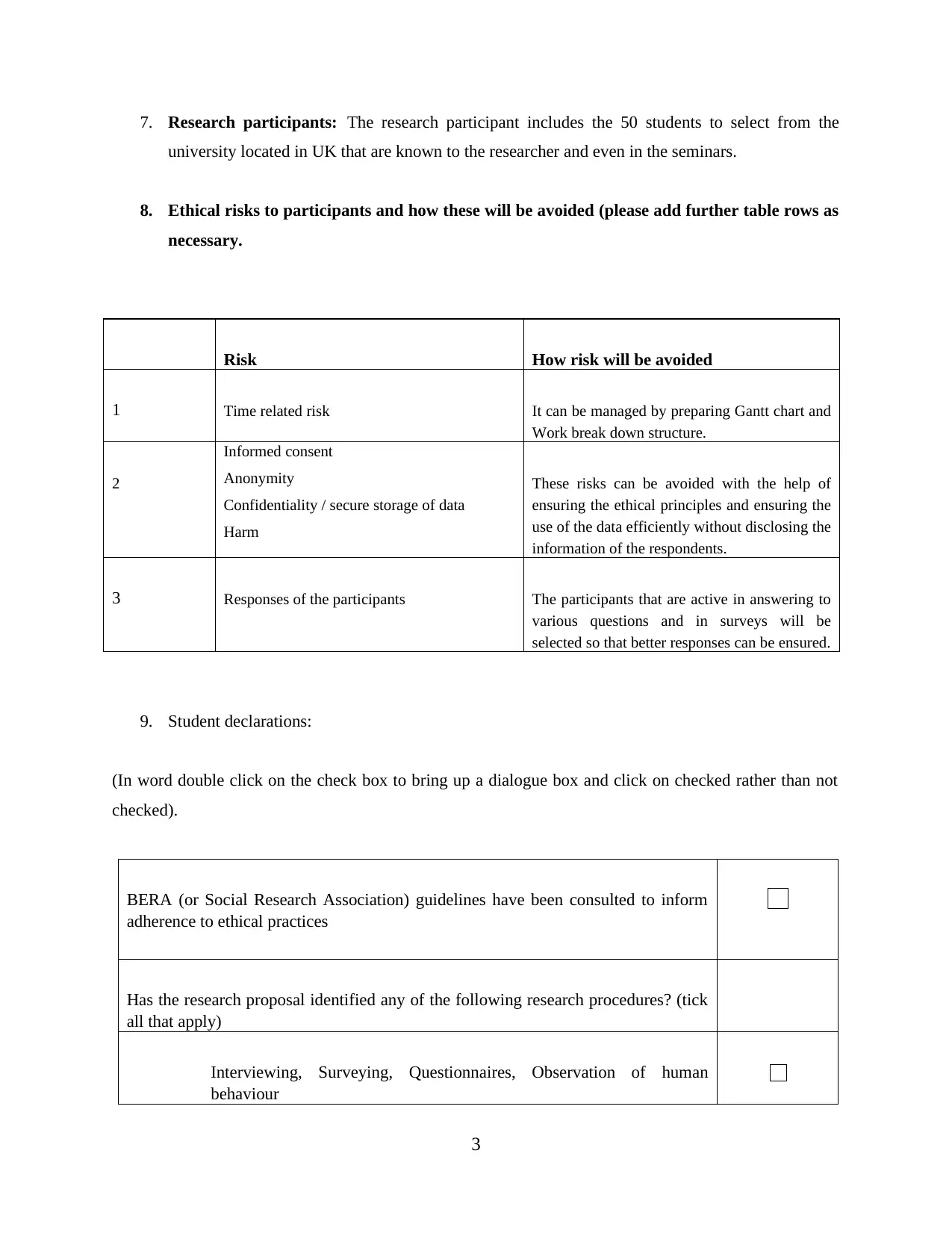
7. Research participants: The research participant includes the 50 students to select from the
university located in UK that are known to the researcher and even in the seminars.
8. Ethical risks to participants and how these will be avoided (please add further table rows as
necessary.
Risk How risk will be avoided
1 Time related risk It can be managed by preparing Gantt chart and
Work break down structure.
2
Informed consent
Anonymity
Confidentiality / secure storage of data
Harm
These risks can be avoided with the help of
ensuring the ethical principles and ensuring the
use of the data efficiently without disclosing the
information of the respondents.
3 Responses of the participants The participants that are active in answering to
various questions and in surveys will be
selected so that better responses can be ensured.
9. Student declarations:
(In word double click on the check box to bring up a dialogue box and click on checked rather than not
checked).
BERA (or Social Research Association) guidelines have been consulted to inform
adherence to ethical practices
Has the research proposal identified any of the following research procedures? (tick
all that apply)
Interviewing, Surveying, Questionnaires, Observation of human
behaviour
3
university located in UK that are known to the researcher and even in the seminars.
8. Ethical risks to participants and how these will be avoided (please add further table rows as
necessary.
Risk How risk will be avoided
1 Time related risk It can be managed by preparing Gantt chart and
Work break down structure.
2
Informed consent
Anonymity
Confidentiality / secure storage of data
Harm
These risks can be avoided with the help of
ensuring the ethical principles and ensuring the
use of the data efficiently without disclosing the
information of the respondents.
3 Responses of the participants The participants that are active in answering to
various questions and in surveys will be
selected so that better responses can be ensured.
9. Student declarations:
(In word double click on the check box to bring up a dialogue box and click on checked rather than not
checked).
BERA (or Social Research Association) guidelines have been consulted to inform
adherence to ethical practices
Has the research proposal identified any of the following research procedures? (tick
all that apply)
Interviewing, Surveying, Questionnaires, Observation of human
behaviour
3
Paraphrase This Document
Need a fresh take? Get an instant paraphrase of this document with our AI Paraphraser
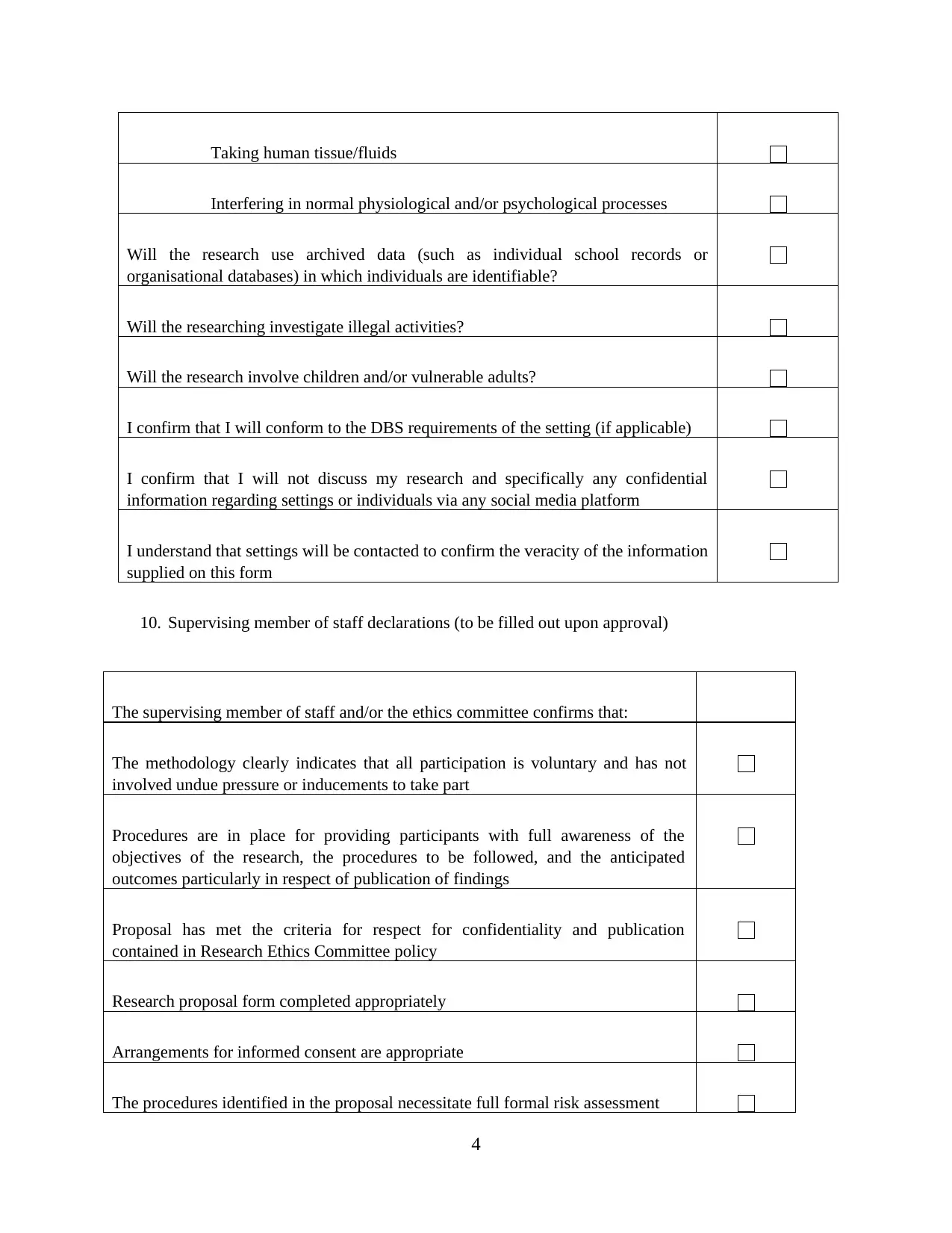
Taking human tissue/fluids
Interfering in normal physiological and/or psychological processes
Will the research use archived data (such as individual school records or
organisational databases) in which individuals are identifiable?
Will the researching investigate illegal activities?
Will the research involve children and/or vulnerable adults?
I confirm that I will conform to the DBS requirements of the setting (if applicable)
I confirm that I will not discuss my research and specifically any confidential
information regarding settings or individuals via any social media platform
I understand that settings will be contacted to confirm the veracity of the information
supplied on this form
10. Supervising member of staff declarations (to be filled out upon approval)
The supervising member of staff and/or the ethics committee confirms that:
The methodology clearly indicates that all participation is voluntary and has not
involved undue pressure or inducements to take part
Procedures are in place for providing participants with full awareness of the
objectives of the research, the procedures to be followed, and the anticipated
outcomes particularly in respect of publication of findings
Proposal has met the criteria for respect for confidentiality and publication
contained in Research Ethics Committee policy
Research proposal form completed appropriately
Arrangements for informed consent are appropriate
The procedures identified in the proposal necessitate full formal risk assessment
4
Interfering in normal physiological and/or psychological processes
Will the research use archived data (such as individual school records or
organisational databases) in which individuals are identifiable?
Will the researching investigate illegal activities?
Will the research involve children and/or vulnerable adults?
I confirm that I will conform to the DBS requirements of the setting (if applicable)
I confirm that I will not discuss my research and specifically any confidential
information regarding settings or individuals via any social media platform
I understand that settings will be contacted to confirm the veracity of the information
supplied on this form
10. Supervising member of staff declarations (to be filled out upon approval)
The supervising member of staff and/or the ethics committee confirms that:
The methodology clearly indicates that all participation is voluntary and has not
involved undue pressure or inducements to take part
Procedures are in place for providing participants with full awareness of the
objectives of the research, the procedures to be followed, and the anticipated
outcomes particularly in respect of publication of findings
Proposal has met the criteria for respect for confidentiality and publication
contained in Research Ethics Committee policy
Research proposal form completed appropriately
Arrangements for informed consent are appropriate
The procedures identified in the proposal necessitate full formal risk assessment
4

Please complete the final box ONLY if the condition above has been checked
Has the risk assessment been carried out?
Does this assessment fall within University limitations on research?
Please sign on behalf of the
portfolio/school/faculty/university panel to
confirm that ethical approval has been
granted for this research to be conducted
Name:
______________________________________
__________________________
Role:
______________________________________
________________________
Date:
______________________________________
_______________________
Signature:
11. Confirmation signatures (note that e-signatures are not permitted on hard copies)
Approved on behalf of the organisation
5
Has the risk assessment been carried out?
Does this assessment fall within University limitations on research?
Please sign on behalf of the
portfolio/school/faculty/university panel to
confirm that ethical approval has been
granted for this research to be conducted
Name:
______________________________________
__________________________
Role:
______________________________________
________________________
Date:
______________________________________
_______________________
Signature:
11. Confirmation signatures (note that e-signatures are not permitted on hard copies)
Approved on behalf of the organisation
5
⊘ This is a preview!⊘
Do you want full access?
Subscribe today to unlock all pages.
Trusted by 1+ million students worldwide

1 out of 13


Related Documents


Your All-in-One AI-Powered Toolkit for Academic Success.
+13062052269
info@desklib.com
Available 24*7 on WhatsApp / Email
![[object Object]](/_next/static/media/star-bottom.7253800d.svg)
Unlock your academic potential
Copyright © 2020–2026 A2Z Services. All Rights Reserved. Developed and managed by ZUCOL.