COMP640 Capstone Project: Technological Changes and Student Impact
VerifiedAdded on 2022/09/09
|42
|6227
|32
Capstone Project
AI Summary
This capstone project, completed for COMP640 at the University of the Potomac, investigates the profound impact of technological advancements on students. The project explores the pervasive influence of technology in modern education, examining its effects on learning outcomes, cognitive abilities, and student engagement. It delves into the evolution of technology, from early innovations like calculators to the rise of the internet, e-learning platforms, and artificial intelligence. The study poses critical research questions about the use of technology in education, its evolution over time, and its multifaceted effects on students. It also reviews the relevant literature, including the benefits and drawbacks of technology in education. The project aims to evaluate the changes in technology over the years and their effects on the lives of students, considering both the positive aspects, such as increased access to information and interactive learning, and the potential negative impacts, such as over-reliance and distraction. The project also explores the use of digital media, online learning, and the role of technology in shaping the future of education. The capstone concludes with findings, conclusions and a list of references.
Running head: TECHNOLOGICAL CHANGES AND THEIR EFFECTS ON STUDENT
University of the Potomac
TECHNOLOGICAL CHANGES AND THEIR EFFECTS ON STUDENT
by
Utsav Ban
Sachin Kumar
For
COMP640 – Forecasting and Management Technology - Capstone Project
Paul Jaikaran, Ed.D. Advisor
April 2020
University of the Potomac
TECHNOLOGICAL CHANGES AND THEIR EFFECTS ON STUDENT
by
Utsav Ban
Sachin Kumar
For
COMP640 – Forecasting and Management Technology - Capstone Project
Paul Jaikaran, Ed.D. Advisor
April 2020

Paraphrase This Document
Need a fresh take? Get an instant paraphrase of this document with our AI Paraphraser
TECHNOLOGICAL CHANGES AND THEIR EFFECTS ON STUDENTS
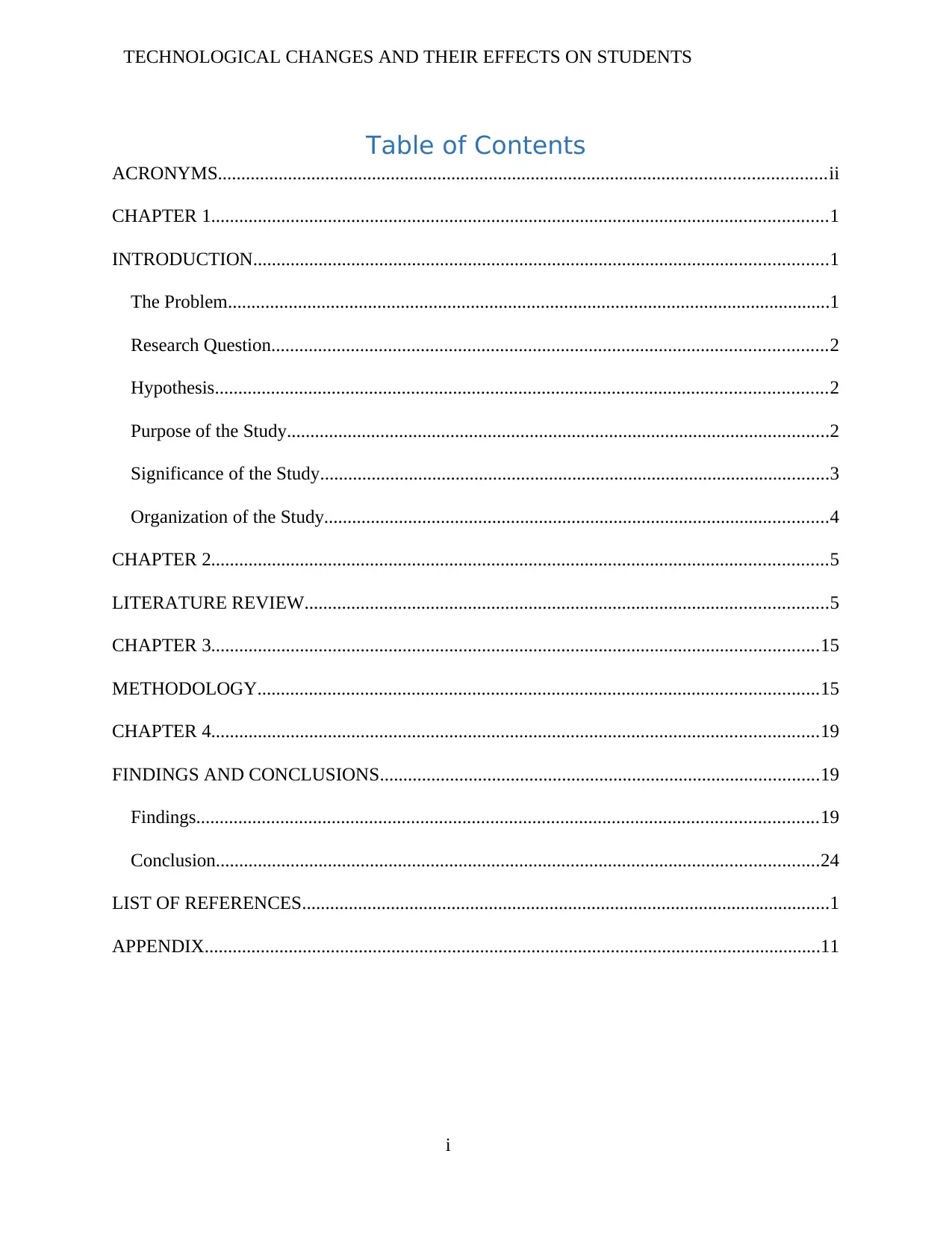
Table of Contents
ACRONYMS..................................................................................................................................ii
CHAPTER 1....................................................................................................................................1
INTRODUCTION...........................................................................................................................1
The Problem.................................................................................................................................1
Research Question.......................................................................................................................2
Hypothesis...................................................................................................................................2
Purpose of the Study....................................................................................................................2
Significance of the Study.............................................................................................................3
Organization of the Study............................................................................................................4
CHAPTER 2....................................................................................................................................5
LITERATURE REVIEW................................................................................................................5
CHAPTER 3..................................................................................................................................15
METHODOLOGY........................................................................................................................15
CHAPTER 4..................................................................................................................................19
FINDINGS AND CONCLUSIONS..............................................................................................19
Findings.....................................................................................................................................19
Conclusion.................................................................................................................................24
LIST OF REFERENCES.................................................................................................................1
APPENDIX....................................................................................................................................11
i
Table of Contents
ACRONYMS..................................................................................................................................ii
CHAPTER 1....................................................................................................................................1
INTRODUCTION...........................................................................................................................1
The Problem.................................................................................................................................1
Research Question.......................................................................................................................2
Hypothesis...................................................................................................................................2
Purpose of the Study....................................................................................................................2
Significance of the Study.............................................................................................................3
Organization of the Study............................................................................................................4
CHAPTER 2....................................................................................................................................5
LITERATURE REVIEW................................................................................................................5
CHAPTER 3..................................................................................................................................15
METHODOLOGY........................................................................................................................15
CHAPTER 4..................................................................................................................................19
FINDINGS AND CONCLUSIONS..............................................................................................19
Findings.....................................................................................................................................19
Conclusion.................................................................................................................................24
LIST OF REFERENCES.................................................................................................................1
APPENDIX....................................................................................................................................11
i
TECHNOLOGICAL CHANGES AND THEIR EFFECTS ON STUDENTS
ACRONYMS
Artificial Intelligence ----- (AI)
Electronic Learning ------- (e-learning)
Information and Communication Technology (ICT)
Experimental Group (EG)
ii
ACRONYMS
Artificial Intelligence ----- (AI)
Electronic Learning ------- (e-learning)
Information and Communication Technology (ICT)
Experimental Group (EG)
ii
⊘ This is a preview!⊘
Do you want full access?
Subscribe today to unlock all pages.

Trusted by 1+ million students worldwide
TECHNOLOGICAL CHANGES AND THEIR EFFECTS ON STUDENTS
CHAPTER 1
INTRODUCTION
The Problem
The problem today is the overuse of technology as a result of which, the dependency of
technology has increased several folds in human life. According to the opinion of Raja and
Nagasubramani (2017), technology is a technical means that is used by the people in order to
improve their surroundings and, thus, help them to do work. All over the world, the classroom
has implemented various kinds of technology that have been able to grasp the attention and
increase the achievement level. As per the opinion of Goldin and Katz (2018), the potential of a
small calculator had been able to enhance the learning ability of students in mathematics as well
as saved time. The gain in cognitive ability in term of number, conceptual development and
visualization was able to empower and encourage the students to engage in critical learning
problem and solved them that was previously denied to all. Therefore, the calculator is stated to
be an essential tool for students. However, overuse of the same device leads to reluctance among
the students, thus, leading to solving simple problems and reduced usage of cognitive ability
(Cascio & Narayan, 2017). This, in recent times, has been found to have a serious implication on
the brain functioning of the children and teenagers studying in schools and colleges. Therefore,
several postsecondary educators view it as a distraction that includes the use of mobile phones
and social media. Thus, it is vital to understand both sides in order to form an opinion of it. From
time and over, it can be seen that technological developments are taken place that has a profound
impact on the lives of the people. The initial invention of the telephone has been replaced with
smartphones that are more user-friendly and accessible in nature. In the education sector, the
1
CHAPTER 1
INTRODUCTION
The Problem
The problem today is the overuse of technology as a result of which, the dependency of
technology has increased several folds in human life. According to the opinion of Raja and
Nagasubramani (2017), technology is a technical means that is used by the people in order to
improve their surroundings and, thus, help them to do work. All over the world, the classroom
has implemented various kinds of technology that have been able to grasp the attention and
increase the achievement level. As per the opinion of Goldin and Katz (2018), the potential of a
small calculator had been able to enhance the learning ability of students in mathematics as well
as saved time. The gain in cognitive ability in term of number, conceptual development and
visualization was able to empower and encourage the students to engage in critical learning
problem and solved them that was previously denied to all. Therefore, the calculator is stated to
be an essential tool for students. However, overuse of the same device leads to reluctance among
the students, thus, leading to solving simple problems and reduced usage of cognitive ability
(Cascio & Narayan, 2017). This, in recent times, has been found to have a serious implication on
the brain functioning of the children and teenagers studying in schools and colleges. Therefore,
several postsecondary educators view it as a distraction that includes the use of mobile phones
and social media. Thus, it is vital to understand both sides in order to form an opinion of it. From
time and over, it can be seen that technological developments are taken place that has a profound
impact on the lives of the people. The initial invention of the telephone has been replaced with
smartphones that are more user-friendly and accessible in nature. In the education sector, the
1
Paraphrase This Document
Need a fresh take? Get an instant paraphrase of this document with our AI Paraphraser
TECHNOLOGICAL CHANGES AND THEIR EFFECTS ON STUDENTS
availability of information through internet platform has been increased, and the use of
technological applications such as Moodle, use of online learning and interaction session have
been promoted in order to increase the productivity of the student.
Research Question
The purpose of this research is to determine the change in technology and its effect on the
students. The research questions include:
What is the use of technology in the education system?
What are the changes that took place in technology over time?
How do technological changes affect students?
Hypothesis
The hypothesis of the study includes:
H0: There is no change in technology that affect students.
HI: There is a positive change in technology that affects the students.
Purpose of the Study
The modern era of humans is referred to as the era of technology. McNaughton and Billot (2016)
Again, no Reference for this citation opined that technology plays an essential role in each
individual’s life and is one of the most robust foundations in the growth of the economy. An
economy with an underdeveloped economy is never able to grow as technology aids in making
the work much easier, timesaving and can be done with less effort. Thus, the impact of
technology can be seen in every sphere of life, even in education. The use of modern
technological developments helps in increasing learning and interactivity. The use of the internet
has revolutionized the entire digital world as it helps in gaining more information. However, it
2
availability of information through internet platform has been increased, and the use of
technological applications such as Moodle, use of online learning and interaction session have
been promoted in order to increase the productivity of the student.
Research Question
The purpose of this research is to determine the change in technology and its effect on the
students. The research questions include:
What is the use of technology in the education system?
What are the changes that took place in technology over time?
How do technological changes affect students?
Hypothesis
The hypothesis of the study includes:
H0: There is no change in technology that affect students.
HI: There is a positive change in technology that affects the students.
Purpose of the Study
The modern era of humans is referred to as the era of technology. McNaughton and Billot (2016)
Again, no Reference for this citation opined that technology plays an essential role in each
individual’s life and is one of the most robust foundations in the growth of the economy. An
economy with an underdeveloped economy is never able to grow as technology aids in making
the work much easier, timesaving and can be done with less effort. Thus, the impact of
technology can be seen in every sphere of life, even in education. The use of modern
technological developments helps in increasing learning and interactivity. The use of the internet
has revolutionized the entire digital world as it helps in gaining more information. However, it
2
TECHNOLOGICAL CHANGES AND THEIR EFFECTS ON STUDENTS
can be seen that the positive aspects of technology can be overemphasized (Englund, Olofsson &
Price, 2017). Various aspects highlight the harmful effects of technology from physical to
psychological. In severe cases, there are reports of death due to the overuse of technology.
Therefore, the purpose of the study is to evaluate the change in technology that took place over
the years, and its effect on the lives of the students.
Significance of the Study
Technology is considered to be a gift of humankind and it has changed the way of living. It has
helped people in various ways as a result of which, people are in constant search of new and
innovative development (Hershbein & Kahn, 2018). From the time, since the first discovery of
technology is during the Stone Age and it had reached to genetic engineering and information
technology. The most affected sector of technology in education because it has given the
students the power to excel, support and transform students and to learn in a new dimension. It is
also considered to be a powerful tool for the teachers to create competent instructional material
that enables the pupils to learn and work in an integrated manner. The study will help in gaining
an in-depth exploration of the technological changes in the education system that helped the
students in innumerable ways.
The study will not only assess the technological aspects and its impact on the student, but it will
also try to evaluate the influence on education for assessing the importance of technology in this
sector. This will further enhance the ability of the student to effectively use advanced tools and
techniques that will further enhance the prospect of research and development. This, in turn, will
benefit the nation as a whole. The education technology includes hardware, software, and the
education theoretic that help in facilitating the learning process and enhancing the performance
with the aid of creating, utilizing as well as management of the processes and resources related to
3
can be seen that the positive aspects of technology can be overemphasized (Englund, Olofsson &
Price, 2017). Various aspects highlight the harmful effects of technology from physical to
psychological. In severe cases, there are reports of death due to the overuse of technology.
Therefore, the purpose of the study is to evaluate the change in technology that took place over
the years, and its effect on the lives of the students.
Significance of the Study
Technology is considered to be a gift of humankind and it has changed the way of living. It has
helped people in various ways as a result of which, people are in constant search of new and
innovative development (Hershbein & Kahn, 2018). From the time, since the first discovery of
technology is during the Stone Age and it had reached to genetic engineering and information
technology. The most affected sector of technology in education because it has given the
students the power to excel, support and transform students and to learn in a new dimension. It is
also considered to be a powerful tool for the teachers to create competent instructional material
that enables the pupils to learn and work in an integrated manner. The study will help in gaining
an in-depth exploration of the technological changes in the education system that helped the
students in innumerable ways.
The study will not only assess the technological aspects and its impact on the student, but it will
also try to evaluate the influence on education for assessing the importance of technology in this
sector. This will further enhance the ability of the student to effectively use advanced tools and
techniques that will further enhance the prospect of research and development. This, in turn, will
benefit the nation as a whole. The education technology includes hardware, software, and the
education theoretic that help in facilitating the learning process and enhancing the performance
with the aid of creating, utilizing as well as management of the processes and resources related to
3
⊘ This is a preview!⊘
Do you want full access?
Subscribe today to unlock all pages.
Trusted by 1+ million students worldwide
TECHNOLOGICAL CHANGES AND THEIR EFFECTS ON STUDENTS
technology (Tondeur et al., 2017). On having a closer look at the developing technology and its
role in the education field, it can be seen that it help in shaping the future of the education
system. With the influx of new learning processes and models, traditional models are evolving.
This created a philosophical shift of the teaching practices and remodeling of the classroom;
thus, increase the competent level of each of the students irrespective of the intelligence quotient
(IQ) level. The most prominent impact of technological change on the student is the
accommodating learning style of the student based on the individual needs; thus, personalizing
the education system. Therefore, it is important to gain knowledge about the changes in
processes and practices related to technology in order to acknowledge its implication of the
education system and particularly on the students.
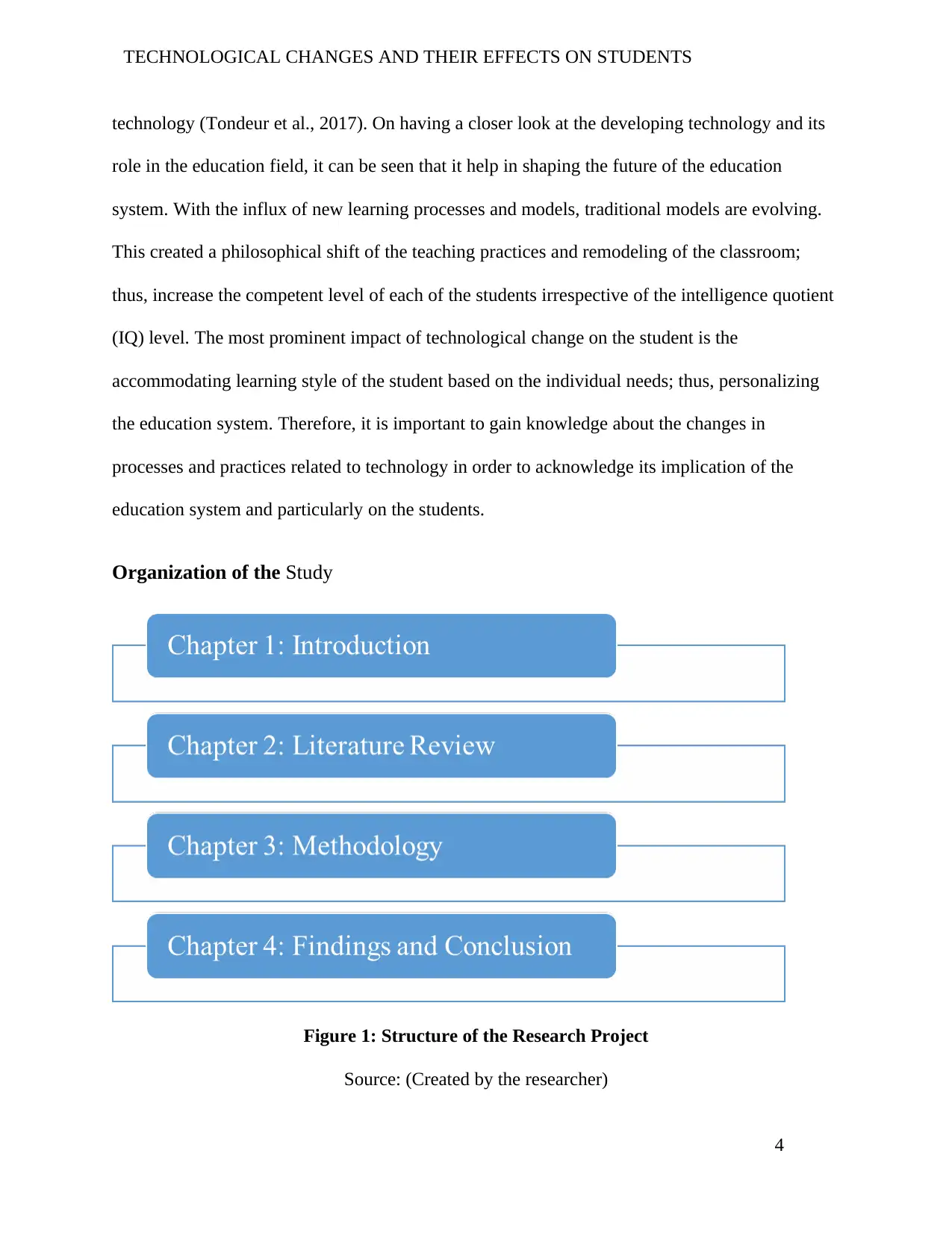
Organization of the Study
Figure 1: Structure of the Research Project
Source: (Created by the researcher)
4
technology (Tondeur et al., 2017). On having a closer look at the developing technology and its
role in the education field, it can be seen that it help in shaping the future of the education
system. With the influx of new learning processes and models, traditional models are evolving.
This created a philosophical shift of the teaching practices and remodeling of the classroom;
thus, increase the competent level of each of the students irrespective of the intelligence quotient
(IQ) level. The most prominent impact of technological change on the student is the
accommodating learning style of the student based on the individual needs; thus, personalizing
the education system. Therefore, it is important to gain knowledge about the changes in
processes and practices related to technology in order to acknowledge its implication of the
education system and particularly on the students.
Organization of the Study
Figure 1: Structure of the Research Project
Source: (Created by the researcher)
4
Paraphrase This Document
Need a fresh take? Get an instant paraphrase of this document with our AI Paraphraser
TECHNOLOGICAL CHANGES AND THEIR EFFECTS ON STUDENTS
CHAPTER 2
LITERATURE REVIEW
Technology is stated to be a boom in human life and it is the civilizations of science and arts. It
had changed the way of human lives in certain ways. It affects various facets of life and, thus,
redefines the way of living. On an undoubted note, technology is stated to play a role in each
sphere of life. It helps in automating several tasks that are conducted manually due to
technology. It is useful in carrying complex and critical processes that can be done with ease and
efficiency that revolutionized the sphere of education. As per the opinion of Bashir, Mahmood &
Shafique (2016), the application of technology has changed everything around and its
implication in the school setting cannot be ignored. The onset of computers in the educational
field made it easier for the teacher to render lesion and the students in acquiring it. According to
Godbole (2020), students in modern times prefer to use technology in their learning because they
have found it to be more productive and more comfortable than the traditional way of learning.
The use of modern equipment and techniques has increased the ability to interact and learn in a
collaborative manner. It opened an avenue of interesting facts to the students other than learning
their syllabus, making it more stimulating and thought to provoke in nature. This makes the
transfer of knowledge easier, convenient, and effective in nature. In another study, it was found
that the stimulating effect of the technology enables the brain to work much fasters help in
simultaneously working in various tasks at a time. On the other hand, Dufour et al. (2016) opined
that overdependence and reliance on the technological aspects of learning by the students are
unavoidable in schools, colleges, and universities. One of the most predominant technological
change is the development of the internet. As per the opinion of Nazim & Islam (2020), the use
5
CHAPTER 2
LITERATURE REVIEW
Technology is stated to be a boom in human life and it is the civilizations of science and arts. It
had changed the way of human lives in certain ways. It affects various facets of life and, thus,
redefines the way of living. On an undoubted note, technology is stated to play a role in each
sphere of life. It helps in automating several tasks that are conducted manually due to
technology. It is useful in carrying complex and critical processes that can be done with ease and
efficiency that revolutionized the sphere of education. As per the opinion of Bashir, Mahmood &
Shafique (2016), the application of technology has changed everything around and its
implication in the school setting cannot be ignored. The onset of computers in the educational
field made it easier for the teacher to render lesion and the students in acquiring it. According to
Godbole (2020), students in modern times prefer to use technology in their learning because they
have found it to be more productive and more comfortable than the traditional way of learning.
The use of modern equipment and techniques has increased the ability to interact and learn in a
collaborative manner. It opened an avenue of interesting facts to the students other than learning
their syllabus, making it more stimulating and thought to provoke in nature. This makes the
transfer of knowledge easier, convenient, and effective in nature. In another study, it was found
that the stimulating effect of the technology enables the brain to work much fasters help in
simultaneously working in various tasks at a time. On the other hand, Dufour et al. (2016) opined
that overdependence and reliance on the technological aspects of learning by the students are
unavoidable in schools, colleges, and universities. One of the most predominant technological
change is the development of the internet. As per the opinion of Nazim & Islam (2020), the use
5
TECHNOLOGICAL CHANGES AND THEIR EFFECTS ON STUDENTS
of the internet helps the student to access information at their own convenience and help in
gaining support in vast areas of education from video tutorials to online classes as well as
assisting material that can enhance the academic performance and improve the learning
experience. It is a well-known fact that the use of sensory organs to its maximum potential helps
to retain it from a longer period of time. The Internet not only aid in reading, visualizing, but it
also helps in hearing the facts; thus, increase the appeal in comparison to only words found in
books. The use of projectors and visual presentation support in learning based on technology. As
per the opinion of Tejumaiye, Simon and Obia (2018), top universities are using PowerPoint
presentations and projectors to make the learning interactive and interesting in nature. It helps in
elevating the interest level as well as improve the motivation level of the student. This appealing
aspect of technology is efficient in improving the grades and gaining more in-depth knowledge
on a particular subject. The use of digital media in education has now grown and resulted in
offering around the clock connectivity. Tong et al. (2019) stated that students could use different
platforms or forums that offer assignments or help to take guidance. With the power of digital
media has increased, more applications have been developed that assisted the student in learning
and growing in a simultaneous manner. According to Harris and Al-Bataineh (2015), an online
degree is stated to be a common phenomenon in today’s time. People can initiate online learning
and earn certificates through virtual classrooms and the learning process. The top institutes all
over the world are offering online programs that utilize applications and the internet to provide
knowledge. The concept is growing at a fast rate because of its increasing acceptance and
awareness among the students. Therefore, the scenario of an online degree is now becoming
more significant among the students who are working professionally and are in search of flexible
studying programs. As per the opinion of Mitchell, Wohleb and Skinner (2016), the role of
6
of the internet helps the student to access information at their own convenience and help in
gaining support in vast areas of education from video tutorials to online classes as well as
assisting material that can enhance the academic performance and improve the learning
experience. It is a well-known fact that the use of sensory organs to its maximum potential helps
to retain it from a longer period of time. The Internet not only aid in reading, visualizing, but it
also helps in hearing the facts; thus, increase the appeal in comparison to only words found in
books. The use of projectors and visual presentation support in learning based on technology. As
per the opinion of Tejumaiye, Simon and Obia (2018), top universities are using PowerPoint
presentations and projectors to make the learning interactive and interesting in nature. It helps in
elevating the interest level as well as improve the motivation level of the student. This appealing
aspect of technology is efficient in improving the grades and gaining more in-depth knowledge
on a particular subject. The use of digital media in education has now grown and resulted in
offering around the clock connectivity. Tong et al. (2019) stated that students could use different
platforms or forums that offer assignments or help to take guidance. With the power of digital
media has increased, more applications have been developed that assisted the student in learning
and growing in a simultaneous manner. According to Harris and Al-Bataineh (2015), an online
degree is stated to be a common phenomenon in today’s time. People can initiate online learning
and earn certificates through virtual classrooms and the learning process. The top institutes all
over the world are offering online programs that utilize applications and the internet to provide
knowledge. The concept is growing at a fast rate because of its increasing acceptance and
awareness among the students. Therefore, the scenario of an online degree is now becoming
more significant among the students who are working professionally and are in search of flexible
studying programs. As per the opinion of Mitchell, Wohleb and Skinner (2016), the role of
6
⊘ This is a preview!⊘
Do you want full access?
Subscribe today to unlock all pages.
Trusted by 1+ million students worldwide
TECHNOLOGICAL CHANGES AND THEIR EFFECTS ON STUDENTS
technology in the educational field is stated to be fourfold, it is integrated into all aspects such as
curriculum, instructional delivery system, and act as a support system for students, and it is a tool
that enhances the overall learning process. Due to the technological development of the years,
education has changed from passive to reactive form and from aggressive to interactive form.
According to Downes and Bishop (2015), education is an important aspect in both corporate and
academic settings. In the corporate sector, it is used for providing training to the employees that
enhance their knowledge. On the other hand, education is used to instill curiosity in the minds of
the student to learn more. Thus, in both cases, the use of technology allows the student to grasp
and effectively retain the concepts. Robinson (2016) opined in modern times, new technologies
such as machine learning, Artificial Intelligence (AI), and educational software are not only
changing the scenario for the student, but it is affecting the role of the educators as well. With the
availability of new and improved learning models, the traditional methods of learning have
started to evolve. Each student is unique and different in his or her own way; thus, it can be seen
that their IQ level is different, and they have a different learning process; some learn faster while
some learn slowly. In the traditional setting, the educator could not understand the need of each
student and the delivery of the lesson accordingly. However, the application of technology had
made it possible to accommodate the unique learning ability on a student-to-student basis
(Business Insider, 2020). This, in turn, uplifts the possibility of productivity of all students rather
than those having a higher IQ level. One of the best examples is technological development
called DreamBox, which is a math education software that is implemented in the number of
classrooms in the US. It has the ability to adapt to the skill level of a student and thus, allowing
him or her to learn at own pace that is best suited according to the need. One of the studies
conducted by Ghosh and Mukhopadhyay (2019) stated that adaptive learning software is a new
7
technology in the educational field is stated to be fourfold, it is integrated into all aspects such as
curriculum, instructional delivery system, and act as a support system for students, and it is a tool
that enhances the overall learning process. Due to the technological development of the years,
education has changed from passive to reactive form and from aggressive to interactive form.
According to Downes and Bishop (2015), education is an important aspect in both corporate and
academic settings. In the corporate sector, it is used for providing training to the employees that
enhance their knowledge. On the other hand, education is used to instill curiosity in the minds of
the student to learn more. Thus, in both cases, the use of technology allows the student to grasp
and effectively retain the concepts. Robinson (2016) opined in modern times, new technologies
such as machine learning, Artificial Intelligence (AI), and educational software are not only
changing the scenario for the student, but it is affecting the role of the educators as well. With the
availability of new and improved learning models, the traditional methods of learning have
started to evolve. Each student is unique and different in his or her own way; thus, it can be seen
that their IQ level is different, and they have a different learning process; some learn faster while
some learn slowly. In the traditional setting, the educator could not understand the need of each
student and the delivery of the lesson accordingly. However, the application of technology had
made it possible to accommodate the unique learning ability on a student-to-student basis
(Business Insider, 2020). This, in turn, uplifts the possibility of productivity of all students rather
than those having a higher IQ level. One of the best examples is technological development
called DreamBox, which is a math education software that is implemented in the number of
classrooms in the US. It has the ability to adapt to the skill level of a student and thus, allowing
him or her to learn at own pace that is best suited according to the need. One of the studies
conducted by Ghosh and Mukhopadhyay (2019) stated that adaptive learning software is a new
7
Paraphrase This Document
Need a fresh take? Get an instant paraphrase of this document with our AI Paraphraser
TECHNOLOGICAL CHANGES AND THEIR EFFECTS ON STUDENTS
technology that is quickly replacing the need for a textbook in the classroom settings. Thus, the
students are able to tackle each subject with the support of the tailor-made program that assists
them to solve their queries and help them to learn and retain them. With the aid of technology,
things are much easier, such as search a query in Google or solve a math problem using a
calculator as well as it helps the educators to determine the knowledge requirement of the pupils
thus, allowing them to thrive in a technology-saturated workforce. The education model of the
past was more focused on offering the students the required skills in order to make them skilled
workers; in today’s time, the educators are more focused on making the student learn in their
own way. According to Goos et al. (2019), the real meaning of education is to empower the
information in the brain and thus, enabling the students to think, learn and critically evaluate the
situation rather than getting high grades.
Education has evolved over time, especially in the last few decades. Previously, a single
classroom includes chairs, benches and desk are now stated to be traditional and in some year
will be a tourist attraction. Jain and Bhatia (2018) stated that today’s class involve a computer
lab or students with laptops who are listening to a podcast or taking video lecture. The
technological changes in the education industry have given a new way of learning and teaching.
The teachers are adopting the new instructional methodologies and the students are eager to
embrace the new style of learning. The technological developments are allowing the teacher to
gain more access to varied information on a global scale through the internet that helps in
manipulating and making the lesson more engaging in nature. In the same way, the student the
resources from the internet to enhance and improve their learning experience. Earlier, the use of
technology such as projector and overhead had been used that is now replaced with power points
and streaming video that can be used by a large number of students at one time in a classroom
8
technology that is quickly replacing the need for a textbook in the classroom settings. Thus, the
students are able to tackle each subject with the support of the tailor-made program that assists
them to solve their queries and help them to learn and retain them. With the aid of technology,
things are much easier, such as search a query in Google or solve a math problem using a
calculator as well as it helps the educators to determine the knowledge requirement of the pupils
thus, allowing them to thrive in a technology-saturated workforce. The education model of the
past was more focused on offering the students the required skills in order to make them skilled
workers; in today’s time, the educators are more focused on making the student learn in their
own way. According to Goos et al. (2019), the real meaning of education is to empower the
information in the brain and thus, enabling the students to think, learn and critically evaluate the
situation rather than getting high grades.
Education has evolved over time, especially in the last few decades. Previously, a single
classroom includes chairs, benches and desk are now stated to be traditional and in some year
will be a tourist attraction. Jain and Bhatia (2018) stated that today’s class involve a computer
lab or students with laptops who are listening to a podcast or taking video lecture. The
technological changes in the education industry have given a new way of learning and teaching.
The teachers are adopting the new instructional methodologies and the students are eager to
embrace the new style of learning. The technological developments are allowing the teacher to
gain more access to varied information on a global scale through the internet that helps in
manipulating and making the lesson more engaging in nature. In the same way, the student the
resources from the internet to enhance and improve their learning experience. Earlier, the use of
technology such as projector and overhead had been used that is now replaced with power points
and streaming video that can be used by a large number of students at one time in a classroom
8
TECHNOLOGICAL CHANGES AND THEIR EFFECTS ON STUDENTS
and in an ample space such as an auditorium. Thus, from audio to video technology, the use of
podcasts, e-learning facilities, and interactive tutorial and real-time online lectures, education
technology has evolved. According to the opinion of Petko, Prasse and Cantieni (2018),
education technology is defined as the usage of various kinds of technology that help ad improve
the process of learning. In another term, it includes instructional technology and e-learning
facilities. In a more accurate sense, the definition of educational technology is stated to be a
technological change that has an immense impact on the education and learning process with
respect to the way of delivering the lesson, enabling a two-way communication process and
offering assessment and feedback to the individual student. The reform in the education system
took place during the 1980s and 1990s that is responsible for playing the role of initiating the
need and, finally, implementation of the education technology in this field. It can be observed
that many schools all over the world in the school restructuring initiatives have incorporated the
changes in technology to be the focal point in the industry (Zinger, Tate & Warschauer, 2017).
The effort at that time has opened new doors and opportunities for the advancement of
educational technology at the end of the 20th century. As a result of this, computers, assistive
technology, education software, virtual classrooms, and other development are now
commonplace in the began of the 21st century.
The most common technology that can be seen in most of the classrooms from grades k to 12
and in colleges and universities is a computer or a laptop. The initiatives from the national, state
and local level were given that sponsored and funded and were the driving force to install a
computer and laptop for each student in classes. With time, the laptops became affordable,
compact and thus, increased in popularity that replaced the use of larger and stationary desktop
from the platforms. With the outrageous use of computers and laptops, it created a need in the
9
and in an ample space such as an auditorium. Thus, from audio to video technology, the use of
podcasts, e-learning facilities, and interactive tutorial and real-time online lectures, education
technology has evolved. According to the opinion of Petko, Prasse and Cantieni (2018),
education technology is defined as the usage of various kinds of technology that help ad improve
the process of learning. In another term, it includes instructional technology and e-learning
facilities. In a more accurate sense, the definition of educational technology is stated to be a
technological change that has an immense impact on the education and learning process with
respect to the way of delivering the lesson, enabling a two-way communication process and
offering assessment and feedback to the individual student. The reform in the education system
took place during the 1980s and 1990s that is responsible for playing the role of initiating the
need and, finally, implementation of the education technology in this field. It can be observed
that many schools all over the world in the school restructuring initiatives have incorporated the
changes in technology to be the focal point in the industry (Zinger, Tate & Warschauer, 2017).
The effort at that time has opened new doors and opportunities for the advancement of
educational technology at the end of the 20th century. As a result of this, computers, assistive
technology, education software, virtual classrooms, and other development are now
commonplace in the began of the 21st century.
The most common technology that can be seen in most of the classrooms from grades k to 12
and in colleges and universities is a computer or a laptop. The initiatives from the national, state
and local level were given that sponsored and funded and were the driving force to install a
computer and laptop for each student in classes. With time, the laptops became affordable,
compact and thus, increased in popularity that replaced the use of larger and stationary desktop
from the platforms. With the outrageous use of computers and laptops, it created a need in the
9
⊘ This is a preview!⊘
Do you want full access?
Subscribe today to unlock all pages.
Trusted by 1+ million students worldwide

1 out of 42


Related Documents


Your All-in-One AI-Powered Toolkit for Academic Success.
+13062052269
info@desklib.com
Available 24*7 on WhatsApp / Email
![[object Object]](/_next/static/media/star-bottom.7253800d.svg)
Unlock your academic potential
Copyright © 2020–2026 A2Z Services. All Rights Reserved. Developed and managed by ZUCOL.