Essay: Teen Brain Development and Transition - Psychology

Verified

Added on  2023/01/18

|7
|1964
|74
Essay
AI Summary
This essay delves into the multifaceted topic of teen brain development and the transition to adulthood, analyzing it through the lenses of bio-developmental perspectives and the history of childhood. The paper is structured into four key parts: identifying relevant theories, exploring bio-developmental perspectives, discussing socio-historical perspectives, and examining the utility of youth theories. The essay examines theories such as the "teen brain theory" and "deviance theories," highlighting the role of the prefrontal cortex, changes in brain matter, and the influence of dopamine. It also explores the socio-historical context of youth development and the application of deviance theories, including differential association, anomie, and control theories. The essay emphasizes the importance of these theories in understanding adolescent behavior, memory development, reasoning, and cognition, while also acknowledging the limitations of these theories in providing a complete understanding of the transition from childhood to adulthood.
Document Page
Running head: TEEN BRAIN DEVELOPMENT AND TRANSITION
Teen brain development and transition
Name of the student
Name of the university
Author note
tabler-icon-diamond-filled.svg

Paraphrase This Document

Need a fresh take? Get an instant paraphrase of this document with our AI Paraphraser
Document Page
1TEEN BRAIN DEVELOPMENT AND TRANSITION
Introduction
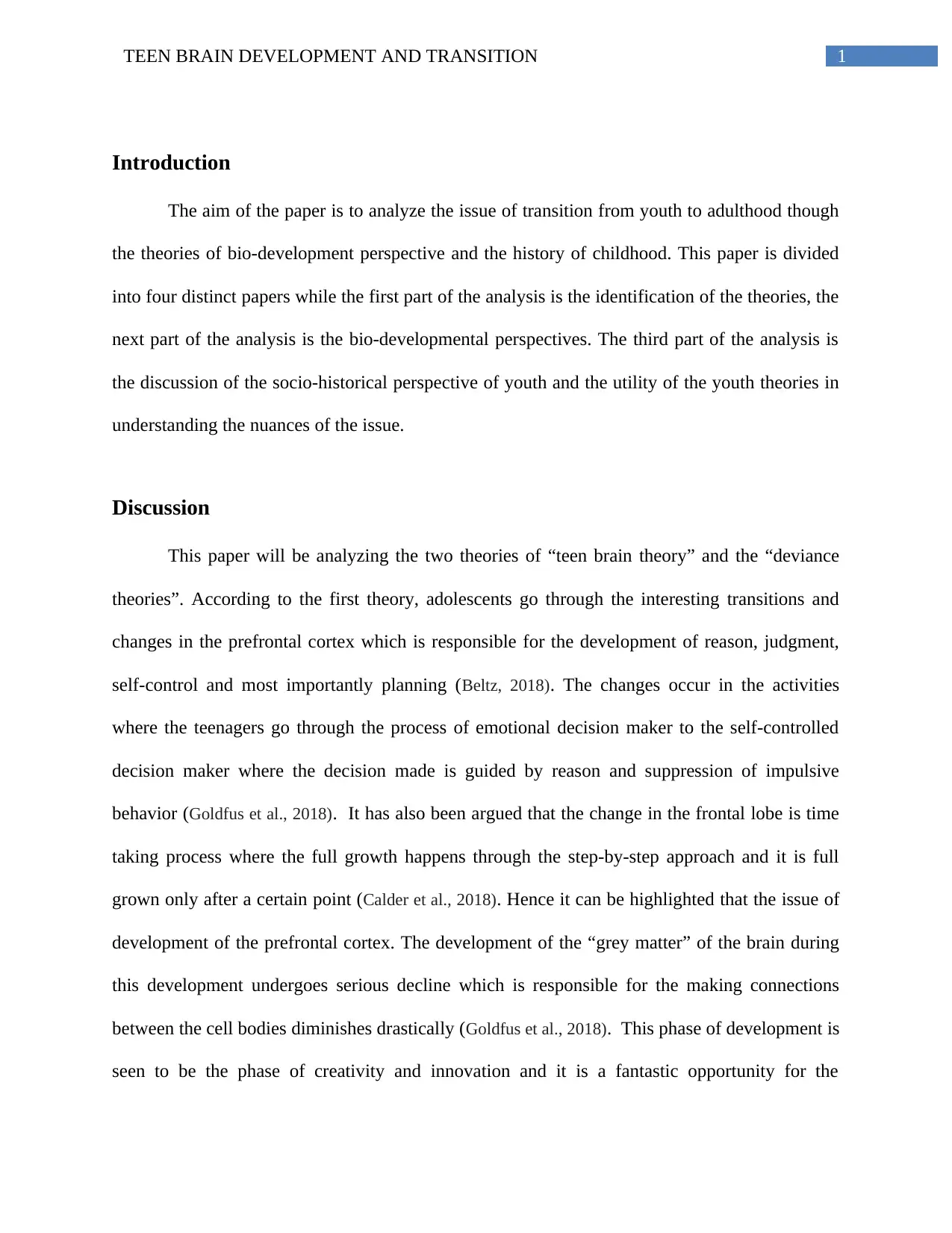
The aim of the paper is to analyze the issue of transition from youth to adulthood though
the theories of bio-development perspective and the history of childhood. This paper is divided
into four distinct papers while the first part of the analysis is the identification of the theories, the
next part of the analysis is the bio-developmental perspectives. The third part of the analysis is
the discussion of the socio-historical perspective of youth and the utility of the youth theories in
understanding the nuances of the issue.
Discussion
This paper will be analyzing the two theories of “teen brain theory” and the “deviance
theories”. According to the first theory, adolescents go through the interesting transitions and
changes in the prefrontal cortex which is responsible for the development of reason, judgment,
self-control and most importantly planning (Beltz, 2018). The changes occur in the activities
where the teenagers go through the process of emotional decision maker to the self-controlled
decision maker where the decision made is guided by reason and suppression of impulsive
behavior (Goldfus et al., 2018). It has also been argued that the change in the frontal lobe is time
taking process where the full growth happens through the step-by-step approach and it is full
grown only after a certain point (Calder et al., 2018). Hence it can be highlighted that the issue of
development of the prefrontal cortex. The development of the “grey matter” of the brain during
this development undergoes serious decline which is responsible for the making connections
between the cell bodies diminishes drastically (Goldfus et al., 2018). This phase of development is
seen to be the phase of creativity and innovation and it is a fantastic opportunity for the
Document Page
2TEEN BRAIN DEVELOPMENT AND TRANSITION
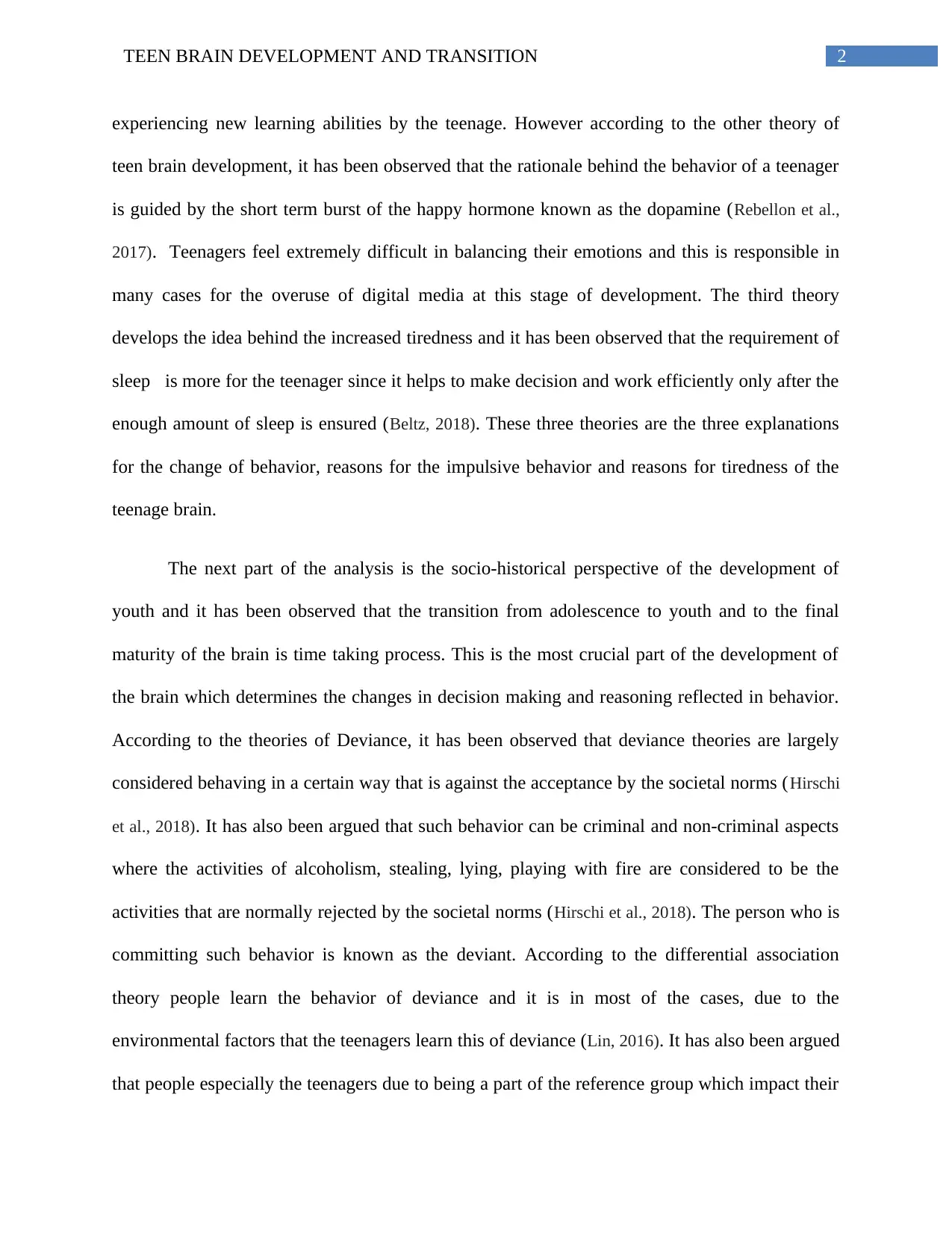
experiencing new learning abilities by the teenage. However according to the other theory of
teen brain development, it has been observed that the rationale behind the behavior of a teenager
is guided by the short term burst of the happy hormone known as the dopamine (Rebellon et al.,
2017). Teenagers feel extremely difficult in balancing their emotions and this is responsible in
many cases for the overuse of digital media at this stage of development. The third theory
develops the idea behind the increased tiredness and it has been observed that the requirement of
sleep is more for the teenager since it helps to make decision and work efficiently only after the
enough amount of sleep is ensured (Beltz, 2018). These three theories are the three explanations
for the change of behavior, reasons for the impulsive behavior and reasons for tiredness of the
teenage brain.
The next part of the analysis is the socio-historical perspective of the development of
youth and it has been observed that the transition from adolescence to youth and to the final
maturity of the brain is time taking process. This is the most crucial part of the development of
the brain which determines the changes in decision making and reasoning reflected in behavior.
According to the theories of Deviance, it has been observed that deviance theories are largely
considered behaving in a certain way that is against the acceptance by the societal norms (Hirschi
et al., 2018). It has also been argued that such behavior can be criminal and non-criminal aspects
where the activities of alcoholism, stealing, lying, playing with fire are considered to be the
activities that are normally rejected by the societal norms (Hirschi et al., 2018). The person who is
committing such behavior is known as the deviant. According to the differential association
theory people learn the behavior of deviance and it is in most of the cases, due to the
environmental factors that the teenagers learn this of deviance (Lin, 2016). It has also been argued
that people especially the teenagers due to being a part of the reference group which impact their
Document Page
3TEEN BRAIN DEVELOPMENT AND TRANSITION
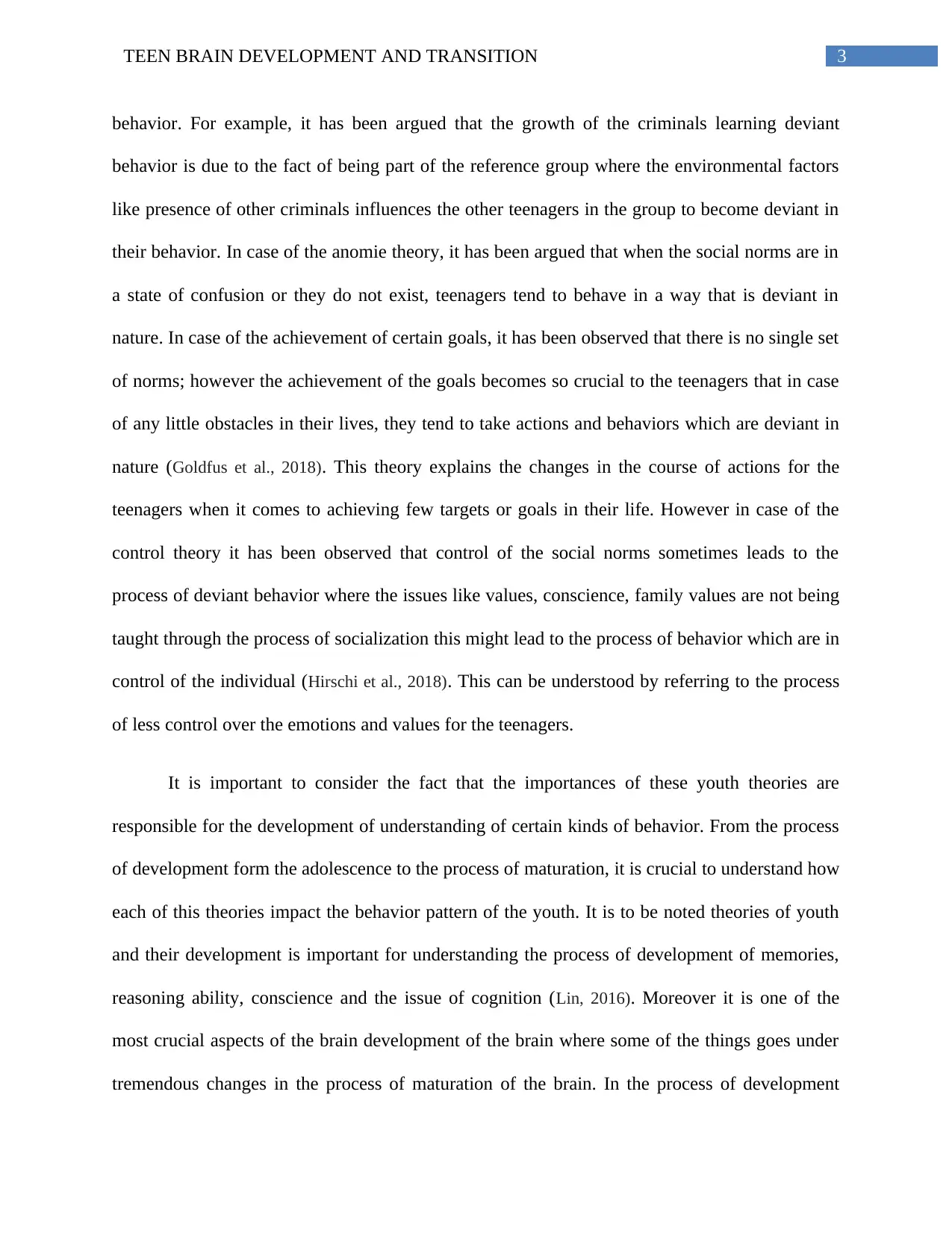
behavior. For example, it has been argued that the growth of the criminals learning deviant
behavior is due to the fact of being part of the reference group where the environmental factors
like presence of other criminals influences the other teenagers in the group to become deviant in
their behavior. In case of the anomie theory, it has been argued that when the social norms are in
a state of confusion or they do not exist, teenagers tend to behave in a way that is deviant in
nature. In case of the achievement of certain goals, it has been observed that there is no single set
of norms; however the achievement of the goals becomes so crucial to the teenagers that in case
of any little obstacles in their lives, they tend to take actions and behaviors which are deviant in
nature (Goldfus et al., 2018). This theory explains the changes in the course of actions for the
teenagers when it comes to achieving few targets or goals in their life. However in case of the
control theory it has been observed that control of the social norms sometimes leads to the
process of deviant behavior where the issues like values, conscience, family values are not being
taught through the process of socialization this might lead to the process of behavior which are in
control of the individual (Hirschi et al., 2018). This can be understood by referring to the process
of less control over the emotions and values for the teenagers.
It is important to consider the fact that the importances of these youth theories are
responsible for the development of understanding of certain kinds of behavior. From the process
of development form the adolescence to the process of maturation, it is crucial to understand how
each of this theories impact the behavior pattern of the youth. It is to be noted theories of youth
and their development is important for understanding the process of development of memories,
reasoning ability, conscience and the issue of cognition (Lin, 2016). Moreover it is one of the
most crucial aspects of the brain development of the brain where some of the things goes under
tremendous changes in the process of maturation of the brain. In the process of development
tabler-icon-diamond-filled.svg

Paraphrase This Document

Need a fresh take? Get an instant paraphrase of this document with our AI Paraphraser
Document Page
4TEEN BRAIN DEVELOPMENT AND TRANSITION
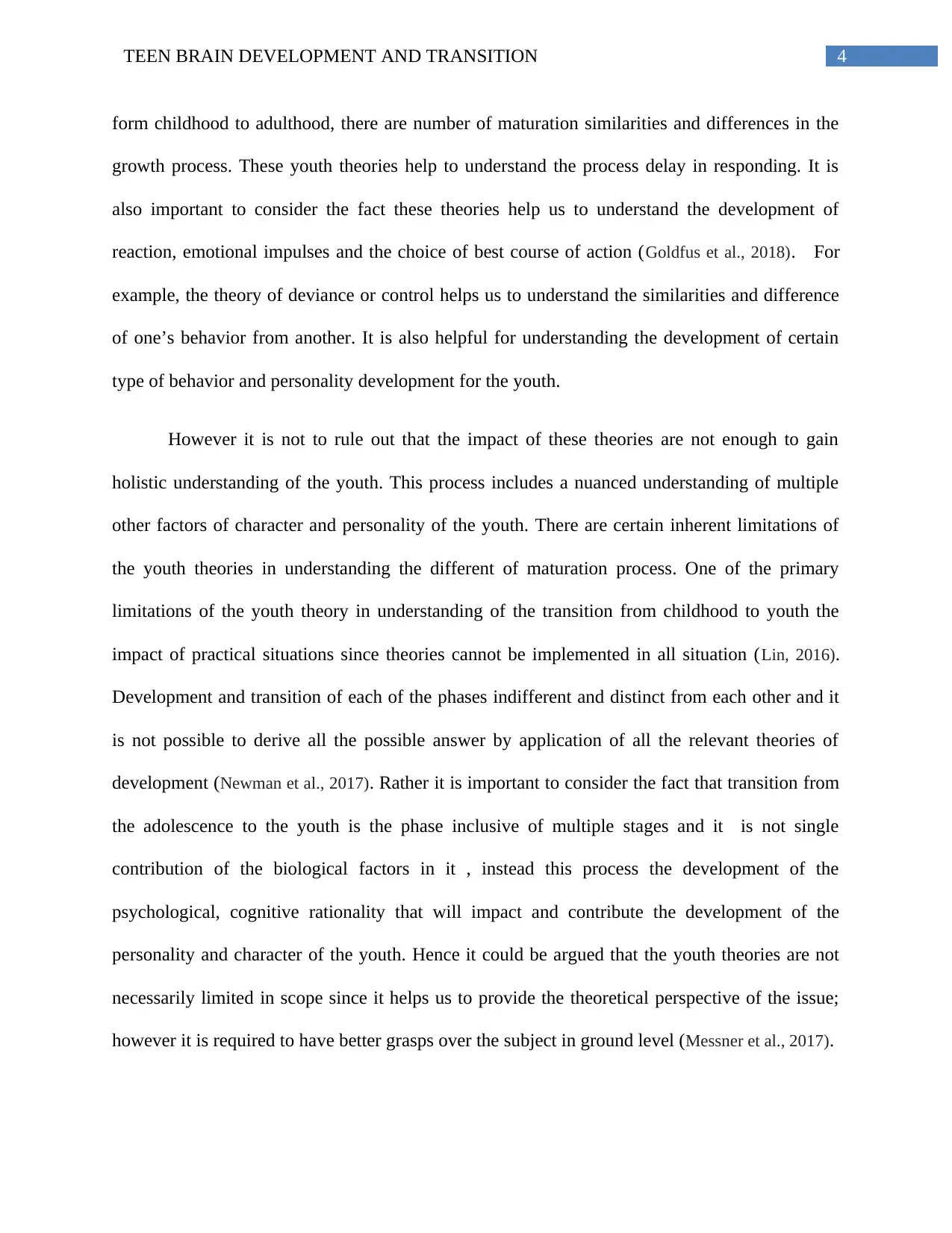
form childhood to adulthood, there are number of maturation similarities and differences in the
growth process. These youth theories help to understand the process delay in responding. It is
also important to consider the fact these theories help us to understand the development of
reaction, emotional impulses and the choice of best course of action (Goldfus et al., 2018). For
example, the theory of deviance or control helps us to understand the similarities and difference
of one’s behavior from another. It is also helpful for understanding the development of certain
type of behavior and personality development for the youth.
However it is not to rule out that the impact of these theories are not enough to gain
holistic understanding of the youth. This process includes a nuanced understanding of multiple
other factors of character and personality of the youth. There are certain inherent limitations of
the youth theories in understanding the different of maturation process. One of the primary
limitations of the youth theory in understanding of the transition from childhood to youth the
impact of practical situations since theories cannot be implemented in all situation (Lin, 2016).
Development and transition of each of the phases indifferent and distinct from each other and it
is not possible to derive all the possible answer by application of all the relevant theories of
development (Newman et al., 2017). Rather it is important to consider the fact that transition from
the adolescence to the youth is the phase inclusive of multiple stages and it is not single
contribution of the biological factors in it , instead this process the development of the
psychological, cognitive rationality that will impact and contribute the development of the
personality and character of the youth. Hence it could be argued that the youth theories are not
necessarily limited in scope since it helps us to provide the theoretical perspective of the issue;
however it is required to have better grasps over the subject in ground level (Messner et al., 2017).
Document Page
5TEEN BRAIN DEVELOPMENT AND TRANSITION
Conclusion
This paper made analysis of the issues of bio-development and transition childhood to
adulthood. However it has been observed that transition from one phase to another is the process
of different nuances of the same. This transition is not about the bio-development growth of the
body instead it is the development of cognitive and non-cognitive aspects. This is the holistic
approach where understanding of each of the factor is crucial to the development of teenagers.
This approach discusses the probable approaches of different phases of life where the
development of one or the other faculty is more centered on the development of the brain. Thus it
can be concluded that the development of brain is more complicated than it appears since the
development taken place in a step-by-step and systematic manner.
Document Page
6TEEN BRAIN DEVELOPMENT AND TRANSITION
References
Beltz, A. M. (2018). Connecting theory and methods in adolescent brain research. Journal of Research on
Adolescence, 28(1), 10-25.
Calder, G., De Wispelaere, J., & Gheaus, A. (2018). The science of the adolescent brain and its cultural
implica
Goldfus, C., & Karny-Tagger, A. (2017). Changing Perceptions About Changes in the Teen Brain: An
Overview. LEARNing Landscapes, 10(2), 173-187.
Goode, E. (Ed.). (2015). The handbook of deviance. John Wiley & Sons.
Hirschi, T., & Gottfredson, M. R. (2018). The generality of deviance. In The generality of deviance (pp.
1-22). Routledge.
Lin, P. (2016). Risky behaviors: Integrating adolescent egocentrism with the theory of planned
behavior. Review of General Psychology, 20(4), 392-398.tions. In The Routledge Handbook of the
Philosophy of Childhood and Children (pp. 49-60). Routledge.
Messner, S. F., & Rosenfeld, R. (2017). The present and future of institutional-anomie theory. In Taking
Stock (pp. 127-148). Routledge.
Newman, G. R., & Wolfgang, M. E. (2017). Comparative deviance: Perception and law in six cultures.
Routledge.
Rebellon, C. J., & Anskat, P. (2017). Crime, Deviance, and Social Control: Travis Hirschi and His
Legacy. The Handbook of the History and Philosophy of Criminology, 189-205.
chevron_up_icon
1 out of 7
circle_padding
hide_on_mobile
zoom_out_icon
[object Object]