Telecommunication Assignment: Network Protocols and Data Transmission

Verified

Added on  2021/04/22

|7
|657
|72
Homework Assignment
AI Summary
This telecommunication assignment solution addresses key concepts in data transmission and network protocols. It begins by analyzing AMI coding and its drawbacks, then presents the HDB3 encoding scheme as a solution. The assignment explores constellation diagrams produced by a v.32bis modulator, including the 64 PSK modulation technique, and calculates the bits per signal and data rate. Further, the solution calculates the rate of characters per second for data transmission. The assignment also analyzes satellite channel characteristics, including propagation delay, data frame size, and window size, to determine maximum link utilization and required frame size. The document concludes with a bibliography of relevant research papers and patents related to data link control protocols and object detection techniques.
Document Page
Running head: TELECOMMUINICATION
Telecommunication
Name of the Student:
Name of the University:
Author Note
tabler-icon-diamond-filled.svg

Paraphrase This Document

Need a fresh take? Get an instant paraphrase of this document with our AI Paraphraser
Document Page
1
TELECOMMUINICATION
Answer to question number 2
a)
iii)
AMI coding is used for the first generation networks of PCM, and the major drawback of
that the AMI coding holds is that the long run of 0’s provides no transition in the data stream. It
does not contain enough transitions so that a lock of DPLL can be guaranteed. The user has to
rely on the long run of 0’s that has to be sent for a successful transmission. Hence, the encoding
is not transparent for the sequence of bits that are being sent.
Hence the HDB3 encoding scheme is being used for the solution to this problem. It has
been developed irrespective of the pattern of data that is being carried. The pattern of bits " 1 0 0
0 0 1 1 0 " encodes to " + 0 0 0 0 - + " in AMI encoding. Whereas, in HDB3 is converted into “+
0 0 0 + - +”.
b)
i)
The constellation diagram has been produced by a v.32bis modulator. 64 PSK modulation
technique is being used. This is a 64 point constellation used in the v.32bis modulator. With the
2400 baud.
ii)
2^N bits can be represented.
Document Page
2
TELECOMMUINICATION
Hence 2^N = 64. Therefore N = 6. Hence, 6 bits can be represented in a single signal in this
technique.
iii)
In 2400 bauds the modem will achieve 2400x6 = 14400 bits per second
Answer to question number 3
b)
i)
The number of characters: 200
Total number of bits for a character = 1+7+2+1 = 11 bits
Total bits = 200 x 11 bits = 2200 bits
Communication line = 20 x 1024 bits = 20480
Therefore the rate is 22000/20480 = 1.07421875charcter/sec
ii)
Total bits = 100 x 48 bits = 4800
Therefore number characters that can pass through the network at that time = 20480/4800 = 4.27
Answer to question number 4
a)
Satellite channel = 3mbps
Propagation delay = 270mS
Document Page
3
TELECOMMUINICATION
Number of bytes in each data frame = 1000 bytes
i) Window size = 2^7 = 128
ii) T1 = 128 * 1000b/3Mbps = 42.666ms
T2 = 42.666ms + 270ms + 0.0023333333333333335ms + 270ms = 540.33ms
Maximum Link Utilization = 42.666ms/540.33ms = 7.8963%
iii) a = 270/ 42.666 = 6.33
Therefore when the efficiency is 100%
W = 1 + 2a
Or, 2^N = 1 + 2a
Or, 2^N = 1 + 6.33
Or, 2^N = 7.33
Or, 2^N = 8 approx
Or N = 3,
Hence the required frame size is 3.
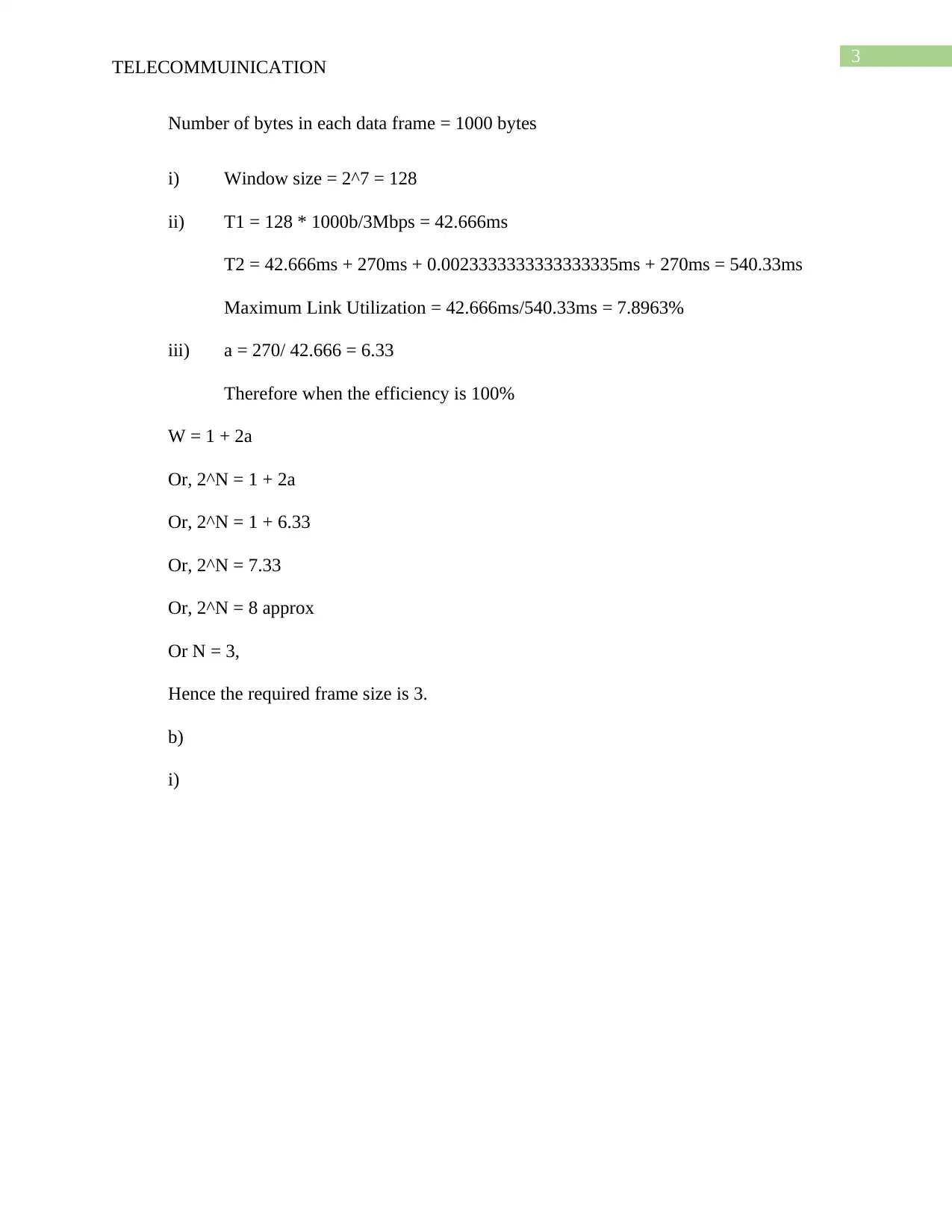
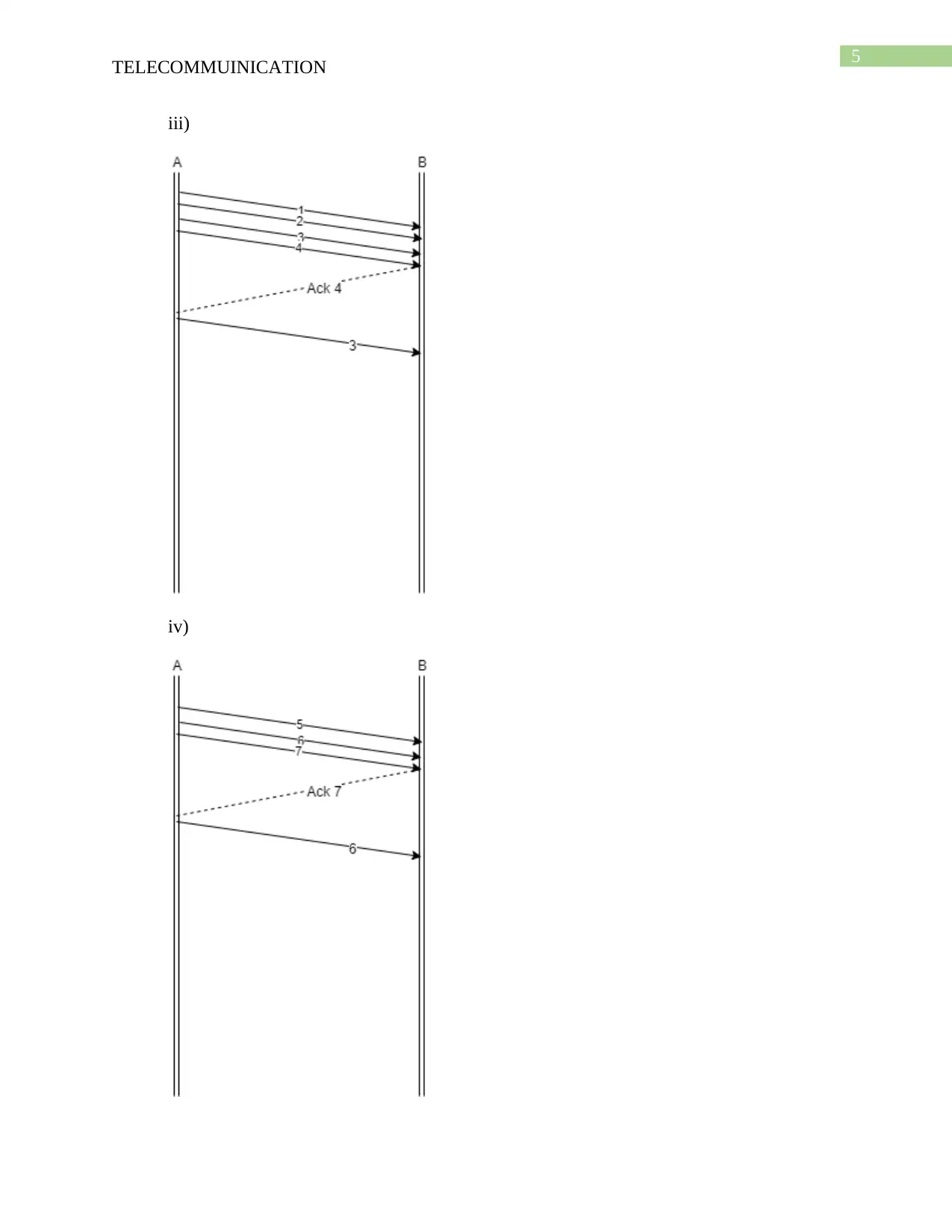
b)
i)
tabler-icon-diamond-filled.svg

Paraphrase This Document

Need a fresh take? Get an instant paraphrase of this document with our AI Paraphraser
Document Page
4
TELECOMMUINICATION
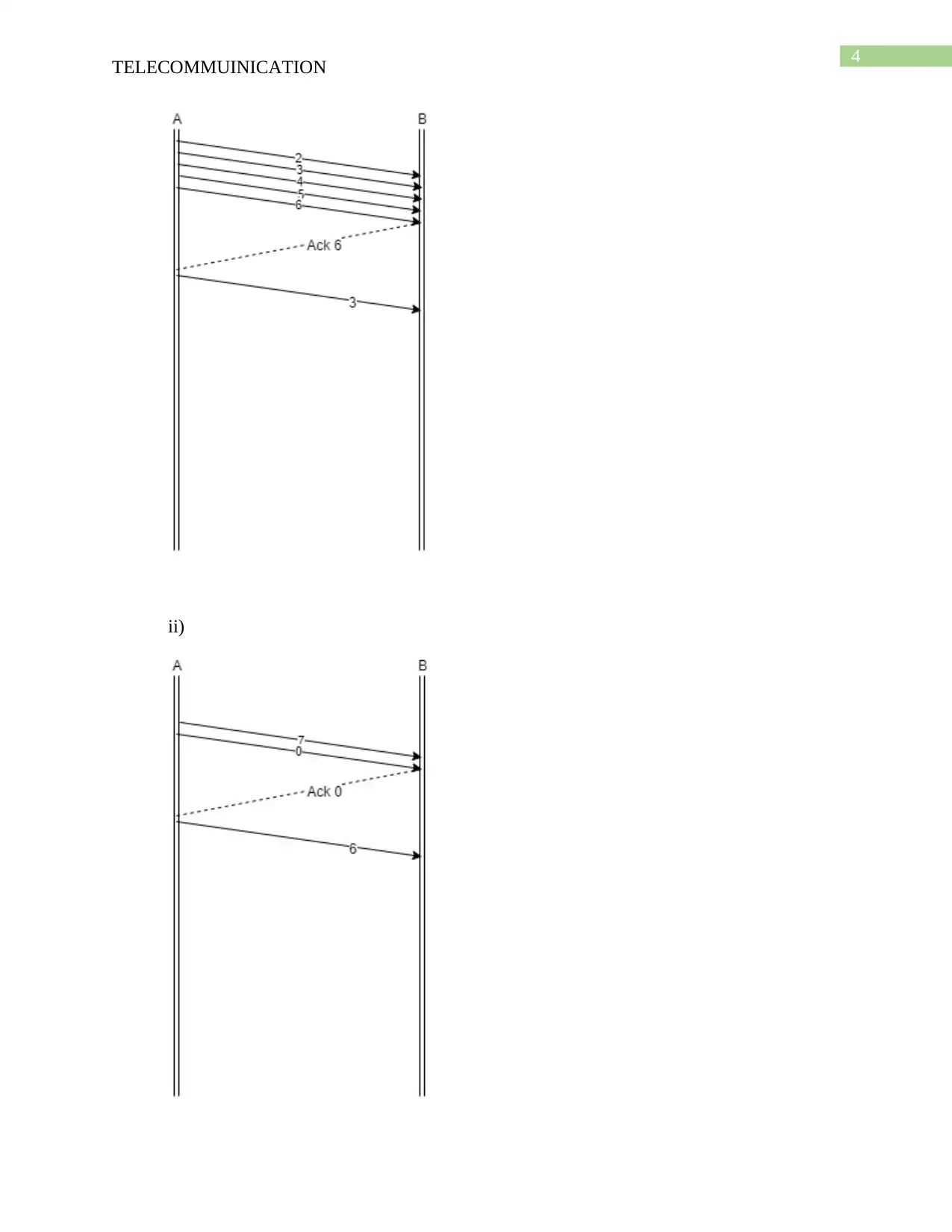
ii)
Document Page
5
TELECOMMUINICATION
iii)
iv)
Document Page
6
TELECOMMUINICATION
Bibliography
Mitra, P. (2015). An Analysis of Data Link Control Protocols. In Cutting Edge Research in
Technologies. InTech.
Papandreou, G., Kokkinos, I., & Savalle, P. A. (2015, June). Modeling local and global
deformations in deep learning: Epitomic convolution, multiple instance learning, and sliding
window detection. In Computer Vision and Pattern Recognition (CVPR), 2015 IEEE Conference
on (pp. 390-399). IEEE.
Ren, S., He, K., Girshick, R., & Sun, J. (2015). Faster r-cnn: Towards real-time object detection
with region proposal networks. In Advances in neural information processing systems (pp. 91-
99).
Terry, S. E., Chao, Y. J., & Miller, J. M. (2015). U.S. Patent No. 8,929,385. Washington, DC:
U.S. Patent and Trademark Office.
chevron_up_icon
1 out of 7
circle_padding
hide_on_mobile
zoom_out_icon
[object Object]