Case Study: Critical Review of Telephone Intervention for Diabetes

Verified

Added on  2023/06/10

|5
|909
|293
Case Study
AI Summary
This case study critically reviews a research article focusing on telephone interventions to improve diabetes control within the New York City A1c Registry. The article explores the effectiveness of scalable self-management interventions, particularly for minority populations, given the increasing prevalence of diabetes in New York City. The NYC Department of Health and Mental Hygiene (DOHMH) implemented a program providing haemoglobin A1c (A1c) test results and guidelines, later expanding to telephone interventions. The methodology involved a survey of 941 adults with diabetes, with participants from diverse cultural and linguistic backgrounds receiving a 'welcome' packet and regular phone calls for behavioral counseling and support. The study found a modest decrease in A1c levels, particularly among participants with higher baseline A1c, but noted no significant changes in self-reported behaviors. The review concludes that while the study had limitations, telephone interventions show promise for improving glycemic control in low-income populations due to their accessibility and low cost. Desklib provides access to similar case studies and solved assignments for students.
Document Page
critical review of research
article
tabler-icon-diamond-filled.svg

Paraphrase This Document

Need a fresh take? Get an instant paraphrase of this document with our AI Paraphraser
Document Page
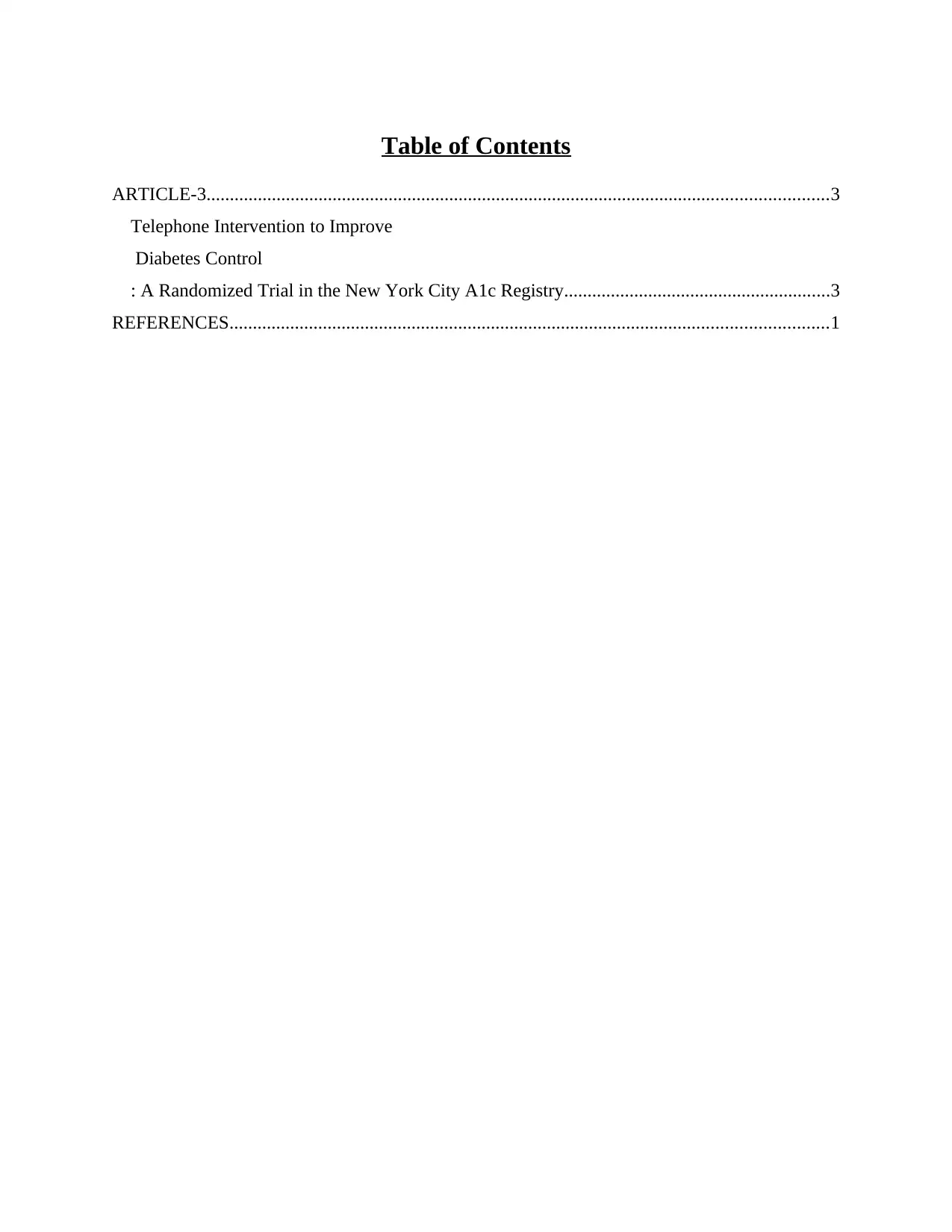
Table of Contents
ARTICLE-3.....................................................................................................................................3
Telephone Intervention to Improve
Diabetes Control
: A Randomized Trial in the New York City A1c Registry.........................................................3
REFERENCES................................................................................................................................1
Document Page
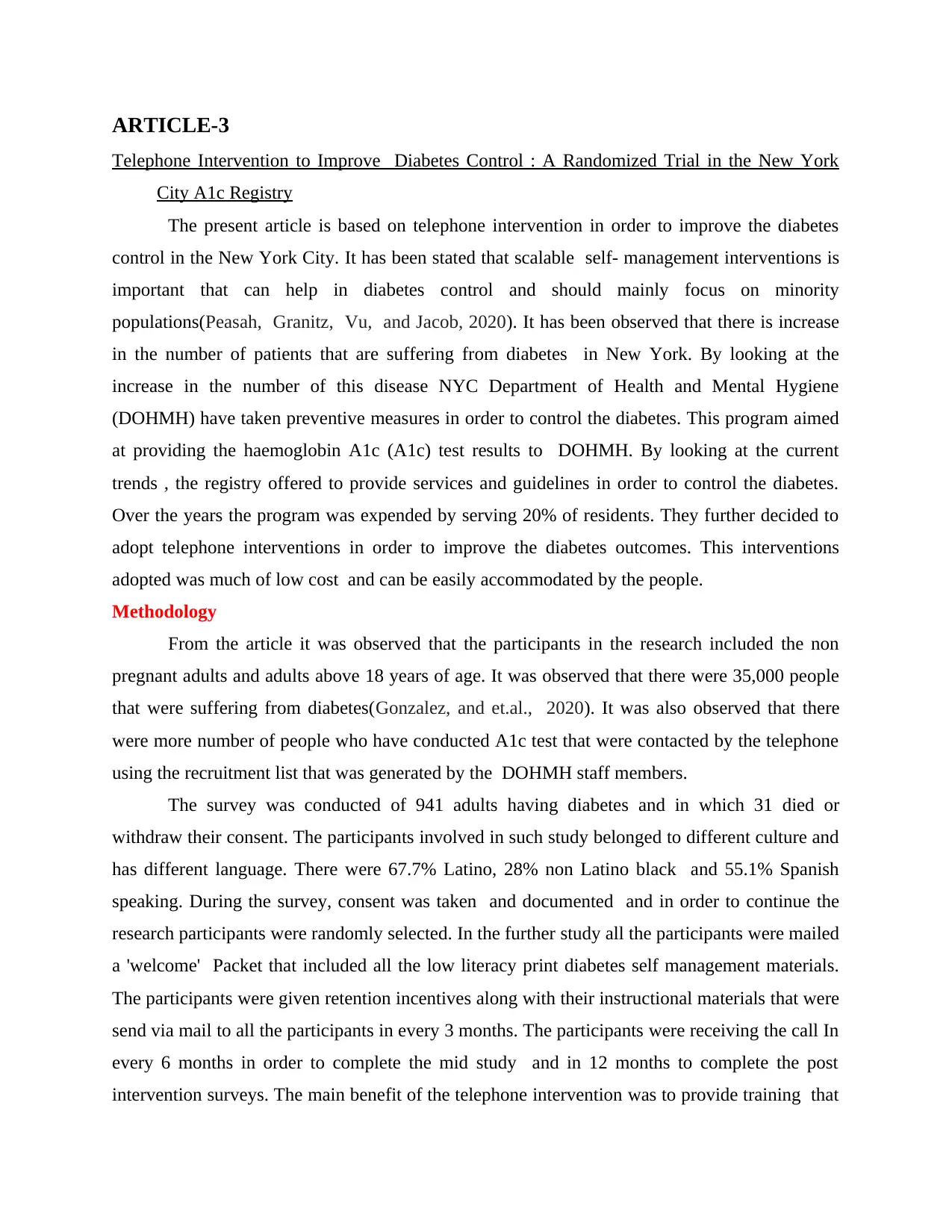
ARTICLE-3
Telephone Intervention to Improve Diabetes Control : A Randomized Trial in the New York
City A1c Registry
The present article is based on telephone intervention in order to improve the diabetes
control in the New York City. It has been stated that scalable self- management interventions is
important that can help in diabetes control and should mainly focus on minority
populations(Peasah, Granitz, Vu, and Jacob, 2020). It has been observed that there is increase
in the number of patients that are suffering from diabetes in New York. By looking at the
increase in the number of this disease NYC Department of Health and Mental Hygiene
(DOHMH) have taken preventive measures in order to control the diabetes. This program aimed
at providing the haemoglobin A1c (A1c) test results to DOHMH. By looking at the current
trends , the registry offered to provide services and guidelines in order to control the diabetes.
Over the years the program was expended by serving 20% of residents. They further decided to
adopt telephone interventions in order to improve the diabetes outcomes. This interventions
adopted was much of low cost and can be easily accommodated by the people.
Methodology
From the article it was observed that the participants in the research included the non
pregnant adults and adults above 18 years of age. It was observed that there were 35,000 people
that were suffering from diabetes(Gonzalez, and et.al., 2020). It was also observed that there
were more number of people who have conducted A1c test that were contacted by the telephone
using the recruitment list that was generated by the DOHMH staff members.
The survey was conducted of 941 adults having diabetes and in which 31 died or
withdraw their consent. The participants involved in such study belonged to different culture and
has different language. There were 67.7% Latino, 28% non Latino black and 55.1% Spanish
speaking. During the survey, consent was taken and documented and in order to continue the
research participants were randomly selected. In the further study all the participants were mailed
a 'welcome' Packet that included all the low literacy print diabetes self management materials.
The participants were given retention incentives along with their instructional materials that were
send via mail to all the participants in every 3 months. The participants were receiving the call In
every 6 months in order to complete the mid study and in 12 months to complete the post
intervention surveys. The main benefit of the telephone intervention was to provide training that
Document Page
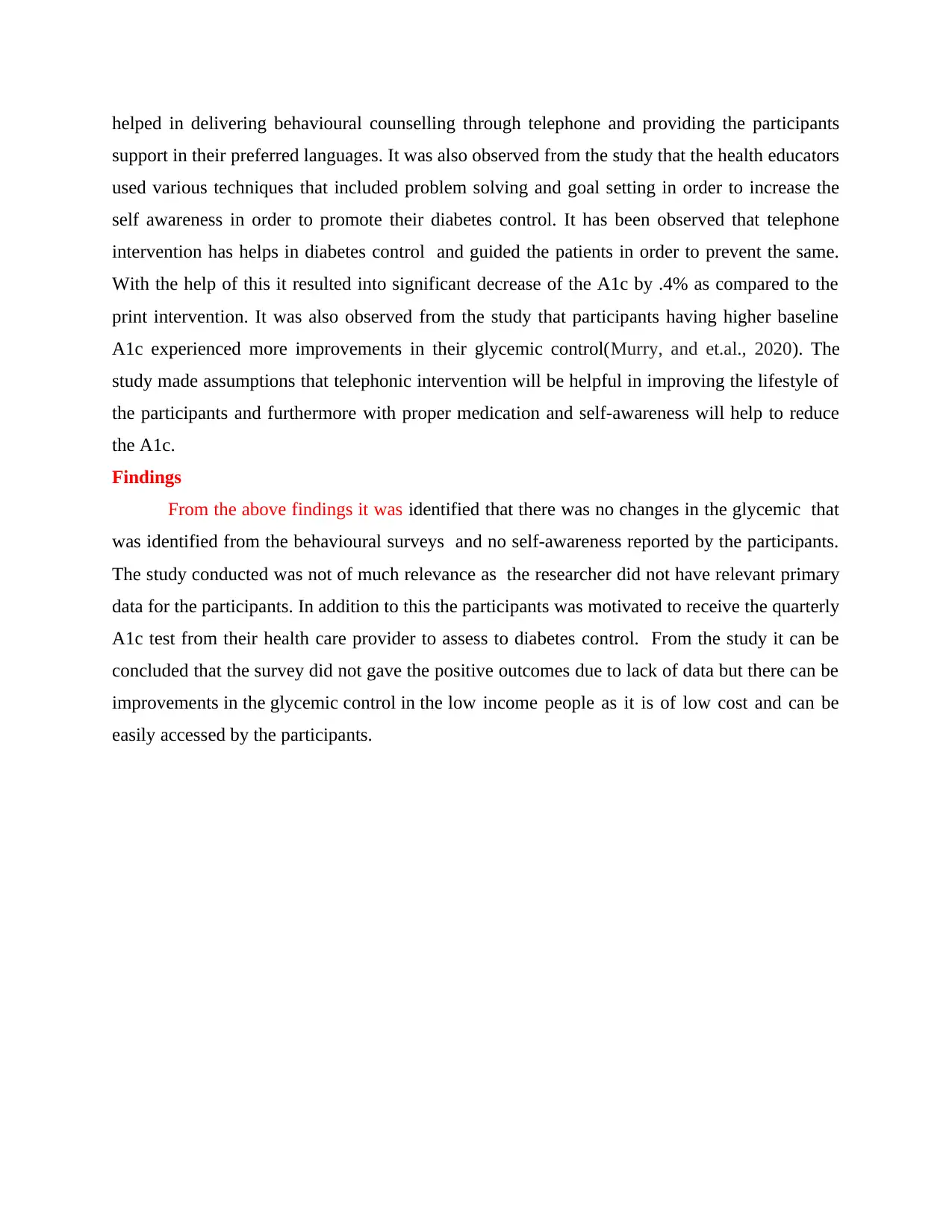
helped in delivering behavioural counselling through telephone and providing the participants
support in their preferred languages. It was also observed from the study that the health educators
used various techniques that included problem solving and goal setting in order to increase the
self awareness in order to promote their diabetes control. It has been observed that telephone
intervention has helps in diabetes control and guided the patients in order to prevent the same.
With the help of this it resulted into significant decrease of the A1c by .4% as compared to the
print intervention. It was also observed from the study that participants having higher baseline
A1c experienced more improvements in their glycemic control(Murry, and et.al., 2020). The
study made assumptions that telephonic intervention will be helpful in improving the lifestyle of
the participants and furthermore with proper medication and self-awareness will help to reduce
the A1c.
Findings
From the above findings it was identified that there was no changes in the glycemic that
was identified from the behavioural surveys and no self-awareness reported by the participants.
The study conducted was not of much relevance as the researcher did not have relevant primary
data for the participants. In addition to this the participants was motivated to receive the quarterly
A1c test from their health care provider to assess to diabetes control. From the study it can be
concluded that the survey did not gave the positive outcomes due to lack of data but there can be
improvements in the glycemic control in the low income people as it is of low cost and can be
easily accessed by the participants.
tabler-icon-diamond-filled.svg

Paraphrase This Document

Need a fresh take? Get an instant paraphrase of this document with our AI Paraphraser
Document Page
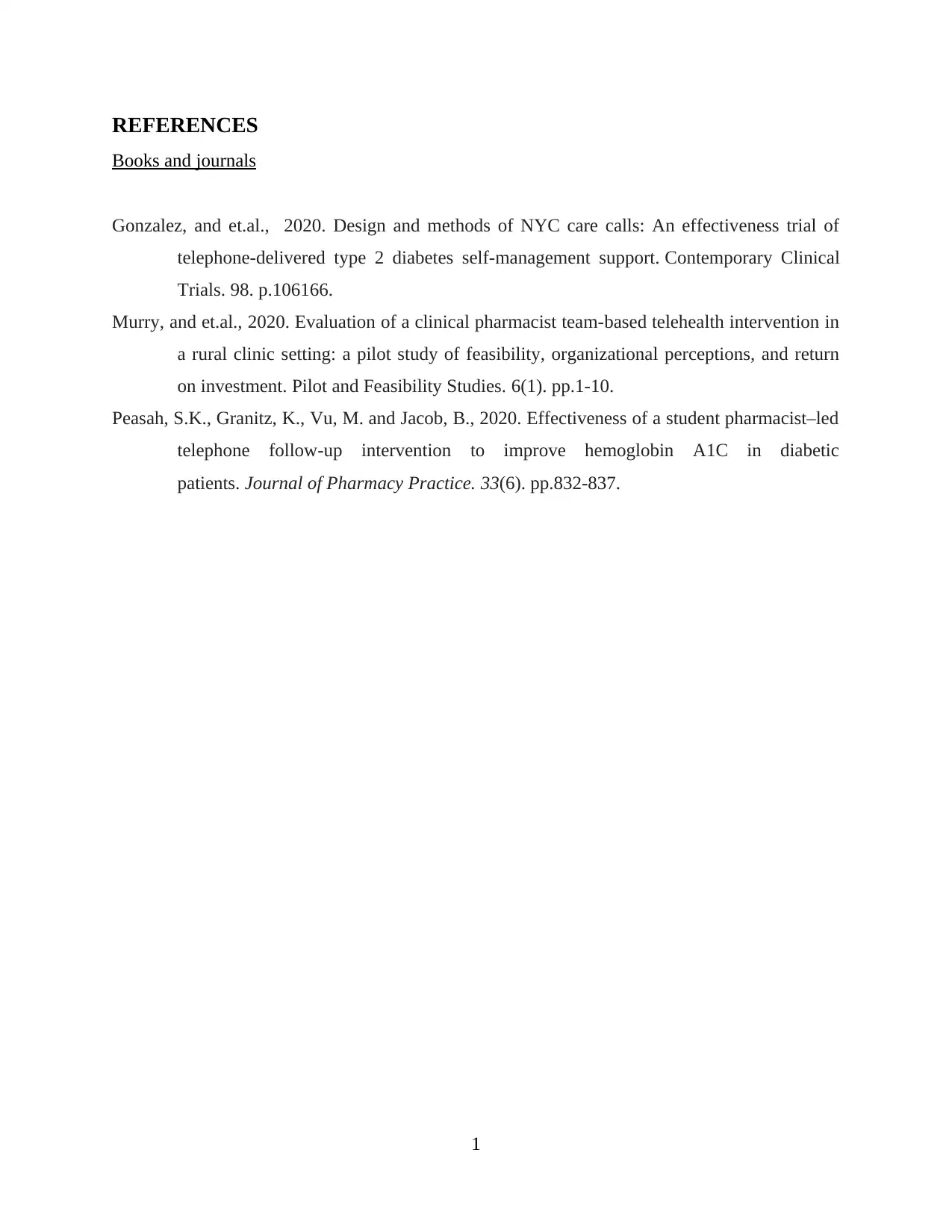
REFERENCES
Books and journals
Gonzalez, and et.al., 2020. Design and methods of NYC care calls: An effectiveness trial of
telephone-delivered type 2 diabetes self-management support. Contemporary Clinical
Trials. 98. p.106166.
Murry, and et.al., 2020. Evaluation of a clinical pharmacist team-based telehealth intervention in
a rural clinic setting: a pilot study of feasibility, organizational perceptions, and return
on investment. Pilot and Feasibility Studies. 6(1). pp.1-10.
Peasah, S.K., Granitz, K., Vu, M. and Jacob, B., 2020. Effectiveness of a student pharmacist–led
telephone follow-up intervention to improve hemoglobin A1C in diabetic
patients. Journal of Pharmacy Practice. 33(6). pp.832-837.
1
chevron_up_icon
1 out of 5
circle_padding
hide_on_mobile
zoom_out_icon
[object Object]