Research Report on Telomere Length, Aging, and Measurement Methods

Verified

Added on  2023/06/10

|1
|743
|469
Report
AI Summary
This research summary explores the relationship between telomeres, telomerase, and aging, highlighting the role of telomeres as protective structures at the end of chromosomes. It discusses the variability of telomere length within species and organisms, its association with aging and various pathologies, and different methods for measuring telomere length, including leukocyte telomere measurement and quantitative PCR. The report also addresses the end of replication issues in DNA replication, the impact of oxidative stress on telomere length, and the limitations of various telomere length quantification techniques like Southern blot, PCR, and in situ hybridization, emphasizing the need for effective real-time PCR-based methods. The study references various research articles to support its claims and provide a comprehensive overview of the subject.
Document Page
RESEARCH SUMMARY
Telomeres along with telomerase include the aging which is a
biological process which affect most cells, species and organisms. It also
includes the end of the chromosomes along with which consist of
evolutionary conserved nucleotide sequences that range from few hundred
base pairs. This also associates with sheltering proteins that can lead to form
complex protecting chromosomal deoxyribonucleic acid (DNA) which can
be recognition from DNA damage-repair system (Srinivas et. al., (2020)).
First identification includes the sequence of terminal end of chromosome
which also includes the Tetraphymena that was discovered by Elizabeth
Blackburn. There is most striking characteristic of telomeres which is a
somatic cells and can shortening with age within culture with directly linked
through replicative capacity.
Here, Telomere include the end of chromosome which is G-rich
strand and have ends in single strand extension of 75-200 bp. Here, telomere
shelterin complex includes the designed which can include the protection of
chromosomal ends from end-to-end fusing and erosion (Froy et. al., (2021)).
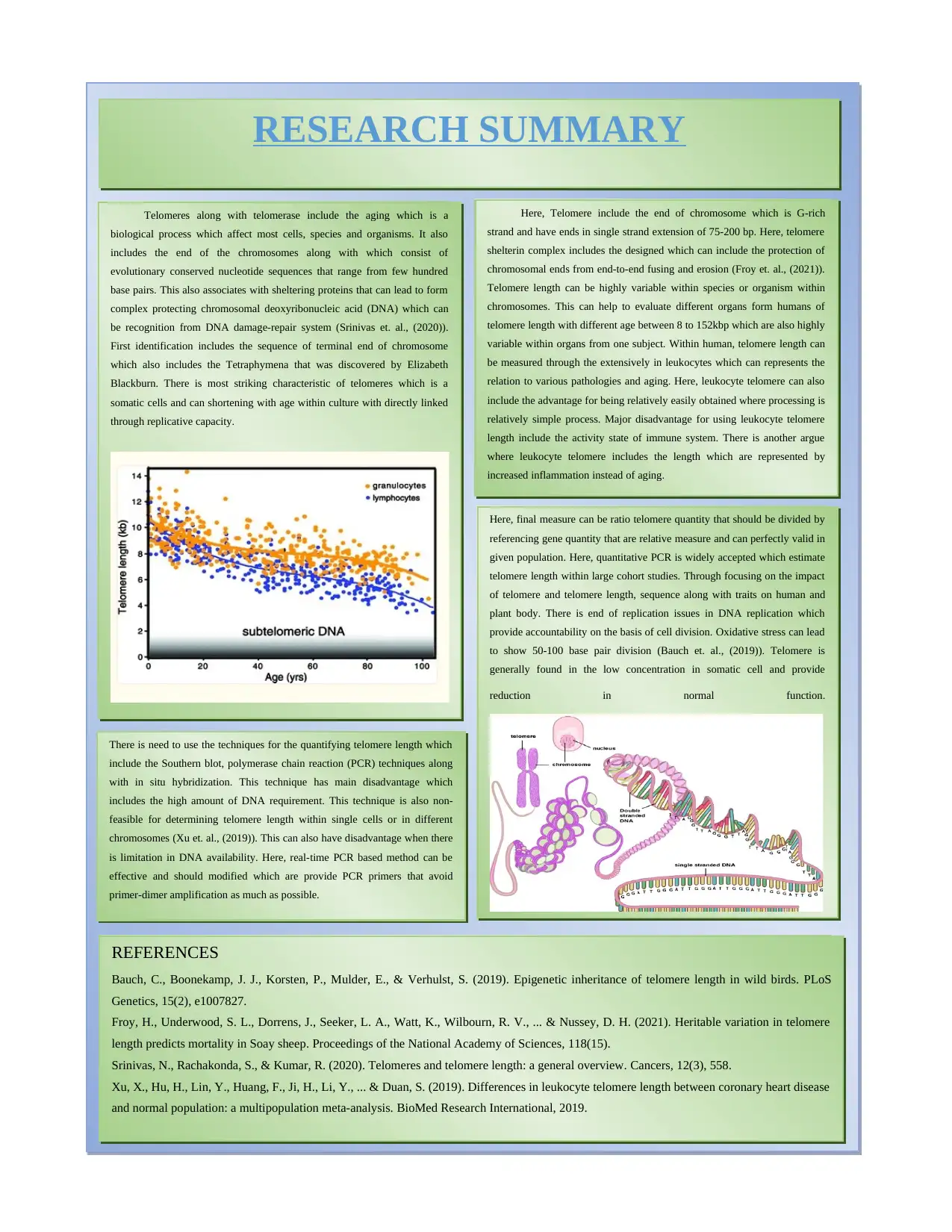
Telomere length can be highly variable within species or organism within
chromosomes. This can help to evaluate different organs form humans of
telomere length with different age between 8 to 152kbp which are also highly
variable within organs from one subject. Within human, telomere length can
be measured through the extensively in leukocytes which can represents the
relation to various pathologies and aging. Here, leukocyte telomere can also
include the advantage for being relatively easily obtained where processing is
relatively simple process. Major disadvantage for using leukocyte telomere
length include the activity state of immune system. There is another argue
where leukocyte telomere includes the length which are represented by
increased inflammation instead of aging.
There is need to use the techniques for the quantifying telomere length which
include the Southern blot, polymerase chain reaction (PCR) techniques along
with in situ hybridization. This technique has main disadvantage which
includes the high amount of DNA requirement. This technique is also non-
feasible for determining telomere length within single cells or in different
chromosomes (Xu et. al., (2019)). This can also have disadvantage when there
is limitation in DNA availability. Here, real-time PCR based method can be
effective and should modified which are provide PCR primers that avoid
primer-dimer amplification as much as possible.
Here, final measure can be ratio telomere quantity that should be divided by
referencing gene quantity that are relative measure and can perfectly valid in
given population. Here, quantitative PCR is widely accepted which estimate
telomere length within large cohort studies. Through focusing on the impact
of telomere and telomere length, sequence along with traits on human and
plant body. There is end of replication issues in DNA replication which
provide accountability on the basis of cell division. Oxidative stress can lead
to show 50-100 base pair division (Bauch et. al., (2019)). Telomere is
generally found in the low concentration in somatic cell and provide
reduction in normal function.
REFERENCES
Bauch, C., Boonekamp, J. J., Korsten, P., Mulder, E., & Verhulst, S. (2019). Epigenetic inheritance of telomere length in wild birds. PLoS
Genetics, 15(2), e1007827.
Froy, H., Underwood, S. L., Dorrens, J., Seeker, L. A., Watt, K., Wilbourn, R. V., ... & Nussey, D. H. (2021). Heritable variation in telomere
length predicts mortality in Soay sheep. Proceedings of the National Academy of Sciences, 118(15).
Srinivas, N., Rachakonda, S., & Kumar, R. (2020). Telomeres and telomere length: a general overview. Cancers, 12(3), 558.
Xu, X., Hu, H., Lin, Y., Huang, F., Ji, H., Li, Y., ... & Duan, S. (2019). Differences in leukocyte telomere length between coronary heart disease
and normal population: a multipopulation meta-analysis. BioMed Research International, 2019.
tabler-icon-diamond-filled.svg

Paraphrase This Document

Need a fresh take? Get an instant paraphrase of this document with our AI Paraphraser
[object Object]