BBAC601: Audit Strategy and Risk Assessment for Telstra Corp
VerifiedAdded on 2023/04/19
|16
|4373
|138
Report
AI Summary
This report outlines an audit strategy for Telstra Corporation Limited for the 2017-2018 financial year, developed in accordance with Australian Standard on Auditing (ASA) 315. It includes a detailed analysis of the client, covering information about Telstra, its industry, regulatory environment, nature of operations, and accounting policies. The report also examines related party transactions, changes in accounting policies, preliminary analytical procedures, financial performance measurement, and business objectives and strategies, assessing their impacts on future audit work. The aim is to provide a comprehensive understanding of Telstra to facilitate effective audit planning. Desklib provides a platform to explore similar solved assignments and past papers for students.
Running head: AUDIT STRATEGY
Audit Strategy
Name of the Student
Name of the University
Author’s Note
Audit Strategy
Name of the Student
Name of the University
Author’s Note

Paraphrase This Document
Need a fresh take? Get an instant paraphrase of this document with our AI Paraphraser
1AUDIT STRATEGY
Table of Contents
1. Introduction............................................................................................................................2
Part A: The Client......................................................................................................................2
2.1 Information about the Client............................................................................................2
2.2 Industry, Regulatory and Other External Factors............................................................3
2.3 Nature of the Client..........................................................................................................3
2.4 Accounting Policy............................................................................................................4
2.5 Related Parties and Transaction with Related Parties......................................................5
Part B: Analysis of the Client and Impacts on the Future Audit Works....................................8
2.6 Changes in Accounting Policies and the Impact of Changes...........................................8
2.7 Preliminary Analytical Procedures..................................................................................9
2.8 Measurement and Review of Financial Performance....................................................10
2.9 Objectives, Strategies and Related Business Risks........................................................11
3. Conclusion............................................................................................................................11
References................................................................................................................................13
Table of Contents
1. Introduction............................................................................................................................2
Part A: The Client......................................................................................................................2
2.1 Information about the Client............................................................................................2
2.2 Industry, Regulatory and Other External Factors............................................................3
2.3 Nature of the Client..........................................................................................................3
2.4 Accounting Policy............................................................................................................4
2.5 Related Parties and Transaction with Related Parties......................................................5
Part B: Analysis of the Client and Impacts on the Future Audit Works....................................8
2.6 Changes in Accounting Policies and the Impact of Changes...........................................8
2.7 Preliminary Analytical Procedures..................................................................................9
2.8 Measurement and Review of Financial Performance....................................................10
2.9 Objectives, Strategies and Related Business Risks........................................................11
3. Conclusion............................................................................................................................11
References................................................................................................................................13
2AUDIT STRATEGY
1. Introduction
Auditing is considered as the systematic and methodical process of inspecting as well
as examining the financial statements of the companies in order to make sure that there is not
any material misstatements in them (Louwers et al. 2015). Before commencing the audit
works, it is needed for the auditors to chalk out the audit strategy in detailed manner. An
Audit Strategy sets the direction, timing as well as scope of the audit work and the auditors
use the audit strategy as a parameter for the development of audit plan (Knechel and Salterio
2016). For this reason, the auditors are needed to include the key decision required in the
audit strategy document for effective planning of auditing. At the time to develop the audit
strategy, an auditor is needed to consider the methodical analysis of the audit client that
includes the analysis and evaluation of business, industry, external factors, nature, accounting
policies, change in accounting policies, objectives, strategies and business risks of the audit
client. Information about all these aspects provides the auditor with the necessary direction to
plan the audit procedures (Byrnes et al. 2018). The main aim of this report is to gain
understanding about the audit client that is Telstra Corporation Limited (Telstra) so that
effective audit strategy can be developed for the company for the 2017 to 2018 financial year.
Part A: The Client
2.1 Information about the Client
Name: Telstra Corporation Limited
Address: 242 Exhibition Street, Level 41, Melbourne, VIC 3000, Australia
Year of Establishment: 1901
Field of Operations: Telstra Corporation Limited is the provider is the provider of
telecommunication services to businesses, governments, communities and individuals in
Australia as well as internationally. The company has operations in four segments; they are
Telstra Consumer and Small Businesses, Telstra Operations, Telstra Enterprise and Telstra
Wholesale. Telstra provides their customers with telecommunication products, services as
well as solutions through mobiles, telephones, broadband services and others.
Period of Financial Report Period under Consideration: 1st July 2017 to 30th June 2018
Types of Financial Report: Consolidated
1. Introduction
Auditing is considered as the systematic and methodical process of inspecting as well
as examining the financial statements of the companies in order to make sure that there is not
any material misstatements in them (Louwers et al. 2015). Before commencing the audit
works, it is needed for the auditors to chalk out the audit strategy in detailed manner. An
Audit Strategy sets the direction, timing as well as scope of the audit work and the auditors
use the audit strategy as a parameter for the development of audit plan (Knechel and Salterio
2016). For this reason, the auditors are needed to include the key decision required in the
audit strategy document for effective planning of auditing. At the time to develop the audit
strategy, an auditor is needed to consider the methodical analysis of the audit client that
includes the analysis and evaluation of business, industry, external factors, nature, accounting
policies, change in accounting policies, objectives, strategies and business risks of the audit
client. Information about all these aspects provides the auditor with the necessary direction to
plan the audit procedures (Byrnes et al. 2018). The main aim of this report is to gain
understanding about the audit client that is Telstra Corporation Limited (Telstra) so that
effective audit strategy can be developed for the company for the 2017 to 2018 financial year.
Part A: The Client
2.1 Information about the Client
Name: Telstra Corporation Limited
Address: 242 Exhibition Street, Level 41, Melbourne, VIC 3000, Australia
Year of Establishment: 1901
Field of Operations: Telstra Corporation Limited is the provider is the provider of
telecommunication services to businesses, governments, communities and individuals in
Australia as well as internationally. The company has operations in four segments; they are
Telstra Consumer and Small Businesses, Telstra Operations, Telstra Enterprise and Telstra
Wholesale. Telstra provides their customers with telecommunication products, services as
well as solutions through mobiles, telephones, broadband services and others.
Period of Financial Report Period under Consideration: 1st July 2017 to 30th June 2018
Types of Financial Report: Consolidated
⊘ This is a preview!⊘
Do you want full access?
Subscribe today to unlock all pages.

Trusted by 1+ million students worldwide
3AUDIT STRATEGY
2.2 Industry, Regulatory and Other External Factors
The Australian economy has taken an upturn on in the fourth quarter of the last year
after an unsatisfactory third quarter and it is expected that this robust growth is expected to
continue in the coming year. After that, the Australian telecommunication industry is
expected to grow in the next five years. Other key developments are decline in fixed-line
DSL broadband, growth in second tier market, slow growth in mobile subscriptions and
others (focus-economics.com 2019).
The laws and regulations applicable to Telstra are industry specific competition
regulation, consumer protection regulation and industry codes and standards under a self-
regulatory regime. Telstra is needed to comply with all the regulations introduced by The
Communication Minister and the Communication Minister’s Department.
Increase in competition can be seen in the Australian telecommunication industry due
to the deregulation of the industry in 1997, but Telstra has been able in maintaining their
dominant position in the industry. The major competitors of Telstra are Optus, AAPT,
Primus, Orange and Vodafone.
The Australian government provides funding support to the Australian
telecommunication industry for their overall growth. At the same time, the Australian
government also supports the telecommunication industry in the policy making process
(communications.gov.au 2019).
Increase in revenue from wireless services can be seen in the Australian
telecommunication industry due to the rise in consumption volume of mobile data along with
improved mobile connectivity. However, decrease in demand can be seen in fixed line
services (ibisworld.com.au 2019).
Even after the deregulation of the Australian telecommunication industry, there are
certain entry barriers for the new companies. The new entrants need to bear huge set-up cost
for the new business in this industry that need huge capital. After that, new companies are
needed to invest hugely for the adoption of new technologies for their business (Fontagné and
Mitaritonna 2013).
2.3 Nature of the Client
Telstra Corporation Limited is the provider is the provider of telecommunication
services to businesses, governments, communities and individuals in Australia as well as
2.2 Industry, Regulatory and Other External Factors
The Australian economy has taken an upturn on in the fourth quarter of the last year
after an unsatisfactory third quarter and it is expected that this robust growth is expected to
continue in the coming year. After that, the Australian telecommunication industry is
expected to grow in the next five years. Other key developments are decline in fixed-line
DSL broadband, growth in second tier market, slow growth in mobile subscriptions and
others (focus-economics.com 2019).
The laws and regulations applicable to Telstra are industry specific competition
regulation, consumer protection regulation and industry codes and standards under a self-
regulatory regime. Telstra is needed to comply with all the regulations introduced by The
Communication Minister and the Communication Minister’s Department.
Increase in competition can be seen in the Australian telecommunication industry due
to the deregulation of the industry in 1997, but Telstra has been able in maintaining their
dominant position in the industry. The major competitors of Telstra are Optus, AAPT,
Primus, Orange and Vodafone.
The Australian government provides funding support to the Australian
telecommunication industry for their overall growth. At the same time, the Australian
government also supports the telecommunication industry in the policy making process
(communications.gov.au 2019).
Increase in revenue from wireless services can be seen in the Australian
telecommunication industry due to the rise in consumption volume of mobile data along with
improved mobile connectivity. However, decrease in demand can be seen in fixed line
services (ibisworld.com.au 2019).
Even after the deregulation of the Australian telecommunication industry, there are
certain entry barriers for the new companies. The new entrants need to bear huge set-up cost
for the new business in this industry that need huge capital. After that, new companies are
needed to invest hugely for the adoption of new technologies for their business (Fontagné and
Mitaritonna 2013).
2.3 Nature of the Client
Telstra Corporation Limited is the provider is the provider of telecommunication
services to businesses, governments, communities and individuals in Australia as well as
Paraphrase This Document
Need a fresh take? Get an instant paraphrase of this document with our AI Paraphraser
4AUDIT STRATEGY
internationally. The company has operations in four segments; they are Telstra Consumer and
Small Businesses, Telstra Operations, Telstra Enterprise and Telstra Wholesale. Telstra
provides their customers with telecommunication products, services as well as solutions
through mobiles, telephones, broadband services and others (telstra.com.au 2019).
It needs to be mentioned that Telstra has a large customer base and the company has
segregated their customer base in a well manner. In Australia, Telstra has 17.7 million
customers for the retail mobile service, 4.9 million customers for retail fixed voice services
and 3.6 million customers for retail fixed broadband services (telstra.com.au 2019).
It can be seen from the above that Telstra has certain increased dependency on the
customers for the retail mobile services as it consists of the majority portion of the customer
base.
Telstra has certain major suppliers who supply the company with many things like
office equipment to uniform, coffee to stationary, cables of buildings along with servers to
satellite capacity. For this reason, the major suppliers of Telstra are businesses across
Australia and overseas that includes small companies, companies from remote areas and large
corporations (telstra.com.au 2019).
As per the ownership structure, Telstra falls under Corporation. Telstra adheres to the
third edition of the ASX Corporate Governance Council’s Corporate Governance Principles
and Recommendations (ASX Recommendations) for the purpose of corporate governance.
The board size of Telstra is 11. The company has four committees; they are Board Charter,
Audit and Risk Committee Charter, Remuneration Committee Charter and Nomination
Committee Charter (telstra.com.au 2019).
Telstra has a total of 360 retail stores across the regions of Australia. In addition, the
company has retail stores in many other countries like United States, United Kingdom,
Indonesia, Singapore, Malaysia, Philippines, India, China, Taiwan, Hong Kong and others
(telstra.com.au 2019).
2.4 Accounting Policy
Property, Plant and Equipment: As per the accounting policies of Telstra, the company has
reported and recorded the property, plant and equipment at cost less accumulated
depreciation. Hence, the company has adopted the cost model (telstra.com.au 2019).
internationally. The company has operations in four segments; they are Telstra Consumer and
Small Businesses, Telstra Operations, Telstra Enterprise and Telstra Wholesale. Telstra
provides their customers with telecommunication products, services as well as solutions
through mobiles, telephones, broadband services and others (telstra.com.au 2019).
It needs to be mentioned that Telstra has a large customer base and the company has
segregated their customer base in a well manner. In Australia, Telstra has 17.7 million
customers for the retail mobile service, 4.9 million customers for retail fixed voice services
and 3.6 million customers for retail fixed broadband services (telstra.com.au 2019).
It can be seen from the above that Telstra has certain increased dependency on the
customers for the retail mobile services as it consists of the majority portion of the customer
base.
Telstra has certain major suppliers who supply the company with many things like
office equipment to uniform, coffee to stationary, cables of buildings along with servers to
satellite capacity. For this reason, the major suppliers of Telstra are businesses across
Australia and overseas that includes small companies, companies from remote areas and large
corporations (telstra.com.au 2019).
As per the ownership structure, Telstra falls under Corporation. Telstra adheres to the
third edition of the ASX Corporate Governance Council’s Corporate Governance Principles
and Recommendations (ASX Recommendations) for the purpose of corporate governance.
The board size of Telstra is 11. The company has four committees; they are Board Charter,
Audit and Risk Committee Charter, Remuneration Committee Charter and Nomination
Committee Charter (telstra.com.au 2019).
Telstra has a total of 360 retail stores across the regions of Australia. In addition, the
company has retail stores in many other countries like United States, United Kingdom,
Indonesia, Singapore, Malaysia, Philippines, India, China, Taiwan, Hong Kong and others
(telstra.com.au 2019).
2.4 Accounting Policy
Property, Plant and Equipment: As per the accounting policies of Telstra, the company has
reported and recorded the property, plant and equipment at cost less accumulated
depreciation. Hence, the company has adopted the cost model (telstra.com.au 2019).
5AUDIT STRATEGY
Inventory: As per the 2018 Annual Report of Telstra, the company has valued their inventory
at the lower of cost and net realizable value. For the majority items of the inventory, Telstra
assigns cost by using the weighted average cost basis. Hence, the company has adopted
average basis for inventory (telstra.com.au 2019).
Accounts Receivable: Telstra considers accounts receivable as financial assets. As per the
accounting policies, the company measures them on the basis of fair value and they are
subsequently measures at amortized costs with the use of effective interest method. Hence,
the company used fair value method for the measurement of accounts receivable
(telstra.com.au 2019).
Financial Instrument: As per the 2018 Annual Report of Telstra, the company has complied
with the principles and regulations of AASB 9 Financial Instrument. Hence, Telstra
recognizes a financial asset or financial liability in the balance sheet when the company
becomes party to the promised provision of the instrument (aasb.gov.au 2019).
Intangible Assets: Telstra measures their goodwill at the cost basis. After that, the company
amortizes their internally generated intangible assets on the basis of straight-line over their
useful life. After that, Telstra records their acquired intangible assets on the basis of fair value
at the date of acquisition (telstra.com.au 2019).
Revenue Recognition: The main sources of revenue in Telstra are revenue from rendering of
services, sales of goods, construction contracts, lease income, grants from government and
interest income. In Telstra, revenue characterises the fair value of the received consideration
or receivable. The company records the revenue net of sales return, trade allowance, sales
incentives, discounts, taxes and duties (telstra.com.au 2019).
2.5 Related Parties and Transaction with Related Parties
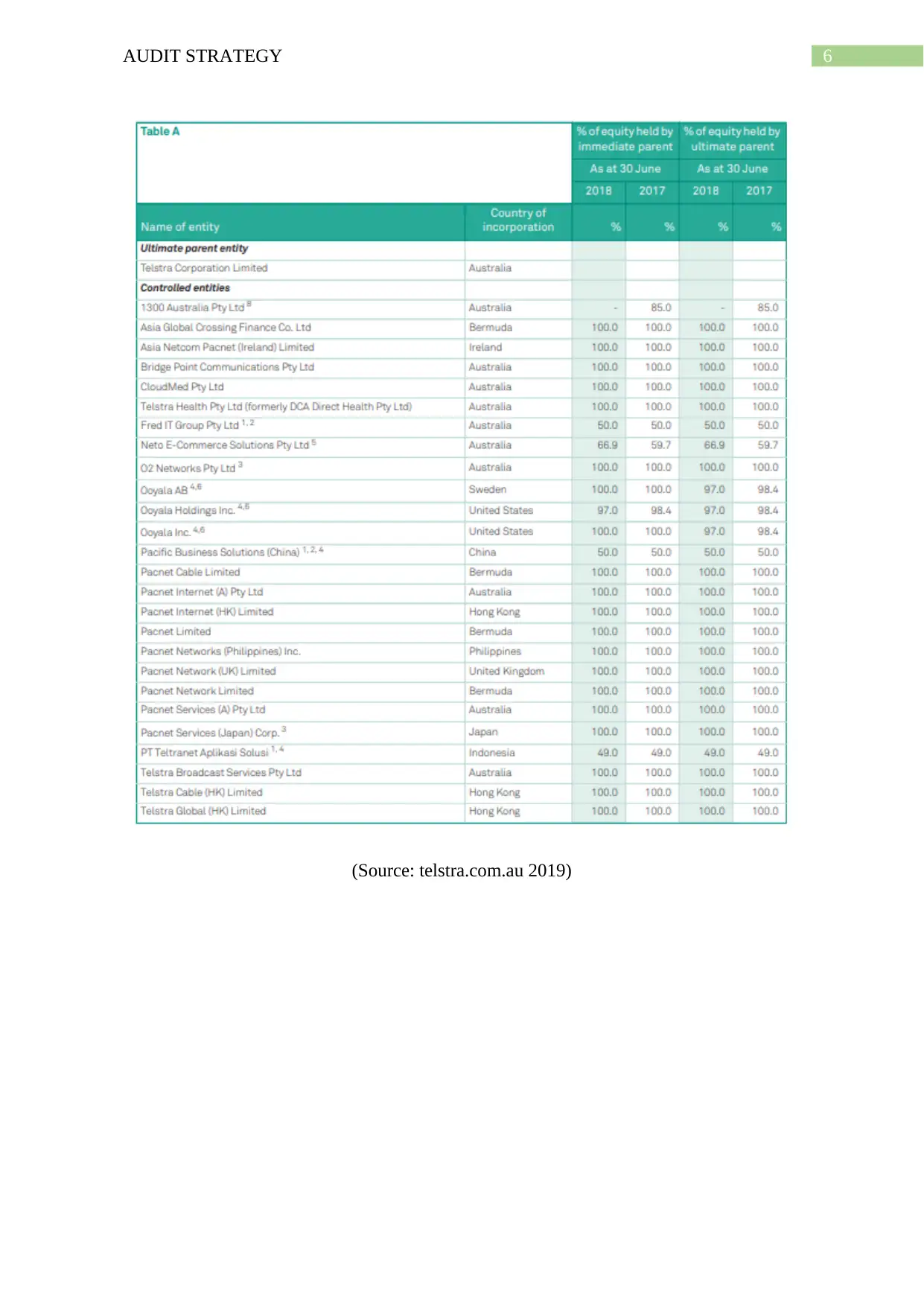
It can be seen from the 2018 Annual Report of Telstra that the company has certain
controlled entities with certain percentage of financial benefits; it can be seen in below:
Inventory: As per the 2018 Annual Report of Telstra, the company has valued their inventory
at the lower of cost and net realizable value. For the majority items of the inventory, Telstra
assigns cost by using the weighted average cost basis. Hence, the company has adopted
average basis for inventory (telstra.com.au 2019).
Accounts Receivable: Telstra considers accounts receivable as financial assets. As per the
accounting policies, the company measures them on the basis of fair value and they are
subsequently measures at amortized costs with the use of effective interest method. Hence,
the company used fair value method for the measurement of accounts receivable
(telstra.com.au 2019).
Financial Instrument: As per the 2018 Annual Report of Telstra, the company has complied
with the principles and regulations of AASB 9 Financial Instrument. Hence, Telstra
recognizes a financial asset or financial liability in the balance sheet when the company
becomes party to the promised provision of the instrument (aasb.gov.au 2019).
Intangible Assets: Telstra measures their goodwill at the cost basis. After that, the company
amortizes their internally generated intangible assets on the basis of straight-line over their
useful life. After that, Telstra records their acquired intangible assets on the basis of fair value
at the date of acquisition (telstra.com.au 2019).
Revenue Recognition: The main sources of revenue in Telstra are revenue from rendering of
services, sales of goods, construction contracts, lease income, grants from government and
interest income. In Telstra, revenue characterises the fair value of the received consideration
or receivable. The company records the revenue net of sales return, trade allowance, sales
incentives, discounts, taxes and duties (telstra.com.au 2019).
2.5 Related Parties and Transaction with Related Parties
It can be seen from the 2018 Annual Report of Telstra that the company has certain
controlled entities with certain percentage of financial benefits; it can be seen in below:
⊘ This is a preview!⊘
Do you want full access?
Subscribe today to unlock all pages.
Trusted by 1+ million students worldwide
6AUDIT STRATEGY
(Source: telstra.com.au 2019)
(Source: telstra.com.au 2019)
Paraphrase This Document
Need a fresh take? Get an instant paraphrase of this document with our AI Paraphraser
7AUDIT STRATEGY
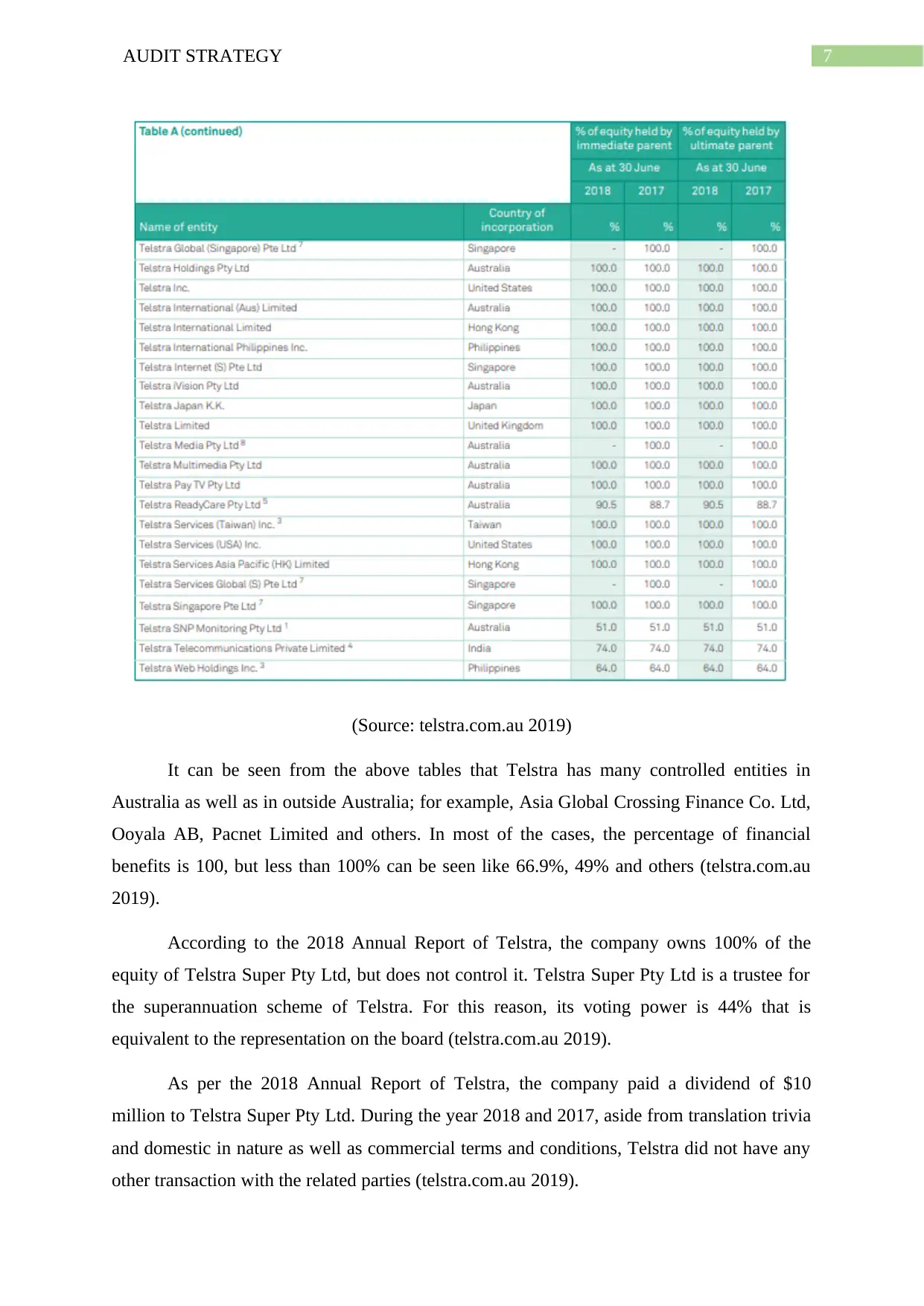
(Source: telstra.com.au 2019)
It can be seen from the above tables that Telstra has many controlled entities in
Australia as well as in outside Australia; for example, Asia Global Crossing Finance Co. Ltd,
Ooyala AB, Pacnet Limited and others. In most of the cases, the percentage of financial
benefits is 100, but less than 100% can be seen like 66.9%, 49% and others (telstra.com.au
2019).
According to the 2018 Annual Report of Telstra, the company owns 100% of the
equity of Telstra Super Pty Ltd, but does not control it. Telstra Super Pty Ltd is a trustee for
the superannuation scheme of Telstra. For this reason, its voting power is 44% that is
equivalent to the representation on the board (telstra.com.au 2019).
As per the 2018 Annual Report of Telstra, the company paid a dividend of $10
million to Telstra Super Pty Ltd. During the year 2018 and 2017, aside from translation trivia
and domestic in nature as well as commercial terms and conditions, Telstra did not have any
other transaction with the related parties (telstra.com.au 2019).
(Source: telstra.com.au 2019)
It can be seen from the above tables that Telstra has many controlled entities in
Australia as well as in outside Australia; for example, Asia Global Crossing Finance Co. Ltd,
Ooyala AB, Pacnet Limited and others. In most of the cases, the percentage of financial
benefits is 100, but less than 100% can be seen like 66.9%, 49% and others (telstra.com.au
2019).
According to the 2018 Annual Report of Telstra, the company owns 100% of the
equity of Telstra Super Pty Ltd, but does not control it. Telstra Super Pty Ltd is a trustee for
the superannuation scheme of Telstra. For this reason, its voting power is 44% that is
equivalent to the representation on the board (telstra.com.au 2019).
As per the 2018 Annual Report of Telstra, the company paid a dividend of $10
million to Telstra Super Pty Ltd. During the year 2018 and 2017, aside from translation trivia
and domestic in nature as well as commercial terms and conditions, Telstra did not have any
other transaction with the related parties (telstra.com.au 2019).
8AUDIT STRATEGY
Part B: Analysis of the Client and Impacts on the Future Audit Works
2.6 Changes in Accounting Policies and the Impact of Changes
According to the 2018 Annual Report of Telstra, there are certain changes in the
accounting policies that can have impact on the financial reporting. AASB has issued the
final version of AASB 9 Financial Instruments (AASB 9 (2014)) (telstra.com.au 2019).
Telstra early adopted the old version of this standards that is AASB 9 (2013), but now they
are needed to adopt AASB 9 (2014). The absence of impairment section can be seen in the
new version that replaces the model of incurred loss impairment with an expected credit loss
(telstra.com.au 2019). As an impact, Telstra will need to record expected credit loss on the
financial assets. After that, Telstra will have to apply the new revenue recognition standard of
AASB 15 Revenue from Contracts with Customers (telstra.com.au 2019). As an impact of
this, Telstra will be needed to recognize the revenue in such a way that portrays the promised
goods transfer to a customer and an amount reflecting the expected consideration to be
received. After that, Telstra will be needed to adopt AASB 16 Leases in the place of AASB
117 Leases; and as the effect, Telstra will be needed to recognize the lease liabilities and
right-to-use assets in the financial statements (telstra.com.au 2019). Lastly, Telstra will be
needed to adopt the revised Conceptual Framework for Financial Reporting issued by the
International Accounting Standards Board as the old one did not cover some of the crucial
areas of financial reporting.
The main aim of AASB and IASB behind bringing these changes in the above-
mentioned accounting standards is to cover the areas that were uncovered by the previous
accounting standards. For this reason, these changes in accounting policies will strengthen the
accounting standards in future by improving the crucial areas of financial reporting. For this,
the users will be able in gaining more accurate financial information of the companies
(Henderson et al. 2015).
These changes in the accounting policies will increase the work of the auditors due to
the fact that the auditors will be needed to analyse certain more elements of financial
reporting. For example, for the introduction of AASB 16, it will be needed for the auditors to
analyse whether the companies have recognized their lease liabilities and right-to-use assets
in the balance sheet. After that, with the adoption of AASB 9 (2014), the auditors will be
needed to analyse whether the companies have reported expected credit loss for their assets.
Hence, these will affect the future audit work (Okolie 2014).
Part B: Analysis of the Client and Impacts on the Future Audit Works
2.6 Changes in Accounting Policies and the Impact of Changes
According to the 2018 Annual Report of Telstra, there are certain changes in the
accounting policies that can have impact on the financial reporting. AASB has issued the
final version of AASB 9 Financial Instruments (AASB 9 (2014)) (telstra.com.au 2019).
Telstra early adopted the old version of this standards that is AASB 9 (2013), but now they
are needed to adopt AASB 9 (2014). The absence of impairment section can be seen in the
new version that replaces the model of incurred loss impairment with an expected credit loss
(telstra.com.au 2019). As an impact, Telstra will need to record expected credit loss on the
financial assets. After that, Telstra will have to apply the new revenue recognition standard of
AASB 15 Revenue from Contracts with Customers (telstra.com.au 2019). As an impact of
this, Telstra will be needed to recognize the revenue in such a way that portrays the promised
goods transfer to a customer and an amount reflecting the expected consideration to be
received. After that, Telstra will be needed to adopt AASB 16 Leases in the place of AASB
117 Leases; and as the effect, Telstra will be needed to recognize the lease liabilities and
right-to-use assets in the financial statements (telstra.com.au 2019). Lastly, Telstra will be
needed to adopt the revised Conceptual Framework for Financial Reporting issued by the
International Accounting Standards Board as the old one did not cover some of the crucial
areas of financial reporting.
The main aim of AASB and IASB behind bringing these changes in the above-
mentioned accounting standards is to cover the areas that were uncovered by the previous
accounting standards. For this reason, these changes in accounting policies will strengthen the
accounting standards in future by improving the crucial areas of financial reporting. For this,
the users will be able in gaining more accurate financial information of the companies
(Henderson et al. 2015).
These changes in the accounting policies will increase the work of the auditors due to
the fact that the auditors will be needed to analyse certain more elements of financial
reporting. For example, for the introduction of AASB 16, it will be needed for the auditors to
analyse whether the companies have recognized their lease liabilities and right-to-use assets
in the balance sheet. After that, with the adoption of AASB 9 (2014), the auditors will be
needed to analyse whether the companies have reported expected credit loss for their assets.
Hence, these will affect the future audit work (Okolie 2014).
⊘ This is a preview!⊘
Do you want full access?
Subscribe today to unlock all pages.
Trusted by 1+ million students worldwide
9AUDIT STRATEGY
2.7 Preliminary Analytical Procedures
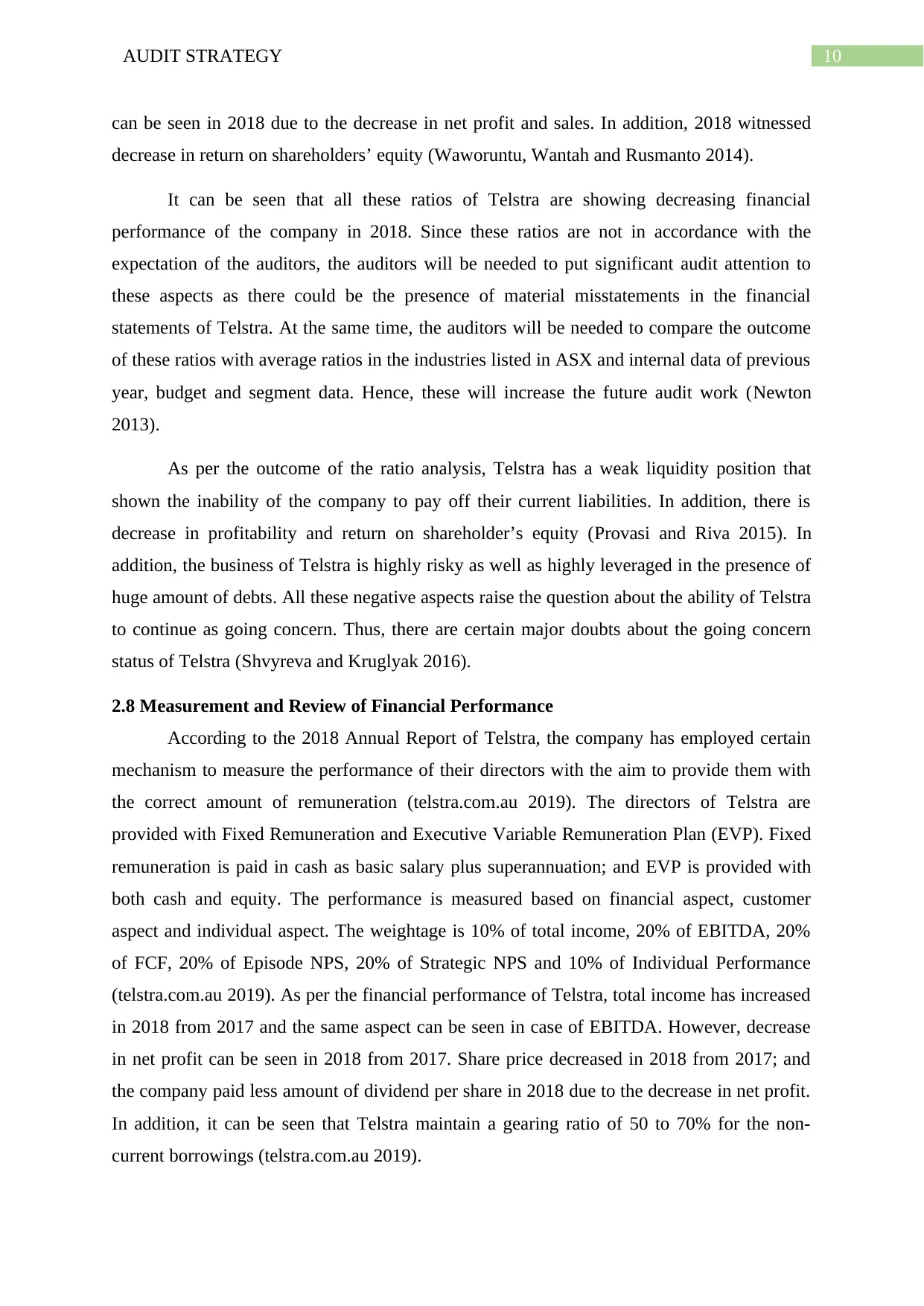
It can be seen from the above that current ratio of Telstra has increased in 2018 from
2017. Moreover, it is also much lower than the standard that is 2 (Delen, Kuzey and Uyar
2013). It implies that Telstra does not have the needed current assets to pay off their current
liabilities. Like current ratio, quick asset ratio has decreased in 2018 and is lower than 1. It
means Telstra lacks the required liquid assets to pay off their current liabilities (Enekwe, Agu
and Eziedo 2014). When considered debt to equity ratio, it can be seen that this ratio has
decreased in 2018; and it also implies that Telstra uses high level of debts instead of equity
that makes their business highly risky and leveraged. After that, decrease in net profit ratio
2.7 Preliminary Analytical Procedures
It can be seen from the above that current ratio of Telstra has increased in 2018 from
2017. Moreover, it is also much lower than the standard that is 2 (Delen, Kuzey and Uyar
2013). It implies that Telstra does not have the needed current assets to pay off their current
liabilities. Like current ratio, quick asset ratio has decreased in 2018 and is lower than 1. It
means Telstra lacks the required liquid assets to pay off their current liabilities (Enekwe, Agu
and Eziedo 2014). When considered debt to equity ratio, it can be seen that this ratio has
decreased in 2018; and it also implies that Telstra uses high level of debts instead of equity
that makes their business highly risky and leveraged. After that, decrease in net profit ratio
Paraphrase This Document
Need a fresh take? Get an instant paraphrase of this document with our AI Paraphraser
10AUDIT STRATEGY
can be seen in 2018 due to the decrease in net profit and sales. In addition, 2018 witnessed
decrease in return on shareholders’ equity (Waworuntu, Wantah and Rusmanto 2014).
It can be seen that all these ratios of Telstra are showing decreasing financial
performance of the company in 2018. Since these ratios are not in accordance with the
expectation of the auditors, the auditors will be needed to put significant audit attention to
these aspects as there could be the presence of material misstatements in the financial
statements of Telstra. At the same time, the auditors will be needed to compare the outcome
of these ratios with average ratios in the industries listed in ASX and internal data of previous
year, budget and segment data. Hence, these will increase the future audit work (Newton
2013).
As per the outcome of the ratio analysis, Telstra has a weak liquidity position that
shown the inability of the company to pay off their current liabilities. In addition, there is
decrease in profitability and return on shareholder’s equity (Provasi and Riva 2015). In
addition, the business of Telstra is highly risky as well as highly leveraged in the presence of
huge amount of debts. All these negative aspects raise the question about the ability of Telstra
to continue as going concern. Thus, there are certain major doubts about the going concern
status of Telstra (Shvyreva and Kruglyak 2016).
2.8 Measurement and Review of Financial Performance
According to the 2018 Annual Report of Telstra, the company has employed certain
mechanism to measure the performance of their directors with the aim to provide them with
the correct amount of remuneration (telstra.com.au 2019). The directors of Telstra are
provided with Fixed Remuneration and Executive Variable Remuneration Plan (EVP). Fixed
remuneration is paid in cash as basic salary plus superannuation; and EVP is provided with
both cash and equity. The performance is measured based on financial aspect, customer
aspect and individual aspect. The weightage is 10% of total income, 20% of EBITDA, 20%
of FCF, 20% of Episode NPS, 20% of Strategic NPS and 10% of Individual Performance
(telstra.com.au 2019). As per the financial performance of Telstra, total income has increased
in 2018 from 2017 and the same aspect can be seen in case of EBITDA. However, decrease
in net profit can be seen in 2018 from 2017. Share price decreased in 2018 from 2017; and
the company paid less amount of dividend per share in 2018 due to the decrease in net profit.
In addition, it can be seen that Telstra maintain a gearing ratio of 50 to 70% for the non-
current borrowings (telstra.com.au 2019).
can be seen in 2018 due to the decrease in net profit and sales. In addition, 2018 witnessed
decrease in return on shareholders’ equity (Waworuntu, Wantah and Rusmanto 2014).
It can be seen that all these ratios of Telstra are showing decreasing financial
performance of the company in 2018. Since these ratios are not in accordance with the
expectation of the auditors, the auditors will be needed to put significant audit attention to
these aspects as there could be the presence of material misstatements in the financial
statements of Telstra. At the same time, the auditors will be needed to compare the outcome
of these ratios with average ratios in the industries listed in ASX and internal data of previous
year, budget and segment data. Hence, these will increase the future audit work (Newton
2013).
As per the outcome of the ratio analysis, Telstra has a weak liquidity position that
shown the inability of the company to pay off their current liabilities. In addition, there is
decrease in profitability and return on shareholder’s equity (Provasi and Riva 2015). In
addition, the business of Telstra is highly risky as well as highly leveraged in the presence of
huge amount of debts. All these negative aspects raise the question about the ability of Telstra
to continue as going concern. Thus, there are certain major doubts about the going concern
status of Telstra (Shvyreva and Kruglyak 2016).
2.8 Measurement and Review of Financial Performance
According to the 2018 Annual Report of Telstra, the company has employed certain
mechanism to measure the performance of their directors with the aim to provide them with
the correct amount of remuneration (telstra.com.au 2019). The directors of Telstra are
provided with Fixed Remuneration and Executive Variable Remuneration Plan (EVP). Fixed
remuneration is paid in cash as basic salary plus superannuation; and EVP is provided with
both cash and equity. The performance is measured based on financial aspect, customer
aspect and individual aspect. The weightage is 10% of total income, 20% of EBITDA, 20%
of FCF, 20% of Episode NPS, 20% of Strategic NPS and 10% of Individual Performance
(telstra.com.au 2019). As per the financial performance of Telstra, total income has increased
in 2018 from 2017 and the same aspect can be seen in case of EBITDA. However, decrease
in net profit can be seen in 2018 from 2017. Share price decreased in 2018 from 2017; and
the company paid less amount of dividend per share in 2018 due to the decrease in net profit.
In addition, it can be seen that Telstra maintain a gearing ratio of 50 to 70% for the non-
current borrowings (telstra.com.au 2019).
11AUDIT STRATEGY
Hence, the auditor of Telstra is needed to consider all these above aspects in their
auditing works. For example, the auditor needs to ascertain the fact that whether the
remuneration is paid to the directors as per the remuneration structure while considering the
achievements and non-achievement of financial goals. After that, the auditor is also needed to
ensure that whether Telstra has maintained a gearing ratio of 50% to 70% for raising capital
through non-current borrowings. In case the auditor is not satisfied with the outcomes, they
need to put special audit consideration to these aspects (Bing et al. 2014).
2.9 Objectives, Strategies and Related Business Risks
The main strategy of Telstra is to expand their business in Australia and
internationally. The company is considering implementation of program for efficiently use
assets, to improve distribution capabilities and improve productivity in delivering the
products and services. For this, the focus of Telstra is on the sales and marketing activities so
that costs can be controlled and services to the customers can be improved (telstra.com.au
2019).
As per the 2018 Annual Report, the business activities of Telstra are exposed to
certain risks; they are interest rate risk, foreign currency risk, credit risk and liquidity risk. It
needs to be mentioned that these risks include both internal as well as external forces creating
difficulties for the company to attain the strategic objectives and business goals (Belás et al.
2014).
It is the responsibility of the auditor of Telstra to take into consideration these
business risks for ascertaining whether these risks can create material misstatements in the
financial statements of Telstra or not. For this reason, the audit works will include the
analysis and examination of the relevant financial statements and figures related to these risks
with the aim to measure their impact on the financial statements and financial outcomes of
Telstra (Kilgore, Harrison and Radich 2014).
3. Conclusion
It can be seen from the above discussion that the auditors are needed to take into
account many aspects at the time of the development of audit strategies. In case of Telstra,
the auditor of the company must acquire understanding about various aspects of the client’s
business such as nature of the industry, accounting policies and others; and this acquired
understanding provides the auditor with the directors in developing the audit strategy. In this
process, the auditor is needed to examine employed accounting policies by Telstra for the
Hence, the auditor of Telstra is needed to consider all these above aspects in their
auditing works. For example, the auditor needs to ascertain the fact that whether the
remuneration is paid to the directors as per the remuneration structure while considering the
achievements and non-achievement of financial goals. After that, the auditor is also needed to
ensure that whether Telstra has maintained a gearing ratio of 50% to 70% for raising capital
through non-current borrowings. In case the auditor is not satisfied with the outcomes, they
need to put special audit consideration to these aspects (Bing et al. 2014).
2.9 Objectives, Strategies and Related Business Risks
The main strategy of Telstra is to expand their business in Australia and
internationally. The company is considering implementation of program for efficiently use
assets, to improve distribution capabilities and improve productivity in delivering the
products and services. For this, the focus of Telstra is on the sales and marketing activities so
that costs can be controlled and services to the customers can be improved (telstra.com.au
2019).
As per the 2018 Annual Report, the business activities of Telstra are exposed to
certain risks; they are interest rate risk, foreign currency risk, credit risk and liquidity risk. It
needs to be mentioned that these risks include both internal as well as external forces creating
difficulties for the company to attain the strategic objectives and business goals (Belás et al.
2014).
It is the responsibility of the auditor of Telstra to take into consideration these
business risks for ascertaining whether these risks can create material misstatements in the
financial statements of Telstra or not. For this reason, the audit works will include the
analysis and examination of the relevant financial statements and figures related to these risks
with the aim to measure their impact on the financial statements and financial outcomes of
Telstra (Kilgore, Harrison and Radich 2014).
3. Conclusion
It can be seen from the above discussion that the auditors are needed to take into
account many aspects at the time of the development of audit strategies. In case of Telstra,
the auditor of the company must acquire understanding about various aspects of the client’s
business such as nature of the industry, accounting policies and others; and this acquired
understanding provides the auditor with the directors in developing the audit strategy. In this
process, the auditor is needed to examine employed accounting policies by Telstra for the
⊘ This is a preview!⊘
Do you want full access?
Subscribe today to unlock all pages.
Trusted by 1+ million students worldwide

1 out of 16


Related Documents


Your All-in-One AI-Powered Toolkit for Academic Success.
+13062052269
info@desklib.com
Available 24*7 on WhatsApp / Email
![[object Object]](/_next/static/media/star-bottom.7253800d.svg)
Unlock your academic potential
Copyright © 2020–2026 A2Z Services. All Rights Reserved. Developed and managed by ZUCOL.