Service Operations Management Report: Telstra Business Strategies
VerifiedAdded on 2023/01/24
|11
|2802
|47
Report
AI Summary
This report provides a comprehensive analysis of Telstra's service operations management, encompassing an executive summary, introduction, and detailed background information on the company. It examines Telstra's strategies and approaches to customers, including customer segmentation, customer-focused strategies, and value differentiation. The report identifies the challenges and gaps Telstra faces, particularly in the context of a saturated mobile market and the need to align stakeholder interests with organizational growth. It offers recommendations for market segmentation, product feature enhancements, and customer engagement strategies, drawing on theoretical frameworks and examples from companies like Vodafone to emphasize the importance of customer experience and organizational alignment. The report concludes by highlighting the significance of understanding customer needs and adapting organizational structures to ensure customer satisfaction and long-term business sustainability.
Service Operations Management

Paraphrase This Document
Need a fresh take? Get an instant paraphrase of this document with our AI Paraphraser
Executive Summary
This report reveals the implication of the strategies in the inbound activities of the
organization and how it could be used to mitigate the business challenge. This signifies that if
company wants to sustain its business in long run it will have to create core competency in the
market either in product differentiation strategy or cost leadership strategy. This report has
divulged that Telstra company needs to know the purpose of the business and what in exact to
deliver so that the consumer is always satisfied. Such a strategy can also be implemented by
Telstra and a change in the organizational structure that recreates the alignment of the objectives
to strengthen its business output.
This report reveals the implication of the strategies in the inbound activities of the
organization and how it could be used to mitigate the business challenge. This signifies that if
company wants to sustain its business in long run it will have to create core competency in the
market either in product differentiation strategy or cost leadership strategy. This report has
divulged that Telstra company needs to know the purpose of the business and what in exact to
deliver so that the consumer is always satisfied. Such a strategy can also be implemented by
Telstra and a change in the organizational structure that recreates the alignment of the objectives
to strengthen its business output.
Contents
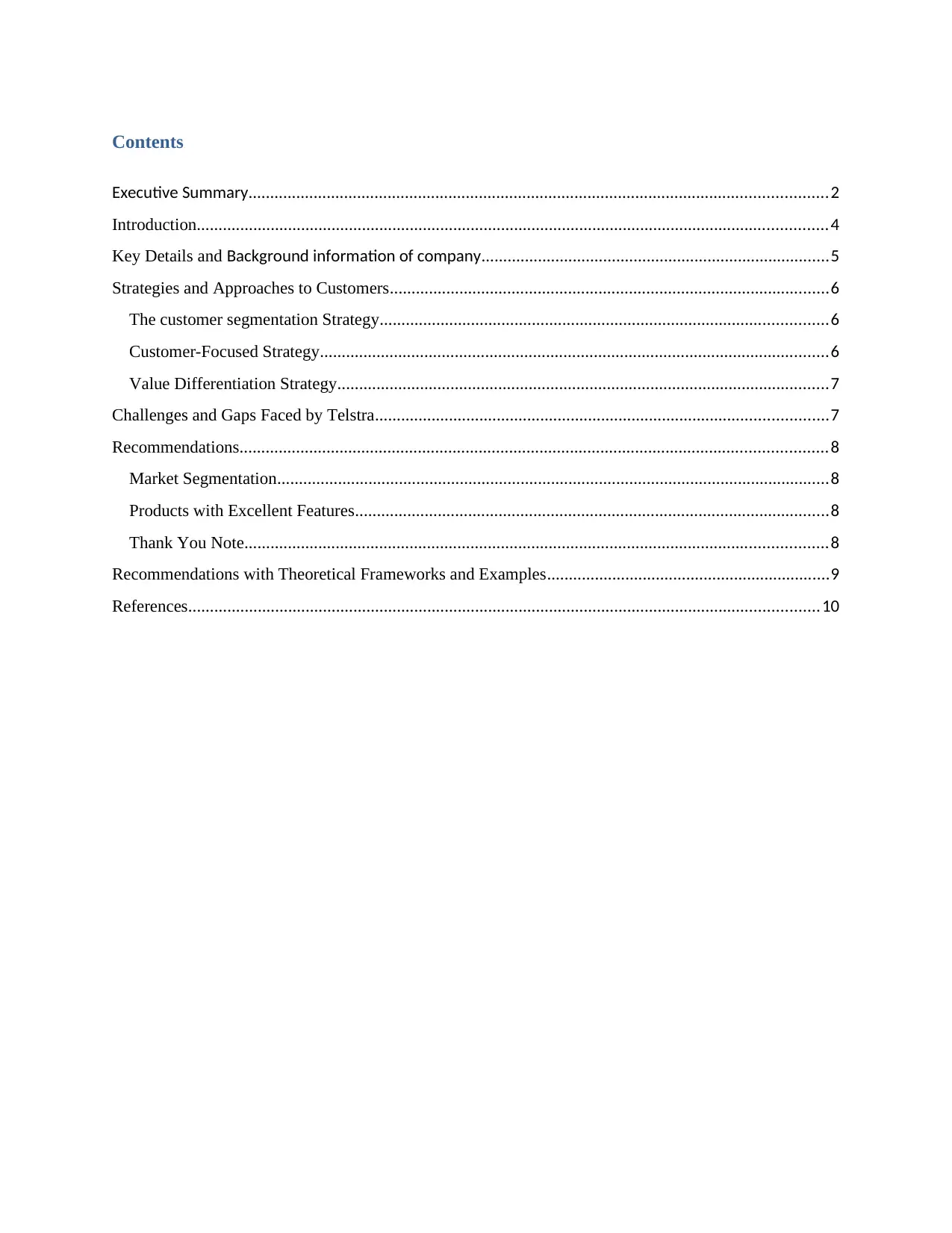
Executive Summary.....................................................................................................................................2
Introduction.................................................................................................................................................4
Key Details and Background information of company................................................................................5
Strategies and Approaches to Customers.....................................................................................................6
The customer segmentation Strategy.......................................................................................................6
Customer-Focused Strategy.....................................................................................................................6
Value Differentiation Strategy.................................................................................................................7
Challenges and Gaps Faced by Telstra........................................................................................................7
Recommendations.......................................................................................................................................8
Market Segmentation...............................................................................................................................8
Products with Excellent Features.............................................................................................................8
Thank You Note......................................................................................................................................8
Recommendations with Theoretical Frameworks and Examples.................................................................9
References.................................................................................................................................................10
Executive Summary.....................................................................................................................................2
Introduction.................................................................................................................................................4
Key Details and Background information of company................................................................................5
Strategies and Approaches to Customers.....................................................................................................6
The customer segmentation Strategy.......................................................................................................6
Customer-Focused Strategy.....................................................................................................................6
Value Differentiation Strategy.................................................................................................................7
Challenges and Gaps Faced by Telstra........................................................................................................7
Recommendations.......................................................................................................................................8
Market Segmentation...............................................................................................................................8
Products with Excellent Features.............................................................................................................8
Thank You Note......................................................................................................................................8
Recommendations with Theoretical Frameworks and Examples.................................................................9
References.................................................................................................................................................10
⊘ This is a preview!⊘
Do you want full access?
Subscribe today to unlock all pages.

Trusted by 1+ million students worldwide
Introduction
In this report, critical analysis and evaluation of the existing service offerings, strategy,
and approaches to customers has been analyzed. All the details and critical analysis of the
offering, strategies made by Telstra Company has been taken into consideration. This report
reflects the key understanding on the inbound and outbound activities of the Telstra Company.
In the starting of this report key information about the Telstra Company has been given. After
that, value chain analysis and offering of the Telstra company has been analyzed that. Afterward,
in the end, recommendation for strengthen the business functioning of Telstra company has been
given. This report reflects the key aspects of the undertaken business strategies and challenges
faced by Telstra in its business. Nonetheless, recommendations have also been given to
strengthen the business outcomes.
In this report, critical analysis and evaluation of the existing service offerings, strategy,
and approaches to customers has been analyzed. All the details and critical analysis of the
offering, strategies made by Telstra Company has been taken into consideration. This report
reflects the key understanding on the inbound and outbound activities of the Telstra Company.
In the starting of this report key information about the Telstra Company has been given. After
that, value chain analysis and offering of the Telstra company has been analyzed that. Afterward,
in the end, recommendation for strengthen the business functioning of Telstra company has been
given. This report reflects the key aspects of the undertaken business strategies and challenges
faced by Telstra in its business. Nonetheless, recommendations have also been given to
strengthen the business outcomes.
Paraphrase This Document
Need a fresh take? Get an instant paraphrase of this document with our AI Paraphraser
Key Details and Background information of company
Telstra is the largest telecommunication company of Australia and is also one of the
world’s best telecommunication companies. It is a leading full-service telecommunications
operator in Australia and also has a department that takes care of the data usage, internet, and the
business of e-commerce that may help in the development of the value added services. The
headquarters are in Melbourne, Australia. It is also known to be the first operator that has lead
Australia into internet Broadband and has maintained network performance. It sold 49.9% of its
shares to the individual investors so that the company can be partially privatized in the year
1997. However, the government still has a hold of 50.1% shares. The services are managed by its
subsidiary companies namely BigPond that offer cables and internet connectivity at a great speed
to the individuals as well as the businesses. There is one more subsidiary that deals in selling
products to other companies. In Australia, there are outlets as well for its products. These outlets
are the places where a customer sees the products and analyze the same before buying the
services.
The company is known to have a big asset base and hence can provide the products even
internationally. Telstra is known to have the GSM network that covers 94% of the regions of the
country. Telstra also participates in the advertisements of the other companies across the world
as well as the individuals. It provides a supply of its products to merchants as well as the
consumers directly (Brendan, 2005). The organization is making its way to Europe, Asia, China
and more. These countries can get better services in terms of quality like cable connections,
internet services, broadband services and a lot more. There are call centers that have been
established by Telstra indicates good relations with the customers (Dev, 2007). The company has
a division that deals into operational research and the well diversifies market ensures that the
product development is consistent. The organization makes sure that experienced individuals are
employed to take care of the various divisions. They make different kind of strategies to make
everything effective and efficient. In the year 2011, the organization announced its expansion of
the customer service on the social media with 24/7 coverage (Donate, Peña, & Sanchez de
Pablo, 2018).
Telstra is the largest telecommunication company of Australia and is also one of the
world’s best telecommunication companies. It is a leading full-service telecommunications
operator in Australia and also has a department that takes care of the data usage, internet, and the
business of e-commerce that may help in the development of the value added services. The
headquarters are in Melbourne, Australia. It is also known to be the first operator that has lead
Australia into internet Broadband and has maintained network performance. It sold 49.9% of its
shares to the individual investors so that the company can be partially privatized in the year
1997. However, the government still has a hold of 50.1% shares. The services are managed by its
subsidiary companies namely BigPond that offer cables and internet connectivity at a great speed
to the individuals as well as the businesses. There is one more subsidiary that deals in selling
products to other companies. In Australia, there are outlets as well for its products. These outlets
are the places where a customer sees the products and analyze the same before buying the
services.
The company is known to have a big asset base and hence can provide the products even
internationally. Telstra is known to have the GSM network that covers 94% of the regions of the
country. Telstra also participates in the advertisements of the other companies across the world
as well as the individuals. It provides a supply of its products to merchants as well as the
consumers directly (Brendan, 2005). The organization is making its way to Europe, Asia, China
and more. These countries can get better services in terms of quality like cable connections,
internet services, broadband services and a lot more. There are call centers that have been
established by Telstra indicates good relations with the customers (Dev, 2007). The company has
a division that deals into operational research and the well diversifies market ensures that the
product development is consistent. The organization makes sure that experienced individuals are
employed to take care of the various divisions. They make different kind of strategies to make
everything effective and efficient. In the year 2011, the organization announced its expansion of
the customer service on the social media with 24/7 coverage (Donate, Peña, & Sanchez de
Pablo, 2018).
Strategies and Approaches to Customers
Telstra has been known to implement new strategies that improved the customer
experience and reduced the costs. The organization has created a new wholly owned
infrastructure unit that drives performance and gives future optionality as well. The organization
has a functional research department and a diversified market that ensures that there is
consistency in the product development and hence meets the needs of the customers. Customer
plans were changed and pricing was improved so that the customer experience gets better.
Company has focused on developing the core competency in product differentiation and cost
leadership strategy by integrating its existing traditional business value chain activities with the
advance technologies. There are various strategies that are used by the company as follows:
The customer segmentation Strategy
When it comes to the strategy of the company, they have segmented their audience with
difference gender and age, having different cultures that define the use of new business
(Banuargo. 2008). They started customized services for the young generation in the year 2002
and young people were those who were under 25 years of age. This helped in introduction of
Communic8 business as per the habits and expenditures of such people with the help of Text
message service. Along with Text message, Communie8 also organized promotional activities
with SMS in association with Sony Ericsson to find who all users send the texts on a faster pace.
This analysis also helped in showing that Communie8 users keep using SMS to communicate,
chat and organize any social activity. This strategy helps company to strengthen its market share
and attracting more clients in market (Ried, Peretz, & Levi, 2918). The business has a big financial
foundation and has employed a good number of people in various departments. People who had
special talents have been utilized intelligently and provide excellent competitive services. This
has helped the organization to have a major customers stick to the services. It is also making sure
that the business is expanded and hence is increasing its presence abroad by opening subsidiaries
Customer-Focused Strategy
Their customers were loyal and such customers can help in sustainable growth of the
enterprise. They have understood the needs of the customers as they have utilized their human as
Telstra has been known to implement new strategies that improved the customer
experience and reduced the costs. The organization has created a new wholly owned
infrastructure unit that drives performance and gives future optionality as well. The organization
has a functional research department and a diversified market that ensures that there is
consistency in the product development and hence meets the needs of the customers. Customer
plans were changed and pricing was improved so that the customer experience gets better.
Company has focused on developing the core competency in product differentiation and cost
leadership strategy by integrating its existing traditional business value chain activities with the
advance technologies. There are various strategies that are used by the company as follows:
The customer segmentation Strategy
When it comes to the strategy of the company, they have segmented their audience with
difference gender and age, having different cultures that define the use of new business
(Banuargo. 2008). They started customized services for the young generation in the year 2002
and young people were those who were under 25 years of age. This helped in introduction of
Communic8 business as per the habits and expenditures of such people with the help of Text
message service. Along with Text message, Communie8 also organized promotional activities
with SMS in association with Sony Ericsson to find who all users send the texts on a faster pace.
This analysis also helped in showing that Communie8 users keep using SMS to communicate,
chat and organize any social activity. This strategy helps company to strengthen its market share
and attracting more clients in market (Ried, Peretz, & Levi, 2918). The business has a big financial
foundation and has employed a good number of people in various departments. People who had
special talents have been utilized intelligently and provide excellent competitive services. This
has helped the organization to have a major customers stick to the services. It is also making sure
that the business is expanded and hence is increasing its presence abroad by opening subsidiaries
Customer-Focused Strategy
Their customers were loyal and such customers can help in sustainable growth of the
enterprise. They have understood the needs of the customers as they have utilized their human as
⊘ This is a preview!⊘
Do you want full access?
Subscribe today to unlock all pages.
Trusted by 1+ million students worldwide
well as financial resources to understand the needs of the customers and develop strategies that
improve the services for the customers based on the needs of the customers. Being a leader,
Telstra knows the needs of the customers. Customers need that the technical staff of the company
visit them and solve problems in front of them. Thus, the telecommunication company had
restructured the profit sharing and incentive systems that improve the service quality along with
increasing the productivity. Under new incentive system, the technical staff has predefined tasks
and objectives that they need to attain on a daily basis ("Integrating customer experience quality
and QFD for IM- proving quality of Wi-Fi broadband service experience in telecommunication
company", 2018). However, there is requirement to align the interest of the stakeholders with the
organizational growth if company wants to sustain its business in long run (Hassan, 2016)
Value Differentiation Strategy
They along with the headset manufacturers maintain a good relation to market their equipment
along with a successful and creative business model. This way Telstra keeps a check and can
maintain the requirement of the customers. They are known to have an extensive coverage of
their business in Australia (Mgombelo & Werner, 1997).
Challenges and Gaps Faced by Telstra
Australia is a country where the mobile market has been saturated. The major amount of
revenues has been made from Australia and there comes a challenge in the near future that may
have an impact on the operational performance of Telstra. Communication service is a service
that is highly regulated in some of the countries and is checked regularly. Running a business in
such countries can be a challenge and the management should have knowledge of such
regulations. For instance, In India the communication services are bought and sold with identity
proof of the buyer or customers. However, this may not be the case in UK and other European
countries (Spitzeck & Chapman, 2012). Thus, a clear understanding of legal framework to run
business in different countries is important. Telstra faces challenges like the complaints and
competition as well. In addition to this, the main challenge which company has been facing is
related to aligning the interest of the stakeholders with the organizational growth. Company
needs to integrate with its stakeholders and align its business growth in the best interest of the
improve the services for the customers based on the needs of the customers. Being a leader,
Telstra knows the needs of the customers. Customers need that the technical staff of the company
visit them and solve problems in front of them. Thus, the telecommunication company had
restructured the profit sharing and incentive systems that improve the service quality along with
increasing the productivity. Under new incentive system, the technical staff has predefined tasks
and objectives that they need to attain on a daily basis ("Integrating customer experience quality
and QFD for IM- proving quality of Wi-Fi broadband service experience in telecommunication
company", 2018). However, there is requirement to align the interest of the stakeholders with the
organizational growth if company wants to sustain its business in long run (Hassan, 2016)
Value Differentiation Strategy
They along with the headset manufacturers maintain a good relation to market their equipment
along with a successful and creative business model. This way Telstra keeps a check and can
maintain the requirement of the customers. They are known to have an extensive coverage of
their business in Australia (Mgombelo & Werner, 1997).
Challenges and Gaps Faced by Telstra
Australia is a country where the mobile market has been saturated. The major amount of
revenues has been made from Australia and there comes a challenge in the near future that may
have an impact on the operational performance of Telstra. Communication service is a service
that is highly regulated in some of the countries and is checked regularly. Running a business in
such countries can be a challenge and the management should have knowledge of such
regulations. For instance, In India the communication services are bought and sold with identity
proof of the buyer or customers. However, this may not be the case in UK and other European
countries (Spitzeck & Chapman, 2012). Thus, a clear understanding of legal framework to run
business in different countries is important. Telstra faces challenges like the complaints and
competition as well. In addition to this, the main challenge which company has been facing is
related to aligning the interest of the stakeholders with the organizational growth. Company
needs to integrate with its stakeholders and align its business growth in the best interest of the
Paraphrase This Document
Need a fresh take? Get an instant paraphrase of this document with our AI Paraphraser
stakeholder. To overcome these challenges, the following initiatives can be taken (Kavanagh, &
Johnson, 2019).
Recommendations
Market Segmentation
The reach to the consumer can be enhanced by segmentation of the customers. The strategy
should be market oriented. A better segmentation of the market that makes sure which segment
of the customer has what kind of demand is the best way to move forward (Pascal, Ozuomba &
kalu, 2015). This will be useful to bifurcate the clients in different segments and will be helpful
in developing core competency in the customization strategy (Zhang, Edgar, Geare, & O'Kane.2016).
Products with Excellent Features
It can also explore what new products can be launched that are unique and excellent in features
so that the competition can be reduced. Exploring new revenue along with the expansion of
services is a great way to make customers loyal. The company can also provide media services
like movies, music, content services, mobile bundled services, and so on. Reducing the cost is
yet another way along with the improvement in the investment of the products and taking
products and pricing that are managed with a budget. Keeping in touch with the customers has
always worked and so does the email marketing. This is an effective way to make the customers
feel valuable. Australia is known to have strict rules regarding spams and how the subscribers are
acquired and hence process the request to unsubscribe. Thus, visiting ACMA website to know
the business compliment with Anti-Spam Act 2003 is a great idea (Gou & Lu, 2013).
Thank You Note
While customers are buying the products of an organization, the cash is hard earned to
them. The organization needs to make sure that they make the customers feel important. Being a
bit creative and writing a “thank you” note can be a great way to make the business stand out.
Telstra’s focus should be on the improvement of the distribution network in the different regions
where it already has a presence (Bayer, 2010). The organization can open point of sale display in
various supermarkets and sell the products through this strategy. This may result in the
Johnson, 2019).
Recommendations
Market Segmentation
The reach to the consumer can be enhanced by segmentation of the customers. The strategy
should be market oriented. A better segmentation of the market that makes sure which segment
of the customer has what kind of demand is the best way to move forward (Pascal, Ozuomba &
kalu, 2015). This will be useful to bifurcate the clients in different segments and will be helpful
in developing core competency in the customization strategy (Zhang, Edgar, Geare, & O'Kane.2016).
Products with Excellent Features
It can also explore what new products can be launched that are unique and excellent in features
so that the competition can be reduced. Exploring new revenue along with the expansion of
services is a great way to make customers loyal. The company can also provide media services
like movies, music, content services, mobile bundled services, and so on. Reducing the cost is
yet another way along with the improvement in the investment of the products and taking
products and pricing that are managed with a budget. Keeping in touch with the customers has
always worked and so does the email marketing. This is an effective way to make the customers
feel valuable. Australia is known to have strict rules regarding spams and how the subscribers are
acquired and hence process the request to unsubscribe. Thus, visiting ACMA website to know
the business compliment with Anti-Spam Act 2003 is a great idea (Gou & Lu, 2013).
Thank You Note
While customers are buying the products of an organization, the cash is hard earned to
them. The organization needs to make sure that they make the customers feel important. Being a
bit creative and writing a “thank you” note can be a great way to make the business stand out.
Telstra’s focus should be on the improvement of the distribution network in the different regions
where it already has a presence (Bayer, 2010). The organization can open point of sale display in
various supermarkets and sell the products through this strategy. This may result in the
improvement of the firm’s visibility in the market. Also to popularize the voice and data
services, the company can create awareness of the quality of its services. Additionally, it should
use tricks like offering discounts to customers who buy both voice as well as data services
("Bases of Market Segmentation Success: A Marketing Decision Makers’ Perspective", 2016).
Recommendations with Theoretical Frameworks and Examples
Talking about Vodafone, the company has a great customer experience because of their process
excellence. Vodafone had aligned the organizational objectives that go hand in hand with the
customer experience. This signifies that one cannot create short term financials keeping customer
experience on stake. The objectives that are long term are the ones that need to be supported and
aligned for any organization and that too from top to bottom. The customers will receive
anything with a smile if they are given something to smile for. The organization needs to know
the purpose of the business and what in exact to deliver so that the consumer is always satisfied.
Such a strategy can also be implemented by Telstra and a change in the organizational structure
that recreates the alignment of the objectives is a must thing to adopt (Heller Baird & Gonzalez‐
Wertz, 2011). This frameworks could also be improved by the organization by undertaking
proper business plans and developing motivational theories such as Herzberg Motivational
theories in keeping employees satisfied in the process.
services, the company can create awareness of the quality of its services. Additionally, it should
use tricks like offering discounts to customers who buy both voice as well as data services
("Bases of Market Segmentation Success: A Marketing Decision Makers’ Perspective", 2016).
Recommendations with Theoretical Frameworks and Examples
Talking about Vodafone, the company has a great customer experience because of their process
excellence. Vodafone had aligned the organizational objectives that go hand in hand with the
customer experience. This signifies that one cannot create short term financials keeping customer
experience on stake. The objectives that are long term are the ones that need to be supported and
aligned for any organization and that too from top to bottom. The customers will receive
anything with a smile if they are given something to smile for. The organization needs to know
the purpose of the business and what in exact to deliver so that the consumer is always satisfied.
Such a strategy can also be implemented by Telstra and a change in the organizational structure
that recreates the alignment of the objectives is a must thing to adopt (Heller Baird & Gonzalez‐
Wertz, 2011). This frameworks could also be improved by the organization by undertaking
proper business plans and developing motivational theories such as Herzberg Motivational
theories in keeping employees satisfied in the process.
⊘ This is a preview!⊘
Do you want full access?
Subscribe today to unlock all pages.
Trusted by 1+ million students worldwide
References
Bases of Market Segmentation Success, (2019) A Marketing Decision Makers’ Perspective.
International Journal of Business and Administrative Studies, 2(3).
Bayer, J. (2010). Customer segmentation in the telecommunications industry. Journal Of
Database Marketing & Customer Strategy Management, 17(3-4), 247-256.
Donate, M I, I Peña,, & Sanchez de Pablo. (2012) “RM practices for human and social capital
development: effects on innovation capabilities.” The International Journal of Human
Resource Management, (27(9), 928-953.), 2018: 23-85.
Fried, Y, H Peretz, & A Levi. (2018) Employee Reactions to HPWS in Multinational Companies:
Effects of Subsidiary and Parent Cultures. In Academy of Management Proceedings (Vol.
2018, No. 1, p. 11271). Australia: Briarcliff Manor, NY 10510: Academy of Man, 2018.
Gou, R., & Lu, T. (2013). IT Architecture Evaluation of Telecommunication Company Using
Analytical Hierarchy Process. Advanced Materials Research, 816-817,
Hassan, S. (2016) “Impact of HRM practices on employee’s performance. International Journal
of Academic Research in Accounting,.” Finance and Management Sciences, 6(1), 15-22.,
2016: 6(1), 15-22.
Heller Baird, C., & Gonzalez‐Wertz, C. (2011). How top performers achieve customer‐focused
market leadership. Strategy & Leadership, 39(1), 16-23.
Integrating customer experience quality and QFD for im- proving quality of wifi broadband
service experience in Telecommunication Company. (2018). Journal of Advances In
Technology And Engineering Research, 4(3) 23-99
Kavanagh,, M J, & Johnson, (2016). Human resource information systems: Basics, applications,
and future directions. Australia: Sage Publications., 2016.
Mgombelo, H., & Werner, M. (1997). Telecommunication for business in Africa. Amsterdam:
IOS Press.
Bases of Market Segmentation Success, (2019) A Marketing Decision Makers’ Perspective.
International Journal of Business and Administrative Studies, 2(3).
Bayer, J. (2010). Customer segmentation in the telecommunications industry. Journal Of
Database Marketing & Customer Strategy Management, 17(3-4), 247-256.
Donate, M I, I Peña,, & Sanchez de Pablo. (2012) “RM practices for human and social capital
development: effects on innovation capabilities.” The International Journal of Human
Resource Management, (27(9), 928-953.), 2018: 23-85.
Fried, Y, H Peretz, & A Levi. (2018) Employee Reactions to HPWS in Multinational Companies:
Effects of Subsidiary and Parent Cultures. In Academy of Management Proceedings (Vol.
2018, No. 1, p. 11271). Australia: Briarcliff Manor, NY 10510: Academy of Man, 2018.
Gou, R., & Lu, T. (2013). IT Architecture Evaluation of Telecommunication Company Using
Analytical Hierarchy Process. Advanced Materials Research, 816-817,
Hassan, S. (2016) “Impact of HRM practices on employee’s performance. International Journal
of Academic Research in Accounting,.” Finance and Management Sciences, 6(1), 15-22.,
2016: 6(1), 15-22.
Heller Baird, C., & Gonzalez‐Wertz, C. (2011). How top performers achieve customer‐focused
market leadership. Strategy & Leadership, 39(1), 16-23.
Integrating customer experience quality and QFD for im- proving quality of wifi broadband
service experience in Telecommunication Company. (2018). Journal of Advances In
Technology And Engineering Research, 4(3) 23-99
Kavanagh,, M J, & Johnson, (2016). Human resource information systems: Basics, applications,
and future directions. Australia: Sage Publications., 2016.
Mgombelo, H., & Werner, M. (1997). Telecommunication for business in Africa. Amsterdam:
IOS Press.
Paraphrase This Document
Need a fresh take? Get an instant paraphrase of this document with our AI Paraphraser
Pascal, C., Ozuomba, S., & kalu, C. (2015). Application of K-Means Algorithm for Efficient
Customer, Australia: Pearson
Segmentation: A Strategy for Targeted Customer Services. International Journal Of Advanced
Research In Artificial Intelligence, 4(10), 34-54
Spitzeck, H., & Chapman, S. (2012). Creating shared value as a differentiation strategy – the
example of BASF in Brazil. Corporate Governance: The International Journal of
Business In Society, 12(4), 499-513
Zhang, J A, F Edgar, A Geare,& C O'Kane 2016. “The interactive effects of entrepreneurial
orientation and capability-based HRM on firm performance: The mediating role of
innovation ambidexterity.” Industrial Marketing Management,, 59 (1), 131-143
Customer, Australia: Pearson
Segmentation: A Strategy for Targeted Customer Services. International Journal Of Advanced
Research In Artificial Intelligence, 4(10), 34-54
Spitzeck, H., & Chapman, S. (2012). Creating shared value as a differentiation strategy – the
example of BASF in Brazil. Corporate Governance: The International Journal of
Business In Society, 12(4), 499-513
Zhang, J A, F Edgar, A Geare,& C O'Kane 2016. “The interactive effects of entrepreneurial
orientation and capability-based HRM on firm performance: The mediating role of
innovation ambidexterity.” Industrial Marketing Management,, 59 (1), 131-143

1 out of 11


Related Documents


Your All-in-One AI-Powered Toolkit for Academic Success.
+13062052269
info@desklib.com
Available 24*7 on WhatsApp / Email
![[object Object]](/_next/static/media/star-bottom.7253800d.svg)
Unlock your academic potential
Copyright © 2020–2026 A2Z Services. All Rights Reserved. Developed and managed by ZUCOL.